

Why is unique content so important in SEO? Because it is the one thing the rest of the internet cannot copy from you. Search engines and AI engines both reward content that adds something genuinely new, and that originality earns the backlinks and authority rankings are built on. In a year when most new web pages are AI-generated and look the same, original content is the most defensible asset your site has. Generic content does not just rank lower. It is invisible.
There is a catch, though, and it is the part most guides get wrong: unique does not mean what people think it means. Plagiarism-free is the floor, not the goal. This guide defines what unique content actually is in 2026, why search engines reward it, and exactly how to make yours genuinely original.
What "unique content" actually means (and what it is not)
Unique content adds information gain: original data, first-hand experience, or an angle the web does not already have. Plagiarism-free is the floor, not the goal.
This is the distinction that trips everyone up. Running your draft through a plagiarism checker until it shows 100 percent original tells you the words are not copied. It tells you nothing about whether the page adds anything new. You can write a thousand original words that simply restate what ten other pages already said, and to a search engine that page is functionally a duplicate of an idea.
| Looks unique but is not | Genuinely unique |
|---|---|
| A reworded version of a top-ranking post | Original data only you have, like a survey or your own results |
| Plagiarism-free text that restates known facts | First-hand experience, your own photos and screenshots |
| AI-spun copy with the synonyms swapped out | A distinct, defensible opinion backed by a number |
| A summary of other people's summaries | Primary sources and analysis that add something new |
The concept that captures the real bar is information gain. Google holds a patent describing an information gain score that measures "additional information that is included in the document beyond information contained in other documents that were already presented to the user." Read that twice. The question is not whether your content differs from a copy-paste. It is whether your page gives the reader something they would not get from the results they already saw.
Why search engines reward unique content
Google's own guidance rewards originality: it asks whether content offers original information and substantial value, and it treats mass-produced unoriginal content as spam, however it was made.
Google has said, in its own words, what it wants. Its helpful content guidance tells you to ask whether your content provides "original information, reporting, research, or analysis" and "substantial value when compared to other pages." If you draw on other sources, it says, you should add "substantial additional value and originality" rather than "simply copying or rewriting."
The flip side is a policy with teeth. Google defines scaled content abuse as producing "large amounts of unoriginal content that provides little to no value to users, no matter how it's created." That last clause matters: it does not care whether a human or a machine made it. Unoriginal is the problem, not the author.
There is a deeper reason underneath the guidance. Original content is how you demonstrate experience and expertise, the first two letters of E-E-A-T, the framework Google uses to judge quality. You cannot fake first-hand experience by rewording someone else's. The duplicate-content side of this coin, where copies split your signals and bury the wrong URL, we cover in our guide to duplicate content. This post is the opposite lesson: originality is the asset that side warns you not to dilute.
Unique content earns the links and authority rankings depend on
Original content is the strongest link magnet there is. 94 percent of pages earn zero backlinks, mostly because they say nothing a person would bother to cite.
That 94 percent comes from Backlinko, in a study of 912 million articles with BuzzSumo, which also found only 2.2 percent of content earns links from more than one site. Most content is not penalized into the void. It is ignored into it.
That is the opinion this number earns: the reason your content has no backlinks is almost never a missing outreach campaign. It is that the page says nothing a person would bother citing. Fix the originality and the links follow.
Original content specifically is the magnet. The same study found that 1.3 percent of articles generate 75 percent of all social shares, the tiny slice of standout work that earns nearly everything. BuzzSumo and Majestic found that 70 percent of content gets no links at all, while a single piece of original research earned roughly ten times the linking domains of a comparable post. Original data is the one kind of content other people have to cite you to use.
The AI-sameness problem: why original content wins now
As AI floods the web with sameness, genuinely original content stands out more, not less, so clearing that bar is worth more than it used to be.
This is what has changed, and it is the reason a post on unique content matters more in 2026 than it did three years ago. Ahrefs found that 74.2 percent of newly created web pages contained some AI-generated content in April 2025, most of it a human-and-AI mix, with only 25.8 percent purely human. The open web is filling up with reworded answers at a speed no human could match.
But that flood is not winning where it counts. Originality.ai found that only 17.31 percent of pages in the top 20 Google results contained AI-generated content as of September 2025. The web is three-quarters AI-written, but the top of the results is not. Mass-produced sameness is winning the volume game and losing the ranking game.
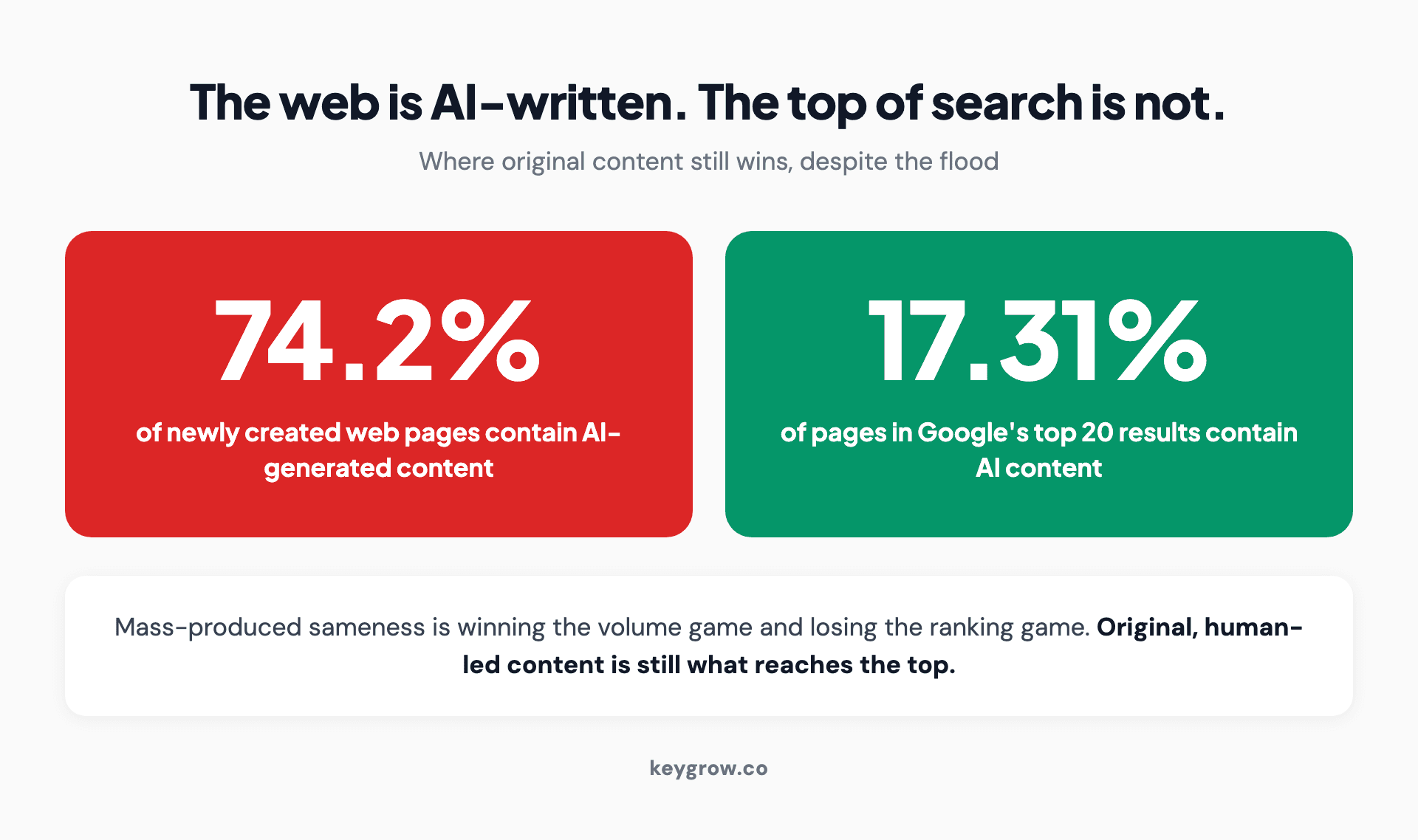
Infographic showing the AI content gap: 74.2 percent of newly created web pages contain AI-generated content, but only 17.31 percent of pages in Google's top 20 results do, illustrating that original human-led content still wins where rankings count.
That gap is your opportunity. When most content is interchangeable, the page with real first-hand experience or proprietary data is the one that gets ranked and the one that gets quoted in AI answers, which we cover in our guide to AI search optimization. AI can remix what already exists. It cannot run your business or hold your opinion, and that is the content that now wins.
We saw this with a doctor's practice in Dubai. Rather than generic medical pages anyone could rephrase, we built original, first-hand educational content answering the specific questions patients were actually asking. It ranked across those queries, and over 12 months organic traffic grew 1,519 percent. The content worked because no competitor could copy a practitioner's real answers.
How to make your content genuinely unique
Knowing originality matters is easy. Producing it is the work. The good news is that genuine uniqueness comes from things you already have and competitors cannot copy. Run a topic through this checklist before you publish.
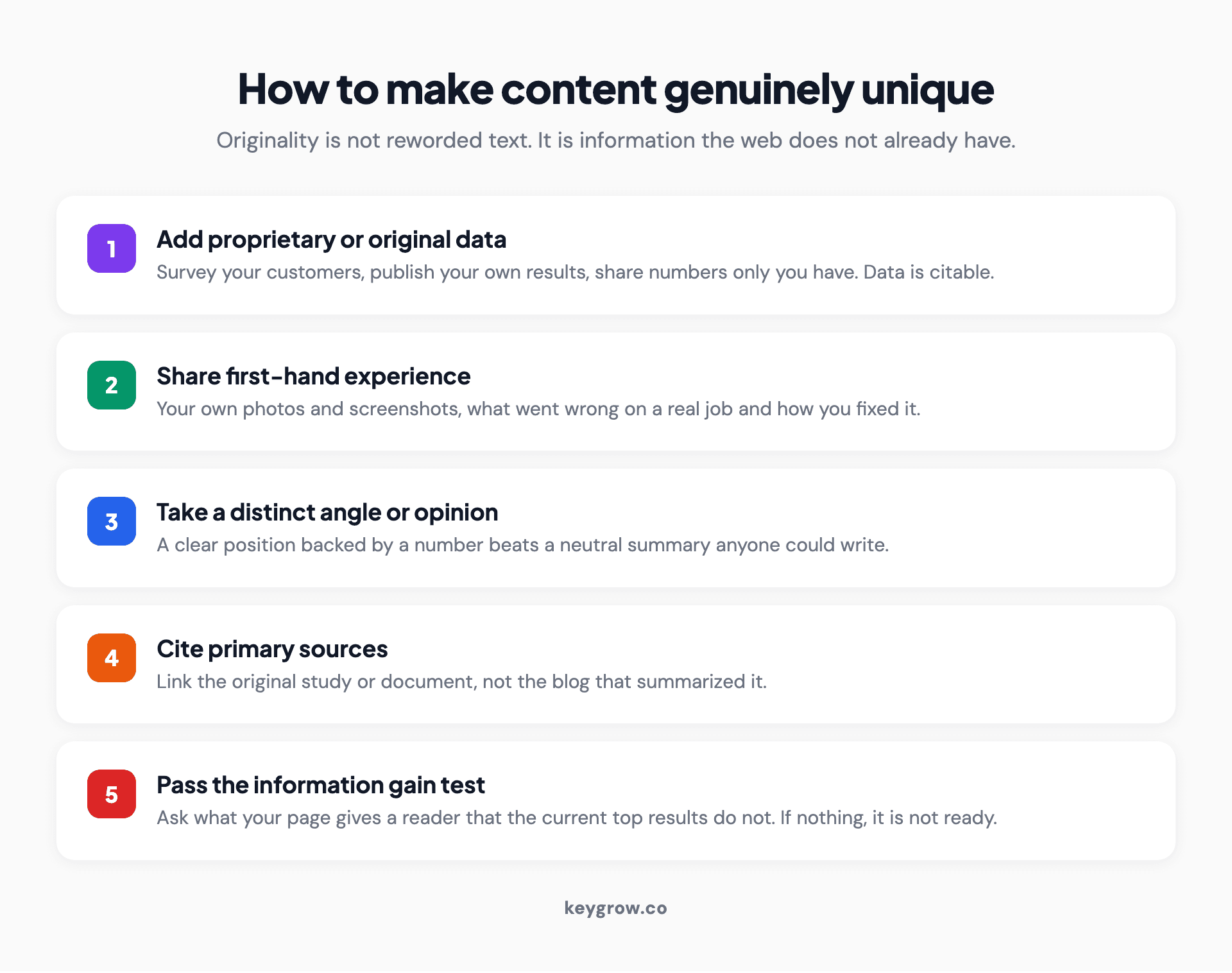
Infographic checklist of five ways to make content genuinely unique for SEO: add proprietary or original data, share first-hand experience with your own photos and screenshots, take a distinct angle or opinion, cite and link primary sources, and add information gain beyond what the top results already say.
None of these is "rewrite it in your own words." That is the floor everyone clears, and the reason so much content sits in the 94 percent that gets ignored.
Here is the part most agencies will not tell you: you do not need to hire anyone to be original. The one thing you own that no agency and no AI has is first-hand experience in your business, and the raw material for unique content is already in your head. Where a team like ours earns its fee is turning that into a structured, optimized asset and doing it consistently, often built around the keywords your customers search, which we cover in do keywords matter in SEO. The originality has to start with you.
How to check whether your content is genuinely unique
Run new content through a duplicate checker like Copyscape or Siteliner to confirm it is not accidentally copied, and to catch internal near-duplicates across your own pages. That handles the floor. For the real test, do the information gain check by hand: read the current top five results for your target query, then ask whether your draft adds data, experience, or a viewpoint none of them have. The tool tells you the words are original. Only you can tell whether the ideas are. If you are mapping a whole site, building a topical map keeps each page covering distinct ground so your own content never competes with itself.
FAQs
What does "unique content" mean in SEO?
Unique content is content that adds information the web does not already have: original data, first-hand experience, or a genuinely different angle. It is not the same as plagiarism-free or reworded text. You can write completely original wording that still restates what other pages say, and search engines treat that as adding no value, even though it would pass a plagiarism checker.
Is 100 percent plagiarism-free text enough to rank?
No. Plagiarism-free is the minimum, not the goal. A plagiarism checker confirms your words are not copied, but says nothing about whether the page adds anything new. Google rewards information gain, meaning content that gives readers something the existing results do not. Original wording that simply repeats known information rarely ranks well on its own.
Does duplicate content get you penalized by Google?
Not with a manual penalty in most cases. The bigger problem is invisibility: duplicate or unoriginal content gives Google no reason to rank you over the original source, splits your link signals, and gets ignored. We cover the mechanics in our duplicate content guide. The practical takeaway is the same either way, originality is what earns rankings.
What is information gain and is it a ranking factor?
Information gain is the additional value a page offers beyond what a searcher has already seen in other results. Google holds a patent describing an information gain score built on exactly that idea. Whether it runs as a named live ranking factor is not confirmed, but the principle matches how Google's helpful content guidance tells you to write, so it is a sound way to think about originality.
Can AI-generated content be unique enough to rank in 2026?
It can, but only when it carries genuine originality a human added: proprietary data, first-hand experience, or a real viewpoint. Google says it rewards quality content however it is produced, and treats mass-produced unoriginal content as spam however it is produced. AI used to restructure your own thinking is fine. AI used to mass-produce reworded sameness is the scaled content abuse Google targets.
How do I check if my content is genuinely unique?
Use a tool like Copyscape or Siteliner to confirm the text is not copied and to find internal near-duplicates. Then run the information gain test manually: read the top results for your query and ask what your page adds that they do not. The tool checks the words; you have to check the ideas. Both have to pass before you publish.
How does Google handle syndicated or republished content?
Google tries to show the version it considers most relevant, which is often the original source rather than the republisher. If you syndicate your content elsewhere, the other site can outrank your original or absorb the signals. Using canonical tags and adding unique value to any republished piece helps, but the safest position is to keep your strongest, most original content on your own domain.
Will repeated product specs or boilerplate hurt my rankings?
Some repetition is normal and unavoidable, like identical technical specifications or legal boilerplate, and Google does not punish it. The risk is when entire pages are near-identical with nothing to tell them apart, such as location pages that differ only by city name. Add genuinely distinct detail to each, and routine repetition of factual data is not a problem.
The short version
The bar for unique content is information gain, not a clean plagiarism report. Give readers something the existing results do not, whether that is your own data, your first-hand experience, or a clear opinion, and you earn the backlinks and the rankings that follow. The flood of AI sameness has not changed that rule. It has raised the reward for breaking it, because standing out is easier when most of the web reads the same. Write the thing only you could write.
If you want a team to turn your first-hand expertise into original content that ranks and earns links, that is what our SEO service does. Tell us about your business and we will build the content only your business could.


