

Here is the part most guides skip. A competitor backlink analysis will show you hundreds of links, and you will be able to get maybe one in ten of them. The value is not the export. It is the short list that survives after you throw out everything that was never available to you in the first place.
The method itself is simple: pick the sites that actually outrank you for the terms you want, pull their referring domains, subtract the ones you already have, then sort what is left by whether you could realistically earn it. An afternoon gets you the list. The months after that are where the work is.
Start with the right competitors, not the obvious ones
The competitor you lose sleep over is usually not the competitor you lose rankings to.
Your business competitor is the firm down the road that undercuts your quotes. Your search competitor is whoever occupies the top three results for the phrase you want. Those are frequently different companies, and sometimes the search competitor is not a company at all. It might be a trade publication, a review roundup, or a directory.
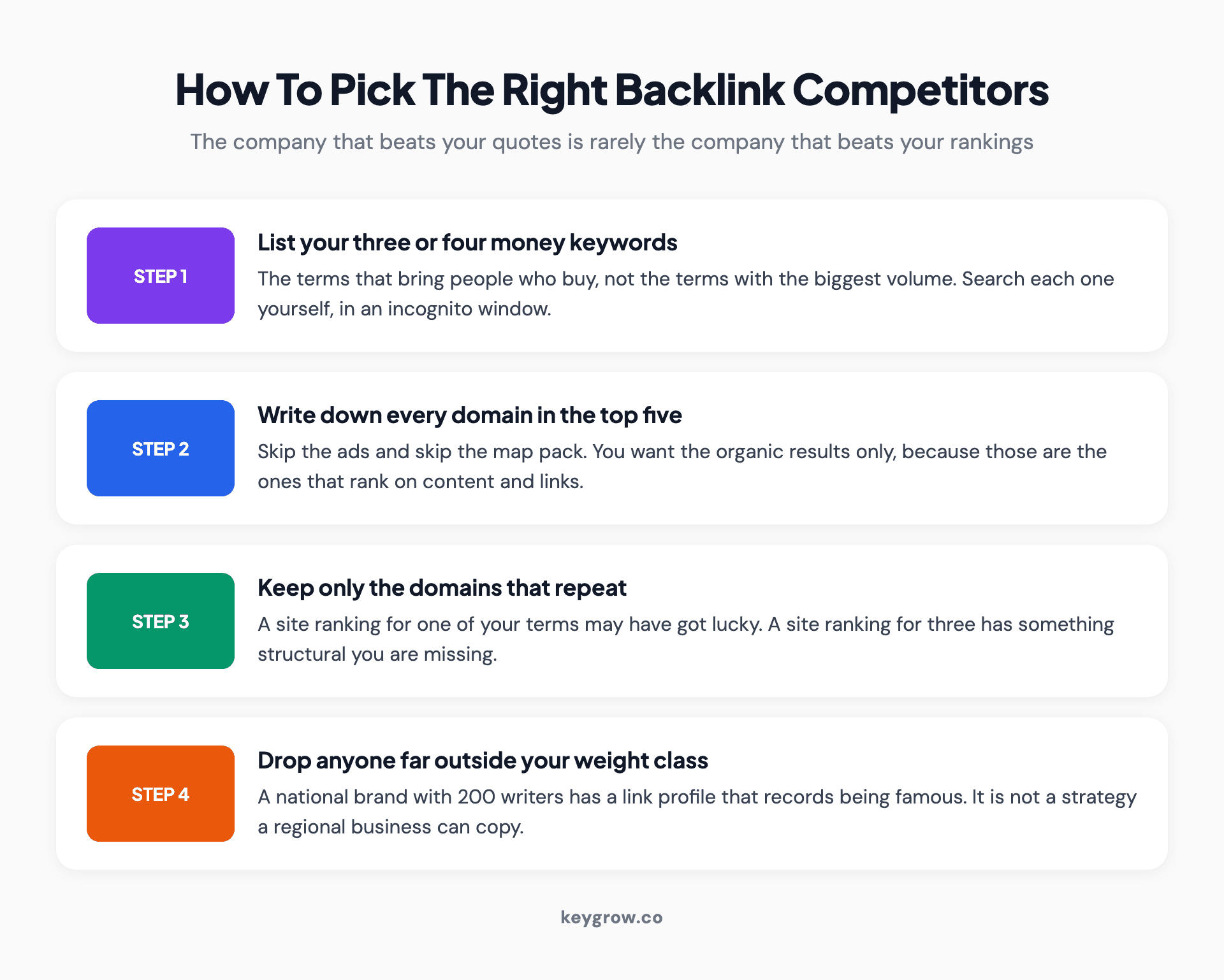
Four-step process for choosing backlink competitors: list your money keywords, record every domain in the organic top five, keep only the domains that repeat, and drop anyone far outside your weight class.
Pick four or five search competitors this way: run your three or four most valuable keywords, ignore the ads, write down every domain that appears in the top five for more than one of them. Repeat domains are the ones worth pulling. A site that ranks for one of your terms got lucky or is very broad. A site that ranks for three of them has something structural you are missing.
One caution that saves a lot of wasted analysis. If the top results are national brands with hundreds of writers and you are a regional business, do not use them as your model. Their link profile is a record of being famous, not a strategy you can follow. Drop down the results page until you find companies roughly your size and analyze those instead.
The three lists you are building
Whatever tool you use, the output is three lists, and they answer different questions.
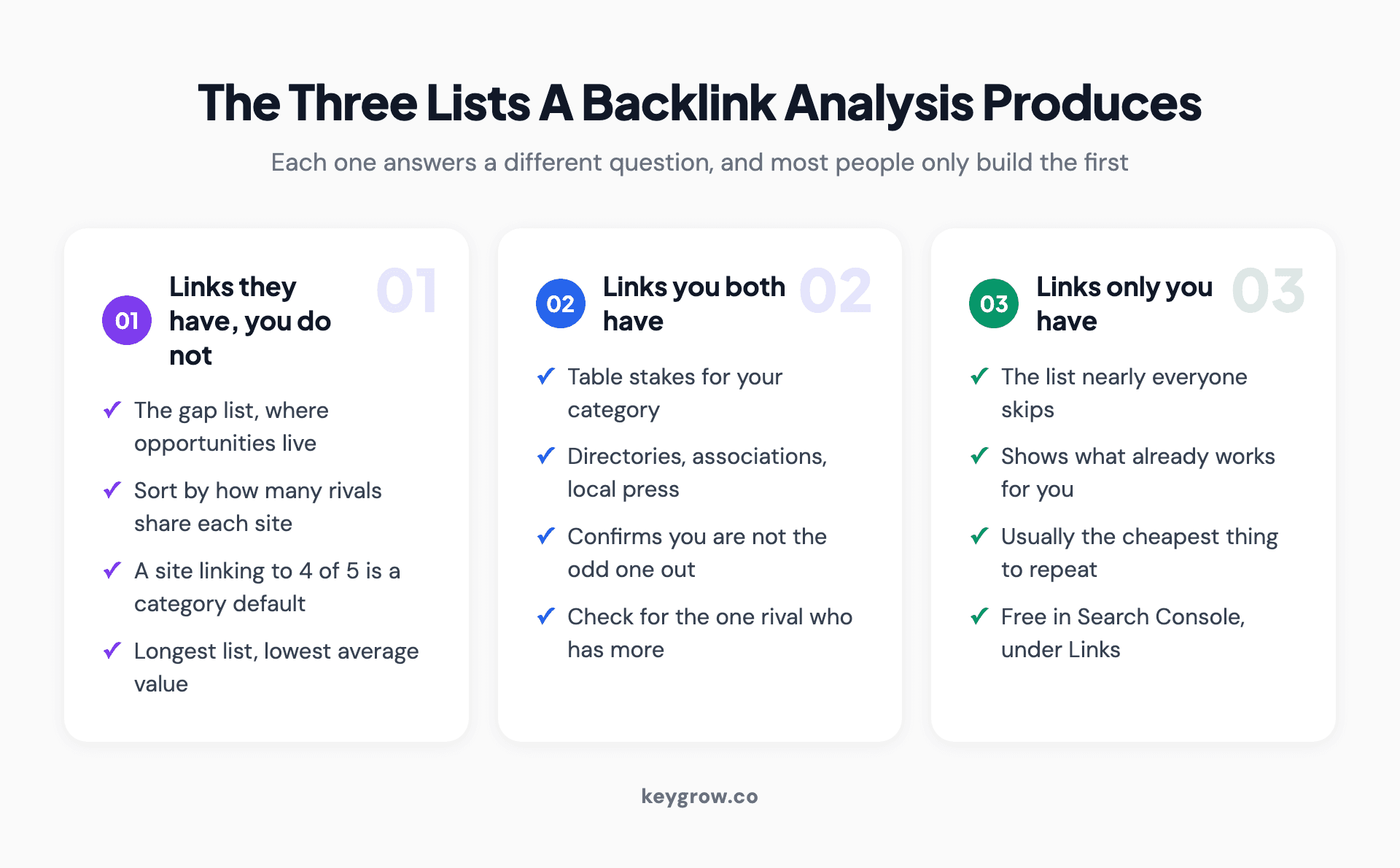
Three-column breakdown of the lists a backlink analysis produces: links competitors have and you do not, links you both have, and links only you have.
Links they have and you do not. This is the gap list, and it is the one everyone means when they say backlink gap analysis. It is where the opportunities live.
Links you both have. Boring, and useful anyway. This is the table stakes list: the directories, associations and local sites that everyone serious in your category is on. If a site links to four of your five competitors and to you, fine. If it links to four of them and not you, that is the fastest fix on the whole list.
Links only you have. Most people skip this one. It tells you what you are already good at, which is usually the thing worth doing more of. If eleven of your links came from being quoted in trade press, the answer to "what should our link building be" is not a spreadsheet of new tactics.
The second list deserves more attention than it gets. Sort it by how many of your competitors each site links to, and the top of that sorted list is a map of your category's default link sources. A site that links to five of the five companies you checked is not a link opportunity, it is a membership requirement, and you are either on it or you are the odd one out in a way that a customer comparing suppliers can see.
How much of this can you actually copy?
Assume most of it is not available to you, then go looking for the part that is.

Open notebook and pen beside a laptop showing a research page.
Run down a competitor's referring domains and the categories sort themselves quickly. Their own properties and their parent company's sites. Press coverage from an acquisition or a lawsuit. A sponsorship they pay five figures a year for. Ancient directories that stopped accepting submissions in 2015. A supplier who links to every certified installer, which you could get if you were certified. A local charity that lists its donors.
That last two are the interesting ones, and they are what the exercise is for.
The useful habit is to mark every row with one of three verdicts before doing anything else: repeatable, repeatable with effort, or not available. Most spreadsheets never get this column, which is why most of them get abandoned at row 40.
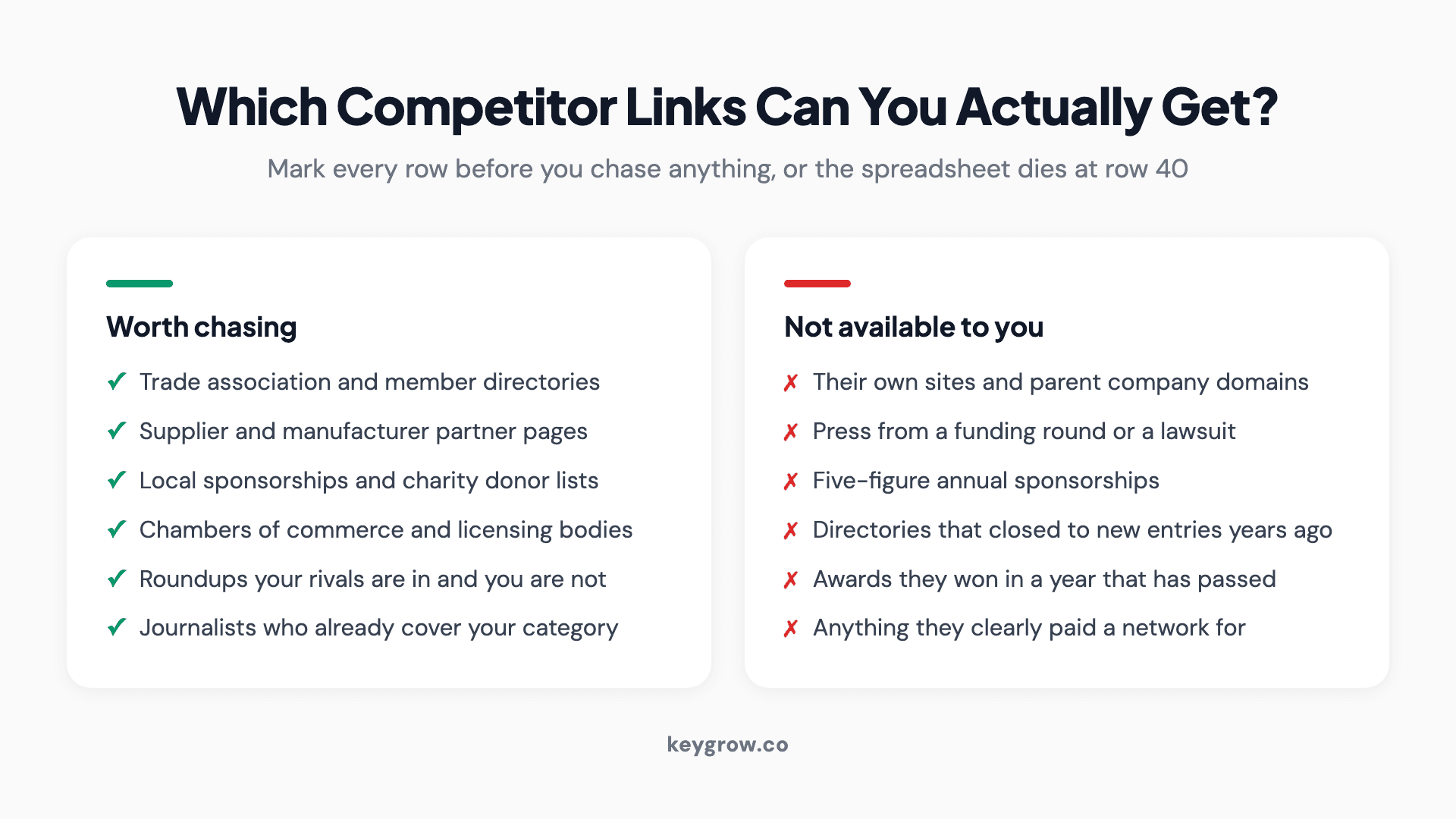
Two-column comparison of competitor backlinks worth chasing, such as trade directories and local sponsorships, against links that are not available to you, such as their own domains and past awards.
Judging a link without staring at the authority score
Every tool sells you a single number for link quality and every number is a guess. They are useful for sorting a thousand rows into a rough order. They are close to useless for deciding whether one specific link is worth three hours of your week.
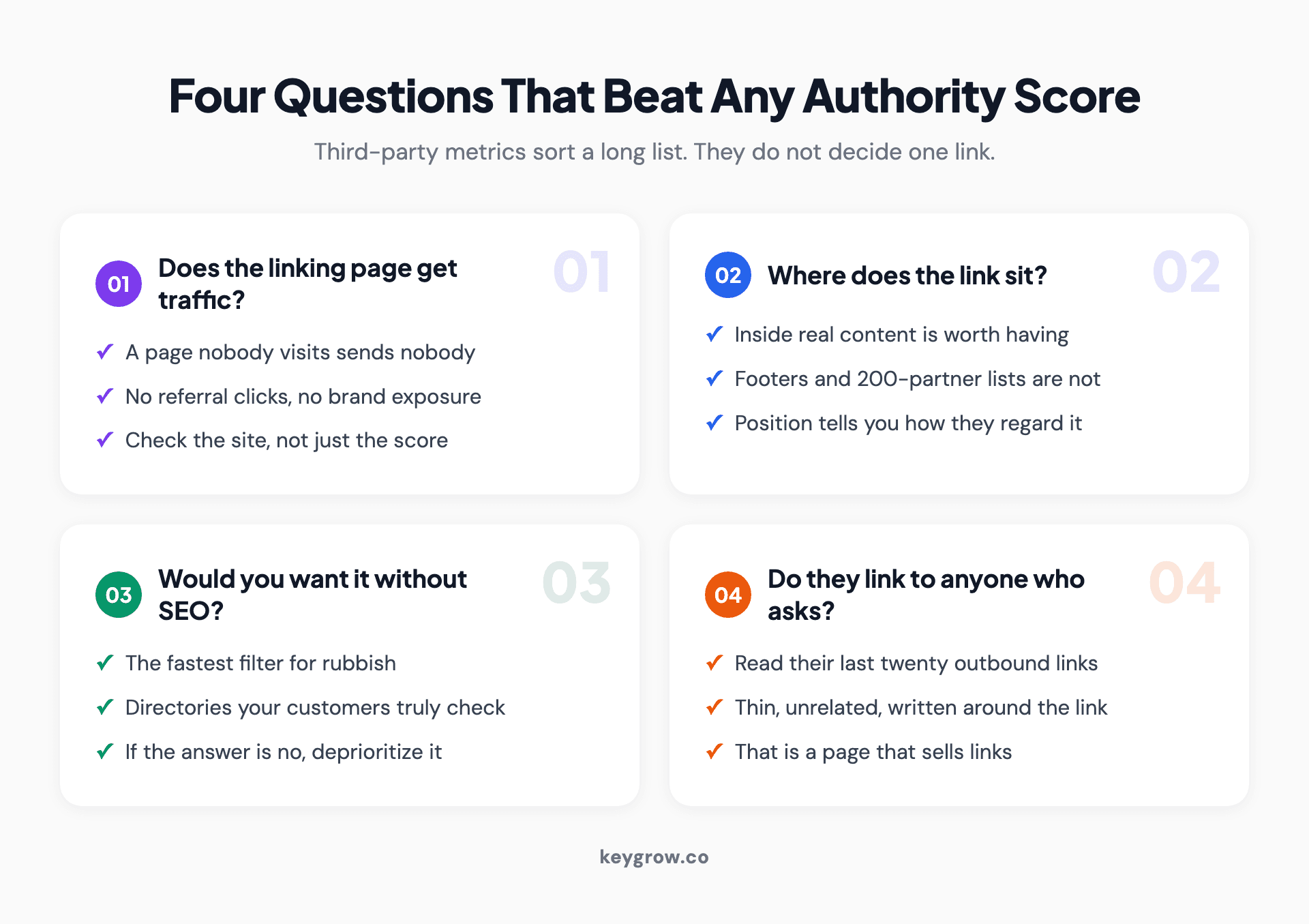
Four numbered cards covering the questions that judge a backlink better than an authority score: does the page get traffic, where does the link sit, would you want it without SEO, and do they link to anyone who asks.
Four questions do a better job:
Does the page that links out get any traffic itself? A link from a page nobody visits passes whatever equity the algorithm assigns and nothing else. No referral clicks, no brand exposure, no human ever sees it.
Is the link inside content, or in a footer, a sidebar, or a list of 200 partners? Position is a signal to Google and a signal to you about how the site actually regards the link.
Would you want the link if search engines did not exist? This is the question that filters the rubbish fastest. A listing in the association directory your customers actually check would be worth having with no SEO benefit at all.
Does the site link out to anyone who asks? Look at their last twenty outbound links. If they are all thin, unrelated and dropped into paragraphs that read like they were written around the link, you are looking at a page that sells links, and Google's spam policies are explicit about what happens to sites on both ends of that.
One row, walked all the way through
Abstract advice about triage is easy to nod at and hard to apply, so here is a single row from a real-shaped list.

Team working through colored sticky notes on a large printed planning sheet.
A commercial roofing company pulls the gap list and finds that three of its four competitors have a link from the same regional builders' association. The page is a member directory. It is not a great page. It gets modest traffic, the links sit in a long alphabetical list, and the third-party authority score is unremarkable.
Run the four questions. The page gets some traffic, from exactly the people who hire commercial roofers. The link is in a list rather than in content, which caps what it is worth. Would they want it without search engines? Yes, because contractors check that directory when they need a subcontractor. Does the site link to anyone who asks? No, it links to dues-paying members.
Verdict: repeatable, with effort, and the effort is joining a trade body they arguably should have joined anyway. That row is worth more than thirty rows of blog comments and syndicated press releases sitting above it in any sorted-by-authority export.
Now the row underneath it. One competitor has a link from a national trade magazine, gained when their project won an award in 2019. Same four questions, and the honest verdict is not available, because you cannot retroactively win a 2019 award. What you can do is note that the magazine covers award winners, find out when entries open, and put it on next year's calendar. That is a different kind of action, and it belongs on a different list.
Turning the list into work you will actually finish
A gap list is not a plan. It becomes one when you group the rows by what you would have to do to get them, because the doing is completely different work.
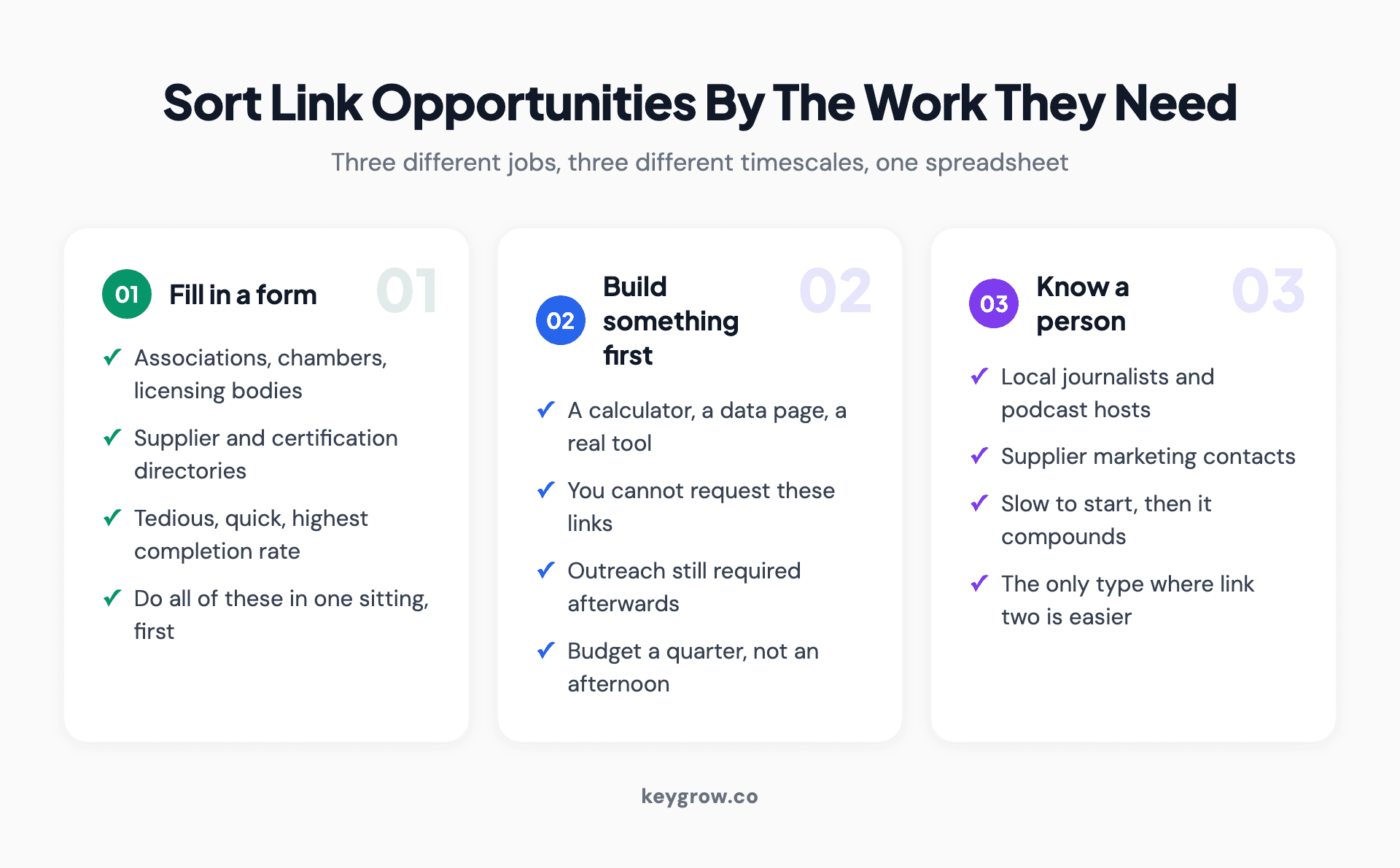
Three-column card layout sorting link opportunities by the work they require: filling in a form, building something first, and knowing a person.
Some rows need a form filled in. Chambers of commerce, trade associations, supplier directories, licensing bodies. Tedious, quick, and the highest completion rate of anything on the list. Do these first, in one sitting, because they are the only category where effort and outcome are reliably related.
Some rows need a page that does not exist yet. A competitor gets forty links to one calculator or one annual data page. You cannot request those links. You would have to build something worth linking to, and then still do the outreach. That is a quarter of work, not an afternoon.
Some rows need a relationship. A local journalist, a podcast host, a supplier's marketing manager. These are slow and they compound, and they are the only category where the second link is easier than the first.
We went through the mechanics of earning each type in our guide to building backlinks, so this post stays on the analysis side.
When this is the wrong tool entirely
Here is the honest version, and it applies to a lot of the businesses reading this.
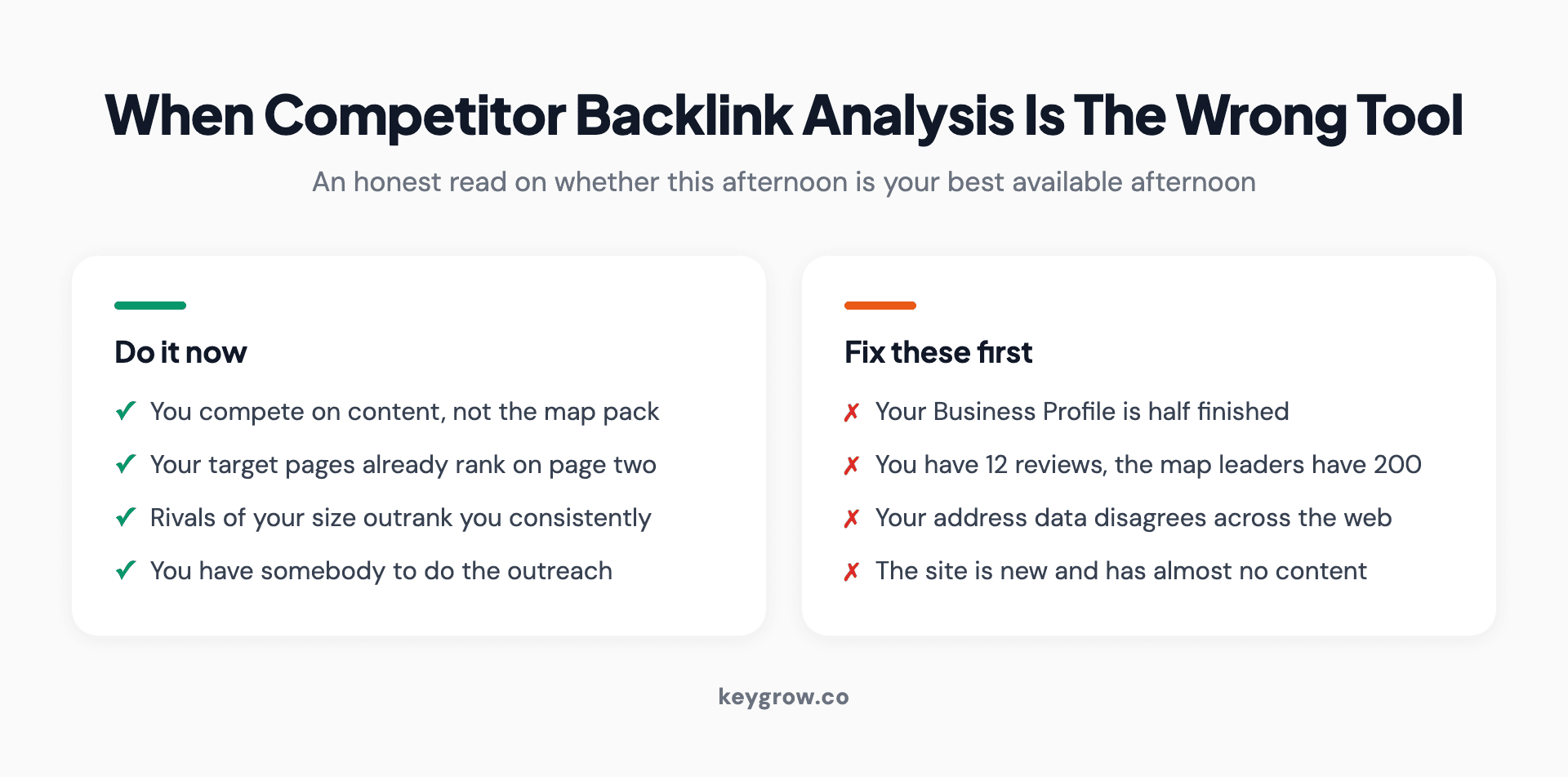
Two-column comparison of when to run a competitor backlink analysis now against the local SEO problems worth fixing first, including an unfinished Business Profile and thin review counts.
If you are a single-location service business competing inside one city, competitor backlink analysis is usually not your bottleneck. Your bottleneck is a half-finished Google Business Profile, twelve reviews when the map pack leaders have two hundred, and inconsistent name and address data across the places that feed local results. Links matter locally, but they matter after those, and the links that matter most are local sponsorships and citations rather than anything a gap analysis surfaces.
Spend the afternoon on your profile instead. Come back to this when you are competing for terms where the whole first page is other people's content rather than other people's map listings.
That is not a guess. Two of our own local builds landed at 50+ monthly phone calls in six months for a junk removal company, and 115+ in seven for a phone repair shop. Not one row of either result traces back to a gap spreadsheet. What moved them was the unglamorous list: a finished profile, service pages worded the way customers actually search, review volume, and business data that matched everywhere it appeared. Three local sponsorships carried the link side, and finding those took a conversation, not a tool.
The same goes for a genuinely new site. A gap analysis against an established competitor will hand you 400 rows and no useful prioritization, because at that stage the answer to "which of these should I chase" is "the twelve easy ones, and then go make something worth linking to".
What the free version gets you
You do not need a paid tool to start, and for a first pass you should not buy one.
Google Search Console shows your own links under Links in the sidebar, which gives you the "links only you have" list for free. It will not show you a competitor's.
The free tiers of the major backlink tools will show you a sample of any domain's referring domains, usually the top hundred by their own authority metric. For a small local competitor that sample is often close to the whole profile. For a national one it is a rounding error, but you will still see the pattern.
Paid tools earn their keep at the point where you are running this monthly across several competitors and want the difference between this month and last, which is genuinely tedious by hand.
| What you want to know | Free route | When you need to pay |
|---|---|---|
| Who links to me | Search Console, Links report | Never, for this |
| Who links to one competitor | Free tier sample, top 100 domains | Competitor has 1,000+ referring domains |
| Gap between me and four competitors | Manual, one at a time | Almost immediately, this is the paid feature |
| New and lost links this month | Not available | As soon as you are tracking it seriously |
| Anchor text distribution | Not available | Only if you suspect a spam problem |
What to do with the links you cannot get
The not-available column is not wasted work, as long as you read it for pattern rather than for targets.
Ten competitor links from award coverage says your category has an awards circuit and you are not in it. Fifteen links from university pages says somebody is running a scholarship or a research partnership. A cluster of links from supplier sites says certifications carry links in your industry, and certifications renew, which means there is an entry point every year.
None of those are rows you tick off this quarter. All of them are budget conversations worth having once, with real numbers attached, instead of being rediscovered every time somebody exports a fresh gap list and feels behind.
The one pattern to act on immediately is a competitor who has clearly paid for a cluster of links: the same anchor text, a run of unrelated sites, pages that exist to host links. Do not copy it. Note it, because their rankings are borrowed against a risk they are carrying and you are not.
The number that should temper all of this
Only 3.45 percent of the web gets any Google traffic at all, according to Ahrefs' index study of roughly 14 billion pages. Missing links explain a good share of the other 96.55 percent, and that is the case for doing this work in the first place.
Sitting inside the same dataset is the correction. Pages carrying links from ten or more referring domains turn up in the zero-traffic group all the time. So links are necessary without being sufficient, and no quantity of matched referring domains will rescue a page aimed at something nobody types into a search box.

Printed line chart on a newspaper page showing a multi-year trend.
Which is the argument for doing the analysis and then checking it against the keyword list before you act on it. If the gap list points you at links for a page targeting a term with no volume, the links are not the problem you found.
What a monthly version looks like
Once is a project. Monthly is where it starts paying, and monthly takes about twenty minutes if you set it up properly.
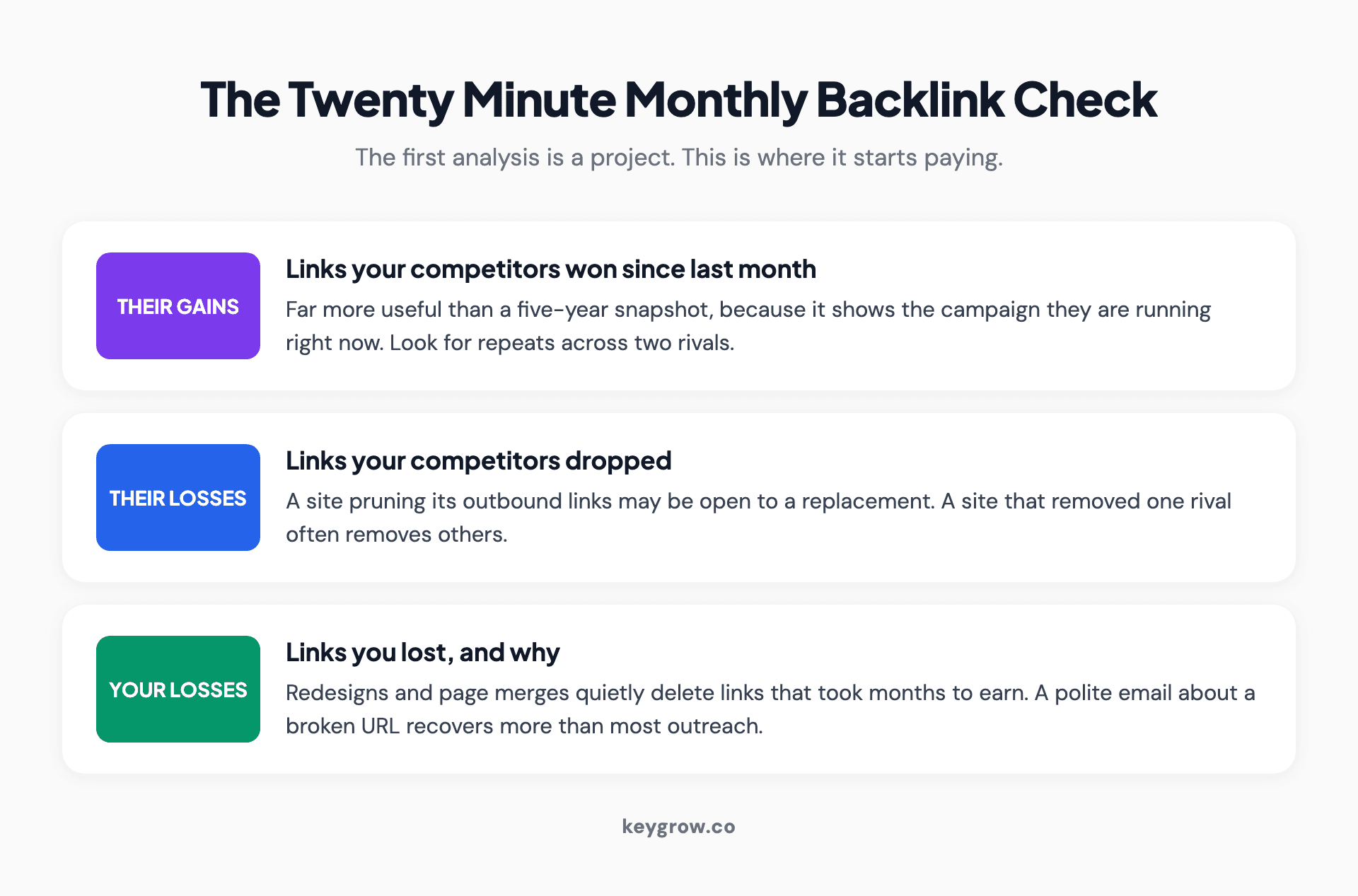
Three-row process for the monthly backlink check: links competitors gained, links competitors lost, and links you lost.
You are looking at three things: links your competitors gained since last month, links they lost, and links you lost. Gains tell you what campaign they are running right now, which is far more actionable than a static snapshot of five years of accumulated links. Losses tell you which sites are pruning, and a site that just dropped a competitor may take you.
Your own lost links are the one people skip and the one with the fastest fix. Sites redesign, pages get consolidated, and a link that took four months to earn disappears in a CMS migration. A polite email about a 404 recovers more links than most outreach campaigns, because you are asking for something that already existed.
FAQs
How many competitors should I analyze?
Four or five is the useful range. Fewer than three and you cannot tell a real pattern from one company's quirk. More than six and the gap list gets so long that everything looks like an opportunity, which is the same as nothing being a priority. Pick the ones that show up repeatedly for your money keywords.
Can I see competitor backlinks for free?
Partly. The free tiers of the major backlink tools show a sample of any domain's referring domains, typically the top hundred, which is often most of the profile for a small local competitor. Google Search Console only shows your own links, never anyone else's. For a proper gap analysis across several competitors at once you will need a paid tool.
Should I try to get every link my competitor has?
No, and trying is the most common way this exercise fails. A large share of any established profile comes from things you cannot repeat: their own sites, press about company events, paid sponsorships, and directories that no longer accept entries. Mark each row as repeatable, repeatable with effort, or unavailable, then work only the first two groups.
How often should I run a competitor backlink analysis?
A full analysis once or twice a year is plenty. After the first one, switch to a monthly check of new and lost links, which takes about twenty minutes and tells you what your competitors are doing now rather than what they did over five years.
Does copying a competitor's backlinks improve my rankings?
Sometimes, and less reliably than the guides suggest. Links are one input among many, and pages with ten or more referring domains routinely get no search traffic because nobody searches for what they cover. Check that the target page is aimed at a term with real demand before you spend months earning links to it.
What is a backlink gap analysis?
It is the part of the process that lists the domains linking to your competitors but not to you. Most tools will run it against several competitors at once and let you filter for sites linking to two or more of them, which is a good proxy for "this site links to companies like ours as a matter of course".
Is a competitor's authority score worth chasing?
Not directly. Authority scores are third-party estimates that let you sort a long list roughly, and they say nothing about whether a specific link will help you. A link from a low-scoring local site your customers actually read can be worth more than a high-scoring link buried in a footer nobody sees.
So, is this worth your afternoon?
If you are fighting for competitive informational terms against other people's content, yes, and the monthly version afterwards is worth more than the first pass. If you are a local business trying to show up in the map pack, no, at least not yet. Fix the profile, get the reviews, sort the citations, then come back.
If you want a second opinion on which of those two situations you are in, that is the first thing our SEO work establishes, usually in the first week. Send us the domain and the three terms you want, and we will tell you whether links are your problem.


