


Local citations for SEO are mentions of your business name, address and phone number on sites you do not own. The honest verdict on them in 2026: they are a data-integrity job, not a ranking tactic, and they pay for themselves at exactly two moments.
Once, at the start, when you clean up whatever is already out there. And again every time your details change. Between those two events, the work is close to worthless, which is why a monthly citation retainer is one of the most reliably wasted line items in local marketing.
That is not the same as saying citations do not matter. Contradictory business data still costs you. It is saying the job is finite, it is mostly deletion rather than creation, and you can do most of it yourself in an afternoon.
What a citation does now, and what it stopped doing
Citations used to work like votes. More listings meant more signals of legitimacy, and agencies sold them by the hundred.
That stopped some years ago. The identity of a business is now established from stronger evidence than a directory page, and listing number fifty changes nothing about it.
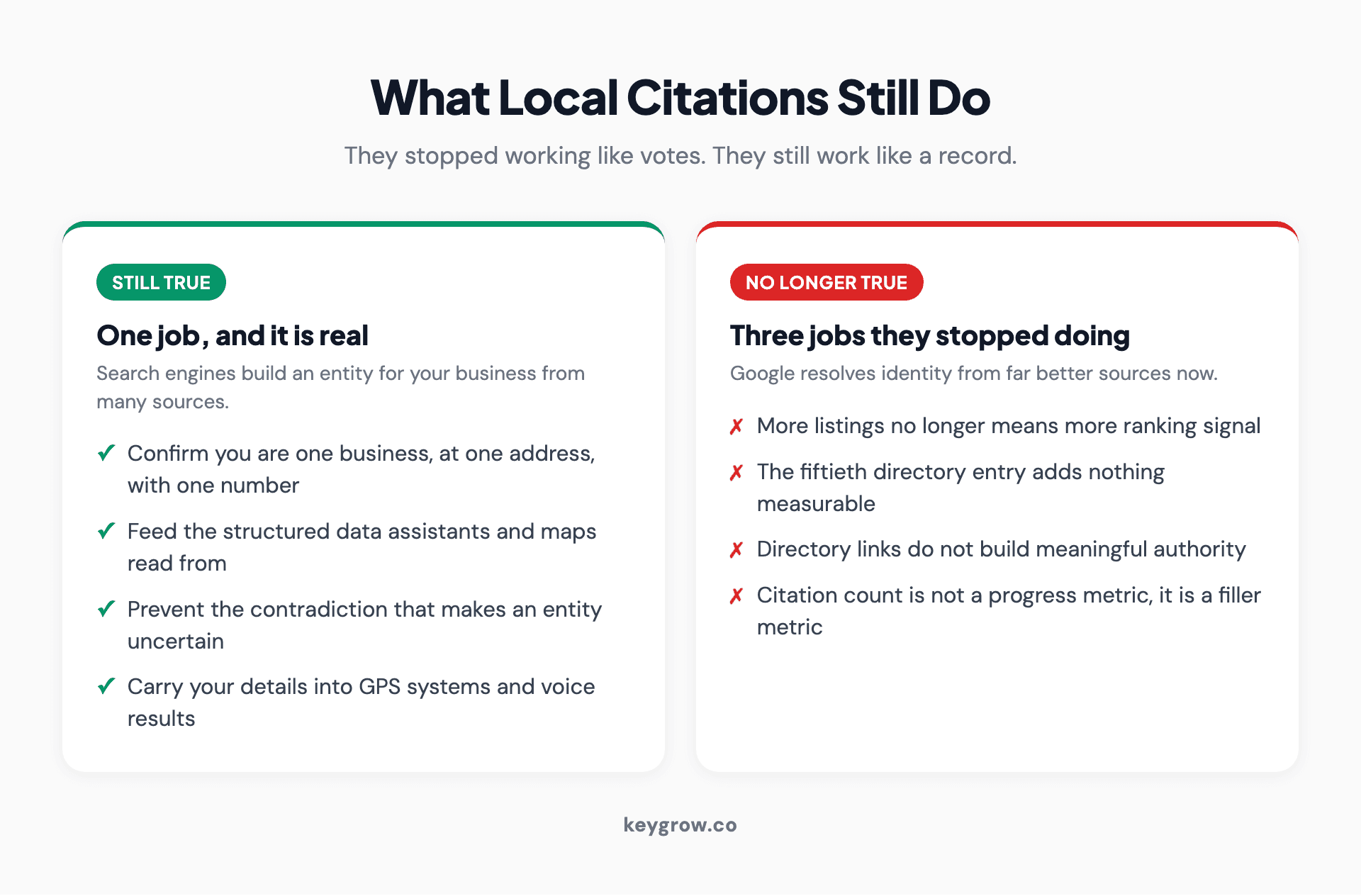
What local citations still do for a business, and the three jobs they no longer perform.
What remains is one job: confirming you are one business, at one address, with one phone number. Search engines build an entity for your business and pull from many sources to do it. When those sources agree, the entity is confident. When four of them list a suite number you left in 2019 and two list a disconnected line, the entity is uncertain.
Uncertainty is the cost. Not a lost ranking point from a missing listing, but a muddied record that makes it harder for any system to be sure which business you are.
So stop thinking about coverage and start thinking about contradiction. That single reframe changes what you do next.
The only two moments this work pays for itself
Most of the confusion about citations comes from treating an occasional job as an ongoing one.
Moment one is the initial cleanup. Every business has accumulated listings it never made: scraped from other directories, created by a former employee, generated by a franchisor, or left behind by a previous owner at your address. Finding and fixing those has real value and takes a few hours.
Moment two is any change to your details. A move, a new phone number, a rebrand, a merger, a new suite number after the landlord renumbers the building. This is when citations genuinely matter, because you are now actively generating the contradiction the entity cares about.
Outside those two moments, the marginal listing does nothing. If someone is billing you monthly to add directory entries, ask what changed about your business that month to justify it.
Fix four sources and you fix a few hundred
The reason cleanup is faster than it looks is that most directories do not gather data. They buy it.
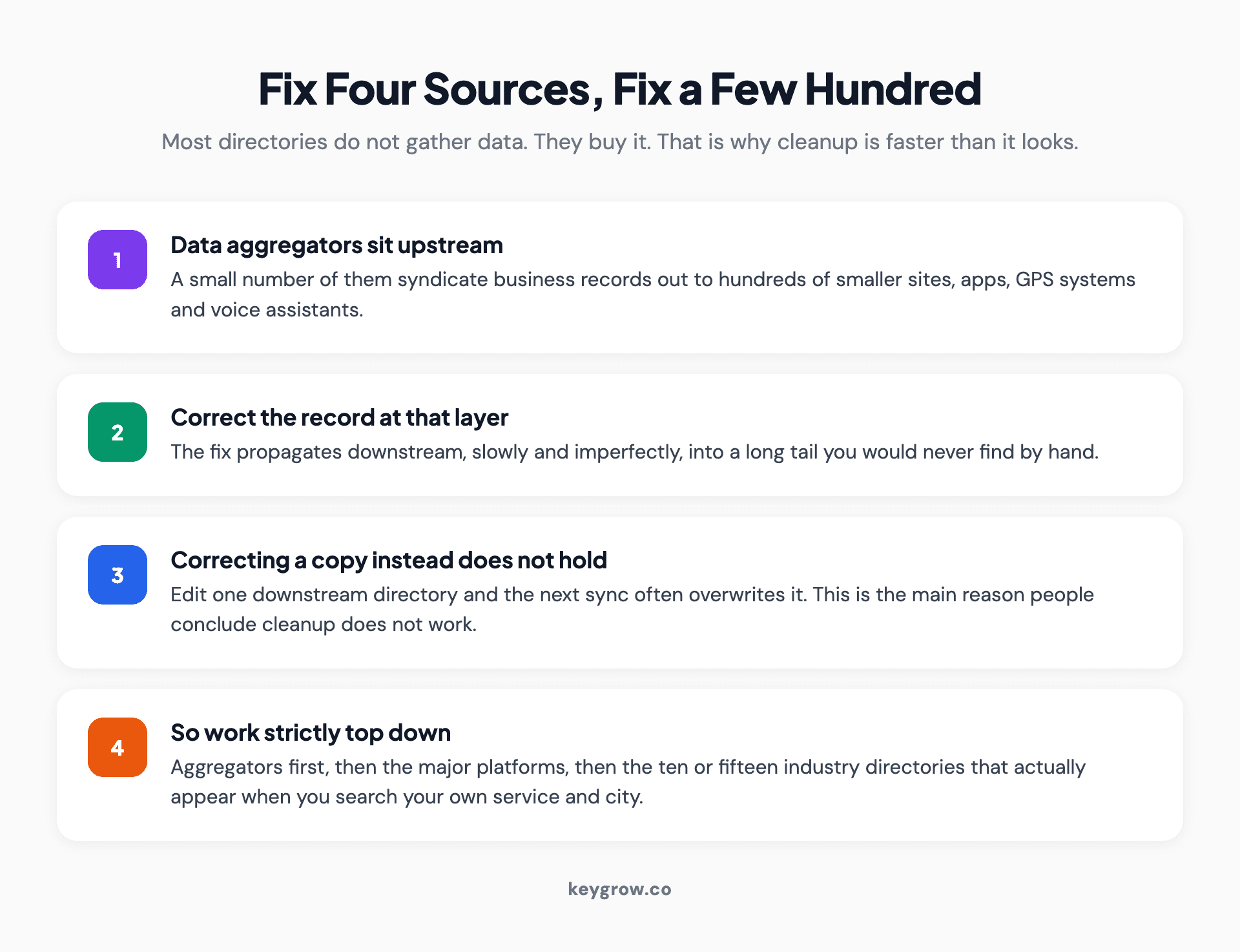
How the data aggregator layer feeds hundreds of downstream directories, and why fixing the source beats fixing the copies.
A small number of data aggregators sit upstream and syndicate business records out to hundreds of smaller sites, apps, GPS systems and voice assistants. Fix a record at that layer and the correction propagates, slowly and imperfectly, to a long tail you would otherwise never find.
Fix the same record on one downstream directory and it will often be overwritten at the next sync, which is the single most common reason people conclude that citation cleanup does not work. They corrected the copy and left the source alone.
So work top down. Get the aggregator layer right first, then the major platforms, then the handful of industry directories that actually appear when you search your own service and city. Everything below that is not worth an hour of your time.
The tier list: where the hour actually goes
Not all listings are equal, and the gap between tier one and tier three is enormous.
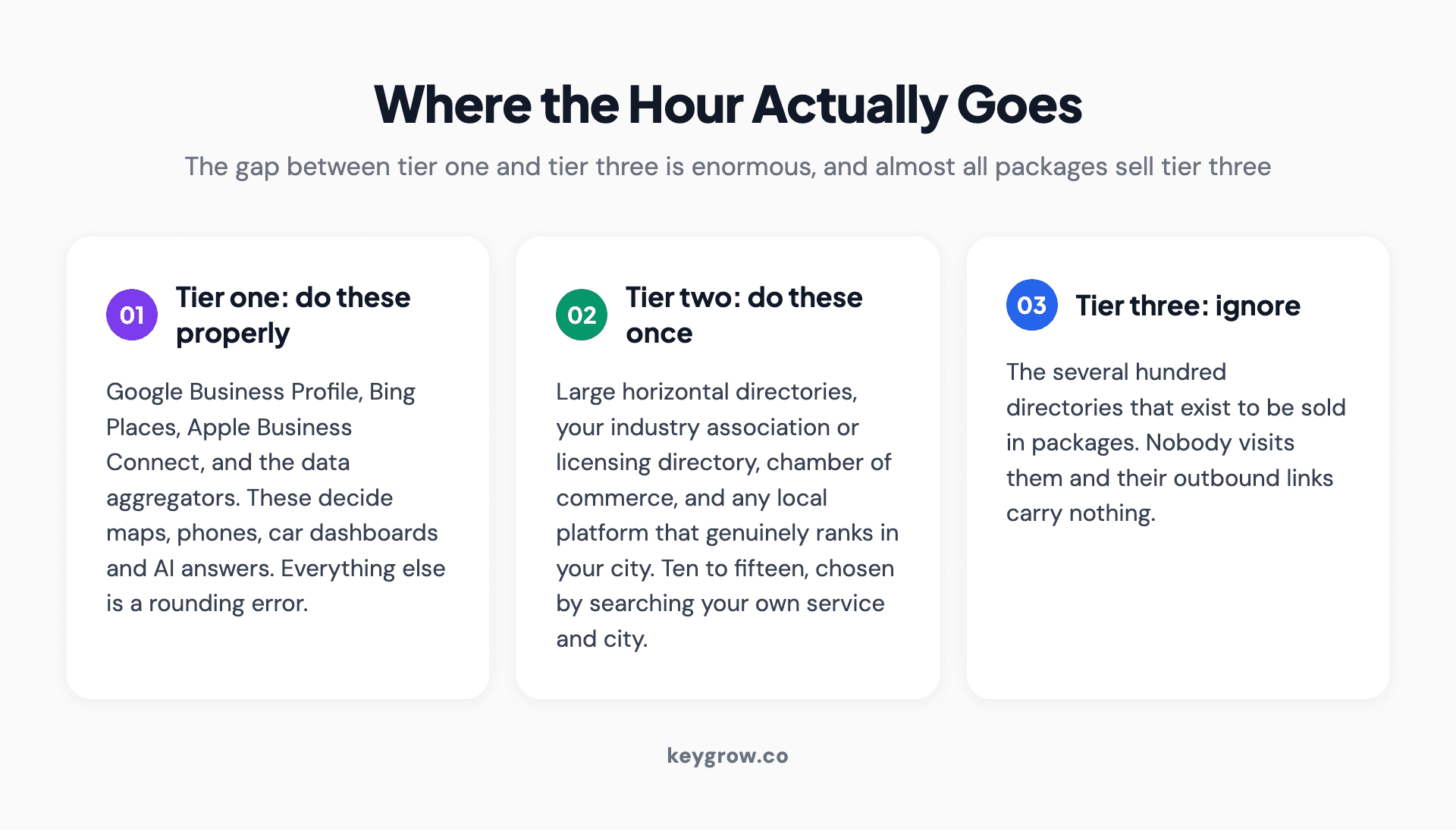
Which local listings are worth your time, in three tiers, from the platforms that decide visibility down to the ones that do nothing.
Tier one, do these properly. Your Google Business Profile, Bing Places, Apple Business Connect, and the data aggregators. These four decide whether you appear in maps, on phones, in car dashboards and in AI answers. Everything else is a rounding error next to them.
Tier two, worth doing once. The large horizontal directories, your industry's main association or licensing directory, your chamber of commerce, and any local platform that genuinely appears in your city's search results. Ten to fifteen of these, chosen by searching your own service and city and seeing who shows up.
Tier three, ignore. The several hundred directories that exist only to be sold in citation packages. Nobody visits them, and their outbound links carry nothing.
Our post on Google Maps SEO covers where citations sit against the other local ranking inputs, which is well below the profile itself and below reviews. The profile field guide is the better place to spend the next hour once tier one is claimed.
Bing and Apple are not optional anymore
This is the part of the tier list worth pulling out, because a lot of businesses still treat both as afterthoughts.

A hanging business sign on a building exterior.
Apple Business Connect feeds Maps on every iPhone, which is the default map for a large share of the people driving to a business. An unclaimed Apple listing is a wrong-hours problem waiting to happen. Apple folded Business Connect into Apple Business in April 2026, and our walkthrough of how to add your business to Apple Maps covers the new setup.
Bing matters for a different reason. ChatGPT search runs on Bing's index, and the overlap between what it surfaces and Bing's own top results runs somewhere between 73 and 87 percent. A business invisible to Bing is invisible to a growing share of the assistants people now ask instead of searching. Claiming Bing Places takes about fifteen minutes, and Apple Business Connect about the same.
Both are free, both are one-time, and both are more valuable than every tier three directory combined.
Audit what is out there in about an hour
You do not need a tool for the first pass, though tools speed it up.
Search your business name in quotes. Then search your phone number in quotes, which is the highest-yield search of the lot, because it surfaces listings under old names you have forgotten. Then search your address in quotes. Then repeat with your previous phone number and previous address if you have them.

Rows of labeled filing cabinets in an archive.
Put every result in a spreadsheet with four columns: the site, the name it shows, the address it shows, the phone it shows. Mark each row correct, wrong or duplicate.
You will usually find between five and thirty listings, most of which you never created, and two or three genuine problems. That spreadsheet is the whole project, and it is also the deliverable you should expect from anyone you pay for this.
Duplicates are the real problem, not missing listings
Here is the thing almost every guide gets backwards. The damage comes from listings that exist twice, not from listings that do not exist.
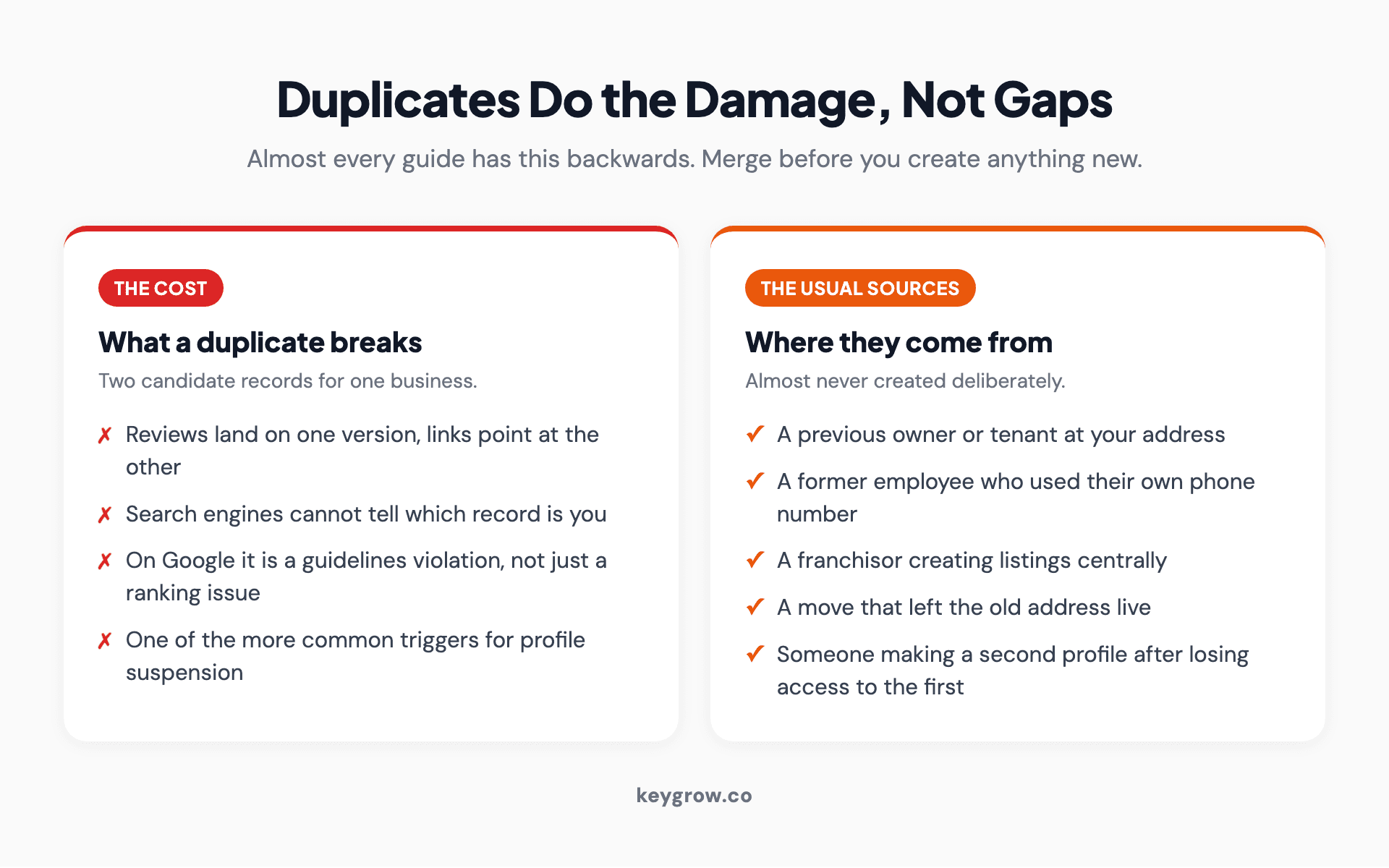
Why duplicate listings do more damage than missing ones, and where duplicates usually come from.
A duplicate splits your signals. Reviews land on one version, links point at the other, and the entity has two candidate records for one business. On Google specifically, a duplicate profile is a policy violation as well as a ranking problem, and it is one of the more common triggers for suspension.
Duplicates come from predictable places: a previous owner at your address, a former employee who created a profile with their own phone, a franchisor creating listings centrally, a move that left the old address live, and the classic case of somebody creating a second profile because they could not get into the first.
Merging or removing them is slower than creating something new and worth far more. Do this before you add a single new listing.
What counts as inconsistent, and what does not
People burn hours on differences that do not matter and miss the ones that do.
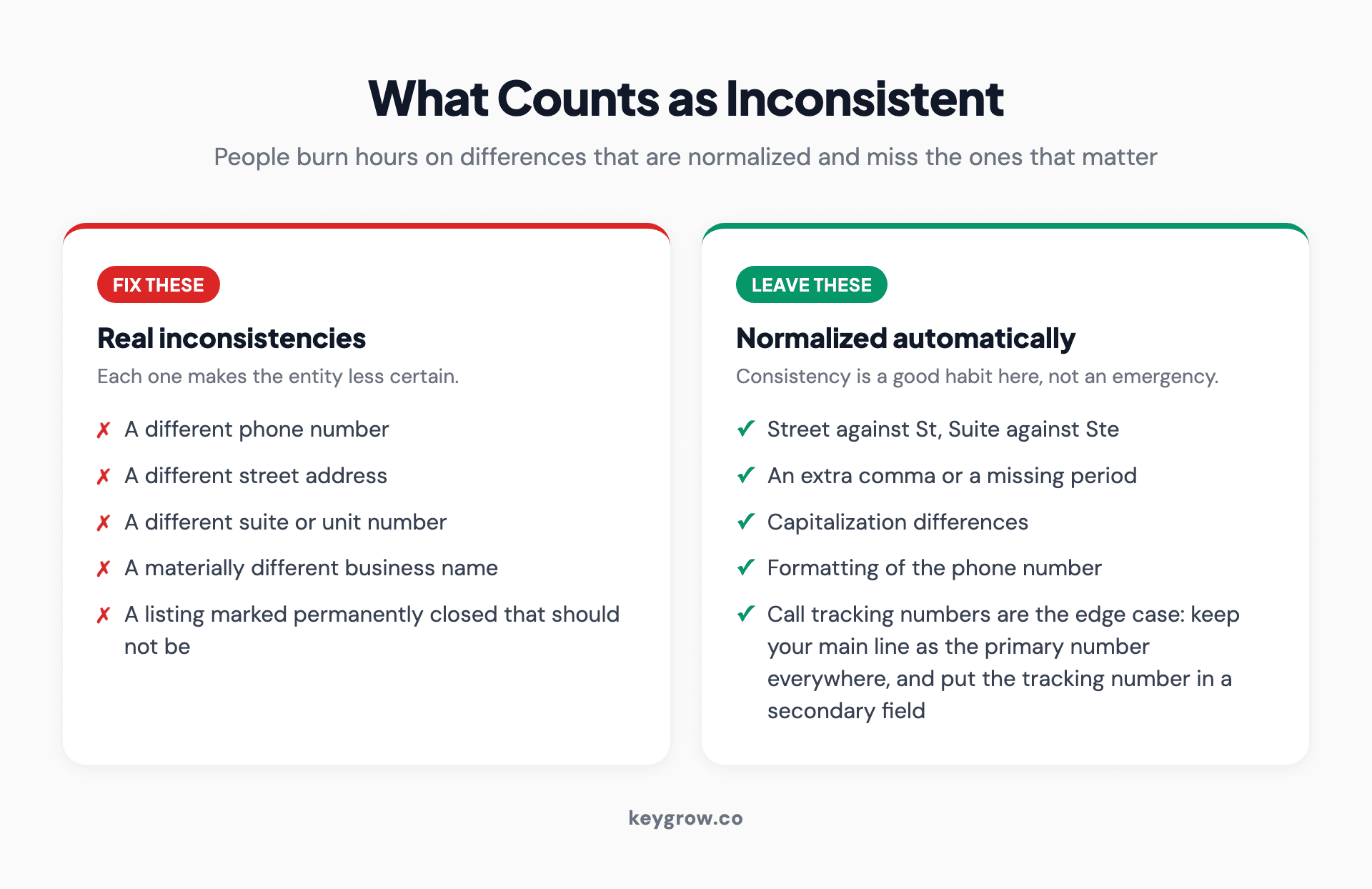
What counts as a real NAP inconsistency and what is normalized automatically, including how to handle call tracking numbers.
Genuinely matters: a different phone number, a different street address, a different suite or unit number, a materially different business name, and a listing marked permanently closed that should not be.
Does not matter: Street against St, Suite against Ste, an extra comma, capitalization, a missing period. These are normalized. Consistency is a good habit, not an emergency.
The one that trips people up is call tracking numbers. A tracking number on a directory listing creates a genuine inconsistency, and the usual advice to never use one is too strict. If you do use them, keep your main line as the primary number everywhere and put the tracking number in a secondary field where the platform supports it.
Google's business guidelines are the reference for name and address formatting, and the name section is where most avoidable trouble starts.
Moving or rebranding is when this becomes urgent
Everything above is routine maintenance. A move is not, and it is worth treating as a project.
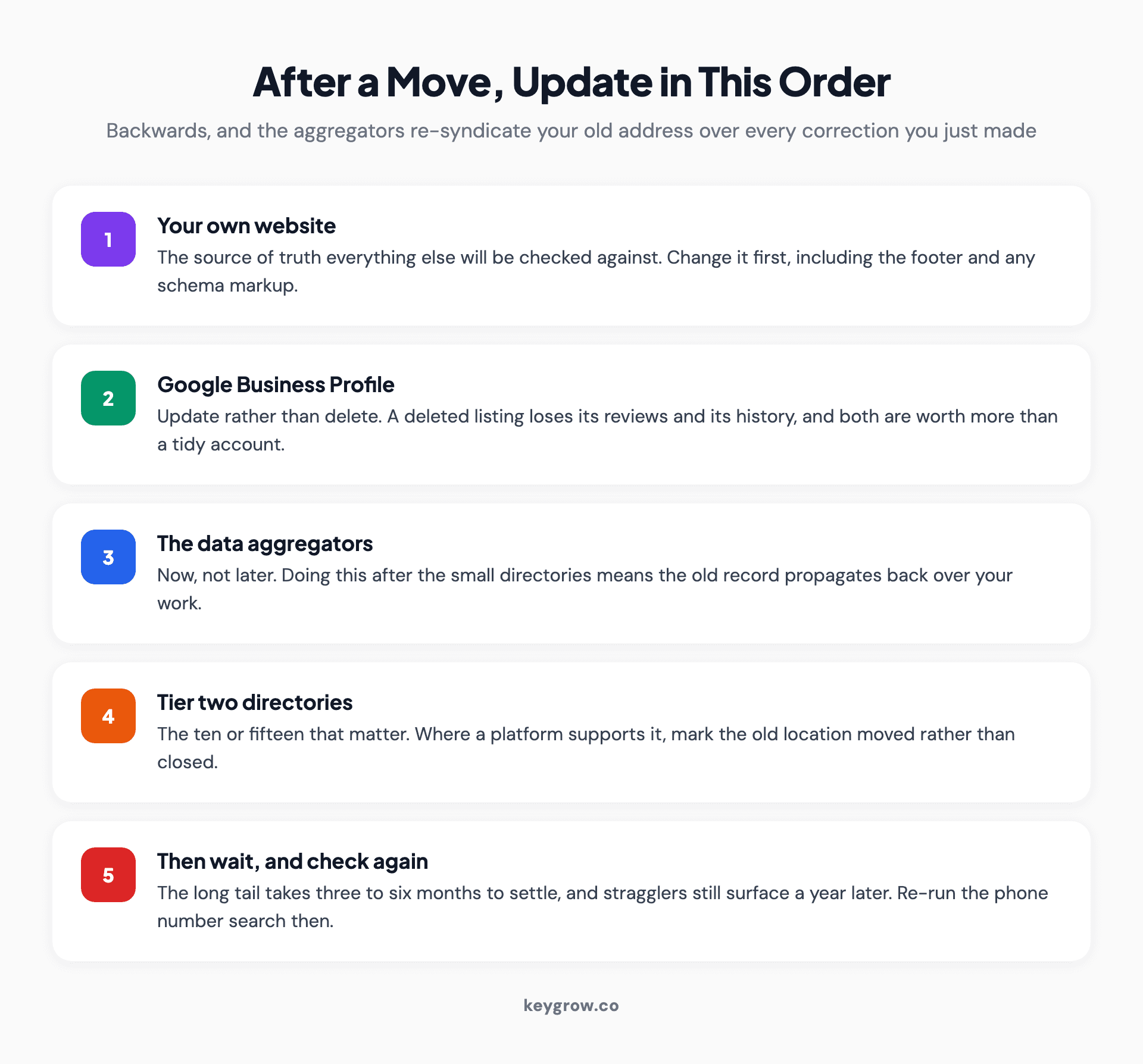
The order to update local citations in after a move or rebrand, and why doing it backwards re-syndicates the old address.
Update in this order, because it matters: your own website first, then your Google Business Profile, then the aggregators, then tier two. Doing it the other way round means the aggregators re-syndicate the old address over your corrections.
Never delete the old listing. Update it. A deleted listing loses its reviews and its history, and both are worth more than the tidiness. Where a platform supports it, mark the old location moved rather than closed.
Expect the long tail to take three to six months to settle, and expect to find stragglers a year later. One phone repair client of ours went from no meaningful inbound calls to 115+ a month over seven months, and a good chunk of the early work was simply making sure every source agreed on where they actually were.
Unstructured mentions now outrank directory entries
The most valuable citation you can get this year is not a listing at all.
An unstructured citation is a mention of your business in ordinary content: a local news story, a supplier's customer page, an event listing, a community organization thanking a sponsor, a blog post about the neighborhood. No form, no NAP block, just your name in context on a page people actually read.
These are worth more than directory entries for the same reason a real link is worth more than a footer link. They come with context, they usually come with a genuine link, and they are the sort of thing an AI system quotes when summarizing a local market.
You get them the way you get anything local: sponsor the thing, host the thing, be quoted in the thing, be the customer example on a supplier's site. It is slower than filling in directory forms and it is the part of this work with a ceiling worth reaching for.
What not to buy, and how to know when you are done
Do not buy a package promising hundreds of listings. Do not buy monthly citation building. And be careful with subscription listing services that manage your data on your behalf, because when you stop paying, some of them revert your listings to their previous state, which means you are renting your own address.
You are done when tier one is claimed and accurate, the aggregators match, duplicates are merged, and ten to fifteen relevant tier two listings agree with each other. That is it. There is no next level.
After that, put a calendar reminder for every six months and after any change to your details. Twenty minutes, twice a year.
If your monthly SEO report still leads with a citation count, that number is being used to look like work. Our post on whether local SEO is dead covers the rest of the metrics worth being suspicious of.
FAQs
Do local citations still help SEO?
They help by preventing a problem rather than by creating a gain. Consistent business data across the major sources supports the entity search engines build for your business, while contradictory data across many sources actively hurts. Adding listings beyond the important ones does nothing measurable.
How many local citations does a business need?
Around fifteen to twenty accurate ones covers it for most local businesses: the major platforms, the data aggregators, and ten or so relevant industry and local directories. Quantity beyond that has no measurable effect, which is why packages promising hundreds are selling volume rather than results.
What is NAP consistency and how exact does it need to be?
It means your name, address and phone number match across sources. Real inconsistencies are different phone numbers, different street addresses, different suite numbers and different business names. Formatting differences like Street against St or Suite against Ste are normalized and not worth your time.
Are duplicate listings worse than missing ones?
Considerably. A duplicate splits reviews and links between two records and leaves search engines with two candidates for one business. On Google it is also a guidelines violation and a common cause of suspension. Find and merge duplicates before creating anything new.
Should I pay for a monthly citation service?
Rarely. The work is finite: clean up once, then update when your details change. Monthly billing suits the vendor rather than the business. Be especially careful with services that revert your listings when you cancel, since that leaves you renting data you should own.
How long do citation changes take to show up?
Direct edits on major platforms appear within days. Changes made at the data aggregator layer take weeks to filter down, and the long tail of small directories can take three to six months. Expect to find stragglers a year after a move.
Do citations matter for AI search and assistants?
Yes, and this is the strongest current argument for getting the important ones right. Assistants lean on structured business data, and ChatGPT search draws on Bing's index, which overlaps its own top results by roughly 73 to 87 percent. A business with contradictory data across sources is harder for any of these systems to represent confidently.
What should I do about citations after moving offices?
Update your website first, then your Google Business Profile, then the aggregators, then the secondary directories, in that order, so nothing re-syndicates the old address over your corrections. Update rather than delete the old listing, because deletion discards the reviews and history attached to it.
One afternoon, then a calendar reminder
Search your phone number in quotes and see what comes back. That one search usually finds more problems than any tool, and it costs nothing.
Then work top down. Claim and correct the four that matter, fix the aggregators, merge every duplicate you find, and get ten or fifteen relevant listings to agree with each other. Write it in a spreadsheet so the next person does not start from nothing. That spreadsheet stops being tidy housekeeping and becomes essential once you run several branches, as our guide to local SEO for multiple locations explains.
Then stop, and put a reminder in the calendar for six months. Citations are plumbing. Once the pipes agree with each other, the useful work moves to reviews, to the profile, and to the local SEO that actually compounds. If someone is quoting you a monthly fee for this, send us the proposal and we will tell you what in it is real.