


You do not have a Google Maps ranking. You have several hundred of them, one for every point on the map a person could be standing when they search, and they are all different. (If your profile is not appearing at all rather than ranking badly, that is a different problem: start with why a business does not show on Google Maps.)
That single fact reorganizes everything else. Google Maps SEO is the work of getting your business into the top three map results for a query, and because distance is one of the three things Google weighs, the honest goal is not position one. It is widening the area in which you appear at all.
The three inputs are relevance, distance and prominence. You can move two of them. The third one decides how much moving the other two is worth.
The three signals, and which ones you actually control
Google is unusually direct about this. Its local ranking guidance names relevance, distance and prominence, in those words, and everything sold as Google Maps SEO is an attempt to move one of them.
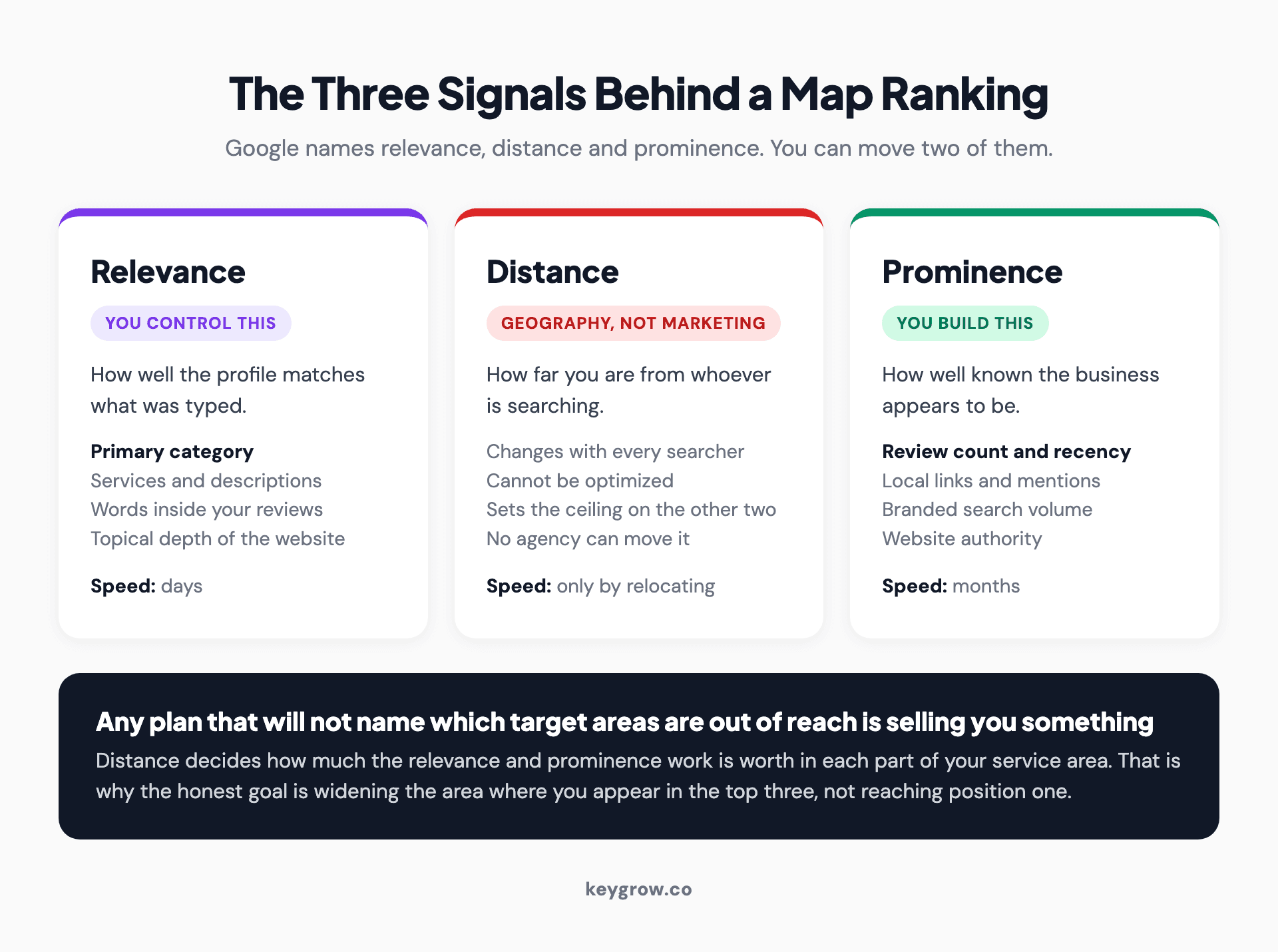
The three signals behind Google Maps rankings, showing which of relevance, distance and prominence a business can actually influence.
Relevance is how well your profile matches what was typed. Categories, services, the business description, the words in your reviews. This is the fastest thing to fix and the one most businesses have wrong.
Distance is how far you are from the searcher. You cannot change it without moving, and no agency can either.
Prominence is how well known the business appears to be: reviews, links, mentions, brand searches, and how established your website is. This is the slowest to build and the reason an established competitor outranks a better-optimized newcomer.
Two of these are work. One is geography. Any Google Maps SEO plan that does not say out loud which of your target areas are geographically out of reach is selling you something.
Stop asking what you rank and start looking at the grid
Your position changes every few blocks. A single rank number, from a tool checking one location or from you searching on your own phone, tells you almost nothing useful.

Someone holding a phone showing a map application outdoors.
Grid rank tracking solves this. The tool checks your ranking from dozens of coordinates spread across your service area and returns a heat map: green where you are in the top three, yellow where you are on the edge, red where you are nowhere. Most local rank trackers include this now, and it changes what you argue about.
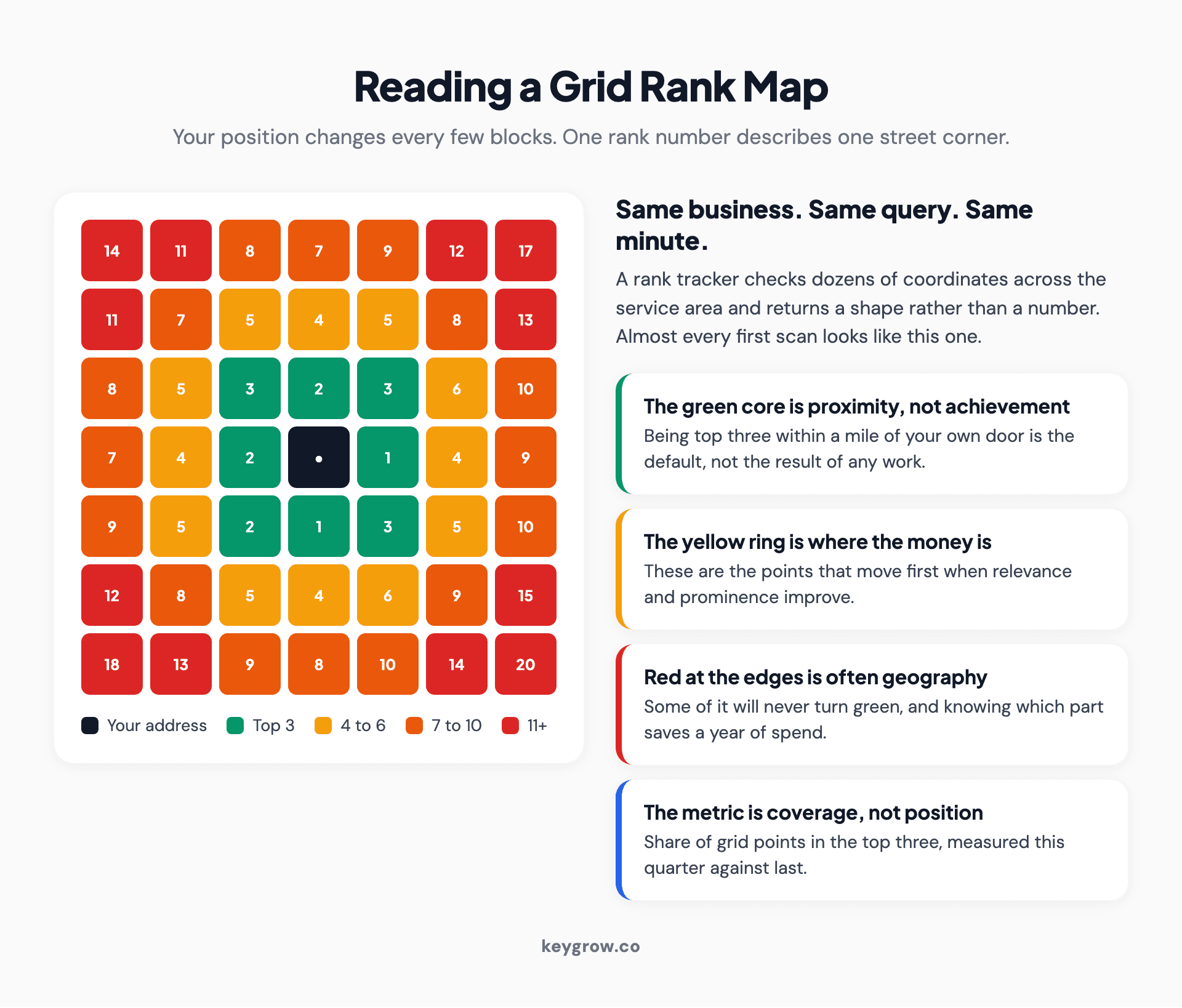
How a grid rank map reads, from a tight green core near the business address out to red at the edge of the service area.
The first grid a business runs almost always shows the same shape. A tight green core within a mile or two of the address, a yellow ring, then red. The green core is not an achievement, it is proximity doing its job. The interesting question is how far out the green goes, and whether it goes further this quarter than last.
That reframes the target. You are not chasing position one. You are trying to hold the top three across more square miles, which is a goal you can measure, budget for, and actually reach.
It also settles a common argument. When a client says a competitor outranks them, the grid usually shows both businesses winning near their own address and losing near the other's. Nobody is beating anybody. They are two pins on a map.
Your primary category moves more than any other field
If you change one thing this week, change this. The primary category is the strongest relevance signal on a Google Business Profile, and picking it by instinct rather than by checking what ranking competitors use is the most common expensive mistake in local search.
Google will only show you for queries it believes your category covers. A business listed as a general contractor will struggle for kitchen remodel searches that a business listed as a kitchen remodeler wins without trying. The categories are not synonyms and Google does not treat them as such.
Do this properly:
- Search your money query from within your service area and note the primary category of the three businesses in the map pack. Several browser extensions read it straight off the listing.
- Pick the most specific category that genuinely describes what you do. Specific beats broad here, which is the opposite of the instinct most owners have.
- Add secondary categories for everything else you genuinely offer, and nothing you do not.
- Recheck after any service change. Categories drift out of date quietly.
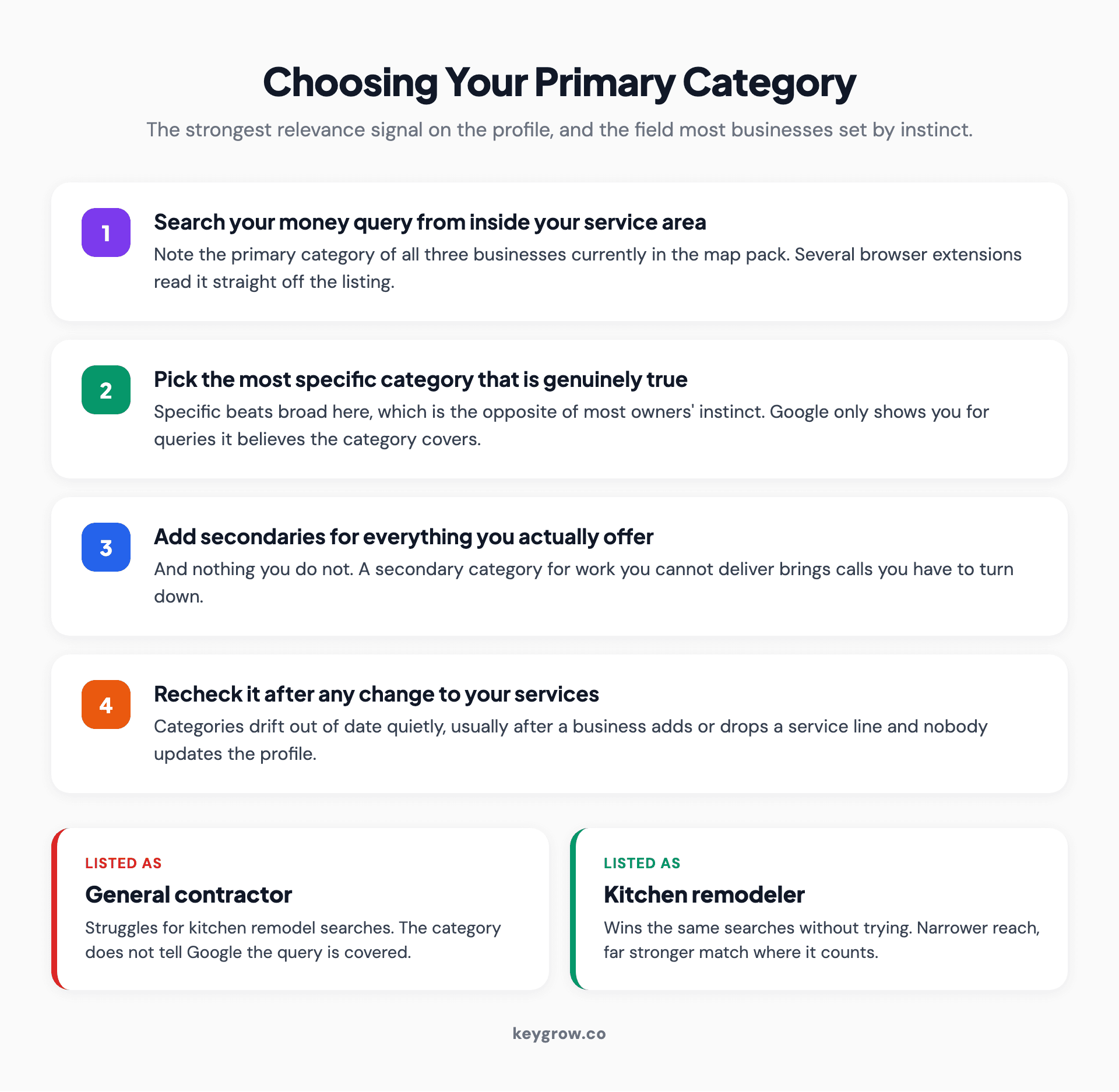
How to choose a Google Business Profile primary category, from checking the competitors already ranking to reviewing it after a service change.
The trade-off is real and worth stating. A narrower primary category shows up for fewer query types. If your revenue genuinely splits across two unrelated services, you have a structural decision to make about which one the profile leads with, and the answer should be the one with the higher job value rather than the higher search volume.
The rest of the profile, ranked by what it moves
Everything on a Google Business Profile is worth completing. Not everything is worth the same amount, and most checklists present them as equals.
| Field | What it moves | Effort |
|---|---|---|
| Primary category | Relevance, heavily | Ten minutes |
| Services and service descriptions | Relevance for long-tail queries | An hour |
| Business name, exactly as signed | Nothing directly, but keyword stuffing risks suspension | Zero |
| Hours, including holiday hours | Conversion more than ranking | Ongoing |
| Photos, added regularly | Engagement signals, and the click | Ongoing |
| Products | Relevance for retail and some services | Varies |
| Q and A, seeded with real questions | Conversion, and occasionally relevance | An hour |
| Posts | Very little ranking effect, some conversion | Weekly |
| Attributes | Filtering and relevance for niche queries | Ten minutes |
| Description | Almost nothing for ranking | Twenty minutes |
The two most over-sold items on that list are posts and the description. Both get recommended weekly by tools with a scheduling feature to sell. Neither will move a stubborn ranking, and treating them as the fix is how six months disappear.
Photos are the one people underrate. They do not carry the weight of a category, but a profile with recent, real photographs gets clicked more than one with a stock exterior shot from 2019, and engagement is part of prominence.
Reviews do more than raise a star rating
Reviews feed prominence, they feed relevance through the words customers use, and they decide whether the click turns into a call. BrightLocal's 2026 survey of 1,002 US consumers found 97 percent read reviews, and the share who always read them jumped from 29 to 41 percent in a year.
Three properties matter more than the total count.
Recency. A profile with 200 reviews where the newest is fourteen months old reads worse than one with 40 reviews from the last quarter, to both a human and, by every observable pattern, to Google.
Velocity. A steady trickle beats a burst. Two silent years followed by a single week of forty reviews is a shape that draws attention, and rarely the kind you want.
Language. Reviews that mention the specific service and the specific area do relevance work that your own copy cannot. You cannot script this, but you can ask the right question. "Would you mind mentioning which service we did and roughly where you are?" produces more useful text than "please leave us a review".
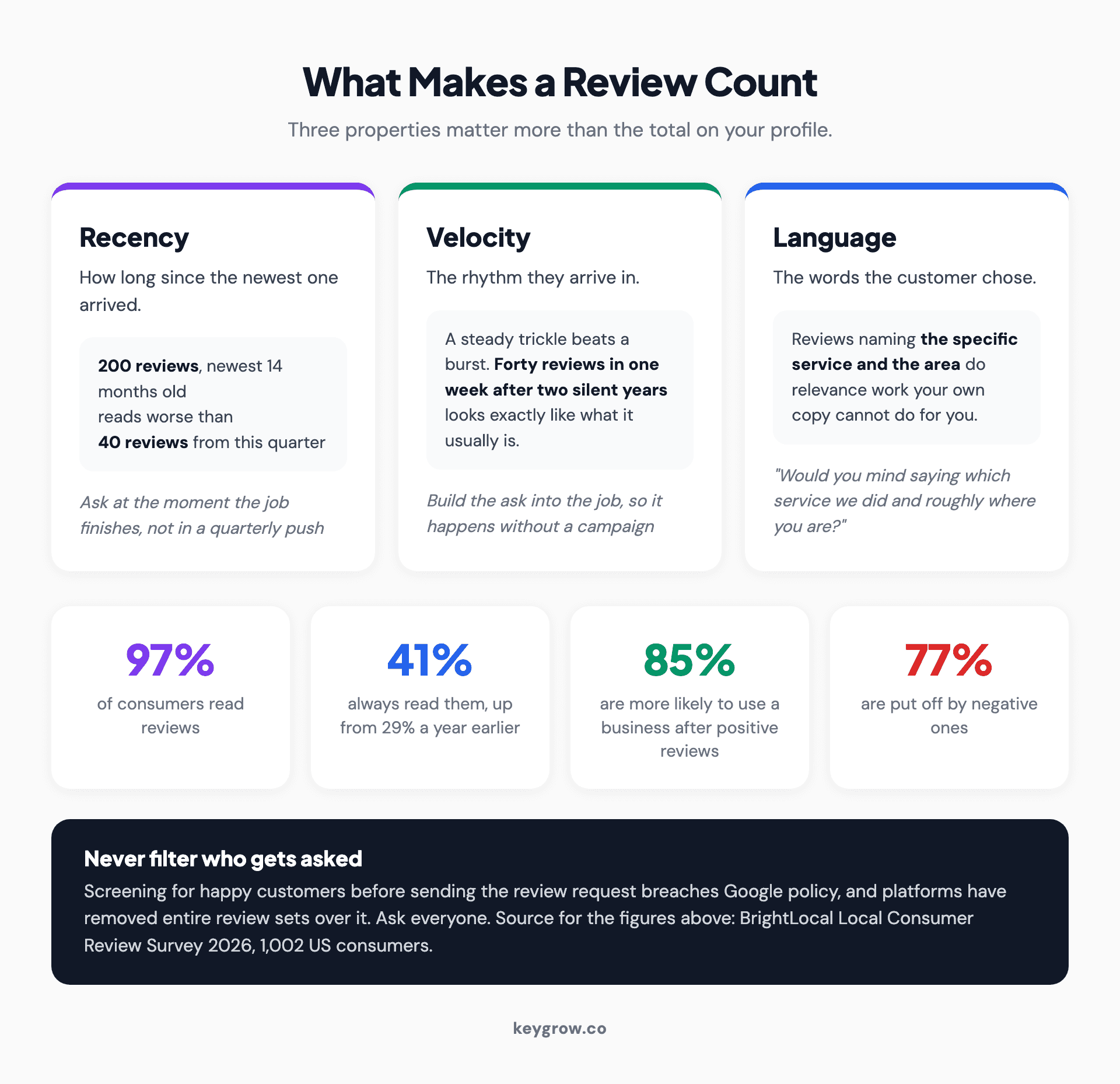
How review recency, velocity and wording feed a Google Maps ranking, and the asking method that produces each.
Reply to them. Not because a reply is a strong ranking signal, it is a weak one, but because the replies are read by the next person deciding whether to call. There is more detail on that in whether responding to reviews helps SEO.
One hard line: never filter who gets asked based on how happy they seem. Review gating breaches Google's policy, and platforms have removed review sets over it. Ask everyone.
What your website still has to do
The profile ranks, but the website behind it is part of prominence, and for anything outside your immediate radius it is doing most of the work.

A row of small business storefronts along a local main street.
Four things earn their place.
A real page per service, not a services list. A page about emergency water damage restoration can rank organically for that phrase and reinforce the profile's relevance for it. A bullet on a combined services page cannot do either.
A real page per area you genuinely serve, with content that could only have been written about that area. Not the same 400 words with the town name swapped. Thin location pages have been a known liability for years and they are worse now that the same pages are being read by AI systems.
LocalBusiness structured data, with the same name, address and phone as the profile. It is not a ranking factor by itself. It removes ambiguity about which entity the site belongs to, which matters more than it used to.
Speed and mobile behavior. Most of this traffic arrives on a phone, often outdoors, often on a slow connection. A profile click that lands on a page taking six seconds is a lost job regardless of where you ranked.
We wrote separately about writing local landing pages that are not templated, which is the part most businesses get wrong.
Citations matter less than they did, and still have one job
Consistent name, address and phone across the major directories is worth doing once, properly, and is not worth paying for monthly.
The old advice was to build hundreds of citations. That era is over. Google resolves business identity from far better signals now, and the fiftieth directory listing does nothing.
What still matters is contradiction. If four sources list your old suite number and two list a disconnected phone number, that is noise in the entity, and noise is the thing citations can still cost you. Fix the major aggregators and the ten or fifteen directories that actually appear when you search your business name, and see local citations for SEO for the tier list and the audit. Then stop.
If you moved premises or changed your number in the last two years, this is a genuine job worth a weekend. If you have not, it is probably already fine.
Local links are the prominence lever almost nobody pulls
Prominence is the slow signal, and links from local sites are the most reliable way to build it. Almost no local business does this, which is exactly why it works.
The ones that are actually obtainable:
- The supplier, manufacturer or franchise directory you already qualify for
- The chamber of commerce, trade association and licensing body you already pay
- The youth team, school event or charity run you already sponsor, with a link on the sponsor page
- A local news or neighborhood publication, when you have something genuinely newsworthy
- The other trades you refer work to, reciprocated as a genuine partners page
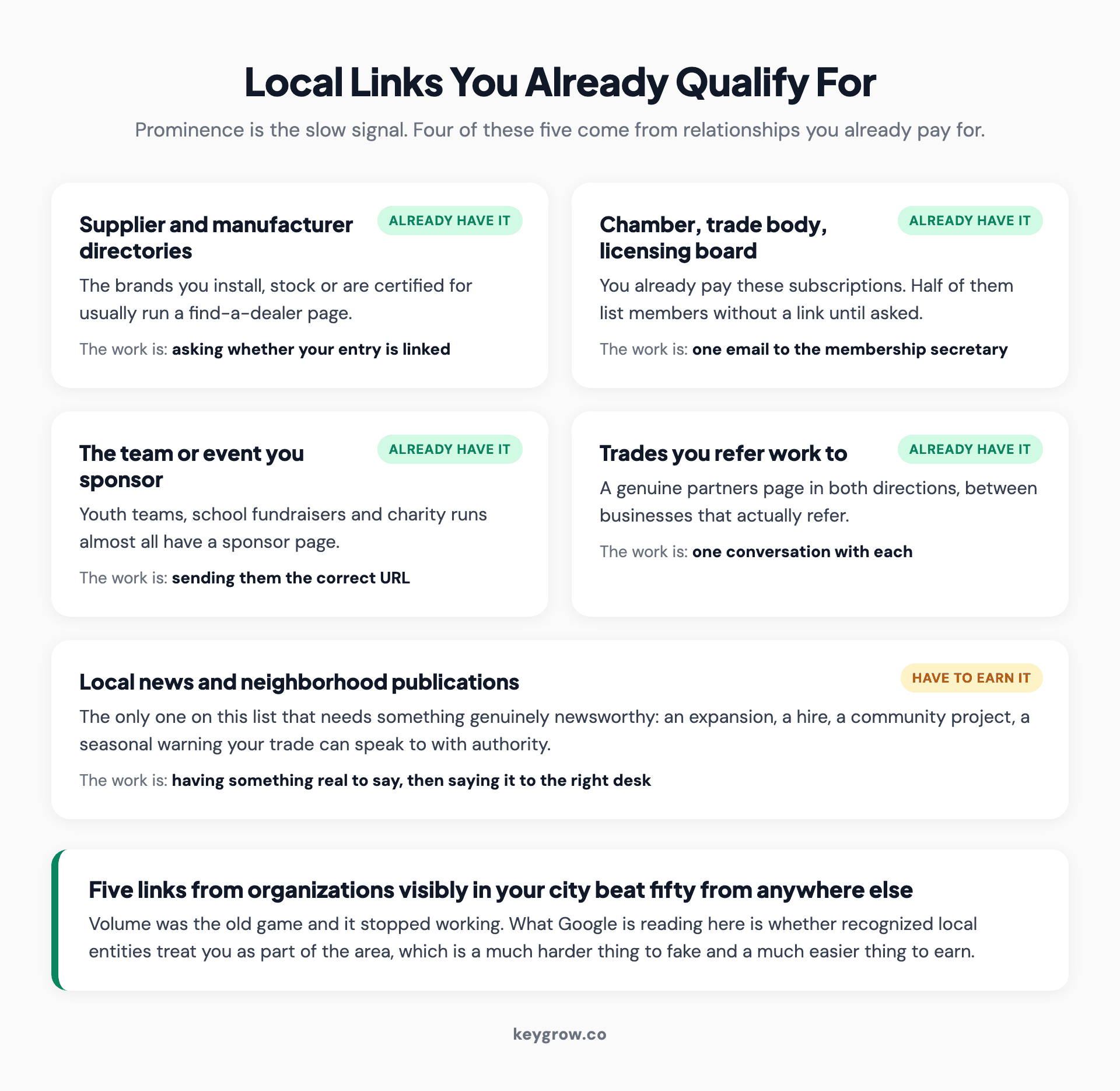
The five local link sources a business can realistically obtain, most of them from relationships it already pays for.
Notice that four of those five are relationships you already have. The work is not outreach, it is asking whether the page listing you includes a link, and about half the time it does not until you ask.
Volume is not the goal. Five links from organizations that are visibly in your city do more for a local ranking than fifty from anywhere else.
The map pack is feeding AI answers now
The same profile signals that decide the map pack are being read by assistants answering "who is the best plumber near me", and the shortlist those tools produce is shorter than three.
This is the part not in the older guides. When somebody asks an AI assistant for a local recommendation, the systems lean on the same structured business data, review corpus and local citations. Roughly 44 percent of AI citations come from the first third of a page, which is why an answer-first site structure now helps in two places at once.
Practically it means three things. Your profile data has to be machine-readable and internally consistent, because an assistant cannot ask a follow-up. Your reviews are now training text as well as social proof. And the pages behind the profile need clear, direct answers near the top rather than five paragraphs of preamble.
We cover the mechanics of that in more depth on our AEO service page. The overlap with Google Maps SEO is larger than most local businesses realize, and the work is mostly the same work.
The tactics that do not work, including some still being sold
Every one of these is still recommended somewhere, and every one of them either does nothing or gets profiles suspended.
Stuffing keywords into the business name. It works until it is reported, and then the profile is suspended and you spend three weeks on reinstatement. Competitors report each other constantly.
Renting a virtual office or a coworking desk in a city you want to rank in. Google requires staffed premises during stated hours. These get caught, and the suspension takes the original listing with it.
Buying reviews. Detection has improved, removal is common, and a purged review set looks worse than a small honest one.
Bulk citation packages. Fifty new directory listings on sites nobody visits is the marketing equivalent of raking leaves in the wind.
Posting to the profile three times a week and calling it local SEO. Posts are a conversion feature. They are not a ranking strategy, and any report that leads with post count is a report designed to look busy.
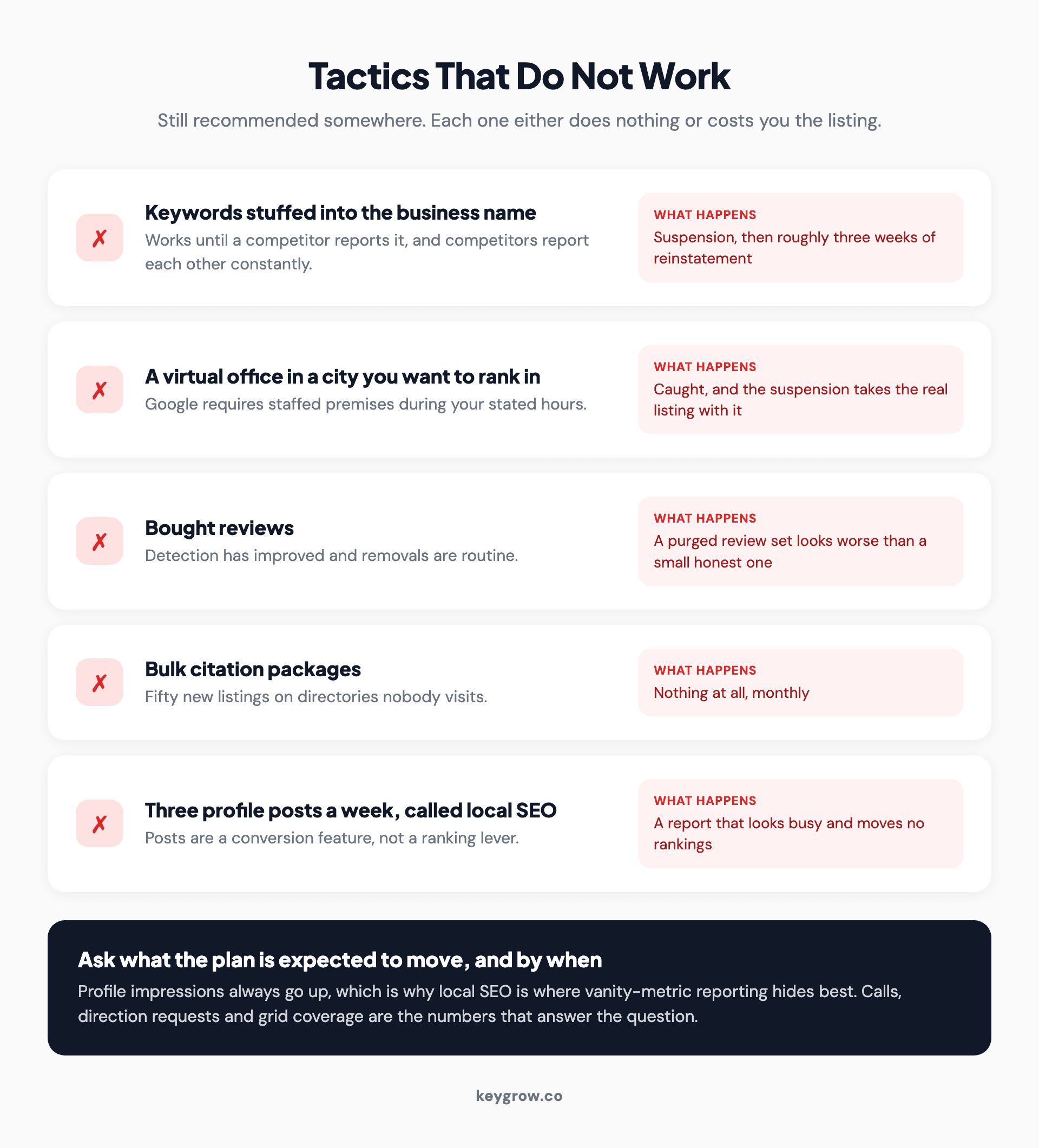
Five Google Maps tactics that do nothing or get a profile suspended, with what actually happens in each case.
If an agency's plan is mostly posts and citations, ask what it is expected to move and by when. Vanity-metric reporting is the industry's oldest habit, and local SEO is where it hides best, because impressions on a profile always go up.
How long it takes, and what to watch while you wait
Category and profile fixes can move things within days. Prominence takes months, and the compounding is the whole point.
Three of our local clients ended up in roughly the same place by different routes: a phone repair shop at 115 plus calls a month after seven months, a real estate office at 90 plus after seven, a junk removal company at 50 plus after six. Their phones were quiet before the work started. They were also quiet at week six, which is the part worth remembering when you check the grid in month two and the shape has not changed. If the phone needs to ring before then, Google Maps advertising can rent a pin in the meantime, though it does nothing for the organic ranking.
Watch these four, in this order:
- Calls and direction requests from the profile, which are the actual output
- Grid coverage, measured as the share of grid points where you sit in the top three
- Review count and recency
- Rankings last, because they are the input, not the result
Anyone reporting ranking position without calls is showing you the easier number. There is a fuller treatment of timelines in how long local SEO takes.
When you should do this yourself
A single-location business with a couple of hours a month and no agency budget can do most of what matters here, and should.
Setting the primary category correctly, completing services, adding photos regularly, asking every customer for a review and replying to all of them covers the majority of the available gain for a small local business. None of it requires a specialist. It requires somebody to actually do it every month, which is the part that fails.
Hiring makes sense when you have multiple locations competing with each other, when you are trying to expand coverage beyond the radius proximity gives you for free, when a suspension needs untangling, or when the hours you would spend are worth more elsewhere. That is a genuine calculation and often the answer is no.
Our local SEO work is month to month with no lock-in, and we will tell a one-location business with time on their hands to go and do it themselves.
FAQs
How long does it take to rank in the Google map pack?
Profile changes like a corrected primary category can show up within a few days. Building enough prominence to hold the top three across a wider area usually takes three to six months of consistent review generation and local link building, and longer in a competitive city. Anyone promising the map pack in 30 days is either targeting phrases nobody searches or planning something that risks a suspension.
Why does my business rank differently on my phone than in the tracking tool?
Because your position depends on where the searcher is standing. Your phone reports the ranking at your location, which is usually your own premises, so it flatters you. A grid rank tracker checks dozens of points across the service area and shows the real picture, which is a range rather than a number.
Can I rank in a city where I do not have an address?
Not in the map pack for that city, no. The map pack requires a real, staffed address, and virtual offices get suspended. You can rank organically below the map with a genuine location page for that area, and service area businesses can appear across a service radius set from their real address, which is often enough.
How many Google reviews do I need to rank?
There is no threshold. What matters relative to your competitors is the trend: are you adding reviews steadily, are they recent, do they describe the specific service and area. A business with 45 recent reviews commonly outranks one with 300 that stopped arriving two years ago.
Do Google Business Profile posts help rankings?
Barely. Posts are worth publishing because they occupy space in the profile a potential customer is already reading, and occasionally surface an offer at the right moment. They are not a ranking lever, and an agency report built mainly around post frequency is measuring effort rather than results.
What is the difference between the map pack and Google Maps results?
The map pack is the three-business block that appears inside a normal Google search. The Maps app or maps.google.com shows a longer list for the same query. They draw on the same signals, but the map pack is the one that matters commercially, because it sits above the organic results on the page most people search from.
Does my website affect my Google Maps ranking?
Yes, through prominence and relevance. Google associates the profile with the site linked from it, so the site's topical relevance, authority and local content all feed in. This is why two businesses with equally complete profiles can rank differently, and why a service business with no real website struggles beyond its immediate few blocks.
Should I pay for citation building?
Once, if your details have changed recently or are inconsistent across the major directories. Not monthly. The value in citations is the removal of contradictory information about your business, and that is a job with an end, not a subscription.
Start with the grid
Run a grid scan before you change anything. It takes ten minutes, it costs very little, and it converts a vague sense that you should rank better into a map with a shape you can work on.
Then do the two things with the best return: confirm your primary category against whoever is currently winning, and start asking every customer for a review in a way that gets them to name the service and the area. Those two account for more movement than everything else on this page combined.
Come back to the grid in ninety days. If the green core is wider, the work is functioning. If it is identical, the problem is prominence, and prominence is where an agency earns its fee. If you would rather work from a list than a grid, our local SEO checklist puts the same jobs in order of return.
If you would rather have someone run that first scan and tell you what it says, send us your business name and we will look at it.