

Google Business Profile optimization is the work of making your free Google listing rank in the map pack and convert the people who see it. Most of it is unglamorous: pick the right primary category, fill in every field, collect reviews, and keep the profile looking active. Done properly it is the highest-return hour a local business can spend, and it costs nothing but attention.
Here is the part most guides leave out. A meaningful share of your local ranking is decided by your address, and no amount of optimization moves it. Knowing which levers actually exist is the difference between three focused hours and three months of busywork.

Storefront of a local business with a glass window display, the kind of business that lives or dies by its map pack ranking.
What Google actually measures
Google is unusually direct about this. Its own documentation names three factors: relevance, distance and prominence. Relevance is how well your profile matches the query. Distance is how far you are from the searcher. Prominence is how well known you are, drawn from reviews, ratings and mentions across the web.
That is the official version, and it is true but vague. The useful version comes from practitioners who test this for a living.
Whitespark's 2026 report surveys local SEOs and scores individual ranking factors for the map pack. The top ten reads as follows: primary category, proximity of your address to the point of search, keywords in your business title, having a physical address in the city being searched, being open at the time of search, high numerical ratings, showing an address rather than hiding it as a service area business, additional categories, quantity of native reviews with text, and correct map pin placement.
Read that list again and notice something. Four of the top ten are about where you are, not what you do.
That is the whole game, and most guides skip it.
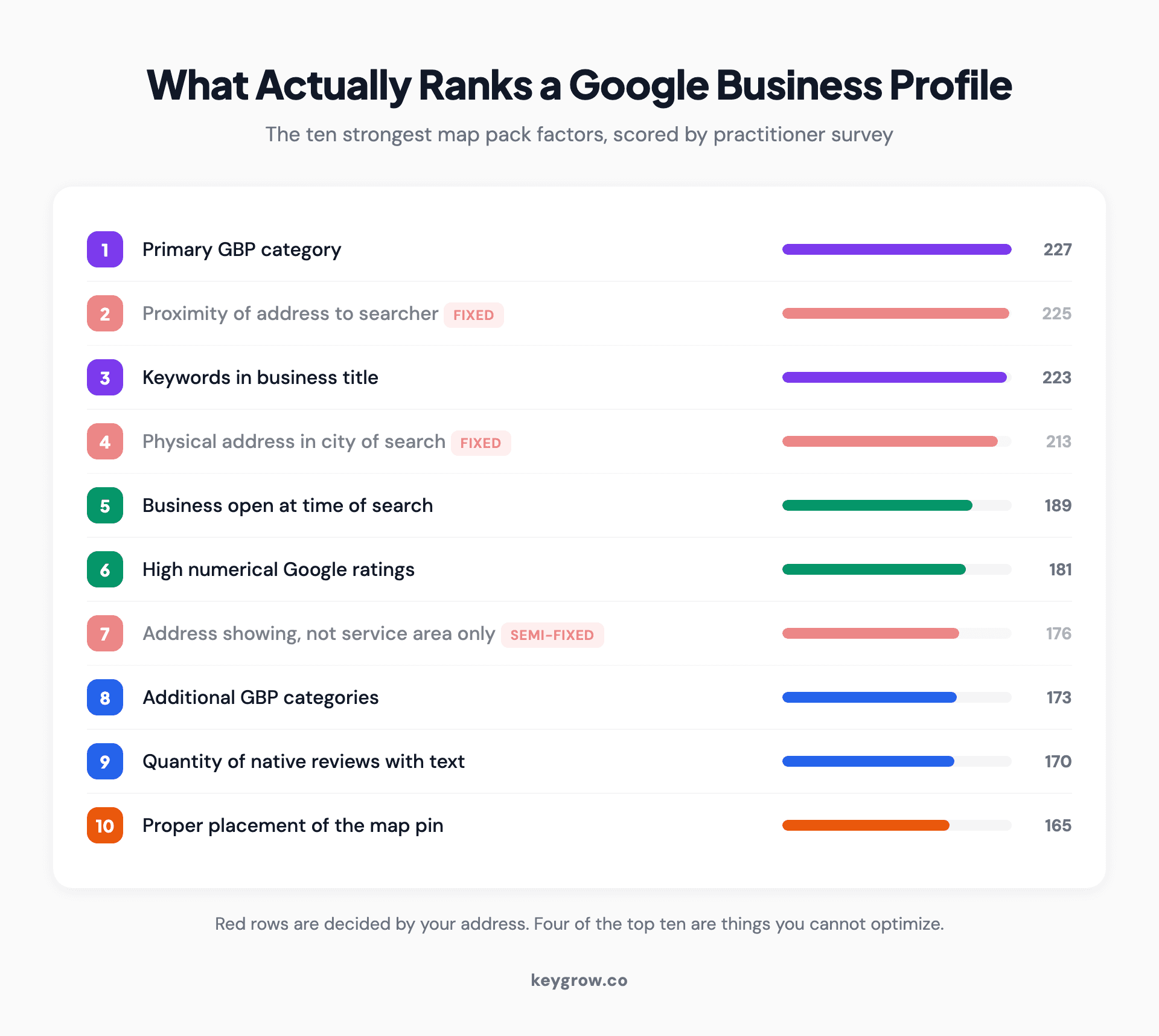
Ranked list of the top ten Google Business Profile ranking factors for the map pack, with primary category and proximity at the top.
The parts you cannot change
Proximity is the second strongest factor in the list and you cannot optimize it. Neither can you optimize having an address inside the city someone is searching from. If your shop is twenty minutes outside the city center, you will lose map pack positions to a worse business that happens to be closer, and there is no field in your dashboard that fixes that.
This matters because it sets a realistic ceiling. A business in a dense downtown block is competing on a different curve than a business on the edge of a service area. Both can optimize well. They will not get the same result.
What you can control is everything else: category, name, completeness, reviews, activity, and whether your website supports the profile. That is still most of the list, and most businesses have not touched any of it.
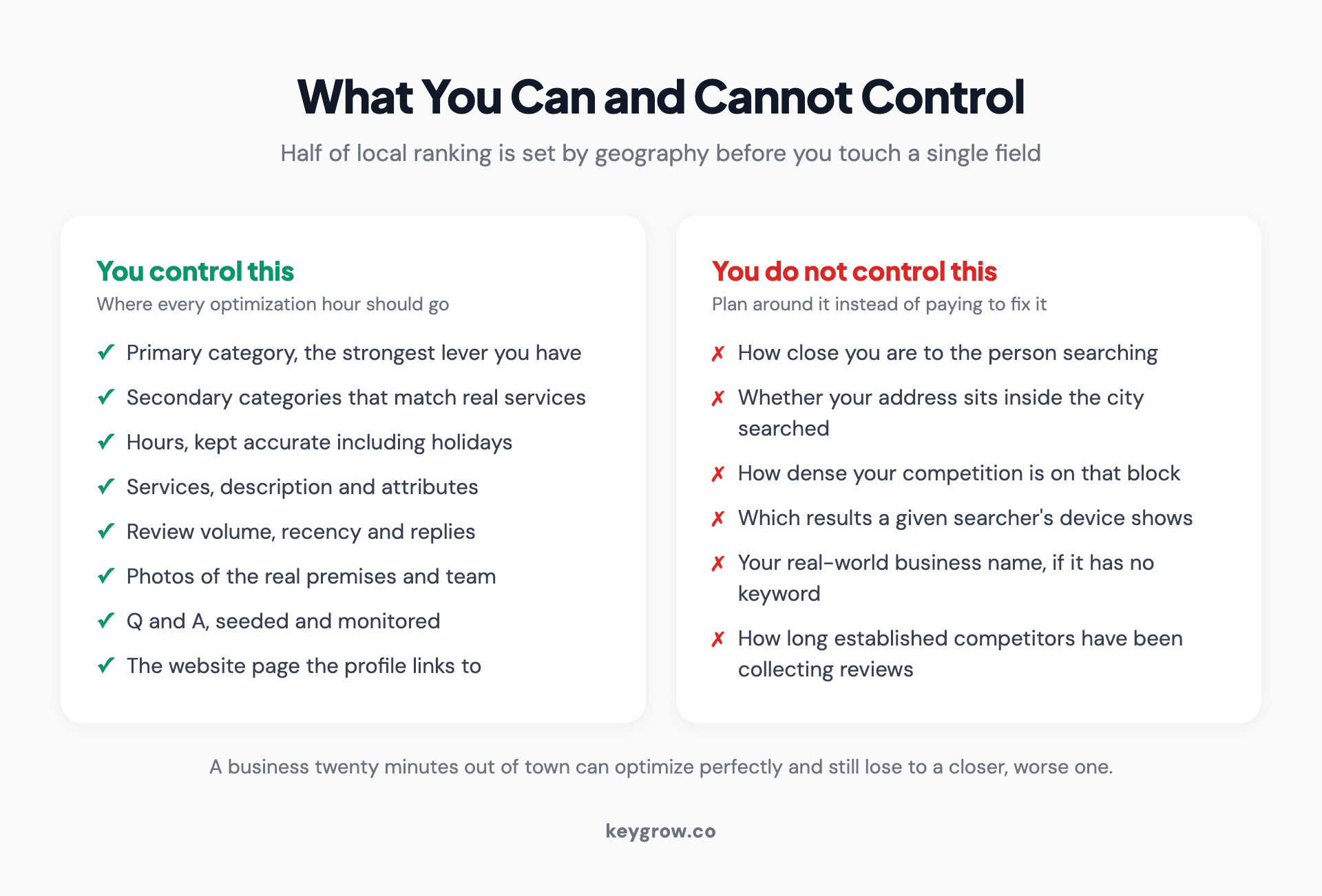
Two-column split showing which Google Business Profile ranking factors you can control and which are fixed by your address.
Anyone selling you map pack rankings without asking where your address is has skipped the first question.
Primary category beats everything else you can touch
Your primary category is the single highest-scored controllable factor in the map pack. Get it wrong and nothing else you do will rescue the profile.
The mistake is picking the category that best describes the business rather than the one that matches what people search. A shop that does custom framing and sells art supplies has to decide which one it wants to rank for, because the primary category largely decides which queries it is eligible for. Pick the one attached to the revenue.
To choose it well, search your main keyword in an incognito window from your actual service area and look at the three businesses in the map pack. Their primary categories are visible on their profiles. If all three share one category and you have picked something else, that is your answer.
Add secondary categories after that, but treat them as secondary in every sense. They rank eighth on the list, well below the primary. Adding fifteen loosely related ones does not multiply your chances; it dilutes the signal and occasionally triggers a review.
A worked example. A business doing both residential and commercial cleaning has two candidate primaries: "House cleaning service" and "Commercial cleaning service." They are not interchangeable. The residential category surfaces for a homeowner searching at 9pm; the commercial one surfaces for an office manager searching at 11am, and the two queries have completely different values per lead. If commercial contracts are worth six times a house clean, the primary category should be commercial, even though residential is the larger share of jobs today. The category is a bet on which customers you want more of.
Changing the primary category later is allowed and does not reset your profile, but expect a few weeks of movement while Google re-sorts which queries you are eligible for. Change it deliberately, once, rather than testing back and forth.
Your business name is a trap
Keywords in the business title score third. That is a real, measured effect, and it is also the fastest way to lose the profile entirely.
Google's guidelines say the name field must be your real-world business name, the one on your signage and your paperwork. "Riverside Plumbing" is a name. "Riverside Plumbing | Emergency Plumber, Drain Cleaning & Water Heater Repair" is a violation, and competitors report it, and Google acts on it.
So the factor is real and you mostly cannot use it. Which is an awkward thing for a guide to admit, so most of them do not. If your legal name genuinely contains a keyword, you are lucky. If it does not, adding one is borrowing ranking against a suspension you will eventually pay.
There is a legitimate version of this. If you have been trading under a name that includes a descriptor for years, and it appears on your storefront, your invoices and your website, that is your real-world name and you can use it. The test is evidence, not preference.
Fill in every field, then keep filling them
Profile completeness is the least interesting section of any guide about Google Business Profile optimization and the one that most often explains why a profile underperforms.
Work through it in this order:
| Field | Why it matters | Common mistake |
|---|---|---|
| Hours | Being open at time of search is a top-five factor | Never updated for holidays |
| Services | Feeds relevance for specific queries | Left empty entirely |
| Description | 750 characters of controlled context | Stuffed with keywords or left blank |
| Attributes | Powers filtered searches | Ignored because they seem cosmetic |
| Products | Extra surface in the profile | Assumed to be retail only |
| Booking link | Removes a step for the customer | Points at the homepage |
Hours are the one people skip. Do not skip hours. If you mirror the profile to Bing, a synced Bing Places for Business listing picks up those hours from Google too.
Being open when someone searches is a top-five ranking factor, which means a profile with stale holiday hours does not just annoy customers, it drops out of results at exactly the moments people are looking.
The description has 750 characters. Use them to say what you do and where you do it, in sentences a person would say out loud. It is not a ranking powerhouse, but it is the paragraph a customer reads before deciding, and it is one of the few places you fully control the wording.
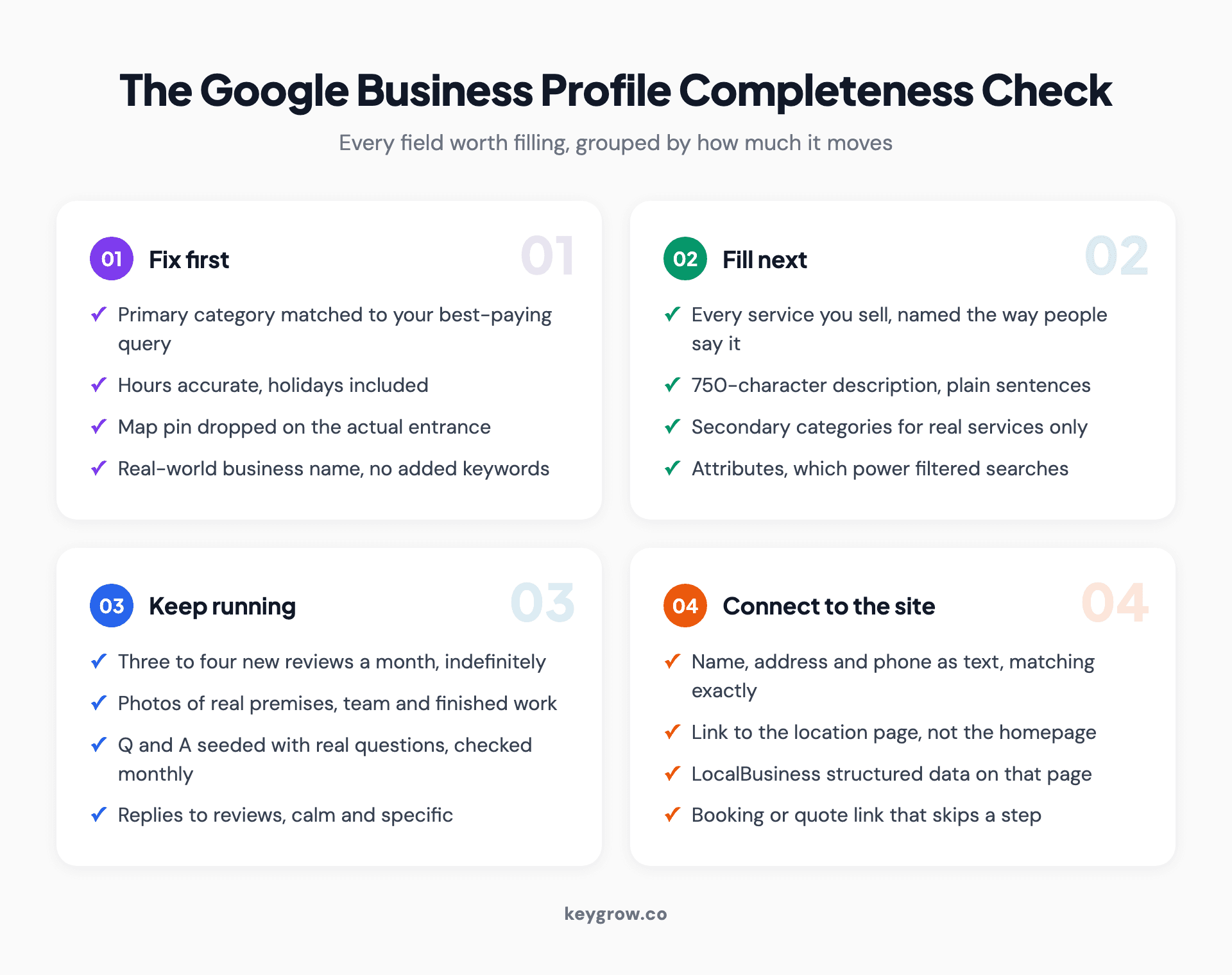
Checklist infographic of every Google Business Profile field that should be completed, grouped by impact.
Reviews count in three separate ways
Ratings, review volume and your replies are measured as different things, which is why "we have good reviews" is not a strategy.
High numerical ratings score sixth on the factor list. Quantity of native Google reviews with text scores ninth. Note the word native: reviews collected on third-party platforms and displayed on your site do not feed this. Note also the word text, because a five-star rating with no words attached carries less than one with a sentence in it.
Replies are the third piece. We have written before about whether responding to reviews affects rankings, and the short version is that it is a weaker signal than volume but a strong conversion one. A prospect reading a two-star review with a calm, specific reply underneath it usually reads the reply as evidence the business is run by adults.
The practical system is boring and works: ask every satisfied customer, ask in person or by text within a day of the job, make it one tap, and never offer anything in exchange. Incentivized reviews violate Google's policies and are increasingly easy to detect from the pattern.
Two details make the difference between a system that produces reviews and one that produces intentions. The first is timing. The window where a customer is happy enough to write something is short, usually the same day, and it closes fast once they are back at work. Asking at the moment of visible satisfaction, before you leave the driveway, outperforms any automated sequence sent three days later.
The second is friction. Google generates a short review link for every profile, and it opens the review box directly. If your ask involves the words "search for us on Google," you have added three steps and lost most of the people who meant to do it. Put the link in a text message. Here is where to find your Google review link, with three messages to send it in.
Steady beats spiky, too. Forty reviews arriving in one week after two silent years is a pattern that gets filtered, and sometimes gets the whole batch removed. Three or four a month, indefinitely, builds something that holds.

Person using a navigation app on a smartphone, the moment a local search turns into a customer visit.
Your website is still doing half the work
The profile does not rank in isolation. On-page signals from the website it links to are consistently one of the heavier factor groups in the map pack, which means a strong profile attached to a thin website is running at a handicap.
Three things on the site matter most for the profile. Your name, address and phone number should appear as text on the page the profile links to, matching the profile exactly, punctuation included. The linked page should be about the location or service being searched, not a generic homepage. And the page should carry LocalBusiness structured data so the same facts are machine readable, which our schema markup generator will produce without hand-writing JSON.
None of this is difficult. It is just usually skipped, because the profile feels like the local SEO task and the website feels like a separate project. Google does not see them separately.
Activity signals that the business is alive
Photos, posts, and the actions people take on your profile all feed the picture Google builds of whether a business is real and operating.
Upload photos regularly rather than in one batch at setup. Photos of the actual premises, the actual team and the actual work outperform stock imagery, partly because customers can tell the difference and partly because the profile is one of the few places where an obviously staged photo is actively suspicious.
Google Posts are worth publishing but not worth agonizing over. They expire, they get modest visibility, and their ranking contribution is small. Publish when you have something real to say: a seasonal offer, a new service, a change in hours. Publishing filler weekly to hit a cadence is effort better spent on reviews. Our full breakdown of what Business Profile posts actually do covers the three types, the rules that get posts rejected, and how often is enough.
The Q&A section is the most neglected surface on the entire profile. Anyone can ask a question, and anyone can answer, which means a competitor or a confused stranger can post an answer that sits on your listing indefinitely. Seed it yourself with the questions you actually get asked, answer them properly, and check it monthly.
What AI assistants do with your profile
Local recommendations are increasingly answered by an assistant rather than a results page, and those systems read structured, consistent business data first.
This changes the weighting of the boring fields. An AI answering "who does emergency plumbing near me, open now" is resolving that from hours, category, service list and review sentiment, all of which live on your profile. A profile with empty services and stale hours is not just ranking lower, it is unreadable to the layer of search that is growing fastest.
The practical implication is uncomfortable for anyone who treated the profile as a set-and-forget task: consistency now matters more than cleverness. The same business name, the same address format, the same phone number, everywhere the business appears. Discrepancies that a human would shrug off are enough to make a machine hedge, and a hedged answer names a competitor instead. This is the same discipline behind answer engine optimization generally, applied to the one listing every local business already owns.
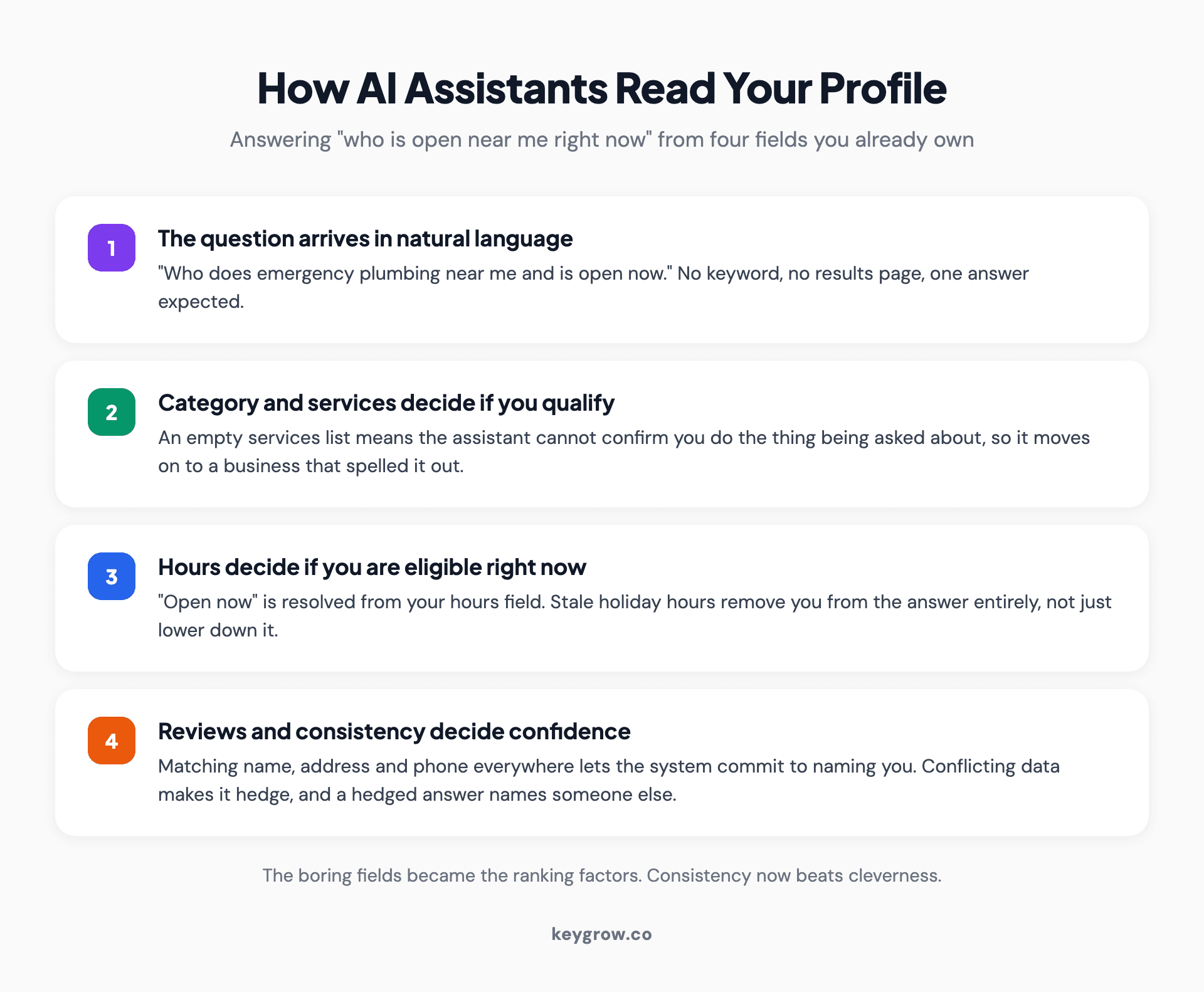
Diagram of how AI assistants read Google Business Profile fields to answer local questions, showing category, hours, services and reviews.
What gets a profile suspended
Suspensions are not rare and they are not always reversible quickly. The common causes are predictable.
Keyword stuffing the business name is the most reported. Using a virtual office or a mailbox as an address is the most fatal, because the address is the one thing Google can verify independently. Listing a service area business with a public address you do not staff will get flagged. So will sudden edits to several core fields at once, which is why a profile rebuild should be staged over days rather than done in one session.
If it happens, the reinstatement process is a form, evidence, and patience. Utility bills, signage photos, business registration and insurance documents in the name and at the address on the profile are what actually resolve cases. Arguing is not.
Two things are worth knowing before you are in that position. Fix the underlying violation before you appeal, because appealing an unchanged profile burns the attempt. And gather the evidence in the name and at the address exactly as they appear on the profile, since a utility bill in a slightly different trading name is the most common reason a legitimate appeal fails.
Prevention is cheaper, and it is mostly restraint. Stage edits over several days, keep your documentation in one folder, and do not let a well-meaning contractor "optimize" the name field.
If you are already suspended rather than trying to avoid it, we wrote the full recovery sequence in Google Business Profile suspended, including the first-hour mistakes that cost people their reviews permanently.
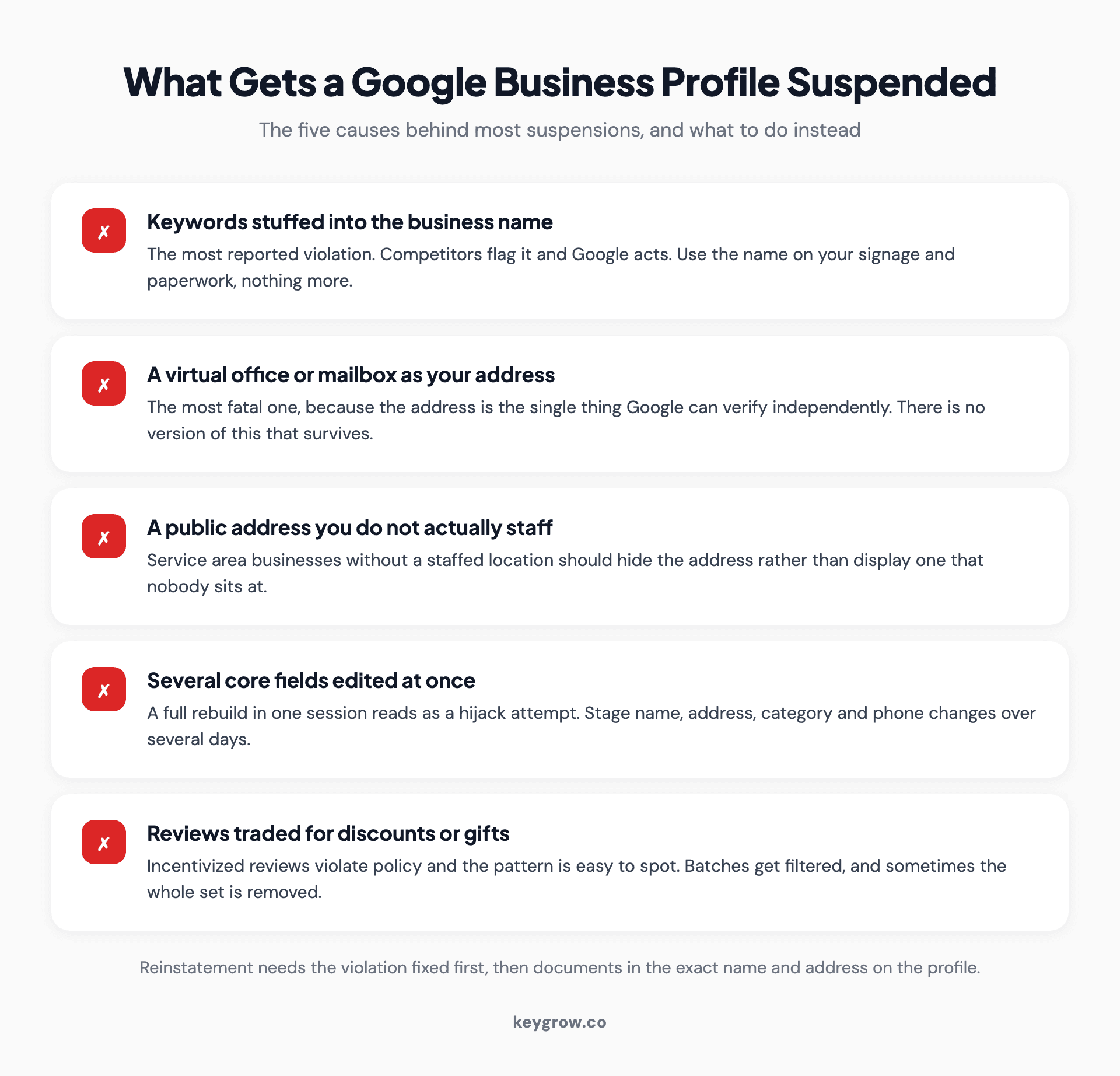
List of the mistakes that most commonly get a Google Business Profile suspended, from name stuffing to virtual addresses.
How to tell whether any of this worked
Rankings are the wrong scoreboard for a local profile, because they change with the searcher's location. Two customers on opposite sides of town see different results for the same query on the same day. Screenshotting your own position from your own office tells you almost nothing.
The Performance tab inside the profile reports what people did: calls, direction requests, website clicks, messages, and the searches that surfaced you. Those are the numbers to track, month over month, against the same month last year where you have the history.
Three local service clients of ours show the shape this takes when it works. A phone repair shop reached 115+ monthly phone calls in seven months. A real estate office reached 90+ in the same period. A junk removal company reached 50+ in six. None of them had meaningful inbound calls before the work started, and none of them got there in a month.
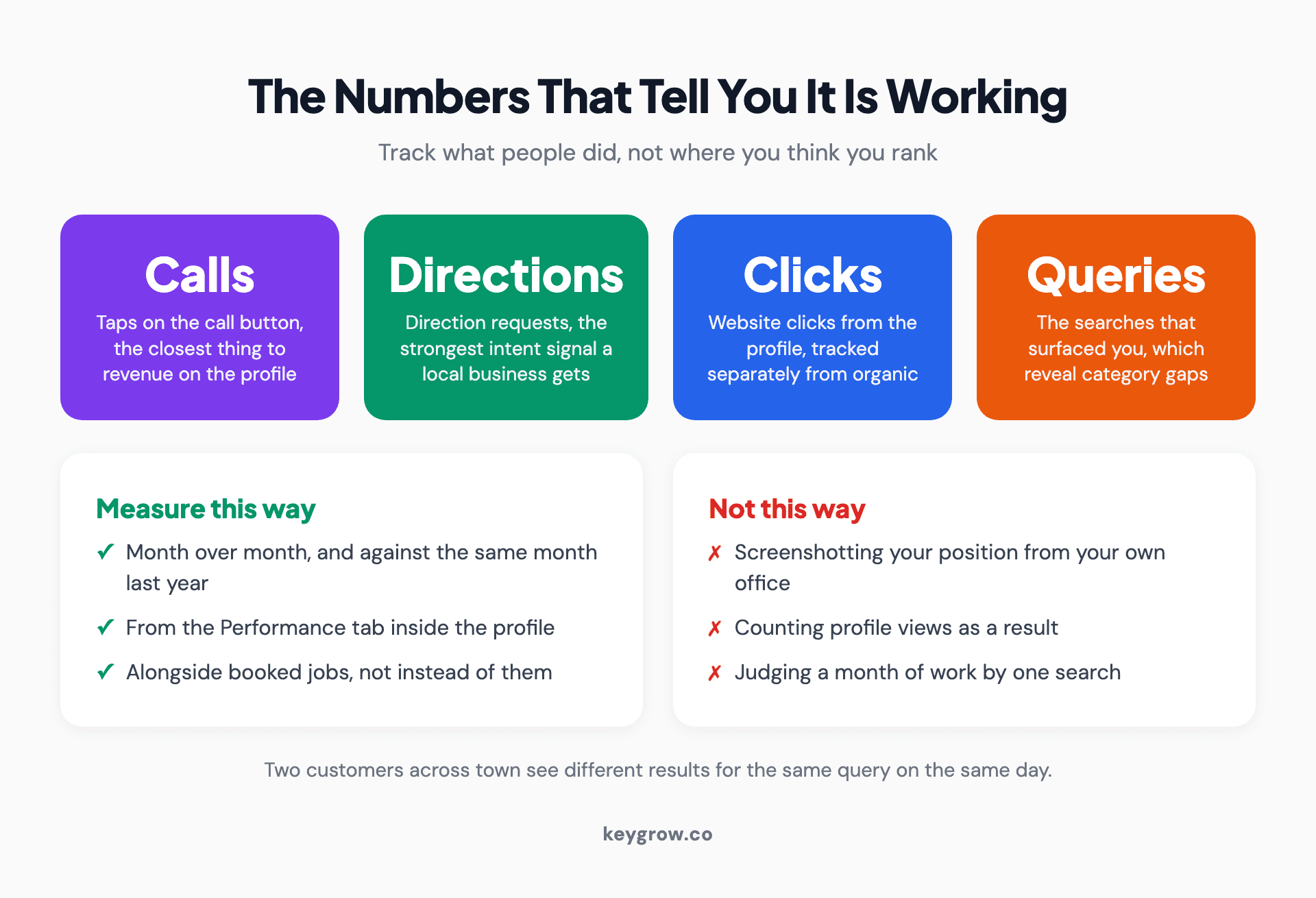
Dashboard metrics that matter for a Google Business Profile: calls, direction requests, website clicks and discovery searches.

Business owner reviewing performance data on a laptop, tracking calls and direction requests rather than rankings.
Running more than one location
Multi-location businesses have a different problem: consistency at scale, and internal competition.
Each location needs its own profile, its own phone number, its own landing page on your site, and its own reviews. Pointing five profiles at one contact page is the most common shortcut and it flattens the relevance signal for all five. Building genuine local landing pages for each one is slower and works.
The internal competition part surprises people. Two of your own locations in the same metro will cannibalize each other in the map pack, and the closer one to the searcher usually wins. That is not a problem to solve, it is a fact to plan around when you decide where the next location goes.
How to benchmark against the profiles beating you
Most optimization advice tells you what to fill in. Almost none tells you how to find out what "good enough" looks like in your specific market, which is the only number that matters.
Do this properly once, in a spreadsheet, and it will direct the next six months of work. Search your primary keyword from your actual service area in an incognito window, take the three profiles in the map pack, and record five things for each: primary category, review count, average rating, number of photos, and whether they have services and a description filled in.
Then compare honestly. If the top three average 180 reviews and you have 22, you now know your gap is not the description field. If they all use a category you had not considered, that is a two-minute fix worth more than a month of posts. If they are all sitting at 4.4 stars and you are at 4.8 with a quarter of the volume, your ratings are fine and your ask process is the problem.
One column usually explains everything.
The number that surprises people most often is photo count. Profiles in competitive categories routinely carry a hundred or more images, accumulated over years, while the business wondering why it does not rank has eleven from the day it was set up.
Repeat the search from two or three points across your service area, not just your office. Positions will change, sometimes dramatically, and seeing that firsthand is the fastest cure for judging performance by a single screenshot.
When your profile is not the problem
Sometimes the profile is fine and the business still is not getting calls. Before spending another hour on it, check three things: whether your category is right (covered above), whether you have meaningfully fewer reviews than the businesses ranking above you, and whether your website ranks for anything at all.
If your competitors have 200 reviews and you have nine, the profile fields are not your bottleneck. Reviews are. If your website has no local pages and no authority, the profile is carrying the whole load alone, and local SEO beyond the profile is the next investment.
And here is the honest part. If you are a single-location business with more time than money, do not hire anyone for this. Claim the profile, pick the category properly, fill in every field, and build a review habit. That is genuinely most of the available upside, and an agency charging a monthly retainer to do it is charging you for an afternoon. Hire help when the opportunity cost of your own time exceeds the fee, or when you are managing enough locations that consistency becomes a real operational job.
FAQs
How long does Google Business Profile optimization take to work?
Field changes like categories and hours can affect results within days because Google recrawls profiles frequently. Review-driven and authority-driven improvements take months. Most businesses see measurable movement in calls and direction requests within two to three months of consistent work, and the compounding continues well past that.
Does posting on Google Business Profile improve rankings?
Only slightly. Posts rank low among measured ranking factors, and they expire. They are worth publishing when you have real news, an offer, or a seasonal change, because they occupy space on the profile a competitor does not. They are not worth a weekly content calendar at the expense of collecting reviews.
How many categories should I add?
One primary category chosen carefully, then only the secondary categories that describe services you actually sell. Additional categories rank eighth among factors, well below the primary. Adding a long list of loosely related categories dilutes relevance and can attract a manual review.
Can I put keywords in my Google Business Profile name?
Only if they are genuinely part of your real-world business name as it appears on your signage, paperwork and website. Keywords in the title do measurably help rankings, which is why the practice is widespread, but it violates Google's naming guidelines when the name is invented. Competitors report it and profiles get suspended.
Why is my competitor ranking above me with worse reviews?
Usually proximity. Distance from the searcher is the second strongest map pack factor, and it cannot be optimized. A closer business with fewer reviews will often outrank a better one further away for the same query. Check your position from several points across your service area rather than from your own office.
What is the difference between Google Business Profile and Google My Business?
They are the same product. Google renamed Google My Business to Google Business Profile in 2021 and retired the standalone app, moving management directly into Search and Maps. Older articles and tools still use the old name, but the underlying listing has not changed.
Do I need a physical address to rank locally?
Not necessarily, but it helps. Service area businesses can hide their address and still rank, though showing a real address scores as a ranking factor and having one inside the city being searched scores higher still. Using a virtual office or mailbox to fake this is the single most reliable way to get a profile suspended.
Start here, not everywhere
If you do nothing else this week, do these three things in order. Confirm your primary category matches what the businesses ranking above you have chosen. Fill in every empty field, starting with hours and services. Then build one repeatable habit for asking customers for reviews. Our closer look at choosing Business Profile categories covers how many secondary ones to add and what the one real study on it found.
Everything else on the profile is real but smaller, and none of it compensates for getting those three wrong.
The profile is one half of the picture. Where you actually appear on the map, and how far that reach extends, is covered in our guide to Google Maps SEO, including how to measure it on a grid rather than as a single ranking.
If you want a second opinion on where your profile sits against the businesses currently outranking you, our team can take a look.