

You do not rank for "near me". You rank near the person searching, and Google fills in the rest.
That distinction decides everything else on this page. When someone types "plumber near me", Google does not hunt for pages containing the phrase "near me". It reads the location their phone is broadcasting and answers the question "which plumbers are close to this spot, relevant to this need, and well regarded enough to recommend". So the way to rank for near me searches is to win those three things in a specific place, not to stuff two extra words into your title tag.
That is the short answer. The longer answer is more interesting, because the two most-cited guides on this topic flatly contradict each other, and there is data that settles the argument.
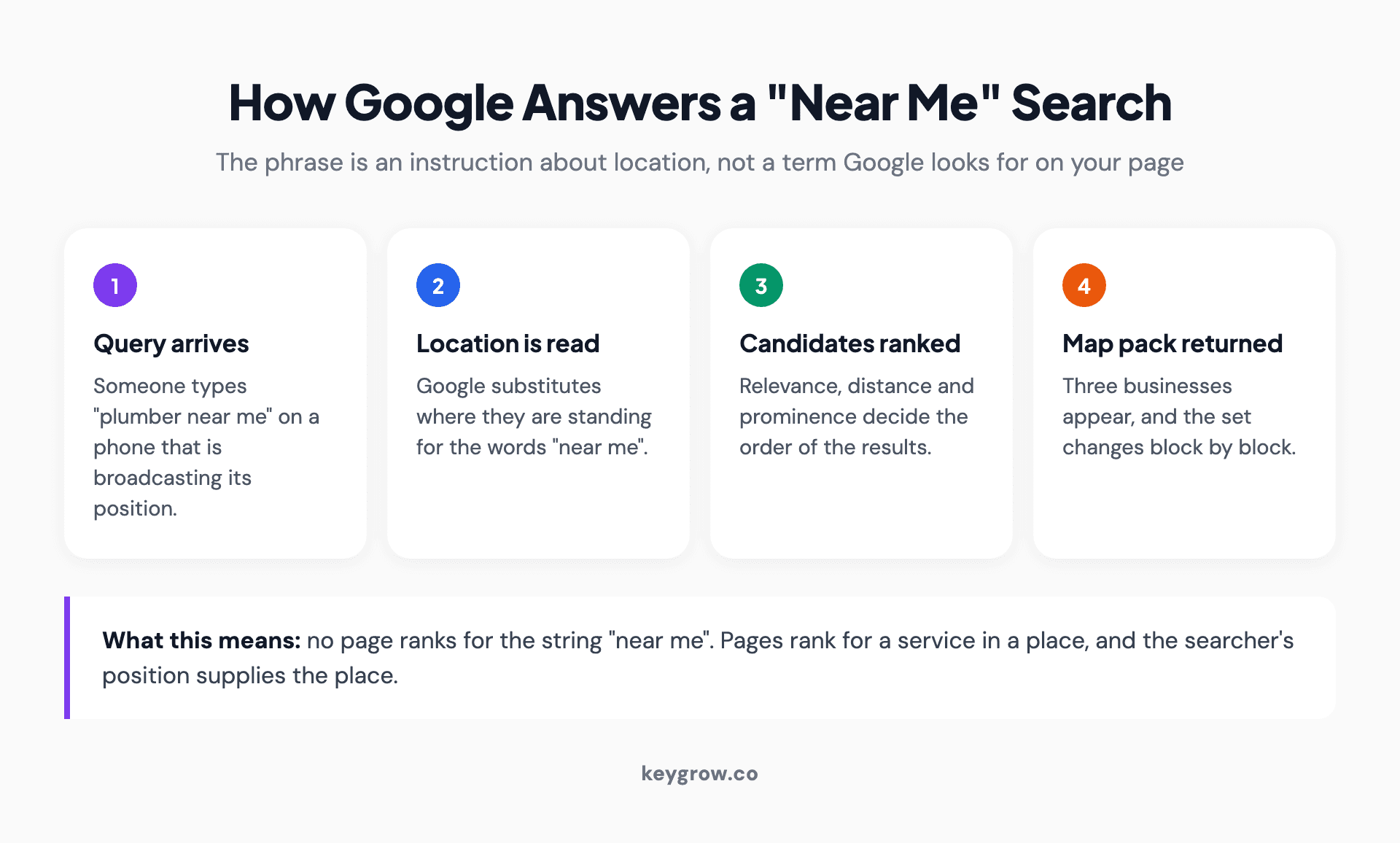
Four-step flow showing how Google answers a near me search: the query arrives from a phone broadcasting its position, Google substitutes that location for the words near me, candidates are ranked on relevance, distance and prominence, and a map pack of three businesses is returned.
What Google is actually doing with that query
Google's own documentation is unusually plain here. Local results are ranked on three things, and Google states them as relevance, distance and prominence.
That page also shuts the door on buying your way in. Google's position is that no amount of money or pleading shifts a local ranking. Useful to have in mind whenever somebody offers to sell you a map pack position.
Notice what is missing from that list. There is no factor called "contains the phrase near me". The phrase is an instruction to the search engine about how to interpret the query, not a term the engine goes looking for in your copy.
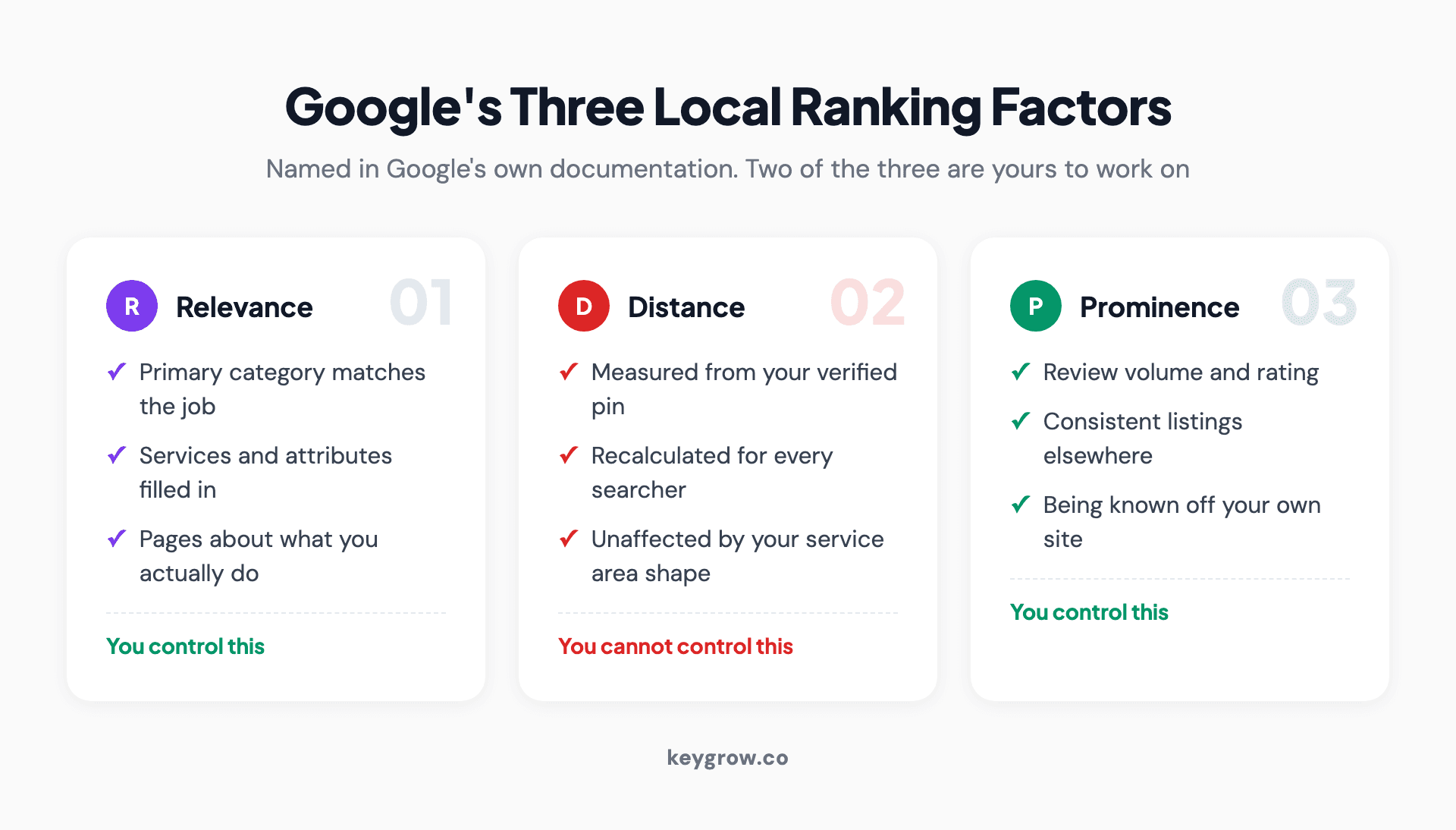
Google's three local ranking factors as three cards: relevance and prominence marked as things you control, distance marked as the one you cannot, measured from your verified pin and recalculated for every searcher.
The argument nobody in the top results resolves
Here is where it gets genuinely contested, and it is worth laying out because the advice you follow depends on who you believe.
Camp one says use the literal phrase. Sterling Sky's testing makes the case that putting "near me" and "near you" into titles, headers and URLs measurably lifts organic rankings for proximity queries. Their framing is that Google is less clever than SEOs assume, so the literal string still does work.
Camp two says the phrase is a red herring and the city name is what matters.
They cannot both be the whole story, so look at what actually ranks. A study by RicketyRoo pulled the top three results for furnace repair across ten US cities and counted what those pages contained:
| What the top-3 pages contained | Share |
|---|---|
| A location in the title tag | 85% |
| A location in the headings | 70% |
| A location in the body content | 90% |
| The word "near" anywhere at all | 20% |
Eighty-five percent named a place in the title. Twenty percent used the word "near". If the literal phrase were the lever, that ratio would be the other way around.
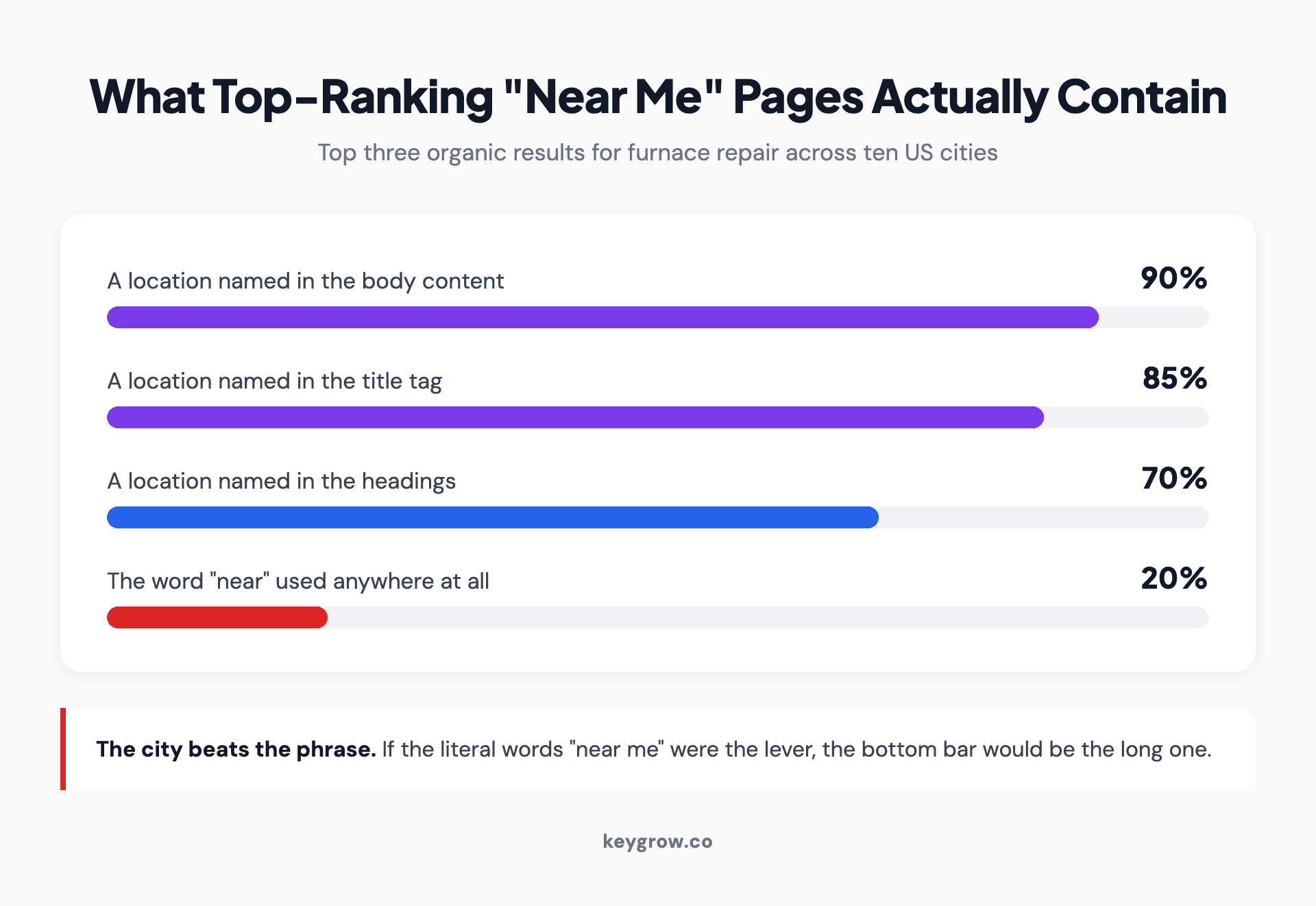
Bar chart of what top three organic results for furnace repair across ten US cities contained: a location in the body content 90 percent, in the title tag 85 percent, in the headings 70 percent, and the word near used anywhere only 20 percent.
The honest reading is that both camps are describing something real. The literal phrase is a small effect that can show up in organic blue links, especially in thin markets where nobody else has bothered. The city name is the large effect, and it is the one that works in the map pack where most of this traffic actually lives. If you have time for one, do the city.
Proximity is the factor you cannot fix
This is the uncomfortable part, and most guides skate over it.
Distance is measured from your verified location to wherever the searcher is standing. You cannot optimize your way across town. A business in the north of a city will struggle to appear for near me searches run from the south side, no matter how good the site is, because a closer competitor is a better answer to the question that was actually asked.
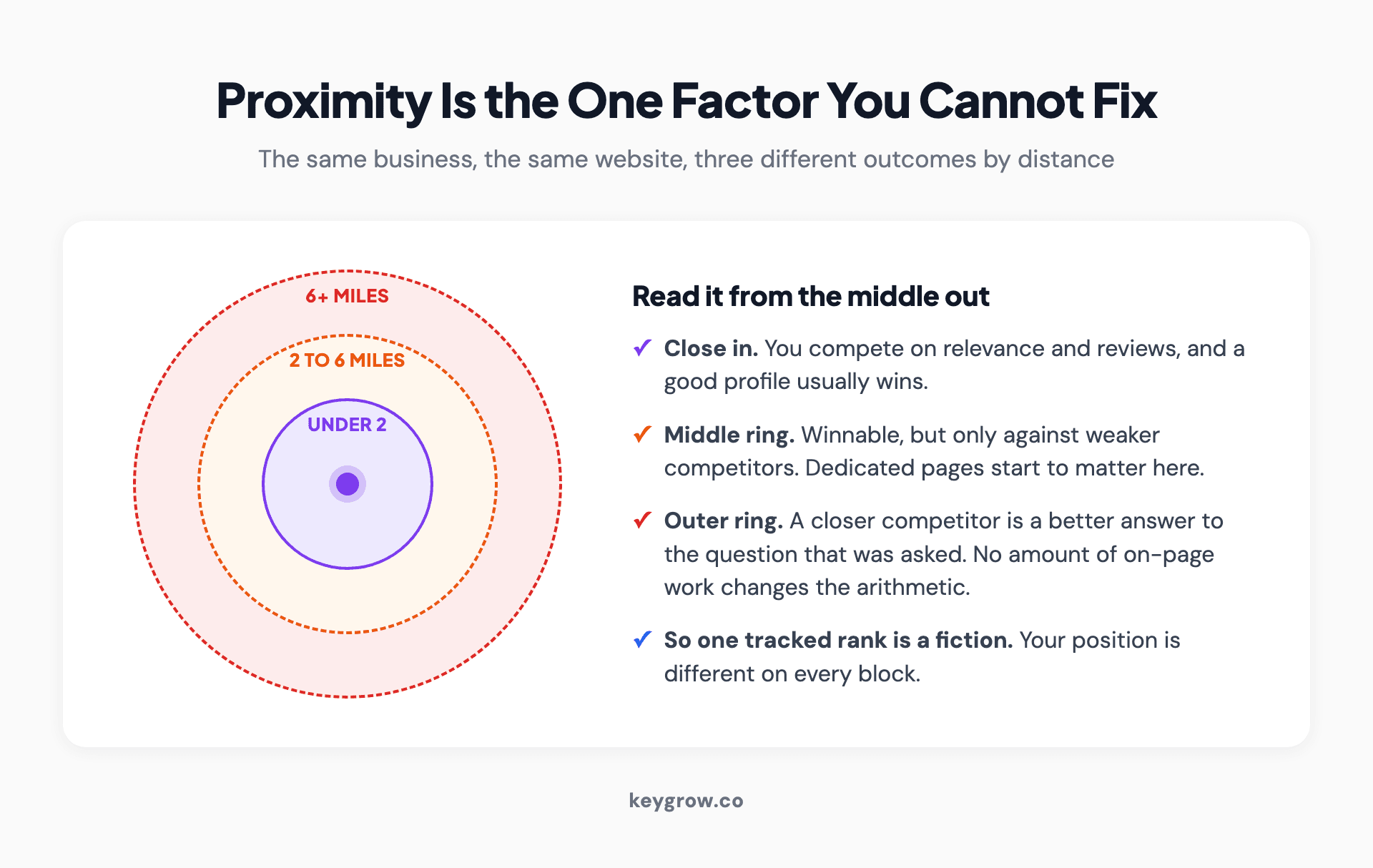
Concentric rings around a business pin showing how outcomes change with distance: under two miles you compete on relevance and reviews, two to six miles is winnable against weaker competitors, and beyond six miles a closer competitor wins regardless of on-page work.
What this means in practice:
So the goal is not to rank everywhere. It is to own your own area completely, then push outward with dedicated pages for the neighboring places worth having.

A service van parked beside a tall building.
If you have no storefront, your pin is doing something you may not expect
Service area businesses get this wrong constantly, and it costs them.
If you run a mobile business and hide your address on your Google Business Profile, which Google requires when customers do not come to you, proximity is still calculated. It is calculated from the address you verified, the hidden one. Not from the center of the service area you drew on the map.
Draw a service area covering the whole metro and you have not extended your reach. You have told Google where you are willing to travel, which is a different statement from where you are. The pin still decides the distance math.
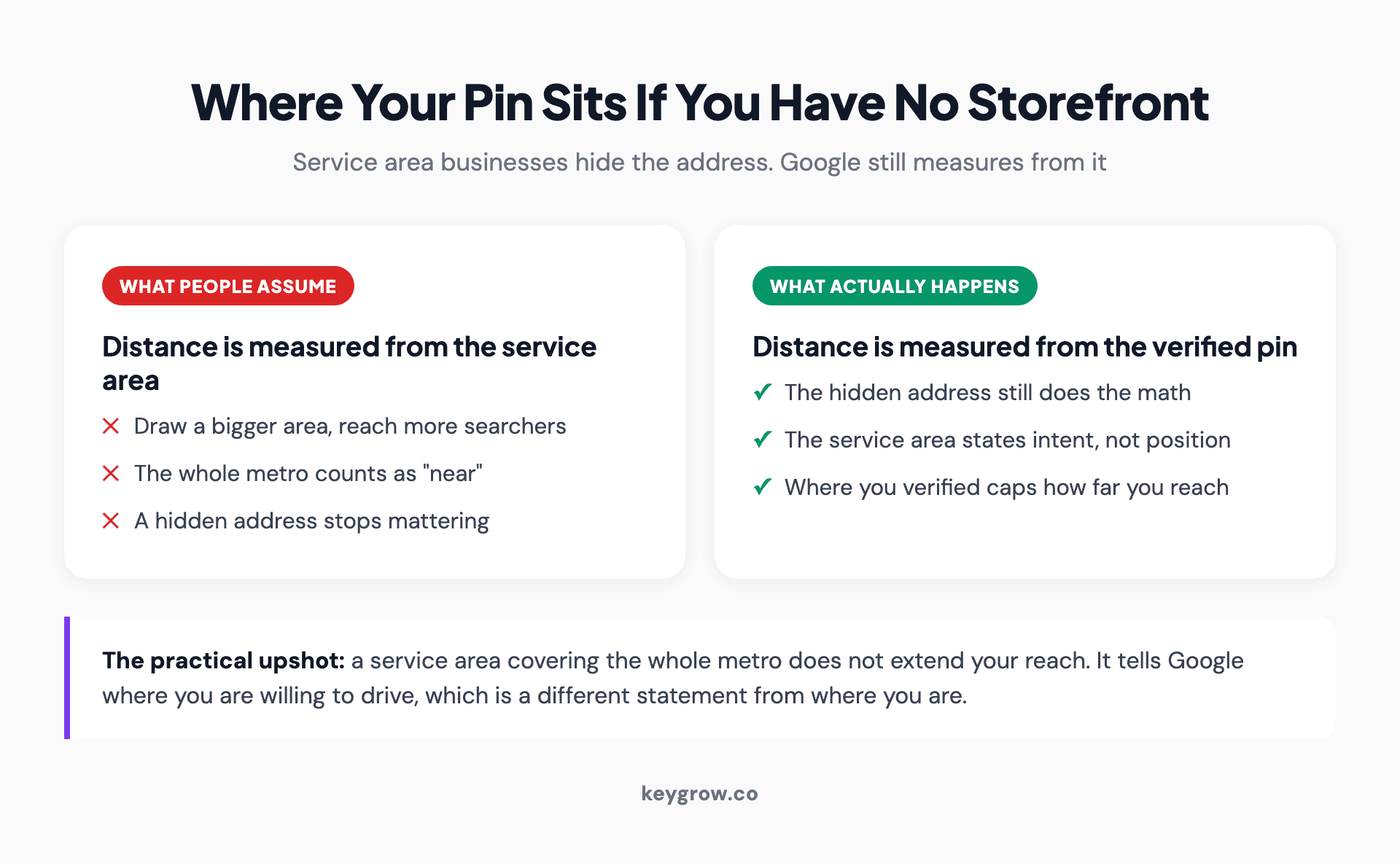
Comparison of what people assume against what actually happens for a service area business: distance is not measured from the service area you drew, it is measured from the verified address even when that address is hidden.
The practical consequences are worth sitting with:
What genuinely moves the needle
Two of the three factors are in your hands. Here is the order we would work in, heaviest first.
Your Google Business Profile, properly filled. Primary category is the single most important field on the whole profile. Get it exactly right rather than approximately right, then fill services, hours, attributes and photos. A half-complete profile is the most common reason a well-optimized website still loses the map pack.
Reviews, continuously. Google says outright that more reviews and positive ratings help local ranking. The word doing the work is continuously. Forty reviews from two years ago reads differently to forty reviews from the last eight months.
A real page for each place you want to rank in. Not a template with the city swapped, which is the fastest way to build something that ranks for nothing. A page that talks about that specific place, what you do there, and who you have done it for.
Consistent listings elsewhere. Your name, address and phone should match everywhere they appear. Sorting out your local citations is unglamorous cleanup work that removes a ceiling rather than adding a lift.

A branded service van parked outside a building.
Three of our local clients landed in a similar spot after working that order. Phone repair: 115+ calls a month, arrived at over 7 months. A real estate office: 90+ a month, also 7 months. Junk removal: 50+ a month, 6 months. All three started from a standing start on inbound calls.
Read the timelines rather than the numbers. Nobody got there in a quarter.
Where "near me" goes when nobody opens Google Maps
This is the part the existing guides have not caught up with, and it is changing quickly.
A growing share of near me questions are now typed into an assistant rather than a search box. SOCi's 2026 Local Discovery Index puts the share of consumers turning to AI assistants for local discovery at 52 percent, alongside 83 percent still using search engines. Those overlap, but the direction is clear enough.
An assistant answering "who is a good plumber near me" is doing something structurally different from the map pack. There is no three-pack. There is often no reliable location signal at all, because the person is typing into an app that may not have location permission. So the model falls back on what it can read: published, quotable, third-party evidence about who serves that area.
Which changes the work in one specific way. The map pack rewards proximity you cannot control. An answer engine rewards stated service areas and outside corroboration, both of which you can. If your service area exists only as a shape drawn inside your Google profile and nowhere in writing on the open web, a model has nothing to go on. Writing it down plainly, on your own pages and in places that get cited, is the closest thing to a proximity lever that exists in that channel. That is the core of how AEO differs from traditional SEO, and the same logic runs through our AEO service.
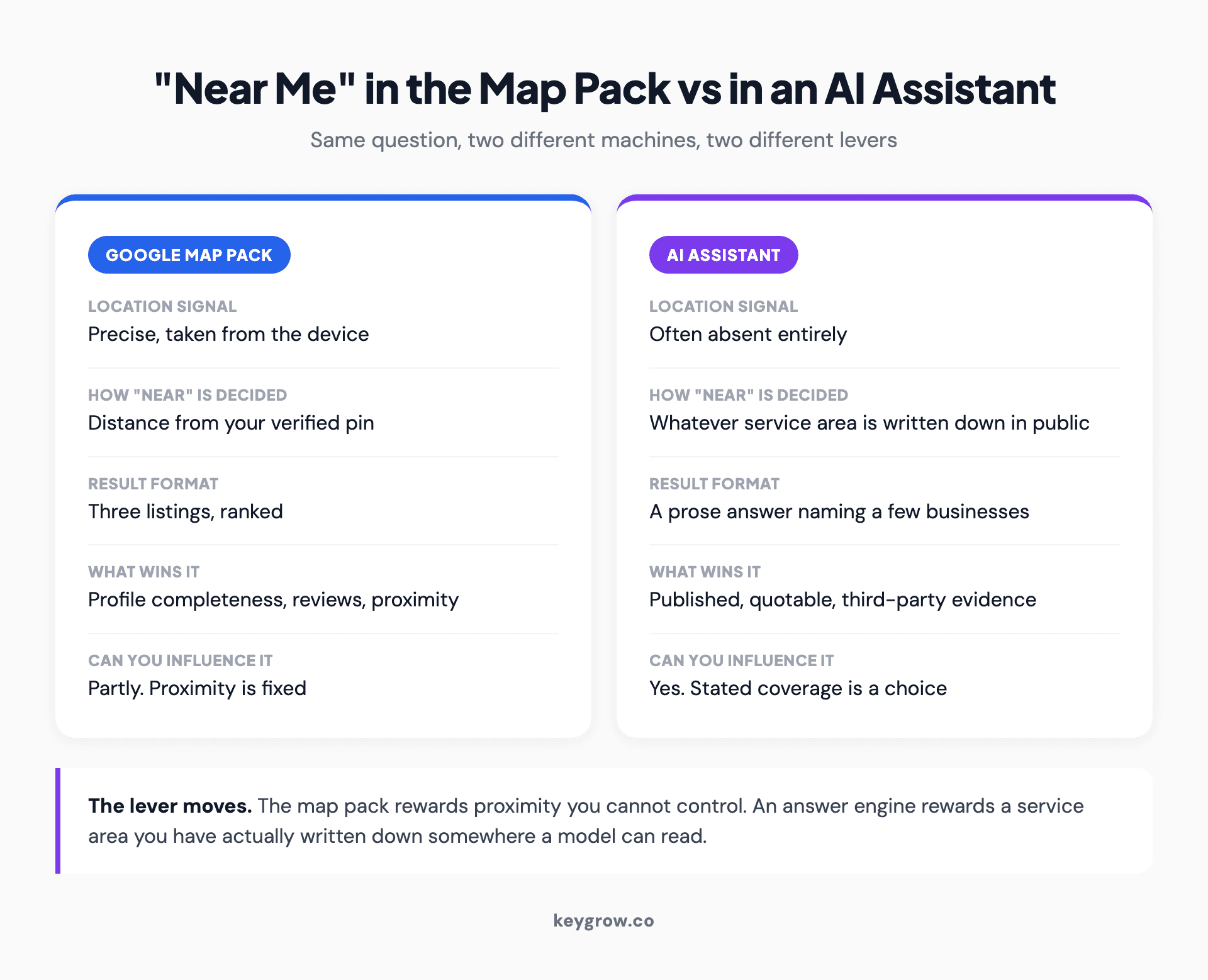
Table comparing a near me query in the Google map pack against the same query in an AI assistant, across location signal, how near is decided, result format, what wins it, and whether you can influence it.
Four ways people make this worse
Stuffing "near me" everywhere. "Best plumber near me in Dallas near me" is not a title tag, it is a penalty risk. The phrase belongs in copy at most once, where it reads naturally.
Inventing locations. Virtual offices, a relative's address in the suburb you want, a mailbox at a co-working space. Suspension is the likely outcome, and a suspended profile is a far worse problem than a mediocre ranking.
Publishing forty city pages in an afternoon. Generic location pages with the city swapped are the textbook doorway pattern. Fewer, better pages beat a directory of near-identical ones every time.
Judging it by rankings instead of calls. The number that matters is inbound contacts from people nearby, and it is visible in your profile's own insights. Rankings vary by the block the searcher is standing on, so treating one tracked position as truth is measuring the wrong thing.
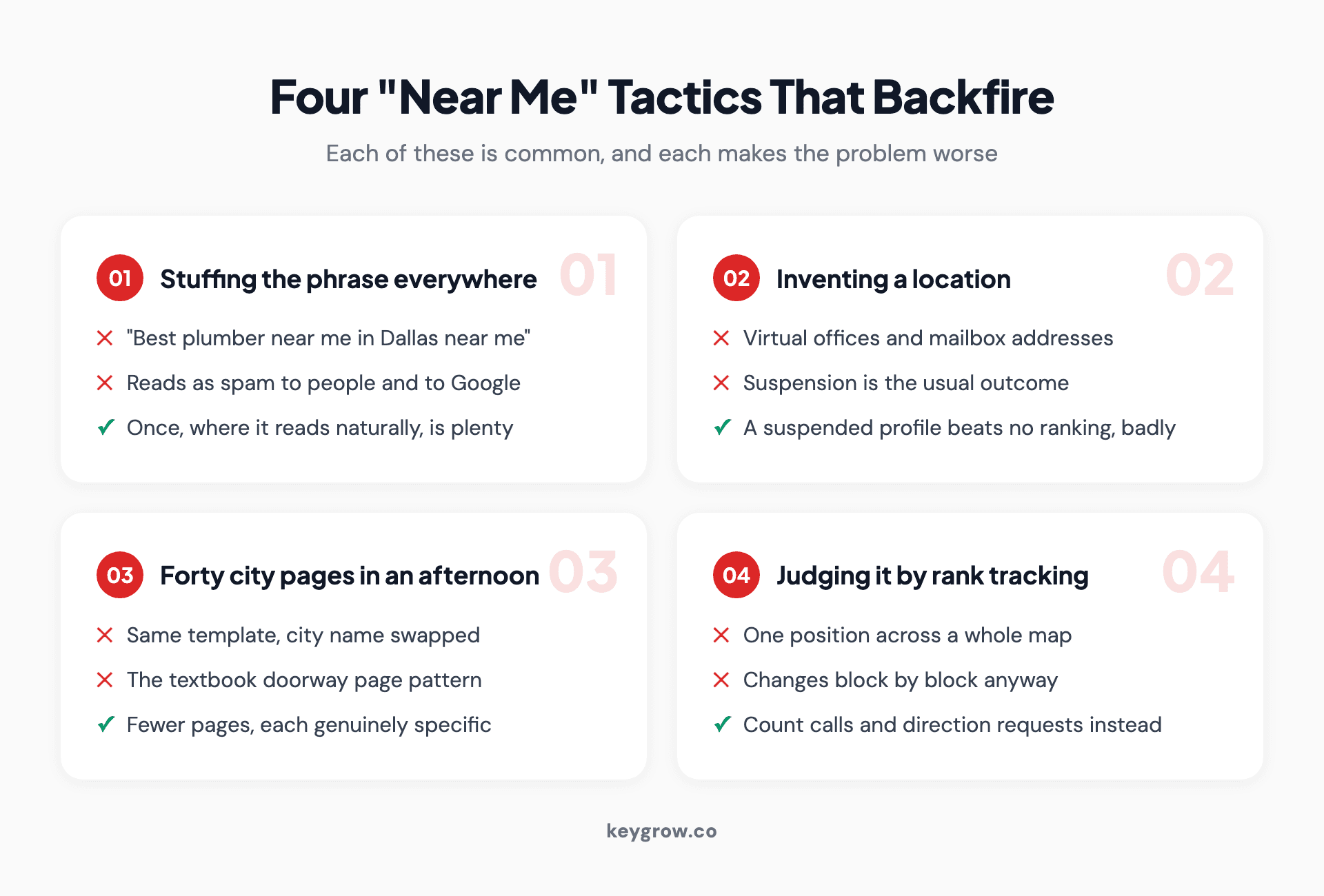
Four near me tactics that backfire: stuffing the phrase everywhere, inventing a location, publishing forty templated city pages, and judging the work by rank tracking instead of calls.
Should you pay someone for this?
Often not, and that is worth saying plainly on a page written by an agency.
If you run one location, the work that produces most of the result is free and you can do it yourself. Claim the profile, get the primary category right, fill every field, ask customers for reviews every week, and make sure your name, address and phone match everywhere. That is the bulk of it. An agency doing exactly those things and charging monthly is charging you for attention you could pay yourself.

The inside of a service van fitted out as a mobile workshop.
Bring someone in when an hour of your attention is worth more than the invoice, or when the problem stops being a checklist: a suspension, a multi-location structure, a market where every competitor already does the basics well, or a merge that went wrong. That is the point where experience saves more than it costs.
When it does make sense, it sits inside our SEO service on month-to-month terms rather than being sold as a separate near me package. There is no such thing as a near me package, and anyone selling one is selling you local SEO with a better name on the tin.
FAQs
Is "near me" an actual keyword I should target?
Not in the way most people mean. Google interprets "near me" as an instruction to use the searcher's location, not as a phrase to match against your page. Target the city and neighborhood names instead, which is what 85 percent of top-ranking pages do, against the 20 percent that use the word "near" anywhere.
Can I rank for "near me" outside my city?
Rarely, and not reliably. Distance is measured from your verified address to the searcher, so a competitor closer to them is usually a better answer. The ground you can actually win is narrower than the ground you cover, and it thins out the further a searcher stands from your pin.
Does adding "near me" to my title tag help?
There is testing suggesting a small effect in organic blue links, especially in markets where nobody else has tried it. It does very little in the map pack, which is where most of this traffic converts. If you only have room for one thing in your title, use the city name.
How does proximity work for a service area business?
Proximity is calculated from the address you verified, even when that address is hidden. Drawing a larger service area tells Google where you are willing to travel, but it does not change where you are. The pin still does the distance math.
How long does it take to rank for local searches?
Months, not weeks. Across our local service clients the pattern has been six to seven months to reach a steady flow of inbound calls. Profile fixes can show up faster, but review velocity and authority compound slowly.
Do reviews affect "near me" rankings?
Yes. Google states directly that more reviews and higher ratings can help local ranking, and reviews are the most accessible part of the prominence factor. Steady new reviews matter more than a large old pile of them.
Should I build a page for every town I serve?
Only for the ones you can write something real about. A handful of genuinely specific pages outperform dozens of templated ones, and near-identical location pages are the pattern Google's spam policies describe as doorways.
Why do my rankings change depending on where I check from?
Because local results are personalized by the searcher's position. The same query returns different results a mile apart, so a single tracked rank is an average rather than a fact.
Where to start this week
Open your Google Business Profile and check one field: the primary category. Getting that exactly right moves more than any amount of copywriting, and it takes a minute.
Then stop looking at rank trackers and open your profile insights instead. Calls, direction requests and messages from nearby are the actual outcome. Rankings are a proxy for it, and a noisy one, because the person searching for a plumber near them is standing somewhere specific and your position on their screen depends on where that is.
If the profile is complete, the reviews are steady, and you still cannot break into the map pack in your own neighborhood, that is the point where our SEO service is worth a conversation. Everything before that point, you can do yourself.


