

You just typed a polite "Thanks so much, we loved having you in" under a fresh five-star review, hit publish, and wondered: did Google notice? Did that nudge you up the map a slot? So, does responding to Google reviews help SEO? The honest answer is yes, but indirectly, and not in the way most articles tell you. Responding is not a direct ranking factor. Google has never listed review replies as one, and stuffing keywords into your replies is a myth. But replying still moves your local rankings through the things Google does measure: review velocity, trust, clicks, and engagement.
That distinction matters, because most of the SERP fudges it. One page opens with "The Short Answer: Yes, Directly" and calls replies "a ranking signal." Another rests its whole case on a proprietary study of "5,000 businesses" with no methodology you can check. We are going to do something different: pin the answer to two named sources that actually disagree with the hype, then show you what to do about it.
What Google itself actually says about replying to reviews
Google says replies help you stand out, not that they rank you. That is the careful wording, and it is worth reading closely.
On its own help page, Google states that "more reviews and positive ratings can help your business's local ranking." It also says, "When you reply to customer reviews, it shows that you value their feedback. Positive reviews and helpful replies can help your business stand out." Note the gap. Reviews and ratings "can help your local ranking." Replies "help your business stand out." Those are not the same claim.
Google determines local ranking through three things: relevance, distance, and prominence. Nowhere in its local ranking tips does it list responses as a factor. And it adds a line every owner should tape to their monitor: "There's no way to request or pay for a better local ranking." So if a vendor promises rankings in exchange for a review-reply service, they are selling something Google says does not exist.

Small business owner at a laptop in her shop reading and replying to customer reviews in warm natural light
Is responding to reviews a direct ranking factor? The honest answer
No. There is no credible evidence that the act of replying, by itself, lifts your rankings.
The most-cited industry source is the Whitespark and BrightLocal Local Search Ranking Factors study, refreshed for 2026. In that data, reviews are a real and growing signal, worth roughly 20 percent of local pack weight, up from about 16 percent in 2023. The factors that pull the weight are high star rating, the number of native Google reviews with text, the recency of reviews, and steady review growth over time. Replying is not on that list. "Keywords in owner responses to reviews" is explicitly rated as having little impact.
So when a page tells you replies are "a ranking signal," ask for the source. The largest survey in the field, run by named researchers who publish their method, puts response wording near the bottom of the pile. That is the verdict the rest of the SERP keeps softening.
This is the same trap people fall into with Google Business Profile generally. Owning and working the profile helps, but for reasons that get tangled together. We pulled those apart in our guide on whether Google My Business helps SEO.
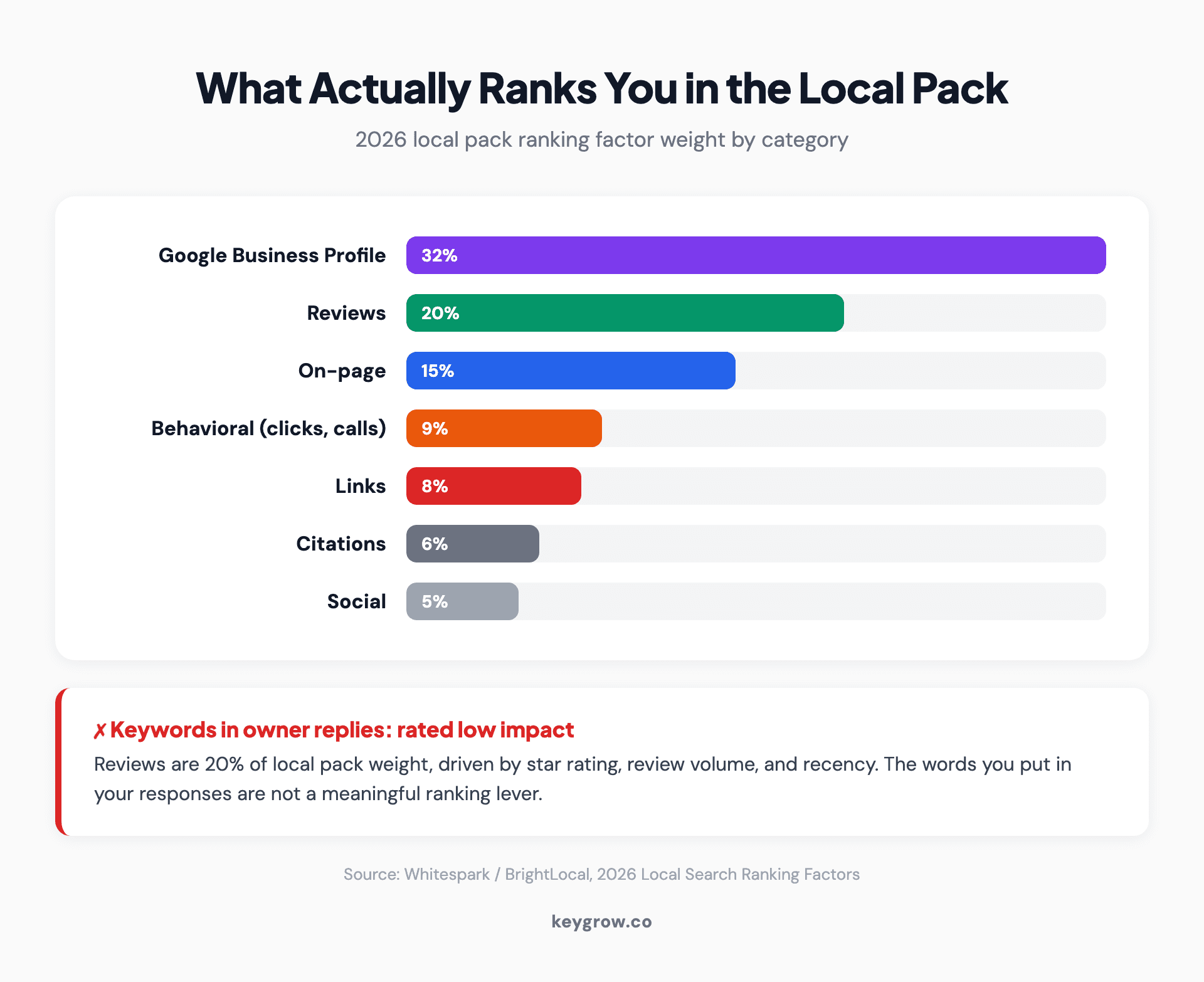
Bar chart comparing the 2026 local pack ranking factor categories, with Google Business Profile signals at 32 percent and reviews at 20 percent, and a callout noting that keywords in owner responses are rated low impact
So why do businesses that reply still rank better?
Because replying drives the things that are measured. The act of responding is connected to review velocity, trust, and engagement, and those move rankings. Building that velocity deliberately is its own job, covered in how to get more Google reviews. The reply is the cause, the ranking lift is two steps downstream.
Here is the chain. You reply quickly and well. Customers see an owner who shows up, so more of them bother to leave a review, which lifts your volume and recency, two factors Whitespark rates highly. Searchers who read those exchanges trust you more, so they click your listing and request directions, which feeds behavioral signals worth about 9 percent of the local pack. None of that is the reply "ranking" you. It is the reply setting off a sequence of things that do.
This is also why active businesses look like they rank better in correlation studies. They reply, post, and gather reviews all at once. A study watching owners who reply to 75 percent of reviews "rank higher" cannot tell you the reply did it, because those owners are doing ten other things too. The real mechanism is review velocity and engagement, which take time to compound, the same way the rest of local SEO takes months to show up.
The keyword-in-your-reply myth
Putting service or city keywords into your replies does almost nothing for rankings. Several top-ranking pages tell you to do it anyway. They are wrong, and the data says so.
The 2026 Whitespark and BrightLocal factors rate "keywords in owner responses to reviews" as low impact for local pack rankings. That is a direct, named finding, not a guess. Compare it to what does carry weight: the keywords inside the customer's review text, review volume, and recency. A customer mentioning "emergency plumbing in Dallas" in their review is mild signal. You writing "thanks for choosing our emergency plumbing in Dallas service" back at them is not.
Worse, keyword-stuffed replies read like a robot wrote them, and they often did. That breaks the one thing replies are good at, which is trust. You get the SEO benefit of nothing and the conversion cost of sounding fake. If the location comes up naturally because the customer raved about your Dallas crew, fine. Forcing it is effort spent on a lever connected to nothing.
Reviews, recency, and responses are three different things
People lump four separate things together and then argue about "reviews and SEO." Separating them is most of the clarity you need.
There are really four moving parts, and they carry very different weight:
When someone says "reviews help SEO," they are usually right about the first two and wrong if they mean the fourth drives rankings directly. Keep them separate and the advice stops contradicting itself. Engagement behaviors like clicks and direction requests sit alongside these; we covered how much site engagement affects SEO in its own post.
What responding really buys you: trust and conversions
The real return on replying is conversion, not rank. This is where the verified consumer data is overwhelming, and where the ROI actually lives.
BrightLocal's 2026 Local Consumer Review Survey found that 89 percent of consumers expect business owners to respond to reviews, and 80 percent say they are more likely to use a business that responds to all of its reviews. On the flip side, 42 percent are unlikely to use a business that never replies. So a silent profile is not neutral. It is actively losing you the searchers who already found you.
There is a catch that should change how you write. The same survey found 50 percent of consumers are put off by generic or templated replies. Half. So the copy-paste "Thank you for your feedback, we appreciate your business" you fire under every review is landing as a negative with half your audience. The reply has to read like a human wrote it for that person, or it works against you.
That is the framing the algorithm-obsessed posts miss. You are not replying to please a crawler. You are replying because 97 percent of consumers read reviews for local businesses, and what they see in your responses decides whether they call. This is closer to a branding question than a ranking one.
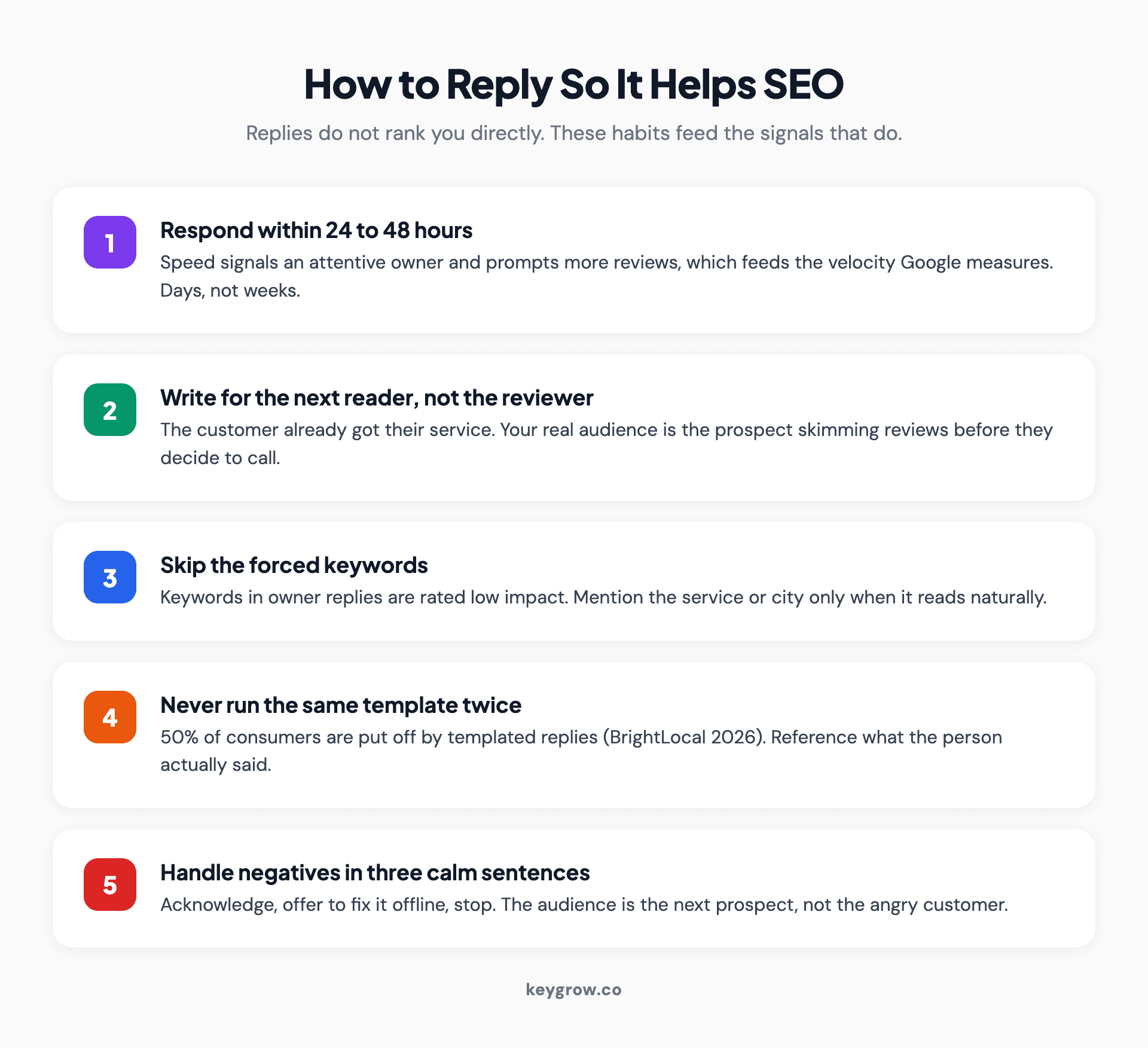
Numbered checklist of how to respond to Google reviews so it helps indirect SEO signals, covering speed within 24 to 48 hours, writing for the next reader, skipping forced keywords, and never copy-pasting templates
How to respond so it helps the indirect signals
Reply fast, sound human, and write for the next reader, not the one who left the review. Those three habits hit every indirect mechanism that actually moves the needle.
1. Respond within 24 to 48 hours. Speed signals an attentive owner and prompts more reviews, which feeds velocity. There is no Google deadline, so do not panic over an hour. Days, not weeks, is the bar.
2. Write for the searcher reading later. The customer already got their service. Your audience is the next prospect skimming reviews before they call. A specific, warm reply sells them.
3. Skip the forced keywords. Mention the service or city only when it reads naturally. The ranking value is near zero and the fake tone costs you trust.
4. Never run the same template twice. Half of consumers reject templated replies. Reference what the person actually said.
5. Reply to negatives, calmly and once. More on that next.
When is responding not worth your time? If you run a single location, get a handful of reviews a month, and have more time than money, do this yourself. You do not need an agency to type four honest sentences. We turn down businesses where the math does not work, and a small shop that can knock out its own replies in ten minutes a week is one of them. Hire help when the volume gets unmanageable or when reviews tie into a larger local SEO and reputation program, not before.
Responding to negative reviews without making it worse
Reply to negative reviews briefly, take it offline, and resist the urge to win the argument in public. A calm response to a bad review converts better than a perfect score with no engagement.
The audience for a negative-review reply is never the angry customer. It is the prospect watching how you handle pressure. So keep it short, acknowledge the issue, offer to fix it offline, and stop. Three sentences. Do not relitigate, do not get defensive, and never post anything you would not want screenshotted.
Coordinated review attacks are different. If you get a sudden cluster of fake one-stars, do not reply to each one with a fight. Reply once, factually, then report them through Google Business Profile for removal, following the steps in our guide to removing a fake Google review. Spreading your defensiveness across twenty replies just makes the profile look chaotic to the next reader. Where this is NOT worth it: do not pay a vendor promising to "bury" or "remove" legitimate negative reviews. That is the same forbidden territory as buying rankings, and it can get your profile flagged.

Person reading reviews on a phone outside a local storefront in daytime before deciding to go in
How to measure whether your replies are doing anything
Measure replies against trust metrics, not rank checkers. Watch profile actions, not a single keyword position, because the payoff shows up in behavior first.
Inside Google Business Profile, the Performance section tracks calls, direction requests, website clicks, and how people found you. Those are the behaviors your replies influence. Track them month over month against your review-to-response time. If your response speed improves and calls and direction requests climb, you are seeing the indirect chain work. A run of local clients we worked with measured exactly this way: a phone repair shop reached 115 or more monthly phone calls in seven months and a junk removal company hit 50 or more in six, none of which had meaningful inbound calls before the work started. The number that mattered was calls, not a ranking screenshot.
Do not judge replies by a rank tracker alone. Rankings move for a dozen reasons, and attributing a one-slot shift to your reply strategy is the same correlation error the hype articles make. If you want to know what is actually pulling your rankings, that is what an SEO audit is for.
Where this is heading: AI replies and review sentiment
In 2026, two things are changing. Google Business Profile now offers AI-generated reply suggestions, and AI search surfaces read your reviews to decide what to say about you. Both raise the stakes on sounding human.
AI reply tools are convenient and dangerous in the same breath. They let you fire off a reply in seconds, and that speed is exactly how you end up with the templated, hollow tone half of consumers reject. Use them as a starting draft if you must, then make every reply specific before it posts.
The bigger shift is on the answer-engine side. AI Overviews and assistant-style local answers read review sentiment to summarize businesses. A profile full of unanswered complaints and robotic replies feeds a worse summary than one showing genuine back-and-forth. The trust your replies build is no longer only for human readers. It feeds the systems that increasingly answer "who is the best plumber near me" before anyone clicks a link.
FAQs
Does Google rank you higher for replying to reviews?
Not directly. Google has never listed review responses as a ranking factor, and the 2026 Whitespark and BrightLocal data rates keywords in owner responses as low impact. Replying helps indirectly by encouraging more reviews and building the trust that drives clicks and calls, which are measured.
How quickly should you respond to a Google review?
Within 24 to 48 hours is a healthy target. There is no Google deadline, so an extra hour will not hurt you. Fast replies signal an attentive owner and tend to prompt more reviews, which feeds the review velocity that does affect local rankings.
Should you put keywords in your review responses for SEO?
No. The 2026 Whitespark and BrightLocal study rates keywords in owner responses as low impact, so stuffing service or city terms into replies does almost nothing for rankings. It also makes you sound robotic, and BrightLocal found 50 percent of consumers are put off by templated replies.
Do you need to reply to every Google review?
It helps. BrightLocal found 80 percent of consumers are more likely to use a business that responds to all its reviews, and 42 percent are unlikely to use one that never replies. Replying to all of them, especially negatives, signals an engaged owner to both searchers and AI summaries.
Does responding to negative reviews help or hurt your ranking?
It helps your conversions, which is the real prize. A brief, calm reply that takes the issue offline shows prospects you handle problems well. Getting defensive or arguing in public hurts you with the next reader, even if it never touches your ranking.
Is it bad to use AI to respond to Google reviews?
It is risky if you post the output unedited. AI tools tend to produce the generic tone that 50 percent of consumers say puts them off, per BrightLocal. Use AI as a first draft, then rewrite each reply to reference what the specific customer said before you publish.
What to do Monday morning
Stop chasing a ranking bump that the reply itself was never going to give you. Reply within a day or two, write like a human to the next reader, skip the forced keywords, handle negatives in three calm sentences, and watch calls and direction requests in your profile instead of refreshing a rank checker. That is the whole job, and it is the part that compounds.
If your review volume has outgrown what you can handle, or replies are one piece of a wider local SEO problem, that is when outside help earns its fee. We work month-to-month and cancel anytime, because the results should keep us, not a contract. When you are ready, tell us what you are working on.


