

Does Google My Business help SEO? Yes, but only if you are precise about which kind. A Google Business Profile, the tool most people still call Google My Business, is the single biggest lever you have for local search: the map pack, Google Maps, and anything with local intent. It is not a direct ranking factor for classic national organic results; it complements your website's SEO rather than replacing it.
That distinction is the whole answer, and most articles blur it. They either oversell the profile as a magic ranking button or wave it off as "just a listing." Neither is right. Here is exactly what a Google Business Profile does for your visibility, where it stops helping, and how to make it earn its keep.
Google My Business is now Google Business Profile
First, the naming, because it confuses everyone. Google renamed Google My Business to Google Business Profile in 2021 and retired the old app in 2022. Same free tool, new name. People still search "Google My Business" out of habit, so that is the phrase used here, but inside Google it is your Business Profile, managed straight from Search and Maps.
What it is: a free profile that controls how your business shows up in Google's local results, the map pack, and Maps. Your name, category, hours, photos, reviews, and posts all live there. It is the difference between appearing in the three-business map box for "plumber near me" and not appearing at all.
Does Google My Business help SEO, or is it separate?
A Google Business Profile and your website's SEO are two connected systems. The profile drives your visibility in local results and Maps, while your website drives classic organic rankings. They feed each other, but they are ranked by different signals.
This is the part worth slowing down on. When someone searches "emergency dentist Phoenix," Google often shows two things: a map pack of three local businesses up top, then the regular blue-link results below. Your Business Profile competes for the map pack. Your website competes for the blue links. Strong reviews and a complete profile will not lift a national blog post, and a great blog post will not put you in the map pack. You need both, aimed at the right race.
| Google Business Profile | Your website |
|---|---|
| Wins the map pack and Google Maps | Wins classic organic (blue-link) results |
| Ranked by relevance, distance, prominence | Ranked by content, links, technical health |
| Free, managed in Search and Maps | Yours to build and control |
| Best for local-intent searches | Reaches local and national searches |
So when a local business asks whether a Business Profile helps SEO, the honest answer is that it is probably the highest-return hour of "SEO" work they can do, because local intent is where their customers are. BrightLocal reports that about 46 percent of Google searches have local intent, a figure a Google representative shared back in 2018. For a service business, that share is most of the searches that matter.
How a Google Business Profile affects local rankings
Google ranks local results on three things: relevance (how well you match the search), distance (how close you are to the searcher), and prominence (how well-known and trusted you are). Your Business Profile is where you influence all three.
You cannot move your storefront, so distance is mostly fixed. Relevance and prominence are where the work is, and the profile is the main control panel for both.
The weighting is not a guess. In BrightLocal's breakdown of local ranking factors, Business Profile signals are the single largest category at roughly 32 percent of local pack ranking weight, and review signals have grown to about 20 percent. Put together, that means well over half of what decides the map pack runs through your profile and the reviews attached to it.
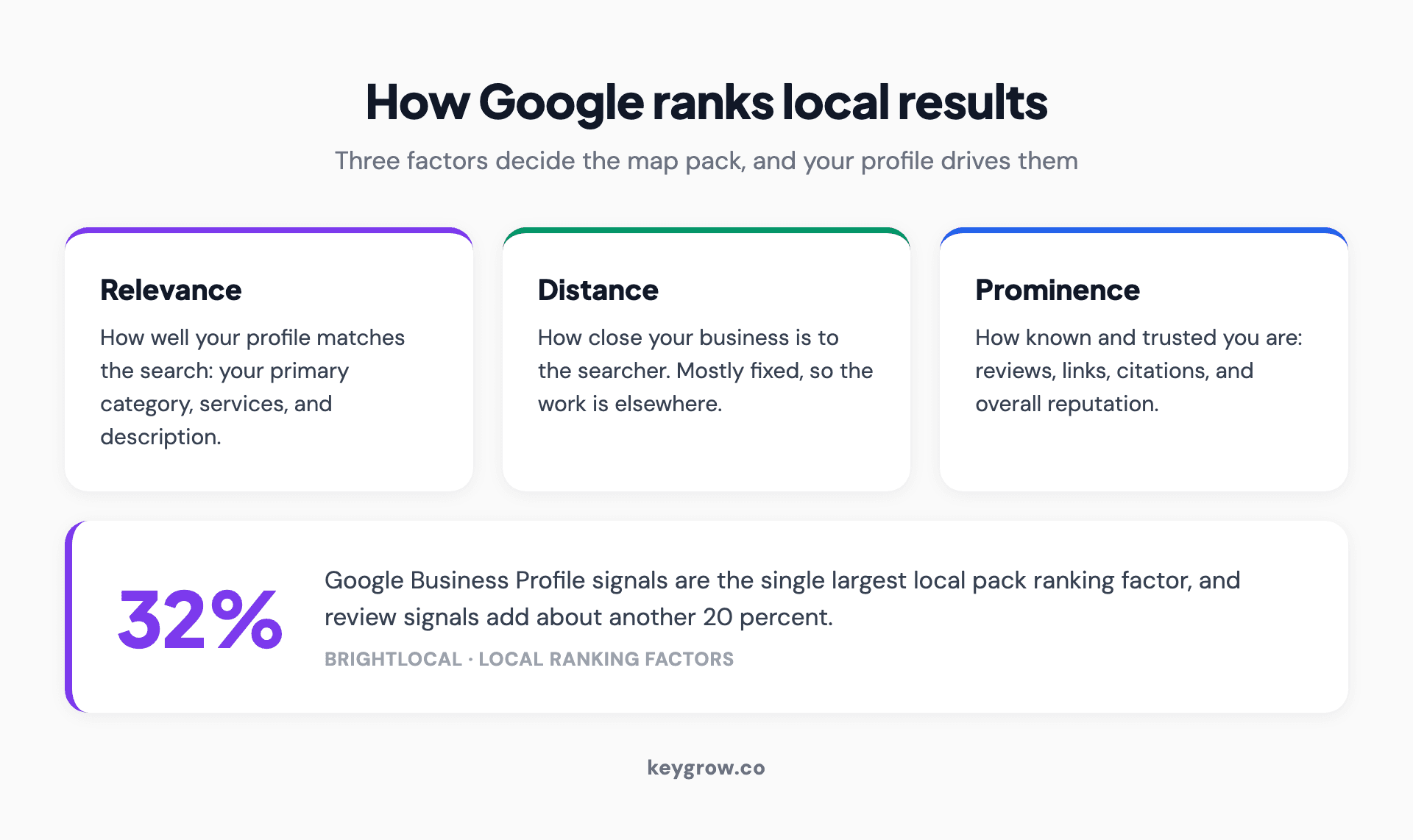
Infographic explaining how Google ranks local results using three factors, relevance, distance, and prominence, and showing that Google Business Profile signals account for about 32 percent of local pack ranking weight and review signals about 20 percent, per the Whitespark local ranking factors survey.
Why a complete profile beats a half-filled one
A complete, accurate Business Profile ranks better and converts better than a thin one. Every empty field is a relevance signal you are not sending and a reason for a searcher to pick the competitor who filled theirs in.
The conversion side is measurable. BrightLocal found that customers are 70 percent more likely to visit and 50 percent more likely to consider buying from a business with a complete Business Profile, and 2.7 times more likely to consider it reputable. Given that 45 percent of consumers default to Google for local searches, a half-filled profile is leaking customers at the exact moment they are deciding.
Completeness is unglamorous and it works. Fill in every section: correct categories, full service list, real hours including holidays, a written description, and current photos. Keep your name, address, and phone number identical to what is on your website and other listings, because inconsistent information is a relevance and trust problem Google notices.
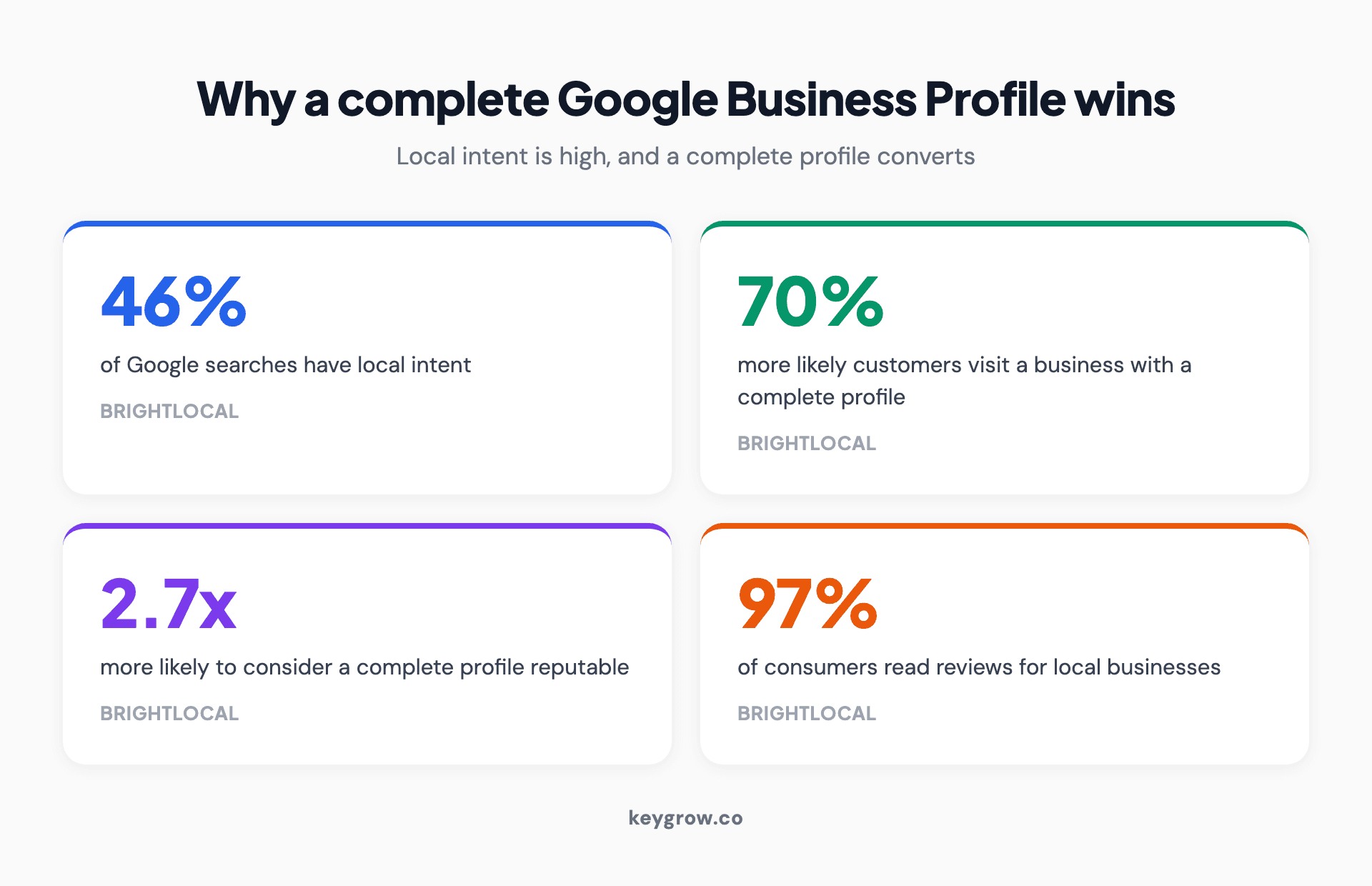
Infographic showing four local search statistics that make the case for a complete Google Business Profile: 46 percent of all Google searches have local intent, customers are 70 percent more likely to visit a business with a complete profile, 2.7 times more likely to consider it reputable, and 97 percent of consumers read reviews for local businesses.
Reviews are the lever most businesses underuse
Reviews do double duty: they are a documented local ranking signal and the thing customers read before they call. Earning them steadily, and replying to all of them, moves both rankings and bookings.
The numbers are blunt. BrightLocal's review survey found that 97 percent of consumers read reviews for local businesses, 80 percent are more likely to use a business that responds to all of its reviews, and 42 percent would not use one that never replies. Replying is free, takes minutes, and a surprising number of businesses still skip it.
A practical version: ask every happy customer for a review, in person or by text, while the job is fresh. Respond to every review, good or bad, in a calm and human way. Do not buy reviews or gate them, which violates Google's policy and can get a profile suspended. Steady, genuine reviews are the highest-return local SEO habit there is, and almost nobody does it consistently.
When Google My Business will not help your SEO
If your business has no local intent, a Google Business Profile does little for you. A purely online store that ships nationwide, a software company, or any business without a physical location or service area is competing in classic organic search, where the profile is not a factor.
This is the honest line the cheerleader articles skip. The map pack only appears for searches Google reads as local. If your customers are spread across the country and never type a city or "near me," your growth comes from content, links, and technical SEO on your website, not from a listing. A Business Profile will not hurt, and even online brands sometimes keep one for brand searches, but it is not where your effort should go.
And here is the opinion we will put in writing: for a single-location business with more time than money, do this yourself before you pay anyone. Claim and complete your Business Profile, ask for reviews, reply to them, and fix your site basics. That sequence is free, it is most of local SEO, and a one-location owner with a few spare hours can run it without an agency. Hire help when you have multiple locations, when you are stuck behind entrenched competitors, or when the opportunity cost of your time beats the fee. Paying someone to fill in fields you could fill in yourself is not a great trade.
How your profile and website work together
Your profile and your website should point at each other. The profile sends local searchers to your site, and the site gives Google the deeper relevance and authority signals that lift the profile.
The practical moves: link your Business Profile to a relevant page, not just the homepage, so a "roof repair" searcher lands on your roof repair page. If you serve several areas, build genuine local landing pages with real, distinct content for each, rather than thin copies. Then watch the right numbers. A profile's value shows up as calls, direction requests, and form fills, not impressions, so track those the way our guide to tracking SEO lays out.
This is exactly the shape of result we see on local accounts. A phone repair shop reached 115+ phone calls a month within seven months, and a junk removal company hit 50+ a month in six, both starting from almost no inbound calls. None of that came from a single listing field. It came from a complete profile, steady reviews, and pages that backed it up. If you want the proof, the case studies are there.
Does a Google Business Profile help with AI search?
Yes, indirectly. Answer engines and AI Overviews increasingly summarize local options by pulling from Google's local data and reviews, so a complete, well-reviewed profile makes you more likely to be surfaced when someone asks an AI for a recommendation.
When a person asks an AI assistant for "a good electrician near me," the model often leans on the same local signals Google uses: profile completeness, categories, and review sentiment. The fundamentals that win the map pack increasingly win the AI recommendation too. Our guide to AI search optimization covers the website side of that shift; the profile side is simply keeping it complete, accurate, and well-reviewed.
FAQs
Does Google My Business help SEO?
Yes, for local SEO. A Google Business Profile is the main driver of your visibility in the map pack and Google Maps, which is where local-intent searches are won. It is not a direct ranking factor for classic national organic results, so it complements your website's SEO rather than replacing it.
What is the difference between Google My Business and Google Business Profile?
They are the same tool. Google renamed Google My Business to Google Business Profile in 2021 and retired the standalone app in 2022. You now manage your profile directly from Google Search and Maps. Most people still say "Google My Business" out of habit, but the official name is Google Business Profile.
Is a Google Business Profile free?
Yes, completely free. You claim it, verify ownership, and manage every part of it, categories, hours, photos, posts, and review responses, at no cost. There is no paid tier that buys you a higher map ranking. Anyone charging you a recurring fee just to "keep your listing active" is selling something Google gives away.
Does a Google Business Profile help national or non-local SEO?
Not really. The profile drives local results and Maps, which only appear for searches with local intent. If you sell nationwide with no physical location or service area, your rankings come from your website's content, links, and technical SEO, not from a Business Profile. It will not hurt, but it is not your growth lever.
Can my business rank on Google Maps without a Google Business Profile?
No. The Business Profile is what places you on Maps and in the local map pack. Without a claimed, verified profile, you are not eligible to appear there at all, no matter how strong your website is. Claiming it is the non-negotiable first step of local SEO.
My business is online-only with no storefront. Can I still have a Google Business Profile?
Only if you serve customers in person somewhere, even as a service-area business without a public address. A purely online business that ships everywhere and meets no one face to face does not qualify and would not benefit much anyway, since its searches are national rather than local. Focus that effort on your website instead.
How often should I post on my Google Business Profile?
A post every week or two is plenty for most businesses. Posts are a minor engagement signal and a way to surface offers and updates, not a major ranking lever. Consistency matters more than volume, so a steady, light cadence beats a burst followed by months of silence.
What should I do if my Google Business Profile is suspended?
Do not panic-edit it. Review Google's guidelines to find the likely cause, often a keyword-stuffed name, a fake address, or a prohibited category, fix it, then file a reinstatement request with proof your business is legitimate. Buying reviews and using a fake address are the most common triggers, so avoid both in the first place.
What is more important for SEO, my website or my Google Business Profile?
It depends on your customers. For a local service business, the Business Profile usually delivers faster, higher-return visibility because local intent is where the searches are. For a national or online business, the website wins, because that is the only race it is in. Most local businesses need both, but should start with the profile.
The short version
Does Google My Business help SEO? For local search, yes, more than almost anything else you can do in an hour. A complete Google Business Profile with steady reviews is what wins the map pack and Maps, where 46 percent of searches and most of your local customers live. For national organic rankings, it is not a factor, and your website does that job instead.
So claim it, complete every field, earn reviews and reply to all of them, and connect it to real pages on your site. If you are a single-location business with a free afternoon, do that yourself first. If you have several locations or you are stuck behind tougher competitors, that is when our SEO team is worth a call. Tell us about your business and we will tell you where your next customers are searching.


