

How do you track SEO? You track it by watching five things over time: where you rank, how much organic traffic you get, how often people click, how many of them convert, and whether you show up in AI answers. The free combination of Google Search Console and Google Analytics 4 covers most of it, you add a paid rank tracker or backlink tool when you outgrow them, and you check each metric on a set cadence rather than refreshing dashboards in a panic.
That is the whole system in two sentences. The rest of this guide turns it into something you can run: which metrics matter and which ones fool you, how to build a tracking stack starting at zero dollars, exactly what to check daily versus monthly, and how to track SEO now that AI Overviews can steal your clicks even when you rank number one. This is the setup and the operating routine. For reading the results and deciding whether the work is paying off, we have a separate guide on how to know your SEO is working that this one feeds into.
Set up tracking before you track anything
The mistake almost everyone makes is opening a tool and staring at numbers before deciding what those numbers are for. Tracking without a goal is just watching. Spend twenty minutes on the setup first and every report afterward means something.
Work in this order. Start with the business goal, because SEO traffic that does not lead to leads or sales is a vanity number. Then pick the few key performance indicators that prove progress toward that goal, usually organic conversions and organic revenue, with rankings and traffic as the leading signals underneath them. Then choose your tools to measure those specific KPIs, not every metric a tool can produce. Finally, record a baseline, a snapshot of where every metric sits today, so that in three months you can prove movement instead of arguing about it.
One honest note before you spend anything: if your site is brand new, there will be almost nothing to track for the first couple of months, and that is normal. SEO takes time to register, which is its own subject in why SEO takes so long. Set the baseline anyway and be patient with it.
The metrics that matter, and the ones that fool you
Track five groups: visibility (rankings, impressions, CTR), traffic (organic sessions), engagement, business results (conversions, revenue, calls), and site health. The business metrics are the ones that count.
There are dozens of things you can measure and only a handful worth your attention. Group them by what question they answer, and the noise falls away.
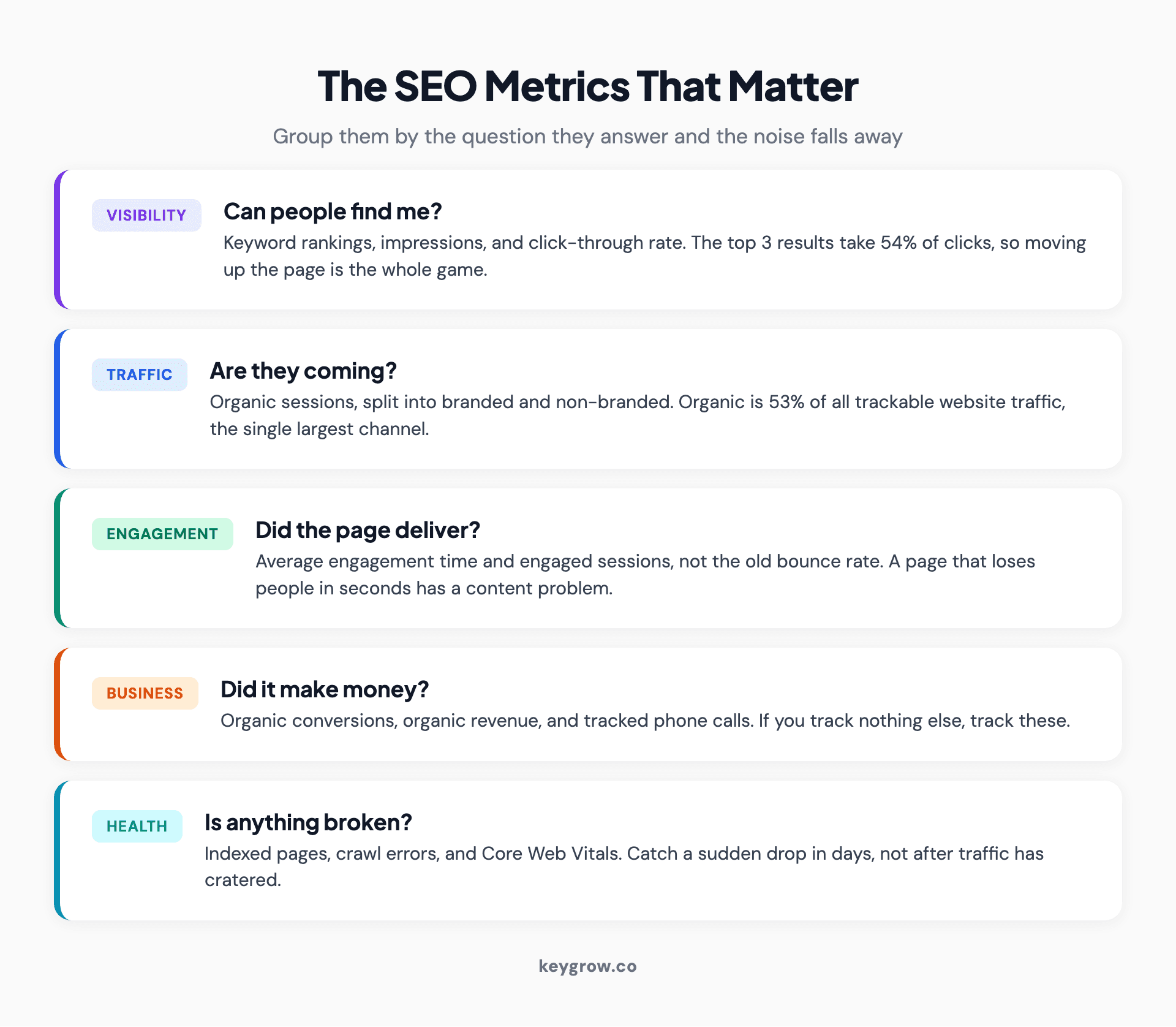
Infographic grouping SEO metrics into five categories: visibility, traffic, engagement, business results, and site health, with the key metric in each.
Visibility metrics tell you whether people can find you in the first place: keyword rankings, impressions, and click-through rate. Position matters enormously here. Backlinko found the number one organic result earns a 27.6 percent click-through rate and is ten times more likely to be clicked than the result in tenth, with the top three positions capturing 54.4 percent of all clicks. Page two is a cliff, Sistrix found every second-page position draws well under 1 percent of clicks. Moving a keyword from position 8 to position 3 is the difference between a trickle of visitors and a stream of them, which is exactly why position is worth watching.
Traffic metrics come next, telling you whether anyone is arriving. The core number is organic sessions, the visits from unpaid search, ideally split into branded and non-branded so you can see whether you are growing demand or just harvesting people who already know you. Organic deserves the obsession because BrightEdge research found it at 53 percent of all trackable website traffic in 2019, up from 51 percent in 2014, the dominant single source of web traffic.
Engagement metrics show whether the page held the people it brought in. Watch average engagement time and engaged sessions rather than the old bounce rate, which told you almost nothing useful. A page that ranks but loses people in four seconds has a content problem no ranking will fix.
Business metrics are the only ones a business owner truly cares about: organic conversions, organic revenue, and tracked phone calls. These connect all the activity above to the bank account, and if you track nothing else, you track these.
Health metrics are the plumbing, the things that rarely move on a good day but cause real damage when they break. Keep an eye on indexed pages, crawl errors, and Core Web Vitals, because a sudden indexing drop or crawl-error spike is something you want to catch in days, not after traffic has already cratered.
A quick word on Domain Authority and similar scores. They are useful as a rough relative gauge of strength, but they are third-party inventions, not numbers Google uses to rank you. Track them loosely, never treat them as the goal.
Build your tracking stack: free first, paid when you need it
Start with the free trio of Google Search Console, Google Analytics 4, and Looker Studio. Add a paid rank tracker, backlink tool, or dashboard only to close a specific gap.
You can track SEO properly for zero dollars, and most small businesses should start there. The paid tools are worth it, but only once you know what gap you are paying to close.
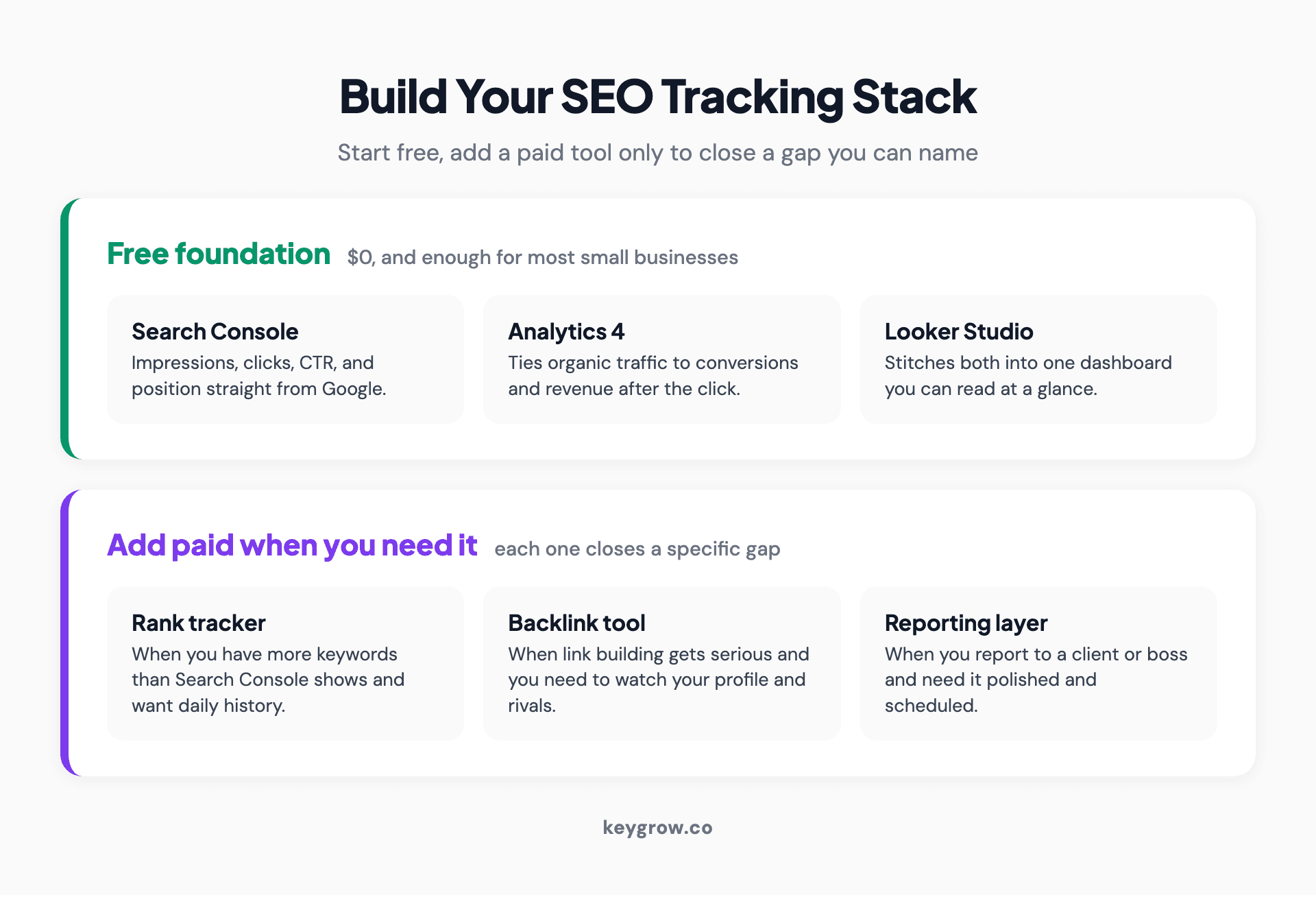
Infographic showing a free SEO tracking stack of Google Search Console, Google Analytics 4, and Looker Studio, then paid additions like a rank tracker, backlink tool, and dashboard layer.
The free foundation is three tools. Google Search Console shows you everything that happens inside Google's results before the click: impressions, clicks, click-through rate, average position, and which queries trigger them. Google Analytics 4 picks up after the click and ties traffic to conversions and revenue. Looker Studio stitches the two into one dashboard you can read at a glance. That stack costs nothing and covers visibility, traffic, and business outcomes, which is most of what matters.
You add paid tools to close specific gaps, not to feel professional. A dedicated rank tracker earns its place when you have more keywords than Search Console comfortably shows and you want daily position history on your money terms. A backlink tool like Ahrefs, Semrush, or Moz earns its place when link building becomes a real part of your strategy and you need to monitor your profile and your competitors'. A reporting layer earns its place when you are reporting to clients or a boss and need it to look polished and run on a schedule. If none of those describe you yet, the free stack is the right answer, full stop.
Google Search Console is where SEO tracking starts
If you track one tool, make it Search Console, because it is the only one showing you Google's own view of your site. Its Performance report is built on four metrics that Google defines: impressions, how often someone saw (or could have seen) a link to your site on Google; clicks, how often they clicked through; CTR, clicks divided by impressions; and position, your average ranking where one is the top.
Use it to do four things. Watch impressions to see whether Google is showing your pages more over time, the earliest sign SEO is taking hold. Watch average position on your priority keywords to see them climb. Sort by CTR to find pages that rank well but get few clicks, which usually means a weak title or description worth rewriting. And check the indexing reports so you know every page you care about is actually eligible to appear. Search Console is free, it is Google's own data, and nothing else replaces it.
Google Analytics 4 connects traffic to outcomes
Search Console tells you what happens in the search results. Google Analytics 4 tells you what happens after someone lands, which is where SEO either pays off or does not. Connect the two and you can follow a visitor from a query all the way to a conversion.
The practical setup in GA4 is to isolate organic traffic and mark your important actions as key events: form submissions, calls, purchases, signups. Then you can answer the question that matters, which is not "how much organic traffic do I have" but "how much organic traffic turned into business." Filtering to the organic channel and watching key events and revenue against your baseline is how you prove SEO is doing a job, not just drawing visitors.
It is worth looking past the headline conversion count too. GA4's landing-page report shows which specific organic pages bring visitors who convert, so you learn which content earns its keep and which ranks for nothing useful. The engagement signals sitting next to those conversions, average engagement time and engaged sessions, tell you whether a page is holding attention or quietly losing it. Together they turn a vague "organic is up" into a list of pages worth doubling down on and pages worth fixing.
Your SEO tracking cadence
Here is the part no one writes down. Tracking is a rhythm you keep, not a task you do once, and checking everything every day is the fastest way to burn out and misread normal wobble as disaster. Different metrics move on different clocks, so check them on different clocks.
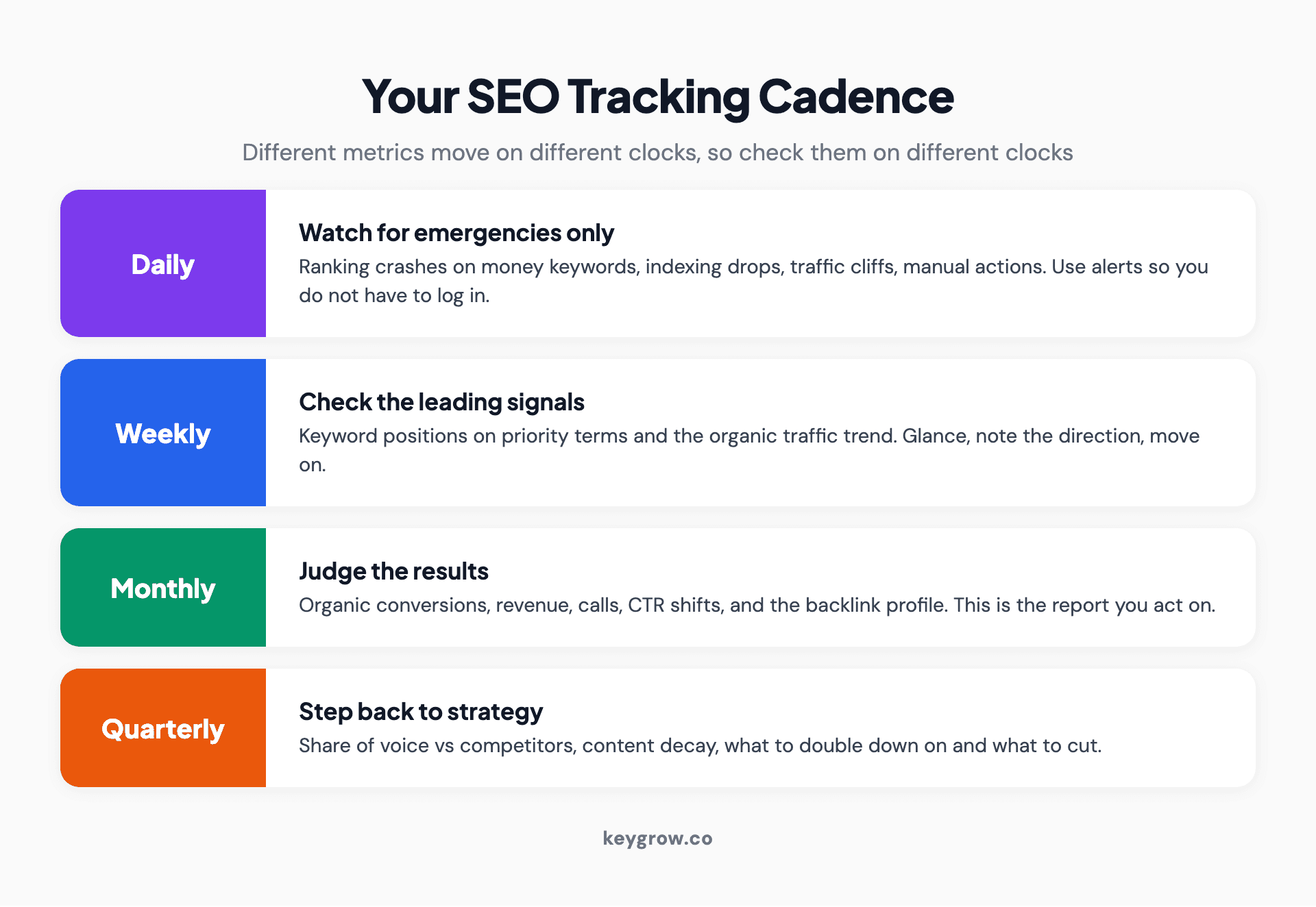
Infographic of an SEO tracking cadence: daily checks for anomalies, weekly checks for rankings and traffic, monthly checks for conversions and reporting, quarterly checks for strategy.
The routine breaks down cleanly by clock.
| Cadence | What to check | Why |
|---|---|---|
| Daily | Anomaly alerts: ranking crashes on money keywords, indexing drops, traffic cliffs, manual actions | Catch fires fast; most days there is nothing, which is the point |
| Weekly | Keyword positions on priority terms and the organic traffic trend | These leading signals show direction before the money metrics catch up |
| Monthly | Organic conversions, revenue, calls, CTR changes, backlink profile | Long enough to smooth out daily noise, short enough to act on |
| Quarterly | Share of voice vs competitors, content decay, what to double down on or cut | Strategy is a quarterly decision, not a weekly reaction |
The trap is treating a weekly glance like a quarterly decision. Rankings wobble, and confusing that wobble for a reason to change strategy is how people abandon a plan right as it starts working. Set daily checks up as alerts so you are not logging in to watch nothing happen, and save the real judgment for the monthly report.
If you run a single location and can spare an hour a week, this whole routine is something you can keep yourself, no agency required. The free Google stack and the cadence above are the entire job. You hire help when the strategy behind the numbers gets complicated, not to read the dashboard for you.
Tracking SEO in the age of AI Overviews
AI Overviews can take the click even when you rank first, so track the impressions-to-clicks gap in Search Console and whether you are cited in AI answers, not just your position.
This is the dimension that did not exist a few years ago and now breaks classic tracking, so it deserves its own section. The short version: you can rank number one and still lose clicks, because an AI Overview answered the question above you.
The data is blunt. Ahrefs found that the presence of an AI Overview correlated with a 34.5 percent lower click-through rate for the top-ranking page, across 300,000 keywords. Amsive's analysis of 700,000 keywords found an average CTR drop of 15.49 percent when an AI Overview appears, worsening to nearly 20 percent on non-branded queries. If you track rank alone, this looks like failure: same position, fewer clicks. It is not failure, it is the SERP changing under you, and your tracking has to account for it.
So track two new things alongside the classics. First, watch the gap between impressions and clicks in Search Console. When impressions hold or rise while clicks fall, an AI Overview or other zero-click feature is likely eating the difference, and that is information, not an error. Second, track whether you are cited in AI answers at all, because that visibility is now its own goal. seoClarity found that 94 percent of AI Overviews include at least one source from the top 20 organic results, and 56 percent of all citations come from those top 20, so strong organic rankings still feed AI visibility, but the overlap is far from total. You have to measure citation presence directly. This is involved enough that we treat it as its own discipline in how an AI search monitoring platform improves strategy. The takeaway for tracking: rank is no longer the whole story, and a tracking setup built in 2021 is now blind in one eye.
Turning tracked numbers into decisions
Tracking is only useful if it changes what you do, and the trap is collecting numbers no one acts on. The simplest discipline is to separate leading indicators from lagging ones. Impressions, rankings, and indexing move first and tell you the work is taking hold. Conversions and revenue move last and tell you it paid off. When the leading signals climb but the lagging ones have not yet, the right move is usually patience, not a strategy change.
We watched this with a doctor's practice in Dubai. The first thing our dashboard showed was impressions and rankings rising, months before the patient calls did. Reading those leading signals correctly is what kept everyone calm through the quiet early months, and by the end the practice was taking more than 130 calls a month. The numbers told the story before the phone did, but only because someone was tracking the right ones.
Knowing which number means what, and when to act versus wait, is a deep enough topic that we covered reading your SEO results and deciding what they mean on its own. Pair it with the tracking system here: this post gets the data flowing, that one helps you read it.
The tracking mistakes that quietly mislead you
Most bad SEO decisions trace back to a tracking habit, not a strategy. Five show up again and again, and all of them are easy to avoid once you know to look.
The first is tracking rankings and nothing else. A position is satisfying to watch, but it pays no bills. If you cannot tie the work back to conversions and revenue, you are measuring motion, not progress, and you will keep paying for keywords that rank and convert no one.
The second is never setting a baseline. Without a snapshot of where you started, every later conversation becomes a guess. Capture the numbers on day one even if they are embarrassingly low, because the low number is exactly what makes the later one impressive.
The third is ignoring the branded-versus-non-branded split. Branded searches are people who already know you, so branded traffic growth can flatter a report while your actual reach goes nowhere. Non-branded organic traffic is the honest measure of whether SEO is winning you new audiences, and it deserves its own line in every report.
The fourth is reacting to daily noise. Rankings bounce, traffic dips on weekends, a single bad day means nothing. Treat the weekly trend as the signal and the daily number as weather, or you will spend your budget chasing wobble.
The fifth is letting attribution gaps hide the value SEO is creating. Last-click models undercount organic because it often starts the journey rather than finishing it, and offline conversions like phone calls vanish if you do not track them. Set up call tracking and look at assisted conversions, or you will conclude SEO is failing when it is quietly feeding every other channel.
FAQs
How do you track SEO performance step by step?
Set a business goal, pick the KPIs that prove progress toward it (usually organic conversions and revenue), choose tools to measure those KPIs, and record a baseline. Then check rankings and traffic weekly, conversions and reporting monthly, and overall strategy quarterly. Google Search Console and Google Analytics 4 cover most of it for free.
What are the most important SEO metrics to track?
The ones tied to money come first: organic conversions, organic revenue, and tracked phone calls. Underneath them, track keyword rankings, organic traffic, click-through rate, and engagement time as leading signals, plus indexing and Core Web Vitals for site health. Skip vanity metrics that do not connect to a business outcome.
Which is better for tracking SEO, Google Search Console or Google Analytics 4?
You need both. Search Console shows what happens inside Google's results: impressions, clicks, CTR, and position. Analytics 4 shows what happens after the click: traffic, conversions, and revenue. Connecting them lets you follow a visitor from a search query all the way to a sale.
What free tools can I use to track SEO, and when do I need to pay for one?
Google Search Console, Google Analytics 4, and Looker Studio form a complete free stack covering visibility, traffic, and conversions. You add a paid rank tracker when you have more keywords than Search Console shows comfortably, a backlink tool when link building gets serious, and a reporting layer when you report to clients or a boss.
How often should you track and report on SEO?
Check daily only for emergencies like ranking crashes or indexing drops, ideally through alerts. Review rankings and traffic weekly, judge conversions and revenue monthly in your main report, and review overall strategy quarterly. Treating a weekly wobble as a reason to change strategy is a common and costly mistake.
How long does SEO take to show measurable results?
Most sites see meaningful movement in four to twelve months, with the leading indicators like impressions and rankings moving first and conversions following. New and competitive sites sit at the longer end. Set your baseline early so you can prove the gradual progress rather than waiting for a single dramatic jump.
How do you track SEO ROI and tie it to revenue?
In Google Analytics 4, isolate organic traffic and mark your valuable actions as key events, then assign a value to conversions or import revenue. Comparing organic conversions and revenue against your monthly SEO cost gives you the ROI. The point of tracking is to connect search activity to the bank account, not just to count visitors.
How do you track SEO visibility in AI Overviews and answer engines?
Watch the gap between impressions and clicks in Search Console, since rising impressions with falling clicks signals an AI Overview is taking the click. Then track whether you are cited in AI answers directly, because rank alone no longer guarantees it. Strong organic rankings still feed AI visibility, but you have to measure citation presence as its own metric.
The short version
The businesses that grow with SEO are not the ones with the fanciest dashboard. They are the ones who check the right number on the right clock and act on it: a weekly glance at the leading signals, a monthly verdict on the money, and the discipline to leave a working plan alone while the slow metrics catch up. Track the AI-visibility dimension that classic setups miss, and you will see the SERP changing instead of being blindsided by it.
If you would rather have a team set up the tracking, read the numbers, and tell you the truth about what they mean, that is part of how our SEO service works. Tell us about your site and we will show you what to watch.


