


How do you know if your SEO is working? The short answer: your non-branded organic traffic is climbing and those visitors are turning into leads, on a trend that holds across months. Rankings and impressions are clues. Qualified traffic that converts is the proof.
If you are asking how do I know my SEO is working, the metrics themselves are not the hard part. The hard part is three things every "track these 10 metrics" guide skips. How to tell the early signals from the slow ones, so you don't panic in month two. How to strip real SEO gains out of paid, seasonal, and branded noise. And how to read the one 2026 pattern that fools almost everyone, where impressions rise while clicks flatline. This guide covers all three, plus the metrics worth watching and a realistic timeline.
The 30-second gut check
Open an incognito window and search for what you sell, the way a customer would, not your business name. If you appear on page one for a few of those non-branded terms, your SEO is doing something. If you only show up when you search your own brand, it is not.
This is the crudest possible test, and it is still the one we run first on any new account. It tells you nothing about trend or conversions, but it instantly separates "we rank for our own name and nothing else" from "we show up where customers are looking." Do it for three or four of your real service-plus-location phrases before you open a single dashboard.
Leading indicators vs lagging indicators
The single biggest reason business owners think SEO is failing: they watch the lagging indicators and ignore the leading ones. Early signals show up in weeks. The outcomes that pay rent take months. Both are real, and they arrive on different clocks.
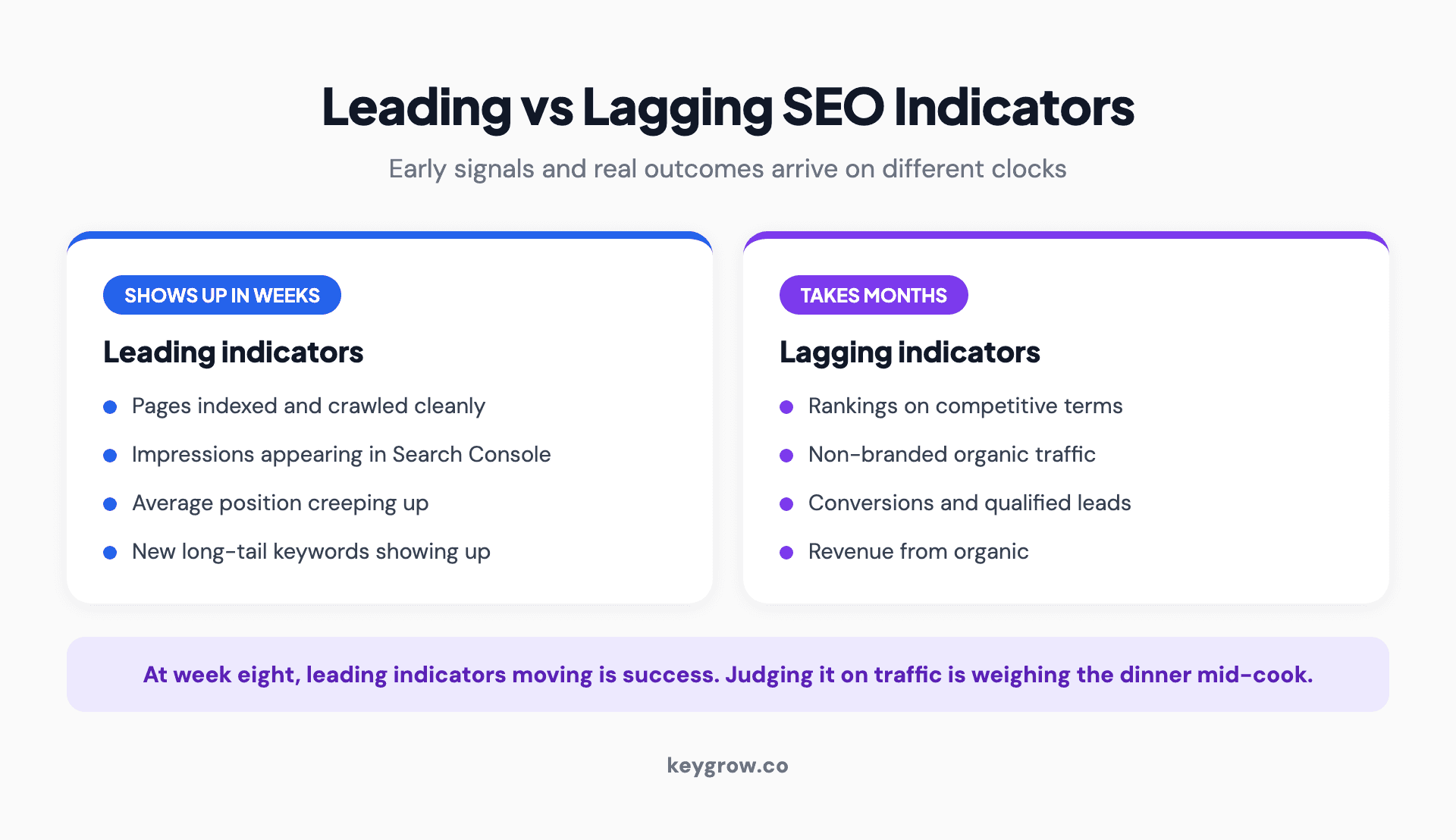
Two-column infographic contrasting leading SEO indicators that appear in weeks (pages indexed, impressions rising, average position creeping up, new keywords appearing) against lagging indicators that take months (rankings on competitive terms, organic traffic, conversions, revenue).
| Leading indicators (weeks) | Lagging indicators (months) |
|---|---|
| Pages indexed and crawled cleanly | Rankings on competitive terms |
| Impressions appearing in Search Console | Non-branded organic traffic |
| Average position creeping up | Conversions and qualified leads |
| New long-tail keywords showing up | Revenue from organic |
Here is the reality: if you are eight weeks in and your pages are indexed, impressions are starting to register, and your average position is drifting up a few spots, your SEO is working even though traffic and leads have barely moved. Those are the leading indicators doing exactly what they should. Judging the project on traffic at that point is like weighing yourself halfway through cooking dinner.
Which metrics actually prove SEO is working?
Non-branded organic traffic, conversions, and qualified leads. Those three move only when SEO is genuinely earning attention from people who weren't already looking for you. Everything else is context.
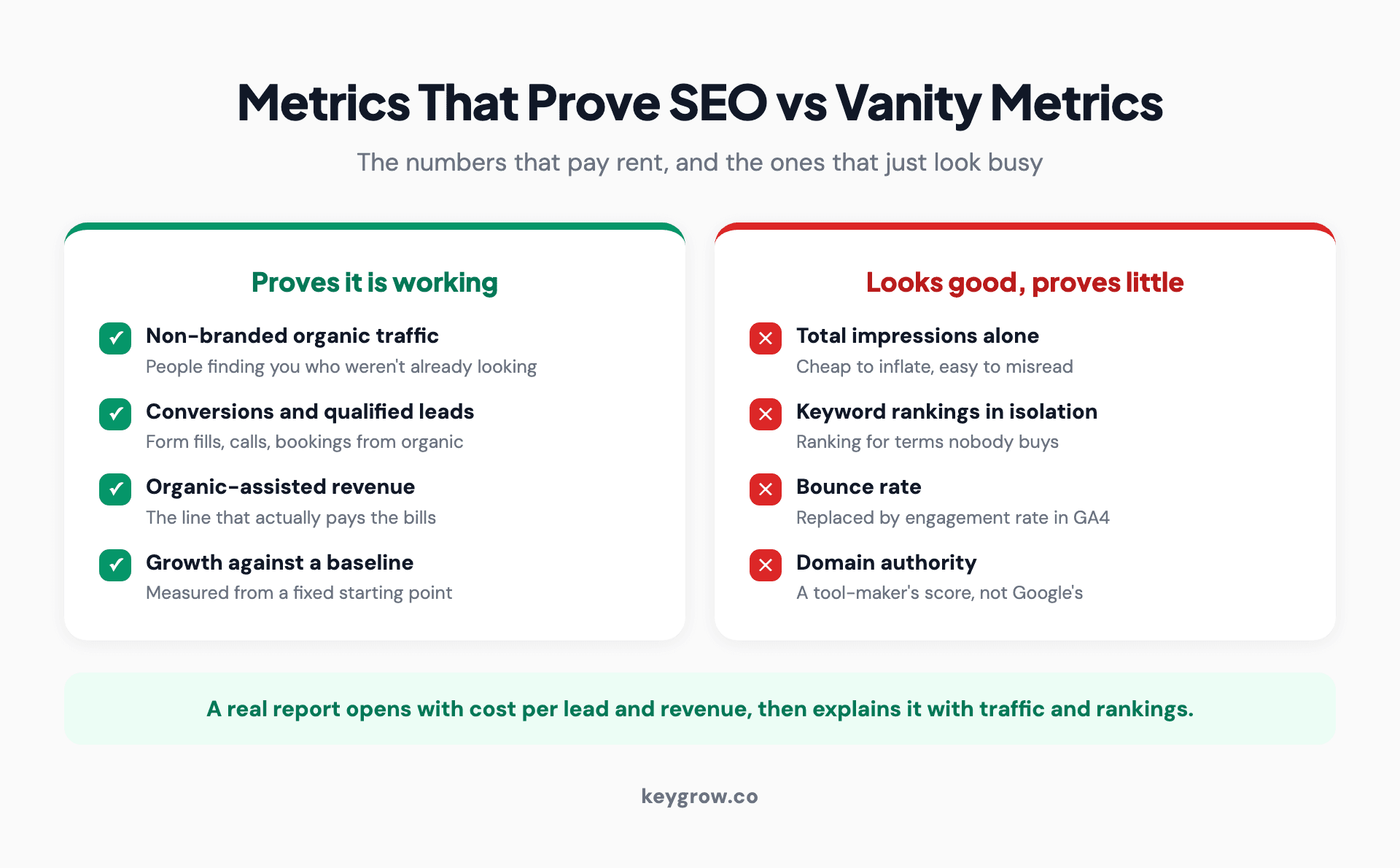
Two-column infographic separating SEO metrics that prove results (non-branded organic traffic, conversions and qualified leads, organic-assisted revenue, growth against a baseline) from vanity metrics that look good but prove little (total impressions alone, keyword rankings in isolation, bounce rate, third-party domain authority scores).
| Proves it is working | Looks good, proves little on its own |
|---|---|
| Non-branded organic traffic | Total impressions |
| Conversions and qualified leads | Keyword rankings in isolation |
| Organic-assisted revenue | Bounce rate |
| Growth measured against a baseline | Domain authority |
A few of those need a footnote. Keyword rankings feel like the scoreboard, but ranking first for a phrase nobody searches, or that never converts, is a participation trophy. Bounce rate is worse: Google Analytics 4 replaced it with engagement rate, so if your report still leads with bounce rate, the report is older than the tool it claims to use. And domain authority is a score invented by SEO tool companies, not Google, useful for rough comparison and meaningless as proof your campaign worked.
Here is the opinion that has cost us pitches: vanity-metric reporting is the industry's biggest scam. Impressions, clicks, and "engagement" do not pay rent. A report should open with cost per lead, booked jobs, and revenue, then use rankings and traffic to explain them. When SparkToro finds 68 percent of Google searches now end without any click at all, impressions have never been a cheaper number to inflate or a worse one to celebrate.
Your free measurement toolkit: GA4 and Search Console
You can answer most of "is my SEO working" with two free Google tools. Search Console shows what happens in search results. Analytics shows what happens after the click.

Person reviewing performance analytics on a laptop, the free Search Console and GA4 data that answers whether SEO is working.
Google Search Console is the source of truth for the search side: which queries show your pages, how many impressions and clicks each earns, your average position, and which pages Google has indexed. The Performance report, filtered to compare two date ranges, is where you watch non-branded impressions and clicks move over time.
Google Analytics 4 takes over after the visit: how many people arrived from organic search, what they did, and whether they converted. Set up conversion events for the actions that matter, form submissions, calls, bookings, so "traffic" becomes "leads" on the screen. If you have added schema and want to see how your listings render and whether the markup earns richer results, that ties directly into whether rich snippets are helping your click-through rate at the same ranking position.
One number to read carefully here is which pages Google has indexed. A page that is not indexed cannot rank, so an indexing problem can masquerade as an SEO that "isn't working" when the content is fine and simply unseen.
Paid rank trackers like Semrush, Ahrefs, or Moz add convenience and competitor visibility, and they are worth it past a certain size. They are not required to answer the basic question. The two free tools do that.
"Impressions up, clicks flat": the 2026 trap
Here is the pattern that now fools almost everyone, and that not one of the top-ranking guides on this topic even mentions: your Search Console impressions climb steadily while your clicks refuse to follow. It usually is not broken tracking. It is AI search eating the click.
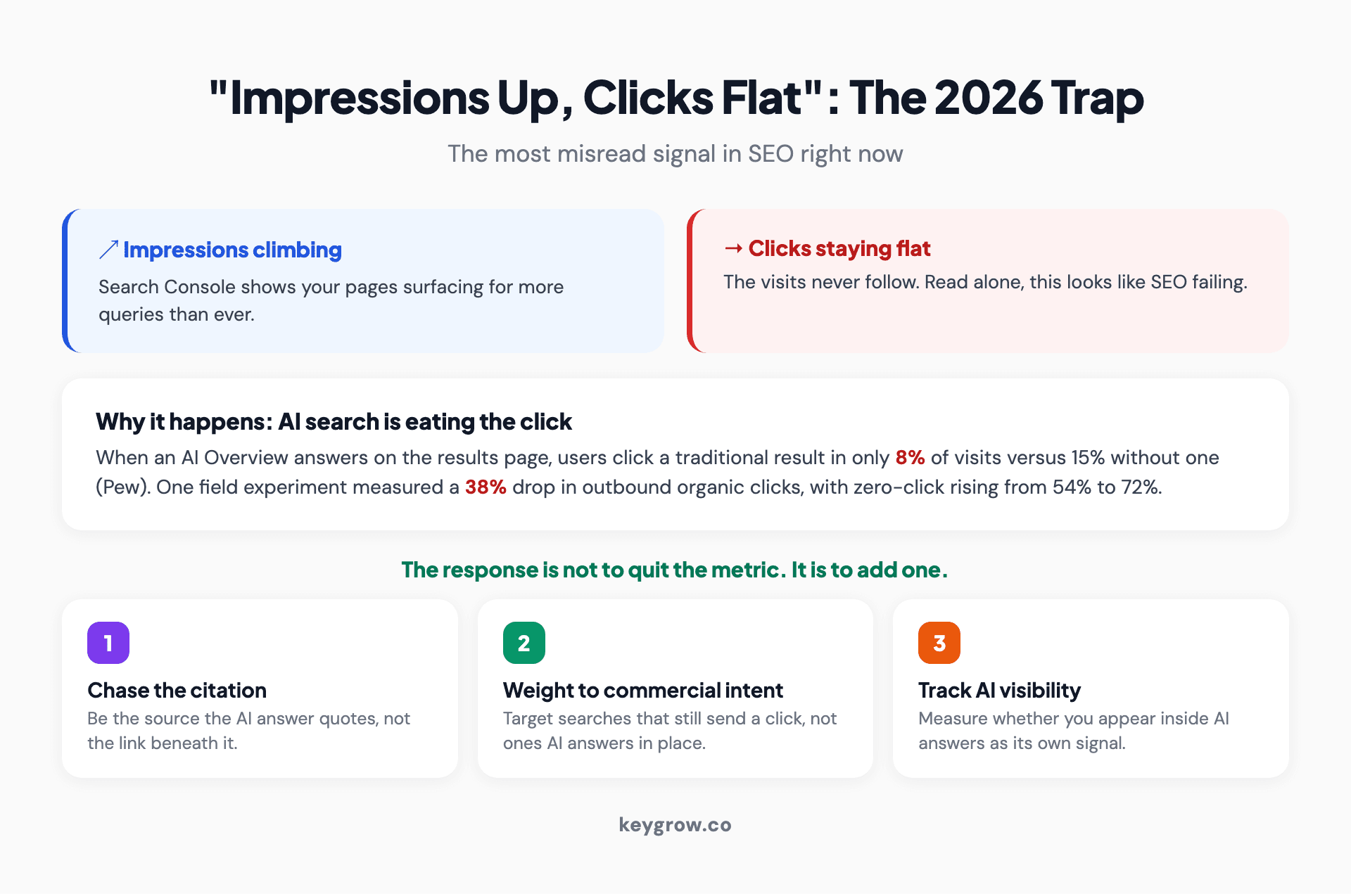
Diagnostic flow infographic for the impressions-up-clicks-flat pattern: check whether AI Overviews appear for your queries, whether you rank below the answer box, and whether the queries are informational, then act by targeting commercial intent, structuring for citation, and tracking AI visibility.
When Google shows an AI Overview above the results, the click economics change. Pew Research found users clicked a traditional search result in only 8 percent of visits where an AI summary appeared, versus 15 percent without one, and clicked a link inside the AI summary in just 1 percent of visits. The first randomized field experiment on the feature measured a 38 percent drop in outbound organic clicks on triggered queries, with the zero-click rate rising from 54 to 72 percent.
So your rankings can hold and your impressions can climb while your clicks stall, all at once, because the answer is delivered on the results page before anyone reaches you. Read alone, that chart looks like SEO failing. It is closer to the goalposts moving.
The fix is not to give up on the metric. It is to add one: are you the source the AI answer quotes, or just a blue link below it? Being quoted in the overview is the new front page, which is why we track AI-answer visibility as its own signal and built a whole method around how an AI search monitoring platform improves SEO strategy. If your traffic is shifting toward informational queries that AI now answers in place, the move is to weight your content toward commercial-intent searches that still send a click, and to structure pages so they get cited rather than skimmed.
How long before you should expect results?
Most sites see early movement in three to six months and meaningful results between six and twelve. Anyone promising page one in 30 days is selling, not forecasting.
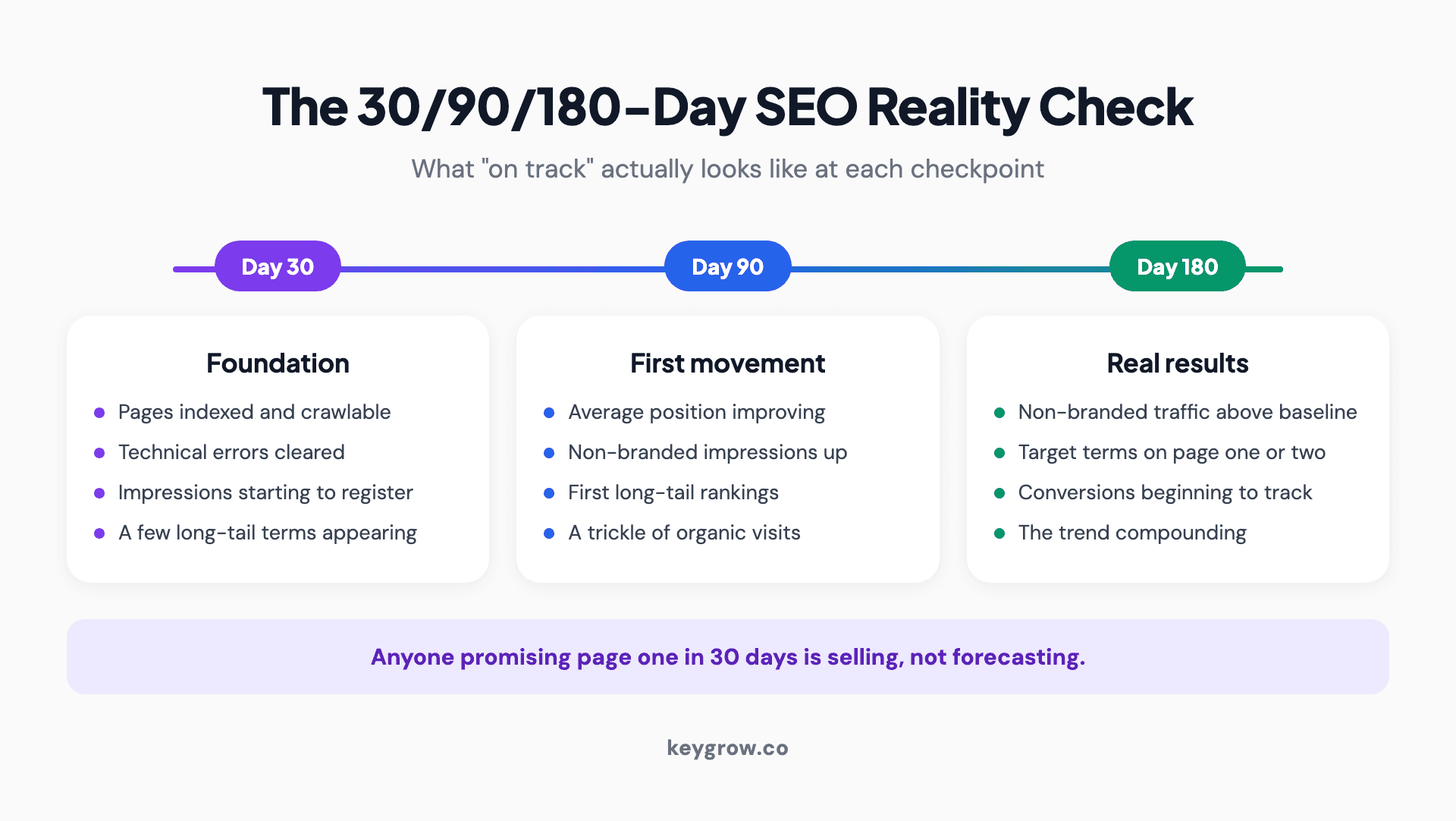
Three-phase timeline infographic of a realistic SEO reality check: Day 30 with pages indexed and technical errors cleared, Day 90 with average position improving and first long-tail rankings, Day 180 with non-branded organic traffic clearly up and conversions tracking.
The numbers back the patience. Ahrefs polls of 3,680 people put the typical time to see SEO results at three to six months, though Ahrefs stresses the real timeline depends on the case. Google's own Maile Ohye said years ago that SEO usually needs four months to a year to implement changes and see the benefit. And only 1.74 percent of newly published pages reach the top 10 within a year, and Ahrefs found the average number-one page is about five years old. SEO is a compounding asset, not a switch.
| Checkpoint | What "on track" looks like |
|---|---|
| Day 30 | Pages indexed, technical errors cleared, impressions starting, a few long-tail terms appearing |
| Day 90 | Average position improving, non-branded impressions up, first long-tail rankings and a trickle of organic visits |
| Day 180 | Non-branded organic traffic clearly above baseline, target terms reaching page one or two, conversions beginning to track |
We watched this play out with a doctor's practice in Dubai that committed to a full year. Months one through three looked unremarkable from the outside. By month twelve, organic traffic had grown 1,519 percent and the practice was fielding more than 130 patient calls a month, on the same site, with no shortcuts. The businesses that quit at month three pay for the hardest part of the work and leave right before it pays out. The same compounding logic is why content marketing benefits SEO only for the people who stay in it.
Is it your SEO working, or just noise?
This is a correlation-versus-causation problem: traffic rising at the same time as your SEO work does not prove the SEO caused it. Traffic can climb for reasons that have nothing to do with you: a seasonal spike, a paid campaign, a press mention, or your brand simply getting more famous. Proving SEO did the work means stripping those out.

Line graph trending upward on a screen, the kind of chart that needs a baseline and a branded-versus-non-branded split before it proves anything.
Five habits do most of it:
- Split branded from non-branded. In Search Console, separate queries that contain your business name from those that do not. Brand searches grow when your offline marketing works. Non-branded growth is the part SEO actually earns.
- Benchmark against a baseline. Record where you started: traffic, rankings, conversions, on a fixed date. "Up and to the right" means nothing without the line you are comparing against.
- Compare like windows. Measure this month against the same month last year, not against December, so seasonality does not masquerade as progress.
- Watch conversion rate, not just raw conversions. Organic conversion rate, conversions divided by organic sessions, confirms the new traffic is qualified rather than merely larger. GA4's assisted-conversion view also catches when organic touched a sale another channel closed.
- Rule out algorithm updates. Before deciding your SEO failed, check whether a traffic drop lines up with a known Google core update, or whether a sudden gain is a competitor getting hit by one. A core-update calendar separates "our work stopped working" from "the weather changed for everyone."
There is an uncomfortable version of this question too: is it the SEO working, or just the agency looking busy? A monthly report thick with impressions, "work completed," and rankings for terms nobody buys can hide the absence of the only line that matters. If your provider cannot show non-branded organic growth against a baseline and tie it to leads, the activity may be real and the results may not be. That, not a missing tactic, is the actual red flag.
And if you can run the incognito check, read a Search Console trend, and see your own leads arriving, you may not need to pay anyone to confirm your SEO is working. The honest signal is in tools you already have for free. Hiring help makes sense when the diagnosis turns up a real problem you do not have time to fix, or when your market is competitive enough that doing it well is a full-time job.
What if the answer is that it is not working?
Sometimes the metrics are honest and the verdict is bad. If six months in your non-branded impressions are flat and nothing is indexed beyond your homepage, the usual culprits are a short list: thin or duplicate content, technical issues blocking crawling, a market far more competitive than the strategy assumed, or targeting keywords chosen for search volume rather than buyer intent.
The move is diagnosis before more effort. Confirm pages are indexed in Search Console, check that your content genuinely answers the query better than what ranks above you, and make sure the terms you target are ones your customers actually use and act on. More content poured on top of a technical or intent problem just buries the problem deeper.
FAQs
How can I tell if my SEO is working?
Check three things in order: do you appear on page one for non-branded searches, is your non-branded organic traffic rising against a baseline, and are those visitors converting into leads or sales. Movement in all three across months, not days, is proof. Rankings and impressions alone are clues, not confirmation.
How long does SEO take to show results?
Most sites see early signals like impressions and indexing within weeks, and meaningful traffic gains in three to six months. Competitive terms and real authority often take six to twelve months or more. An Ahrefs poll of 3,680 people put the typical answer at three to six months, and Google has said four months to a year is normal.
Why are my impressions going up but my clicks staying flat?
Usually because AI Overviews and zero-click search are answering the query on the results page before anyone reaches your site. Your ranking can hold while the click disappears. The response is to target searches with commercial intent that still send clicks, and to structure content so AI answers cite you as the source.
Is bounce rate still a useful SEO metric?
Not really. Google Analytics 4 replaced bounce rate with engagement rate, which measures meaningful sessions rather than single-page visits. Engagement rate, time on page, and conversions tell you far more about whether visitors found what they came for.
How do I separate SEO results from paid, social, and seasonal spikes?
Split branded from non-branded queries in Search Console, compare the same period year over year to remove seasonality, and benchmark every number against a fixed starting point. Non-branded organic growth measured against a baseline is the cleanest proof that SEO, and not another channel, did the work.
How do I know if it is my SEO working or my agency just looking busy?
Ask for non-branded organic growth against a baseline, tied to leads or revenue. A report full of impressions, completed tasks, and rankings for terms nobody buys can hide a lack of results. If a provider cannot connect their work to qualified traffic and conversions, that is the red flag.
Should I worry about AI Overviews when measuring SEO?
Yes. AI Overviews and zero-click results now reshape what your traffic numbers mean, since a strong ranking no longer guarantees a click. Track whether you are cited inside AI answers, not just whether you rank beneath them, and weight content toward queries that still drive visits.
The short version
The trap most owners fall into is reading the slow numbers, ignoring the fast ones, and quitting in month three. Watch the leading indicators, strip the noise, and treat "impressions up, clicks flat" as a 2026 signal to chase citations, not as failure.
If you want a second set of eyes on whether your SEO is working, our SEO team will benchmark where you stand and tell you plainly whether the numbers are real. Tell us about your business and we will lead with the line that matters: leads, not impressions.