


Do rich snippets help SEO? Yes, but not the way most guides claim. Rich snippets are not a ranking factor, and Google has said so directly. What they do is make your listing bigger, more specific, and more clickable than the plain blue links around it, and they feed search engines the structured facts that decide whether you qualify for those enhanced listings at all.
There is also a current-events reason to read past the usual advice: Google removed FAQ rich results for everyone in May 2026, after years of winding them down, and retired HowTo results back in 2023. A lot of the "add FAQ schema for rich snippets" advice still ranking today describes features that no longer exist. This guide covers what rich snippets still do for SEO, which types still show up, and how to earn them without wasting a sprint on retired decorations.
What are rich snippets?
A rich snippet is a normal organic result with extra visual information pulled from structured data on your page: star ratings, prices, event dates, recipe times, video thumbnails. Google's current term is "rich results," but searchers and most of the industry still say snippets.
They are not the same thing as featured snippets, and the difference matters when you are deciding what to optimize:
| Rich snippet | Featured snippet | |
|---|---|---|
| What it is | Your own listing, enhanced with ratings, prices, or dates | An answer box above the results quoting one page |
| How you get it | Structured data markup on your page | Writing the clearest answer to the query |
| Where it appears | At your normal ranking position | Position zero, above everything |
Rich snippets come from code. Featured snippets come from content. This post covers the first kind, and how to get featured snippets covers the second.
Do rich snippets directly improve rankings?
No. Google has said for years, including through its official Search Liaison, that structured data is not a ranking signal. Adding Product markup does not move you from position eight to position three.
The help arrives through a chain that starts after the ranking is decided:
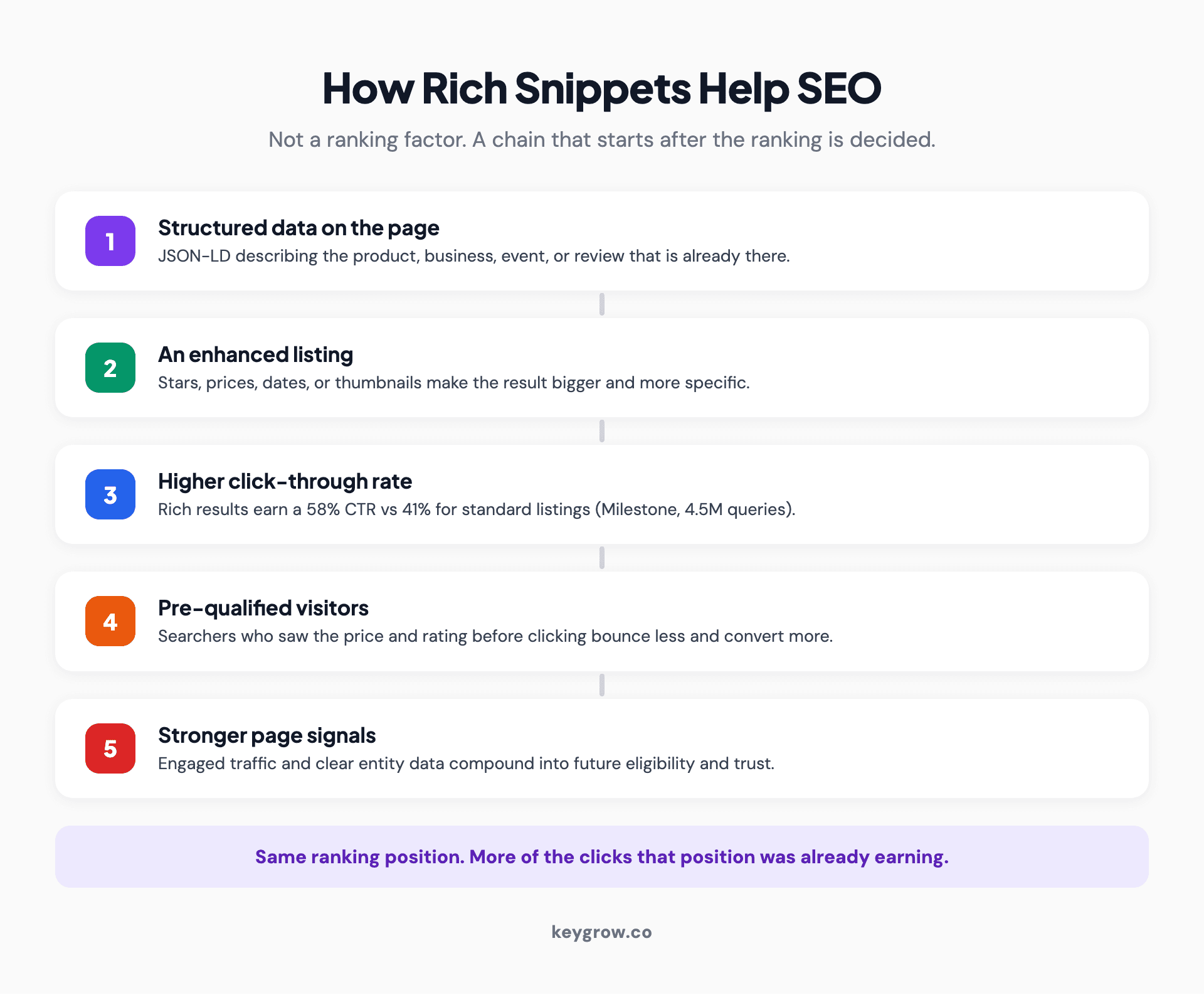
Flow infographic of how rich snippets help SEO indirectly: structured data, an enhanced listing, higher click-through rate, pre-qualified visitors, and stronger engagement signals.
More clicks from the same position. Milestone Research analyzed 4.5 million queries and found rich results earn a 58 percent click-through rate against 41 percent for standard results. A listing with stars and a price simply gives a searcher more reasons to pick it.
Pre-qualified visitors. Someone who clicked your result after seeing the price and a 4.7 rating already accepted both. Those visitors bounce less and convert more than searchers who clicked a bare title tag and hoped.
Cleaner machine understanding. Structured data tells Google exactly what your page is: a product, a local business, an event, a review. Google's own documentation describes structured data as how it understands page content and decides eligibility for special result types. Understanding doesn't raise your rank, but it controls which search features you can appear in at all.
So the honest summary: rich snippets won't change where you rank, they change what your ranking is worth.
Which rich results still pay in 2026?
The menu shrank. Product, review, local business, event, recipe, and video markup still produce visible rich results. FAQ and HowTo are gone.
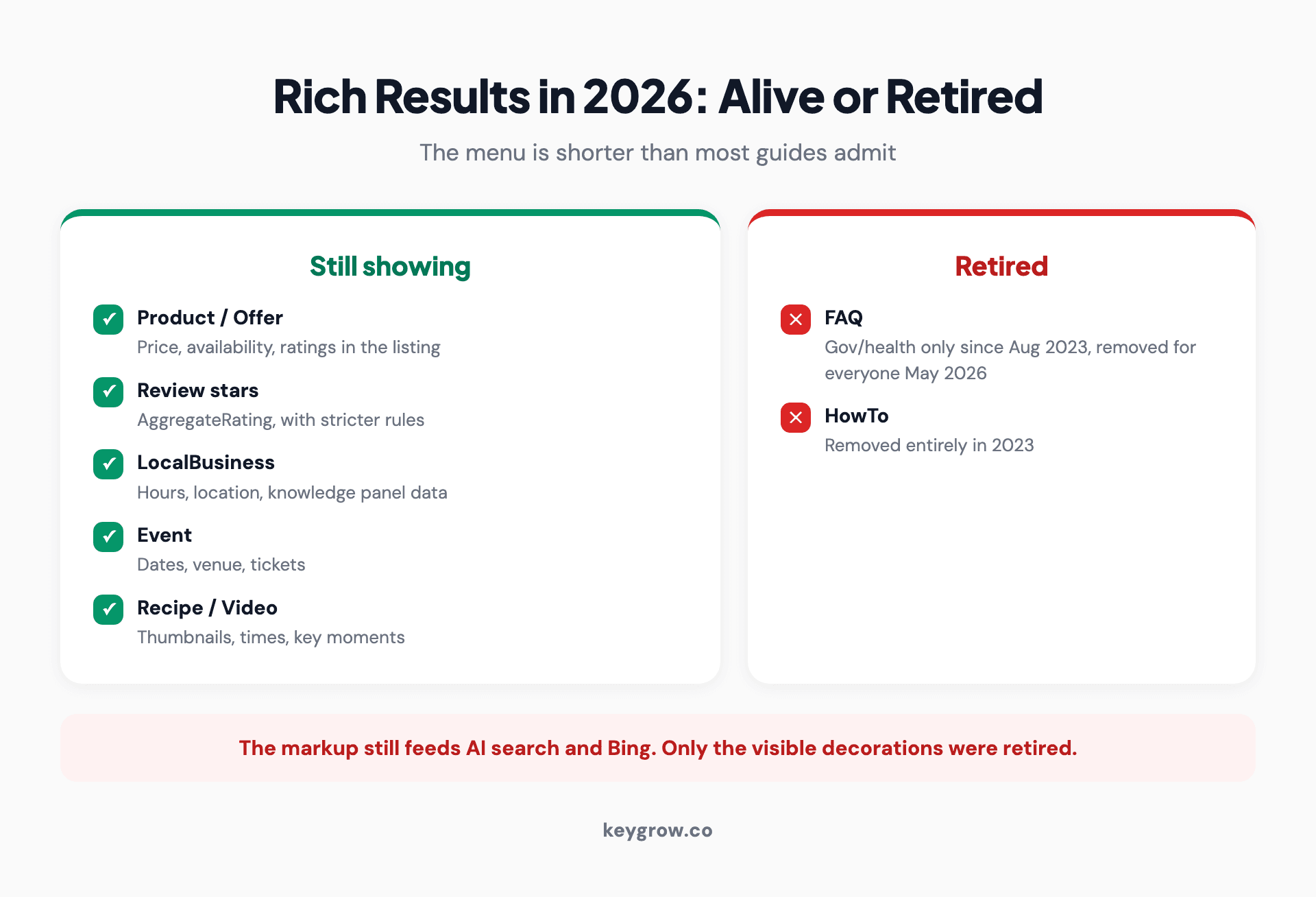
Two-group infographic of rich result types in 2026: product, reviews, local business, events, recipes, and video still showing, with FAQ and HowTo retired by Google.
The timeline, since most guides skip it: in August 2023 Google restricted FAQ rich results to well-known government and health sites and pulled HowTo results from mobile, removing them entirely a month later. In May 2026 FAQ rich results stopped appearing for everyone, and Search Console dropped the report. Google spent years encouraging the markup, then took down the decorations.
| Markup type | What shows in search | Status in 2026 |
|---|---|---|
| Product / Offer | Price, availability, ratings | Alive and valuable |
| Review / AggregateRating | Star ratings | Alive, with stricter rules |
| LocalBusiness | Hours, location info, knowledge panel data | Alive |
| Event | Dates, venue, ticket info | Alive |
| Recipe / Video | Thumbnails, cook times, key moments | Alive |
| FAQPage | Nothing since May 2026 | Retired as a visual result |
| HowTo | Nothing since 2023 | Retired |
If an agency pitches you FAQ markup "for the rich snippets" in 2026, that is not a strategy, it is a calendar problem.
Why keep schema that shows nothing?
Because the visual result was never the only payoff. Structured data is machine-readable facts about your business, and machines are a growing share of your readers.

Laptop screen showing code, the machine-readable layer of a page that schema markup feeds to search engines and AI systems.
AI search systems work from parsed, structured understanding of pages. ChatGPT's search runs on Bing's index, which reads schema markup, and that is one reason we treat Bing as no longer optional: a site invisible to Bing is invisible to a meaningful slice of AI-assisted search. Clear entity markup (who you are, where you operate, what you sell, what things cost) makes you easier to retrieve accurately and harder to misquote.
We practice this position. Every post on this blog still ships FAQPage JSON-LD, a month after Google stopped drawing stars from it, because the question-answer pairs feed answer engines and keep our content parseable. The decoration died; the data kept its job. That reasoning is most of what our answer engine optimization service does at the site level.
How do you get rich snippets?
Four steps: pick the types that match your pages, add the markup as JSON-LD, validate it, then give Google time.
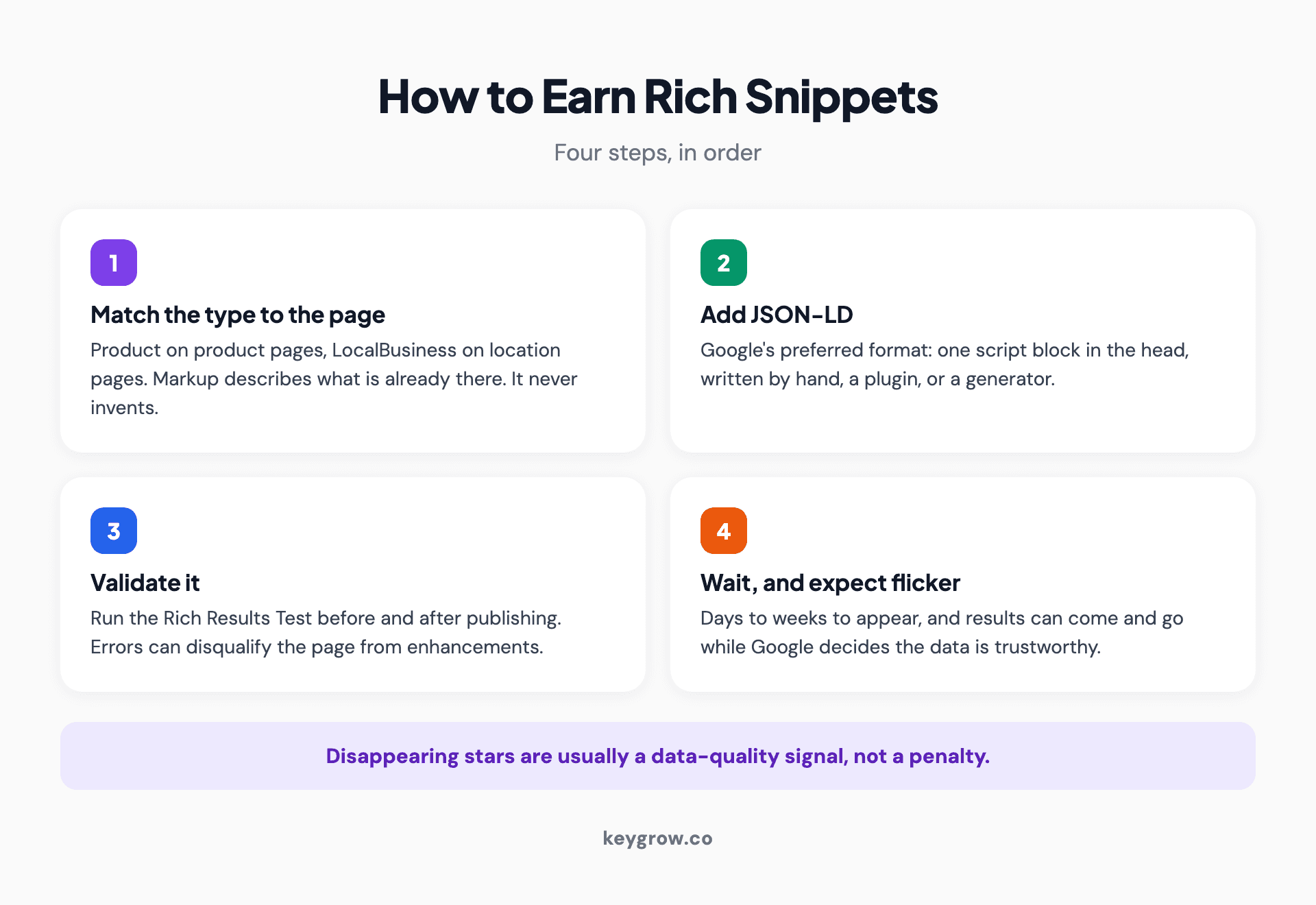
Four-step infographic for earning rich snippets: choose matching schema types, add JSON-LD markup, validate with the Rich Results Test, and allow weeks for Google to trust it.
- Match the type to the page. Product markup on product pages, LocalBusiness on your contact and location pages, Event on event pages. Markup describes what is already there; it never invents.
- Add JSON-LD. Google's preferred format, a script block in the page head. Most CMS platforms have plugins for it, or generate it by hand with our free schema markup generator and paste it in.
- Validate. Run the page through Google's Rich Results Test before and after publishing. A markup error doesn't just fail silently; it can disqualify the page from enhancements.
- Wait, and expect flicker. Rich snippets commonly take days to a few weeks to appear, and they can come and go while Google decides whether your data is trustworthy. Disappearing stars are usually a data-quality signal, not a penalty.
One habit worth keeping: check how your pages present in search after the markup lands. Our SERP preview tool shows how the title and description read alongside the enhancements.
Which types fit which business?
Start from your business model, not from the schema documentation:
| Business | Start with | The payoff |
|---|---|---|
| Local service business | LocalBusiness, Review | Stars and trust signals on the searches that ring the phone |
| Online store | Product, Offer, AggregateRating | Price and stock visible before the click |
| Content or media site | Article, VideoObject | Thumbnails and Top Stories eligibility |
| Events and venues | Event | Dates and tickets in the listing |
Two or three well-maintained types beat ten thin ones. Markup multiplies what a page already earns; it cannot resurrect a page nobody wanted.
How do you measure whether rich snippets helped?
In Search Console, compare the page's click-through rate at the same average position before and after the markup started showing. Same position, more clicks: that is the rich snippet earning its keep.
The mechanics take five minutes. Open the Performance report, filter to the page you marked up, and set the date comparison to the 28 days before and after the enhancement appeared. Watch two numbers together: average position and CTR. If CTR rose while position held steady, the snippet did that. If position also jumped, something else moved and the stars don't get the credit.
Search Console's enhancement reports also list which pages have valid markup and which have errors, one report per type. Worth knowing: the FAQ report was removed in June 2026 along with the feature, so its absence from your dashboard is Google's doing, not yours.
A vendor who credits a ranking jump to schema should be able to show you exactly this before-and-after. It is a reasonable thing to ask for.
Can structured data hurt your SEO?
Yes, in one specific way: marking up things that are not really on the page. Review stars for reviews nobody can see, products that aren't for sale, fake aggregate ratings. Google issues manual actions for spammy structured markup, and a manual action is a much worse Tuesday than having no stars at all.
The duller risk is opportunity cost. If your site is five pages and your phone isn't ringing, schema is not your bottleneck, and you don't need to pay anyone to add it. Spend that effort on the content and the local landing pages that give markup something worth describing. Schema is seasoning, not the meal.
FAQs
Are rich snippets a direct ranking factor?
No. Google has stated that structured data does not affect rankings. Rich snippets increase click-through rate from whatever position you already hold, and structured data helps search engines understand and classify your content.
How long does it take for rich snippets to appear?
Typically a few days to a few weeks after Google recrawls the page with valid markup. Appearance is never guaranteed, and snippets can flicker on and off while Google evaluates the data quality.
Why did my FAQ or HowTo rich results disappear?
Google retired them. HowTo rich results were removed in 2023, and FAQ rich results stopped showing for all sites in May 2026 after being restricted to government and health sites since August 2023. The markup itself is harmless to keep and still useful for AI search systems.
Can incorrect structured data hurt my site?
Yes. Markup that misrepresents page content, such as fake review stars or products that don't exist, can earn a manual action for spammy structured markup. Honest, accurate markup carries no penalty risk even when it doesn't produce a visible result.
Do rich snippets matter for AI search?
The structured data behind them does. AI systems and the search indexes they rely on use schema markup to parse entities, prices, locations, and reviews accurately. The visible stars matter less; the machine-readable facts matter more each year.
Which schema types should a local business start with?
LocalBusiness on the contact or location page and Review or AggregateRating where real customer reviews are displayed. Those two cover the searches that produce calls, and both still generate visible rich results in 2026.
The short version
Rich snippets help SEO the way a good storefront helps a shop in a fixed location: same address, more people walking in. They will not move your rankings, and the 2026 menu is shorter than the guides admit, but stars, prices, and dates still win clicks, and the structured data behind them is how machines, including AI search, understand what you sell.
Add the types that match your pages, keep the markup honest, and put the effort into pages worth enhancing. If you want the whole system handled, from markup to the content it describes, tell us about your business and our SEO team will tell you whether schema is your bottleneck or just your seasoning.