


Why does SEO take so long? Because it is a trust-and-compounding process, not a setting you switch on. Search engines have to crawl your changes, re-evaluate your site, watch how people respond, and weigh you against competitors who have been earning authority for years. Most sites see meaningful results in four to twelve months, and new or competitive ones take longer.
That is the short answer. The longer one is more useful, because "it takes time" is what every agency says right before they ask you to keep paying. This guide explains what is happening during those months, why your timeline differs from the next business owner's, how to earn faster wins honestly, and the red flags that mean someone is selling you a shortcut that does not exist.
Why does SEO take so long, really?
Because Google ranks pages it trusts, and trust is earned slowly through signals that take months to accumulate: crawled changes, fresh content, earned links, and real user behavior. There is no way to fast-forward a track record.
The numbers show how patient the system is. Ahrefs found only 1.74 percent of newly published pages reach Google's top 10 within a year, rising to about 6 percent when you filter to non-empty English content. The same Ahrefs study found the average number-one page is about five years old, with 72.9 percent of top-10 pages more than three years old. You are not competing against pages published last week. You are competing against pages that have spent years earning their spot.
Google's own guidance matches this. Google's Maile Ohye said in a video that SEO usually needs four months to a year to first implement improvements and then see the benefit. When Google itself quotes a one-year horizon, the agency promising 30 days is the outlier, not the realist.
What is happening month to month?
A lot, most of it invisible at first. Google has to discover your changes, judge them, and watch how searchers react before any of it shows up as a ranking. Here is the rough shape.
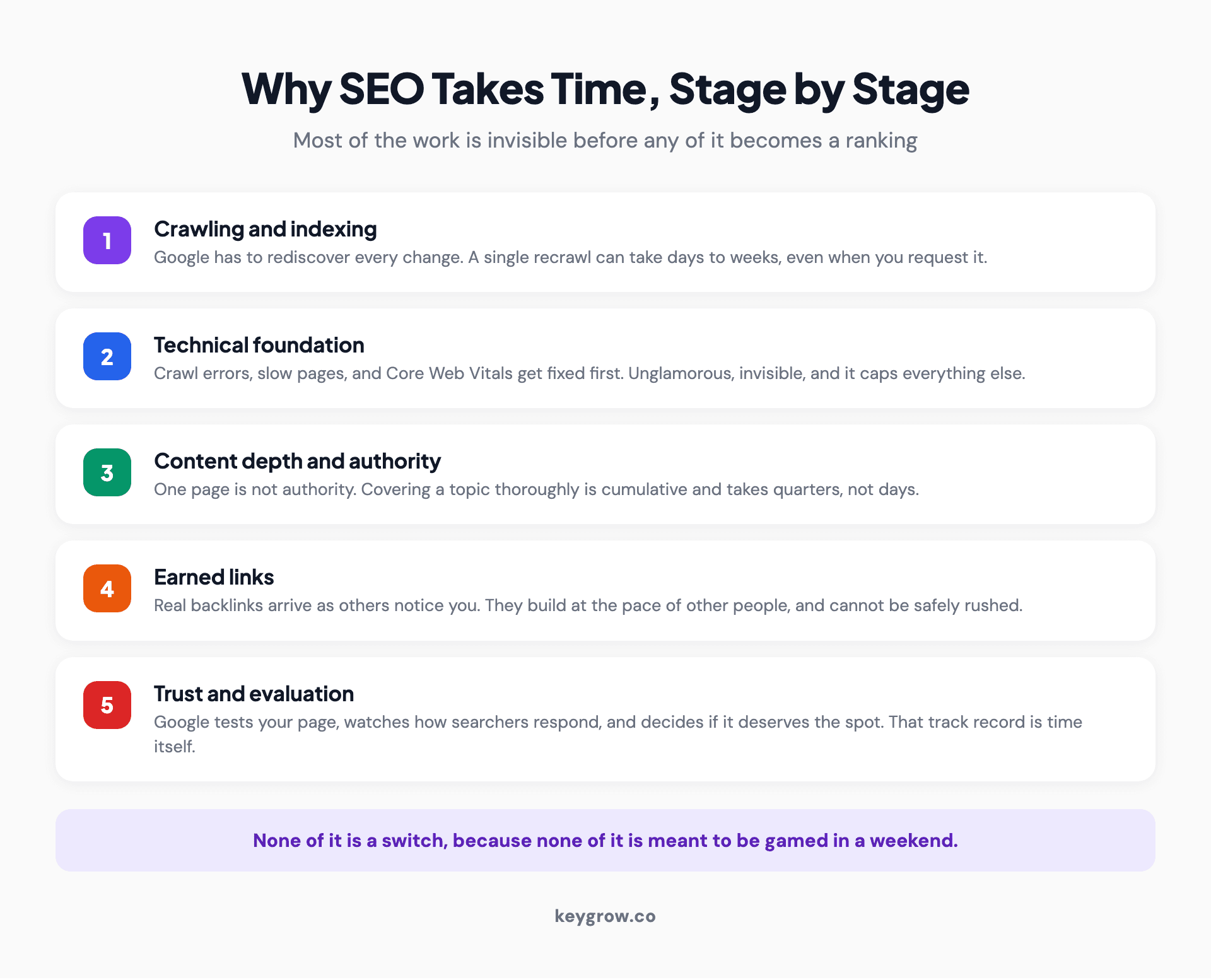
Stage-by-stage infographic of why SEO takes time: crawling and indexing, technical foundation, content and topical depth, authority and links, and Google's trust and evaluation period.
| Phase | What Google and your site are doing | What you see |
|---|---|---|
| Months 1-3 | Crawling and indexing changes, fixing technical issues, publishing foundational content | Pages indexed, impressions starting, little traffic |
| Months 4-6 | Content maturing, first links landing, Google testing your pages in results | Long-tail rankings, average position rising, first organic visits |
| Months 7-12 | Authority compounding across the topic, competitive terms moving | Non-brand traffic clearly up, leads beginning to track |
The first bottleneck is mechanical. When you publish or change a page, Google has to recrawl it, and a recrawl can take anywhere from a few days to a few weeks even after you request it. Multiply that across a site's worth of pages and updates, and the indexing cycle alone eats the first stretch.
Then comes the slow part: Google watches. It tests your page at a position, measures whether searchers click and stay, compares you to alternatives, and adjusts. Content needs time to be read and linked. Links need time to be earned and counted. None of it is a switch, because none of it is meant to be gamed in a weekend.
The four things you cannot rush
Four ingredients drive the timeline, and none of them respond to money or urgency. They respond to time.
Start with the technical foundation. Before anything ranks, the site has to be crawlable, fast, and stable, so month one is usually crawl-error fixes, speed work, and Core Web Vitals cleanup. It produces no visible traffic, which is exactly why it feels like nothing is happening: the wins are obstacles removed, not gains you can see. Skip it and you cap everything that follows, because a page Google struggles to render on mobile will not rank no matter how good the writing is.
Content depth is slower still. One good page does not make you an authority. Google rewards sites that cover a topic thoroughly, and that coverage is a body of work that has to be published, crawled, and judged against everyone else competing for the query. Authority on a subject is cumulative, and cumulative things take quarters.
Links are the part you control least. Real backlinks arrive as other people discover your content and reference it, at the pace of other people noticing you, and a sudden spike of them looks manipulative rather than impressive. Even deliberate link-building has to be paced.
All of it compounds into the thing Google measures over time: whether your site has a track record of being useful. An older domain clears each stage faster because it has already banked some of that trust. A new one starts the clock at zero, and no payment buys a back-dated history.
Why is your timeline different from someone else's?
Because three things change the math: how old and trusted your domain is, how competitive your keywords are, and whether you are fighting for a town or a country. The same work pays off in weeks for one business and a year for another.
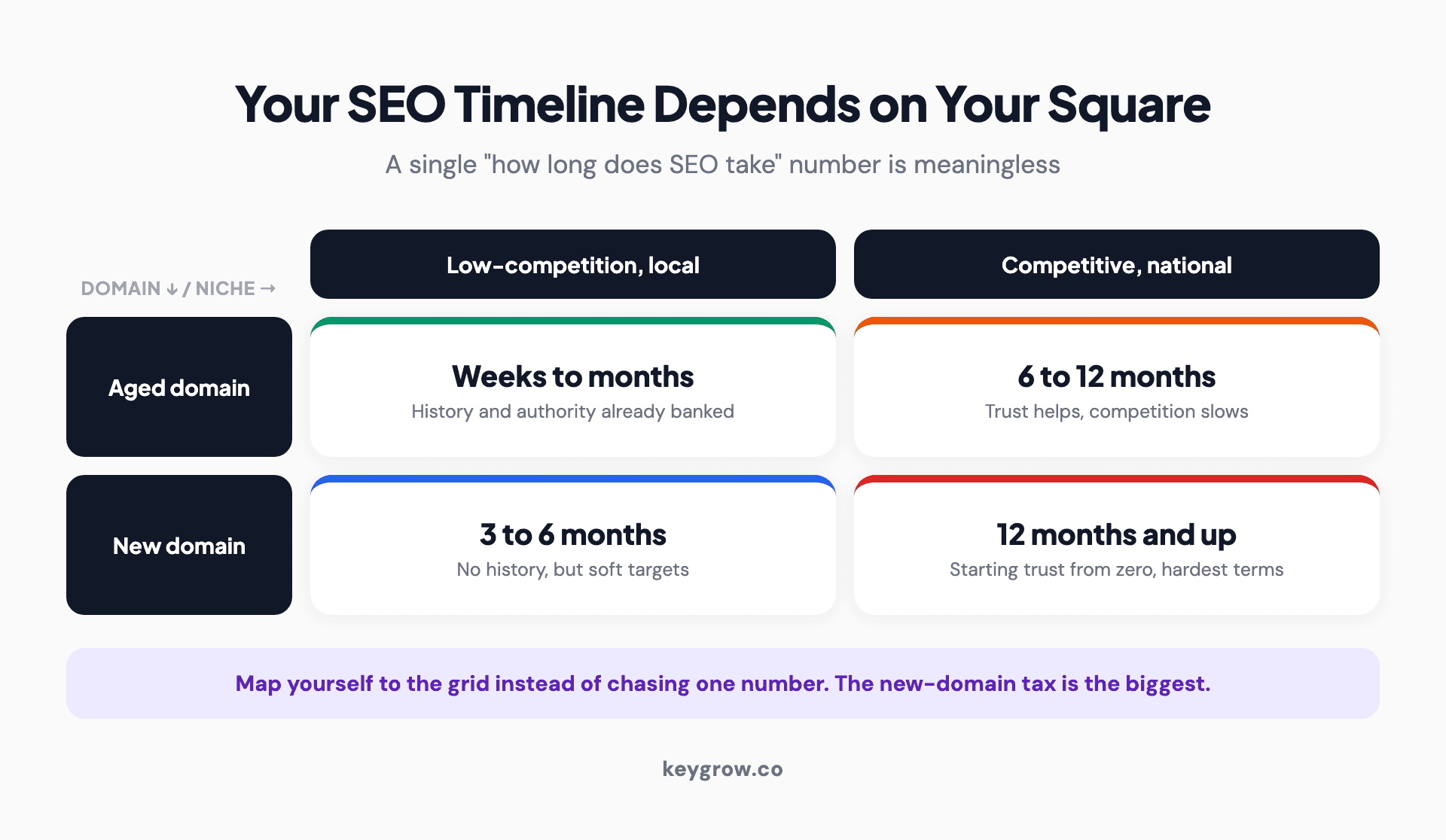
Scenario matrix infographic of SEO timelines: a new domain in a competitive national niche is slowest, an aged domain targeting low-competition local terms is fastest, with mixed cases in between.
| Your situation | Realistic time to meaningful results |
|---|---|
| Aged domain, low-competition local terms | Weeks to a few months |
| Aged domain, competitive national terms | 6 to 12 months |
| New domain, low-competition local terms | 3 to 6 months |
| New domain, competitive national terms | 12 months and up |
A new domain is the biggest tax. Google is cautious with a site that has no history, no authority, and no behavioral data, so a brand-new business starts slower than an established one making the same moves. Competition is the second: ranking for "plumber in a small town" is a different sport than ranking for "project management software," where you are up against companies spending more on content per month than your whole budget. This is why a single number for "how long does SEO take" is meaningless. The honest answer is a range that depends on your square on this grid.
Can you make SEO faster?
Yes, somewhat, by being strategic about where you spend effort first. You cannot skip the trust-building, but you can pick targets that pay off sooner and clear the obstacles slowing you down.
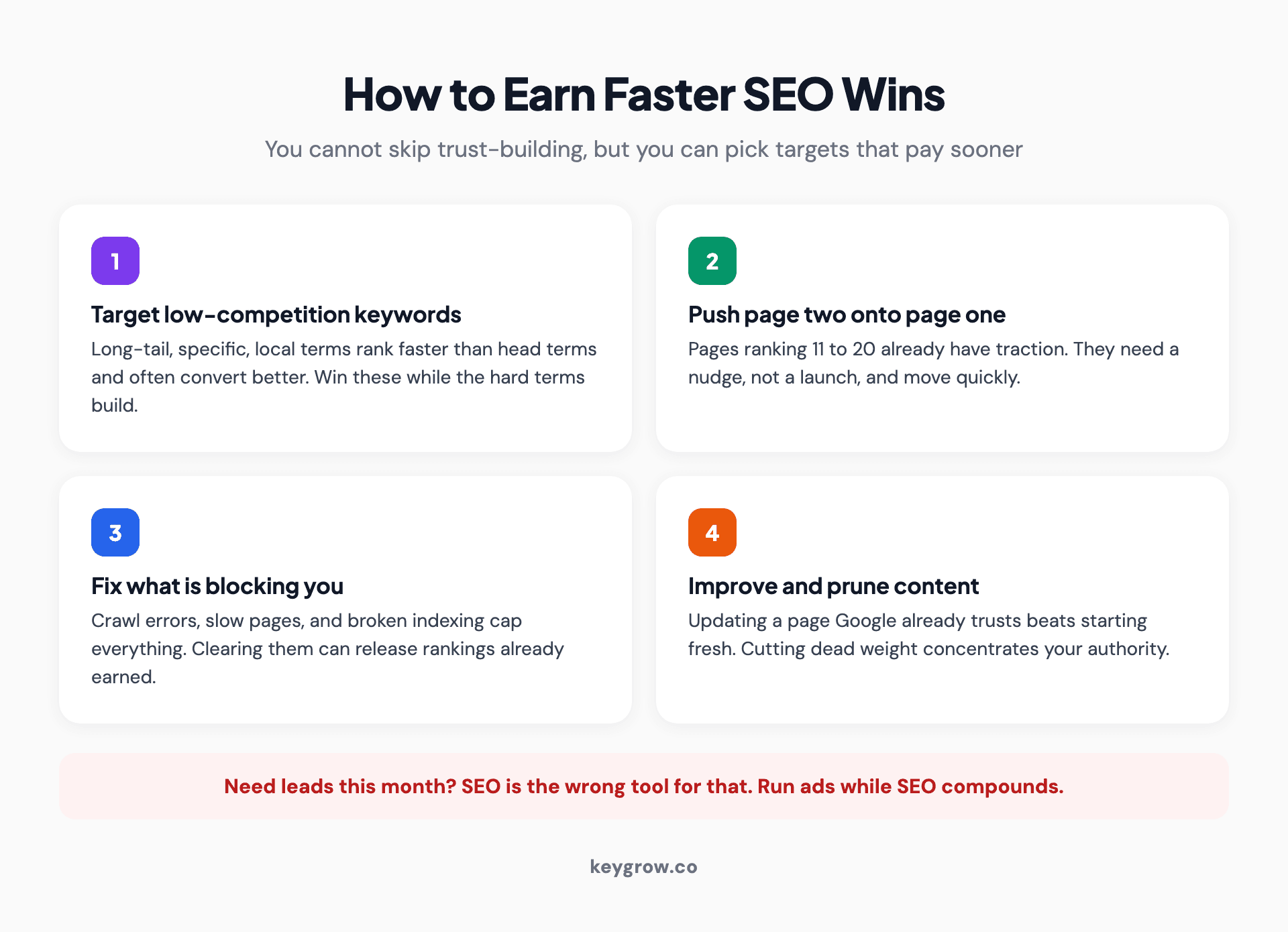
Four-tactic infographic for faster SEO wins: target low-competition long-tail keywords, push page-two rankings onto page one, fix technical errors blocking crawling, and improve or prune existing content.
Four moves produce the earliest returns:
- Target low-competition keywords first. Long-tail, specific, local terms rank faster than head terms and often convert better. Win those while the hard terms build.
- Push your page-two rankings onto page one. Pages ranking 11 to 20 are your fastest wins; they already have traction and need a nudge, not a launch.
- Fix what is blocking you. Crawl errors, slow pages, and broken indexing cap everything else. Clearing them can release rankings that were already earned but held back.
- Improve and prune existing content. Updating a page Google already trusts is faster than starting fresh, and cutting dead weight concentrates your authority.
One honest caveat: if you need leads this month, SEO is the wrong tool, and no amount of strategy changes that. That is what paid ads are for. The right play for many businesses is to run ads for immediate leads while SEO compounds in the background, then lean on organic as it takes over the cheaper traffic.
And if you are a single-location business with more time than budget, the early wins above are ones you can do yourself: claim your Google Business Profile, gather reviews, and fix the obvious technical errors before paying anyone. Hire help when the competitive terms, not the basics, are what you need.
Why "page one in 30 days" is a red flag
Because the only ways to move that fast are targeting terms nobody searches or using tactics that get your site penalized. Here is the opinion, and it is not close: a guarantee of page one in 30 days is a red flag, full stop.
Given that under 2 percent of new pages reach the top 10 in a year, anyone promising it in a month is either redefining "page one" to mean keywords with no demand, or buying links and stuffing content in ways that earn a manual action later. Both leave you worse off than patience would have.
The shortcuts that "work" are the ones that work until a core update notices, and then you lose everything at once. Bought-link networks get devalued, doorway pages get filtered, and AI-spun content gets demoted, often months after they briefly lifted a ranking, so the bill arrives right when you have stopped expecting it. A penalty can take longer to recover from than the honest path would have taken to rank in the first place. SEO is slow for the same reason it is durable: it is built on trust that cannot be faked, which is also why it does not collapse the moment you stop paying, the way ads do. If a pitch leans on speed and a guarantee instead of a realistic timeline and leading indicators, treat the speed as the warning sign, not the selling point.
How do you tell it is working before rankings move?
Watch the leading indicators. Pages getting indexed, impressions rising in Search Console, average position creeping up, and rankings appearing for non-brand terms you did not rank for before all move months before traffic and revenue do. If those are climbing, it is working but slow, even when the traffic line looks flat.
There is also a faster lane in 2026. AI Overviews and answer engines can surface a well-structured, already-indexed page quickly, sometimes before the classic ten-blue-links cycle rewards it, so an appearance in an AI answer is its own early signal. That visibility rides on brand and entity signals more than on rankings alone, which is why we track AI-answer presence separately from positions.
This is the single most important thing to understand while you wait, and it deserves its own playbook, which is why we wrote how to tell whether your SEO is actually working separately. The short version: do not judge a months-long process by its first month of traffic. Judge it by whether the early signals are pointing up. The businesses that quit DIY or fire their agency at month three usually do it right as the leading indicators turn, paying for the hard part and leaving before the payoff.
Is the wait actually worth it?
Yes, because the payoff compounds while the cost does not. Organic traffic you earn this year keeps arriving next year without paying per click, which is why SEO's return climbs the longer you hold it.

Young plant sprouting from soil, a picture of how organic traffic compounds slowly and then keeps growing.
Organic search drives about 53 percent of all trackable website traffic, the largest single channel, and BrightEdge found that share rose from 51 percent in 2014 rather than fading. The return reflects the patience required: First Page Sage puts positive SEO ROI at the 6-to-12-month mark, peaking in year two or three, with three-year average returns ranging from 317 percent for ecommerce to nearly 1,400 percent for some service industries.
The contrast with paid ads is the whole case for patience. Ads are a tap: turn them on and traffic appears, turn them off and it vanishes the same day, and the cost per click does not fall the longer you run them. SEO is a snowball. The page you rank this quarter keeps bringing visitors next quarter without paying for each one, the authority you build makes the next page rank faster, and the traffic gets cheaper per visit the longer you hold it. The slow start is the price of an asset that keeps paying after you stop pushing, which is the opposite of how ads behave. The two are not rivals. Ads buy you traffic now; SEO earns it cheaper later, and the businesses that win run both.
| Paid ads | SEO | |
|---|---|---|
| When traffic starts | The same day | Months in |
| When you stop paying | It vanishes | It keeps coming |
| Cost per visit over time | Flat or rising | Falls as authority builds |
We watched this play out with a doctor's practice in Dubai that committed to a full year. Months one through three looked unremarkable from the outside, the leading indicators moving while traffic barely did. By month twelve, organic traffic had grown 1,519 percent and the practice was taking more than 130 patient calls a month. Same site, same client, no shortcuts. The first quarter looked like nothing was happening. It was the foundation that made month twelve possible.
FAQs
How long does SEO take to show results?
Most sites see meaningful results in four to twelve months. An Ahrefs poll of 3,680 people put the typical answer at three to six months for first signs, and Google's own guidance says four months to a year. Competitive terms and new domains sit at the longer end.
Does SEO have any quick wins?
Some. Optimizing pages already ranking on page two, targeting low-competition long-tail keywords, and fixing technical errors that block crawling can produce results in weeks. These are real wins, but they are the exception that funds the patience the competitive terms require.
Why does a new website take longer to rank?
Google is cautious with sites that have no history, authority, or behavioral data, so a new domain starts slower than an established one making the same moves. Trust accrues over time, and a brand-new site has none yet. This is the single biggest factor lengthening a timeline.
Should I keep paying for SEO if I am not seeing results yet?
It depends on the leading indicators, not the traffic. If pages are getting indexed, impressions are rising, and average position is climbing, the work is compounding and you are close. If nothing has moved after six months and pages are not even indexed, that is a different conversation. Judge the signals, not just the revenue line.
Can SEO be guaranteed in 30 days?
No, and a guarantee is a red flag. With under 2 percent of new pages reaching the top 10 within a year, a 30-day promise means either targeting keywords with no demand or using tactics that risk a penalty. Honest providers quote months and show you leading indicators, not guarantees.
Is SEO worth the wait compared to paid ads?
For durable traffic, yes. Ads stop the moment you stop paying; organic rankings keep delivering. The smart approach for many businesses is both: ads for immediate leads while SEO builds, then organic taking over the cheaper, compounding traffic over time.
The short version
There is no number that answers "why does SEO take so long" for everyone, only a grid. Find your square, decide whether you can wait for the payoff or need ads in the meantime, and judge the months by the leading indicators rather than the traffic line. The slow part is not a flaw in SEO. It is the reason the result lasts.
If you want a team that will tell you honestly where you sit on that timeline and show you the early signals while they build, our SEO service works that way. Tell us about your business and we will give you a realistic horizon, not a guarantee.