


How important is branding for SEO? More important than it has ever been, and the gap is widening. Search engines and AI answer engines now lean heavily on signals that branding produces: branded searches, clicks earned by recognition, mentions of your name across the web, and the trust that makes people choose your result over a higher-ranked stranger. You can do everything technical right and still lose to a weaker page from a brand people know.
Here is the honest version, which most guides skip: branding does not have a single neat "ranking factor" you can toggle. It works through a bundle of signals, some of which branding causes and some of which branding only proves. This guide separates the two, shows the actual mechanism with the evidence, and covers how to build brand in a way that earns rankings instead of just looking nice.
What does branding mean for SEO?
Branding for SEO is not your logo or your color palette. It is whether people recognize, search for, trust, and mention your name, and whether search engines can identify you as a distinct, credible entity.

Brand identity materials laid out on a desk, a reminder that branding for SEO is far more than a logo.
A logo is a brand asset. A brand is what happens in people's heads and in their search behavior because of everything you do. For SEO purposes, the parts that matter are the measurable ones: how many people search your name, whether they click you over competitors, how often other sites mention you, and whether your reviews and reputation say you are trustworthy. Those are the branding outputs search engines can read. Branding and SEO are not competing budgets either. Brand is the demand-side input that makes the technical work pay off.
Is branding actually a Google ranking factor?
Not as a single switch, and this is where honesty matters. Branding influences a cluster of signals Google does use, but some of the connection is brand causing rankings and some is brand proving authority you already earned.
The strongest evidence for the mechanism came from the 2024 Google Search document leak. It surfaced a "siteAuthority" metric, click-based signals like goodClicks, badClicks, and lastLongestClicks, and a module showing Google uses Chrome browsing data for ranking. Separately, antitrust trial testimony confirmed Google's NavBoost system treats clicks as one of its important ranking signals. Put together, Google watches whether people seek you out and stay with you, and a recognized brand wins both. That is the closest thing to proof that brand strength feeds rankings.
The causation honesty: when a brand with high branded-search volume also ranks well, you cannot always tell whether the brand lifted the rankings or whether the same authority did both. Treat branded search as a strong signal and a symptom at once. The practical takeaway is the same either way, build the brand, because every interpretation points to it helping.
How does branding move the SEO needle?
Through six signals search engines can measure: branded search volume, click-through rate, dwell time and return visits, earned backlinks, unlinked mentions, and entity recognition.
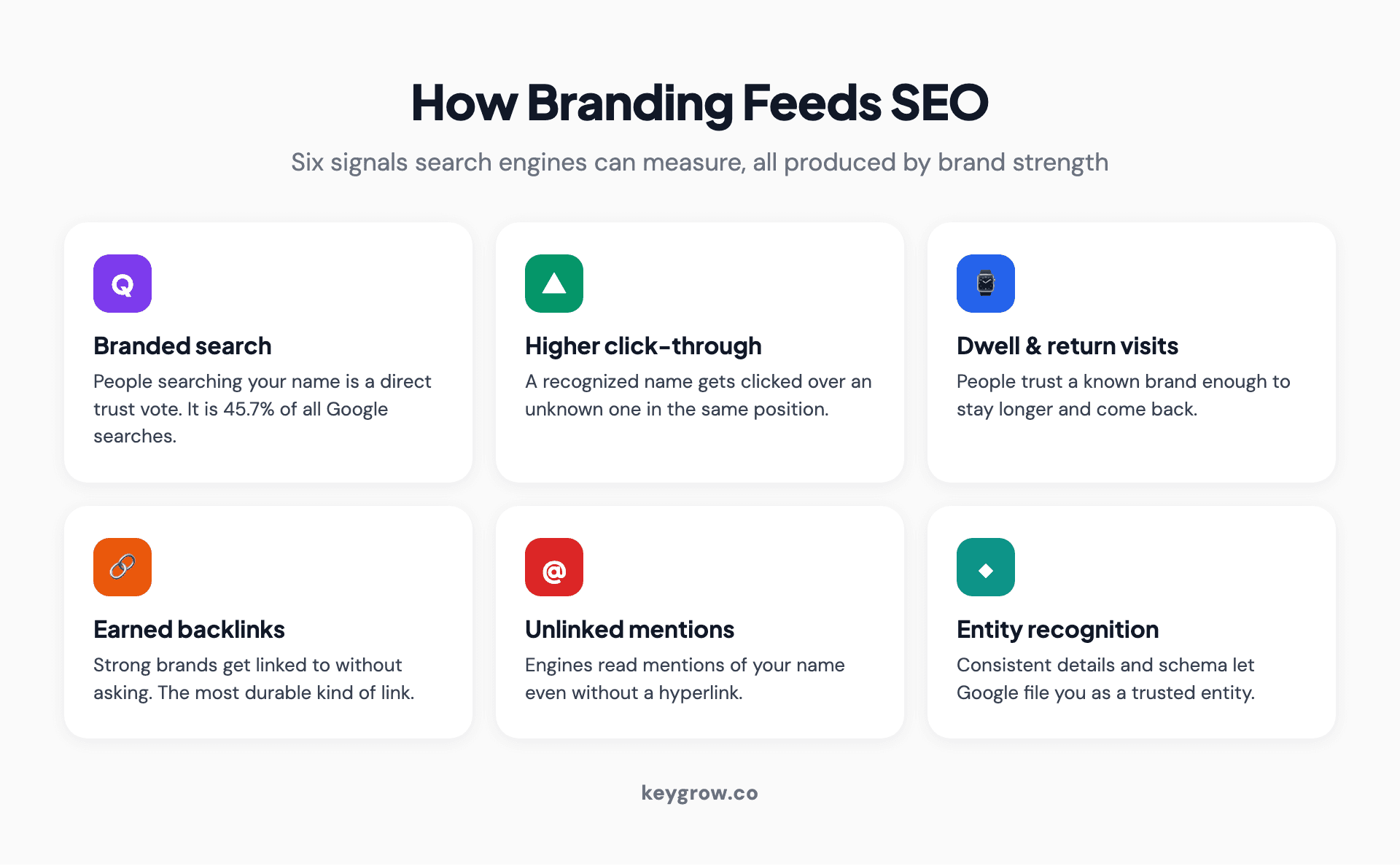
Six-signal infographic of how branding feeds SEO: branded search volume, higher click-through rate, longer dwell time and return visits, naturally earned backlinks, unlinked brand mentions, and entity recognition.
The biggest is branded search. People searching your name is a direct trust vote, and it is enormous: branded searches make up 45.7 percent of all Google searches by volume in a study of roughly 150 million keywords. Almost half of all search is people looking for brands they already know.
Recognition then compounds in behavior. A name people recognize gets clicked over an unknown one at the same position, and those people stay longer and come back more often. That is exactly the click behavior the leaked signals reward.
Brand also earns the things slower sites have to chase. Strong brands get linked to without anyone asking, which is the most durable kind of link and most of why link building becomes passive once a name is known. They get mentioned across the web even without a hyperlink, and search engines now read those unlinked mentions to gauge who you are. And consistent name, details, and schema let Google file you as a distinct entity it can trust and surface, which matters most of all in AI answers.
Brand is becoming the deciding factor in AI search
In AI Overviews and answer engines, brand recognition is pulling ahead of classic ranking signals. Being a known, mentioned brand is now one of the strongest predictors of whether AI cites you at all.
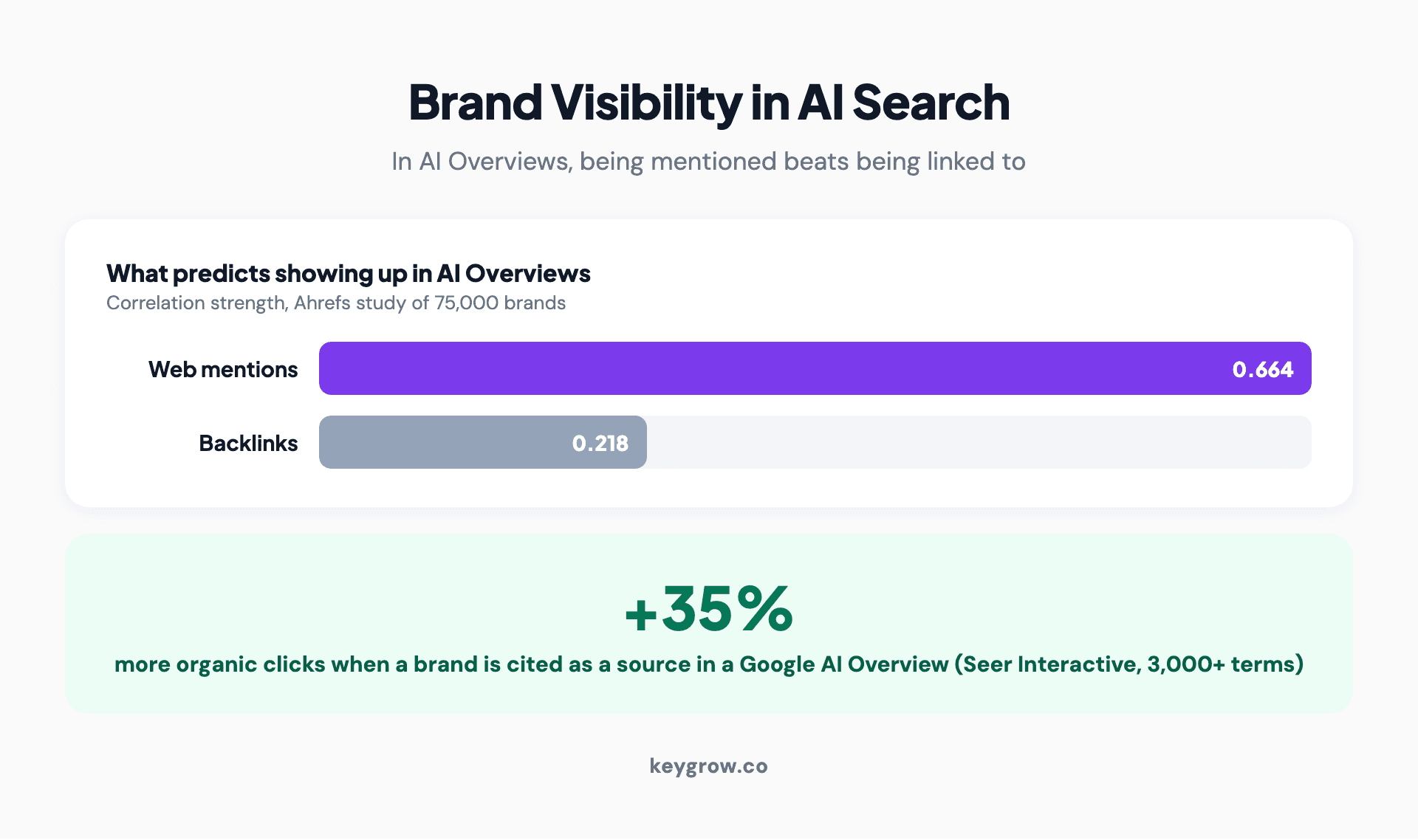
Comparison infographic of brand visibility in AI search: web mentions correlate with AI Overview presence at 0.664 versus 0.218 for backlinks, and brands cited in AI Overviews earn 35 percent more organic clicks.
The data is striking. In an Ahrefs study of 75,000 brands, web mentions were the strongest predictor of appearing in AI Overviews, roughly three times stronger than backlinks.
| Signal | Correlation with AI Overview presence |
|---|---|
| Web/brand mentions | 0.664 |
| Branded anchors | 0.527 |
| Branded search volume | 0.392 |
| Domain Rating | 0.326 |
| Backlinks | 0.218 |
Here is the opinion that follows from that table, and it is a real shift: the link-building era is giving way to the brand-mention era. For AI visibility, getting talked about now beats getting linked to.
It pays off in clicks too. Seer Interactive found brands cited as a source in a Google AI Overview earn 35 percent more organic clicks and 91 percent more paid clicks than when they are not cited, across more than 3,000 search terms. Getting your brand cited inside the answer is the new front page. If you want to see whether your brand currently shows up in AI answers, that is exactly what an AI search monitoring approach tracks.
What the AI engines pull from matters as much as how often. Muck Rack's analysis of more than a million links cited by AI models found most cited links are earned editorial coverage, not paid placements. Journalistic sources make up about a quarter of all AI citations, and more than half of citations come from content published in the last twelve months. So getting covered by real publications, and staying recently mentioned, is now SEO work, not only public relations.
Trust, reviews, and E-E-A-T
Branding feeds the trust signals that both search engines and buyers weigh. Reviews, consistent reputation, and recognizable expertise are branding outputs that show up directly in rankings and in conversions.
Trust is not abstract here. 81 percent of consumers say trust in a brand is a deal breaker or deciding factor in a purchase, and for local businesses, 97 percent read online reviews and 92 percent care about star ratings. Those reviews are a core local brand signal, and they move the map pack as well as the click.
A junk removal company we worked with is the local version of this. They went from almost no inbound calls to more than 50 a month over six months, and a large part of it was building the local brand signals Google leans on: a complete and consistent Google Business Profile, a steady flow of reviews, and the same name and details everywhere. The technical work mattered, but the brand signals are what made the phone ring.
How do you build a brand that helps SEO?
Pick one thing to be known for, then be consistent, mentioned, and reviewed enough that people remember it. The tactics are ordinary; the discipline of doing them steadily is the hard part.
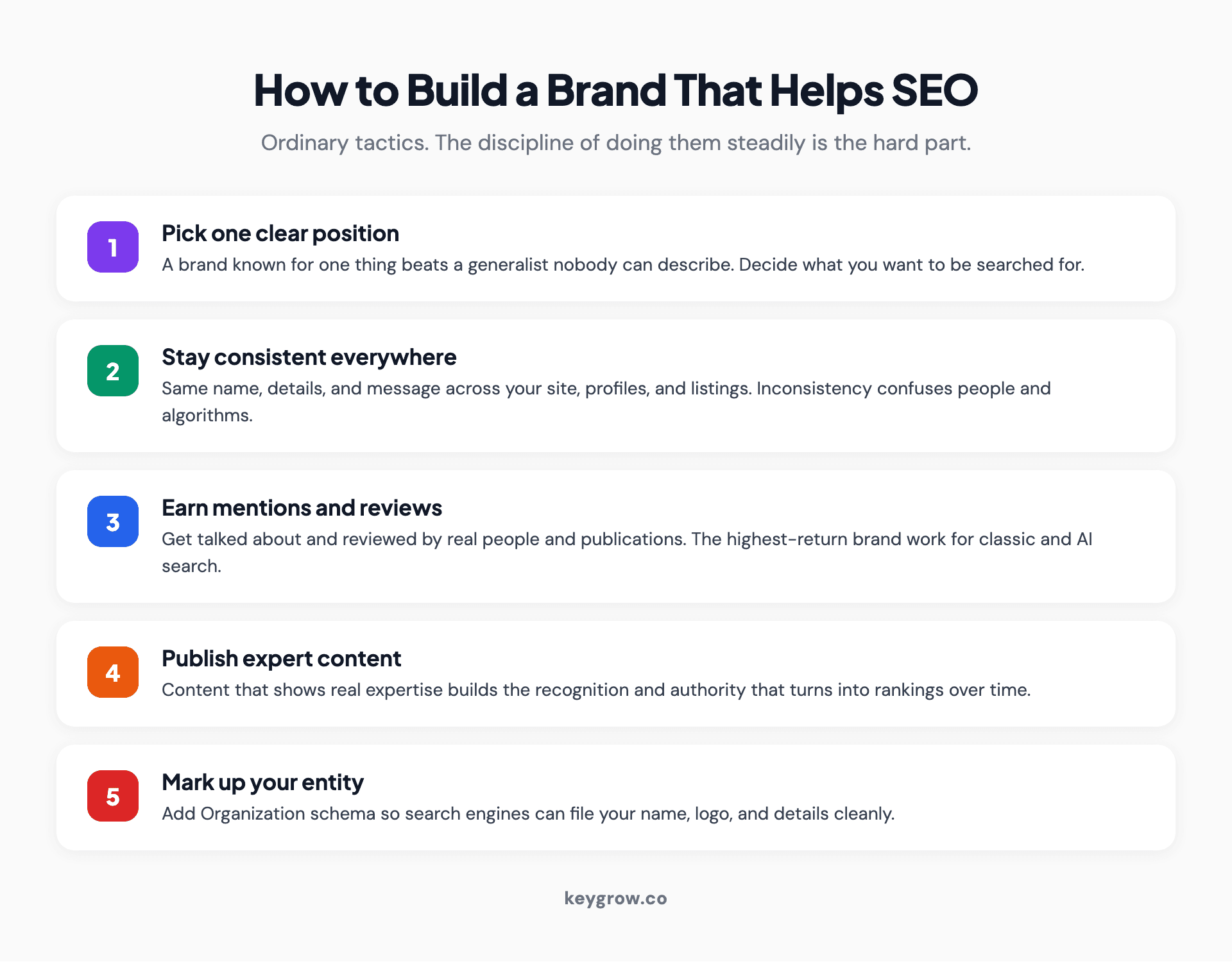
Five-step infographic for building a brand that helps SEO: define one clear positioning, keep name and details consistent everywhere, earn mentions and reviews, publish expert content, and add Organization schema so search engines recognize you as an entity.
- Pick one clear position. A brand known for one thing beats a generalist nobody can describe. Decide what you want to be searched for.
- Stay consistent everywhere. Same name, details, and message across your site, profiles, and listings. Inconsistency confuses both people and the entity-recognition systems.
- Earn mentions and reviews. Get talked about and reviewed by real people and publications. This is the highest-return brand work for both classic and AI search.
- Publish expert content. Content that demonstrates real expertise builds the recognition and authority that content marketing turns into rankings over time.
- Mark up your entity. Add Organization schema so search engines can file your name, logo, and details cleanly. Our free schema markup generator outputs it.
Should a startup prioritize branding or technical SEO first?
Fix the technical basics first, then build brand. A brand-strong site that Google cannot crawl still will not rank, and a flawless site with no brand stays invisible. The order is foundation, then recognition.
This is the honest priority most branding-for-SEO posts will not give you, and for a single-location business it can mean not hiring anyone yet. If you have five pages, no reviews, and a site with crawl errors, do not spend your first budget on a rebrand. Claim your Google Business Profile, gather reviews, fix the crawl errors, and publish the pages your customers search for, all of which an owner can do without an agency. Let brand signals build on a foundation that works. Branding accelerates SEO; it does not replace the plumbing.
How do you measure branding's impact on SEO?
Track branded search volume, direct traffic, brand mentions, and review growth over time, then watch whether your non-branded rankings rise alongside them.
Branded impressions in Google Search Console and direct traffic in analytics are the early movers; they climb first as recognition grows. Non-branded rankings and AI citations are the lagging payoff. The honest read on whether it is working is the same discipline as any SEO measurement, which we covered in how to tell whether your SEO is working: compare against a baseline, separate branded from non-branded, and give it months. Brand-building is a leading indicator of organic strength, not an overnight one.
FAQs
Is branding actually a Google ranking factor?
Not as a single, named factor you can switch on. Branding influences a cluster of signals Google does use, including the siteAuthority metric and click signals surfaced in the 2024 document leak, plus the NavBoost click system confirmed in antitrust testimony. Some of the link between brand and rankings is causal and some is brand proving authority you already earned, but every interpretation points to building it.
How do branded searches affect rankings?
When people search your name and click your result, it signals demand and relevance to Google. Branded searches are 45.7 percent of all Google search volume, so this is a large and constant signal. It feeds the click-behavior systems Google uses to decide which results deserve their position.
Do unlinked brand mentions count for SEO?
Increasingly, yes. Search engines and AI answer engines read mentions of your brand even without a hyperlink, using them to gauge how known and credible you are. For AI Overview visibility specifically, web mentions correlate about three times more strongly than backlinks.
Does branding help local SEO?
Strongly. Reviews, a consistent Google Business Profile, and matching name and address details are local brand signals that move the map pack. With 97 percent of consumers reading reviews for local businesses, your local reputation is both a ranking input and a conversion driver.
Should a small business invest in branding or technical SEO first?
Technical first, then brand. A site that cannot be crawled will not rank no matter how strong the brand, so fix the foundation, then build recognition on top of it. Branding accelerates SEO once the plumbing works.
How does branding affect AI search visibility?
It is becoming the dominant factor. Brand mentions across the web are the strongest correlate of appearing in AI Overviews, and brands cited in those answers earn 35 percent more organic clicks. Being a recognized, mentioned brand is how you get into AI answers.
How long does brand-building take to show up in SEO?
Branded impressions and direct traffic move first, often within a few months, while non-branded rankings and AI citations lag behind. Plan in quarters. Brand is a compounding asset that looks slow early and pays off as recognition accumulates.
The short version
The mechanism is real, and the AI-search shift is making brand decisive rather than optional. So the move is not to choose between branding and SEO. Fix the technical foundation first, then put the rest of your effort into becoming a name people search for and sources mention, because that is what the next decade of search rewards.
If you want a team that treats brand and search as one system rather than two budgets, our SEO service and social media work are built that way. Tell us about your business and we will tell you which half is holding you back.