

Why is an SEO audit important? Because the problems costing you traffic almost never announce themselves. A broken redirect, a page that quietly fell out of Google's index, a template change that stripped your title tags: none of it shows up as an error message. It shows up as a slow bleed of rankings and leads that you only notice months later, when the quarter looks soft and nobody can say why.
An audit is how you find those problems before they compound. That is the whole case for running one, and it is worth making properly, because most articles on this topic list what an audit checks and never tell you why skipping it is expensive. This guide does the opposite.
What an SEO audit is, in one line
An SEO audit is a structured review of everything that affects your site's ability to rank: its technical health, its content, its links, and how easily search engines can crawl and understand it.
Think of it as a diagnostic, not a fix. The audit tells you what is wrong and what to do about it, in priority order. The fixing comes after. If you want the step-by-step version of how that review is run, our guide to a technical SEO audit walks through it. This post is about why it earns a place on your to-do list in the first place.
Why an SEO audit is important: what bleeds away when you skip it
An SEO audit is important because search problems are silent and cumulative. Pages drop out of the index, links rot, and speed degrades without warning, and every week unaudited is traffic and leads you do not get back.
Here is the uncomfortable backdrop. Ahrefs found that 96.55 percent of the pages in its index get zero traffic from Google. Most of those pages are not cursed. They are just never diagnosed. Nobody checked whether they were indexed, whether anything linked to them, or whether they answered the query better than the page ranking above them.
Decay is the other half of it. Links break on their own. Ahrefs' link rot study found that 66.5 percent of links pointing to the sites it sampled had rotted over about nine years. Your internal links are part of that: pages get deleted, slugs change, and the links pointing at them quietly start returning errors. Multiply that across a site nobody audits and you get a structure that leaks authority and frustrates crawlers, with no single moment where it broke.
None of this is dramatic. That is exactly why it is dangerous. A site does not fall off a cliff. It erodes, and erosion does not trigger an alert.
What an SEO audit catches
A good audit surfaces the common, fixable problems that quietly suppress rankings: duplicate content, missing metadata, broken links, slow pages, and content that no longer matches what people search for.
These are not rare edge cases. In a Semrush study of 100,000 websites, the most common on-site issues were duplicate content (on 50 percent of sites), missing image alt attributes (45 percent), broken internal links (35 percent), and missing meta descriptions (25 percent). Half the sites had a duplicate content problem. The odds that yours has at least one of these are high.
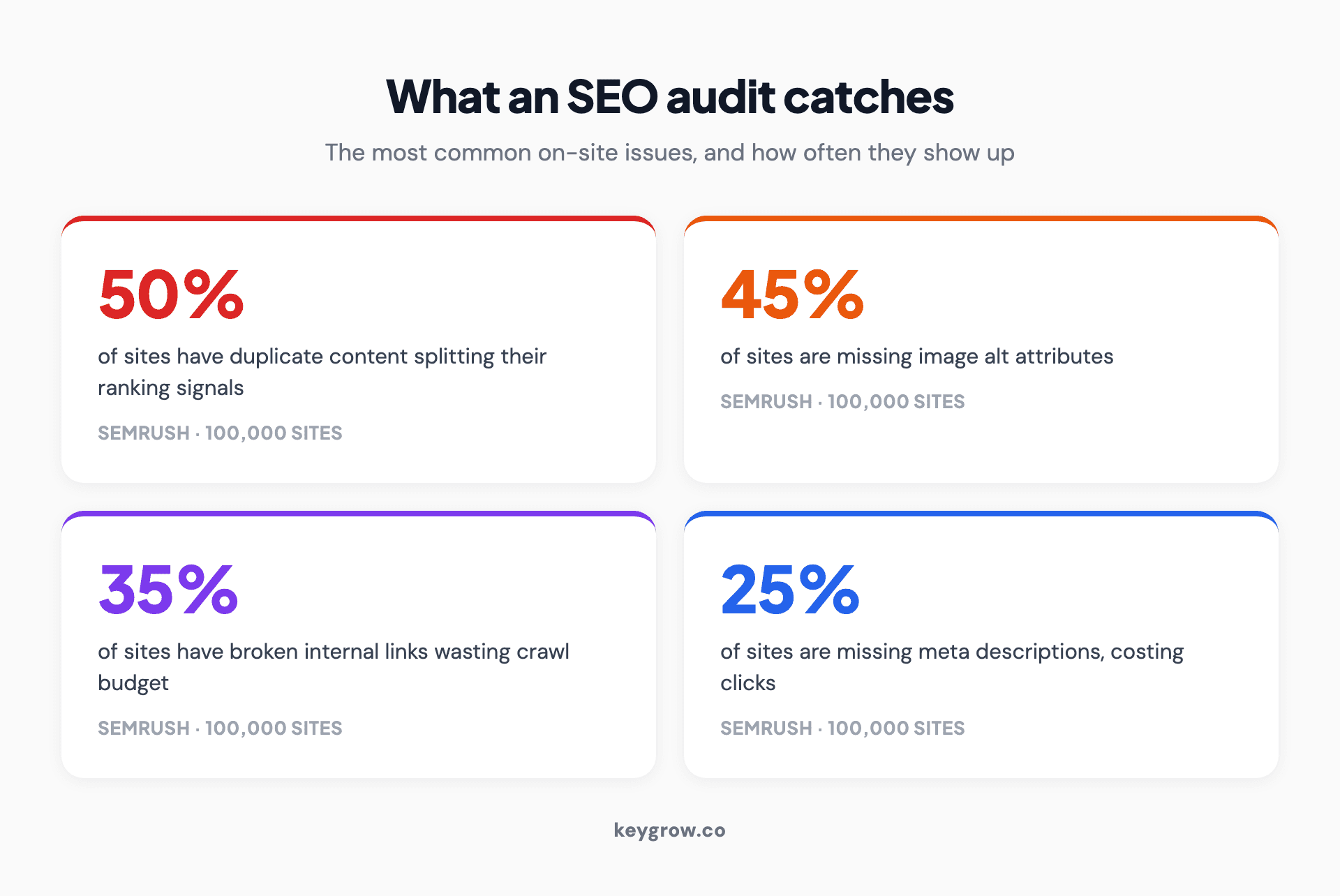
Infographic showing the most common on-site SEO issues found across 100,000 websites in a Semrush study: duplicate content on 50 percent of sites, missing image alt attributes on 45 percent, broken internal links on 35 percent, and missing meta descriptions on 25 percent.
Each one maps to a real cost:
There is a quieter technical cost too. Google's own crawl budget guidance is explicit that if a site slows down or returns server errors, Google crawls it less. A neglected, slow site ranks worse, and it gets crawled less by the very system that decides what to rank.
What it costs you to skip the audit
The cost of skipping an audit is not a fine. It is the compounding gap between the traffic you have and the traffic a healthy version of your site would earn, month after month.
This is where the abstract gets concrete. Every issue above is a leak, and leaks compound. A page that quietly deindexed in March is six months of missed leads by September. A title tag stripped in a redesign is every click you did not get since launch. The bill is real. It just never arrives as a single invoice.
The flip side is what fixing these things frees up. A doctor's practice in Dubai came to us with a site that looked fine and performed poorly. The work was not glamorous: consistent technical fixes, better content, and authority building, the exact items an audit surfaces. Months one through three looked unimpressive. By month twelve, organic traffic had grown 1,519 percent and the practice was taking 130+ patient calls a month. The audit did not create that growth. It pointed at what to fix so the growth had somewhere to come from.
That is the honest ROI framing. An audit does not add traffic. It removes the things stopping traffic, and on most neglected sites there is plenty stopping it.
Can you run an SEO audit yourself, or should you hire someone?
You can run a useful basic audit yourself with free tools. Hire a professional when the site is large, the stakes are high, or the opportunity cost of your time is greater than the fee.
Here is the part most agencies will not put in writing: a lot of audit value is do-it-yourself. Google Search Console alone shows you indexing problems, Core Web Vitals, and which pages get clicks. It is free, and for a small site it catches most of what matters. A one-location business owner with a few spare hours can find the biggest leaks without paying anyone.
| Free DIY checks | A professional audit |
|---|---|
| Search Console: indexing, Core Web Vitals, top pages | Crawls the whole site for issues you would not think to check |
| Analytics: traffic and engagement trends over time | Prioritizes fixes by impact, instead of just listing them |
| PageSpeed Insights: speed and Core Web Vitals per page | Diagnoses why traffic dropped across technical, content, and links |
| Best for small sites, a first pass, and routine checks | Best for large sites, post-migration, and unexplained drops |
So when is a paid audit worth it? When the site is big enough that issues hide in the volume, when a migration or redesign just happened, when traffic dropped and you cannot find why, or when your time is simply worth more spent elsewhere. The rule we give people is to hire when the opportunity cost of doing it yourself beats the fee, not before. If a free afternoon in Search Console would fix your top three problems, take the afternoon.
How often to repeat the audit is its own question, and we cover the cadence in how often you should audit.
Does an SEO audit help with AI search in 2026?
Yes. A modern audit now also checks whether AI crawlers can reach your content and whether your pages are structured to be quoted by answer engines, not just ranked by Google.
This layer did not exist a few years ago. AI Overviews, ChatGPT, and other answer engines pull from pages they can crawl and that clearly answer a question. A 2026 audit checks the same fundamentals as before, crawlability, clean structure, fast pages, plus a new set of questions: is your content readable in the raw HTML, is your schema in place, and are the AI crawlers allowed to fetch your pages at all. Sites that quietly block these bots, or bury their answers in scripts, are invisible to a growing share of search. Our guide to AI search optimization covers what that layer looks like.
The point is that "is my site healthy for search" now includes search that looks nothing like ten blue links. An audit is how you find out where you stand.
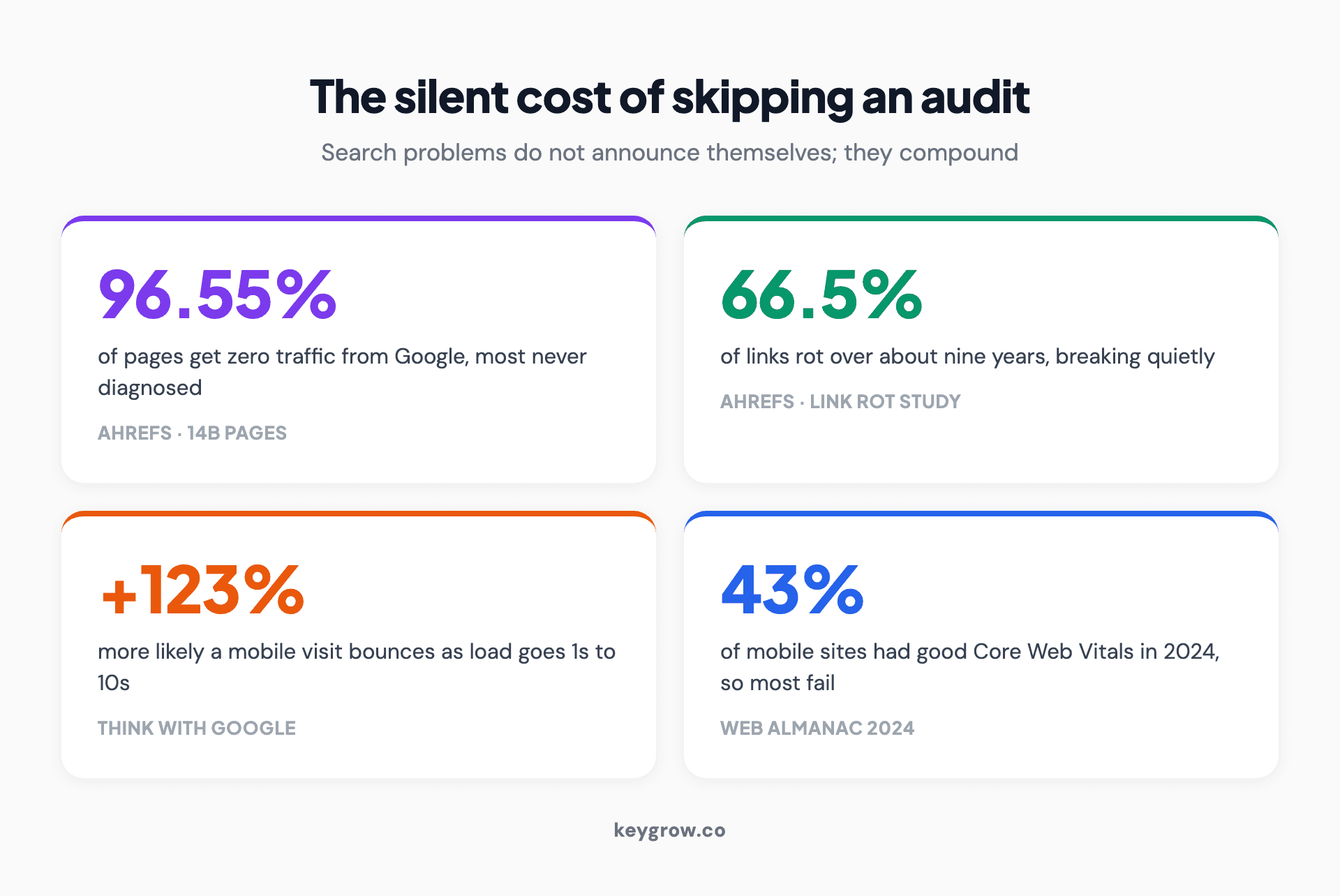
Infographic on the silent cost of skipping an SEO audit, showing four statistics: 96.55 percent of pages get zero Google traffic, 66.5 percent of links rot over about nine years, mobile bounce probability rises 123 percent as load time goes from one to ten seconds, and only 43 percent of mobile sites had good Core Web Vitals in 2024.
FAQs
What is the main goal of an SEO audit?
The goal is to find and prioritize everything stopping your site from ranking and converting. A good audit ranks problems by impact, so you fix the few issues that move traffic first instead of spending weeks on cosmetic ones that change nothing.
Why is an SEO audit important for my business?
An SEO audit is important because search problems are silent. Pages deindex, links break, and speed slips without any alert, and each one quietly costs you traffic and leads. An audit catches those leaks before they compound into a soft quarter nobody can explain, which is far cheaper than discovering them a year later.
What does an SEO audit catch?
The common, fixable issues that suppress rankings: duplicate content, missing or weak metadata, broken internal links, slow pages and failing Core Web Vitals, pages that fell out of Google's index, and content that no longer matches search intent. A Semrush study found half of sites have duplicate content alone.
How long does an SEO audit take?
A focused technical audit of a small site can be done in a day. A full audit of a large or complex site, covering technical health, content, and backlinks, usually takes one to two weeks to do properly. Rushing it defeats the purpose, since the value is in catching what a quick look misses.
Can I do an SEO audit myself or should I hire a professional?
You can do a useful basic audit yourself with Google Search Console, Analytics, and PageSpeed Insights, all free. That is the right call for a small site. Hire a professional when the site is large, a migration or redesign just happened, traffic dropped for reasons you cannot find, or your time is worth more elsewhere.
Does an SEO audit guarantee higher rankings?
No, and be wary of anyone who says it does. An audit finds what to fix. Rankings move when you fix those things and then earn content and links over time. The audit is the diagnosis, not the cure, and SEO results still take months to compound regardless of how good the audit is.
How much does it cost to skip an SEO audit?
There is no invoice, which is the trap. The cost is the compounding gap between the traffic you have and what a healthy site would earn: a deindexed page is months of missed leads, a stripped title tag is every click since the redesign. On a neglected site that gap is usually large and entirely invisible until someone looks.
Does an SEO audit help with AI search and AI Overviews in 2026?
Yes. A current audit checks whether AI crawlers can reach your pages, whether your content sits in the raw HTML rather than buried in scripts, and whether your schema and structure make you easy to quote. Answer engines pull from pages they can crawl and understand, so the same health that helps Google now helps AI visibility too.
The short version
The problems that cost you rankings stay quiet, and they compound while you are not looking. Half of sites have duplicate content, links rot on their own, most mobile sites fail Core Web Vitals, and almost none of it announces itself. An SEO audit is simply how you find those leaks before they turn into a year of missed leads, and then fix the few that matter most.
You can start the basic version yourself this afternoon in Search Console. If the site is large, something broke after a redesign, or traffic dropped and you cannot find why, that is when an outside audit earns its fee. If you want a second set of eyes on yours, that is what our SEO team does. Tell us about your traffic and we will tell you where it is leaking.


