

How many times should you audit your site for SEO? For most sites, run a full SEO audit at least twice a year, move to quarterly if your site is large, competitive, or changes often, and add a quick fifteen-minute health check every month on top. Then run an extra audit whenever something big happens: a traffic drop, a redesign, a migration, or a Google core update. There is no single magic number, because "audit" is really four different jobs on four different clocks.
That is the honest answer, and the rest of this guide makes it usable. Below is how to find your own cadence based on your site, the four audit types and how often each one needs doing, the events that should force an off-schedule audit, and why none of this is one-and-done. If you only take one thing: twice a year is the floor, not the goal.
Why an SEO audit is never one-and-done
An audit is a snapshot, and your site, your competitors, and Google all keep moving after you take it. Treating an audit as a one-time setup is the single most common reason sites quietly slide down the rankings while the owner assumes everything is fine.
Start with Google itself. By its own account, in 2023 Google ran 719,326 search quality tests and shipped 4,781 changes to Search. On top of that steady drip, Google makes core updates "several times a year," and Search Engine Land counted three core updates in 2025 and four in 2024. The ground under your rankings shifts constantly, so a clean audit in January says little about where you stand in July.
Then there is the rot that accumulates on any active site. Links break, redirects pile up, pages get republished with broken formatting, and duplicate content creeps in. This is not rare. In an Ahrefs study of over a million domains, 72.9 percent had missing or empty meta descriptions and 72.3 percent had slow-loading pages. A Semrush study of 100,000 sites found duplicate content was the most common issue at 50 percent of sites, followed by missing image alt tags at 45 percent, then broken internal links and duplicate title tags tied at 35 percent. These problems do not announce themselves. An audit is how you find them before they cost you.
Finally, content decays. Ahrefs found that 96.55 percent of the pages in its index get zero traffic from Google, based on a roughly 14-billion-page sample, and even your winners fade: Animalz measured content decaying at about 1.21 percent per week as it ages. The flip side is the opportunity. HubSpot grew monthly organic views to old posts by 106 percent on average and tripled the leads from them, by updating and republishing content they already had. Auditing is also how you find the pages worth reviving.
Find your audit cadence
Your ideal frequency comes down to two axes: how often your site changes and how competitive your market is. Find your cell in the grid below, then bump up a tier if your site is large.
The more your site changes and the harder your market, the more often you look. Cross those two axes and you can locate your cadence instead of guessing at a number.
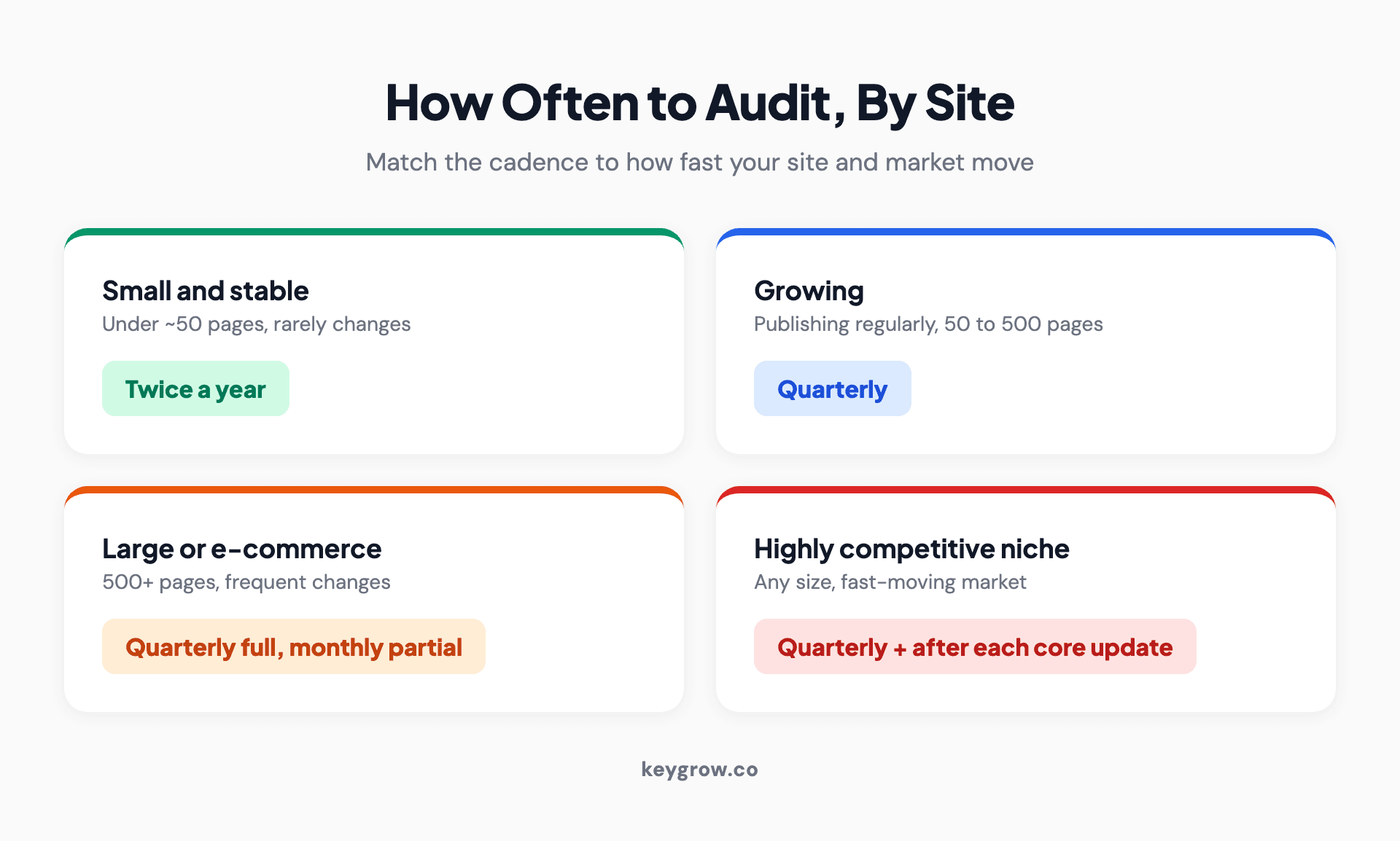
Infographic showing SEO audit cadence by site type: small stable sites twice a year, growing sites quarterly, large or competitive sites monthly to quarterly.
| How often your site changes | Low-competition market | High-competition market |
|---|---|---|
| Rarely (small, static site) | Twice a year | Quarterly |
| Regularly (active blog or new pages) | Quarterly | Quarterly, plus after each core update |
| Constantly (large or e-commerce) | Quarterly full, monthly partial | Monthly partial, plus quarterly full and post-update checks |
Two modifiers sit on top of the grid. If your site is large (roughly 500 pages or more), bump yourself up a tier, because scale multiplies small issues fast and rolling section-by-section audits beat one annual sweep. And any trigger event, covered below, overrides the calendar entirely. A local plumber with a ten-page site that never changes does not need a monthly audit; a retailer adding products every week does. Match the effort to the rate of change, not to a number you read somewhere.
The four audit types, each on its own clock
There is no single audit. Run a fifteen-minute health check monthly, a full technical audit quarterly, a deep content audit annually, and backlink and local checks whenever events demand them.
Here is the reframe that makes "how many times" finally make sense. An SEO audit is really four different jobs, and each one runs on its own schedule. Stop thinking about a single audit and start thinking about a rotation.
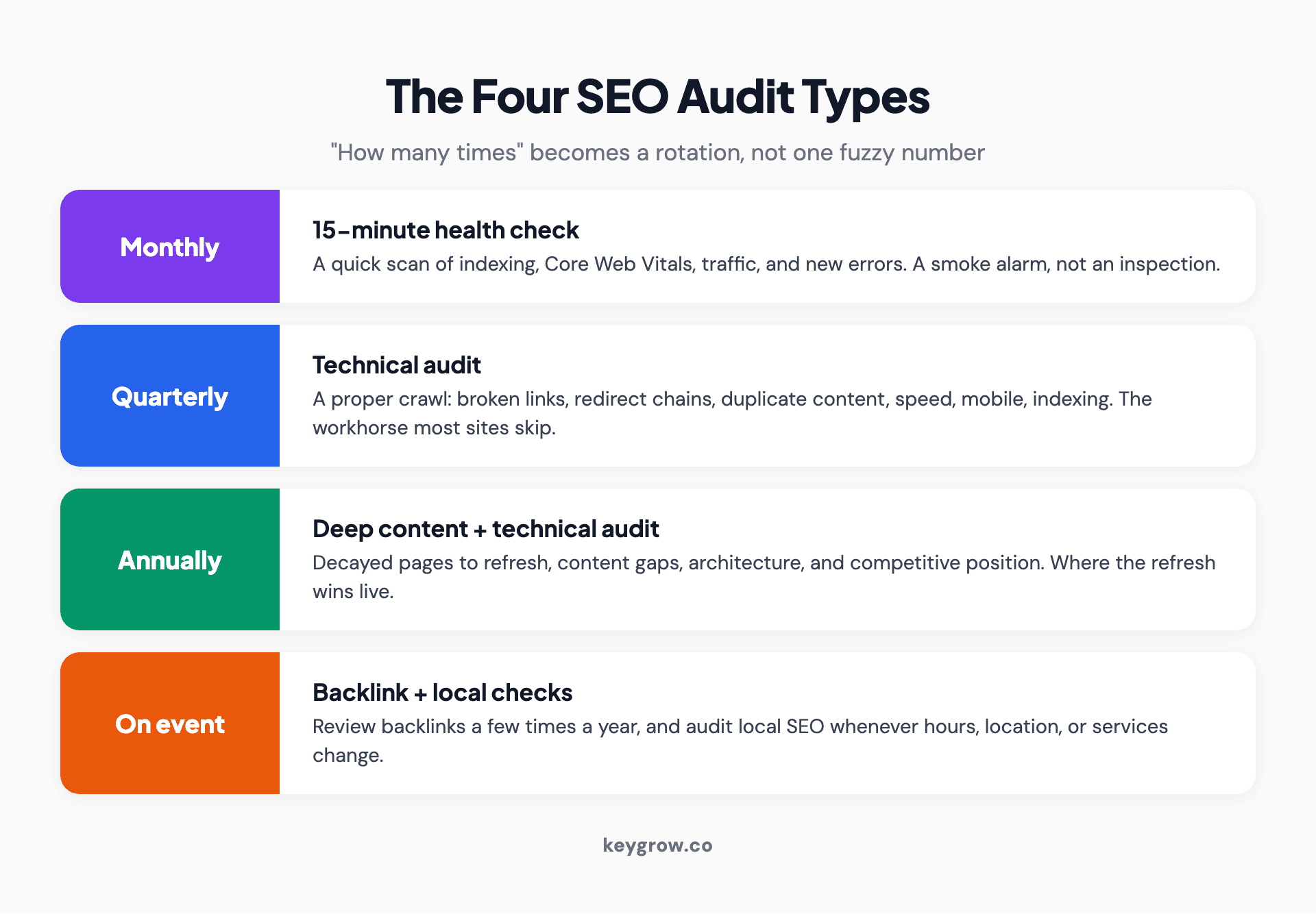
Infographic of four SEO audit types and their cadences: a monthly fifteen-minute health check, a quarterly technical audit, an annual deep content and technical audit, and event-driven backlink and local checks.
The monthly health check takes fifteen minutes. You open Search Console and Analytics, glance at indexing, Core Web Vitals, traffic, and any new crawl errors, and you confirm nothing is on fire. Think of it as a smoke alarm rather than a full inspection, and the cheapest insurance in SEO.
The quarterly technical audit does the heavy lifting. Every three months you crawl the site properly, checking broken links, redirect chains, duplicate content, page speed, mobile usability, and indexing coverage. Most sites that "do SEO audits" should be doing this one, and most are not.
The annual deep audit goes wider than the rest. Once a year you move beyond technical into content and strategy: which pages have decayed and need refreshing, where the content gaps are, how your site architecture is holding up, and how you stack against competitors. This is where the content-refresh wins live.
Event-driven audits of your backlink profile and local presence happen on demand rather than on a calendar. Check your backlinks a few times a year or when you suspect a problem, and audit your local SEO and Google Business Profile whenever your hours, location, or services change.
Run all four and "how often should I audit" stops being one fuzzy number. It becomes a calendar.
Trigger events that demand an off-schedule audit
Audit immediately, no matter your schedule, after a traffic or ranking drop, a migration, a redesign, or a Google core update, and before any major campaign.
Your regular cadence handles the slow drift. Some events cannot wait for the next scheduled check, and auditing immediately is how you catch a problem while it is still small.
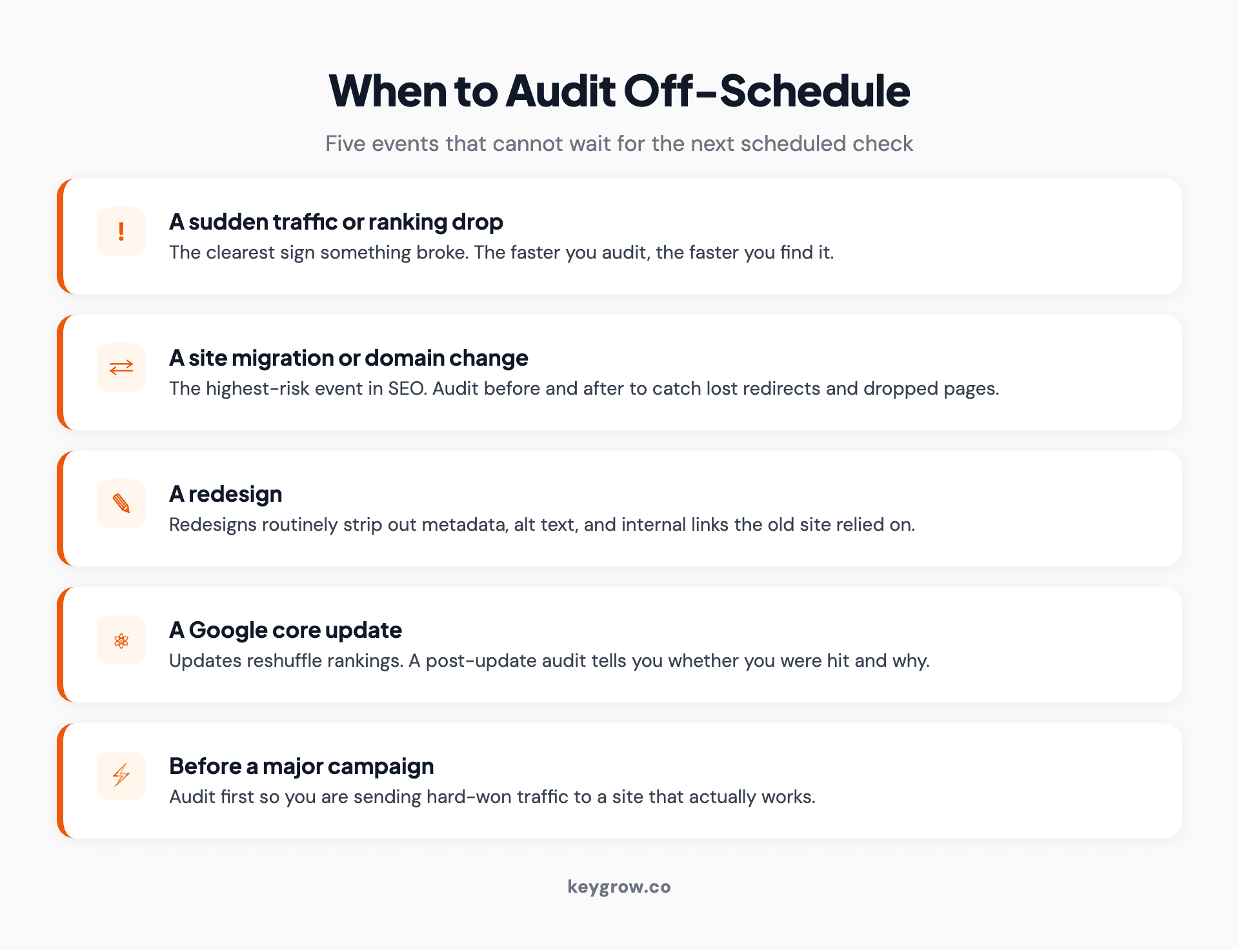
Infographic listing five trigger events for an immediate SEO audit: a sudden traffic or ranking drop, a site migration, a redesign, a Google core update, and before a major campaign.
| Trigger | Why it cannot wait |
|---|---|
| Sudden traffic or ranking drop | The clearest sign something broke; the faster you audit, the faster you find it |
| Site migration or domain change | The highest-risk event in SEO; audit before and after to catch lost redirects and dropped pages |
| A redesign | Redesigns routinely strip out metadata, alt text, or internal links the old site relied on |
| A Google core update | Updates reshuffle rankings; a post-update audit tells you whether you were hit and why |
| Before a major campaign | Audit first so you are sending hard-won traffic to a site that actually works |
The rule of thumb: any time the site changes a lot, the market changes a lot, or the numbers change a lot, do not wait for the calendar.
Auditing and monitoring are not the same thing
One distinction saves a lot of wasted effort. Monitoring is the continuous, automated watch you keep every day through alerts and dashboards. Auditing is the periodic, hands-on deep dive you schedule. You need both, and they answer different questions.
Monitoring tells you the moment something breaks. Auditing tells you what to improve and why. If your monitoring is set up well, your audits get easier, because the fires are already handled and you can spend audit time on strategy instead of triage. We cover the daily side in detail in how to track SEO, so this guide stays on the periodic audits. The short version: monitor continuously, audit on a schedule, and never let one stand in for the other.
A note on doing it yourself. The monthly fifteen-minute health check is genuinely something most business owners can run alone with free tools, and you should, because it costs nothing and catches the obvious problems early. The quarterly and annual audits are where depth and experience start to matter, and where a DIY approach can quietly fail by missing the issues you do not know to look for. Do the easy part yourself and bring in help for the deep ones, rather than paying someone to glance at a dashboard you could read yourself.
FAQs
How many times a year should you audit your site for SEO?
Most sites should run a full SEO audit at least twice a year, with a quick monthly health check in between. Larger, more competitive, or fast-changing sites should move to quarterly full audits. On top of that, run an extra audit after any major event like a migration, redesign, or Google core update.
How often should a small business or low-page-count site run an SEO audit?
A small site under about 50 pages that rarely changes is fine with a full audit twice a year, plus a fifteen-minute monthly check of Search Console for indexing and crawl errors. There is no need to audit a stable ten-page site every month; match the frequency to how often the site actually changes.
How often should large or fast-changing sites be audited?
Large sites, e-commerce stores, and sites in competitive niches should run a full technical audit quarterly, often with monthly partial audits of key sections. At scale, small issues multiply quickly, so rolling section-by-section audits work better than one big annual sweep.
What events should trigger an immediate, off-schedule SEO audit?
Audit right away after a sudden traffic or ranking drop, a site migration or domain change, a redesign, or a Google core update, and before launching a major campaign. These events either introduce errors or change the playing field, and catching the impact early is far cheaper than discovering it months later.
Is a quick monthly health check the same as a full SEO audit?
No. A monthly health check is a fifteen-minute scan of indexing, Core Web Vitals, traffic, and new errors to confirm nothing is broken. A full audit is a deep, hands-on review of technical health, content, and strategy. The health check is a smoke alarm; the audit is the inspection.
Can you fully automate SEO audits?
Automated tools handle the continuous monitoring and flag many technical issues, but they cannot replace a manual audit. Judging content quality, search intent, site architecture, and strategy still needs a human. The best setup pairs automated monitoring with periodic human-led audits.
How often should you do a content audit versus a technical audit?
Run a technical audit quarterly for most active sites, since technical errors accumulate fast. A full content audit, where you find decaying pages to refresh and gaps to fill, is usually an annual job, though high-volume publishers benefit from a lighter content review every quarter.
How long does an SEO audit take?
A monthly health check takes about fifteen minutes. A quarterly technical audit on a small-to-medium site takes a few hours to a couple of days depending on size. A full annual audit covering technical, content, and competitive analysis can take several days. Larger sites and deeper audits take proportionally longer.
The short version
Build the calendar once and the question answers itself. Block out a monthly smoke test, a quarterly deep crawl, and an annual content sweep, then treat any sharp change in your site, your market, or your numbers as a reason to audit early. Google ships thousands of changes a year and content decays every week, so a one-time audit cannot hold the line. Do the monthly check yourself with free tools, hand off the deep ones, and you will catch problems while they are still cheap to fix.
If you would rather hand off the deep audits and just get a clear list of what to fix, that is part of how our SEO service works. Tell us about your site and we will tell you how often it needs auditing.


