

Does site engagement affect SEO? Partly, and the distinction matters. The engagement metrics you watch in Google Analytics, bounce rate, time on page, session duration, are not ranking factors, and Google has said so for years. But click signals from the search results page do influence rankings, through a system called Navboost that came to light in 2024. So engagement matters, just not the version of it most people obsess over.
This is one of the most confused topics in SEO, because Google spent a decade saying user signals do not affect rankings, and then a document leak and an antitrust trial suggested they do. Both are true once you split them apart. This guide untangles it: what Google genuinely does not use, what it does, and the practical takeaway that makes the whole debate moot for how you actually run your site.
Does site engagement affect SEO?
Indirectly, and through clicks rather than dashboard metrics. Your Google Analytics bounce rate and time on page are not ranking factors. But Google does use click behavior from the search results, so engagement influences rankings as a result of satisfying searchers, not as a metric you tune.
The trap is treating "engagement" as one thing. The engagement in your analytics dashboard and the click behavior Google measures on its own results page are different data from different places. Google sees how people interact with its search results. It does not log into your Analytics account. Once you separate those two, the contradiction that confuses everyone disappears, and so does the temptation to game metrics that were never the point.
What Google says: your bounce rate is not a ranking factor
Google has stated plainly and repeatedly that it does not use Google Analytics metrics like bounce rate to rank pages. This has been the official line for years, from multiple Google representatives.
Take it from Google directly. As Search Engine Journal documents, Google's John Mueller said there is a misconception that Google looks at things like the analytics bounce rate when ranking websites, and that this is definitely not the case. Years earlier, Gary Illyes of Google said the same in plainer terms: Google does not use analytics or bounce rate in search ranking.
There are good technical reasons to believe them. Not every site even runs Google Analytics, so Google cannot depend on a metric most of the web does not expose to it. Bounce rate is also easy to manipulate and easy to misread. A high bounce rate can mean a page failed, or it can mean the page answered the question so completely that the visitor had no reason to click further. A metric that ambiguous is a poor ranking signal, which is part of why Google does not use it. So the popular advice to "lower your bounce rate to improve SEO" is chasing a number that does not feed rankings.
What the 2024 leak and antitrust trial revealed
That Google does use click behavior, through a system called Navboost. This is not the same as your analytics data. Navboost works from clicks on the search results page itself, and two separate events in 2024 and 2023 confirmed it.
The first was sworn testimony. In the United States antitrust trial, Google VP Pandu Nayak described Navboost on the record. As Search Engine Land reported, Nayak called Navboost one of the important signals Google has, and explained it as a memorization system that learns from clicks on queries over roughly the past 13 months.
The second was the document leak. In spring 2024, thousands of internal Google Search API documents became public, with 2,596 modules and 14,014 attributes between them, as Search Engine Land covered. Among the attributes were click measures named badClicks, goodClicks, and lastLongestClicks. Analyzing the same documents, Mike King of iPullRank concluded there can be little doubt that Google uses clicks and post-click behavior as part of its ranking algorithms. Notably, the documents also describe normalizing the click data to guard against manipulation, so you cannot bot your way up.
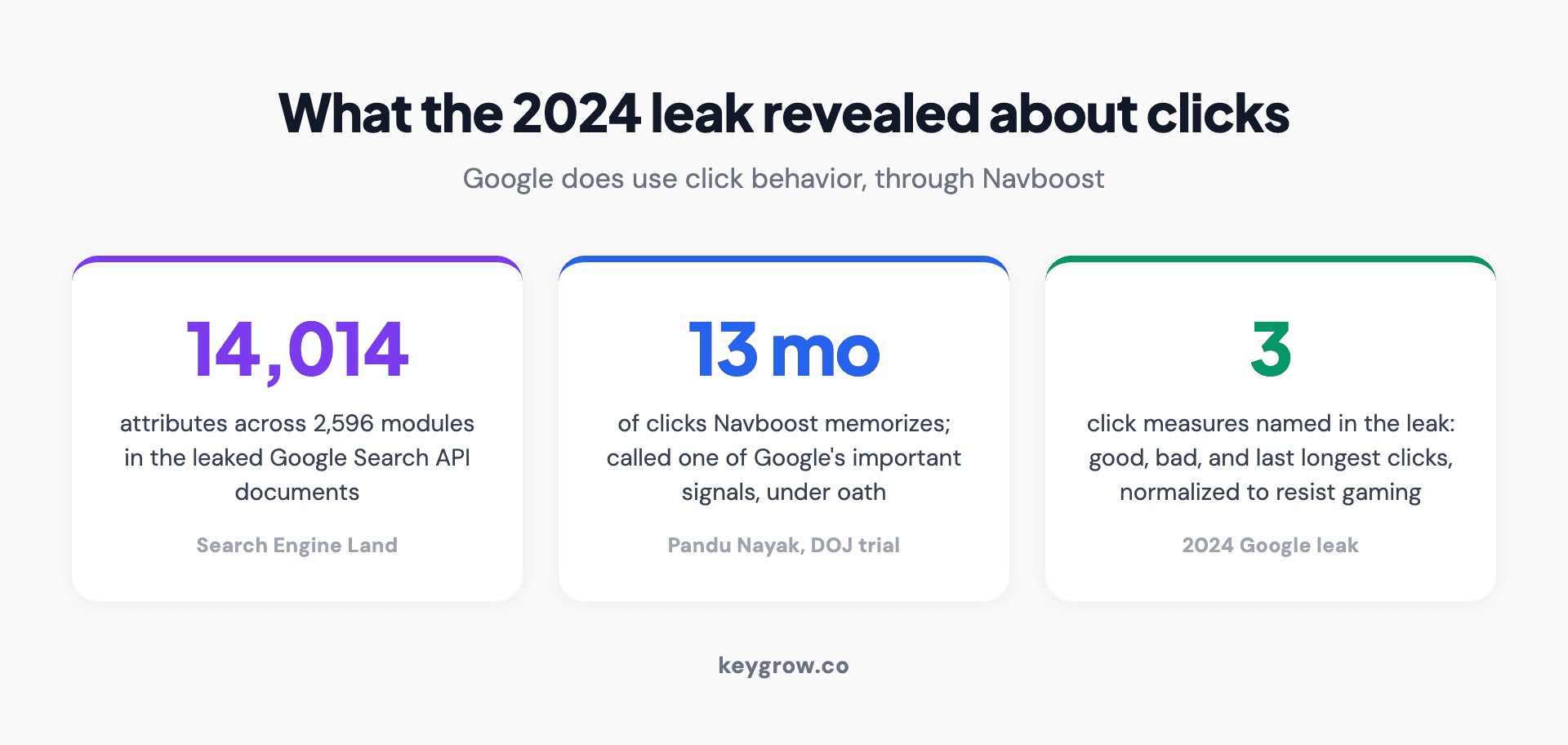
Infographic explaining what the 2024 Google leak and antitrust trial revealed about Navboost, shown as three facts. First: the leaked Google Search API documents contained 14,014 attributes across 2,596 modules, source Search Engine Land. Second: Navboost memorizes roughly 13 months of click data and Google VP Pandu Nayak called it one of Google's important signals under oath. Third: the leaked click measures were named good clicks, bad clicks, and last longest clicks, with the data normalized to prevent manipulation.
So the headline is real: clicks influence rankings. But read the detail. These are clicks and post-click satisfaction measured on Google's results, not the engagement numbers in your dashboard.
So does engagement affect SEO, or not?
Both answers are right, because they describe different things. The engagement metrics in your analytics are not ranking factors. The click behavior on Google's search results is. Once you draw that line, the years of seemingly contradictory advice line up.
Here is the clean version of the reconciliation:
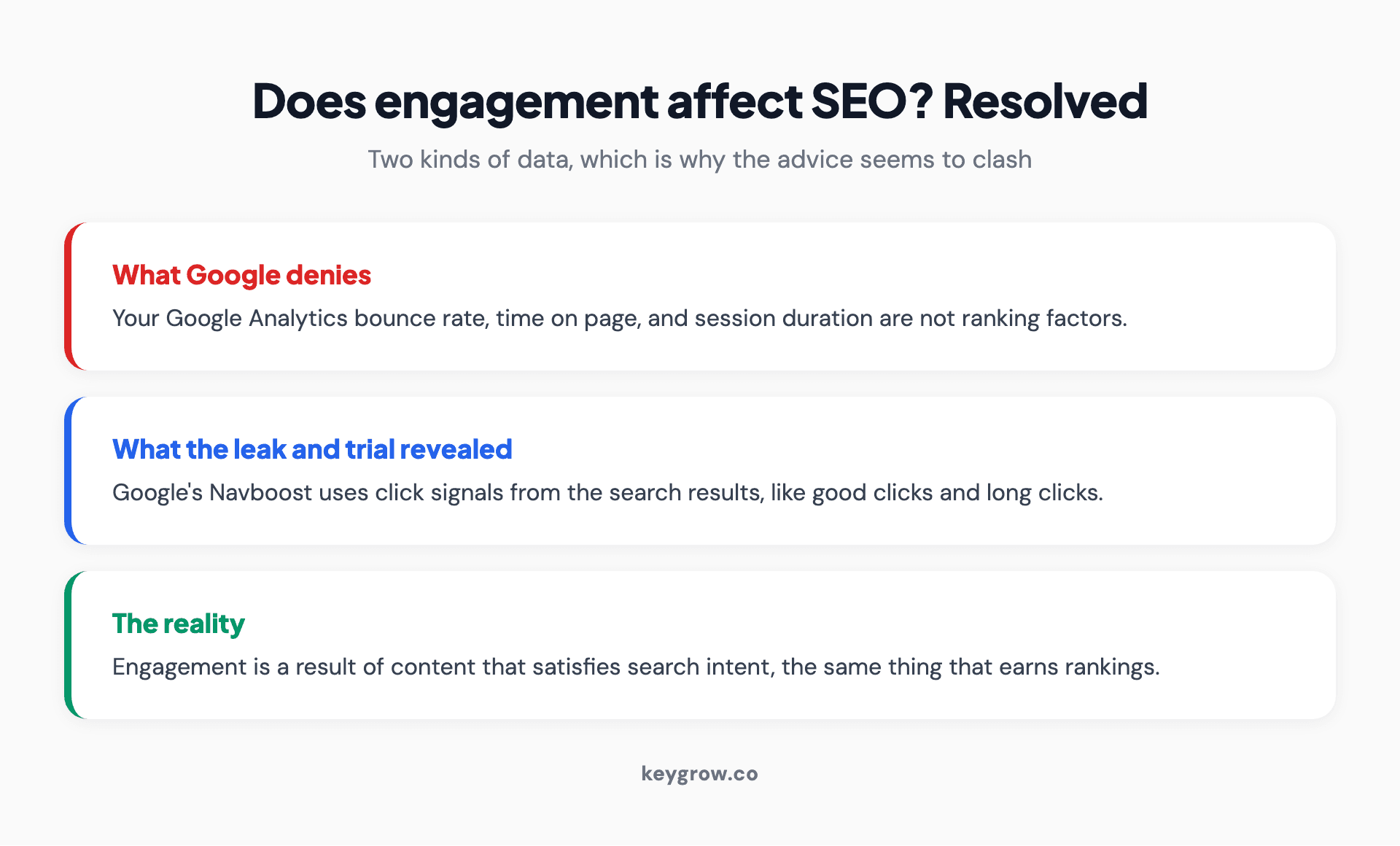
Infographic resolving the engagement and SEO contradiction in three stacked parts. Part one, in red, what Google denies: your Google Analytics bounce rate, time on page, and session duration are not ranking factors. Part two, in blue, what the leak and trial revealed: Google's Navboost uses click signals from the search results, like good clicks and long clicks. Part three, in green, the reality: engagement is a result of content that satisfies search intent, the same thing that earns rankings.
This is why two SEOs can argue forever. One points at Google saying bounce rate does not matter and is correct. The other points at Navboost and is also correct. They are describing different data.
Engagement is a result, not a lever
Here is the opinion worth taking from all of this: engagement is a result, not a lever. You cannot pull it directly to lift rankings, and trying to is a waste of effort. The pages that earn good click signals are the ones that genuinely answer the query, full stop.
The leak makes this point better than any theory. Google normalizes click data specifically so that fake or manipulated clicks do not move rankings, and Navboost is built around long clicks, the searcher clicking your result and not coming back for something better. You cannot fake a long click at scale. The only reliable way to produce one is to be the result that satisfies the person. That is also what lowers your real bounce rate, raises real time on page, and earns links. The cause is the same.
So chasing engagement metrics directly gets the logic backward. Clickbait titles raise click-through rate and then crater satisfaction when the page does not deliver, which is exactly the short-click pattern Navboost penalizes. Padding a page to inflate time on page annoys readers. The honest move is to make the page so clearly useful that engagement happens on its own, which is the same standard we argue for in why unique content is so important.
Which engagement metrics should you ignore?
Stop treating dashboard metrics as ranking levers. Bounce rate, raw time on page, and session duration are useful for understanding your users, but they are not knobs that move rankings, and optimizing them for SEO is effort spent in the wrong place.
Here is the practical split between what to stop chasing and what to work on:
| Stop chasing for SEO | Optimize instead |
|---|---|
| Google Analytics bounce rate as a ranking metric | Matching the search intent behind the query |
| Raw average time on page | Answering the question in the first lines |
| Generic session duration | Page speed and a clean mobile experience |
| Click-through rate via clickbait titles | A title and snippet that earn the right click |
None of this means ignore your analytics. Bounce rate and time on page are genuinely useful for spotting pages that frustrate visitors, and fixing those pages is worth doing. Just do it to serve users, not to feed a ranking signal that does not exist. The metrics worth tracking for SEO are the ones tied to outcomes, which we lay out in how to track SEO. And because click satisfaction now matters in the age of AI Overviews too, earning the right click rather than any click is more valuable than ever.
FAQs
Does bounce rate affect SEO?
Not directly. Google has said repeatedly that it does not use Google Analytics bounce rate as a ranking factor, and there are good reasons to believe it, since most sites do not expose that data to Google and the metric is easy to misread. A high bounce rate can even mean a page answered the question perfectly. Fix high bounce rates to serve users, not to chase rankings.
Is dwell time a Google ranking factor?
Not as a metric Google measures on your site. Google does not track how long visitors stay on your page from your analytics. What it does measure, through Navboost, is click behavior on its own search results, including whether someone clicks your result and stays rather than returning to search for a better answer. That is related to dwell time in spirit, but it is measured from the search results, not your site.
Does click-through rate affect SEO?
Click behavior does influence rankings via Navboost, which the 2024 leak and antitrust testimony confirmed. But that does not make raising your click-through rate with clickbait a winning strategy. Misleading titles earn the click and then lose the visitor fast, the short-click pattern the system is designed to discount. A title that earns the right click from the people your page serves is what helps.
What is Navboost?
Navboost is a Google ranking system that uses click signals from search results to adjust rankings. Google VP Pandu Nayak described it under oath as a memorization system that learns from clicks over about 13 months, and the 2024 document leak revealed click measures like good clicks, bad clicks, and last longest clicks. It uses behavior on Google's results page, not data from your analytics, and the click data is normalized to resist manipulation.
Does Google use Google Analytics data for ranking?
No. Google representatives including John Mueller and Gary Illyes have stated that Google does not use Google Analytics metrics such as bounce rate for ranking. Most websites do not run Analytics, so Google could not rely on it even if it wanted to. The click signals Google does use come from its own search results page, which is entirely separate from your Analytics account.
What is pogo-sticking, and does it hurt rankings?
Pogo-sticking is when a searcher clicks your result, quickly returns to the search page, and clicks a different result instead. It signals your page did not satisfy the query. This kind of short-click behavior is the opposite of the long clicks Navboost rewards, so consistently failing to satisfy searchers can work against you. The fix is not a trick, it is making the page deliver what the searcher came for.
Can I improve rankings by lowering my bounce rate?
Not directly, because bounce rate is not a ranking factor. What helps is the thing that also lowers a genuine bounce rate: a page that matches intent, answers quickly, and gives people a reason to stay. Optimize for that, and the engagement numbers improve as a side effect. Optimize the number itself and you are tuning a gauge that is not wired to rankings.
The short version
Does site engagement affect SEO? The engagement in your analytics dashboard does not. Google has said for years that bounce rate and analytics data are not ranking factors, and the technical reasons hold up. But click behavior on Google's search results does matter, through the Navboost system that the 2024 leak and antitrust testimony brought into the open. Those are two different kinds of data, which is why the advice has always seemed to contradict itself.
The practical takeaway makes the whole debate easy. Engagement is a result, not a lever. You cannot fake the long clicks Navboost rewards, and you cannot trick your way to better rankings by massaging dashboard metrics. Build pages that genuinely satisfy the searcher, and good clicks, real engagement, and rankings follow from the same cause. If you want help working out whether your pages are actually satisfying searchers or quietly sending them back to Google, that is part of what our SEO team digs into. Tell us about your site and we will show you where visitors are losing interest, and why.


