

Google AI Overviews will affect your SEO in one specific way: they reduce clicks on informational searches, the "what is" and "how does" queries where Google can answer the question in the box without sending anyone to your site. They do far less damage to the searches that make you money, and they have not killed SEO. They have changed which SEO is worth paying for.
That is the honest version, and it sits between the two stories you will hear everywhere else. One says AI Overviews are an extinction event for organic traffic. The other, told by Google, says everything is fine and clicks are even better now. The data tells a more useful story than either. This guide walks through what the independent studies actually found, what Google claims and why to read it carefully, and the practical move: stop spending on the content AI Overviews eat, and redeploy toward the queries they leave alone.
How are Google AI Overviews going to affect SEO?
AI Overviews lower click-through rates on informational queries by answering them directly, so top-of-funnel blog traffic falls. They affect transactional, local, and branded searches far less, which is where most revenue comes from anyway.
The effect is real but uneven. If your organic strategy leans on broad informational content (definitions, basic how-tos, "what is X" articles), AI Overviews are a direct threat, because Google now summarizes that answer above your link and most people never scroll to you. If your strategy targets people ready to buy, hire, or visit, the impact is smaller. The mistake is treating AI Overviews as a single problem to panic about, when they are really a reason to move your effort from the content that was never your best traffic to the content that was.
What are AI Overviews, and how often do they appear?
An AI Overview is the AI-generated summary Google places at the top of some search results, pulling from multiple web pages and citing a few of them. They do not appear on every search. Independent measurement puts the share well below half.
This is the first place the panic narrative overreaches. AI Overviews feel like they are everywhere, but the data says otherwise. A 2025 Pew Research Center study, built from the real browsing data of 900 US adults across nearly 69,000 searches, found that 18 percent of Google searches produced an AI summary. Ahrefs, measuring 146 million search results, put the share of keywords that trigger an AI Overview at 21 percent. So roughly one in five searches, not all of them.
The technical part worth understanding is how Google chooses what to cite. AI Overviews work by retrieving relevant pages and generating an answer from them, which means your page has to be retrievable and good enough to pull from. The catch, and we will come back to it, is that the pages Google cites are overwhelmingly ones that already rank well.
Do AI Overviews reduce clicks?
Yes, clearly, on the searches where they appear. The strongest independent studies all point the same direction: when an AI Overview shows up, fewer people click through to any website, and the top organic result loses a large share of its clicks.
Here is what the research found. The Pew study measured that users clicked a traditional search result in just 8 percent of visits when an AI summary was present, compared with 15 percent when it was not. Clicking the links inside the AI summary was rarer still, happening in only 1 percent of visits to pages with a summary. People were also more likely to end their session entirely: that happened on 26 percent of pages with an AI summary versus 16 percent without.
Ahrefs reached the same conclusion from the ranking side. Analyzing 300,000 keywords, it found that the presence of an AI Overview cut the click-through rate of the number one result by 34.5 percent. Losing a third of the clicks on your best position is not noise. It is a real tax on informational rankings.
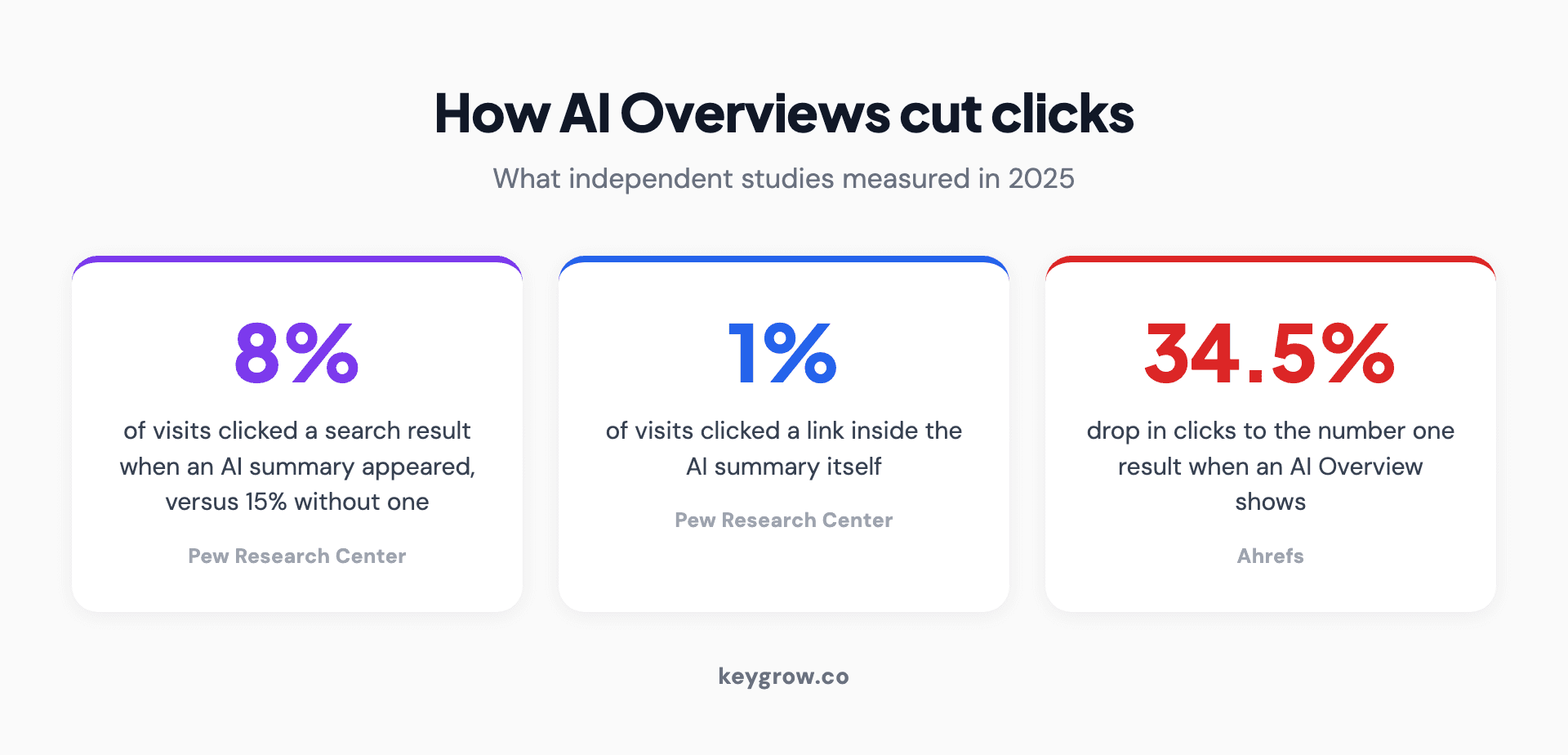
Infographic showing three statistics on how AI Overviews reduce clicks. First: users clicked a search result in 8 percent of visits when an AI summary appeared versus 15 percent when it did not, source Pew Research Center. Second: only 1 percent of visits clicked a link inside the AI summary, source Pew Research Center. Third: the click-through rate of the number one result dropped 34.5 percent when an AI Overview was present, source Ahrefs.
Sit with the 1 percent figure for a second, because it reframes the whole "how do I get cited" conversation. Being named in an AI Overview gets you seen, but it sends almost no direct traffic. Citation is a branding win, not a traffic win.
What does Google say, and should you believe it?
Google's position is that total clicks are holding steady and the clicks AI Overviews send are higher quality. That may be partly true, but Google has not released the data to prove it, while two independent studies measured the opposite at the page level. Read it as a claim, not a finding.
In an August 2025 post, Google stated that total organic click volume to websites has been relatively stable year over year, and that it is sending slightly more "quality clicks," meaning clicks where users do not immediately bounce back. Earlier, in May 2024, Google said that with AI Overviews people visit a greater diversity of websites and that the links inside Overviews get more clicks than the same page would as a plain listing.
Both things can be partly true and still leave a business worse off. "Stable total clicks" across all of Google says nothing about your informational pages specifically, and the independent page-level data (Pew, Ahrefs) found real declines exactly there. Google is not necessarily lying, but it is describing the forest while you are standing in a tree that is losing leaves. Trust your own analytics over any platform's reassurance, which is the same reason we tell clients to track SEO against leads and revenue rather than a vendor's summary.
The real shift: from ranking for clicks to being the source
Here is the one opinion worth taking from this whole piece: the question has changed from "how do I rank" to "how do I become the source Google quotes." Ranking still matters, but it is now the entry ticket to citation rather than the finish line.
The reason is in the data. Ahrefs found that 76 percent of the pages cited in AI Overviews also rank in the top 10 for that query, with a median cited position of 2. In plain terms, Google mostly quotes pages it already ranks highly. There is no separate trick to get into the Overview that skips the work of ranking. If you are not on page one, you are not in the citation pool. So classic SEO, earning your way into the top 10 with good content and authority, is still the foundation. What changes is the payoff: at the top, you now compete to be the quoted source as much as the clicked link, and on informational queries the quote may be all you get.
Which queries do AI Overviews leave alone?
The queries where money changes hands. AI Overviews concentrate on informational searches, the ones with a clean factual answer. They are far weaker on transactional, local, comparison, and branded searches, which is exactly where buyers, not browsers, are searching.
Think about what an AI summary is good at. "What causes a slab leak" has a tidy answer Google can generate. "Emergency plumber near me open now" does not, because the searcher wants a provider to call, not a paragraph. The same goes for "best CRM for small law firms" (a comparison with commercial intent), "book a dental cleaning in Austin" (transactional and local), and anyone searching your brand name directly. These are the searches that convert, and they are the ones AI Overviews disrupt least.
One honest caveat, because the line is moving. Semrush, studying more than 10 million keywords, found that informational queries made up 91.3 percent of AI Overview triggers in January 2025 but only 57.1 percent by October 2025, with the rest shifting toward commercial and transactional intent. So AI Overviews are creeping into money queries, not staying politely in the informational lane. The strategic point holds, transactional and local intent is still the safer ground, but treat it as higher ground, not untouchable ground.
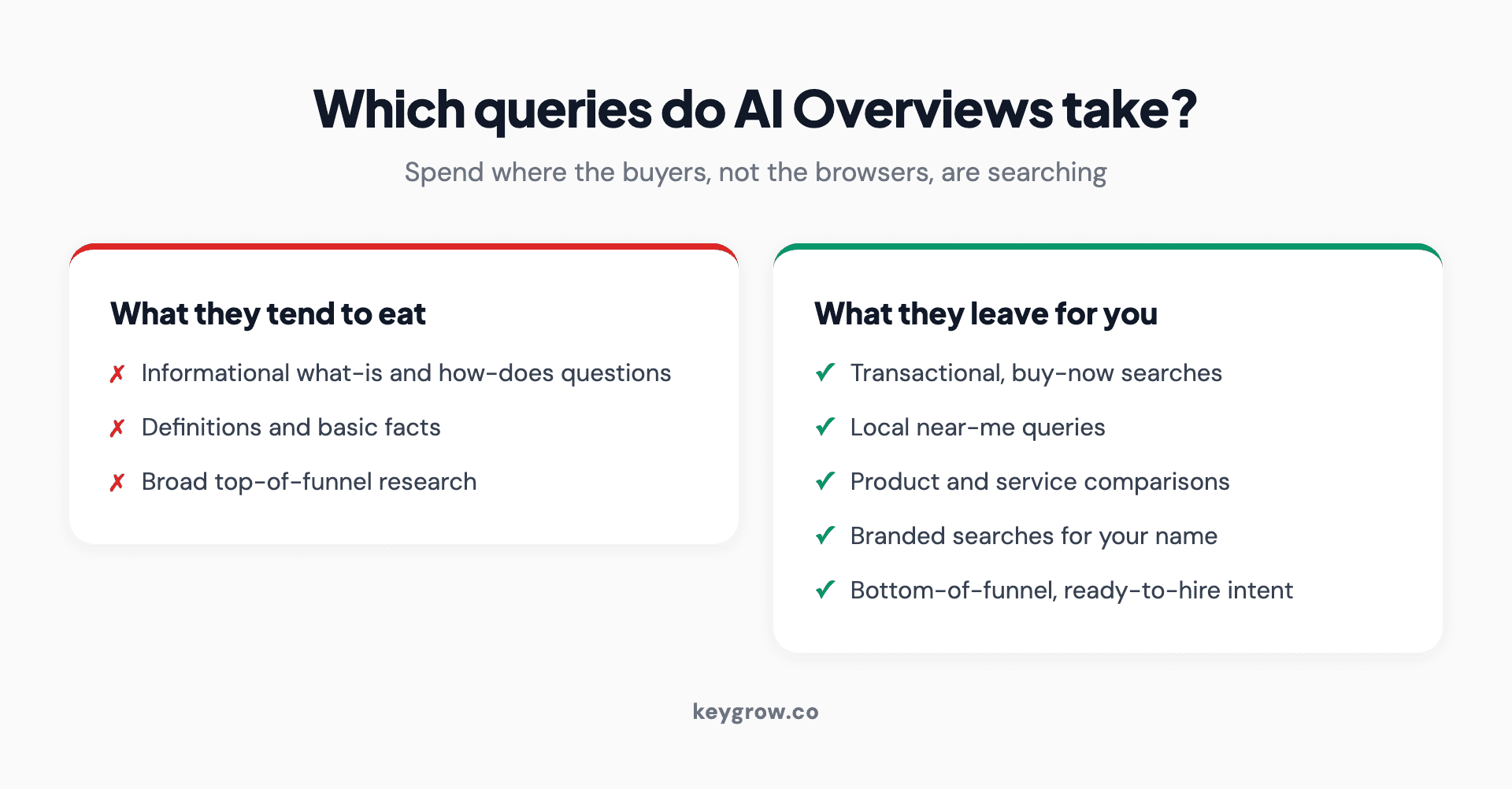
Infographic with two columns comparing query types. Left column headed What AI Overviews tend to eat, in red: informational what-is and how-does questions, definitions, basic facts, and broad top-of-funnel research. Right column headed What they tend to leave for you, in green: transactional and buy-now searches, local near-me queries, product and service comparisons, branded searches for your name, and bottom-of-funnel ready-to-hire intent.
This is also why a strong local landing page strategy has aged well. Local and service-intent pages target queries AI Overviews handle poorly and buyers use constantly.
What to stop wasting effort on
If your budget is finite, the most useful thing AI Overviews can do is tell you what to stop funding. Stop pouring time and money into thin informational content whose only job was to capture a top-of-funnel click you will now lose to the summary.
Concretely, here is what is now a weak bet:
None of that means stop publishing. It means publish content that does a job beyond ranking for a fact: content that demonstrates expertise, supports a buying decision, or targets a query with intent behind it. We made the fuller case for this in why unique content is so important. Informational content still has a role, as the thing that makes you a citable authority, but not as a traffic strategy on its own.
How do you show up in AI Overviews?
You earn it the same way you earn a top ranking, then format so a machine can lift your answer cleanly. There is no separate AI Overview button, because citation flows from ranking well and being easy to quote.
The practical checklist is short and unglamorous:
If you want the deeper version of this, our guides to AI search optimization and optimizing your site for ChatGPT go further, and the same habits help with structured results, which we covered in do rich snippets help SEO.
Is this GEO, and do you need a separate strategy?
Mostly no. Generative engine optimization (GEO) and answer engine optimization (AEO) are new labels for a familiar discipline: rank well, structure clearly, and be quotable. The fundamentals overlap with SEO by perhaps 90 percent.
There is a real shift in emphasis, toward citations across AI Overviews, ChatGPT, and other answer engines rather than clicks alone, and toward brand strength as a ranking and trust signal. But you do not need to hire a separate "GEO agency" or rebuild your site. If anyone pitches GEO as a brand-new service that makes your existing SEO obsolete, that is a sales pitch, not a strategy. The work that earns AI citations is the work that earns rankings, done with answer-first formatting and an eye on the queries that still convert.
FAQs
Will AI Overviews kill SEO?
No. They change it. AI Overviews reduce clicks on informational searches, but they appear on only about one in five queries and largely leave alone the searches where buyers are ready to act. Ranking still matters because 76 percent of AI Overview citations come from pages already in the top 10. SEO is not dead, but informational-traffic-only strategies are in real trouble.
How much traffic do AI Overviews take?
On the searches where they appear, a lot. Pew found people clicked a result in 8 percent of visits with an AI summary versus 15 percent without, and Ahrefs measured a 34.5 percent drop in clicks to the number one result. But Overviews appear on roughly 18 to 21 percent of searches, so the impact is concentrated on informational queries rather than spread evenly across all your traffic.
How do I get my website featured in an AI Overview?
Rank in the top 10 for the query, then make your answer easy to extract: state it in the first 100 words, use clear headings, and include specific facts and numbers. There is no shortcut that bypasses ranking, because Google cites pages it already ranks. Building brand authority also raises your odds of being a trusted source.
Do people click the links inside AI Overviews?
Rarely. Pew found that users clicked a link inside the AI summary in just 1 percent of visits to pages that had one. This is the key reason to treat AI Overview citations as a brand-visibility win rather than a traffic source. Being quoted helps people recognize you, but it sends very few visitors directly to your site.
Which searches trigger AI Overviews most?
Informational ones, though that is shifting. Semrush found informational intent accounted for 91.3 percent of AI Overview triggers in early 2025, falling to 57.1 percent by October as Overviews expanded into commercial and transactional queries. Questions with a clean factual answer ("what is," "how does") trigger them most. Local and clearly transactional searches trigger them least.
Does ranking number one still matter with AI Overviews?
Yes, more than ever in one sense. The number one position loses clicks when an Overview appears, but top-10 ranking is now the gate to being cited at all, since 76 percent of citations come from top-10 pages. So you rank to earn the click on queries without an Overview, and to earn the citation on queries with one. Falling off page one costs you both.
Do I need a separate GEO or AEO strategy?
Usually not a separate one. GEO and AEO overlap heavily with good SEO: rank well, structure content clearly, answer questions directly, and build brand authority. The emphasis shifts toward citations and brand rather than clicks alone, but the underlying work is the same. Be skeptical of anyone selling GEO as a brand-new service that replaces your SEO.
The short version
AI Overviews are real, and they do cut clicks on informational searches: Pew measured 8 percent of visits clicking through with a summary present versus 15 percent without, and Ahrefs found a 34.5 percent drop on the top result. Google's "clicks are stable and higher quality" line is a claim it has not backed with data, so weigh it against your own analytics. But Overviews show on only about one in five searches and concentrate on informational queries, the cheap, low-intent traffic that was never your best.
So the move is reallocation, not retreat. Stop funding thin informational content that exists only to rank for a fact, keep earning top-10 rankings so you stay in the citation pool, and put your real effort into the transactional, local, and branded queries where buyers search and Overviews are weakest. If you want a straight read on which of your pages AI Overviews are quietly costing you, and which queries are still worth chasing, that is a conversation our SEO team is glad to have. Tell us about your site and we will tell you where your traffic is actually leaking.


