


To optimize your website for ChatGPT, you need to make your pages easy for AI systems to crawl, easy to extract, and trustworthy enough to cite. That means allowing the right crawlers, getting indexed in Bing, structuring content as clear answers, adding schema markup, and building authority signals across the web. ChatGPT does not rank pages the way Google does. It pulls candidate pages, evaluates them, and quotes only the ones it trusts most.
This guide walks through exactly how that process works and what to change on your site. It is written for business owners, marketers, SaaS teams, publishers, agencies, and bloggers who want to show up when people ask ChatGPT a question instead of typing it into Google.
The shift is already here. ChatGPT serves hundreds of millions of users every week, and a large share of them now treat it as a search engine. When someone asks "what's the best tool for X" or "how do I fix Y," the AI answers directly and cites a handful of sources. If your site is not in that handful, you are invisible to that person, even if you rank on page one of Google.
What does it mean to optimize your website for ChatGPT?
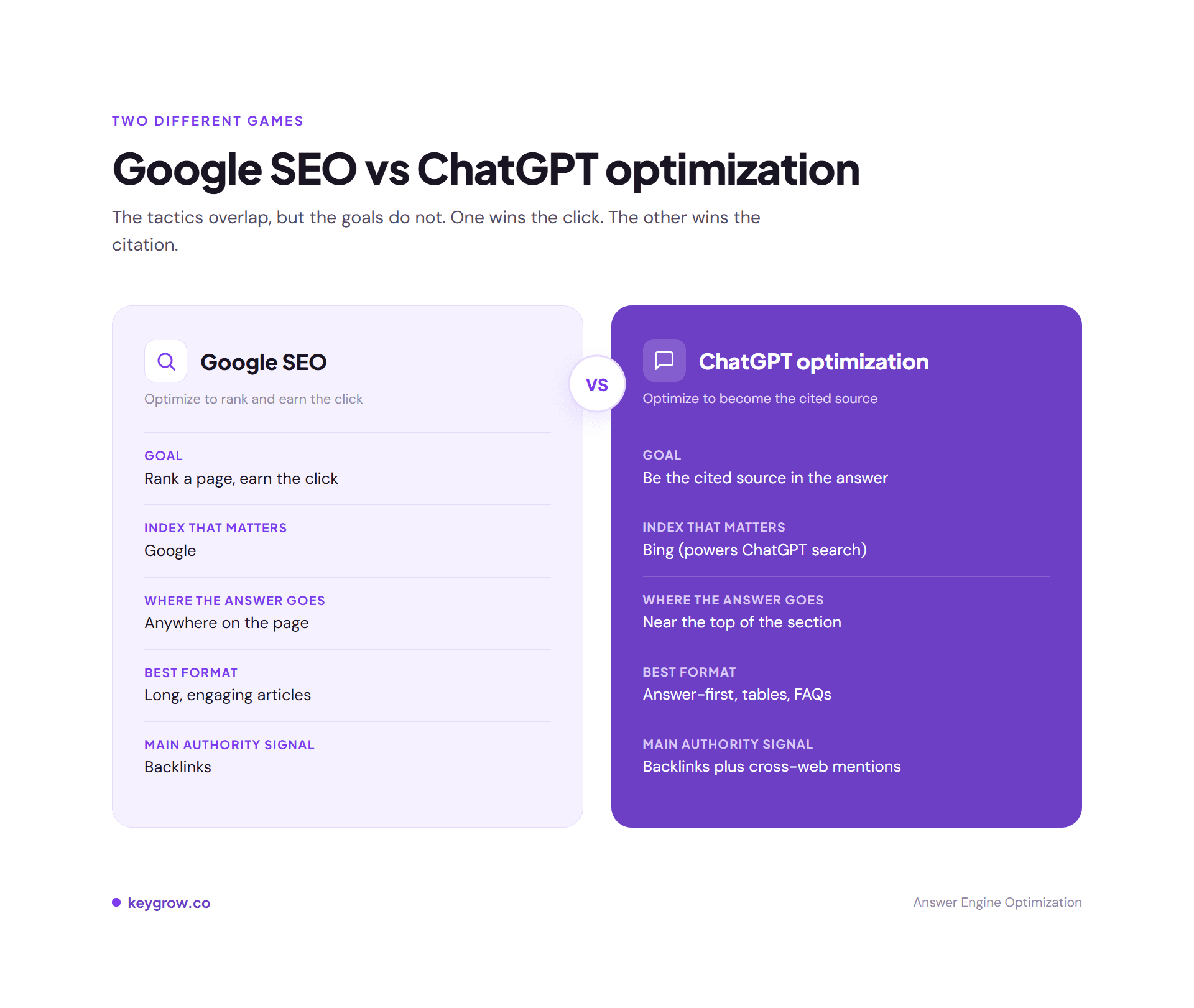
Side-by-side comparison of traditional Google SEO and ChatGPT optimization across goal, index, answer placement, content format, and authority signals.
Optimizing your website for ChatGPT means structuring your content and technical setup so that ChatGPT can find your pages, read them cleanly, and cite them as a source in its answers. This practice is often called Answer Engine Optimization (AEO) or Generative Engine Optimization (GEO).
The goal is different from traditional SEO. Traditional SEO tries to win a ranking position so people click through to your site. ChatGPT optimization tries to make your content the answer itself, so the AI quotes or paraphrases you and names your brand.
Here is the mindset change in one line: stop asking "how do I rank?" and start asking "how do I become the source?"
The good news is that most of the work overlaps with solid SEO. Clean technical setup, helpful content, and real authority still matter. ChatGPT just rewards a few extra things, like answer-first structure and consistent mentions across trusted sites.
How ChatGPT finds and cites sources
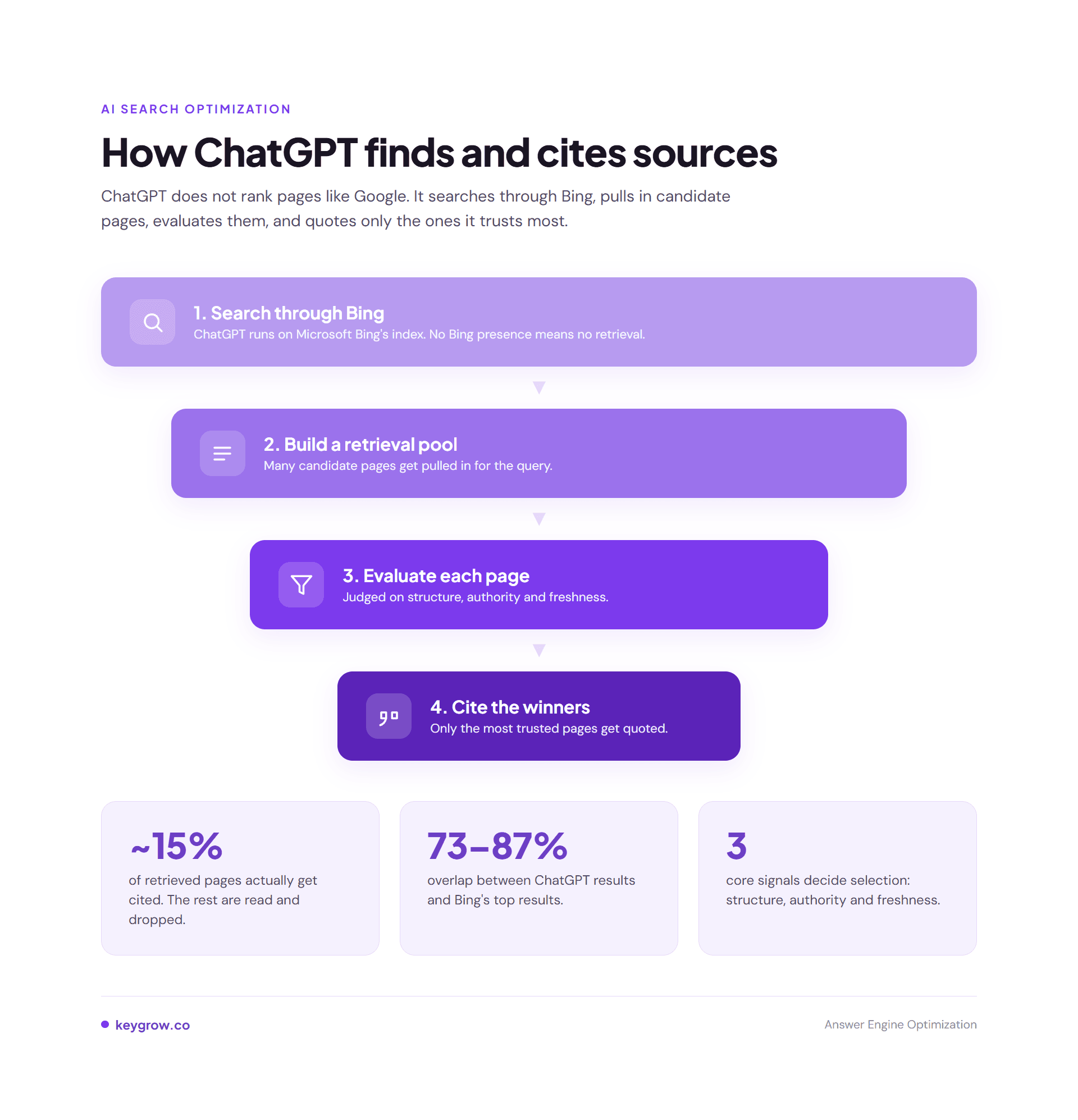
Funnel diagram of ChatGPT's four-stage source process: searching Bing, building a retrieval pool, evaluating pages, and citing the winners, noting only about 15% of retrieved pages get cited.
ChatGPT's search feature runs on Microsoft Bing's web index. When you ask a question that needs current information, ChatGPT searches the web through Bing, gathers candidate pages, and then decides which ones to use in its answer.
Two facts shape everything that follows.
First, Bing is the gatekeeper. Studies have found that ChatGPT search results overlap heavily with Bing's top results, often around 73 to 87 percent. If Bing has not indexed your site, ChatGPT will not see it, no matter how well you rank on Google.
Second, retrieval is not the same as citation, which is exactly why measuring AEO success needs its own instruments. ChatGPT pulls in many pages but cites very few of them. One large analysis of more than half a million pages found that ChatGPT cited only about 15 percent of the pages it retrieved. The other 85 percent were read, judged, and dropped.
So you actually have two problems to solve. You need to get into the candidate pool (discoverability), and you need to be the page that gets quoted (selection). The steps below cover both.
The three signals ChatGPT weighs most
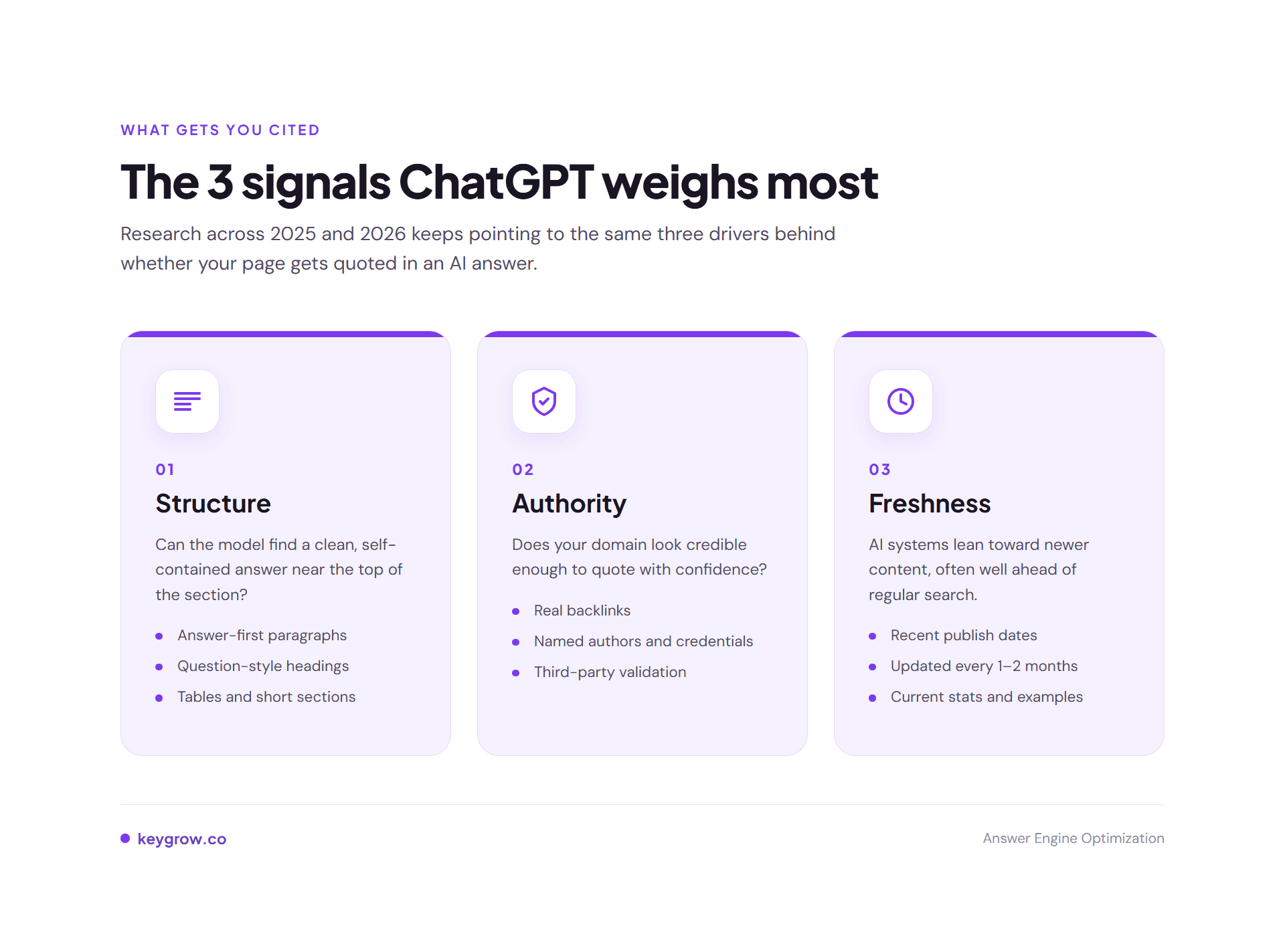
Three-card layout of the main signals ChatGPT weighs when citing a page: content structure, domain authority, and content freshness.
Research from across the industry in late 2025 and early 2026 points to three main drivers of whether your page gets cited:
- Content structure. Can the model find a clean, self-contained answer near the top of the section? Pages that bury the answer rarely get used.
- Authority. Does your domain look credible, with real backlinks, author credentials, and third-party validation?
- Freshness. Was the page published or updated recently? AI systems lean toward newer content, often citing pages 25 percent fresher than what shows up in regular search.
Keep these three in mind. Every step in this guide maps back to one of them.
Step 1: Let ChatGPT's crawlers reach your site
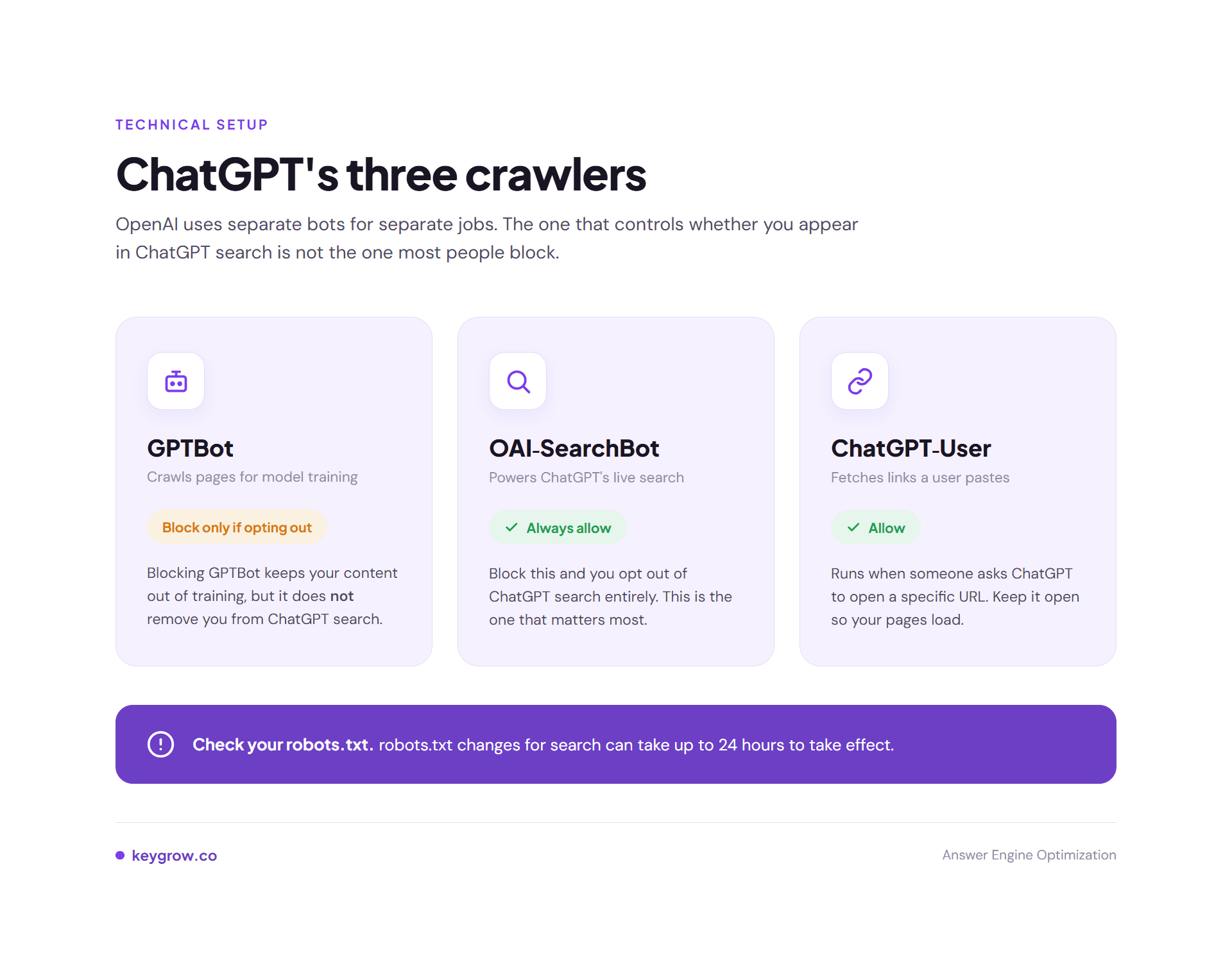
Comparison of OpenAI's three crawlers, GPTBot, OAI-SearchBot, and ChatGPT-User, with guidance on which to allow or block in robots.txt for ChatGPT search visibility.
Before content quality matters at all, the AI has to be able to read your pages. Most guides skip this, and it is the most common reason a site never gets cited.
OpenAI uses separate bots for separate jobs:
- GPTBot crawls pages to help train OpenAI's models.
- OAI-SearchBot crawls pages for ChatGPT's live search answers.
- ChatGPT-User fetches a page when a user asks ChatGPT to open a specific link.
The key detail: blocking GPTBot does not remove you from ChatGPT search, but blocking OAI-SearchBot does. Plenty of site owners blocked all OpenAI bots to protect their content from training, then wondered why they vanished from ChatGPT answers.
Check your robots.txt file and make sure OAI-SearchBot and ChatGPT-User are allowed. If you want to opt out of training but stay visible in search, you can allow the search bots and disallow GPTBot. OpenAI notes that robots.txt changes for search can take up to 24 hours to take effect, so do not expect instant results.
This is also a good time to review your full technical setup. A fast, crawlable, well-structured site helps every channel, not just AI. If your pages are slow or hard to render, that hurts you here too, which is why solid website speed and structure work pays off across the board.
Step 2: Get indexed in Bing
Since ChatGPT search runs on Bing, Bing visibility is not optional. It is the foundation.
Do these three things:
- Create a free Bing Webmaster Tools account.
- Submit your XML sitemap so Bing knows about all your pages.
- Check the index coverage report to confirm your important pages are actually indexed.
Many site owners obsess over Google Search Console and never touch Bing. If that is you, this single step can put you in front of a search index you were ignoring. You can import your settings straight from Google Search Console, so setup takes minutes.
If your priority pages are not indexed in Bing, fix that before doing anything else on this list. The rest of the guide does not help a page that ChatGPT cannot retrieve.
Step 3: Add an llms.txt file
The llms.txt file is an emerging standard that gives AI tools a clean, plain-text map of your site. Think of it as a robots.txt built for language models. It lists your most important pages and explains what they are, so crawlers spend less effort guessing.
A basic llms.txt sits at the root of your domain (yoursite.com/llms-full.txt) and includes your key service pages, top articles, and a short description of each. It is not a magic ranking factor, but it lowers the friction for AI systems trying to understand your content, and adoption is growing fast.
If you do not want to hand-code one, a free llms.txt generator will build and validate a spec-compliant file you can upload in a few minutes. Templates exist for common site types, so even a non-technical owner can get one live the same day.
Step 4: Write answer-first content
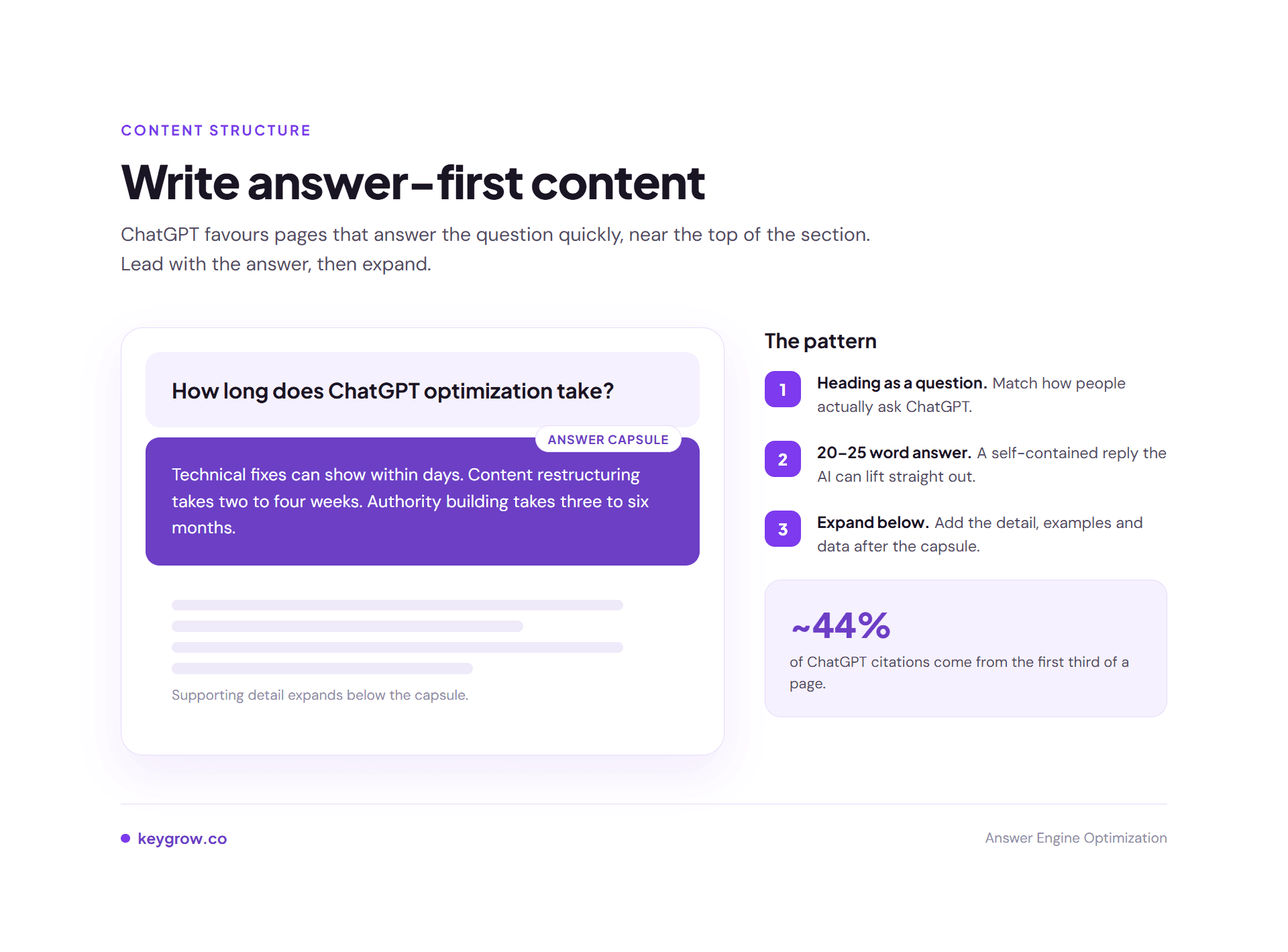
Annotated mockup of answer-first content showing a question heading, a 20 to 25 word answer capsule, and supporting detail, noting about 44% of citations come from the first third of a page.
This is where most of the citation gains live. ChatGPT favors pages that answer the question quickly and clearly, near the top of the relevant section.
Analysis of citation patterns keeps finding the same thing: roughly 44 percent of ChatGPT citations come from the first third of a piece of content. If your answer is buried halfway down, the model often will not wait for it.
So flip the old SEO habit. Instead of teasing information to keep people reading, lead with the answer.
A useful trick is the answer capsule: a short, self-contained reply of about 20 to 25 words placed right after a heading, framed to match how people ask the question. Then expand on it below.
Here is the pattern in practice:
> How long does ChatGPT optimization take to show results?
> Technical fixes can show up within days. Content restructuring usually takes two to four weeks. Authority building takes three to six months of consistent effort.
That capsule can be lifted straight into an AI answer. Everything after it is supporting detail.
Another helpful test is the island test: read each paragraph on its own, with no context around it. Does it still make sense and answer something useful? If it only works as part of a chain, an AI cannot pull it out cleanly. Rewrite it so it stands alone.
Step 5: Structure content so it is easy to extract
ChatGPT reads structure, not just words. Pages with clear hierarchy and scannable formatting get cited far more often than walls of text.
A few specific moves that work:
- Phrase your headings as real questions. Use "What schema types does ChatGPT prefer?" instead of "Schema Types." This mirrors how people actually query AI, so the model maps the question to your section.
- Keep sections tight. Pages that run about 120 to 180 words between headings tend to get cited more than long, undivided blocks. Density beats sprawl.
- Use tables and lists. ChatGPT prefers content already shaped like its output. A pricing table or a comparison grid is far more quotable than the same facts hidden in prose. One research group found pages with original data tables earned several times more AI citations.
- Front-load the useful stuff in each section, following the same answer-first idea from Step 4.
To make sure your writing is easy to parse, run drafts through a readability checker before publishing. Clear, plain sentences help both human readers and the model trying to extract a clean answer.
Here is a simple comparison to keep the difference between the two channels straight:
| Factor | Traditional Google SEO | ChatGPT optimization |
|---|---|---|
| Goal | Rank a page, earn the click | Become the cited source in the answer |
| Index that matters | Bing (powers ChatGPT search) | |
| Where the answer goes | Can be anywhere on the page | Near the top of the section |
| Best content format | Long, engaging articles | Self-contained answers, tables, FAQs |
| Main authority signal | Backlinks | Backlinks plus mentions across trusted sites |
| Freshness pressure | Moderate | High, recent updates strongly favored |
Step 6: Add schema markup
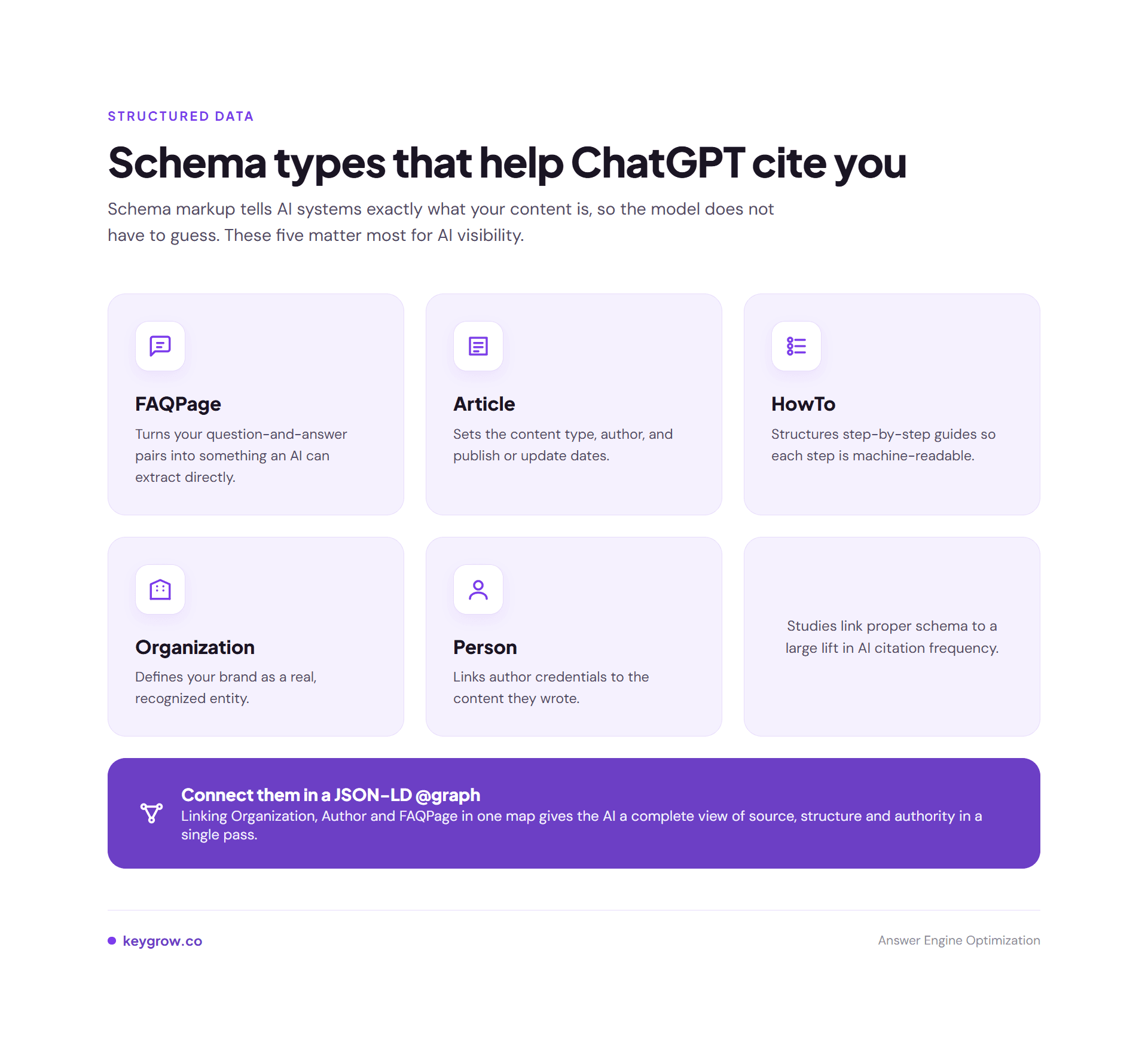
Icon grid of the five schema types that help ChatGPT cite content: FAQPage, Article, HowTo, Organization, and Person, plus a note on linking them in a JSON-LD @graph.
Schema markup is structured data, written in JSON-LD, that tells search engines and AI systems exactly what your content is. It labels your page so the model does not have to guess whether something is an FAQ, a how-to, an author, or a business.
Schema is one of the strongest levers you have. Studies have linked proper Article and FAQ markup to meaningfully higher AI citation rates, with some analyses reporting large lifts in citation frequency for pages that use it.
The schema types that matter most for ChatGPT visibility in 2026:
- FAQPage: turns your question-and-answer pairs into something an AI can extract directly.
- Article: sets the content type, author, and publish or update dates.
- HowTo: structures step-by-step guides so each step is machine-readable.
- Organization: defines your brand as a real, recognized entity.
- Person: links author credentials to the content they wrote.
A smart practice is to connect these with a JSON-LD @graph, so your Organization, Author, and FAQPage schemas reference each other in one map. That gives the AI a full picture of who published the content, what it is, and why it should be trusted, all in one pass.
You do not need to write JSON-LD by hand. A free schema markup generator will produce valid markup for FAQ, Article, HowTo, Organization, and more, then let you validate it before you paste it into your page.
Step 7: Build E-E-A-T and author authority
E-E-A-T stands for Experience, Expertise, Authoritativeness, and Trustworthiness. It is a Google concept, but it maps almost perfectly onto how ChatGPT decides which sources are safe to quote.
The model is cautious. It prefers content it can attribute to a credible, identifiable source, because a wrong answer reflects badly on it. Anonymous, unsourced content is a risk it would rather avoid.
Strengthen your trust signals:
- Add real author bios with credentials, not just a name.
- Use Person schema to tie authors to their work.
- Cite credible external sources inside your content.
- Show publish and update dates clearly.
- Keep your facts accurate and verifiable.
Domain authority matters most for getting into the candidate pool. Interestingly, once a page is retrieved, mid-authority sites in a reasonable range get cited at rates close to big-name domains. So you do not need to be Wikipedia to get quoted. You need to be credible enough to enter the pool and clear enough to win the selection.
Step 8: Add original data, statistics, and expert quotes
ChatGPT loves content it cannot find anywhere else. Original data makes your page a necessary source rather than one of many.
Research from Princeton and Georgia Tech tested different GEO tactics and found two standouts. Adding relevant statistics raised visibility in AI answers by around 40 percent. Adding expert quotes and citations boosted it by roughly 37 percent on subjective queries.
The takeaway is practical. Replace vague claims with specific, sourced facts.
Instead of "many businesses are using AI search," write "half of B2B buyers now start product research on ChatGPT instead of Google." That second sentence is short, specific, and easy for an AI to drop into an answer with attribution.
Other ways to add this kind of value:
- Publish small original studies or survey results from your own customer base.
- Build comparison tables and benchmark data.
- Include clear one-line definitions for the terms in your niche, since "what is X" queries are everywhere.
- Quote named experts rather than "industry observers."
Step 9: Keep your content fresh
AI systems have a strong recency bias. Pages updated recently get cited noticeably more often than older ones, and some research puts the freshness advantage as high as three times for content updated within the last month.
This creates a maintenance habit that old-school SEO did not really demand. Your best pages are not "set and forget." They need regular review.
A simple routine works:
- Revisit cornerstone pages every one to two months.
- Update stats, dates, and examples.
- Refresh the "2026" references and any year-specific claims.
- Add new sections as the topic evolves.
Even small, honest updates signal that the page is maintained and current, which keeps it in the running for citations.
Step 10: Build off-page presence and consensus signals
This is the part most people miss. ChatGPT does not just read your website. It cross-checks what the rest of the web says about you.
When the model considers recommending a brand, it looks for agreement across independent sources. If your business shows up consistently on Reddit, in YouTube videos, on review platforms, and in industry publications, all with similar messaging, the AI gains confidence and is more likely to cite you. If you exist only on your own site with no outside validation, it treats your claims with skepticism and recommends someone with broader presence.
This is the consensus signal, and it is now central to AI visibility.
Practical ways to build it:
- Maintain active, reviewed profiles on platforms like Trustpilot, G2, and Capterra. Research has linked active review profiles to roughly triple the citation probability.
- Earn mentions in industry publications and credible news sites.
- Create video content. YouTube has become one of the most-cited social platforms in AI answers, and you do not need a huge channel to benefit.
- Participate genuinely in relevant Reddit and forum threads. ChatGPT pulls from these communities, especially for product and service recommendations.
- Get listed in legitimate industry directories and "best of" lists, since ChatGPT recommendations often mirror the top-ranked lists on Google.
The point is not to spam your brand everywhere. It is to build a real, consistent presence across the sources AI already trusts.
Step 11: Track your ChatGPT visibility
You cannot improve what you do not measure. ChatGPT visibility is harder to track than Google rankings, but it is doable.
A few things to monitor:
- Direct testing. Ask ChatGPT the questions your customers ask and see whether you appear. Do this regularly and note changes.
- Referral traffic. ChatGPT appends a tracking parameter to many of its outbound links, so you can spot ChatGPT referrals in your analytics. Watch for that source growing over time.
- Citation tools. A growing set of GEO and AI-visibility platforms track how often ChatGPT, Perplexity, and Google's AI mention your brand, your sentiment, and your share of voice against competitors.
Track citation rate, sentiment, and competitive share. If competitors keep showing up and you do not, that tells you exactly where to focus your authority and content work next.
Common mistakes to avoid
A few errors quietly kill ChatGPT visibility. Watch for these:
- Blocking the search crawler. Disallowing OAI-SearchBot in robots.txt removes you from ChatGPT search entirely. Many sites do this by accident while trying to block training bots.
- Ignoring Bing. Optimizing only for Google leaves you out of the index that actually feeds ChatGPT.
- Burying the answer. Writing long, engagement-bait intros pushes your real answer out of the zone where ChatGPT looks.
- No structured data. Skipping schema makes the model work harder to understand your page, and it often picks a competitor that made the job easy.
- Anonymous content. No author, no credentials, no sources. The model has no reason to trust it.
- Letting content go stale. Pages that have not been touched in two years lose out to fresher competitors.
AEO, GEO, and AI search optimization: what's the difference?
These terms get used loosely, so here is a quick, plain breakdown.
AEO (Answer Engine Optimization) focuses on structuring content so answer engines, including ChatGPT, voice assistants, and featured snippets, can pull a clean answer. It is the foundation.
GEO (Generative Engine Optimization) is the broader practice of getting cited across generative AI systems like ChatGPT, Claude, Perplexity, and Gemini. The term came out of academic research on boosting AI visibility.
AI search optimization is the umbrella that covers both, plus the technical and authority work that supports them.
In practice, the tactics overlap heavily. Getting cited by ChatGPT and showing up in a Google AI Overview reward the same things: accurate, well-structured, authoritative content from a credible source. If you build the AEO foundation well, the rest tends to follow. This is the same overlap that makes a combined AI search optimization service practical rather than five separate projects.
Where to get help
ChatGPT optimization touches a lot of moving parts at once. Crawler access, Bing indexing, schema, content rewrites, author authority, off-page mentions, and ongoing monitoring. Many in-house teams have the talent but not the bandwidth to run all of it consistently, which is why a growing number of businesses bring in a specialist agency.
Agencies like KeyGrow focus specifically on this work. KeyGrow is a full-service digital marketing agency founded in 2017, and its Answer Engine Optimization service covers AI search optimization for ChatGPT, Perplexity, and Google AI Overviews, along with structured data implementation, FAQ schema, and content structuring for AI readability. The same team handles the technical SEO foundation that keeps your site indexable in the first place.
For anyone who wants to start hands-on, KeyGrow also publishes a set of free marketing tools, including the llms.txt generator, schema markup generator, and readability checker referenced throughout this guide. If you run a specific niche like a dental practice, its breakdown of top AEO agencies for dentists shows how these principles apply to a single industry.
You can do the core work yourself with the steps above. The decision usually comes down to time. If you can commit to consistent execution, a DIY approach works. If you cannot, a specialist makes it move faster.
A quick-start checklist
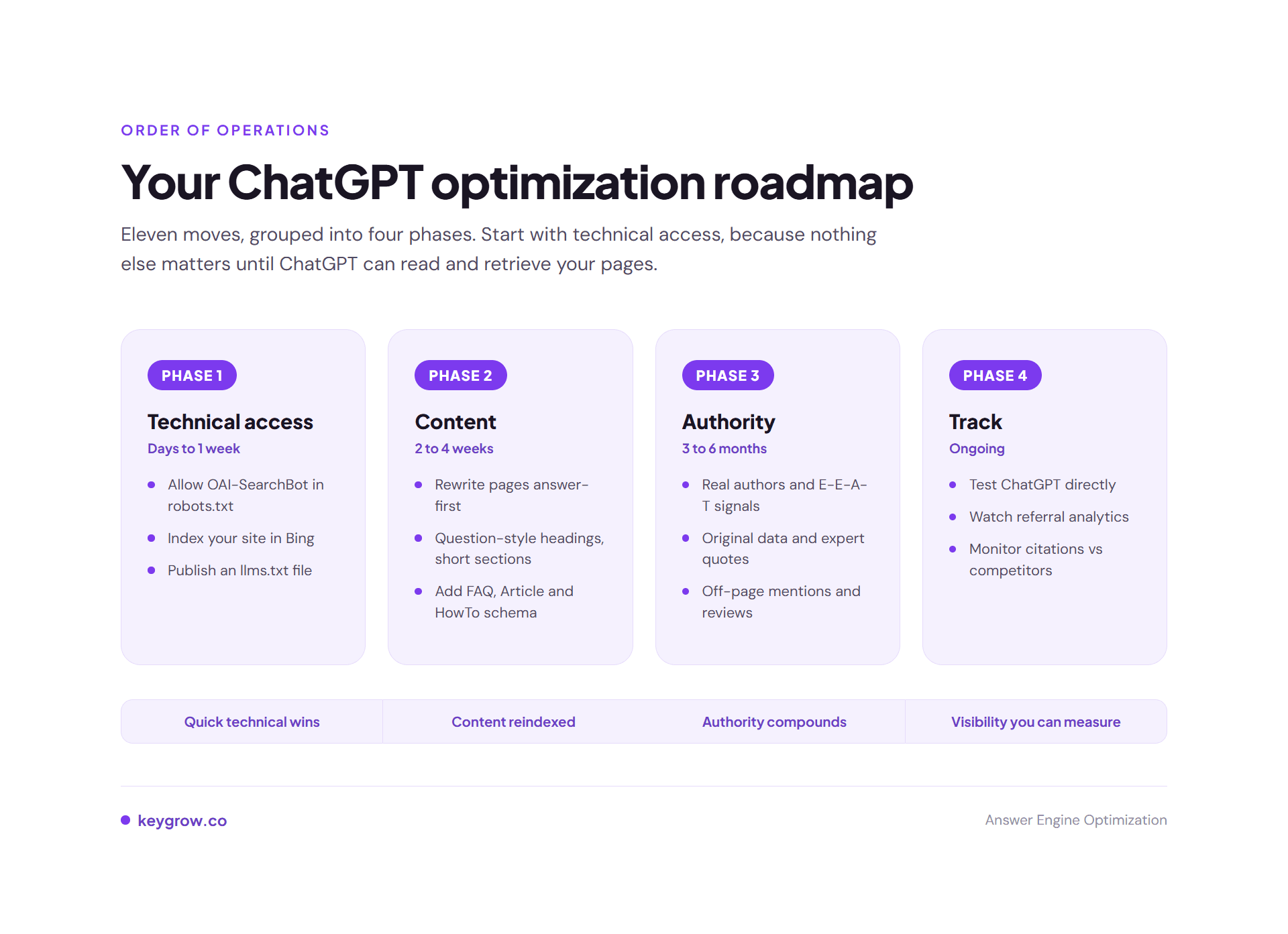
Four-phase roadmap for optimizing a website for ChatGPT: technical access, content, authority, and tracking, with a results timeline running from days to months.
If you want a single page to work from, here is the whole guide boiled down to an order of operations. Work top to bottom, since the early items unblock the later ones.
- Allow OAI-SearchBot and ChatGPT-User in your robots.txt. Block GPTBot only if you want to opt out of training while staying in search.
- Set up Bing Webmaster Tools and submit your sitemap. Confirm your priority pages are indexed.
- Publish an llms.txt file at your domain root listing your key pages.
- Rewrite your top pages answer-first. Put a 20 to 25 word answer right after each heading.
- Tighten structure. Question-style headings, short sections, tables, and lists.
- Add schema markup. FAQPage, Article, HowTo, Organization, and Person, ideally linked in a JSON-LD @graph.
- Strengthen E-E-A-T. Real author bios, credentials, sources, and visible dates.
- Add original data and named expert quotes to the pages you most want cited.
- Update cornerstone content every one to two months.
- Build off-page presence on review platforms, YouTube, forums, and industry lists.
- Track your visibility through direct testing, referral analytics, and a citation tool.
You will not finish all eleven in a day, and you do not need to. Start with the technical access items, because nothing else matters until ChatGPT can actually read and retrieve your pages. Then move into content and authority, which is where the slow, compounding gains come from.
One honest caveat: this field is young and moving fast. The platforms change their behavior, the research keeps updating, and exact numbers shift from study to study. Treat the specific percentages here as direction, not gospel. The principles, clear structure, real authority, and fresh content, have held steady even as the details churn.
FAQs
How do I optimize my website for ChatGPT?
Allow OAI-SearchBot in your robots.txt, get indexed in Bing, and structure content with clear, answer-first sections. Add schema markup like FAQPage and Article, build author credibility, include original data, keep pages fresh, and earn mentions on trusted third-party sites so ChatGPT treats your brand as a reliable source.
Does ChatGPT use Google or Bing for search?
ChatGPT search runs on Microsoft Bing's web index, not Google. Studies show ChatGPT results overlap with Bing's top results by roughly 73 to 87 percent. If your site is not indexed in Bing, ChatGPT cannot retrieve it, no matter how well you rank on Google. Submit your sitemap to Bing Webmaster Tools first.
What is the difference between SEO and ChatGPT optimization?
Traditional SEO aims to rank a page so users click through to your site. ChatGPT optimization aims to make your content the answer the AI quotes directly. SEO targets Google's ranking algorithm. ChatGPT optimization targets a model's citation selection, rewarding answer-first structure, schema, freshness, and cross-web authority.
Will blocking GPTBot remove my site from ChatGPT?
No. GPTBot is used for model training, not live search. Blocking it does not remove you from ChatGPT search answers. The bot that matters for search is OAI-SearchBot. If you block that one, you opt out of ChatGPT's search feature entirely, so check your robots.txt carefully.
How long does it take to see results from ChatGPT optimization?
It depends on the change. Technical fixes like robots.txt and schema can take effect within days to a week as AI systems recrawl. Content restructuring usually takes two to four weeks to reassess. Authority building through mentions and reviews takes three to six months of steady effort.
What is an llms.txt file and do I need one?
An llms.txt file is a plain-text map of your site that helps AI tools understand your most important pages. It sits at your domain root and lists key pages with short descriptions. It is not required, but it lowers friction for AI crawlers, and adoption is growing. Free generators can build one in minutes.
Does schema markup help with ChatGPT visibility?
Yes. Schema markup tells AI systems what your content is, which makes it easier to extract and cite. FAQPage, Article, HowTo, Organization, and Person schemas matter most. Studies link proper schema to higher AI citation rates. Connecting them in a JSON-LD @graph gives the model a complete view of your content and its author.
How does ChatGPT decide which sources to cite?
ChatGPT retrieves candidate pages through Bing, then selects based on three main signals: content structure (a clear answer near the top), authority (credible domain, real author, outside validation), and freshness (recently updated pages). It also checks for consensus, meaning agreement about your brand across independent trusted sources.
Can I track how often ChatGPT cites my website?
Yes, partly. You can test directly by asking ChatGPT relevant questions and noting whether you appear. ChatGPT also adds a tracking parameter to many outbound links, so you can spot referral traffic in analytics. Dedicated GEO and AI-visibility tools track your citation rate, sentiment, and share of voice against competitors.
Is ChatGPT optimization the same as AEO and GEO?
They are closely related. AEO (Answer Engine Optimization) focuses on structuring content for answer engines. GEO (Generative Engine Optimization) covers getting cited across AI systems like ChatGPT, Claude, and Perplexity. ChatGPT optimization is essentially applying both to one specific platform. The underlying tactics, clear structure and real authority, are shared.