

Two businesses run the same SEO budget for a year. One sees a 1,389 percent return. The other sees 317 percent. Same channel, same effort, wildly different payoff. So when people ask what industries need SEO the most, the honest answer is not a top-10 list. It is a set of traits. The industries that need SEO the most are the ones where a customer is worth a lot, where people actually search before buying, where the decision takes real thought, and where paid ads are either brutally expensive or low-trust. Real estate, legal, financial services, healthcare, B2B software, and home services keep topping the charts because they share those traits. Score your own business against them and you will know your answer before you read a single ranking.
That is what this guide does. Below is a five-factor scorecard you run on your own business, then the ROI data that proves which industries score highest, then the honest cases where SEO is a poor fit and you should lead with paid instead.
Why top-industries lists give you the wrong answer
The standard article on this keyword hands you a list of ten or twenty-five industries and walks away. The problem is that "real estate" is not one business. A solo agent in a small town and a national brokerage have nothing in common except a label. A med spa and a pediatric clinic are both "healthcare" and need completely different SEO bets.
A list tells you whether your industry has a famous name. It does not tell you whether your specific business will earn back the cost of ranking. Those are different questions, and only the second one matters when you are deciding where to put money.
So we are flipping it. Instead of asking "is my industry on the list," ask "does my business have the traits that make SEO pay." Five factors decide it.

Small business owner sitting at a desk reviewing a laptop in natural light, thinking through a decision
The 5-factor SEO fit scorecard
Run your business through these five questions. Score each one to 2 points. A total of 8 to 10 means SEO should probably be your lead channel. A 5 to 7 means it works but pick your spots. Below 5 means paid or another channel likely beats it, at least for now.
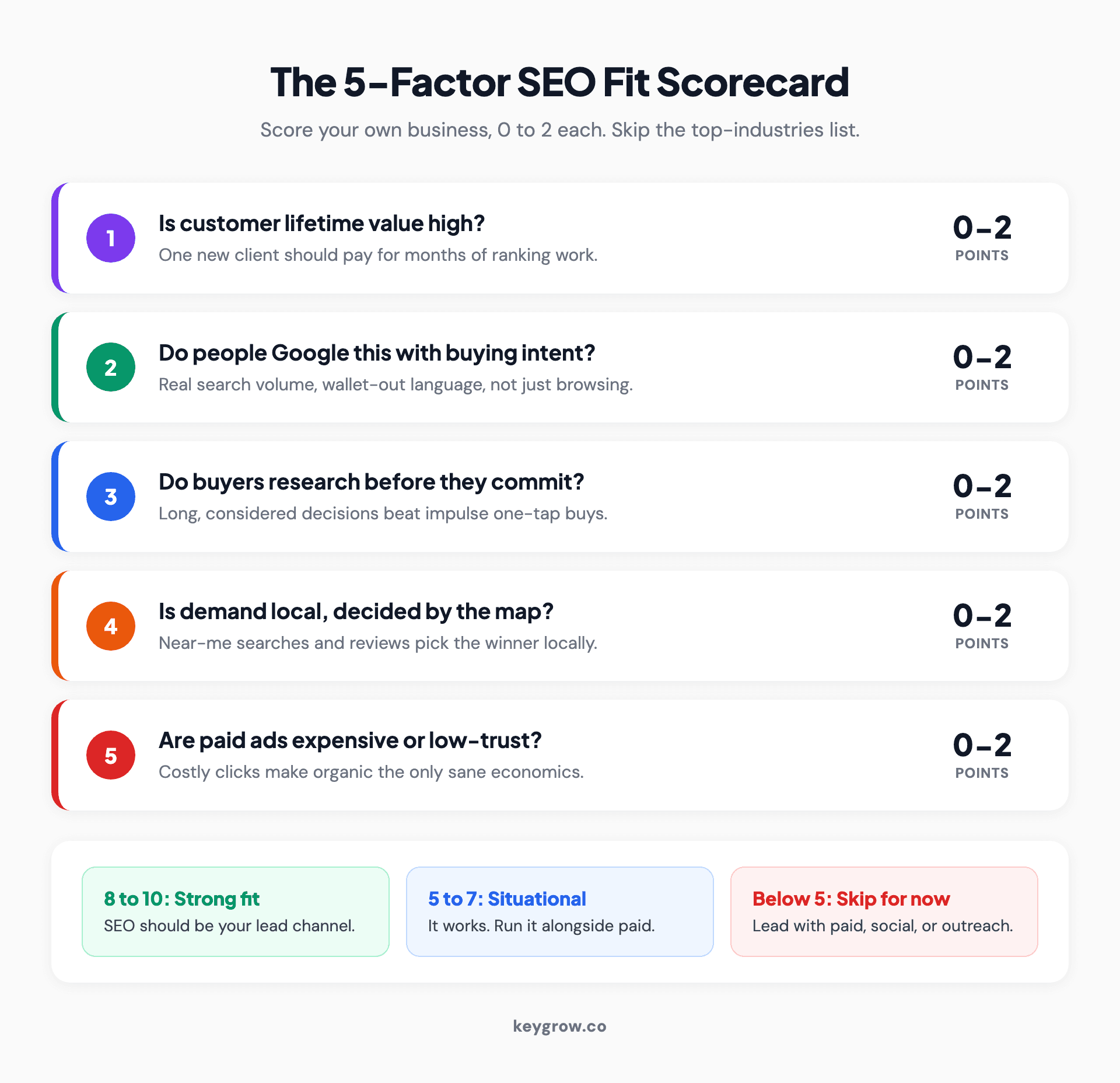
SEO fit scorecard infographic showing five scoring factors: customer lifetime value, search demand and buying intent, purchase consideration time, local demand, and paid-ad cost, with a total-score verdict scale
The factors are not equal in every case, but together they predict fit better than any industry label. Walk through each one with your own numbers.
Factor 1: Is customer lifetime value high enough to outrun the cost of ranking?
The single biggest predictor of SEO fit is what a customer is worth over time. Ranking costs the same effort whether you sell a 12 dollar product or a 12,000 dollar service. The math only works when the value of the customers you win clears the cost of winning them.
A real estate transaction, a legal case, a financing relationship, a multi-year software contract: these carry high lifetime value, so one organic lead a week can fund the entire program. A 9 dollar phone case does not. This is why the ROI spread is so wide, and we get to the numbers in a minute.
The rule of thumb that one competitor mentioned but never used: SEO works when customer lifetime value comfortably exceeds your annual SEO cost per customer acquired. If a single new client pays for months of work, you score 2. If you need hundreds of low-margin sales to break even, score 0.
Factor 2: Do people actually Google this, and with buying intent?
SEO can only capture demand that already exists as searches. If nobody types your problem into a search bar, there is nothing to rank for. And if they search but only to browse, not to buy, ranking brings traffic that never converts.
The high-scoring industries pass both tests. People search "personal injury lawyer near me," "best CRM for small business," and "emergency plumber" with a wallet half-open. The intent is baked into the query. When you own those results, the clicks are worth real money. The top organic result earns an average 27.6 percent click-through rate and the top three positions take 54.4 percent of all clicks, according to Backlinko's analysis of 4 million results.
Score 2 if people search your offer with clear buying language. Score 0 if your product is so new or so niche that search volume is effectively zero (more on that poor-fit case later).
Factor 3: How long do buyers research before they commit?
SEO rewards considered purchases. The longer someone researches before buying, the more touchpoints you get to be the helpful source, and the more content you can rank for across that journey.
Someone choosing a divorce attorney, a wealth manager, or a 50,000 dollar software platform reads for weeks. They compare, they read reviews, they search variations of the same question a dozen ways. Every one of those searches is a chance to show up. A high-consideration buyer is an SEO buyer.
The opposite is the impulse or emergency one-tap purchase where the buyer does not research at all. Those still benefit from being findable, but the deep content advantage that SEO compounds over time matters less. Score 2 for long, research-heavy decisions. Score 1 for medium. Score 0 for pure impulse buys.
Factor 4: Is demand local, and does the map pack decide who wins?
Local demand is an SEO multiplier. When customers search "near me" and pick from the local map results, organic and local SEO basically decide who gets the call. There is no national giant outspending you for a "drain cleaning Tulsa" search. It is you and a handful of local competitors.
This is why home services, local legal, dental, and medical practices score so well even on smaller budgets. The competition is a few miles wide, not nationwide. And trust signals carry enormous weight: only 3 percent of consumers say they never read online reviews, and Google was the top review platform in 2024 at 81 percent usage, per BrightLocal. A strong local presence converts that visibility into booked work.
We see this in our own accounts. A phone repair shop reached 115-plus monthly calls in 7 months, a real estate office 90-plus in 7 months, and a junk removal company 50-plus in 6 months, none of which had meaningful inbound calls before the local work started. Same shape every time: defined area, local intent, calls instead of vanity rankings. Score 2 if you serve a geographic area and customers search locally.
Factor 5: How expensive and brutal are the paid ads in your space?
The final factor is your alternative. SEO looks best where paid search is most painful. In high-stakes verticals, clicks cost a fortune and ads convert worse than organic.
Legal is the classic example. It carries the highest average cost per click of any industry, at 8.58 dollars per WordStream, and the most contested terms like accident-injury searches run far higher still in major markets. When a single click costs that much, ranking organically is not a nice-to-have, it is the only sustainable economics. And the trust gap matters: SEO leads close at an average 2.4 percent versus 1.3 percent for paid, and the gap is widest in exactly these trust-driven verticals (legal 4.4 versus 2.2 percent, financial services 2.2 versus 0.3 percent), per First Page Sage. The number one organic result also pulls 18 times more clicks than the top paid ad, according to First Page Sage.
Score 2 if paid clicks in your space are expensive or low-trust. Score 0 if cheap, high-converting paid clicks are easy to come by, because then paid might be the smarter lead.

Person using a smartphone to look up directions on a map in an everyday outdoor setting
The industries that score highest, and the ROI data behind them
When you total the scorecard, the same industries keep landing at the top, and the ROI data explains why. These are the verticals that combine high lifetime value, real search intent, and long consideration windows.
Here is the spread that proves the thesis. The numbers below are three-year client averages from First Page Sage.
| Industry | Average SEO ROI | Break-even |
|---|---|---|
| Real estate | 1,389% | 10 months |
| Medical devices | 1,183% | 13 months |
| Financial services | 1,031% | 9 months |
| B2B software | 702% | 7 months |
| Legal services | 526% | 14 months |
| E-commerce | 317% | 9 months |
Notice the pattern. Real estate tops the list at 1,389 percent because lifetime value is enormous and buyers research for months. E-commerce sits at the bottom at 317 percent, still positive, but a fraction of the high-consideration verticals, because average order value and margins are thinner and impulse plays a bigger role. The spread is the whole argument: the industries that need SEO the most are the ones where each won customer is worth a lot and takes real thought to win.
Legal is the instructive outlier. It posts a strong 526 percent ROI but the longest break-even on the list at 14 months, because the keywords are fiercely contested and the trust bar is high. Strong fit, slow payout. For the deeper version of the cross-industry case, our breakdowns of why SEO matters for ecommerce and why SEO matters for B2B go vertical by vertical.
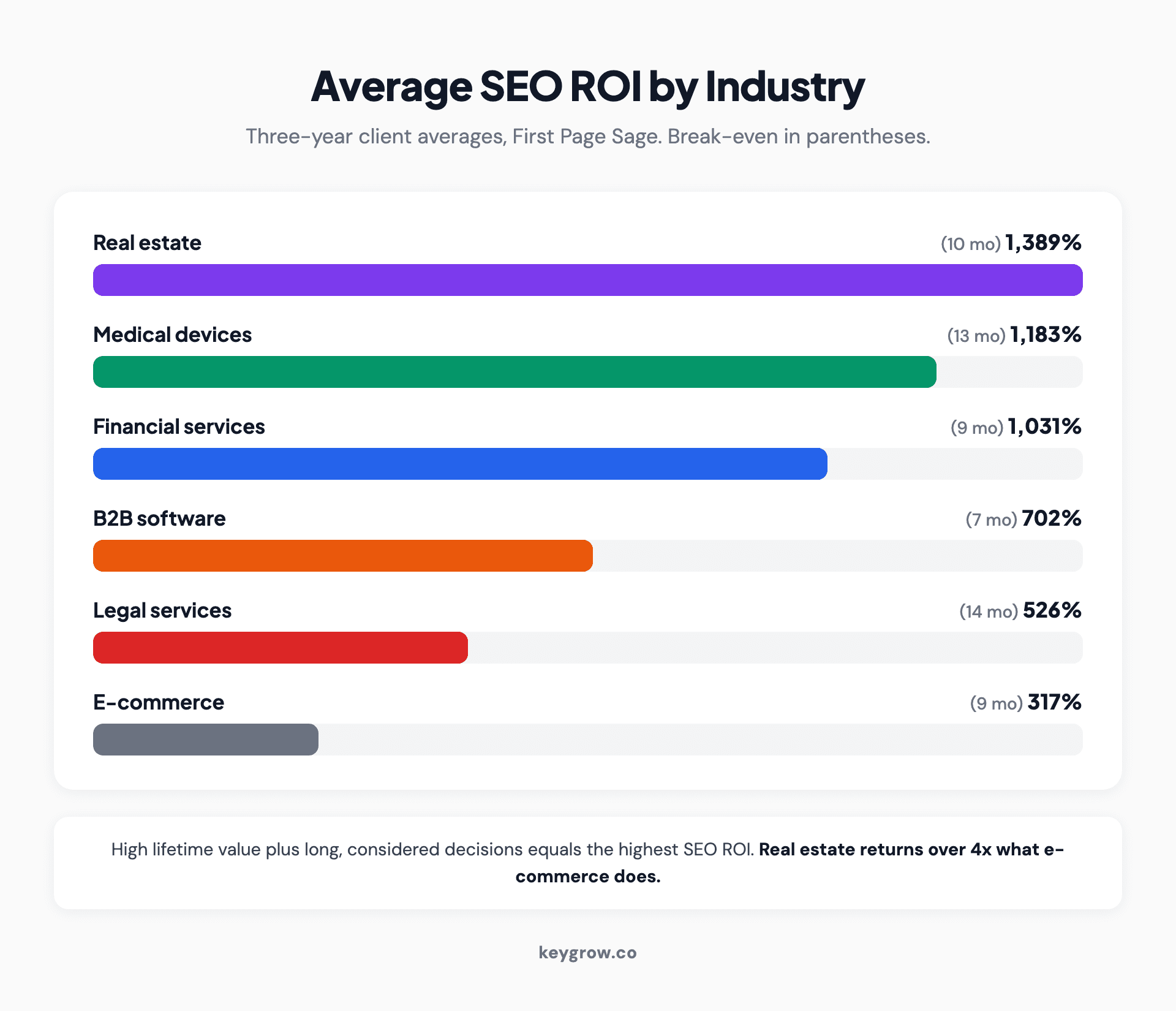
Bar chart of average SEO ROI by industry showing real estate at 1,389 percent, medical devices 1,183 percent, financial services 1,031 percent, B2B software 702 percent, legal 526 percent, and e-commerce 317 percent, three-year client averages from First Page Sage
Where SEO is a poor fit, and you should lead with paid instead
Most articles on this topic pretend SEO is universally worth it. It is not. Here are the situations where it underperforms, and where we would tell a business not to lead with it.
Brand-new categories with no search volume. If you invented something nobody is searching for yet, there is nothing to rank for. SEO captures existing demand; it does not create awareness for a category. You need paid, social, and PR to build the search volume first, then SEO to harvest it later.
Ultra-low-margin or impulse retail. A store selling 8 dollar accessories on thin margins will struggle to ever clear the cost of ranking. When average order value is tiny and the purchase is impulsive, the e-commerce 317 percent figure becomes optimistic for your specific catalog. Paid social and marketplace placement usually move the needle faster.
Pure emergency, one-tap purchases with no research. Some buys happen in seconds with no comparison. Being findable still helps, but the compounding content advantage that makes SEO pay over time barely applies.
Tiny-TAM B2B with a named account list. If your entire market is 200 specific companies, organic search is the wrong tool. Account-based marketing, direct outreach, and targeted paid reach those exact buyers far more efficiently than ranking for generic terms a handful of them might search.
This is the honest part most agencies skip. If your business sits in one of these buckets, an agency selling you a 12-month SEO retainer is selling, not advising. We turn away businesses where the math does not work, and you should be skeptical of anyone who never does.
SEO vs paid by situation: a quick decision rule
The question is rarely SEO or paid forever. It is which to lead with now. Here is the rule we use with clients.
Lead with paid when you need leads this month, you are validating a new offer, your margins are thin, or you are running a time-limited promotion. Paid buys instant visibility and instant data. The trade-off is that it stops the moment you stop paying.
Lead with SEO when your customers research before buying, your lifetime value is high, paid clicks are expensive, and you can wait a few quarters for compounding to kick in. SEO is an asset that keeps paying after the work is done.
Run both when you can afford it, which is most established businesses. Paid covers the gap while SEO builds, and the close-rate edge of organic (2.4 versus 1.3 percent) means the leads SEO eventually delivers tend to convert better. If you want to see whether the organic side is actually paying off, our guide on how to measure SEO ROI shows the tracking to set up first.
Here is the one strong opinion we will commit to with a number behind it: for high-consideration, high-value services, leading with paid alone is leaving money on the table, because organic leads close at nearly double the rate (2.4 versus 1.3 percent, First Page Sage). Paid is the bridge. SEO is the destination.
How AI Overviews and answer engines are changing the math in 2026
Every older article on this keyword was written before AI search mattered. That gap is now central, because AI Overviews, Google AI Mode, and answer engines like ChatGPT and Perplexity are changing which industries get organic value and how.
For considered, trust-driven purchases (legal, medical, financial, B2B), this shift raises the stakes, not lowers them. When an AI engine answers a buyer's question directly, the businesses it cites as the source win the trust that used to come from a ranking. The ones it ignores disappear from the consideration set entirely. The game moved from "how do I rank" to "how do I become the source the answer engine quotes."
A few practical notes from our own AEO work. ChatGPT search citations match Bing's top organic results about 87 percent of the time, per Seer Interactive, so a site invisible on Bing is invisible to a growing share of AI search. ChatGPT also cites only about 15 percent of the pages it retrieves, leaving roughly 85 percent read but never quoted, and 44.2 percent of citations come from the first 30 percent of a page, per Search Engine Land, which is why answer-first structure is now non-negotiable. The high-fit industries above are exactly the ones where becoming the cited source matters most, because their buyers ask AI engines long, research-heavy questions before they ever pick up the phone.
What a realistic timeline and budget look like once you decide to commit
If your business scores well, the next honest question is how long and how much. The answer varies a lot by difficulty, and anyone promising page one in 30 days is either chasing keywords nobody searches or about to burn your domain.
The hard part is the first quarter. SEO looks unremarkable for months and then compounds, which is why businesses that quit at month three pay for the difficult part and leave before the payout. In a high-trust vertical, expect a full year of consistent technical fixes, content, and authority work before the curve bends, and budget for it like an asset rather than a campaign. If you are still deciding whether to hire out at all, are SEO services worth it walks through the in-house versus agency math, and do blogs help SEO covers the content side specifically.
FAQs
What industries benefit the most from SEO?
Real estate, legal services, financial services, healthcare and medical devices, B2B software, and local home services consistently benefit the most. They share four traits: high customer lifetime value, clear buying-intent searches, long research-heavy decisions, and either expensive or low-trust paid ads. Score your own business on those traits rather than relying on the industry label.
Which industries have the highest ROI from SEO?
Real estate leads at an average 1,389 percent SEO ROI, followed by medical devices at 1,183 percent and financial services at 1,031 percent, per First Page Sage three-year client averages. E-commerce sits much lower at 317 percent. The pattern is consistent: higher customer lifetime value and longer consideration windows produce higher SEO ROI.
When is SEO not worth it, and when are paid ads better?
SEO is a poor fit for brand-new categories with no search volume, ultra-low-margin or impulse retail, pure emergency one-tap purchases, and tiny-TAM B2B with a named account list. Lead with paid when you need leads this month, are validating an offer, have thin margins, or are running a time-limited promotion. Paid buys instant visibility; SEO compounds over quarters.
How long does SEO take to work in competitive industries like legal or medical?
Expect 12 months or more in competitive YMYL verticals. Legal services break even around 14 months, per First Page Sage, and high-trust healthcare and finance run on similar timelines. These are topics where Google demands strong E-E-A-T, so results build slowly. Local home services move faster, often within a few months.
Is SEO better than PPC for small and local businesses?
For most local businesses, SEO and local search are the better long-term bet because customers search "near me" and pick from the map results, where you compete with a few local rivals rather than national advertisers. Organic leads also close at 2.4 percent versus 1.3 percent for paid. That said, new local businesses often start with paid for instant visibility while SEO builds.
Which industries are the hardest to rank for on Google?
National legal, finance, and healthcare are the hardest, because they are YMYL (your money or your life) topics where Google applies the strictest E-E-A-T scrutiny and the keywords are fiercely contested. Legal posts the longest break-even at 14 months despite a strong 526 percent ROI. These verticals reward genuine credentials, deep content, and patience over shortcuts.
Score your own business before you spend a dollar
Forget whether your industry made someone's top-10 list. Total your five factors. If you cleared 8, SEO should likely be your lead channel and the ROI data is on your side. If you landed in the middle, run it alongside paid and pick your spots. If you came in low, be honest about it and lead with paid, social, or outreach until your search demand and margins catch up.
If you cleared 8, the patience pays. If you did not, an agency that tells you so is worth more than one that sells you a retainer anyway. When you are ready to score your situation with someone who has run these campaigns, get in touch with our team.


