

Picture two online stores selling the same product at the same price. Store A buys every visitor through paid search at $5.26 a click. Store B has a category page sitting at the top of Google, and it pays nothing for that visitor. That gap is the whole argument for why SEO is important for ecommerce: organic search lets you acquire customers once and keep earning from them, while paid acquisition charges you again for every single click, forever.
That $5.26 figure is the average Google Ads cost per click across all industries between April 2024 and March 2025, up 12.88 percent year over year, according to WordStream. It went up in 87 percent of industries. Paid traffic does not get cheaper as you scale. It gets more expensive.
So the real question is not "is SEO good." It is "what does each new customer actually cost me, and which channel keeps charging me that cost for the rest of the store's life." This post answers that with the math, then tells you honestly when paid search is the smarter near-term move.
What does a customer actually cost you on paid versus organic?
On paid, a customer costs you the same amount on day one and on day one thousand. On organic, the cost is front-loaded into content and links, then it trends toward zero per visitor as the page keeps ranking.
Here is the paid side in plain numbers. WordStream put the average cost per lead at $70.11 in 2025, up from $66.69 in 2024. For an ecommerce store, swap "lead" for "purchase" and the logic holds: every transaction carries an acquisition cost that you pay out of margin, every time, with no carryover.
Organic works differently. You spend on a category page once, maybe a few thousand dollars in content and technical work and a handful of links. If that page ranks, it sends buyers month after month at no marginal cost. The acquisition cost per visitor in month 18 is effectively zero, because the asset already exists.

Small ecommerce business owner handling a cardboard shipping box at a packing workspace
This is the part the benefit-listicles skip. Organic is not "free traffic." It has a real upfront cost in labor and patience. What makes it different from paid is that the cost stops, and the traffic does not.
Why does organic traffic compound while paid traffic resets to zero every month?
Organic compounds because each ranking page is an asset you own, and assets keep producing after you stop paying. Paid resets because the moment your card declines, your traffic is gone the same hour.
Think about what happens when you turn off a Google Ads campaign. Visits go to zero by lunchtime. Now think about what happens when you stop actively working on a category page that already ranks. Nothing, for a while. It keeps pulling traffic for months because the ranking is earned, not rented.
There is a second compounding mechanic most posts never explain: internal links. When your "running shoes" category page earns authority by ranking, it passes some of that equity down to the individual product pages you link from it. One strong category page can lift a dozen product pages below it. Paid spend cannot do that. An ad for one product does nothing for the product next to it.
This is also why a content layer matters. A buying guide that ranks can funnel readers into the exact category page that solves their problem, and that internal link tells Google the two are related. We have written before about whether blogs help SEO, and for ecommerce the honest answer is that content earns its keep mostly through this internal-link routing, not through the blog traffic itself.
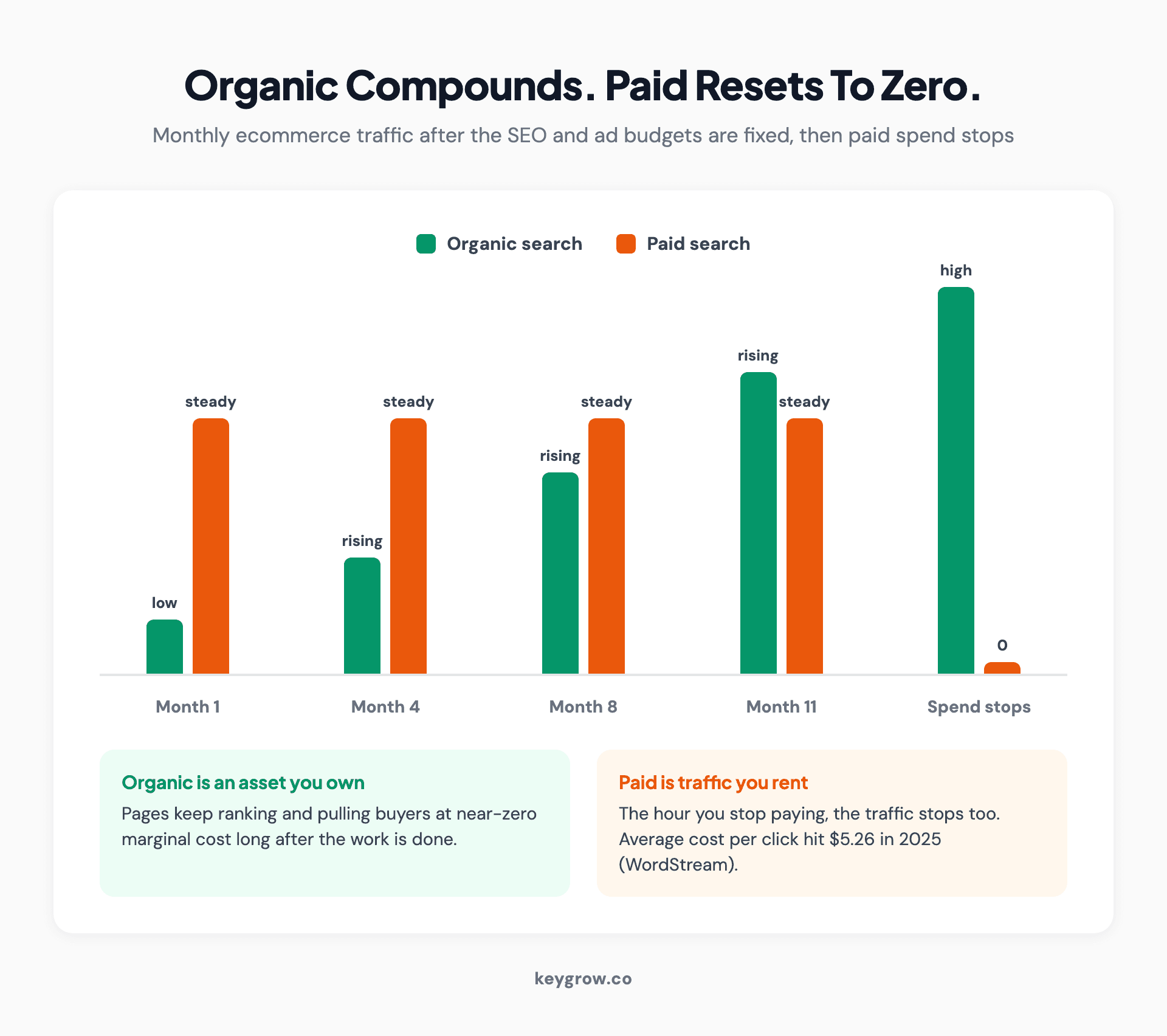
Bar chart comparing paid search traffic dropping to zero the month spend stops versus organic traffic compounding and continuing to climb over twelve months for an ecommerce store
The traffic share backs the structural point. Across all site traffic, organic search drives 53 percent versus roughly 15 percent from paid; for retail and ecommerce specifically, organic is 41 percent of total site traffic versus about 23 percent from paid, in BrightEdge research (study published 2019, and organic has only grown since). Paid is a real channel, but it is the minority partner in how stores actually get found.
The margin math: how AOV and gross margin decide whether SEO or ads wins
Your gross margin and average order value decide the answer before any agency does. The lower your margin per sale, the more punishing paid acquisition becomes, and the more SEO protects the money you actually keep.
Run it. Say your average order value is $60 and your gross margin is 40 percent, so you keep $24 in contribution margin per order. If paid acquisition costs you $20 to land that order, you walk away with $4. One return, one chargeback, one price bump from your ad platform, and that order is underwater.
Now hold the same $60 order and acquire it organically. The page that ranked cost you money once. Spread across the hundreds of orders it sends over its life, the per-order acquisition cost might be $2 or less. You keep $22 of your $24 instead of $4. Same product, same price, six times the contribution margin, because the channel does not skim your margin on every sale.
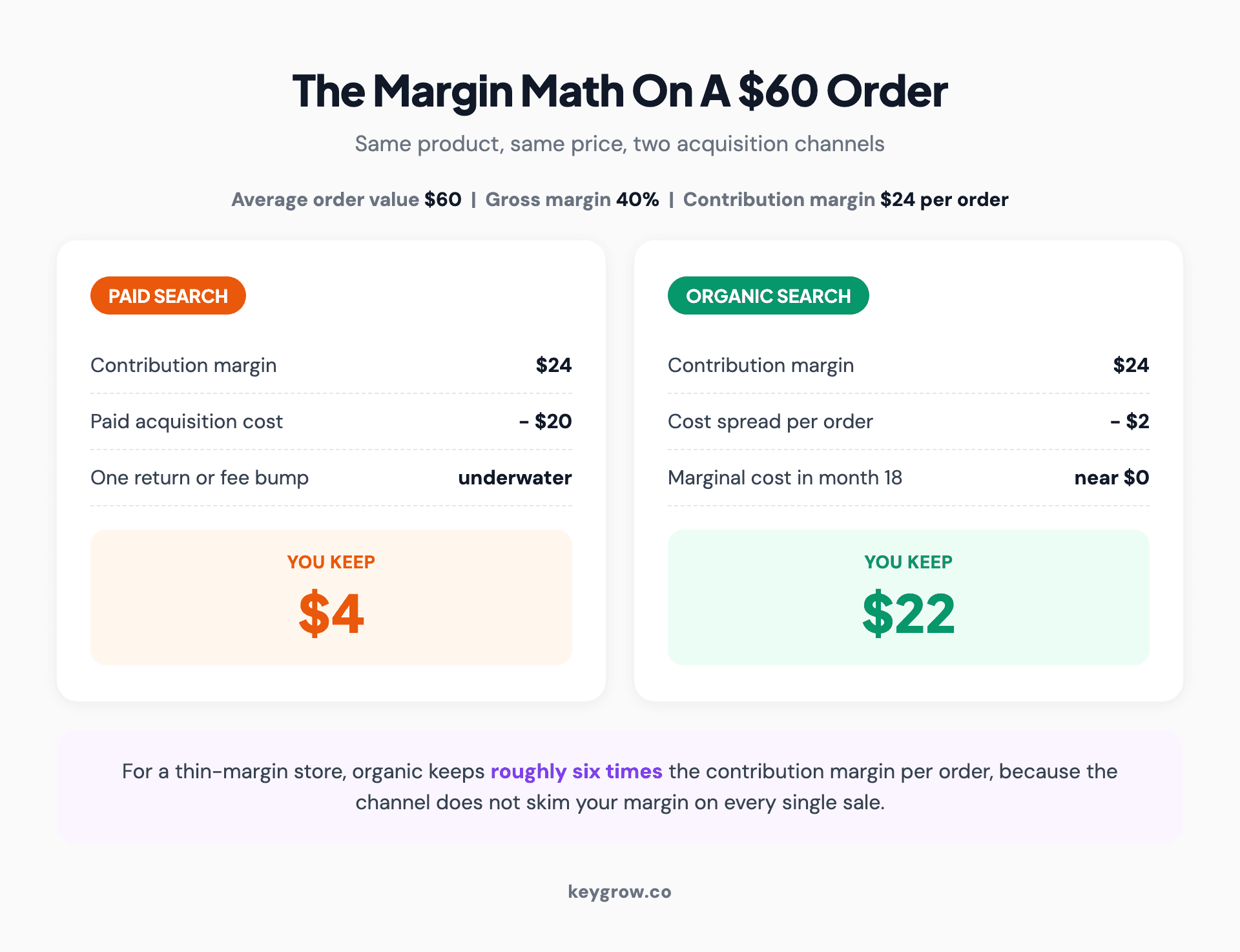
Worked margin example for a sixty dollar order at forty percent gross margin showing paid acquisition leaving four dollars of contribution margin versus organic leaving twenty-two dollars per order
Flip the inputs and the conclusion flips with them. If your AOV is $400 with a 70 percent margin, you keep $280 per order and a $40 paid acquisition cost barely registers. High-margin, high-ticket stores can run profitable ads all day. The stores that get hurt by paid dependence are the thin-margin, low-AOV ones, and those are exactly the stores told they "just need to run ads."
The strong version of this take: for a low-margin store, paid-only acquisition is not a marketing choice, it is a slow margin leak. When the average cost per click rose 12.88 percent in a single year (WordStream), every thin-margin store running paid-only got quietly less profitable without changing a thing. SEO is the channel that does not vote itself a raise every quarter.
How high-intent search captures buyers paid ads never reach
Organic search captures the buyer at the exact moment they describe what they want, and it captures the clicks paid placements never get. Most people scroll past the ads.
The click data is blunt. The number one organic result earns a 39.8 percent click-through rate, and positions one through three capture roughly 68.7 percent of all organic clicks, per click-through-rate research from First Page Sage. Two thirds of the people who search go to the top three organic results, not the ads above them.
High intent is the other half. Someone searching "waterproof hiking boots size 11" is not browsing, they are buying, they just have not decided from whom yet. A product or category page that ranks for that exact phrase meets them at the decision, with no per-click toll. That is the buyer ads compete hardest and pay most to reach, and organic can own the same query for free once it ranks.
This is where the content quality bar matters, because thin, duplicated product descriptions do not rank for specific buying queries. Plenty of stores run the manufacturer's boilerplate copy on every page and wonder why they are invisible. We have made the case for why unique content matters in SEO, and for ecommerce it is the difference between a product page that ranks for its long-tail query and one that never surfaces at all.
When is paid search actually the smarter move? (the honest answer)
Sometimes paid search is the right call and SEO is the wrong place to start. If you tell every store "do SEO," you are selling, not advising. Here is when paid wins in the near term.
You are a brand new store with no rankings and no authority. SEO does not pay out for months. If you launched last week and need revenue this quarter to keep the lights on, paid search buys you traffic today while SEO is still warming up. Starting both at once is ideal; starting with only SEO when you need cash flow now is a mistake, and which channel to fund first comes down to your margin and stage.
You have a time-sensitive launch or a seasonal window. A holiday push, a product drop, a flash promotion. SEO cannot rank a new page fast enough to catch a two-week window. Paid can be live in an hour. This is a legitimate, honest case where ads beat organic, and any agency that pretends otherwise is overselling SEO.
You are still validating product-market fit. Before you invest months in ranking a category, you want proof people will actually buy. Paid search is a fast, brutal test: run ads, see if anyone converts, learn what they search for. That keyword data then tells your SEO what to target. Paid is the scout; SEO is the occupying force.
Your store is too thin to rank yet. Five products, no reviews, no content, a brand-new domain. Google has nothing to reward. Fix the foundation first, run paid to generate sales and reviews in the meantime, and start SEO once the site has something worth ranking.

Marketing analytics dashboard with charts displayed on a computer screen at a desk
The honest framing is that this is not a war between channels. Paid buys you time and data; SEO buys you durable, lower-cost traffic. The mistake is staying on paid-only forever because it felt easier in month one, then waking up three years later with an acquisition cost you cannot escape.
What about AI Overviews and ChatGPT, is organic search even safe in 2026?
Organic search is changing, not dying, and for ecommerce the early data on AI traffic is good, not bad. The work that gets you cited by an AI engine is the same work that gets you ranked: clear answers, structured pages, real authority.
Zero-click search and AI Overviews are real. Some informational queries now get answered on the results page without a click. But ecommerce queries are transactional. Nobody buys waterproof boots from an AI summary; at some point they click through to a store to check price, sizing, and reviews. The commercial click is the click AI is least able to absorb.
The conversion data is the part most "is SEO dead" posts ignore. ChatGPT referral traffic converted 31 percent higher than non-branded organic search for ecommerce, 1.81 percent versus 1.39 percent, based on GA4 data from 94 seven- and eight-figure brands, per Search Engine Land. People arriving from an AI recommendation are further down the funnel and buy at a higher rate.
So "organic" in 2026 is widening to include AI engines, and the optimization is converging. Structured data helps both: marking up products and prices feeds Google and the AI engines alike. The same schema work that earns rich snippets increasingly drives AI visibility too. The stores that lose are the ones with thin, unstructured pages, the same stores that were losing before AI showed up.
How long before ecommerce SEO pays back, realistically?
Realistically, ecommerce SEO shows early movement around month three or four and meaningful revenue around month six to twelve. Anyone promising page one in 30 days is targeting keywords nobody searches or about to damage your domain.
Here is the honest curve, by phase:
1. Months one to two: foundation. Technical fixes, site structure, fixing duplicate and thin product copy, schema. Almost nothing visible in traffic. This is the part stores hate and the part that determines everything after it.
2. Months three to four: first movement. Long-tail product and category pages start surfacing. Small, real, easy to miss if you only watch your head terms.
3. Months five to eight: traffic builds. Category pages climb, internal links compound, and you start seeing organic orders that did not come from ads.
4. Months nine to twelve: the payback. The compounding gets obvious. The pages you built in month two are now ranking and converting at near-zero marginal cost.
We watched this exact curve with a doctor's practice in Dubai (a service business, not ecommerce, but the SEO timeline is identical). Months one through three looked unimpressive on the surface. By month twelve, organic traffic had grown 1,519 percent and the practice was taking 130-plus calls a month. Same site, no shortcuts, just consistent technical work, content, and authority over a full year. The businesses that quit at month three pay for the hard part and leave before the payout.
If you want to hold your campaign to account through that curve, the metric that matters is not rankings, it is return. We wrote a full method for how to measure SEO ROI so you can tell, by month six, whether the channel is actually earning.
A 5-question rubric to decide: SEO-first or paid-first for your store
Answer these five honestly. More "yes" answers on the left means start with SEO; more on the right means lead with paid while you build.
1. Margin. Is your gross margin under 40 percent? If yes, you need SEO to protect contribution margin, because paid will eat it. (High margin can carry paid more easily.)
2. Runway. Can you wait six months for the channel to pay back? If yes, SEO. If you need revenue this quarter to survive, paid first.
3. Authority. Does your domain already rank for anything? If yes, SEO has a head start worth pressing. If you are a brand-new domain, paid bridges the gap.
4. Content depth. Do your product pages have unique copy, reviews, and real category structure? If yes, you have something to rank. If your pages are thin manufacturer boilerplate, fix that before expecting SEO to work.
5. Timeline. Is your goal a durable, lower-cost channel, or hitting a two-week launch window? Durable means SEO. Seasonal spike means paid.
The platform question usually matters less than people think here. Stores on a hosted cart often worry their software is the bottleneck, but crawlability and content almost always matter more than the cart you chose. We dug into whether Shopify is good for SEO and the same point applies to most platforms: the platform is rarely the thing holding you back.
A note on when not to hire an agency for this. If you are a single-product store with time on your hands and a tight budget, you can do the foundation yourself: write unique product copy, add schema, build a sane category structure, and earn a few links. Hire help when the opportunity cost of your time beats the fee, or when the technical and link work has outgrown what you can do between order fulfilment. And if any agency offers you a 12-month lock-in contract to do it, ask why they need a contract to keep you. We are month-to-month, cancel anytime, because the results are supposed to do the retaining.
FAQs
How long does ecommerce SEO take to show results?
Expect first movement around month three or four and meaningful revenue around month six to twelve. The first two months are foundation work with little visible traffic. Our strongest organic case took 12 months to reach 1,519 percent traffic growth, so anyone promising page one in 30 days is a red flag.
Is SEO worth it for ecommerce, or should I just run ads?
For most stores it is worth it, especially below 40 percent gross margin, because organic protects the contribution margin that paid ads eat. Run the math on your AOV and margin first. If you are brand new and need revenue this quarter, start with paid and add SEO alongside it rather than instead of it.
Is SEO cheaper than paid advertising for an online store?
Per customer, over time, yes. Paid charges you for every single click forever, and the average cost per click rose to $5.26 in 2025 (WordStream), up 12.88 percent year over year. SEO front-loads the cost into content and links, then the per-visitor cost trends toward zero as the page keeps ranking.
Can SEO replace Google Ads completely for ecommerce?
For some mature, high-authority stores, mostly yes, but treating them as either-or is usually a mistake. Paid is unbeatable for speed: new launches, seasonal windows, and testing product-market fit. The healthier model is SEO as your durable, lower-cost base and paid as the fast lever you pull when timing matters.
Does SEO still matter for ecommerce with AI Overviews and ChatGPT?
Yes, and the early data is encouraging. ChatGPT referral traffic converted 31 percent higher than non-branded organic search for ecommerce (Search Engine Land), because buyers arrive further down the funnel. Transactional shopping queries still require a click to a store, and the structured, authoritative pages that rank are the same ones AI engines cite.
How much should an ecommerce store budget for SEO?
Budget for the work, not a fixed price, since cost depends on store size, competition, and how much technical and content cleanup you need. The useful test is comparison: model your acquisition cost on paid against the front-loaded cost of ranking pages that then send traffic at near-zero marginal cost. KeyGrow does not publish flat pricing; get a scoped quote and judge it against that math.
Running the numbers for your own store
The honest summary is that SEO is important for ecommerce because it is the only acquisition channel that gets cheaper per customer as it matures, while paid gets more expensive every year. For a thin-margin store, that gap is the difference between keeping $4 and keeping $22 on a $60 order.
That does not make paid the enemy. New stores, seasonal pushes, and product-market-fit tests are real cases where ads are the smarter near-term move. The mistake is staying paid-only out of habit until your acquisition cost has no exit.
Take the five-question rubric, run your own AOV and margin through the math, and you will know which channel to lead with. If you want a second set of eyes on the numbers for your store, tell us about your store and we will run them with you.


