

Is Shopify good for SEO? Yes, genuinely, for an ecommerce store. Out of the box it gives you fast managed hosting, auto-generated sitemaps, clean canonical tags, SSL, mobile-ready themes, and editable titles and meta descriptions. The data backs it up: Shopify stores pass mobile Core Web Vitals at a higher rate than every other major ecommerce platform.
It is not flawless. You cannot remove the forced /products/ and /collections/ URL prefixes, the native blog is basic, and stacking too many apps can slow your store down. But these are manageable limits, not dealbreakers, and none of them is what is actually keeping most stores off page one. This is a platform review with the numbers attached, including the honest part no competitor says out loud: the platform is almost never your SEO bottleneck.
Is Shopify good for SEO?
Yes, for ecommerce. Shopify covers the technical SEO basics by default and loads fast, so a Shopify store can rank as well as a store on any other platform. Its limitations are real but minor and have workarounds.
The short version is that Shopify removes most of the technical SEO decisions you would otherwise have to make and get right. Sitemaps, canonical tags, mobile responsiveness, HTTPS, and image compression are handled for you. That is a genuine advantage for a business owner who would rather sell products than configure a server. The trade is less control over a few specific things, mainly URL structure and the blog, which matter for some businesses and not at all for most.
What does Shopify do well for SEO out of the box?
A lot, and that is the point of a hosted platform. Shopify ships with fast managed hosting, automatic XML sitemaps, default canonical tags, SSL, mobile-responsive themes, and editable meta titles and descriptions, so the technical foundation is set before you write a word.
Here is what you get without lifting a finger, and why each one matters:
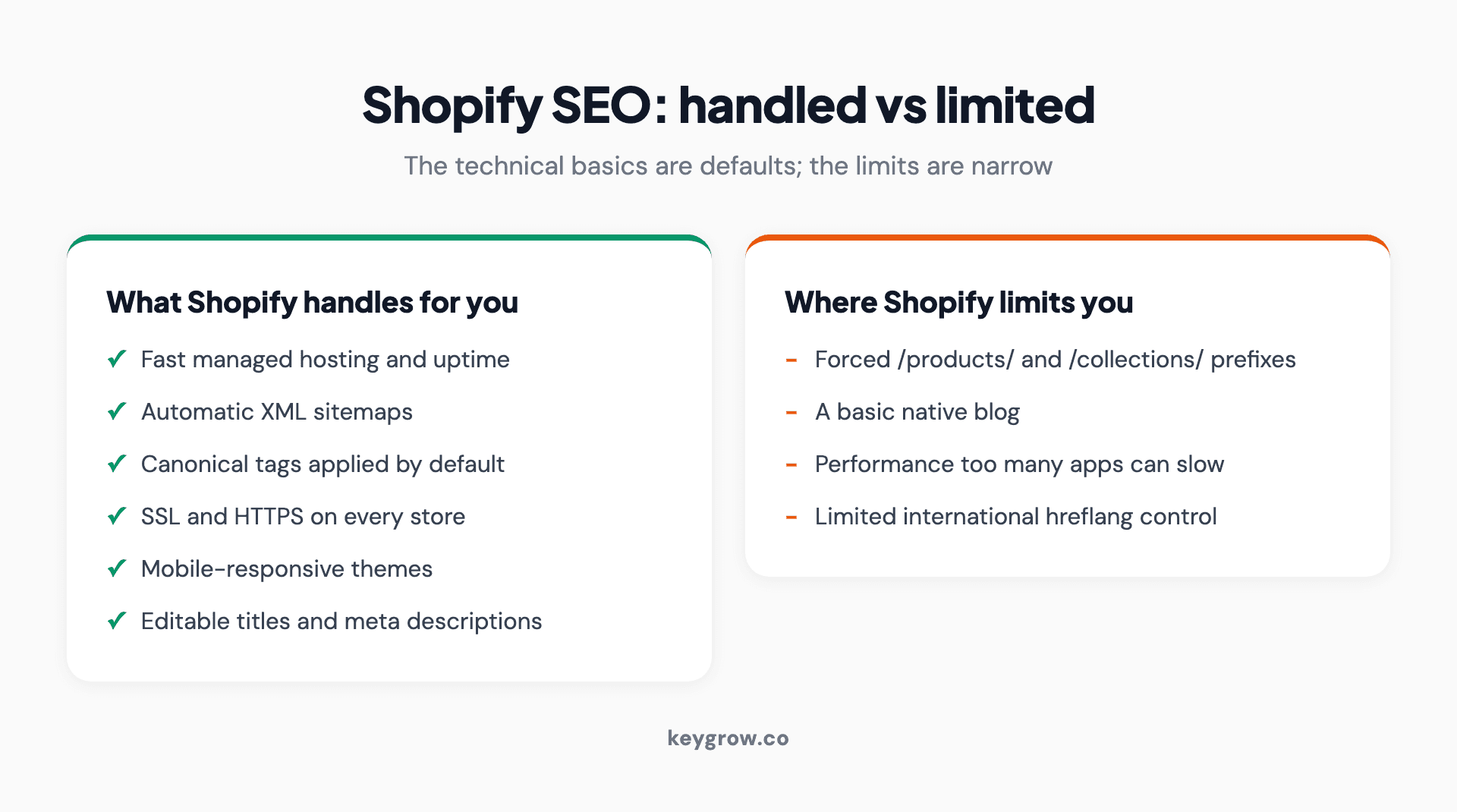
Infographic with two columns. Left column headed What Shopify handles for you, in green checkmarks: fast managed hosting and uptime, automatic XML sitemaps, canonical tags applied by default, SSL and HTTPS on every store, mobile-responsive themes, and editable titles and meta descriptions. Right column headed Where Shopify limits you, in amber: forced /products/ and /collections/ URL prefixes you cannot remove, a basic native blog, performance that too many apps can slow down, and limited control over international hreflang setup.
The takeaway from that list is that Shopify has quietly become one of the more SEO-ready platforms for the specific job it does. You are not fighting the platform to get the basics right. They are the defaults.
Is Shopify fast enough for SEO?
Yes, and it is faster than its rivals where it counts. Site speed is a confirmed ranking signal and a major driver of conversions, and Shopify's managed hosting passes mobile Core Web Vitals at a higher rate than any other major ecommerce platform.
The numbers are clear. The Web Almanac 2025 ecommerce report found that 76 percent of Shopify stores passed Core Web Vitals on mobile, ahead of Squarespace Commerce at 69 percent, Wix eCommerce at 66 percent, and WooCommerce at just 35 percent. For context from the same project's CMS report, self-hosted WordPress sat at 45 percent. Shopify's hosted model out-measures the self-hosted alternatives because the speed work is done for you rather than left to a stack of plugins.
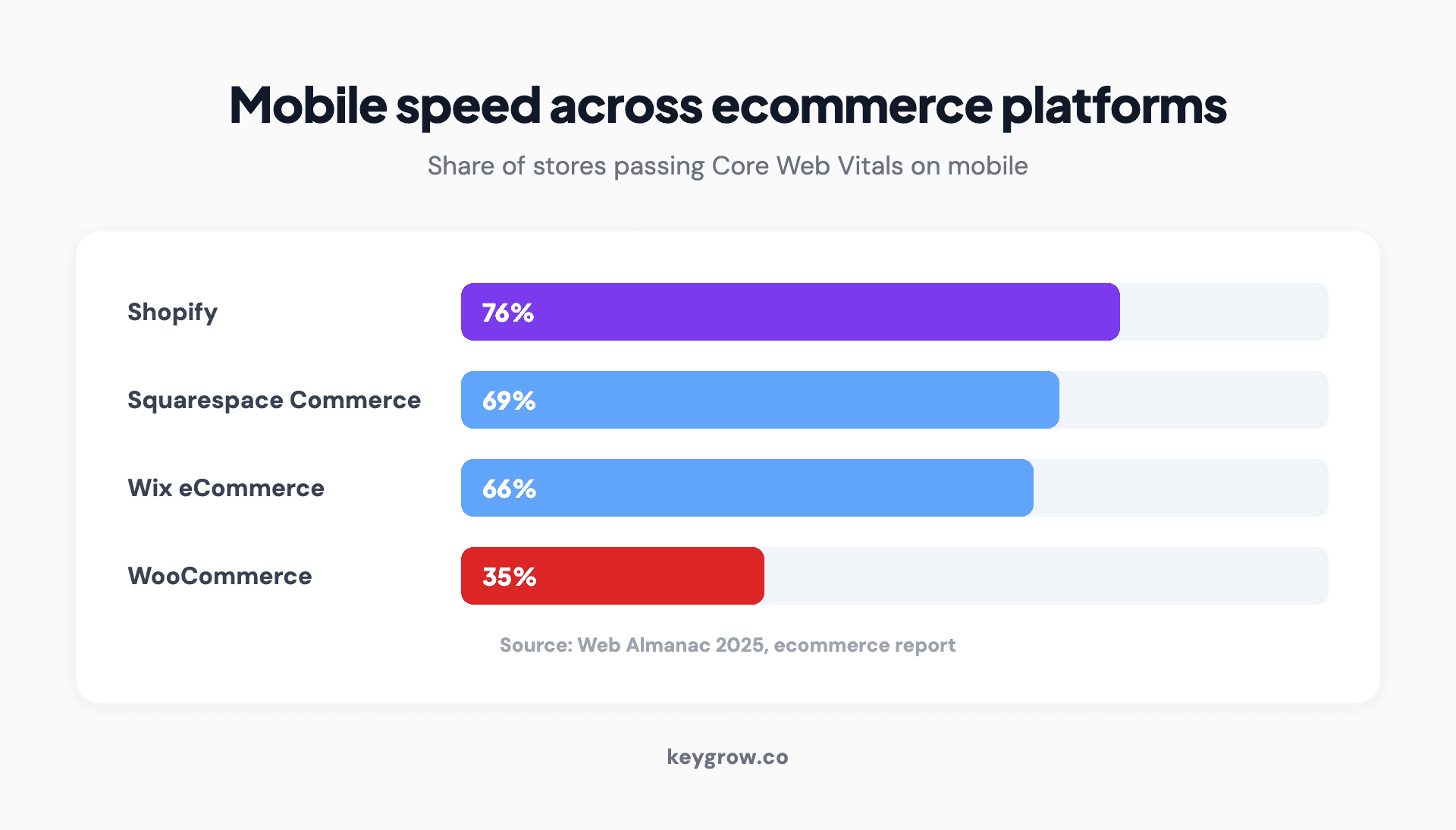
Bar chart comparing the share of stores passing Core Web Vitals on mobile across major ecommerce platforms, from Web Almanac 2025: Shopify 76 percent, Squarespace Commerce 69 percent, Wix eCommerce 66 percent, and WooCommerce 35 percent. Shopify leads.
Speed is not a vanity metric. Portent found, in a study of more than 100 million page views, that an ecommerce site loading in one second converts about 2.5 times better than one loading in five. So Shopify starting you ahead on speed is worth real revenue, not just a better score.
The one caveat is apps. Shopify gives you a fast foundation, but every app you install can add scripts that slow your pages down. Install fifteen apps you barely use and you can squander the head start. This is the most common self-inflicted Shopify speed problem, and it is exactly the kind of bloat a periodic technical SEO audit is built to catch. Keep apps to the ones you actually need.
Where does Shopify fall short for SEO?
In a few specific, well-known ways. You cannot change Shopify's forced URL prefixes, the same product can appear under two paths, the native blog is basic, and international SEO controls are limited. All have workarounds, and none stops a normal store from ranking.
Take them honestly, one at a time:
Notice the pattern. The limitations are real, but they are narrow, and the scariest-sounding one (duplicate URLs) is the one Shopify already solves for you. The same discipline of keeping to clean canonical URLs is what prevents the duplicate content issues an audit looks for anywhere.
Is Shopify or WordPress better for SEO?
Neither wins outright; they win at different jobs. Shopify is better for a product-first store that wants speed and low maintenance. WordPress is better for a content-first site that wants total control over URLs, the blog, and technical details. Pick based on what your business actually is.
The trade-off is control versus convenience.
| Shopify | WordPress (WooCommerce) | |
|---|---|---|
| Hosting and speed | Managed, fast by default (76% pass mobile CWV) | You manage it (45% pass mobile CWV) |
| URL control | Fixed prefixes, less flexible | Full control |
| Blogging and content | Basic native blog | Full editorial control |
| Maintenance | Handled for you | Your responsibility (updates, security, plugins) |
| Best fit | Product-first ecommerce | Content-first or highly custom sites |
For a store whose job is selling products, Shopify's defaults remove work and start you ahead on speed. For a site whose growth engine is publishing, the editorial and URL flexibility of WordPress is worth the extra maintenance. There is no universal winner, only a better fit for your situation, the same conclusion we reached comparing Webflow and Squarespace.
Can you actually rank a Shopify store on Google?
Yes, and plenty do. There is nothing in Shopify's architecture that prevents a store from ranking at the top of Google. The platform handles the technical basics, so whether you rank comes down to content and authority, the same as on any platform.
This is the part worth being blunt about, because it is the one opinion this whole post is built on: the platform is almost never your SEO bottleneck. Google's John Mueller has said plainly that search systems do not look for any particular content management system to treat it differently, and that all mainstream platforms can create pages that work well in search. In practice, we see far more Shopify stores stalled by thin product descriptions and a neglected blog than by anything Shopify's URL structure imposes.
So before you blame the platform, run the diagnostic. Are your product and collection pages genuinely more useful than competitors', or are they manufacturer boilerplate? Are you publishing content that earns links and answers buyer questions? Do other sites cite you? Most "Shopify is bad for SEO" complaints are really content and authority problems wearing a platform costume. We made the broader case for that in why unique content is so important.
When is Shopify the wrong choice?
When your business is content-first rather than product-first. If publishing is your main growth channel, a publisher, a heavy resource library, or a site where the store is secondary to the articles, WordPress gives you more editorial and URL control and is the better home.
Be honest about which one you are. A store that lives or dies on product sales should be on Shopify and stop worrying about the platform. A business whose traffic engine is a large, evolving content library will eventually hit the ceiling of Shopify's blog and URL rigidity, and is better served elsewhere. Most ecommerce businesses are firmly in the first camp, which is why the platform anxiety is usually misplaced. Choose the tool that fits the job, then put your energy into the content and links that actually move rankings.
Does Shopify work for AI search?
Yes, on the same terms as Google. AI Overviews and answer engines pull from pages they can crawl and trust, and Shopify's clean, fast, well-structured pages are easy for them to read. The platform is not the issue; being a citable source is.
The 2026 angle does not change the verdict. Answer engines favor fast, clearly structured pages with genuine expertise, and Shopify gives you the technical foundation for that. Whether you get cited still depends on the quality and authority of your content, which is the same thing that decides your rankings. The fundamentals that make you findable and quotable are covered in our guide to AI search optimization.
FAQs
Is Shopify good for SEO?
Yes, for ecommerce. Shopify handles the technical SEO basics by default (sitemaps, canonical tags, SSL, mobile-responsive themes, editable meta) and loads fast, passing mobile Core Web Vitals on 76 percent of stores per Web Almanac 2025, ahead of every other major ecommerce platform. Its limitations around URL structure and blogging are real but minor for a product-first store.
Is Shopify bad for SEO?
No. The "Shopify is bad for SEO" reputation comes from a few real but narrow limitations (fixed URL prefixes, a basic blog) that get exaggerated. The most-cited worry, duplicate product URLs, is handled automatically because Shopify canonicalizes variants by default. Most stores that struggle to rank have a content or authority problem, not a platform problem.
Is Shopify or WordPress better for SEO?
It depends on the business. Shopify is better for a product-first store that wants speed and low maintenance, and it passes mobile Core Web Vitals more often than self-hosted WordPress (76 percent versus 45 percent). WordPress is better for a content-first site that needs full control over URLs, the blog, and technical details. Neither has an inherent ranking advantage.
Does Shopify have SEO problems with its URL structure?
It has a quirk, not a problem. Shopify forces prefixes like /products/ and /collections/ that you cannot remove, so URLs are slightly less clean than a custom setup. This does not measurably hurt rankings because Google reads the full URL. The related duplicate-URL concern is solved by Shopify's default canonical tags.
Can you change the URL structure on Shopify?
Only partially. You can edit the final part of a URL (the handle), but you cannot remove Shopify's fixed prefixes such as /products/ and /collections/. This is a real limitation if you want fully custom paths, but it has no meaningful effect on rankings, so it is not worth losing sleep over.
Do Shopify apps slow down your site and hurt SEO?
They can. Shopify gives you a fast foundation, but each app can add scripts that slow your pages, and slow pages hurt both rankings and conversions. This is the most common self-inflicted Shopify speed issue. Keep apps to the ones you genuinely use, and audit your store speed periodically to catch the bloat.
Can you rank a Shopify store on Google?
Yes. Nothing in Shopify's setup prevents top rankings. The platform covers the technical basics, so ranking comes down to useful product and collection pages, helpful content, and earned authority, exactly as it would on any platform. If a Shopify store is not ranking, the cause is almost always content and links, not Shopify.
The short version
Is Shopify good for SEO? Yes, for ecommerce, and the data is on its side: 76 percent of Shopify stores pass mobile Core Web Vitals, ahead of every other major ecommerce platform, and the technical basics are handled by default. The limitations are real but narrow, fixed URL prefixes, a basic blog, app bloat you control, and the scariest-sounding one, duplicate URLs, is solved automatically.
The honest verdict is the same one we reach for every platform: it is rarely the thing holding you back. Choose Shopify if you are product-first, choose WordPress if you are content-first, and then spend your energy where rankings are actually won, on content and authority. If you want a straight read on whether your platform is the problem or your content is, that is what our SEO team checks first. Tell us about your store and we will tell you where the real bottleneck is.


