


Do ecommerce sites need SEO and PPC? The honest answer: established stores almost always run both, but which one you fund first, and whether you fund one of them at all, comes down to two numbers most articles never mention. Your gross margin decides whether paid clicks can ever be profitable. Your stage decides which channel earns the first dollar. Everything else in this decision is detail.
That framing matters because the pages ranking for this question were mostly written to sell you both channels by default. One of them still calls the platform "AdWords," a name Google retired in 2018. We would rather show you the math and let it disqualify us where it disqualifies us.
Start with margin, not marketing
The 20-word version: paid traffic is a loan against your gross margin. If the margin cannot repay the click cost, no amount of optimization saves the channel.
The formula is short. Your cost per acquisition is the click price divided by your conversion rate. Your breakeven order value is that CPA divided by gross margin.
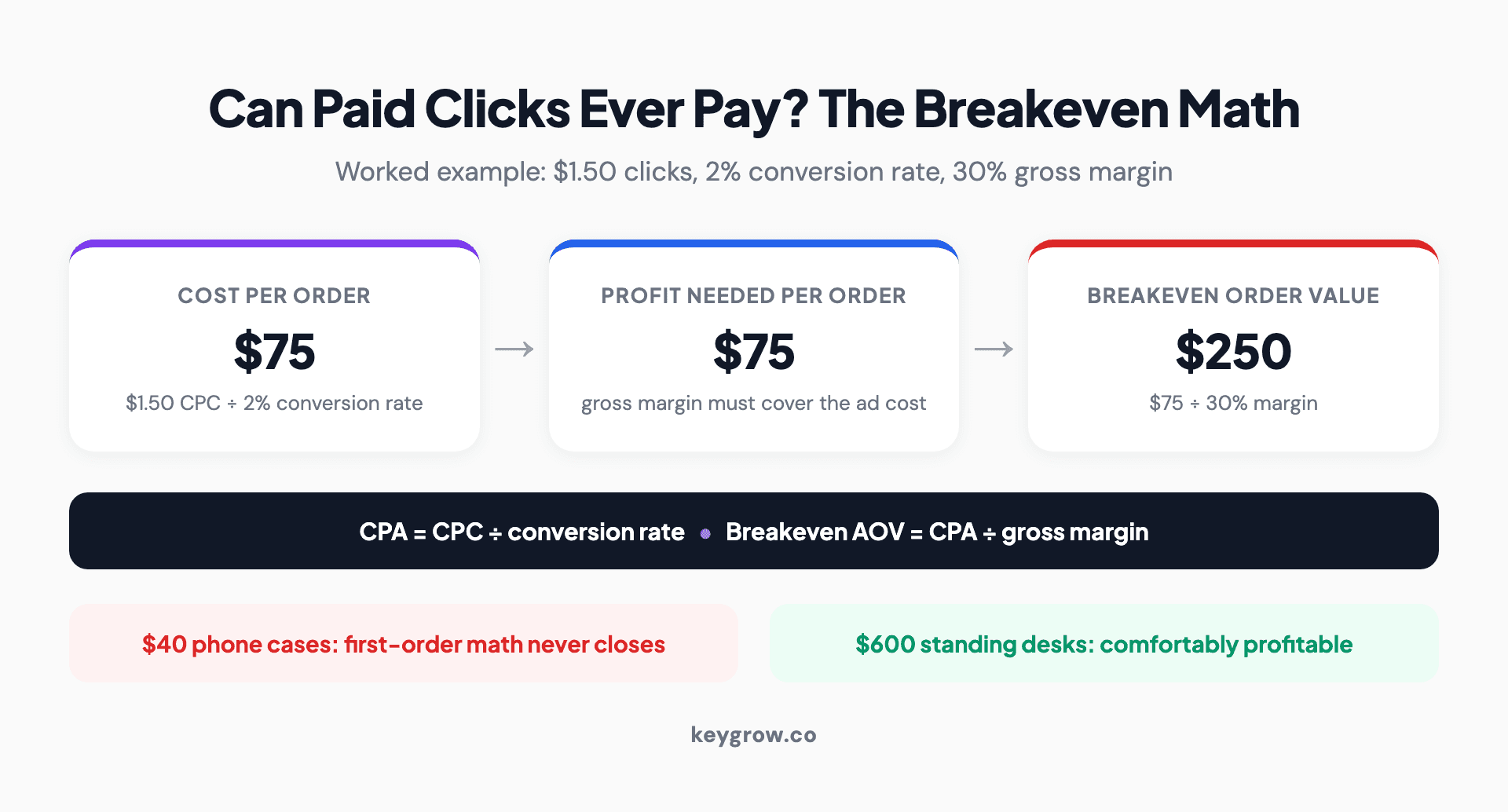
The breakeven math that decides whether PPC can work for an ecommerce store: cost per acquisition equals CPC divided by conversion rate, and breakeven order value equals CPA divided by gross margin, with a worked example at a $1.50 CPC, 2 percent conversion rate, and 30 percent margin requiring a $250 average order.
Worked example. Say your Shopping ad clicks cost $1.50 (product-ad clicks generally run cheaper than search-ad clicks) and your store converts 2 percent of visitors, a normal number for an online store. That is $75 in ad spend per order. At a 30 percent gross margin, you need a $250 average order just to break even on the first purchase. Selling $40 phone cases, that math never closes on first orders; it only works if customers reorder. Selling $600 standing desks, the same clicks are comfortably profitable.
Run your own numbers in our breakeven ROAS calculator before anyone sells you a campaign, and see how PPC actually drives sales for online stores for the full click-to-sale engine. Two minutes with that math beats an hour with an agency pitch deck, including ours.
Your stage decides the order of operations
New stores fund PPC first, mature stores lean on SEO, and the middle runs both on purpose. Not because paid is better, but because a store with no traffic and no data needs revenue and information this quarter, and only ads deliver either that fast.
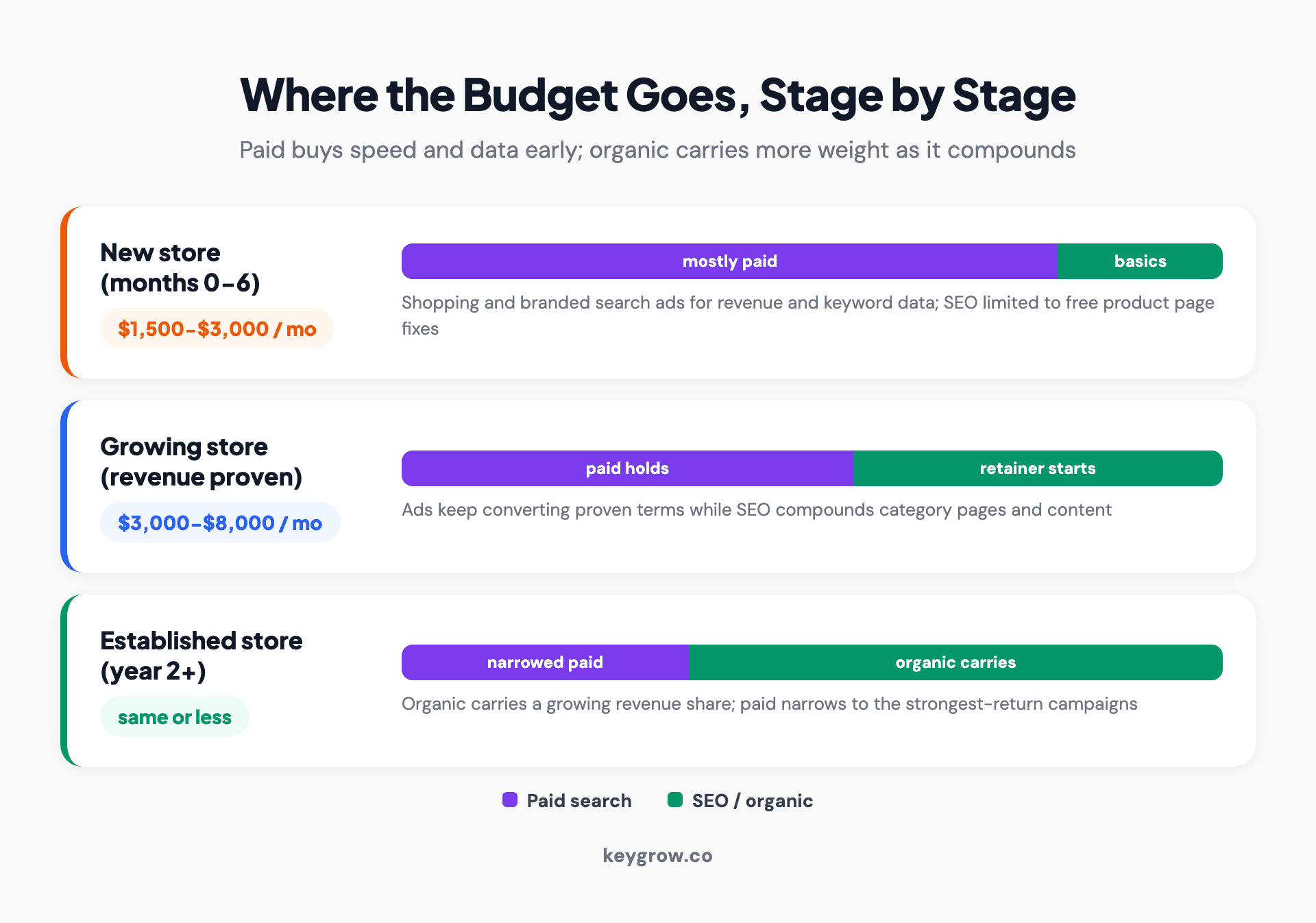
How ecommerce marketing budgets shift by stage: a new store runs mostly paid traffic for immediate revenue and keyword data, a growing store funds both channels, and an established store leans on compounding organic traffic while paid focuses on high-return campaigns.
Here is what that looks like in dollars rather than percentages:
| Stage | Typical monthly budget | Where it goes |
|---|---|---|
| New store (months 0-6) | $1,500-$3,000 | Mostly Shopping and branded search ads; SEO limited to fixing product page basics you control for free |
| Growing store (revenue proven) | $3,000-$8,000 | Paid holds steady while an SEO retainer starts compounding category pages and content |
| Established store (year 2+) | Same or less | Organic carries an increasing share of revenue; paid narrows to the campaigns with the strongest returns |
The sequencing logic: paid search proves which products and search terms convert while your organic pages are still invisible. Every dollar of early ad spend buys revenue plus a list of proven keywords, and that list is the cheapest SEO research you will ever get.
Know what you are actually buying with "PPC"
For a store, PPC is not one product. Shopping ads put your product photo and price directly in the results and do most of the heavy lifting for ecommerce accounts. Standard search ads catch category and problem searches that product feeds miss. Performance Max spreads your feed across Google's surfaces with less control and, in our experience, needs clean conversion data before it earns its keep. And listing your products in Google Merchant Center is free; the unpaid product listings that come with it are the closest thing to free ecommerce traffic Google offers.
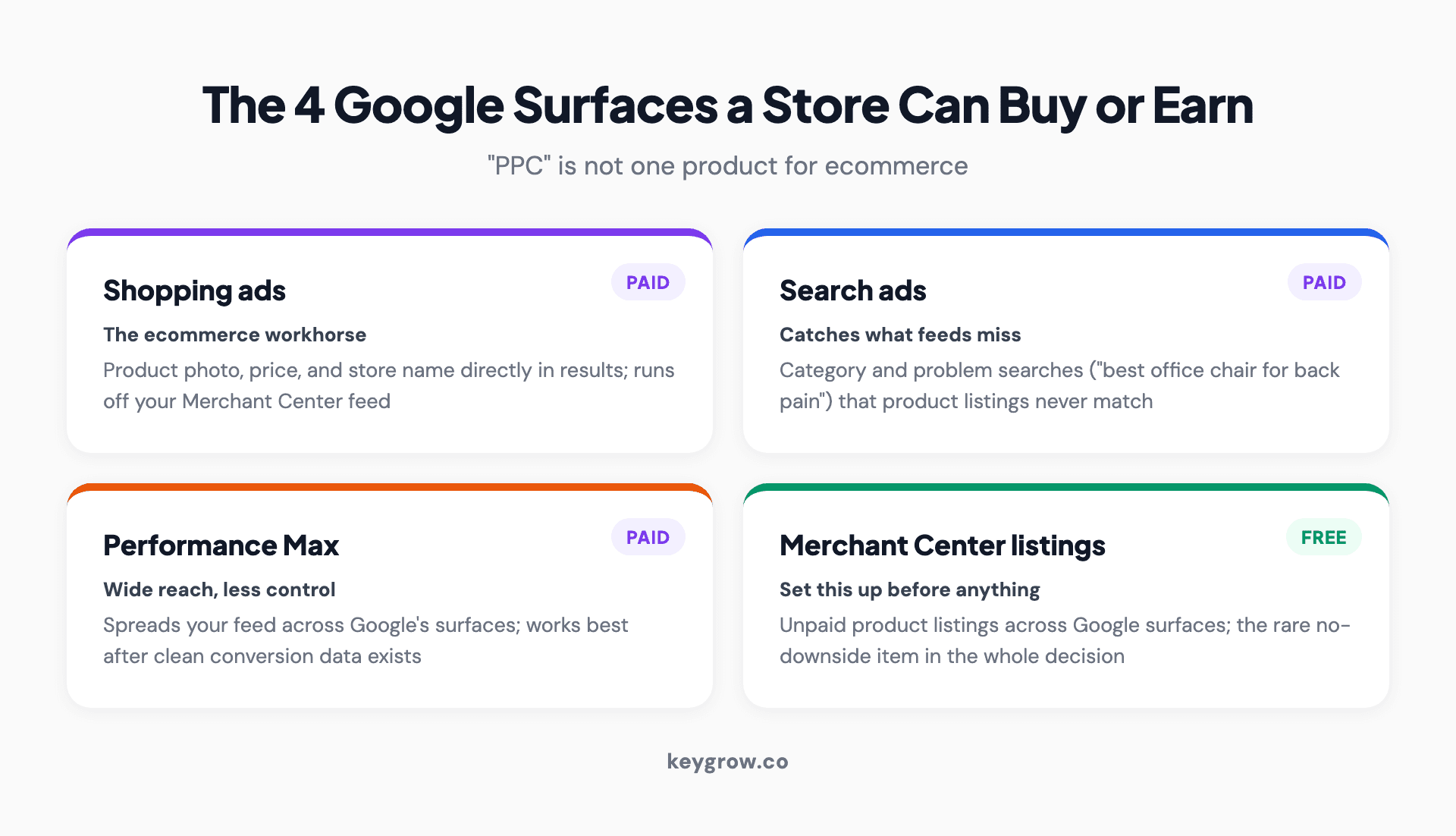
The four Google surfaces an ecommerce store can buy or earn: Shopping ads for product photo and price placements, search ads for category and problem queries, Performance Max across all Google properties, and free Merchant Center product listings.
If nobody has set up your free listings, do that before spending a dollar on ads. It is the rare item in this decision with no downside.
What SEO buys a store, and how long it takes
SEO builds the thing ad spend never becomes: pages that sell without a per-click toll. For ecommerce that means category pages matched to how people search, product pages that answer buying questions, and content that catches the research queries ads price out.

Two people relaxing on a couch browsing an online store together on a tablet
The timeline is the catch, and it is documented. Google's own guidance, delivered back in 2017 by then-Googler Maile Ohye for Google Search Central, says most SEO engagements need four months to a year before showing meaningful results. The return side is also documented: ecommerce SEO averages a 317 percent ROI but takes around nine months to break even, per First Page Sage.
SEO is a compounding asset, not a campaign. It looks unimpressive for the first quarter and embarrassingly good after a year; our strongest organic engagement took 12 months to reach 1,519 percent traffic growth. Stores that quit at month three pay for the hard part and leave before the payout. If you cannot commit to at least six months, put the money into ads instead and revisit later. That is a better outcome than a half-funded retainer you cancel in frustration.
We covered the store-specific tactics in why SEO matters for ecommerce and the page-level work in product page SEO.
The loop that makes each channel cheaper
Run separately, SEO and PPC are two bills. Run together, they trade information.
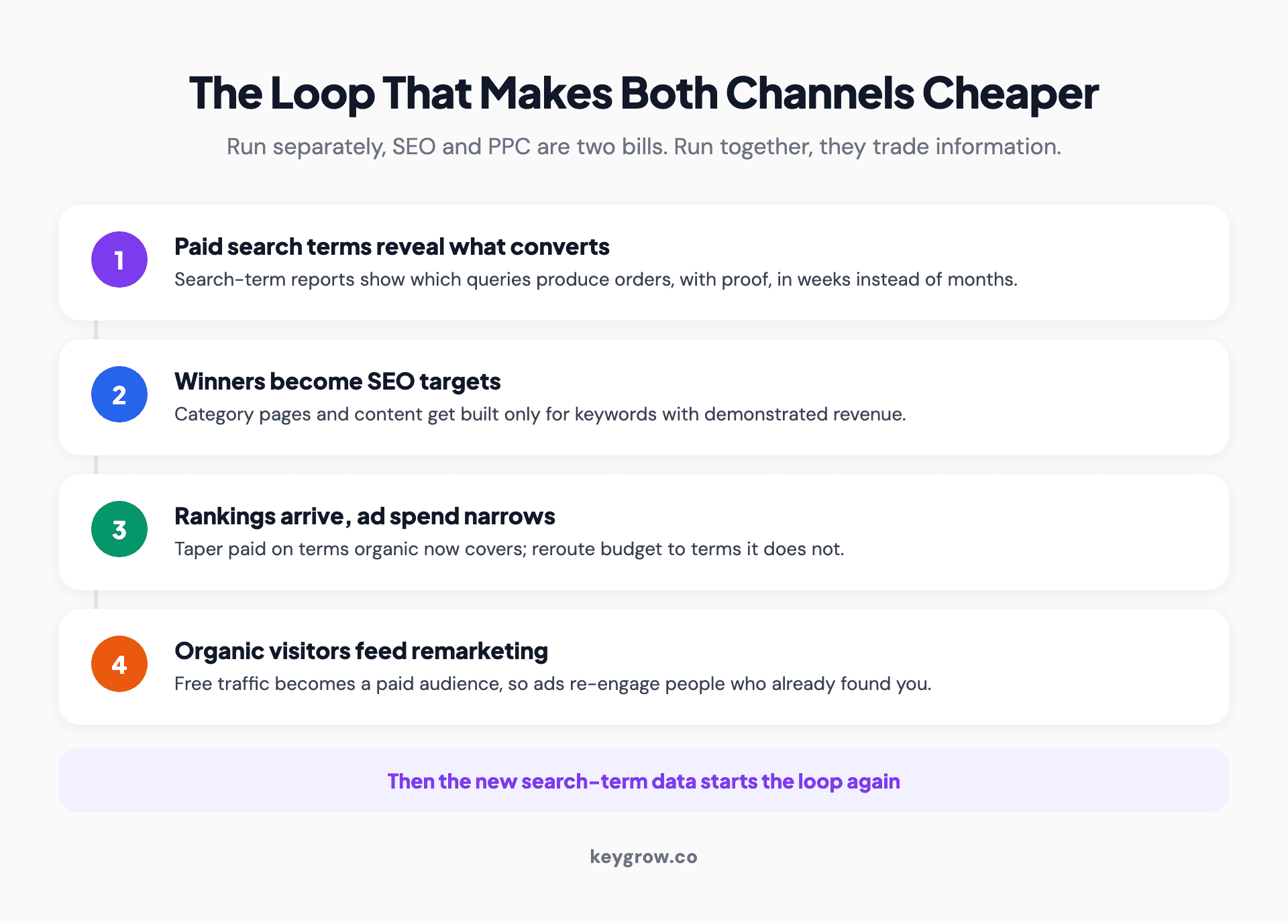
The data loop between PPC and SEO for ecommerce: paid search terms reveal which keywords convert, winning keywords become SEO category page targets, organic pages then carry the traffic while ad spend narrows, and organic visitors feed remarketing audiences.
The loop runs in four moves. Your search-term reports show which queries produce orders, with proof, in weeks. Those winners become the category and content pages your SEO retainer builds next, so organic effort goes only where conversion is already proven. As those pages rank, you taper spend on the terms organic now covers and reroute it to terms it does not. And your growing organic traffic becomes a remarketing audience, so the paid budget re-engages visitors who already found you for free.
Stores buying both channels from separate vendors usually get none of this. If your SEO agency and your PPC agency have never exchanged a search-term report, you are paying twice for half the value.
When you should not buy one of these
The section agency blogs skip. PPC is the wrong buy when the margin math above cannot close and your product has no reorder pattern to rescue it; low-price, low-repeat catalogs fight physics with someone else's money. It is also premature if your site converts terribly, since ads amplify a conversion problem rather than fix it.
An SEO retainer is the wrong buy when your catalog is a handful of products with tiny search volume, when nearly all your sales happen on marketplaces and social rather than your own site, or when you need revenue in 60 days to survive. SEO cannot rescue a cash-flow emergency; it can only reward a store that lives long enough to collect.
DIY is underrated at the small end. A new store owner can claim Merchant Center, fix product titles and descriptions, and run a modest branded and Shopping campaign without hiring anyone. Hire help when the account grows past the hours you have, and judge that help on ecommerce results, not promises.
FAQs
Should an ecommerce store invest in SEO or PPC first?
PPC first in most cases. A new store needs revenue and keyword data immediately, and ads deliver both in weeks. SEO compounds from months four to twelve onward, so it rewards stores that already have cash flow to sustain the wait.
Can an ecommerce site succeed with only SEO or only PPC?
Yes, at the extremes. High-margin niches with patient owners can grow on organic alone, and strong-margin products with proven repeat purchases can scale on ads alone. Most stores sit between those extremes, which is why mature stores usually run both.
How much should an online store spend on SEO and PPC?
New stores typically start around $1,500 to $3,000 a month weighted toward ads, growing stores $3,000 to $8,000 split across both, and established stores shift weight toward organic as it compounds. The right number depends on margin, category click prices, and how fast you need revenue.
How long does ecommerce SEO take to show results?
Google's own guidance says four months to a year for meaningful results, and industry ROI data puts ecommerce SEO breakeven around month nine. Anyone promising page one in 30 days is describing a different product, usually a worthless one.
How can PPC data improve an ecommerce SEO strategy?
Search-term reports show exactly which queries produce orders. Those proven converters become the priority list for category pages, product page keywords, and content, so SEO effort goes only where revenue is already demonstrated.
Do AI Overviews change whether stores need SEO and PPC?
They raise the value of being the cited source and of owning your product data feed, but they do not change the core decision. Margin still decides whether clicks can be profitable, and stage still decides which channel to fund first.
Your Monday morning plan
Compute your breakeven order value from margin, CPC, and conversion rate. Claim the free Merchant Center listings. If the math clears, run Shopping ads to prove which terms convert. Feed the winners to whoever does your SEO. Then taper the paid terms organic starts covering.
If you want one team running that whole loop instead of two vendors ignoring each other, tell us about your store. Month-to-month, and if your margins say ads cannot work, we will say so before you spend.