

The fastest way to vet an agency is to know what questions to ask a seo company and, more importantly, what a good answer and a red-flag answer each sound like. A sales call is a test you are allowed to run. The agency is performing, so your job is to ask the handful of questions that cut through the performance and tell you whether there is real work behind the pitch. This post gives you those questions, grouped the way a buying conversation flows, with a decode for each: the strong answer, the warning sign, and the buyer power that question protects.
You do not need 40 questions. You need maybe a dozen, asked in the right order, with the confidence to notice when an answer dodges. Most thin listicles hand you a flat list and leave you to guess which answers are good. A non-expert can score a sales call in real time if they know what they are listening for.
If you want the wider framework, our guide on how to choose a good SEO company walks the full selection process, and if you are still fuzzy on the actual deliverables, what SEO companies really do defines the work itself. This post is the part in the middle: the questions you ask once you are sitting across the table.
What questions to ask a SEO company before you sign, not after
Ask your hard questions during the sales call, while the agency still wants your business, because that is the only moment you have real bargaining power. Once you have signed, every awkward question becomes a complaint instead of a deal-breaker.
The discovery call is the most honest the relationship will ever be on the agency's side, because they are still selling, and the most powerful you will ever be as a buyer, because you can walk. After you sign, the power flips and you are a client trying to get answers, not a prospect deciding whether to engage. The questions below are not "nice to ask eventually." They are due diligence, and the time to run them is before money changes hands.
There is a second reason to front-load this. The way an agency answers a sharp question tells you more than the answer itself. A team that does real work answers specifics with specifics. A team that does not gets vague, redirects to "trust the process," or pivots to its awards. You are watching how they handle being asked.

Two people in a discovery call reviewing notes, the moment a buyer has the most bargaining power to ask hard questions.
Group your questions into three buckets and you will not forget any: results and proof, process and ownership, and money and contract. That is the order a good buying conversation tends to follow anyway.
Can you show me results for a business like mine?
A good agency can show specific, recent results for businesses similar to yours, with real numbers and ideally a reference you can call. A red flag is generic case studies with no names, no metrics, or results only in unrelated industries.
Ask it early. It tests whether they get results and whether they understand your kind of business. An agency that has moved the needle for a dentist knows things about dental SEO that a generalist does not, and one that has only worked with software startups will learn your market on your dime.
A strong answer sounds like a story with numbers in it. Our strongest organic case is a doctor's practice in Dubai that committed to a full year of SEO. Months one through three looked unimpressive, and by month twelve organic traffic had grown 1,519 percent and the practice was taking 130 or more patient calls a month. That is what a real result sounds like: a before, an after, a timeline, and a specific business.
The red-flag version sounds like "we have helped hundreds of businesses rank higher" with no client you can name and no metric you can verify. "Higher" is not a number. "Hundreds" is not a reference. If they will not point you to a real client in a roughly comparable situation, assume the case study is thinner than the slide.
What it protects: you from paying for a learning curve, by matching proven experience to your market instead of being someone's first attempt at your industry.
How do you define success, and how will you report it?
A good answer ties success to business outcomes, leads, calls, booked jobs, revenue, and shows you a sample report that leads with those. A red flag is a report built around impressions, rankings, and traffic with no line connecting any of it to money.
This question separates agencies that move your business from agencies that move a dashboard. Ask to see an actual client report, redacted if they need to, before you sign. Its structure tells you what they think their job is.
Vanity-metric reporting is the industry's biggest quiet scam. Impressions, clicks, and "engagement" do not pay rent. A report that opens with "your impressions are up 240 percent" is hoping you will not ask whether any of them turned into a customer. The reports that matter lead with cost per lead, booked jobs, and revenue, and only then show the traffic and rankings that drove them. A rankings-only report is easy to game, because you can rank first for a phrase nobody searches. What you want to know is whether the phone is ringing.
If you want a checklist for judging an agency's reports once you are a client, how to tell if your SEO company is working is built for exactly that.
Why it matters: it protects your ability to know whether you are getting value, because you agree on the scoreboard before kickoff and they cannot redefine "winning" as whatever number happened to go up.
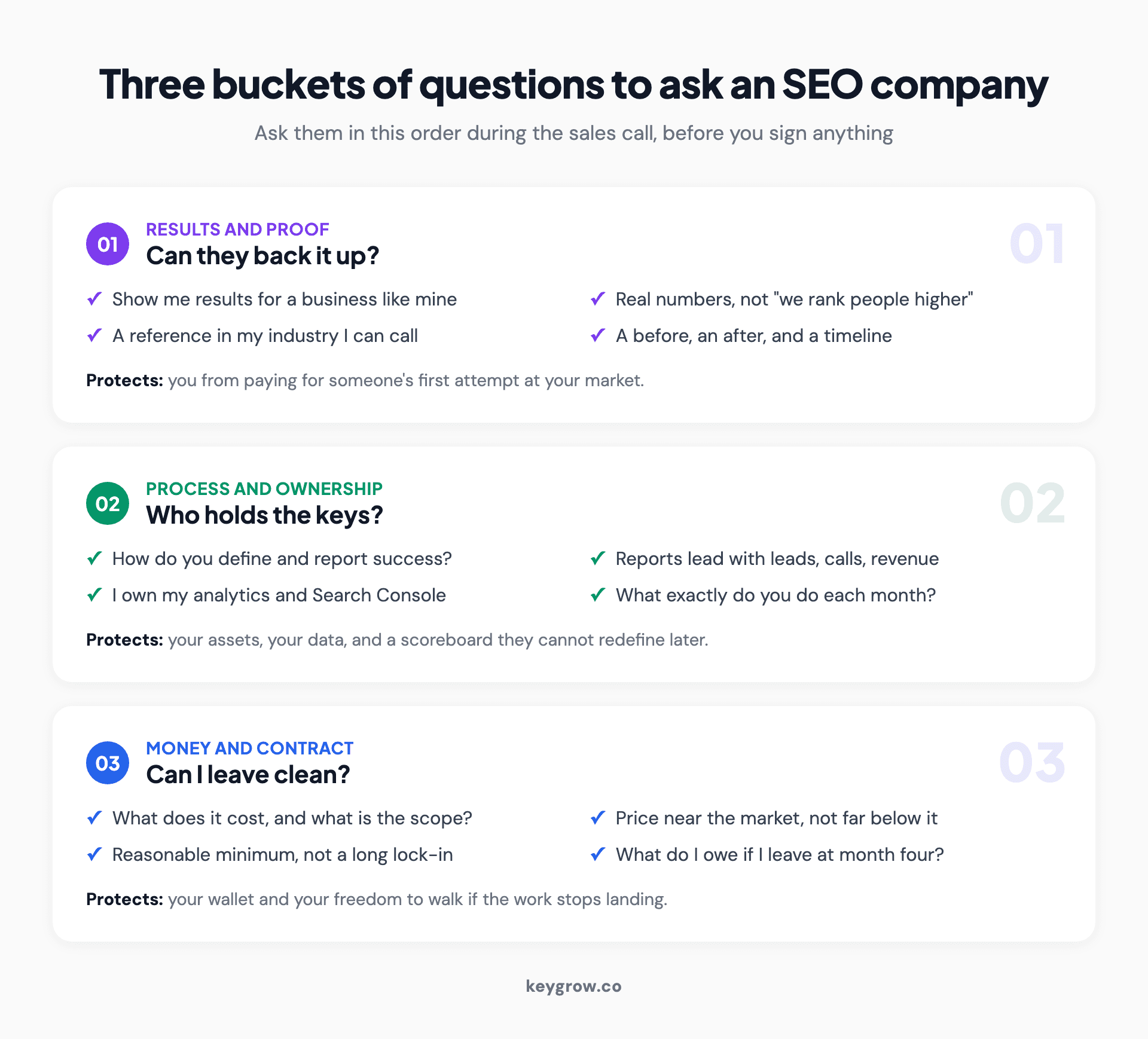
Three buckets of questions to ask an SEO company before signing: results and proof, process and ownership, and money and contract, each with the buyer power it protects.
Who owns my website, content, and analytics if we part ways?
You should own your website, your content, your domain, and your Google Analytics and Search Console accounts, with full admin access in your name. A red flag is any setup where the agency holds the keys and you would lose your assets, or your data history, if you left.
This is the question most buyers forget, and the one that hurts most later. Ownership is power. An agency that controls your analytics controls the story you are told about your own performance, and one that holds your website or domain can hold your business hostage at renewal time. Ask it plainly: if we part ways tomorrow, what do I keep, and what do I lose?
A good answer is boring and confident. They set up Google Analytics and Search Console under your account and grant themselves access, not the other way around. Your domain is registered to you, your content lives on a site you control, and when the relationship ends you keep everything while they lose access. That is how a confident agency operates, because they are not relying on lock-in to keep you.
The red-flag version is subtle, which is why it works. "We will handle all of that for you" can mean they create the accounts under their own login and you never get direct access, or that the content sits on a proprietary platform you cannot export. None of that is necessarily malicious, but all of it is a trap if the relationship sours. Get the answer in writing.
Why it matters: it guards your assets and your exit, so you can leave with everything you paid to build, which is exactly what a lock-in setup is designed to take away. If the same agency runs your ads too, our guide to vetting a combined SEO and PPC company covers the extra questions that split.
What exactly will you do each month, and what do you need from me?
A good answer is a concrete monthly scope, real deliverables, and a clear list of what they need from you to do the work. A red flag is a vague "ongoing optimization" with no specifics and no expectation of your involvement.
SEO is not a black box, and an agency that treats it like one is either hiding thin work or planning to do thin work. Ask them to walk you through a typical month. You want to hear actual activities: technical fixes, content produced, pages optimized, links earned, reporting. You should be able to picture what your money buys.
Pay close attention to the second half of the question, the part about what they need from you. Good SEO requires input: approvals, site access, answers about your business, sometimes a subject-matter interview. An agency that says "we need nothing from you, just sit back" is usually planning to publish generic content with your name on it. The good ones tell you upfront that they will need a few hours of your time a month, because the work depends on knowing your business.
This is also where the honest "you might not need us" moment lives. If you run a single-location business with more time than money, the basics are genuinely DIY-able: claim your Google Business Profile, gather reviews, fix your obvious on-page issues, publish a useful page when you can. Hire help when the opportunity cost of your time beats the fee, not before. We turn away businesses we cannot help, and a good agency will tell you when the honest answer is "you can do this yourself for now." If an agency cannot articulate when you would NOT need them, they are selling, not consulting. The honest read on when to hire versus do it yourself sits in our case for why DIY SEO can fail, which is worth a look before you decide which side of the line you are on.
What it protects: you from paying a retainer for a screenshot of a dashboard, by pinning down a scope you can hold them to.
How long until I see results, and what does month one look like?
A good answer sets honest expectations: meaningful SEO results typically take three to six months, with the first month spent on audit, fixes, and groundwork. A red flag is any promise of page one in 30 days or fast guaranteed wins.
This question doubles as a lie detector. Most sites see measurable SEO movement within three to six months, and Shopify puts that same three to six month window as realistic before efforts show meaningful results. An agency that respects that timeline will tell you month one is mostly setup: a technical audit, fixing what is broken, keyword and competitor research, and starting the content and link work that pays off later. That is what real groundwork looks like, and it is not glamorous.
"Page one in 30 days" is a red flag, full stop. Anyone promising that is either targeting keywords nobody searches, so a ranking means nothing, or about to use tactics that burn your domain. SEO is a compounding asset, not a campaign, and the doctor's account above is the proof: it looked unimpressive for a full quarter before it paid off. Businesses that quit at month three pay for the hard part and leave before the payout, which is the whole point of our breakdown on why SEO takes so long. One more thing to listen for: if they say results take six months but want a 12-month lock-in, ask why the contract is double the timeline they just quoted you.
Why it matters: it keeps your patience and your budget from being set against a fantasy, because a realistic timeline is something you can both be held to.

A marketing report on a laptop showing leads and revenue rather than vanity metrics, the kind of reporting to ask a SEO company for.
What does it cost, and what is your contract and exit policy?
A good answer is transparent pricing with a clear scope, a reasonable minimum commitment, and a clean way out. A red flag is a price far below market with no detail, or a long lock-in contract with no exit clause and vague deliverables.
Price first, as a sanity check. The average SEO agency retainer runs around 3,200 dollars a month per Ahrefs survey data, cited in Digital Elevator. That is a benchmark, not a rule, and good work exists above and below it, but it gives you a way to read a quote. A price dramatically below market usually means the work is automated and thin, or the agency is a one-person operation about to be overwhelmed. Suspiciously cheap is its own kind of red flag, because real SEO labor costs real money.
Now the contract, where I will plant a flag. A 12-month lock-in with no exit clause is a confession. If an agency needs a contract to keep you, the results are not doing it. Six-month minimum commitments are reasonable, because SEO genuinely takes that long to show, but a contract that runs past 12 months with no way out should make you ask hard questions. The strong version is what we run: month-to-month, cancel anytime, because the work has to keep earning the next month rather than relying on a signature on a two-year deal. Ask any agency directly: what happens if I want to leave at month four, and what do I owe.
| Question | Strong answer | Red-flag answer |
|---|---|---|
| What does it cost? | Clear scope and price near market range | Far below market, no detail on deliverables |
| Minimum commitment? | Six months, because results take that long | 12+ months with no exit clause |
| Can I cancel? | Month-to-month or a clean exit clause | Locked in, penalties, vague on terms |
| What do I own at the end? | Everything, including accounts and content | Unclear, or assets stay with the agency |
What it protects: your wallet and your freedom to leave, so you are never trapped paying for work that has stopped delivering.
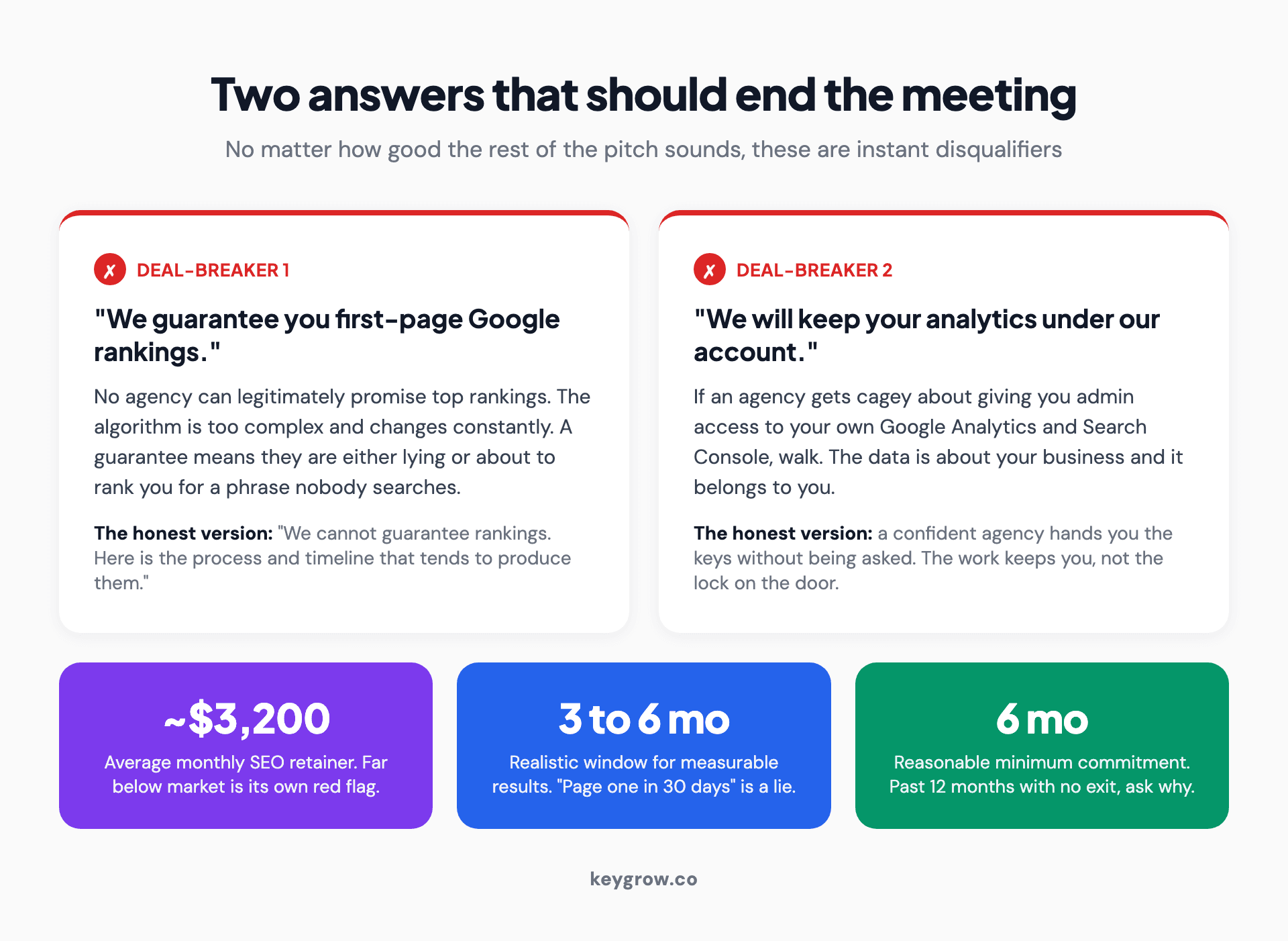
Two answers that should end the meeting: a guarantee of first-page Google rankings, and a refusal to give you admin access to your own analytics, each shown as an instant disqualifier.
The two answers that should end the meeting
Two answers are instant disqualifiers no matter how good the rest of the pitch sounds: a guarantee of first-page Google rankings, and a refusal to give you direct ownership of your own analytics. Either one means you are talking to the wrong agency.
The rankings guarantee first. No agency can legitimately guarantee top Google rankings, because the search algorithm is too complex and changes constantly, a point SEO.com makes plainly. Anyone who guarantees a number-one spot is either lying or planning to rank you for a phrase so obscure the ranking is worthless. If you hear a guarantee, you have learned everything you need to know.
The ownership refusal second. If an agency gets cagey or outright refuses when you ask for admin access to your own Google Analytics and Search Console, end the meeting. The data is about your business and it belongs to you. An agency that wants to keep that access is preserving the option to control the story and make leaving painful. A confident agency hands you the keys without being asked, because the work is what keeps you, not the lock on the door.
Both are quick to test and both are absolute. Everything else in this post is a judgment call with shades of gray. These two are not.
How to score the answers and make the call
Score each answer as green, yellow, or red as you go, and weight the deal-breakers heavily. A pattern of yellow-to-red answers, or a single hard red on guarantees or ownership, is enough to walk, no matter how polished the presentation.
You do not need a spreadsheet, though one helps. Mark each answer as green for specific and numbers-backed, yellow for vague-but-not-alarming, red for evasive, generic, or a known warning sign. A mix of green and yellow is normal and means ask follow-ups. A few reds, or one of the two deal-breakers above, and you have your answer.
Weight matters. The two deal-breakers override everything else: a great answer on reporting does not cancel out a refusal to give you admin access. A slightly awkward answer on monthly scope is forgivable if the proof, the ownership terms, and the contract are all clean.
If you remember one filter, make it this: confident specificity is green, confident vagueness is red. The agencies that do real work answer hard questions with detail because they have nothing to hide. The ones that do not get smooth and general, because general is where thin work hides.
Use how to choose a good SEO company for the full selection process, and once you have hired someone, keep how to tell if your SEO company is working handy so the scoring continues past the sales call. The vetting does not stop the day you sign.
FAQs
How many questions should I actually ask an SEO company?
Around 10 to 12, not 40. Pick a few from each bucket, results and proof, process and ownership, money and contract, and ask follow-ups when an answer gets vague. A handful of sharp questions, asked with the confidence to notice a dodge, tells you more than a long checklist read off a page.
What is the single most important question to ask an SEO agency?
"Can you show me specific, recent results for a business like mine, with real numbers and a reference I can call?" It tests both whether they get results and whether they understand your market. A close second is the ownership question, because controlling your analytics and content is the position you most want to keep.
Should an SEO company guarantee first-page rankings?
No, and a guarantee is a major red flag. Search algorithms are too complex and changeable for any agency to legitimately promise a number-one position. An honest agency describes the process and a realistic timeline instead of guaranteeing an outcome it cannot control. If you hear a rankings guarantee, end the conversation.
How long should an SEO contract be?
A six-month minimum is reasonable, because SEO genuinely takes that long to show meaningful results. A contract longer than 12 months with no exit clause is a warning sign worth questioning. The strongest arrangement is month-to-month or a clean exit clause, which keeps the agency accountable to the work rather than the paperwork.
Who should own my Google Analytics and Search Console accounts?
You should, with full admin access in your name. The agency gets access to your accounts, not the other way around. An agency that controls your analytics controls the reporting and can make leaving painful, so a refusal to give you direct ownership is a deal-breaker.
Is it a red flag if an SEO company is much cheaper than the others?
Often, yes. The average agency retainer is around 3,200 dollars a month, so a price far below market usually signals automated thin work or a solo operator about to be stretched too thin. Cheap is not always wrong, but it deserves hard questions about exactly what you get for it.
What questions reveal whether an SEO agency does AI search optimization?
Ask whether they optimize for AI answer engines like ChatGPT and Google AI Overviews alongside traditional rankings, and how they would make your pages quotable as sources. A current agency will talk about answer-first structure, getting cited rather than only ranked, and Bing visibility, since ChatGPT search runs on Bing. A blank stare means they are still on a ranking-only playbook.
Should I ask for references or case studies before signing?
Yes, both, and weight a callable reference over a polished slide. Case studies show what an agency wants you to see, while a real client on the phone tells you what working with them is actually like. An agency that cannot produce a reference in a roughly similar industry, for a service you are about to pay thousands a month for, is telling you something.
What to do next
Vetting an SEO company is not about catching them out. It is about asking specific questions and listening for whether the answers are specific back: real results spoken plainly, clean ownership of your own assets, an honest timeline, and a contract you can leave. Confident specificity is green, confident vagueness is red.
If you want to run these questions on us, that is the conversation we are built for. We are month-to-month, we hand you admin access to your own accounts on day one, and we will tell you honestly if your situation is a DIY job rather than a hire. Get started here and ask us anything on this list.


