

To choose a good SEO company, look for a track record of real business results, demand reporting on leads and revenue rather than impressions, avoid anyone who guarantees rankings or locks you into a long contract, and ask whether you even need an agency yet. The hard part is not finding an SEO company. It is filtering out the ones that will take your money and show you a dashboard full of numbers that do not pay rent.
If you have been burned before, you are in the right place, and you are not the problem. The industry is full of agencies that have learned it is easier to sell hope than results. This guide gives you the green flags to look for, the exact questions to ask, the red flags to run from, and the most honest part no agency blog will tell you: when you should not hire one at all.
Do you actually need to hire an SEO company?
Maybe not yet. If you run a small or new business with more time than budget, you can do the SEO basics yourself, claiming your Google Business Profile, fixing on-page tags, and publishing a few solid pages. Hire an agency when the value of the leads you would win clears the cost of the retainer.
This is the question every agency skips, because every agency wants you to say yes. We will say it plainly: a single-location business with a few hours a month can handle the fundamentals without paying anyone. The work is learnable, and going the DIY route is the right call more often than the industry admits, as long as you know where it tends to break down.
The math is simple. Estimate what one new customer is worth and how many extra customers good SEO might realistically bring. If that number comfortably beats a monthly retainer, hiring help makes sense. If it does not, or if you are in a market with almost no search demand, paying for SEO is solving a problem you may not have. An honest agency will tell you this before taking your money. Hold that thought, because it is also the first test of whether an agency is any good.
What to look for in a good SEO company
Look for proof of business results and terms you can walk away from. A good SEO company shows real case studies tied to leads or revenue, explains exactly what it will do, reports on business outcomes, follows Google's guidelines, and earns your business month to month instead of trapping you in a contract.
Here is the green-flag checklist to run any candidate against:
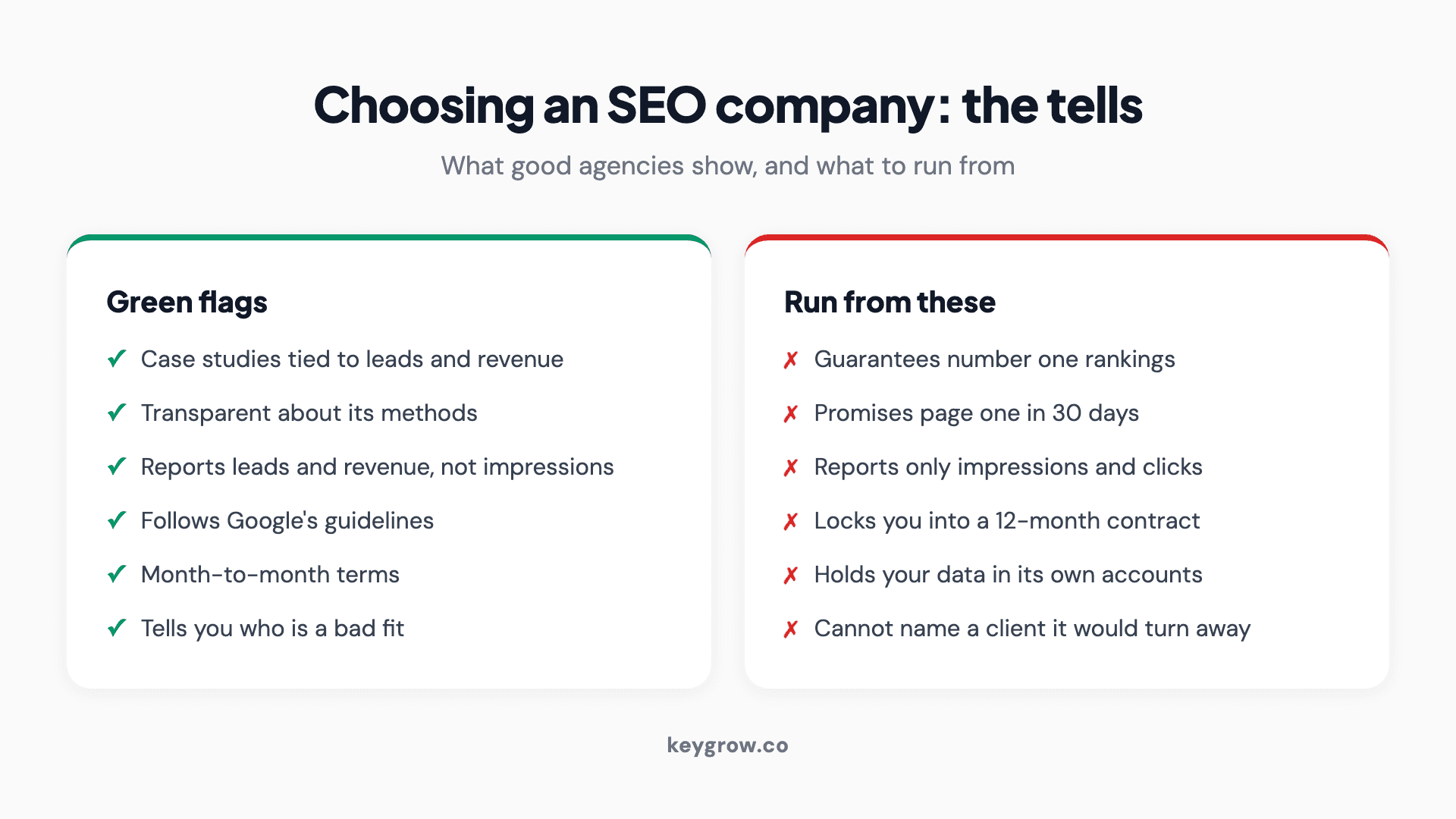
Infographic with two columns comparing green flags and red flags when choosing an SEO company. Left column in green, good signs: shows case studies tied to leads and revenue, transparent about its methods, reports on leads and revenue not impressions, follows Google guidelines, offers month-to-month terms, and tells you who is a bad fit. Right column in red, run from these: guarantees number one rankings, promises page one in 30 days, reports only impressions and clicks, locks you into a 12-month contract, holds your data in its own accounts, and cannot name a client it would turn away.
The questions to ask before you hire
Ask questions that force specifics. The strongest set comes from Google itself, plus one test the agency cannot dodge: make them commit to reporting leads and revenue, not clicks and impressions.
Google publishes its own guidance on hiring an SEO, and the questions it suggests are a great starting point. Adapt these and watch how the agency answers:
Then add the question that separates good agencies from dashboard merchants: will you report on leads and revenue, and will I have ownership of my own analytics, Search Console, and ad accounts? A good agency says yes without flinching. One that wants to keep your data under its own accounts is building a hostage situation for the day you try to leave.
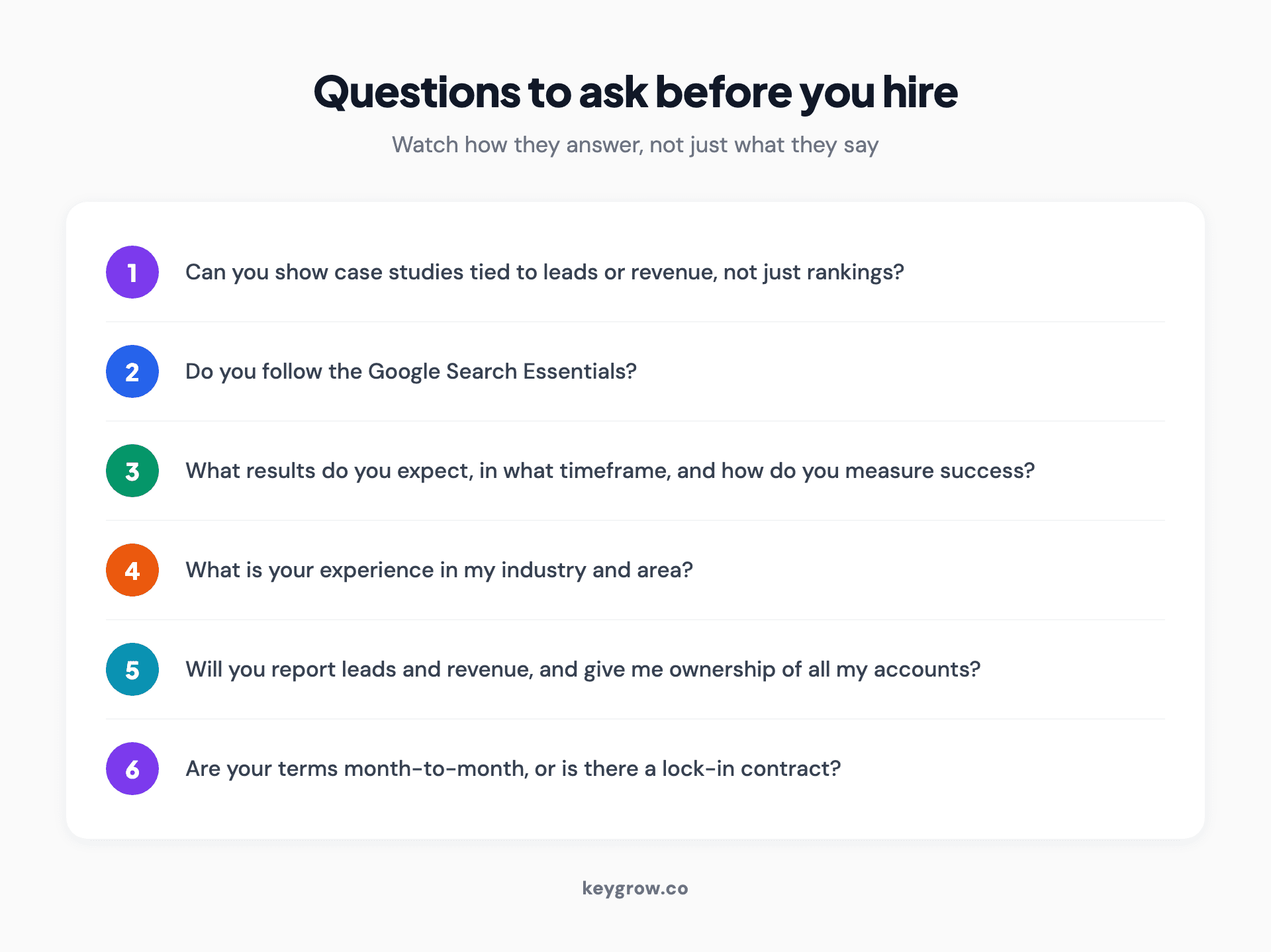
Infographic titled questions to ask before you hire an SEO company, a numbered checklist of six questions: 1 can you show case studies tied to leads or revenue, not just rankings; 2 do you follow the Google Search Essentials; 3 what results do you expect, in what timeframe, and how do you measure success; 4 what is your experience in my industry and area; 5 will you report leads and revenue and give me ownership of all my accounts; 6 are your terms month-to-month, or is there a lock-in contract.
How an agency answers matters more than the answers themselves. Specific, honest, slightly less polished answers beat smooth ones that promise the world.
SEO company red flags to run from
A few red flags should end the conversation immediately. Guaranteed rankings, promises of page one in weeks, reports built on vanity metrics, and demands to control your accounts are all signs of an agency that sells outcomes it cannot deliver.
Take the worst offenders one at a time:
The reason these tactics persist is that they work on buyers who do not know the tells. Now you know them.
Why a lock-in contract is a confession
Here is the one strong opinion to take from this post: if an agency needs a long contract to keep you, that is a confession that the results are not doing it. A good agency keeps you because the work is working, not because you signed away your exit.
The standard defense is that SEO takes six to twelve months, so a long contract is only fair. That gets it exactly backward. Yes, SEO takes time, which is precisely why a good agency should be earning each month rather than handcuffing you to hope for a year. The timeline is the reason to demand month-to-month terms, not to surrender them. KeyGrow is month-to-month, cancel anytime, because the work should be the thing that retains you.
Think about the incentive a twelve-month lock-in creates. An agency that has already secured a year of payments has far less reason to fight for your results in month three than one that knows you can walk in thirty days. The contract that protects you is the one you can leave. If an agency is confident, it will let you.
How much should you pay an SEO company?
Most legitimate SEO retainers run from several hundred to a few thousand dollars a month, depending on your market and scope. The exact number matters less than what it buys. A cheap retainer full of busywork costs more than a fair one that moves real numbers.
For a benchmark, an Ahrefs survey found the most common rate was 501 to 1,000 dollars a month, charged by about a fifth of providers. Competitive markets run higher, and serious work is rarely cheap. Be equally wary at both ends: a 150-dollar-a-month offer is almost always automated, low-value link spam, while a sky-high quote with no clear deliverables is just a confident salesperson.
Judge any price by the value on the other side. Ranking is genuinely hard, 96.55 percent of pages get zero traffic from Google, which is exactly why getting it right is worth paying for. And the payoff at the top is real: Backlinko found the number one result earns 27.6 percent of clicks and the top three take 54.4 percent. The question is never just the price. It is whether the agency can connect that price to leads, and whether you can leave if it cannot.
FAQs
How do I choose a good SEO company?
Look for proof of business results (case studies tied to leads or revenue, not just rankings), transparency about methods, reporting on leads and revenue, white-hat practices, and month-to-month terms. Ask Google's recommended questions, plus whether they will report revenue and give you ownership of your accounts. Run from anyone who guarantees rankings or promises page one in weeks. And first decide whether you even need an agency yet.
What questions should I ask an SEO agency before hiring?
Start with Google's own list: ask for previous work and success stories, whether they follow the Google Search Essentials, what results they expect and in what timeframe, their experience in your industry, and how they will communicate changes. Then add the decisive one: will you report leads and revenue, and will I own my analytics and ad accounts? Watch for specific, honest answers over smooth ones.
What are the biggest SEO agency red flags?
Guaranteed number one rankings (Google says no one can promise this), page one in 30 days (Google's own guidance says four months to a year), reports built on impressions and clicks instead of leads and revenue, demanding to hold your data under their accounts, and long lock-in contracts. Canned audits and secret methods are warning signs too. Any one of these is reason enough to walk.
How much should I pay an SEO company per month?
Most legitimate retainers run from several hundred to a few thousand dollars a month. An Ahrefs survey put the most common rate at 501 to 1,000 dollars. Be wary of both extremes: very cheap offers usually mean automated spam, and very high quotes need clear deliverables to justify them. Judge the price by whether it connects to leads and revenue, not by the number alone.
Should I sign a long-term SEO contract?
We would not, and we do not ask clients to. If an agency needs a six or twelve month lock-in to keep you, that is a sign the results are not doing the convincing. SEO does take months to work, but that is the reason to keep an agency accountable month to month, not to trap yourself for a year. The terms you can walk away from are the ones that protect you.
How long until an SEO company shows results?
Usually four months to a year for meaningful results, per Google's own guidance, and longer in competitive markets. Only 1.74 percent of new pages reach the top 10 within a year, and 72.9 percent of pages in Google's top 10 are more than three years old, so you are competing with pages that have compounded authority for years. Any agency promising fast rankings is contradicting Google.
Can an SEO company guarantee number one rankings?
No. Google states plainly that no one can guarantee a number one ranking, and warns against anyone who claims to or claims a special relationship with Google. Rankings depend on Google's algorithm, your competitors, and your content, none of which an agency controls. A guarantee is a sales tactic, and often a sign the agency will use risky tactics that can get your site penalized.
Are SEO companies worth it for small businesses?
They can be, once the math works. If the value of the extra customers good SEO would win clears the cost of the retainer, it is worth it. If you have little search demand or more time than budget, doing the basics yourself first is the smarter move. A good agency will tell you honestly which situation you are in rather than selling you a retainer you do not need.
The short version
Choosing a good SEO company comes down to a few honest tests. Look for proof tied to leads and revenue, demand reporting on outcomes rather than impressions, ask Google's recommended questions plus the lead-and-revenue test, and run from guarantees, 30-day promises, and lock-in contracts. The agency that lets you leave anytime is usually the one worth staying with.
And do not skip the first question: whether you need an agency at all. If you have the time and a simple local presence, the basics are yours to do for free, and a good agency will say so. If the math does work, choose the company that puts the risk on itself, reports what matters, and earns each month. That is the standard we hold ourselves to, month to month, cancel anytime. If you want a straight, no-pressure read on whether SEO is even right for your business, tell us about it and we will give you an honest answer, including if that answer is not yet. You can also see how we report on what working SEO looks like before you talk to anyone.


