


Run both PPC and SEO when you need leads this month and cheaper leads next year. That is the whole case in one line, and it is why so many growing businesses use both PPC and SEO instead of betting everything on a single channel.
Paid search buys you the top of the results page today. Organic search earns a spot you stop paying for once you hold it. They answer two different questions: how do I get customers this week, and how do I stop paying for every customer forever. A business that only runs ads is renting its entire pipeline. A business that only does SEO is waiting, sometimes for a year, while a competitor books the jobs.
The useful part is not that you can run both. It is that each one makes the other work better and cost less, if you actually connect them. Here is how that plays out, and the one situation where running both is the wrong move.
Do PPC and SEO really work better together, or is that just agency talk?
They genuinely compound. Shared keyword data makes both cheaper, two listings win more of the page, and paid results tell you which organic pages are worth building. The effect is real, and its size depends on discipline.
Here is the catch most agencies leave out. The benefit does not appear just because you happen to buy ads and publish blog posts in the same quarter. It appears when the two share information: when your ad data picks your content targets, and your ranking data trims your ad spend. Run them in separate silos, with separate teams that never talk, and you get two channels and none of the compounding. If you want the mechanics of wiring them together, we cover them in our guide to integrating PPC with your wider marketing.
PPC and SEO run on two different clocks
Paid produces clicks the day it goes live. SEO takes months to build and then keeps working at low cost. Running both means you are not sitting idle while the slow channel matures.
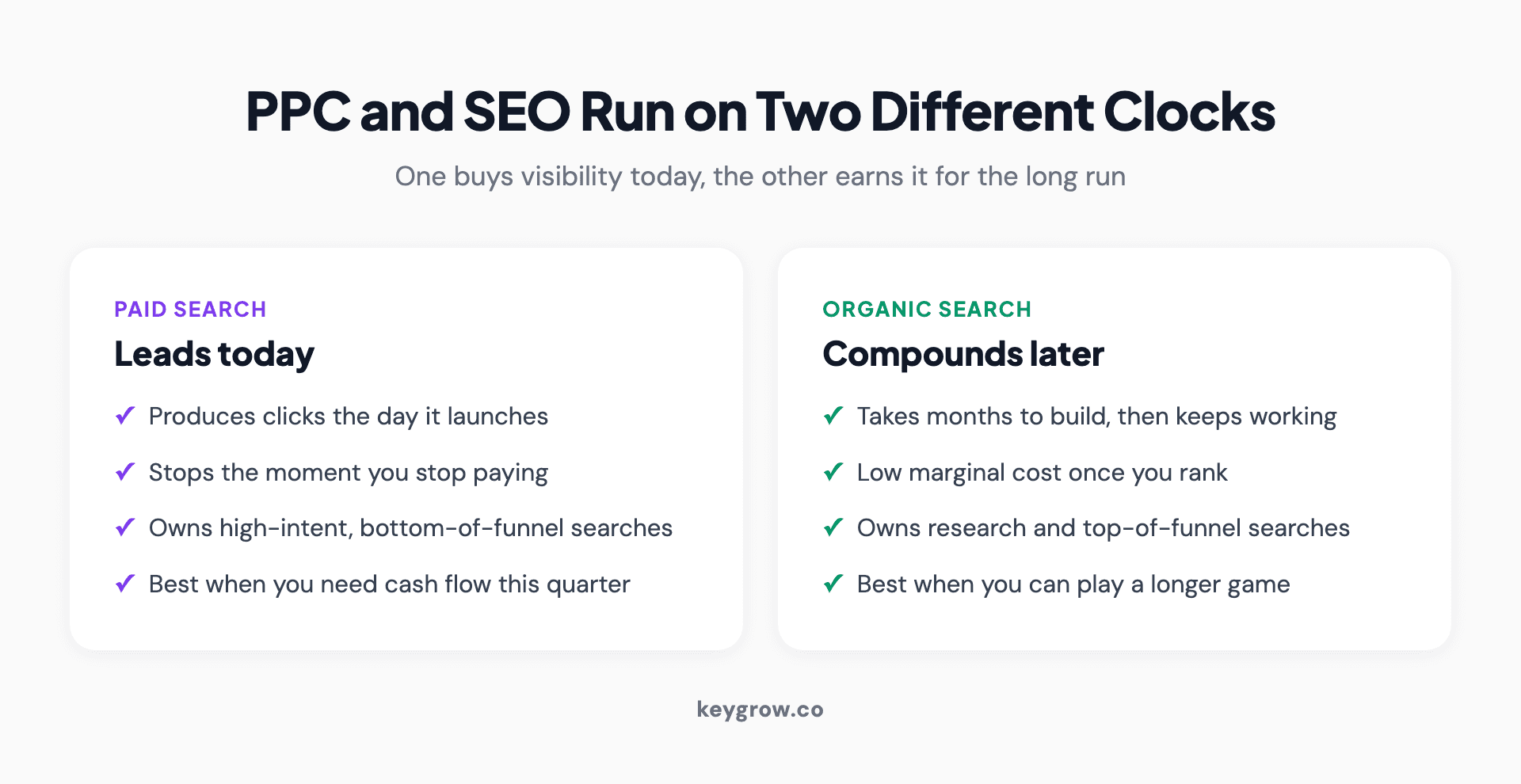
Two-column comparison of paid search and organic search: paid produces leads today and stops when you stop paying, while organic takes months to build then compounds at low marginal cost.
This is the real reason to pair them. A doctor's practice in Dubai committed to SEO for a full year. Months one through three looked unimpressive on the surface. By month twelve, organic traffic had grown 1,519% and the practice was taking 130+ patient calls a month. Same site, same client, no shortcuts.
Now look at those first eleven months. Something has to keep the phone ringing while the organic work compounds, and that something is usually paid search. SEO is a compounding asset, not a campaign: it looks unimpressive for the first quarter and embarrassingly good after a year. PPC is the bridge that funds the wait. Google's own SEO starter guide is upfront that organic results take time, so plan the paid budget to cover the gap rather than hoping SEO lands early.
The ways paid and organic make each other cheaper
The compounding is not vague goodwill. It is four specific exchanges of data and coverage, and the most valuable one saves you months of wasted content work.
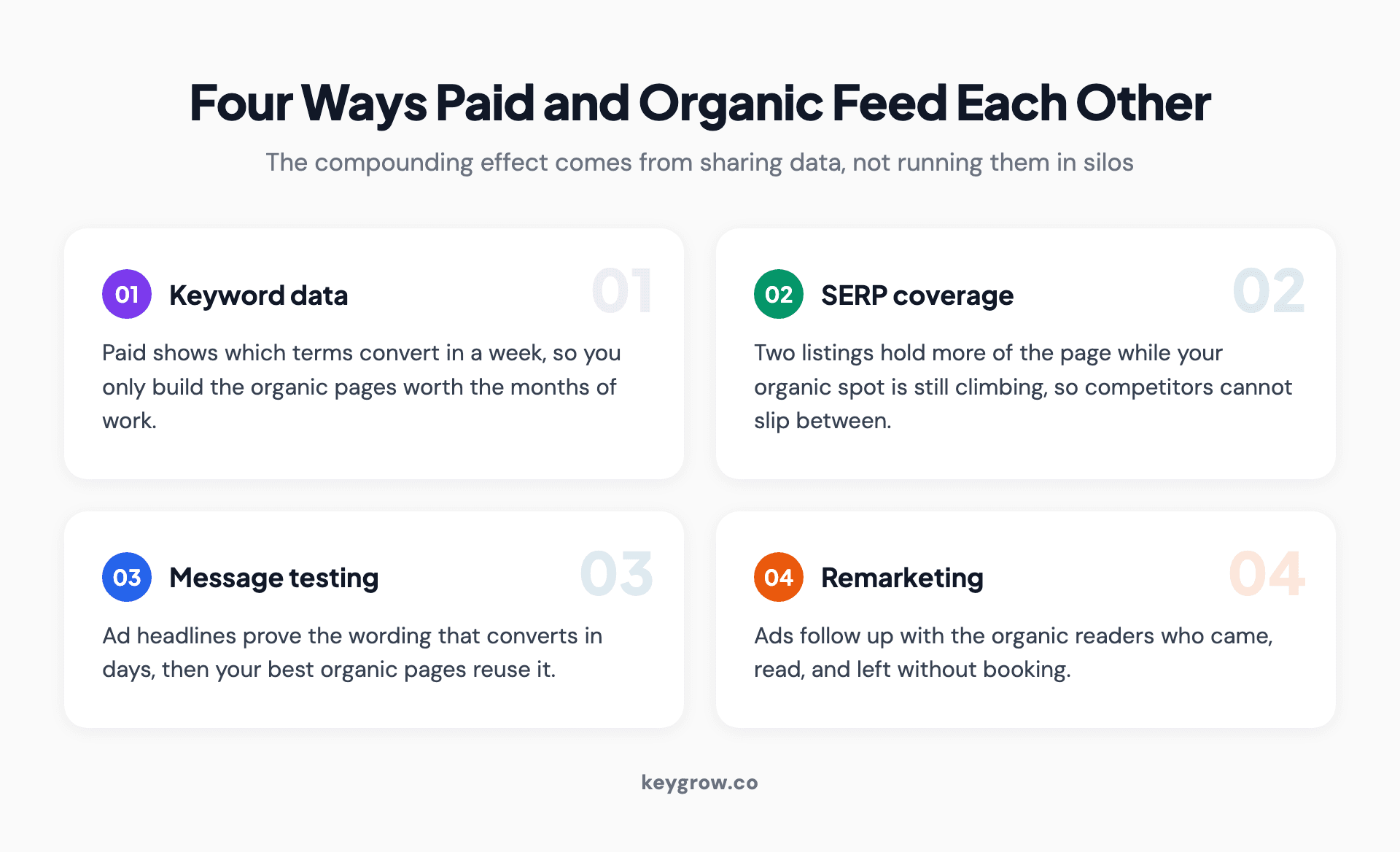
Four cards showing how paid and organic feed each other: keyword data, SERP coverage, message testing, and remarketing.
| What you share | Paid gives organic | Organic gives paid |
|---|---|---|
| Keyword data | Which terms convert, in a week, before you invest months in a page | Which terms you already rank for, so you can stop bidding on them |
| SERP space | A paid slot while the organic one is still climbing | An organic slot that lets you pull paid spend back |
| Message testing | Ad headlines that prove what wording converts, in days | Winning organic pages that become better landing pages |
| Remarketing | Ads that follow up with readers who did not convert | Content that gives the remarketing ad something to say |
The single most useful trade is keyword data. A paid campaign tells you within a week which phrases turn into booked jobs, so you build the organic pages worth the months of effort instead of guessing. Run it the other way too: the terms you already own organically are often the ones to bid down or drop, which frees budget. Review your search terms report every week, because that is where the wasted spend hides, usually a fifth to a third of the budget in accounts nobody is watching.
What running both looks like across the buyer's journey
Early on, someone researching a problem clicks the free guide you rank for. Later, when they search your exact service in their city, you want both the paid slot and the organic slot on the page so a competitor cannot slip between them. At the decision moment, a remarketing ad closes the reader who left without booking.

Aerial view of a road winding through a forest in tight switchbacks, like a buyer's path from first research to a booked job.
SEO tends to own the top of that journey cheaply, where people are still learning. PPC tends to own the bottom, where intent is highest and a missed click is a booked job for someone else. You do not need a funnel diagram to act on this. You need one channel earning attention early and the other capturing demand late, which is exactly what running both gives you. It also protects you from a single point of failure: an algorithm update or a rising cost-per-click hurts far less when the other channel is still delivering.
When you should not run both
If your budget only funds one channel properly, fund one. Splitting a small budget evenly across paid and organic usually buys two underpowered efforts instead of one that works.
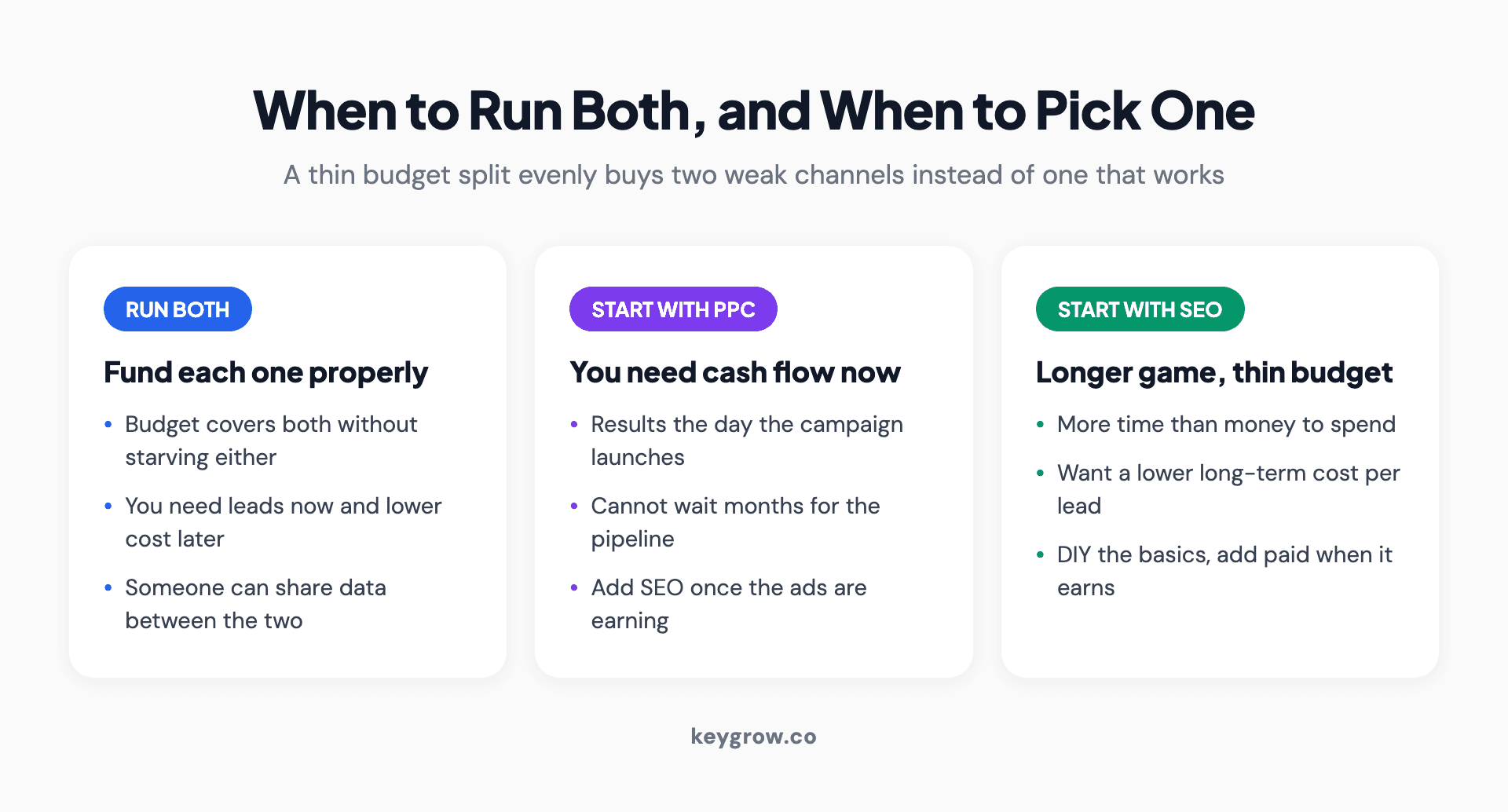
Decision guide for when to run both channels, when to start with PPC, and when to start with SEO based on budget and timeline.
Here is the reality. A $1,500 monthly budget cut into $750 of ads and $750 of SEO tends to produce ads that cannot hold a competitive keyword and SEO that moves too slowly to notice. Pick the channel that matches your timeline instead. If you need cash flow this quarter, start with PPC. If you are playing a longer game and can wait, start with SEO and add paid once it is earning. We have written a full decision framework on which to fund first if you are standing at that fork. And if you run a single-location business with more time than money, you can do the SEO basics yourself: claim your Google Business Profile, gather reviews, and fix the obvious site problems before you pay anyone. Bring in help, or add the second channel, when the opportunity cost of your own time beats the fee.
How do you know it is working, and not just paying for clicks you would get free?
Measure incremental leads, not total clicks. The honest way to test the pair is to pause your branded ads for a week and watch whether organic picks up the slack, then judge everything on cost per booked job.
The cannibalization worry is fair. If you rank first organically and also buy the ad above it, are you paying for a click you would have gotten for nothing? On your own brand name, sometimes yes. So test it. Turn branded ads off for a week and watch organic. If organic absorbs the clicks, keep the ad off and move that budget to terms you do not rank for. If leads drop, a competitor was catching them and the ad was earning its place.
One thing paid will not do is lift your rankings. Google's ranking systems do not factor in how much you spend on ads, so buying clicks never moves your organic position. PPC helps SEO through the data it hands you, not through the algorithm. Keep that straight and you will judge each channel on what it can actually deliver.
FAQs
Is PPC or SEO better for my business?
Neither is better in the abstract, because they do different jobs. PPC gets you leads immediately and stops when you stop paying. SEO takes months to build and then keeps working at low marginal cost. The right choice depends on your timeline and budget, and the answer is often a sequence rather than a pick: paid now, organic building underneath it.
Does running PPC improve my SEO rankings?
No, not directly. Google does not consider how much you spend on ads when it ranks pages, so buying clicks will not move your organic position. PPC helps your SEO indirectly by showing you which keywords convert and which pages are worth building. The benefit is a better content strategy, not a ranking boost.
Should a small business run both PPC and SEO at once?
Only if the budget can fund both properly. A small budget split evenly across paid and organic often produces two weak efforts. If money is tight, pick the channel that matches your timeline, get it working, then add the second once the first is paying for itself.
Does buying ads on my own brand name waste money if I already rank first?
It can. If you already hold the top organic spot for your brand, a branded ad sometimes pays for a click you would get for free. Test it by pausing branded ads for a week. If organic absorbs the traffic, spend that budget elsewhere. If leads drop, competitors were catching them and the ad was worth keeping.
Which should I start first, PPC or SEO?
Start with PPC if you need leads this quarter, because it produces results the day it launches. Start with SEO if you can wait a few months and want a lower long-term cost per lead. Many businesses begin with paid, then shift budget toward organic as it matures and earns its own traffic.
How long before SEO catches up to PPC?
Plan on months, not weeks. Our strongest organic result took twelve months to reach its peak, and most sites see meaningful movement in the three to six month range. Paid search fills that gap in the meantime, which is the main reason to run the two together.
Where this leaves you
Use both PPC and SEO when you can afford to do each one well, because they cover different timelines and feed each other data that makes both cheaper. Use one channel, done properly, when you cannot. The mistake is rarely choosing paid over organic or the other way round. It is spreading a thin budget so evenly that neither channel gets enough to work.
If you want a plan that sequences the two around your budget instead of selling you both on day one, our team runs paid search and SEO together and reports on booked jobs, not impressions. Tell us your goal on our get started page and we will tell you honestly which one to fund first.