


Integrating PPC with your overall marketing strategy comes down to making four things flow between channels: data, audiences, budget, and measurement. When search-term reports feed your content calendar, your email list powers your ad targeting, budget moves to whichever channel currently buys customers cheapest, and every channel reports into one blended acquisition cost, PPC stops being a silo and starts making everything else work harder.
Most advice on this topic tells you to "keep messaging consistent" and "hold regular meetings." True, and useless. This is the operational version: the specific flows to build, the Google features that enable them, and the honest numbers, including the decade-old ones everyone else quotes without dates.
Flow one: share the data
Your PPC account is a paid market-research machine. The search terms report tells you the exact words customers use, and your ad tests settle messaging debates in weeks instead of quarters.
The search terms report is the most underused asset in most accounts. It is a live feed of what real buyers type before spending money with you, and it should flow outward:
- To your content and SEO plan. Recurring questions in search terms are blog posts and service pages waiting to be written. Paid data killing it on a theme is the cheapest possible validation before you invest months of SEO effort ranking for it.
- To your ad copy and beyond. Responsive search ads are a permanent copy laboratory: Google assembles your headlines into combinations and serves the promising ones more often, so the headlines that keep winning across your impressions are strong candidates for email subject lines, title tags, and landing page headlines. A messaging insight that cost you a week of ad spend would cost a quarter to learn from organic data alone.
The flow runs backwards too. Your SEO keyword research seeds new ad groups, and the queries where you already rank first organically become candidates for reduced bidding (more on that math below).
We watched this loop pay off with a cash home buyer drowning in junk leads. The search terms report showed the problem, and the fix, qualifying language in the ad copy itself, came from studying which phrasings attracted serious sellers. Serious leads rose 600 percent between December and January on the same budget, and the qualifying language that did it went straight into their site copy and follow-up scripts. That is integration: a paid-channel lesson made every channel sharper.
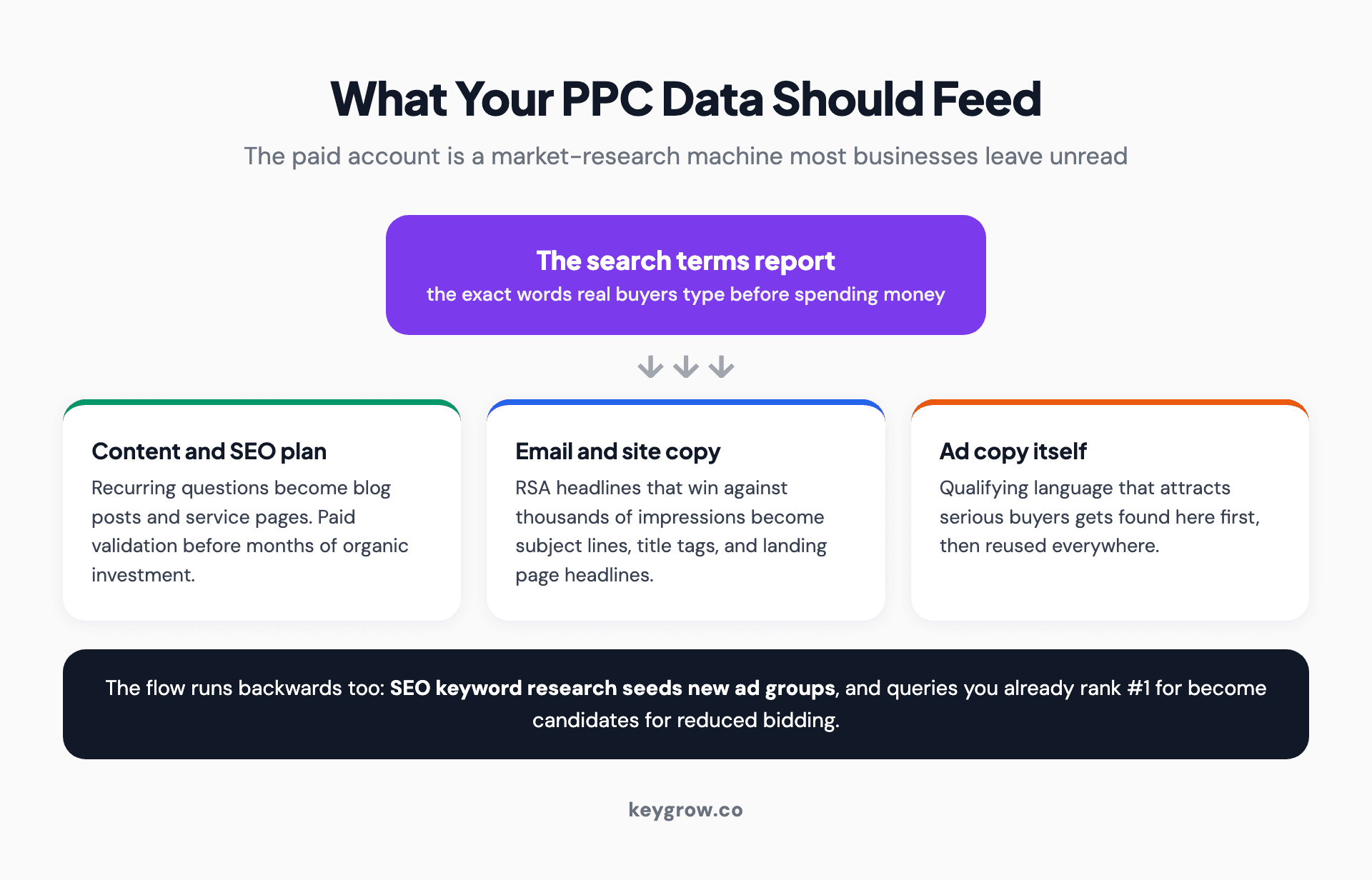
Flow diagram of PPC data feeding the rest of the marketing stack: search terms feed content and SEO, winning ad headlines feed email and title tags, SEO keywords seed new campaigns.
Flow two: share the audiences
Sync your customer and email lists into Customer Match, suppress existing customers from acquisition campaigns, and retarget your organic readers, the same audience plumbing that lets social advertising lift your search performance. The walls between "email people" and "ads people" are costing you money.
Three audience flows, in priority order:
- Customer lists into ads. Customer Match lets you target (or exclude) your actual customers and subscribers in Google Ads. This got dramatically more accessible for small businesses when Google cut the minimum list size for Search campaigns from 1,000 to 100 users, per Search Engine Land. A local business with a few hundred past customers can now build lookalike-style expansion and loyalty campaigns that used to be enterprise-only.
- Suppression lists. The fastest ROI in audience syncing is negative: stop paying acquisition prices to re-acquire people who already bought. Upload your customer list and exclude it from cold campaigns. Ten minutes of setup, immediate waste reduction.
- Organic readers into remarketing. Your blog and SEO traffic is an audience your ads can re-engage. Someone who read three service pages organically is warmer than any cold keyword click, and GA4 audiences flow directly into Google Ads once the accounts are linked.
The practical requirement for all three: consent and account history. Customer Match needs a policy-compliant account, and full targeting features arrive with account tenure and spend history, so start the list plumbing before the quarter you need it.
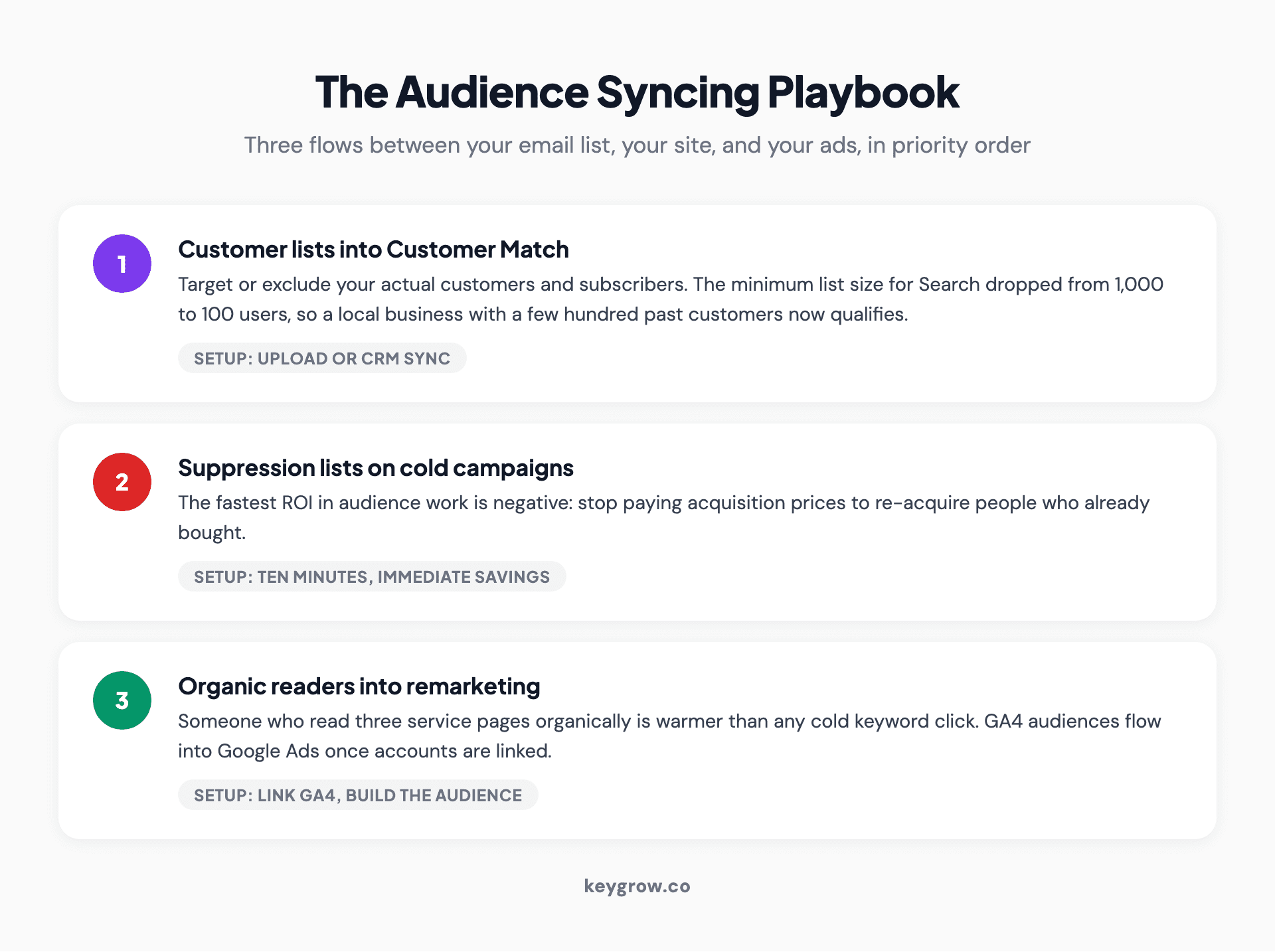
Three-step audience syncing playbook between channels: customer lists into Customer Match, suppression lists to stop re-buying customers, organic readers into remarketing.
Flow three: share the money
Set the paid-organic split by channel maturity, rebalance on blended cost per customer, and use incrementality logic, not loyalty, to decide the overlap questions.
Nobody ranking for this topic touches budget, which is strange, because budget is where integration gets real. A workable framework:
- New site, no organic presence: weight heavily toward paid, roughly 70/30. Ads buy revenue and data today; SEO is planted for later. Here is the opinion behind that sequencing, backed by our own numbers: SEO is a compounding asset, not a campaign. Our strongest organic result, a doctor's practice in Dubai, looked unimpressive for the first quarter and hit 1,519 percent traffic growth with 130+ patient calls a month by month twelve. You budget for that curve; you do not expect it to pay this month.
- Established organic presence: shift toward 40/60 or wherever your blended math points, letting paid concentrate on high-intent commercial terms while organic carries research-stage traffic.
- Rebalance rule: move budget when a channel's marginal cost per customer beats the alternative, checked monthly against the blended number, not channel-by-channel ROAS bragging rights.
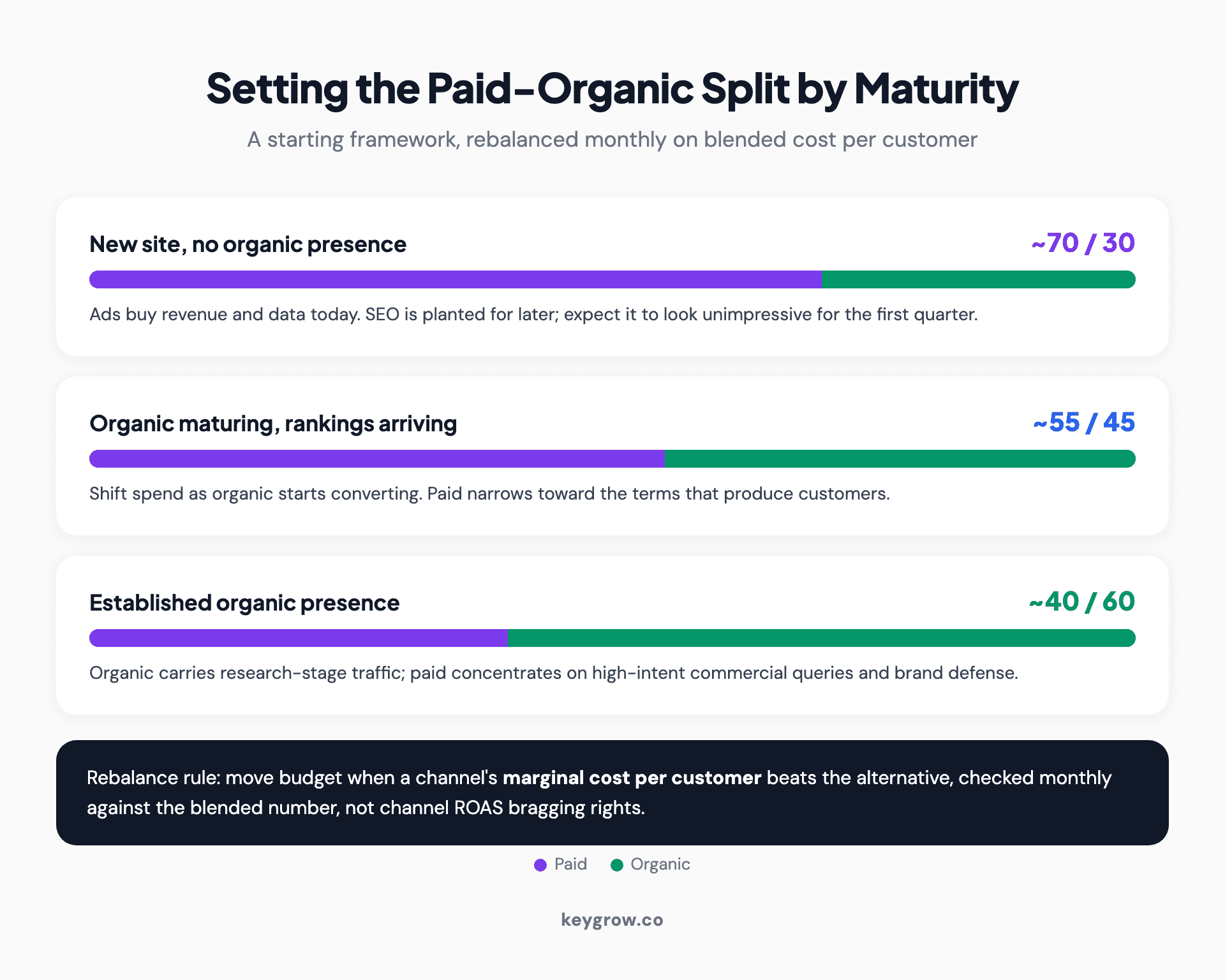
Three-bar framework for splitting budget between paid and organic by channel maturity, from 70/30 for a new site to 40/60 once organic is established.
Then there is the classic overlap question: should you keep bidding on terms you already rank first for? Google's own pause studies are the only real data here, and they are old, from 2011 and 2012, so treat them as directional. Across hundreds of account pauses, Google Research found organic recaptured little of the paused ad traffic: about 89 percent of ad clicks were incremental in the original 2011 studies, 85 percent in the larger 2012 follow-up, and even with a number-one organic ranking, roughly half of ad clicks were incremental. The honest 2026 read: incrementality is usually higher than intuition suggests, and the answer for your account comes from your own test. Pause brand or overlap ads in a few comparable geographies for two weeks, watch total leads rather than channel-attributed leads, and let that number decide.
Flow four: share the measurement
One report, one blended cost per customer, every channel in it. Channel-versus-channel ROAS fights reward whoever claims credit best, not whoever performs best.
Last-click attribution makes PPC look great at the bottom of the funnel and makes everything feeding that funnel look worthless. Meanwhile, paid and organic visibly help each other in ways channel reports never capture. The freshest evidence: Seer Interactive's tracking of roughly 10,000 informational keywords found that queries where a brand appeared inside Google's AI Overview showed an 11 percent paid ad CTR versus 7.89 percent where it did not, per Seer Interactive. Organic and answer-engine visibility make the ads work harder, and no channel report will ever assign credit for it.
The fix is not a fancier attribution model. It is a simpler scoreboard:
- Blended CAC: total marketing spend divided by total new customers, tracked monthly. This is the number the business actually feels.
- Channel CPA as a diagnostic, not a verdict, for spotting trends inside each channel.
- A periodic incrementality check (the pause test above) for the big overlap questions.
If reports lead with impressions and per-channel ROAS instead of blended acquisition cost, the strategy conversation is already rigged toward whoever owns the last click.
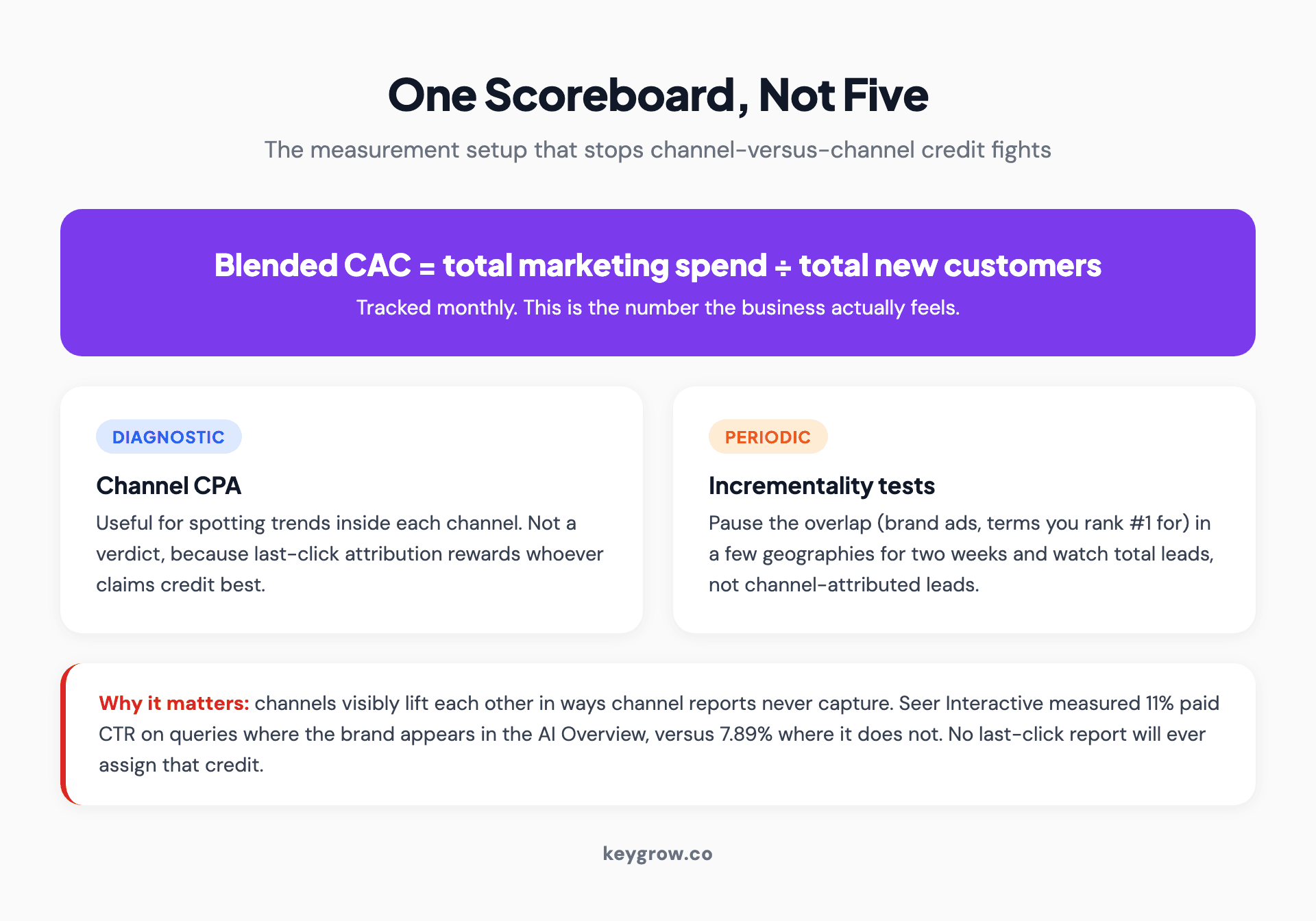
Card layout of the blended measurement scoreboard: blended cost per customer as the headline, channel CPA as diagnostics, periodic incrementality tests for overlap decisions.
The order of operations for a small team
Wire the cheap flows first: suppression lists and search-term reviews in week one, audience syncing in month one, budget rebalancing quarterly. Integration is a sequence, not a project.
The four flows above are not equally urgent, and a two-person marketing team should not attempt them all at once:

Two marketers mapping campaign plans on a flip chart during a planning session.
- This week: exclusion lists live, plus a 30-minute monthly review where search terms get read by whoever writes your content and emails.
- This month: customer and subscriber lists synced to Customer Match, GA4 linked to Google Ads, organic-visitor remarketing audience built.
- This quarter: one blended CAC report replacing the channel scorecards, headline-test learnings flowing into email and title tags.
- Ongoing: budget review against blended CAC monthly, one incrementality test per year on your biggest overlap question.
A solo owner can run flows one and two in an afternoon each. Where it stops being DIY territory is usually volume: when the account has enough spend that search-term hygiene, test design, and rebalancing decisions carry real money, managed PPC pays for itself in caught waste. Month-to-month either way.
FAQs
How does PPC fit into a digital marketing strategy?
PPC is the fastest, most controllable channel in the mix, so it plays three roles: buying revenue while slower channels mature, generating keyword and messaging data the other channels reuse, and covering the high-intent commercial queries where you need guaranteed presence. It works best when its data, audiences, and budget connect to everything else.
Can SEO and PPC work together?
Yes, measurably. Paid search-term data validates what content to build, organic visibility lifts ad performance on the same queries, and shared SERP coverage means a searcher meets you twice. The channels compound each other when the teams share one report.
Should I run SEO and PPC at the same time?
Usually yes, weighted by maturity. A new site leans on PPC while SEO compounds; an established site shifts budget toward organic and focuses paid spend on commercial-intent terms. The exception is a budget too small to fund either channel properly, where picking one beats splitting.
What percentage of my marketing budget should go to PPC?
There is no universal split. A practical starting point is roughly 70 percent paid for a business with no organic presence, drifting toward 40 percent or lower as SEO matures, with monthly rebalancing based on blended cost per customer rather than a fixed formula.
How does PPC work with email marketing?
In both directions. Your subscriber list becomes a Customer Match audience for targeting, upselling, or exclusion, and PPC leads enter your email nurture sequences, which raise close rates on the leads you already paid for. Winning ad headlines also make unusually well-tested subject lines.
Should I bid on keywords I already rank number one for?
Test it rather than assume. Google's pause studies found around half of ad clicks were incremental even with a first-place organic ranking, but the data is from 2012. A two-week geo-split pause, measured on total leads, gives you the answer for your account.
What is the biggest mistake when integrating PPC with other channels?
Judging every channel by its own last-click ROAS. It rewards the channel that claims credit best, starves the channels that create demand, and hides the lift channels give each other. One blended acquisition-cost report fixes the incentive before any tactic matters.
Our take
Integration is plumbing. Four flows (data, audiences, money, measurement), each with a concrete first step you can take this week, most of them free. The businesses that build the plumbing get compounding returns from the same channels their competitors run as disconnected line items.
If you want the audit version, we map these flows for accounts every week: where the search-term data dies unread, which audiences never sync, and what the blended number really says. Or start with flow one yourself tomorrow morning. The search terms report is already waiting.