


Social media advertising improves PPC performance by creating demand that your search ads then capture more cheaply. When people see your brand on social first, more of them later search for you by name, and branded search clicks are cheaper and convert better than cold ones. Social also hands your search campaigns better audiences, better ad copy, and a warmer, more familiar visitor. The two channels are not rivals competing for budget. Run correctly, paid social makes every search click work harder.
The catch is that most articles assert this "synergy" and then wave their hands. This one names the four concrete mechanisms, quantifies what they are worth, and shows you how to actually prove the effect in your own account instead of taking it on faith, because last-click reporting will hide it from you completely if you let it.
The four mechanisms, not just "synergy"
Social lifts PPC through four specific channels: branded-search lift, shared audiences, cheaper full-funnel prospecting, and better creative. Each one is measurable, and together they lower your cost per conversion on search.
Here is what is actually happening when social ads run alongside your search campaigns.
1. Branded-search lift. Someone scrolls past your ad on social, does not click, but remembers the name. A day later they search for your brand directly. That branded search is high-intent and cheap, often a fraction of a cold keyword's cost, and it converts far better because the person already knows who you are. One 2025 analysis of 17 incrementality tests across a dozen advertisers found that social exposure drove about 19 percent more search visits, split 71 percent organic and 29 percent paid. Social manufactures the demand that your search ads collect.
2. Shared first-party audiences. People who engage with your social ads or fill out a lead form can be built into an audience, uploaded to Google Ads through Customer Match, and layered onto your search campaigns to adjust bids. The same owned-audience logic is why email marketing and PPC work best together rather than as rivals. The prospect you paid a few cents to reach on social becomes a warm audience you can bid up on search. It is the same person, met twice, with the second touch far more likely to convert.
3. Cheaper full-funnel prospecting. Social is a low-cost way to reach people early, before they are searching. You warm them up cheaply at the top of the funnel so that by the time they hit a search results page, they are an aware, primed visitor rather than a cold click. Cheap prospecting on social feeds cheaper converting on search.
4. Better creative and keywords. Winning social ad creative and the language real people use in comments feed straight into your PPC ad copy. Social audience and interest data sharpens your keyword and negative-keyword choices. Your best-performing social hook is often your best search headline waiting to be tested.
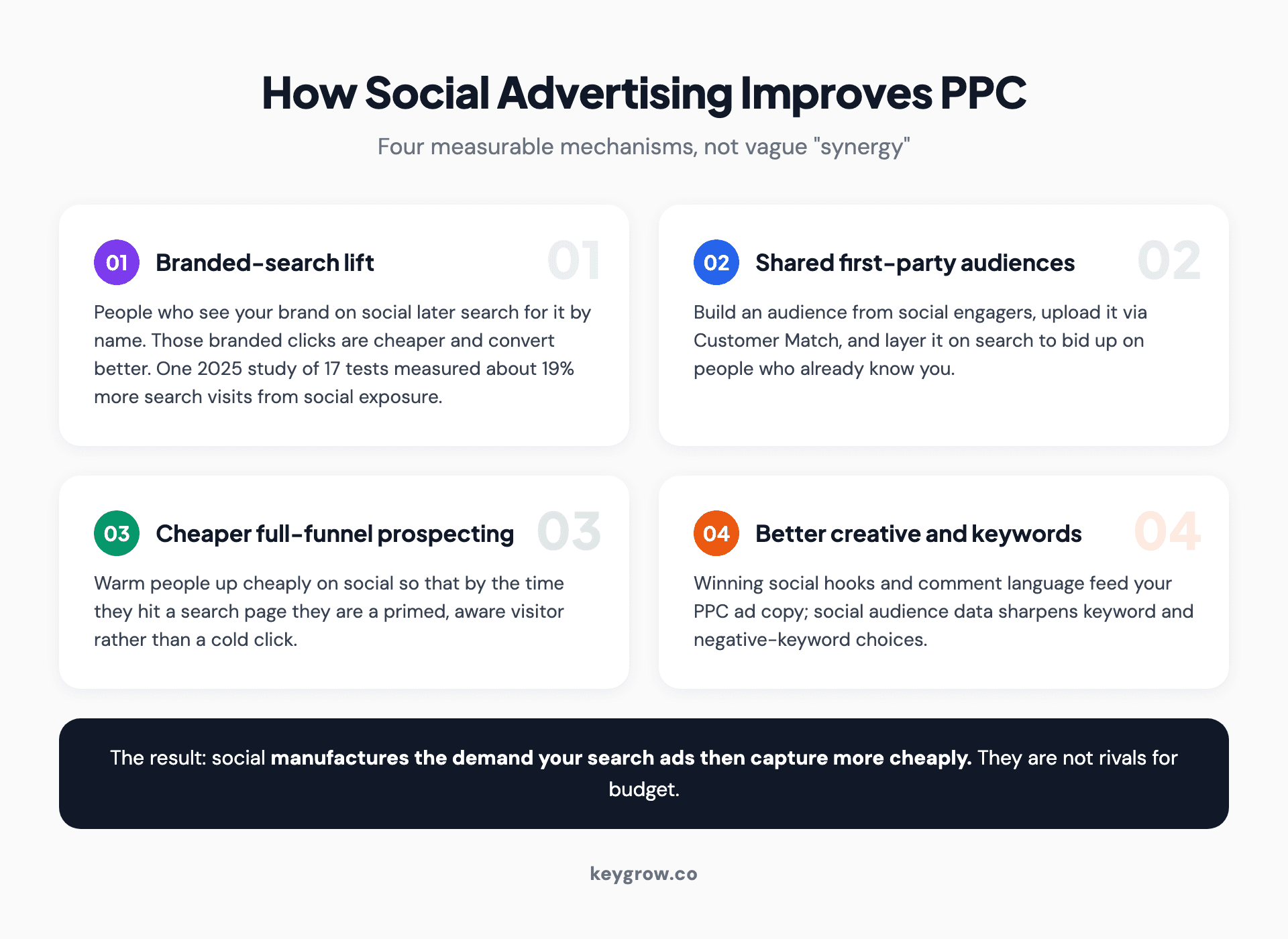
Four-card layout of how social advertising improves PPC: branded-search lift creating cheap high-intent searches, shared first-party audiences for bid adjustments, cheaper full-funnel prospecting warming visitors before they search, and social creative feeding PPC copy and keywords.
Why your reports hide this
Last-click attribution gives all the credit to the final click, usually search, and none to the social ad that created the demand. If you judge social on in-platform conversions alone, you will conclude it does not work and cut the very thing making your search cheaper.
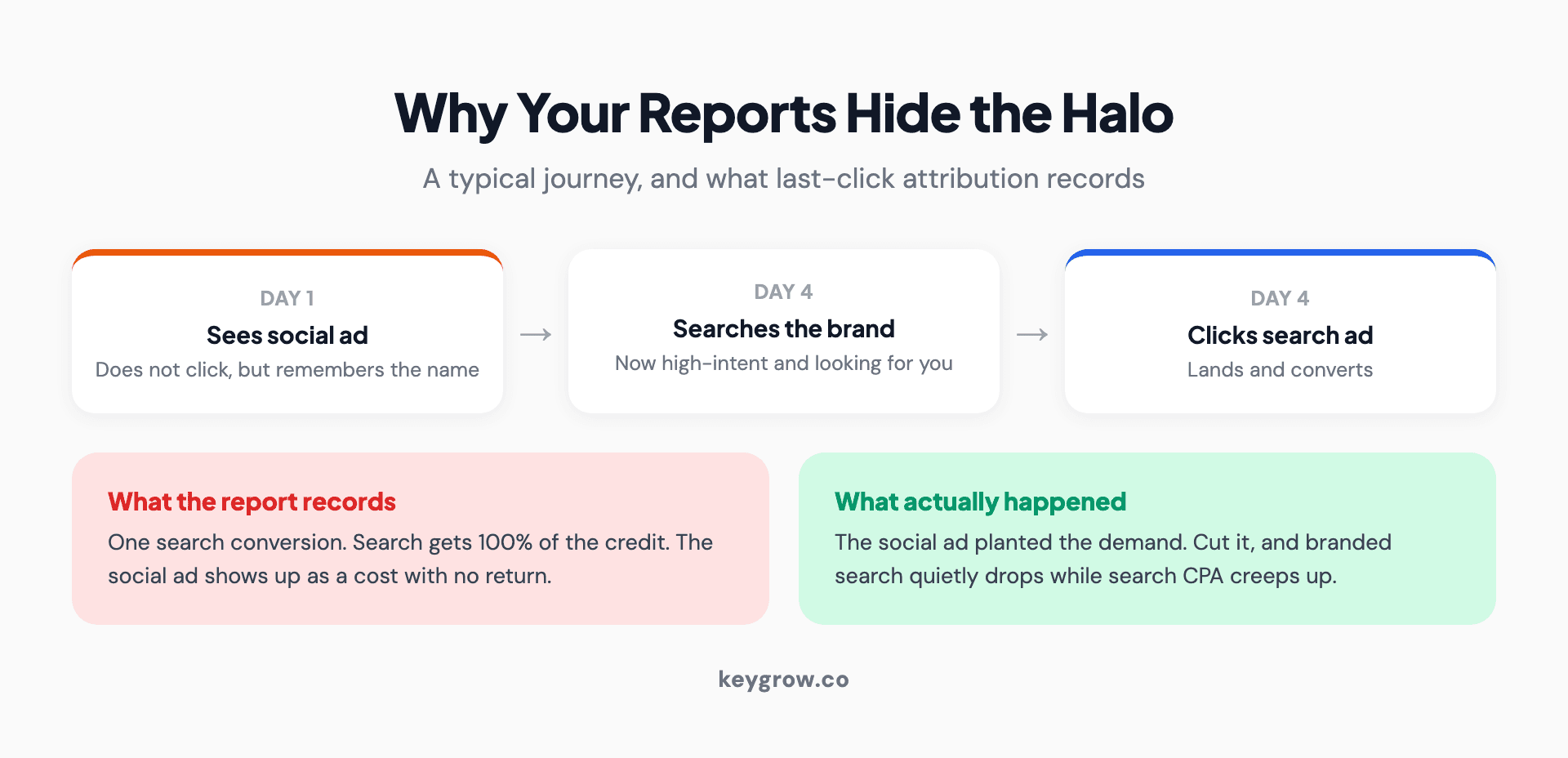
A typical customer journey where a social ad seen on day one leads to a branded search and conversion on day four, and how last-click attribution credits only the final search click.
This is the trap that makes businesses turn off their most valuable channel. A typical journey looks like this: a person sees your social ad, forgets to act, searches your brand three days later, clicks the search ad, and converts. Last-click attribution records one thing, a search conversion, and credits search with the entire sale. The social ad that planted the idea shows up as a cost with no return.
So the finance team looks at the social campaign, sees spend and few in-platform conversions, and kills it. A month later branded search volume quietly drops, cost per acquisition on search creeps up, and nobody connects the two. The channels genuinely help each other, but the default report is built to hide exactly that interaction. Which is why you have to measure it deliberately.
How to actually prove it
Do not assume the halo, test it. A geographic holdout or Google's own Search Lift study will show you the real lift, and branded-search volume tracking gives you a running signal in between.
Three methods, from most rigorous to simplest.
- Geographic holdout test. Run your social ads in some regions and deliberately not in others that are otherwise similar. Watch what happens to branded search volume, search impression share, and total conversions in the exposed regions versus the held-back ones. The difference is your lift, measured against a real control rather than a guess. Give it several weeks so the effect has time to show.
- Google's Search Lift study. Google offers a native Search Lift experiment that runs an exposed-versus-holdout test to measure how much your YouTube video and Demand Gen ads increase searches for your brand on Google. It is the most direct native tool for exactly this question, and almost nobody uses it.
- Branded-search tracking. Between formal tests, watch your branded-query volume in Google Search Console before, during, and after a social push. A social burst that lifts branded searches is your halo effect showing up in a report you already have.
Whatever you do, treat popular hype numbers with suspicion. Figures like "1,300 percent retargeting ROI" or "70 percent higher conversions" float around unsourced. The honest number to anchor on is the measured, controlled kind, like the 19 percent search lift above, and better still, your own test.
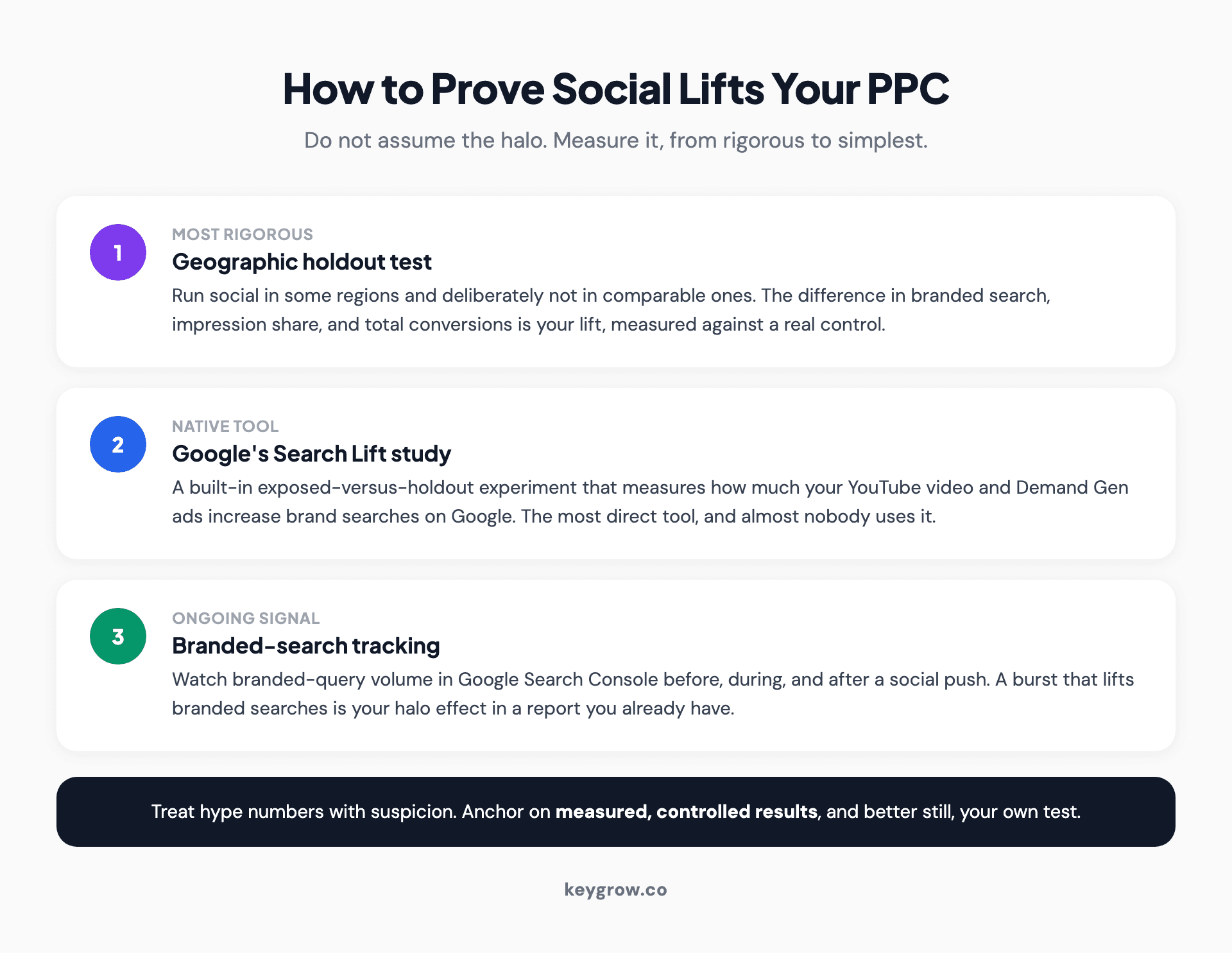
Three-tier method for proving social's lift on PPC: a geographic holdout test as the rigorous option, Google's native Search Lift study, and ongoing branded-search volume tracking in Search Console as the running signal.
Turning it into a plan
Point social at the top of the funnel to build demand and audiences, feed those audiences and that creative into search, then measure the pair on blended cost per acquisition rather than per-channel returns.

A smartphone resting beside a laptop on a desk, representing paid social and paid search running as one system.
A practical way to run the two together:
- Let social do the warming. Use lower-cost social reach to introduce your brand to the right audience, and expect much of the payoff to land later, on search, not in the social platform's own conversion column.
- Pipe the audiences into search. Build audiences from social engagers and leads, upload them via Customer Match, and use them to bid more aggressively on high-intent searches from people who already know you.
- Share the creative both ways. Move winning social hooks into your PPC ad copy and let strong search terms inform your social targeting.
- Judge them together. Track one blended cost per acquisition across both channels, not two separate returns that each claim or disown the same customer. Treating paid social and paid search as one connected system is the whole point.
FAQs
Can you use social media advertising and PPC together?
Yes, and they work better together than apart. Social advertising builds awareness and demand that search ads then capture, while search data and audiences can feed back into your social targeting. The key is to plan them as one funnel and measure them together rather than treating them as competing line items.
Does social media advertising actually help paid search?
It does, primarily by lifting branded search. When people see your brand on social, more of them later search for you by name, and those branded searches are cheaper and convert better than cold keyword clicks. Controlled tests have measured meaningful increases in search visits from social exposure, though you should verify the effect in your own account.
How does social media affect branded search volume?
Social exposure plants brand awareness, so a share of the people who see your ads later search for your business directly instead of clicking straight through. That shows up as a rise in branded-query volume, which you can watch in Google Search Console before and after a social campaign to see the effect in your own data.
What is the halo effect in advertising?
The halo effect is when advertising in one channel lifts performance in others rather than only driving conversions in its own platform. A social ad that never gets clicked can still cause a search or a direct visit later. It is real but invisible to last-click reporting, which is why you have to measure it with holdout tests.
Can I use my social media audiences for Google Ads?
Yes. You can build an audience from people who engaged with your social ads or submitted a lead form, then upload it to Google Ads through Customer Match to target or adjust bids on search and other Google surfaces. Customer Match needs a minimum number of matched contacts to activate, so it works best once your list is sizable.
How do I measure whether social is helping my PPC?
Use a controlled test rather than assumptions. Run a geographic holdout where some regions see your social ads and comparable regions do not, then compare branded search volume and total conversions. Google's native Search Lift study does this for YouTube video and Demand Gen campaigns, and tracking branded-query volume in Search Console gives you an ongoing read between formal tests.
Prove it, do not assume it
Social advertising makes PPC cheaper and more productive through four real mechanisms: it lifts branded search, shares audiences, warms visitors before they search, and improves your creative. The effect is genuine, but it is also invisible to the default reports, which means the businesses that benefit most are often the ones about to cut the channel that is helping them.
So run the test. A geographic holdout or a Search Lift study will tell you what social is actually worth to your search performance, in your account, with your numbers. And if you are still deciding which of the two to fund first rather than how to measure them together, Google Ads vs Facebook Ads works that decision out from your search volume. If you would rather have the two channels planned and measured as one system from the start, our team builds them that way, month-to-month. The synergy is real. It just will not show up unless you go looking for it.