


Ask ten agencies about Google Ads vs Facebook Ads and nine will tell you Google captures intent and Facebook creates it, then compare the two on cost per click anyway.
Cost per click is the least useful number in the comparison. Google Ads and Facebook Ads are not competing for the same job, and the right way to choose between them is to work out whether search demand for what you sell is large enough to hit your growth target. If it is, start with Google. If it is not, no amount of Google optimization fixes that, and you need the other channel whether the clicks are cheap or not.
Here is how to work that out, and what the honest cost comparison looks like once you get past the click.
The short verdict, by situation
| Your situation | Start with | Why |
|---|---|---|
| People search for what you sell by name | Google Ads | The demand exists, you are buying access to it |
| Emergency or urgent services | Google Ads | Nobody schedules a burst pipe from a feed |
| A product people did not know existed | Meta | There is nothing to harvest yet |
| Visual, impulse-friendly, under $60 | Meta | The click is cheap enough for a low hit rate |
| B2B with a small, defined buyer set | Google first, Meta for retargeting | Search volume is tiny but the intent is total |
| Local service, high job value | Google Ads | One extra job usually covers the month |
| You have already maxed out search volume | Meta | Your Google ceiling is the reason growth stopped |
| Budget under about $1,000 a month | One of them, properly | Split across both, neither gets enough data |
That table answers the question for most readers. The rest of this post is the reasoning, and the arithmetic that tells you which row you are actually in.
The two platforms do different jobs
Google Ads harvests demand that already exists. Meta generates demand that does not. That single difference explains almost every other difference between them.
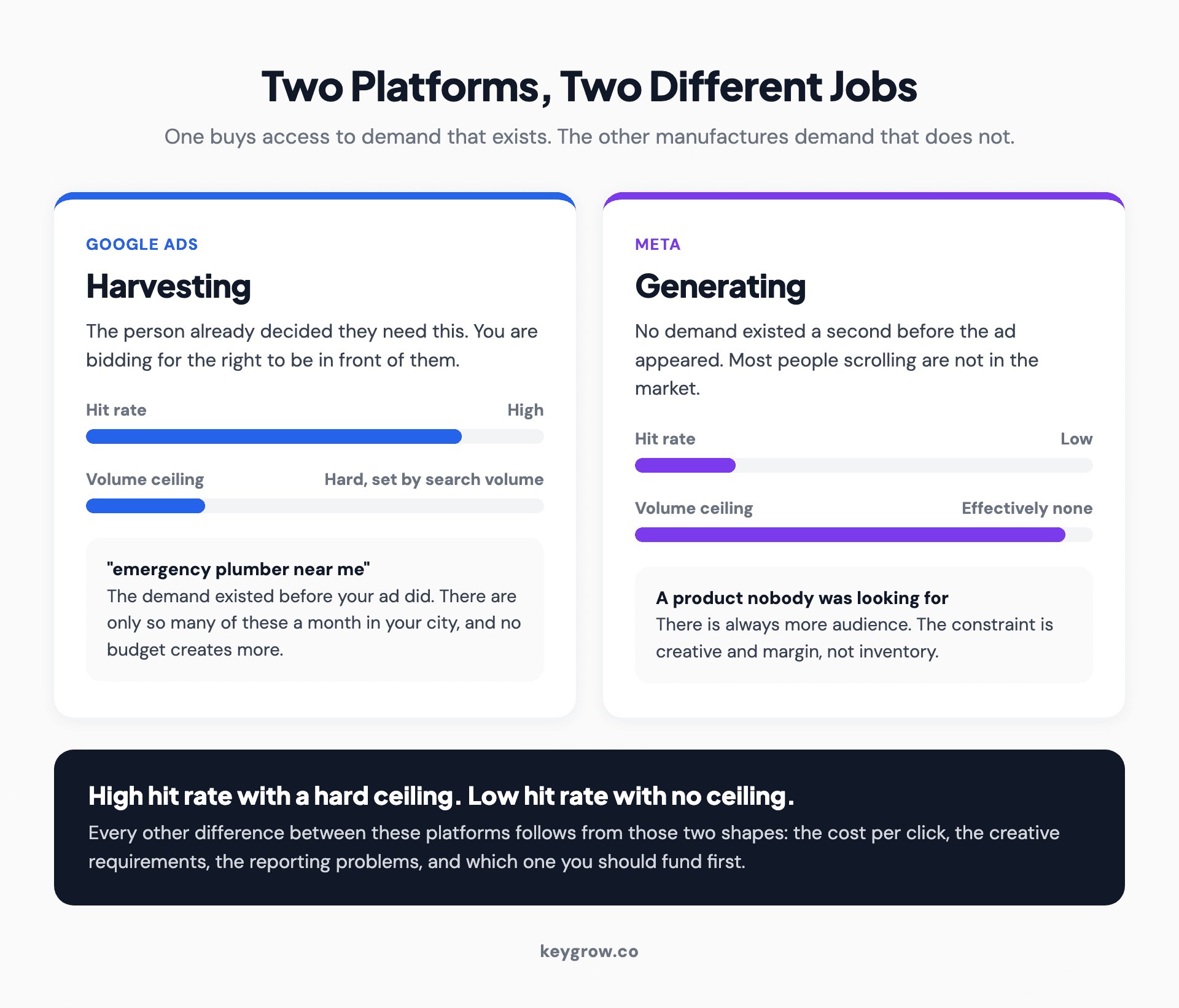
The difference between harvesting existing demand on Google Ads and generating new demand on Meta, and what each one implies for volume and hit rate.
When someone types "emergency plumber near me", the demand is already there. You are bidding for the right to be in front of it. The hit rate is high because the person has already decided they need a plumber. The ceiling is low, because only so many people type that phrase in your city each month.
When someone scrolls past an ad for a product they had not thought about, no demand existed a second earlier. The hit rate is much lower, because most people scrolling are not in the market. The ceiling is effectively unlimited, because there is always more audience.
High hit rate with a hard ceiling. Low hit rate with no ceiling. Everything else, the cost per click, the creative requirements, the reporting problems, follows from those two shapes.
Work out your Google Ads ceiling before you compare anything
Search advertising has a maximum, and you can estimate it in twenty minutes. Most businesses never do, then spend a year wondering why their Google account plateaued.
The calculation:
- Add up monthly search volume for the terms you would actually bid on, in the areas you actually serve. Keyword Planner will give you this free.
- Assume you capture around 20 percent of those searches as clicks if you bid aggressively. You will not get all of them at any price.
- Apply a realistic conversion rate. LocaliQ's 2026 benchmarks, drawn from more than 13,000 US search campaigns across 23 industries, put the cross-industry average at 8.18 percent.
- The result is roughly the most leads Google Ads can produce for you in a month, at any budget. Our Google Ads budget calculator does the spend side of the same sum.
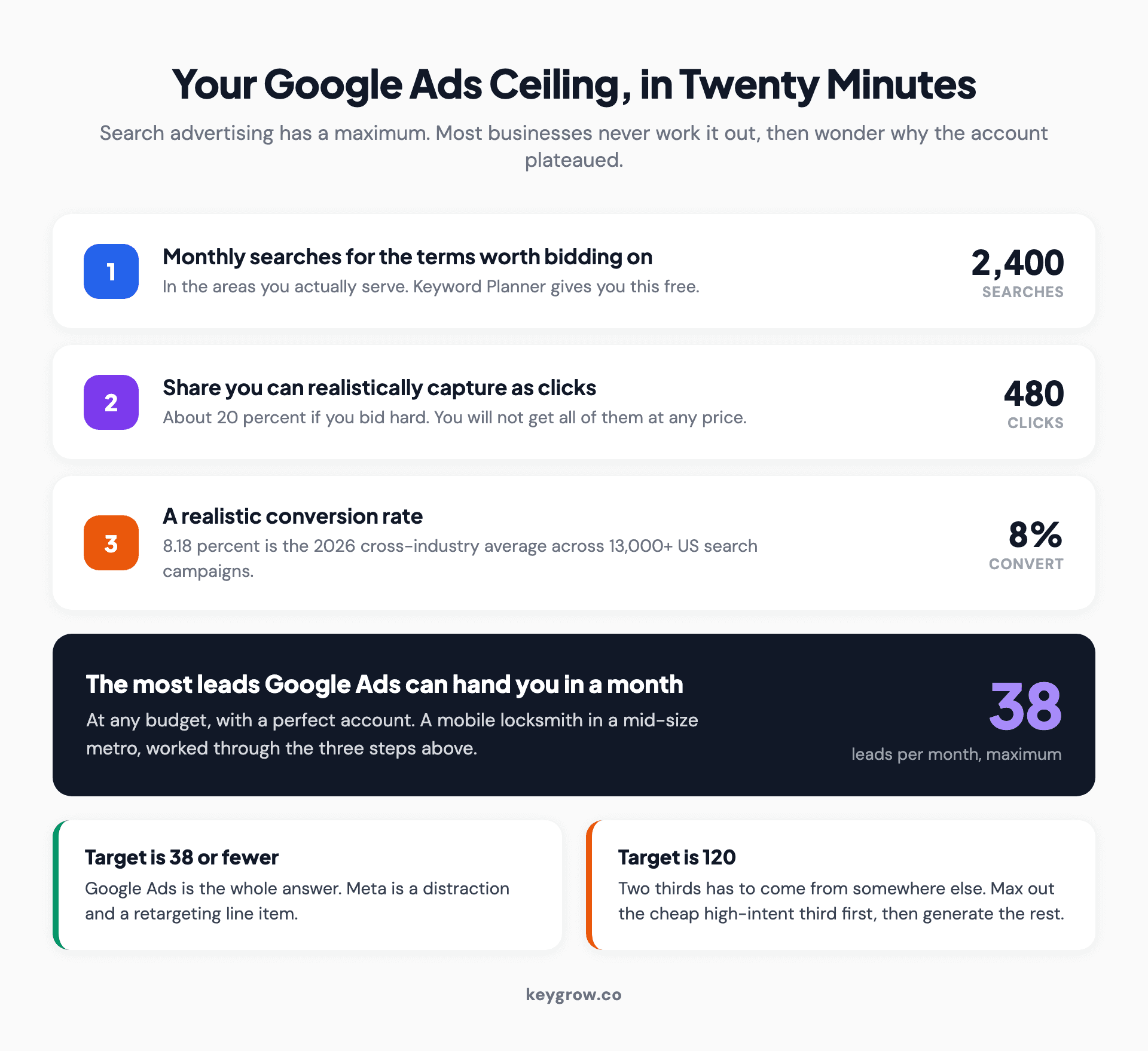
How to estimate the maximum number of leads Google Ads can produce for your business, before comparing it to any other channel.
A worked example. A mobile locksmith in a mid-size metro finds about 2,400 monthly searches across the terms worth bidding on. Twenty percent is 480 clicks. At 8 percent that is roughly 38 leads a month, maximum, with an unlimited budget and a perfect account.
If the business needs 38 leads a month, Google Ads is the whole answer and Meta is a distraction. If it needs 120, then two thirds of the target has to come from somewhere else, and the sensible order is to max out the cheap high-intent third first. When Google is capped, Microsoft Ads is the other search channel worth testing, which we cover in Microsoft Ads vs Google Ads.
This is the calculation that turns a platform argument into an arithmetic problem. It is also the reason "we tried Google Ads and it stopped growing" is usually not an account quality problem.
Cost per click is the wrong comparison
Every comparison article puts Google's higher CPC next to Meta's lower one and implies something. The number that matters is cost per customer, and it frequently reverses the ranking.
Three layers, and each one changes the picture.
At the click, Google Search averages $5.42 across industries in the LocaliQ data, while Meta clicks commonly land between $0.60 and $1.90 depending on objective. Meta looks three to eight times cheaper.
At the lead, the gap narrows sharply. Google's cross-industry cost per lead sits at $66.69 in the same dataset, because a high proportion of those expensive clicks convert. Meta's cost per lead is usually lower but not by the multiple the click suggests.
At the customer, the ranking often flips. Suppose Google produces a $50 lead that your sales process closes at 4 percent, and Meta produces a $25 lead that closes at 1.5 percent. The Google customer costs $1,250. The Meta customer costs $1,667. The cheaper lead was the more expensive customer. Our guide to Facebook ads for leads covers the form settings that move that Meta close rate.
| Layer | Google Search | Meta | Which looks better |
|---|---|---|---|
| Cost per click | $5.42 average | Roughly $0.60 to $1.90 | Meta, by a lot |
| Cost per lead | $66.69 average | Usually lower | Meta, by less |
| Close rate on the lead | Higher, often 2 to 3 times | Lower | |
| Cost per customer | Frequently lower | Frequently higher | Depends entirely on your close rate |
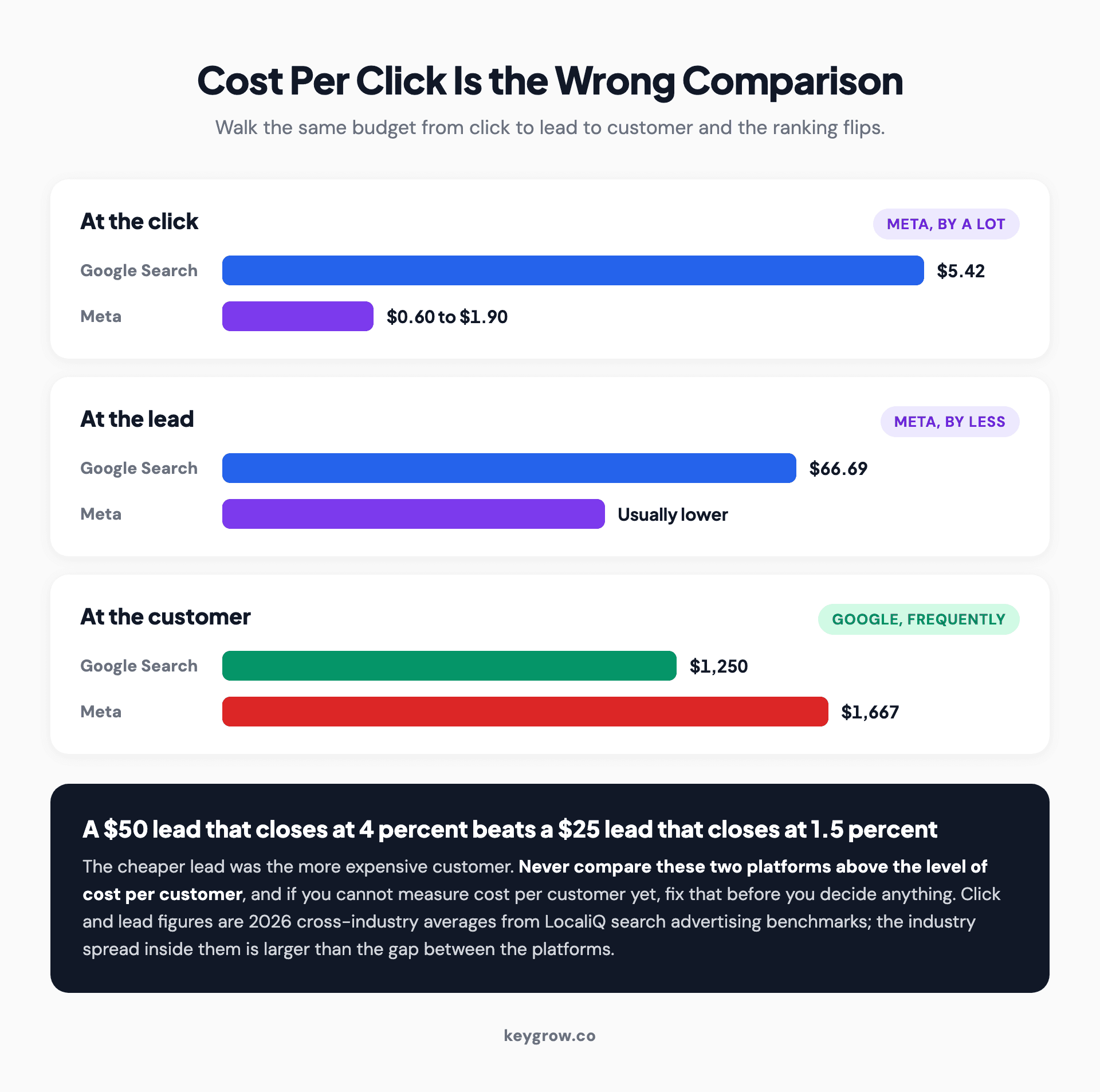
Why comparing Google Ads and Meta on cost per click misleads, walking the same budget from click to lead to customer.
Note the size of the industry spread inside those averages, because it dwarfs the platform difference. Legal services average $9.87 per click and $131.63 per lead. Arts and entertainment average $1.63 and $26.84. A lawyer and a theater are having completely different conversations about whether Google is expensive.
The practical instruction: never compare the two platforms above the level of cost per customer, and if you cannot measure cost per customer, fix that before you decide anything.
Where Google Ads genuinely wins
Urgency, high job value, defined search demand, and any situation where the customer is already looking for a solution rather than a supplier.

Someone looking something up on a phone held in one hand.
Emergency and time-critical services. Nobody books a locksmith from a video. The search happens because something has gone wrong, and the first three results get the call.
Anything with a high value per customer. At a $6,200 average job, a $130 lead is a rounding error. High-ticket local services are the clearest case for search advertising there is, and the reason legal and home services tolerate the highest click prices in the benchmark data.
Buyers who already know the category. If people search "commercial HVAC maintenance contract", the education is done. You are competing on trust and responsiveness, not on whether the thing should exist.
Brand defense. If competitors bid on your name, search is where you deal with it, and there is no equivalent on a social platform.
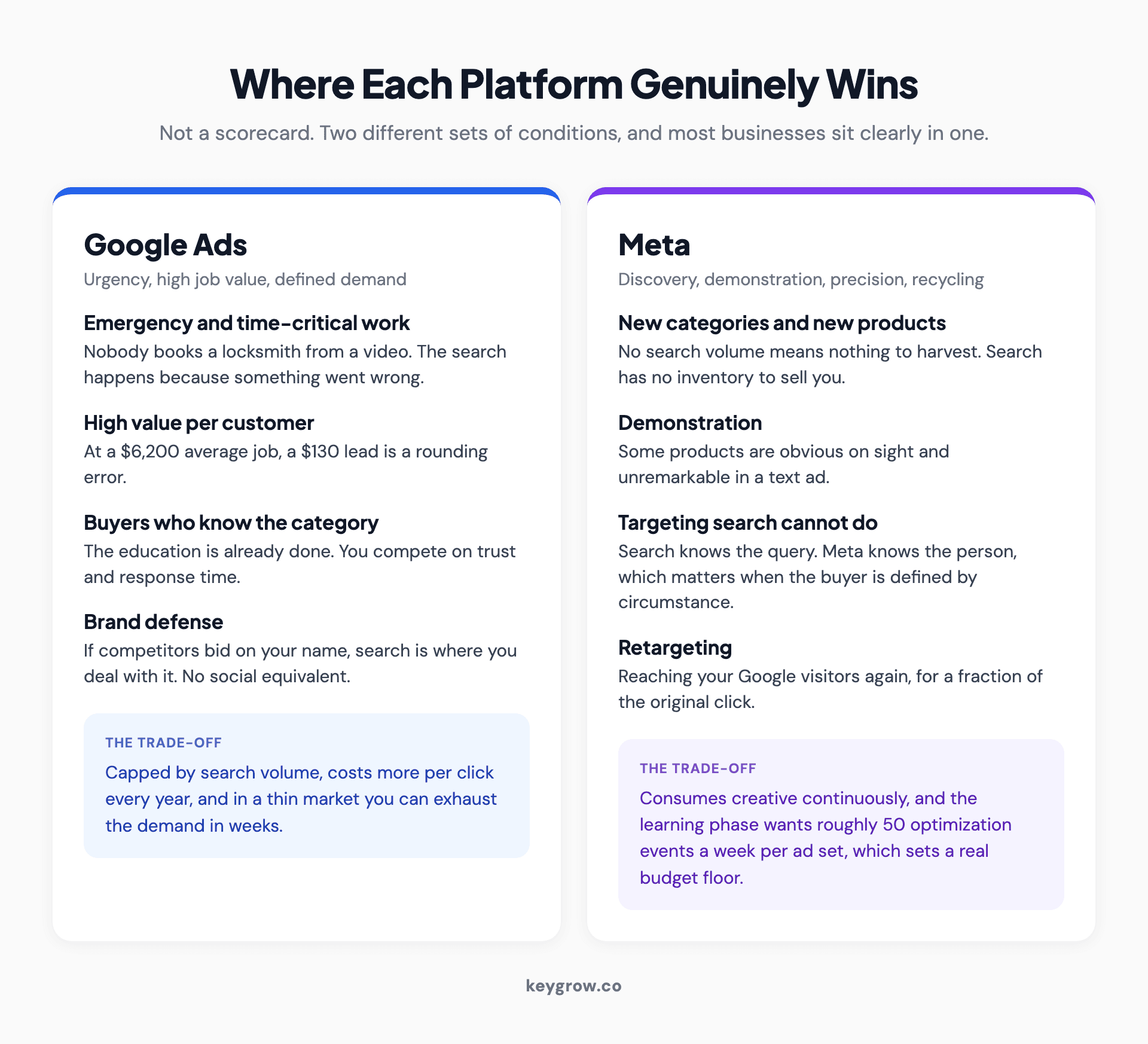
Where Google Ads wins and where Meta wins, with the trade-off attached to each platform's strengths.
The trade-off worth naming: Google Ads is capped by search volume, it costs more per click every year, and in a thin market you can exhaust the available demand in a few weeks and then just be paying more for the same clicks.
Where Meta genuinely wins
Products people did not know they wanted, tight demographic targeting, visual demonstration, and reaching everyone who has already touched your business.
New categories and new products. If there is no search volume, there is nothing to harvest, and search advertising simply has no inventory to sell you.
Demonstration. Some products are obviously good the moment you see them working and unremarkable when described in a text ad. That is a feed problem, not a search problem. Travel is the clearest case, and our blueprint for Facebook ads for travel starts with the place before the price.
Audience precision that search cannot do. Search knows what somebody typed. Meta knows a great deal about who they are, which matters when your buyer is defined by life stage or circumstance rather than by a query.
Retargeting, which is where most accounts get the best return on the platform. The people who visited your site after clicking a Google ad are reachable on Meta for a fraction of what the original click cost, and the two channels reinforce each other in ways we covered in how social advertising improves PPC.
The trade-off: Meta consumes creative. One image will not run for a quarter, which is why it helps to keep a few proven Facebook ad patterns ready to rotate in. Meta's learning phase also needs roughly 50 optimization events a week per ad set before delivery stabilizes, which quietly sets a minimum viable budget that has nothing to do with the cheap clicks.
The cost nobody puts in the comparison
Google Ads needs a landing page. Meta needs a landing page and a creative pipeline. That second requirement is a real budget line and it is missing from every comparison table.
A Google search campaign can run for months on the same text ads. The work is in the keywords, the negatives, the bids and the page.

A camera and studio lighting set up to photograph a single product.
A Meta campaign burns through creative. Frequency climbs, performance decays, and the fix is new material rather than a bid change. Plan on several new pieces a month, indefinitely. If you cannot produce them in-house, that is $500 to $2,000 a month on top of the ad spend, and it makes the cheap clicks considerably less cheap.
This is the single most common reason a Meta account that started well is dead by month four. Nobody planned for the creative treadmill, so the winning ad ran until it burned out and nothing replaced it.
Both platforms will claim the same sale
Run both and add up the conversions each platform reports. The total will exceed the leads that actually reached your CRM, usually by 20 to 40 percent, and every budget decision made from those numbers is wrong.
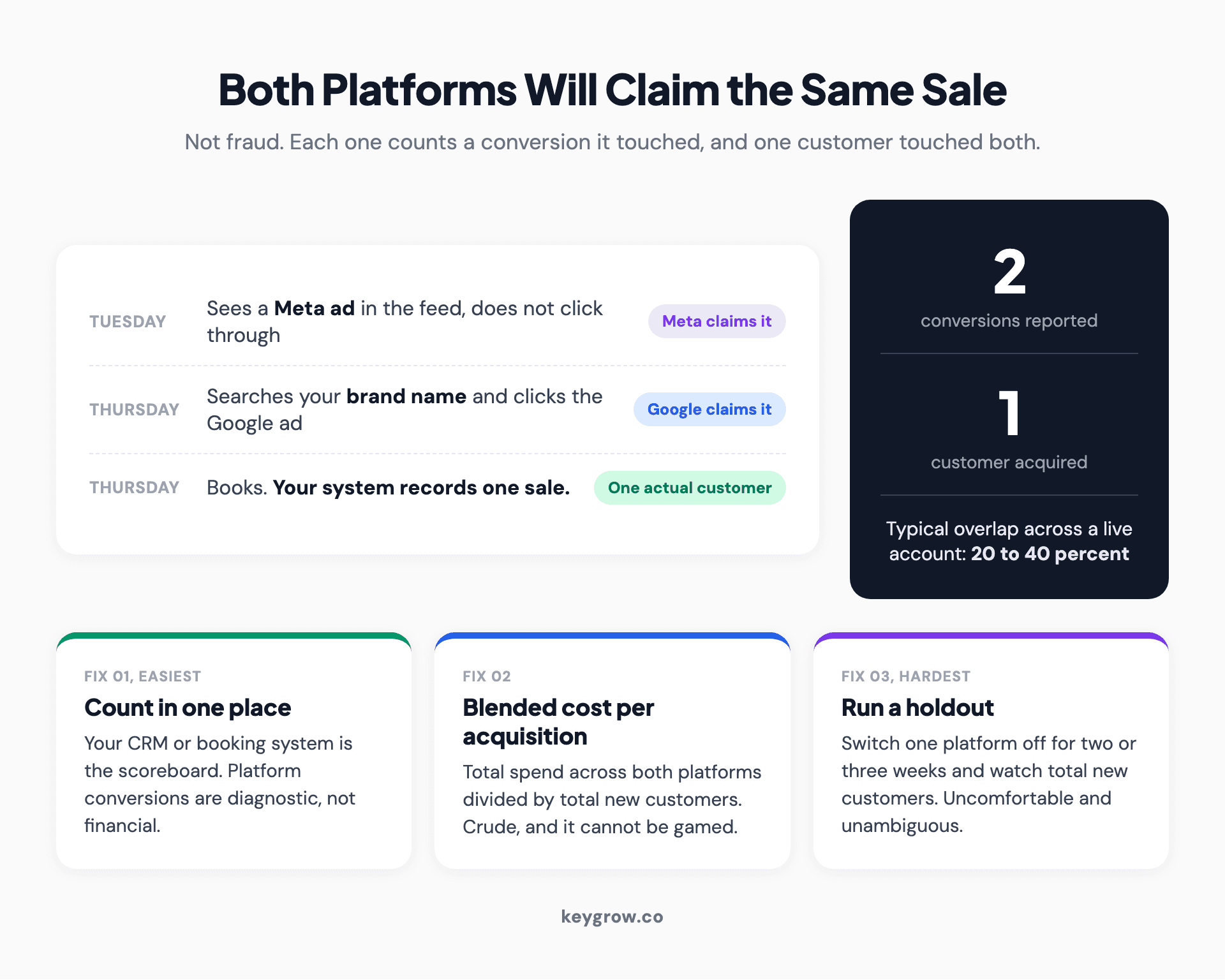
How two advertising platforms can both claim credit for the same sale, and the three ways to get an honest number.
The mechanism is not fraud, it is that both platforms count a conversion they touched. Somebody sees a Meta ad on Tuesday, searches your brand on Thursday, clicks the Google ad and converts. Meta claims a view-through conversion. Google claims a click conversion. Your accounts software records one sale.
Vanity-metric reporting is this industry's oldest habit, and this is where it does real financial damage rather than just wasting a page of a report. Budget gets moved toward whichever platform is more generous with attribution, which is not the same thing as whichever platform is producing customers.
Three fixes, in order of how much work they are:
- Count in one place. Your CRM or booking system is the scoreboard. Platform-reported conversions are diagnostic, not financial.
- Use blended cost per acquisition. Total ad spend across both platforms divided by total new customers. It is crude and it cannot be gamed.
- Run a holdout. Turn one platform off for two or three weeks and watch total new customers, not campaign conversions. Uncomfortable, unambiguous, and the only method that survives an argument.
We had a cash home buyer client drowning in unqualified leads, and the fix was not more traffic from anywhere. It was negative keywords, tighter match types and qualifying language in the ads themselves. Serious leads rose 600 percent between December and January on the same budget. Lead quality is a channel-selection question long before it is a bidding one.
Running both, in the order that works
The sequence matters more than the split. Most businesses that run both start them simultaneously with a divided budget and get two underfunded accounts.
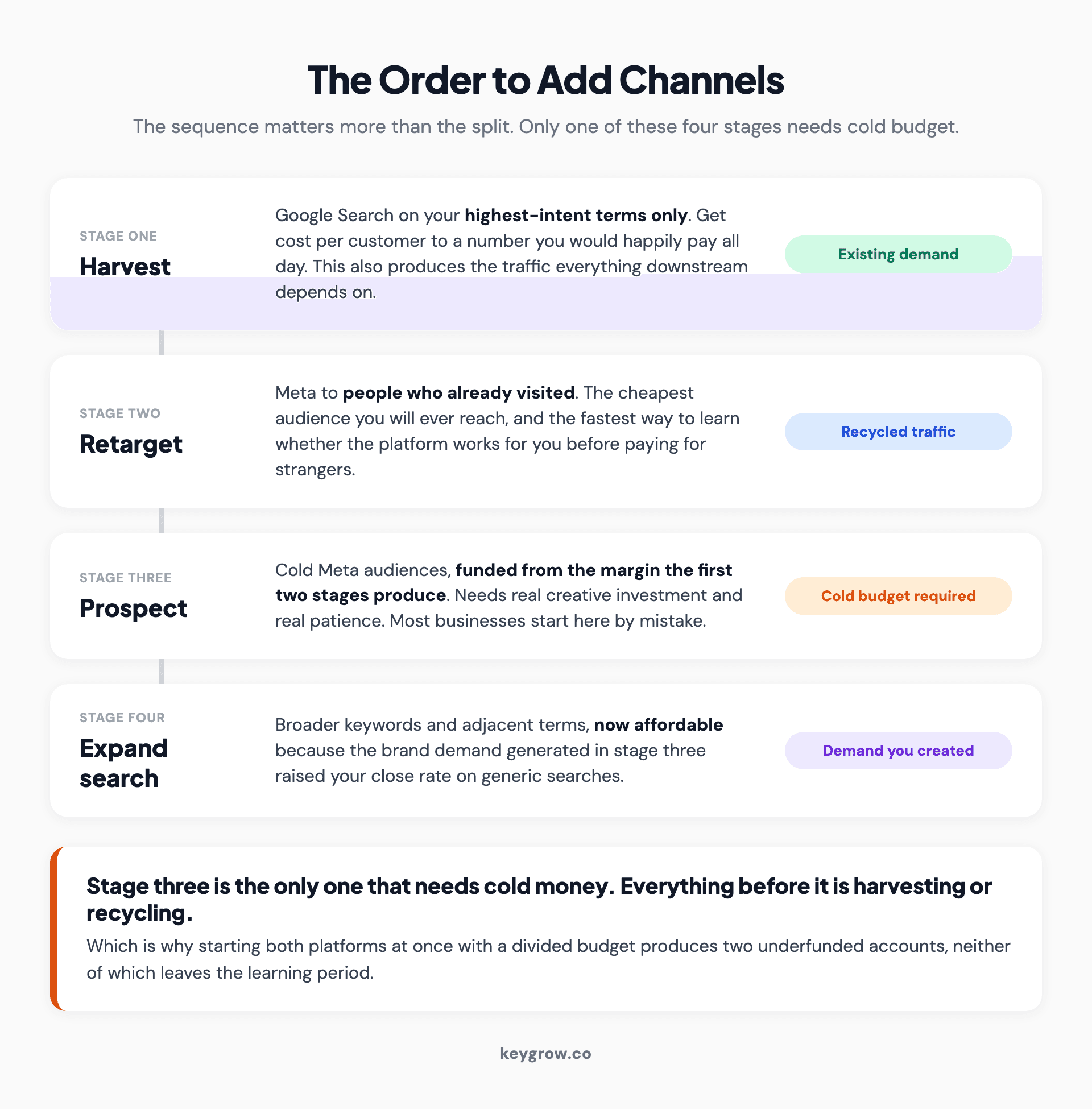
The order to add paid channels, from harvesting existing search demand to retargeting to cold prospecting.
Stage one, harvest. Google Search on your highest-intent terms only. Get cost per customer to a number you would happily pay all day. This also produces the traffic that makes everything downstream possible.
Stage two, retarget. Meta to people who already visited. Cheapest audience you will ever reach, and the fastest way to learn whether the platform's mechanics work for your business before you spend on strangers.
Stage three, prospect. Cold Meta audiences, funded from the margin the first two stages produce. This is the stage that needs real creative investment and real patience, and it is where most businesses start by mistake.
Stage four, expand search. Broader keywords and adjacent terms, now affordable because the brand demand generated in stage three has raised your close rate on generic searches.
Notice that stage three is the only stage that requires cold budget. Everything before it is either harvesting or recycling.
If you can only fund one
Under about $1,000 a month, pick one platform and run it properly. Split budgets produce two accounts that never leave the learning period and one report nobody can read.
Ask three questions and the answer usually falls out.
Does meaningful search volume exist for what you sell, in the area you serve? If yes, Google, almost always. Harvesting beats generating when there is something to harvest.
What is a customer worth? Above roughly $500 in lifetime value, the higher-intent channel is worth the higher click price. Below about $60 with no repeat purchase, search advertising is usually too expensive and the cheaper clicks are the only thing that works.
Can you produce new creative every month, without it becoming the thing that does not happen? An honest no rules out Meta as a primary channel regardless of the other two answers.
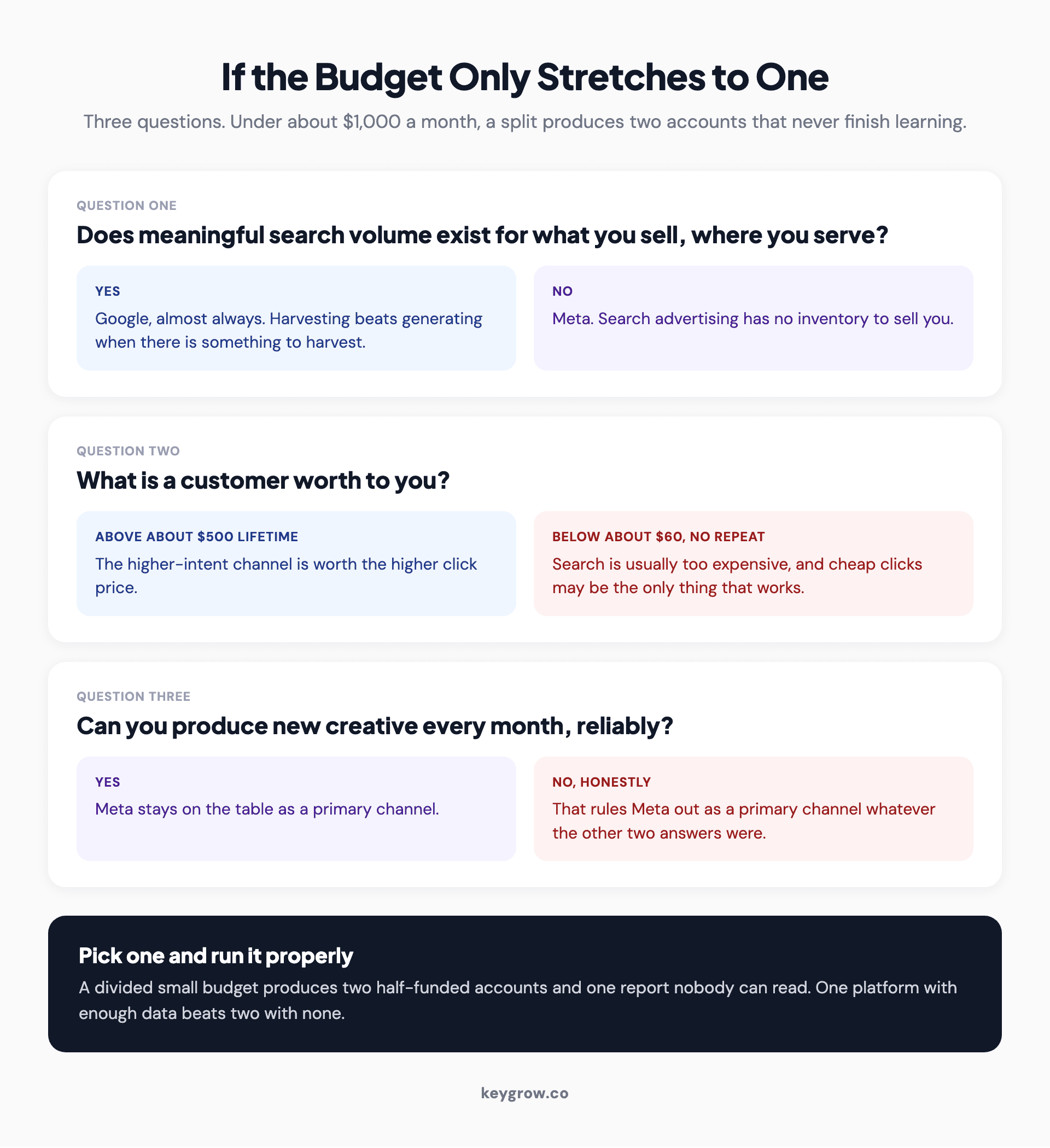
A three-question test for choosing between Google Ads and Meta when the budget only stretches to one.
Our PPC management runs both, month to month with no lock-in, and we will tell a business with $400 a month and a $70 average ticket that neither platform is the right purchase yet.
When the answer is neither
Some businesses should not be buying paid traffic at all this quarter, and it is worth saying so before you compare platforms.
If your website cannot convert the traffic you already have, paid clicks make the leak more expensive rather than fixing it. A page that turns two percent of visitors into enquiries will turn two percent of paid visitors into enquiries, and now you are paying for the other ninety-eight.
If your gross margin per sale is under about $60 and there is no repeat purchase, the arithmetic is hard on both platforms and brutal on search.
If you cannot tell which leads became customers, you cannot manage either channel. That is a tracking job and it takes a week.
And if the demand does not exist yet and you cannot fund a demand-generation campaign for six months, the honest answer is content and organic, not ads. Our post on SEO or Google Ads first works through that decision properly.
FAQs
Is Google Ads or Facebook Ads better for small business?
Whichever matches your demand. If people already search for what you sell in your area, Google Ads converts far better and usually produces a cheaper customer despite the higher click price. If your product is a discovery purchase or a new category, Meta is the only one of the two with inventory to sell you. Estimate your search volume first, then decide.
Which is cheaper, Google Ads or Facebook Ads?
Meta is cheaper per click, typically by three to eight times. Google is often cheaper per customer, because its traffic converts at a much higher rate and closes better afterwards. Compare cost per customer, not cost per click, or you will consistently pick the wrong one.
What is the average cost per click on Google Ads?
$5.42 across all industries in the 2026 LocaliQ benchmark data, though the range is enormous. Legal services average $9.87 and arts and entertainment $1.63. Your industry average matters far more than the cross-industry number.
Should I run Google Ads and Facebook Ads at the same time?
Yes, once each can be funded properly, and in sequence rather than all at once. Start with Google search on high-intent terms, add Meta retargeting to people who already visited, and only then spend on cold Meta prospecting. Under about $1,000 a month, run one platform properly instead of two badly.
Why do my Google Ads and Facebook Ads conversion numbers add up to more than my actual sales?
Because both platforms count conversions they touched, and a customer who saw a Meta ad then clicked a Google ad gets counted twice. Expect a 20 to 40 percent overlap. Use your CRM as the scoreboard and manage to a blended cost per acquisition across both platforms.
Do Facebook Ads work for B2B?
For retargeting and for warming a defined audience, yes. As a cold acquisition channel for complex B2B, usually not, because the buying committee is small, the sales cycle is long, and attribution is close to impossible. Most B2B budgets do better on search for capture plus Meta for retargeting.
How long before either platform produces results?
Google Search can produce leads in the first week and needs about a month of data before you should judge it. Meta needs longer, partly because the learning phase wants roughly 50 optimization events a week per ad set, and partly because cold prospecting takes several creative rounds to find what works. Budget six to eight weeks before making a call on Meta.
Which platform is better for ecommerce?
Both, usually, and the split depends on whether people search for your product category by name. Established categories favor Shopping and Search. Novel or impulse products favor Meta. The one universal is that retargeting on Meta tends to be the best-performing line in an ecommerce account regardless of which platform drives first visits.
Pick by ceiling, not by CPC
Do the twenty minute version before you spend anything. Search volume for your terms, times an achievable click share, times a realistic conversion rate, gives you the most leads Google can ever hand you.
Compare that number to your target. If it clears the target, Google Ads is the answer and Meta is a retargeting line item. If it falls short, you have a demand generation problem, and the cheap clicks are not a bonus, they are the only route to the volume you need.
Then measure both in the same place, on the same metric, which is what a new customer costs across all your spend rather than what each platform claims for itself.
If you want that ceiling worked out for your market before you commit a budget, send us your service area and what you sell and we will run the numbers with you.