


Google Ads remarketing works, and your remarketing report is almost certainly overstating how well by a wide margin.
Both of those are true at the same time, and holding both is the difference between an account that uses remarketing well and one that quietly funds a channel taking credit for other people's work.
Here is the short version. Remarketing shows ads to people who already visited you. Those people were already more likely to come back than a stranger, because they already visited you. So a chunk of every conversion your remarketing campaign reports would have happened with the campaign switched off, and standard reporting has no way to separate the two.
That is not an argument against running it. It is an argument for finding out what your real number is, which takes about three weeks and almost nobody does.
The problem sitting underneath every remarketing report
Remarketing targets the people most likely to convert anyway, then reports their conversions as its own. The gap between reported and incremental is the whole question.

A person working at a laptop with a phone in hand, mid-comparison.
Imagine two hundred people who visited your site last week and were going to come back and buy this week regardless. If a remarketing ad reaches them first, that ad gets the credit. Your dashboard shows a spectacular return on ad spend and a very low cost per conversion, and both numbers are technically accurate and strategically useless.
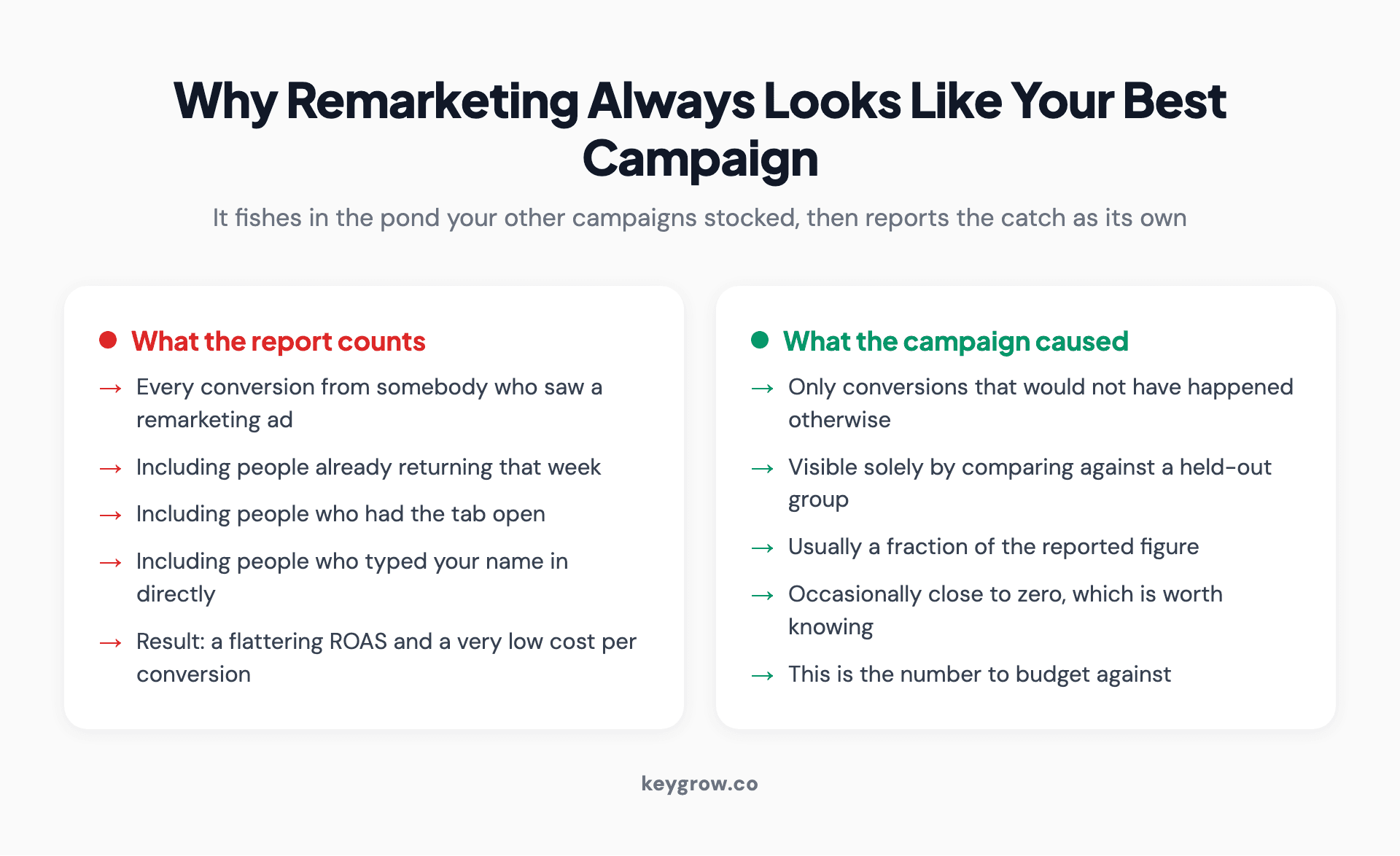
Why a remarketing report overstates its own contribution, showing reported conversions against the incremental ones the campaign actually caused.
This is why remarketing almost always looks like the best-performing campaign in the account. It is fishing in the pond you already stocked. Any campaign given that audience would look good.
The practical consequence is a mistake I see constantly: an advertiser sees remarketing outperforming everything else, moves budget out of prospecting and into remarketing, and six weeks later the whole account declines. They starved the thing that fills the pond in order to feed the thing that fishes in it.
Run the holdout test, it takes about three weeks
Split your remarketing audience, show ads to one half, withhold them from the other, and compare conversion rates between the two groups. The difference is your real number.
This is the single most valuable thing in this post and it costs nothing but patience.
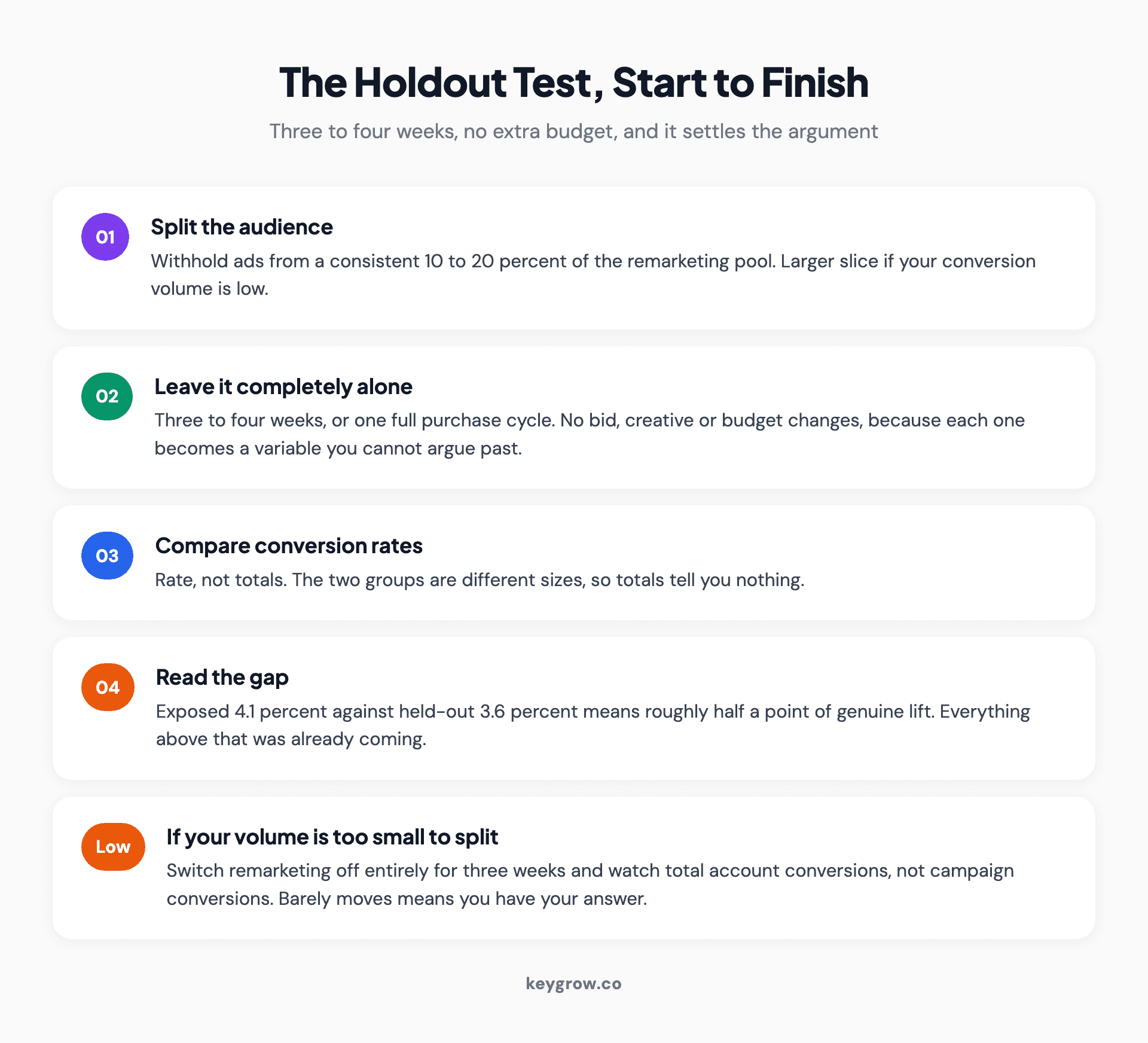
The four steps of a remarketing holdout test, from splitting the audience to reading the incremental result.
- Split the audience. Use an experiment or a campaign-level split so a consistent share of your remarketing pool never sees the ads. Ten to twenty percent is enough for most accounts, more if your volume is low.
- Leave it alone for three to four weeks, or one full purchase cycle if yours is longer. Do not touch bids, creative or budget during the test. Every change you make is a variable you will have to argue about afterwards.
- Compare conversion rate between the two groups, not total conversions, because the groups are different sizes.
- Read the gap. If the exposed group converts at 4.1 percent and the held-out group converts at 3.6 percent, remarketing produced roughly half a percentage point of genuine lift. Everything above that in your reported numbers was already coming.
Most accounts that run this get a real number materially below the reported one, and a few discover their remarketing is close to zero incremental. Both outcomes are worth knowing. The second one frees up budget.
If your volume is too low for a clean split, the cruder version works: turn remarketing off entirely for three weeks and watch total account conversions, not campaign conversions. If the total barely moves, you have your answer.
What remarketing is genuinely good at
Long consideration cycles, high-ticket purchases, abandoned carts and multi-visit research. The longer the gap between first visit and decision, the more real work remarketing does.
The incrementality problem is smallest where the decision genuinely takes time and people genuinely forget. A homeowner comparing four contractors over eight weeks, a B2B buyer circling a demo for a quarter, somebody who filled a cart at eleven at night and closed the tab. In those cases a well-timed reminder changes outcomes rather than just witnessing them.
It is also good at something people underrate: keeping you in the frame during a comparison. If your prospect is evaluating three options over a month, being visible throughout that month is worth something that no single-session attribution model will capture cleanly.
And what it is not good at
Impulse purchases, one-off emergency services, tiny audiences, and anything where the visitor decided within the same session.
Somebody with a burst pipe does not need a reminder next Tuesday. They called a plumber twenty minutes after searching. Running remarketing on an emergency service business mostly means paying to show ads to people who already hired somebody, half of whom hired you.
The other common waste is the audience that is too small to matter. Display remarketing has a minimum list size, and search remarketing lists have their own threshold. If a site gets four hundred visitors a month, the list will hover near the floor, delivery will be erratic, and the reporting will be too noisy to read. Fix traffic first.
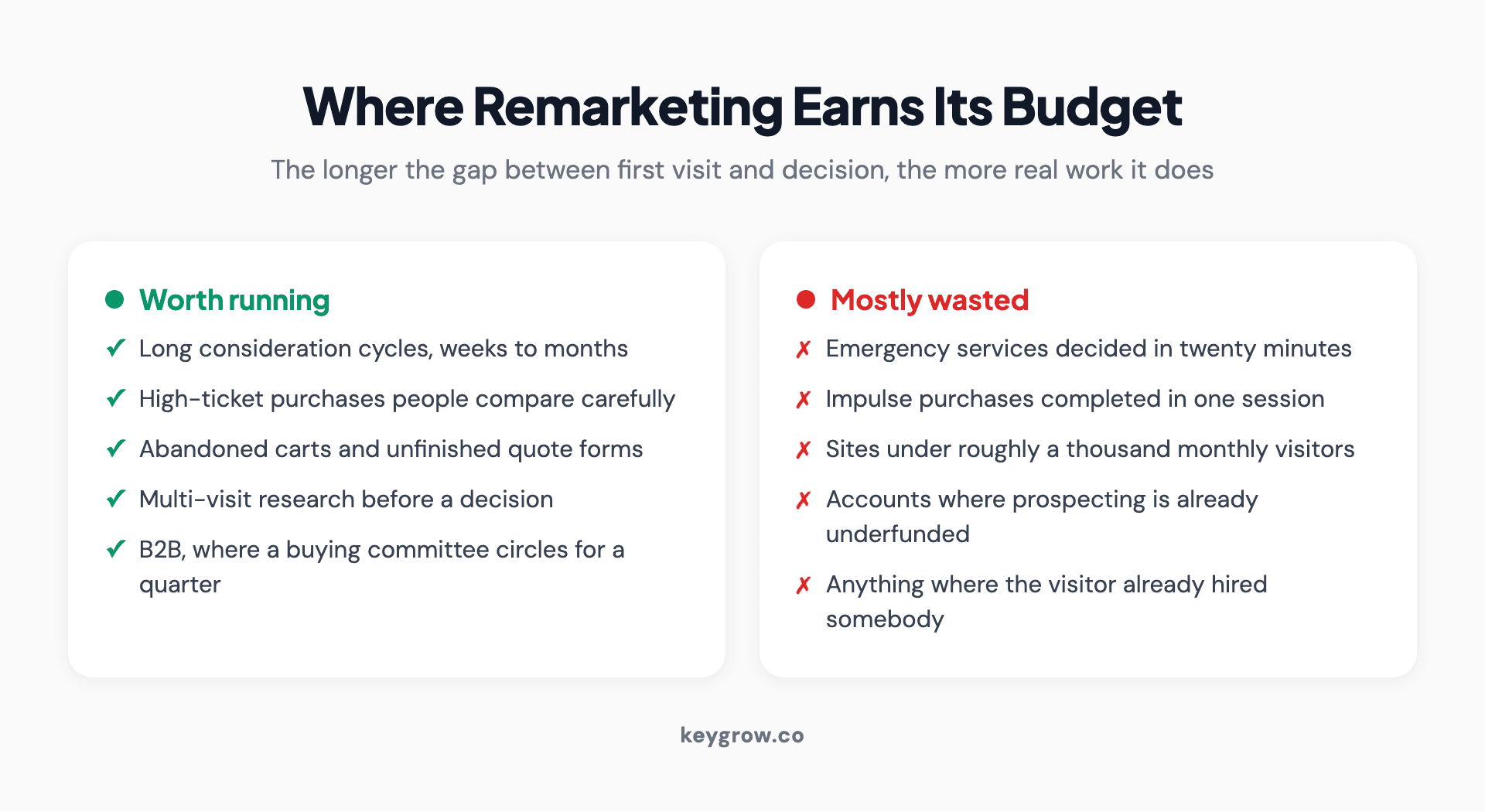
Which businesses get real value from remarketing and which are mostly paying to reach people who already decided.
Your lists are smaller and expire faster than you remember
Privacy changes, browser restrictions and consent requirements have quietly shrunk what a remarketing list actually contains. The tactics written before 2023 assume an audience that no longer exists at that size.
If you set up remarketing years ago and have not looked since, three things changed underneath you.
Lists shrank. Browser restrictions on third-party storage mean a meaningful share of visitors never enter the pool at all, and a share of those who do drop out sooner than your membership duration suggests.
Consent became a gate. In markets where consent requirements apply, a visitor who has not accepted marketing cookies should not be in a remarketing audience, and the platform-level consent settings determine whether they are. This is a compliance question before it is a marketing one, and it is worth confirming with whoever handles your privacy posture rather than assuming the tag manager was configured correctly in 2021.
Targeting rules tightened. Google's personalized ads policy restricts remarketing around sensitive categories: health conditions, financial hardship, and several others. Medical, legal and financial advertisers run into this constantly, usually by discovering a campaign was disapproved rather than by reading the policy first.
The practical response is to stop treating the pixel-built list as the primary asset.
First-party data now outperforms the pixel
Uploaded customer lists reach people the pixel lost, survive browser restrictions, and let you target by what somebody actually did rather than what page they loaded.
Customer Match is the part of this that most small advertisers have never set up, and it is usually available to them. Your CRM, your past purchasers, your quote requests that never closed, your lapsed customers. These are real people with real transaction history, matched by email rather than by a cookie that may not survive the week.
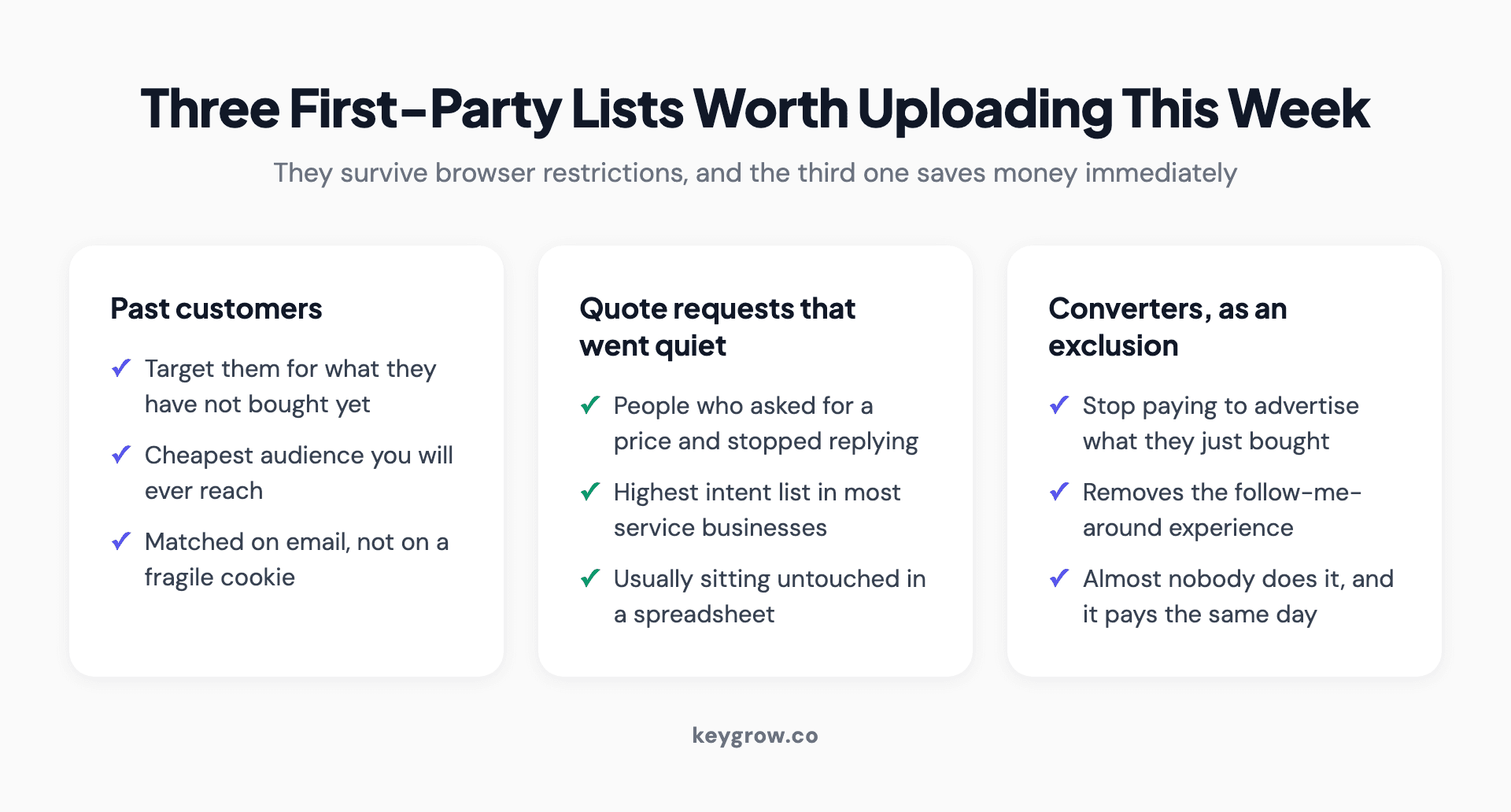
The three first-party audience lists that pay in a Google Ads account: past customers, quiet quote requests, and converter exclusions.
The three uses that pay:
- Past customers, for the thing they have not bought yet. Cheapest audience you will ever reach.
- Quote requests that went quiet. A list of people who explicitly asked for a price and then stopped replying is the highest-intent audience in most service businesses, and it is usually sitting in a spreadsheet.
- Exclusion. Uploading your existing customer list so you stop paying to advertise to people who already bought is often worth more than any positive targeting you do. Almost nobody does it.
That last one is not glamorous and it saves money immediately.
Segment by what they did, not by how long ago
The default duration-based lists (7 days, 30 days, 90 days) describe recency and nothing else. Behavior tells you intent, and intent is what should set the bid.
Recency segmentation is the default because it is easy, not because it is informative. Somebody who bounced off your homepage eleven days ago and somebody who spent nine minutes on your pricing page eleven days ago are in the same 30-day bucket, and they are not remotely the same prospect.
Build the segments around what they did:
| Segment | What it means | How to treat it |
|---|---|---|
| Reached the cart or quote form, did not finish | Highest intent in the account | Bid hardest, short window, specific creative |
| Viewed pricing or a service page | Real consideration | Solid bid, address the objection |
| Read one blog post, left | Curiosity, mostly | Low bid or exclude entirely |
| Bounced under fifteen seconds | Wrong person or wrong page | Exclude |
| Converted already | Not a prospect for this | Exclude, or target for the next product |
Google's data segment documentation covers the mechanics of building these. The judgment part is the willingness to exclude, and it is where most accounts leave money on the table by treating every past visitor as an audience worth paying for.
Frequency, and where remarketing starts costing you
Past a certain exposure count you stop persuading and start irritating, and the damage does not appear in the campaign report because it is happening to people who will never click again.
Every advertiser has been followed around the internet by a pair of shoes they already bought. That experience is produced by an account with no frequency cap and no converter exclusion, and it is one of the few marketing mistakes that actively creates ill will toward the brand.
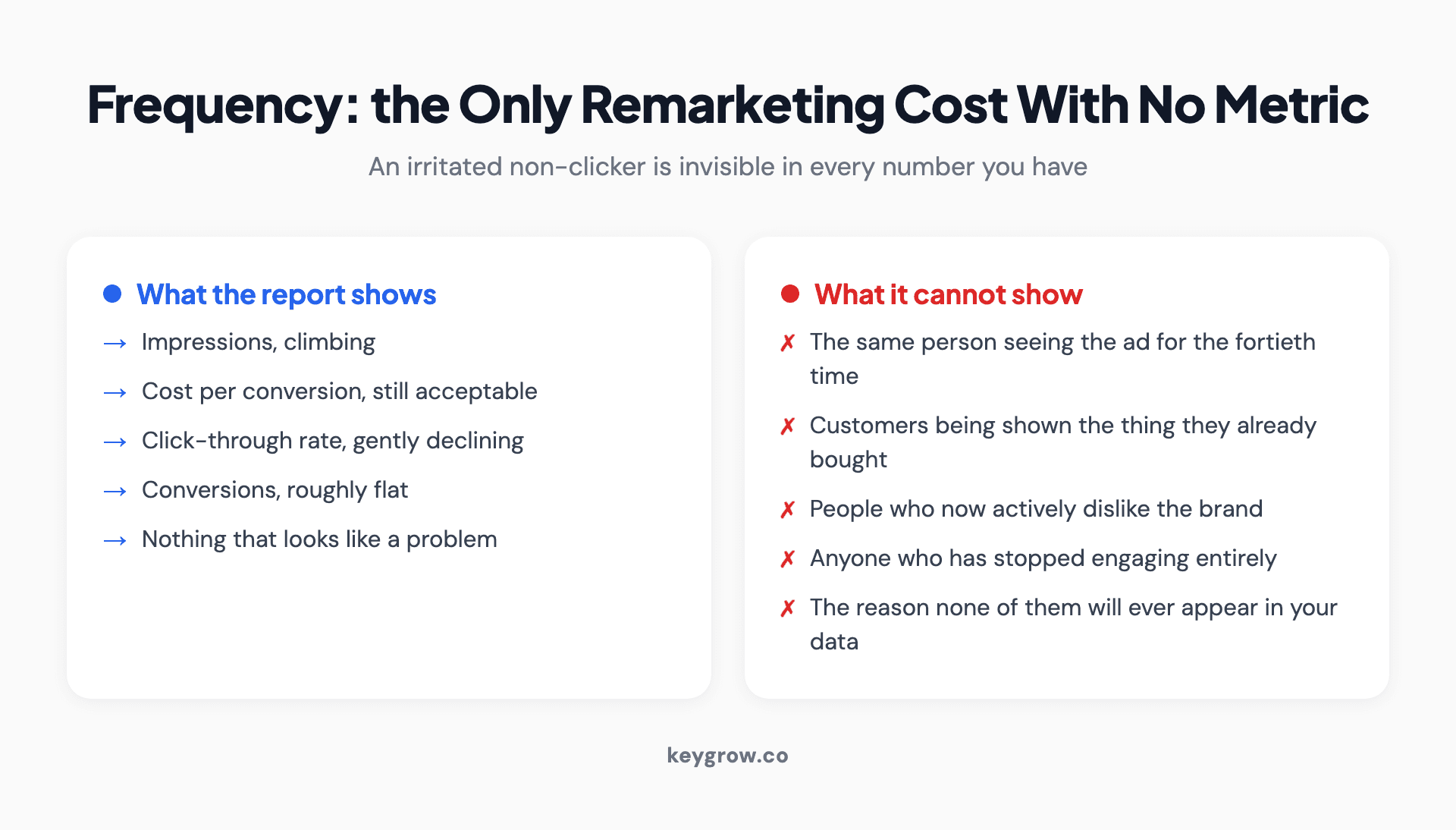
What a remarketing report shows against the cost it cannot show, when frequency runs unchecked.
Set a cap. Set membership durations that match your actual sales cycle rather than the default. Exclude converters. Rotate creative if the same person will see the campaign more than a handful of times.
The reason this gets skipped is that the report never shows the cost. An annoyed non-clicker is invisible in every metric you have.
Where remarketing hides inside Performance Max
Your remarketing lists feed automated campaigns as audience signals, which means you may be running remarketing you did not deliberately turn on.
This is one of several places where automation quietly changes what your account is doing, a theme we picked up in AI for Google Ads. If you use automated campaign types, the audience lists you built are probably being used as inputs whether or not you have a standalone remarketing campaign running. Two things follow.
First, your remarketing and your prospecting may be competing in the same campaign, with the reporting rolled together in a way that makes the incrementality question harder rather than easier. If you want to know what remarketing is doing, you need it separable.
Second, the exclusions matter more, not less. Uploading a converter exclusion list affects the automated campaigns too, and it is one of the few levers that reliably improves them.
The search half almost nobody uses
Remarketing lists applied to search campaigns let you bid differently on somebody who already knows you, and it is the least wasteful version of the whole tactic.

A keyboard with a prominent buy key.
Somebody who visited your site last week and is now searching a generic category term is a materially better prospect than a stranger searching the same term. Applying your lists to search campaigns lets you bid up for that person, or open up broader keywords only for people who already know who you are.
That second use is the interesting one. Terms too expensive or too broad to bid on cold often become viable when restricted to a warm list. It is the closest thing to free targeting improvement available in a search account, and it requires no new creative.
What the remarketing ad actually has to do
Answer the objection that stopped them, and send them to the page they were on, not to your homepage.
Most remarketing creative just repeats the brand at the person. That is a reminder, and reminders only work on people who were already going to return, which is precisely the group inflating your numbers.
The version that produces incremental conversions addresses whatever stopped them, which is a copywriting problem before it is a targeting one (see how to write compelling PPC ad copy). Price uncertainty, delivery time, whether you serve their area, whether the thing is right for their situation. If you know which page they left from, you know roughly which objection they hit.
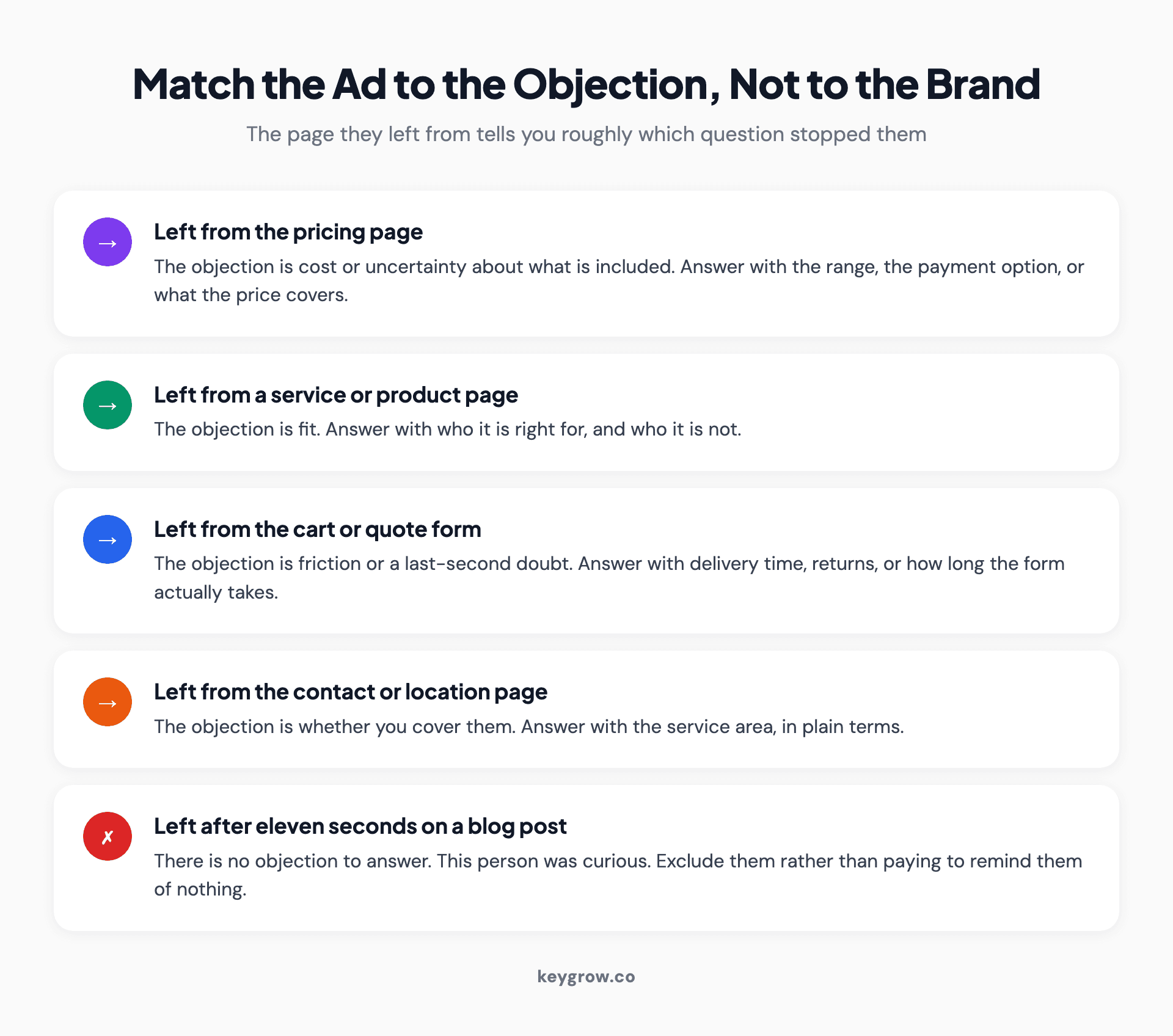
Matching remarketing ad copy to the objection that stopped the visitor, by the page they left from.
And send them back to that page. Sending paid traffic to a homepage is the most expensive default in this industry. We had a mobile detailing client paying around $100 per booking with every click landing on their homepage. Same budget, same ads, rebuilt around a dedicated booking page and a restructured campaign: cost per conversion fell to $22 and bookings grew 650 percent between August and December. The ad was never the problem. The destination was. There is more on that in Google Ads landing page vs website.
What to measure
Incremental conversions from your holdout, cost per incremental conversion, and frequency. Reported ROAS on a remarketing campaign is the least informative number in the account.
| Track | Instead of | Why |
|---|---|---|
| Incremental lift from the holdout | Campaign ROAS | The only figure that reflects what the spend caused |
| Cost per incremental conversion | Cost per conversion | Comparable to your prospecting channels on equal terms |
| Average frequency per user | Impressions | Catches the point where you start irritating people |
| Total account conversions | Remarketing campaign conversions | Detects budget being cannibalized from prospecting |
| List size and match rate | Audience count alone | Tells you whether privacy changes have hollowed out the pool |
The habit worth building: whenever remarketing looks like your best campaign, treat that as a question rather than a result.
When not to run remarketing at all
Under roughly a thousand monthly visitors, same-session purchase decisions, emergency services, and any account where prospecting is underfunded. Fix the input before optimizing the recycling.
The clearest case for switching it off is the account where remarketing is eating the budget that used to generate first visits. You can spot it in a month: remarketing spend climbing, total account conversions flat or falling. The pond is not being restocked.
The second clearest is the very small account. Below about a thousand visitors a month there is not enough audience to deliver consistently or enough data to evaluate honestly, and the time is better spent on the landing page.
If either describes you, the honest recommendation is to skip remarketing for now, and that is not a recommendation an agency selling campaign management usually volunteers.
FAQs
Does Google Ads remarketing actually work?
Yes, but usually less than the report claims. Remarketing targets people who were already more likely to convert, so a portion of every reported conversion would have happened anyway. The only way to know your real figure is a holdout test: withhold ads from a slice of the audience for three to four weeks and compare conversion rates between the groups.
How long should a remarketing list keep somebody in it?
Match it to your actual sales cycle rather than accepting the default. An ecommerce store with a two-day decision does not need a 540-day window. A contractor with a two-month consideration period should not be using 30 days. Segment by behavior as well, because a cart abandoner and a blog reader do not deserve the same window or the same bid.
Why does my remarketing campaign have such a good ROAS?
Because it is reaching people who already visited you and were more likely to return. That is a selection effect rather than campaign performance. It is also why moving budget from prospecting into remarketing on the strength of that number tends to shrink the whole account within a couple of months.
Is remarketing still effective with third-party cookies restricted?
Pixel-built display lists have shrunk and expire sooner than they used to. First-party approaches held up better: uploaded customer lists, remarketing applied to search campaigns, and audiences built from your own conversion data. If your remarketing setup has not been reviewed in a few years, the audience it is reaching is smaller than the interface suggests.
Should I exclude people who already converted?
Almost always, and most accounts do not. Paying to advertise to existing customers for the product they just bought wastes budget and produces the follow-me-around experience that makes people dislike brands. Upload your customer list as an exclusion. Target them separately, if at all, for something they have not bought.
What is a good frequency cap for remarketing?
There is no universal figure, but the discipline matters more than the exact number. Cap it, exclude converters, match the membership duration to the sales cycle, and rotate creative if somebody will see the campaign repeatedly. The cost of getting this wrong never shows up in your reporting, because irritated people simply stop engaging.
Is remarketing different from retargeting?
They describe the same tactic. Remarketing is the term Google uses, retargeting is the term most other platforms use, and in practice people use them interchangeably. Occasionally remarketing is used more narrowly for email-based re-engagement, but in a Google Ads context the two words mean the same thing.
Test it before you scale it
The order that works: run the holdout, learn your real number, then decide the budget.
If the incremental lift is strong, you have a case for spending more and you can defend it with data instead of a flattering dashboard. If it is weak, you have found budget that belongs in prospecting or in the landing page. Either outcome is worth three weeks.
Then do the two housekeeping jobs almost every account is missing: upload a converter exclusion list, and rebuild your segments around behavior instead of recency.
We manage Google Ads month to month with no lock-in, and we will tell an advertiser their account is too small for remarketing to be worth the setup. If you want the holdout designed properly for your volume, start here.