

The core benefit of Google Ads automated bidding is auction-time bidding: the ability to set a different bid for every single auction, using signals about that specific search, rather than one fixed bid applied to everyone. One consequence catches people out, so it is worth knowing early: switching to it retires your manual bid adjustments, including the ones on ad scheduling. If you came here for the certification answer, that is it.
Everything else automated bidding is credited with, saving time, improving performance, allocating budget better, follows from that one capability. A human sets a bid once and it applies to every search until they change it. The system sets a bid per auction, and it does that millions of times a day.
Now the part the other pages answering this question leave out: knowing the answer does not tell you whether it will work in your account. It often will not, and the reason is measurable.

Marketer reviewing campaign performance data on a laptop at a desk.
What auction-time bidding actually does
Google's Smart Bidding documentation describes it as using Google's AI to predict the value of a potential conversion every time somebody searches, then adjusting the bid accordingly. The signals named include device, browser, location, time of day, and whether the person is on one of your remarketing lists.
Consider what that means concretely. Two people search the same phrase at the same moment. One is on a phone, three miles away, at 8pm on a Saturday, and has visited your site twice. The other is on a desktop in another state at 3pm on a Tuesday and has never been to your site.
Under manual bidding those two searches get the same bid, adjusted only by whatever blanket modifiers you set. Under automated bidding they get different bids, because the system has estimated different conversion probabilities for them.
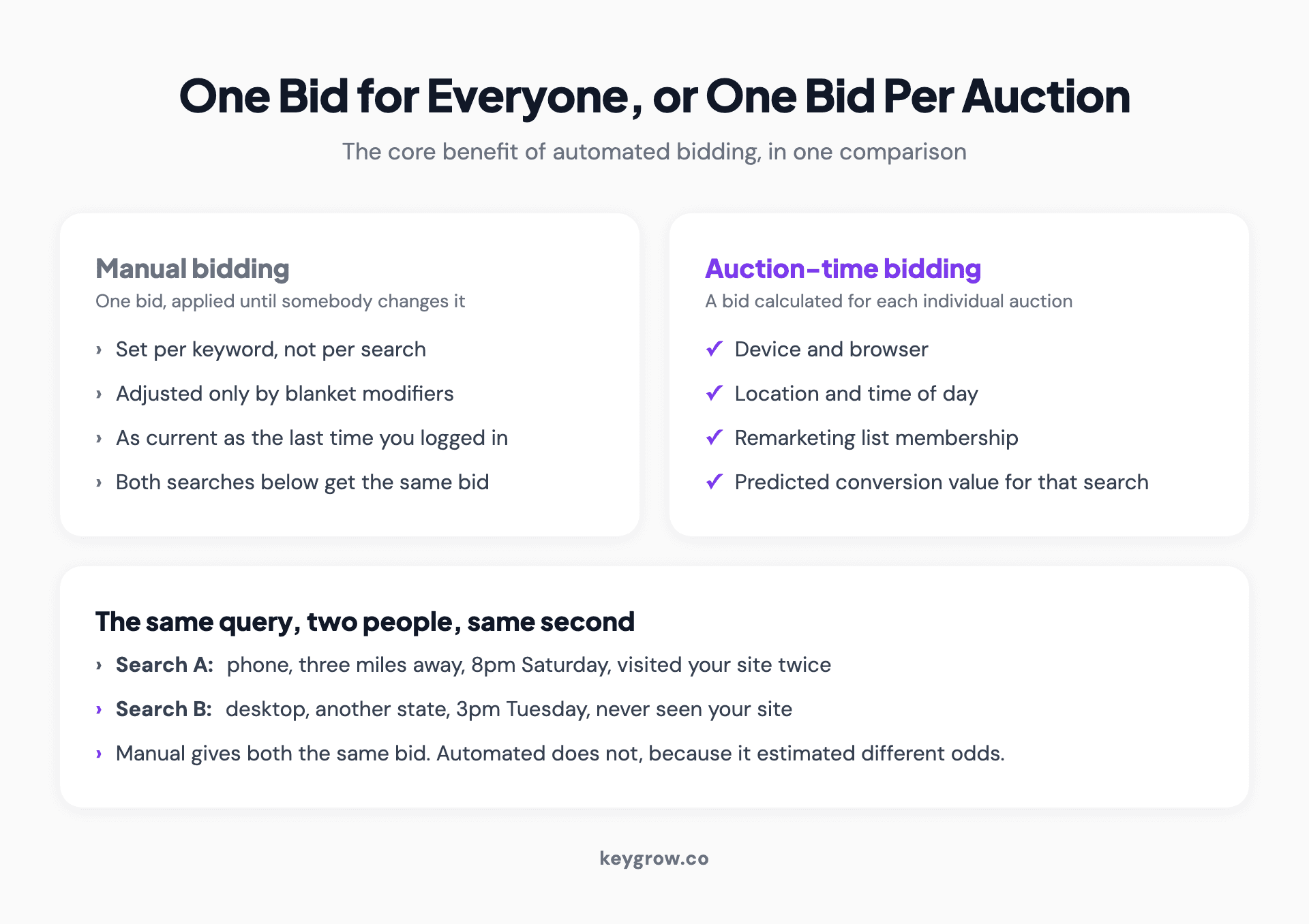
How auction-time bidding differs from manual bidding, showing one fixed bid against a bid calculated per auction from real-time signals.
That is the whole mechanism. Not magic, not really even complicated. Just a bid decision made per auction instead of per keyword, using information a human cannot act on fast enough.
Which strategies count as automated, and which are Smart Bidding
These two terms are used interchangeably and they are not the same thing, which trips people up in exams and in account reviews.
Automated bidding covers any strategy where Google sets the bid. Smart Bidding is the subset that optimizes for conversions or conversion value using auction-time bidding.
| Strategy | Automated | Smart Bidding | Optimizes for |
|---|---|---|---|
| Maximize Clicks | Yes | No | Click volume within budget |
| Target Impression Share | Yes | No | Ad visibility at a chosen position |
| Maximize Conversions | Yes | Yes | Conversion count within budget |
| Maximize Conversion Value | Yes | Yes | Conversion value within budget |
| Target CPA | Yes | Yes | Conversions at a cost you set |
| Target ROAS | Yes | Yes | Conversion value at a return you set |
Maximize Clicks and Target Impression Share are automated but not Smart Bidding, because they are not optimizing toward conversions. Our impression share guide covers the narrow case where Target Impression Share earns its place: brand searches. That distinction is worth holding onto: an account running Maximize Clicks is automated and is not getting the core benefit described above in any way that relates to leads or sales.
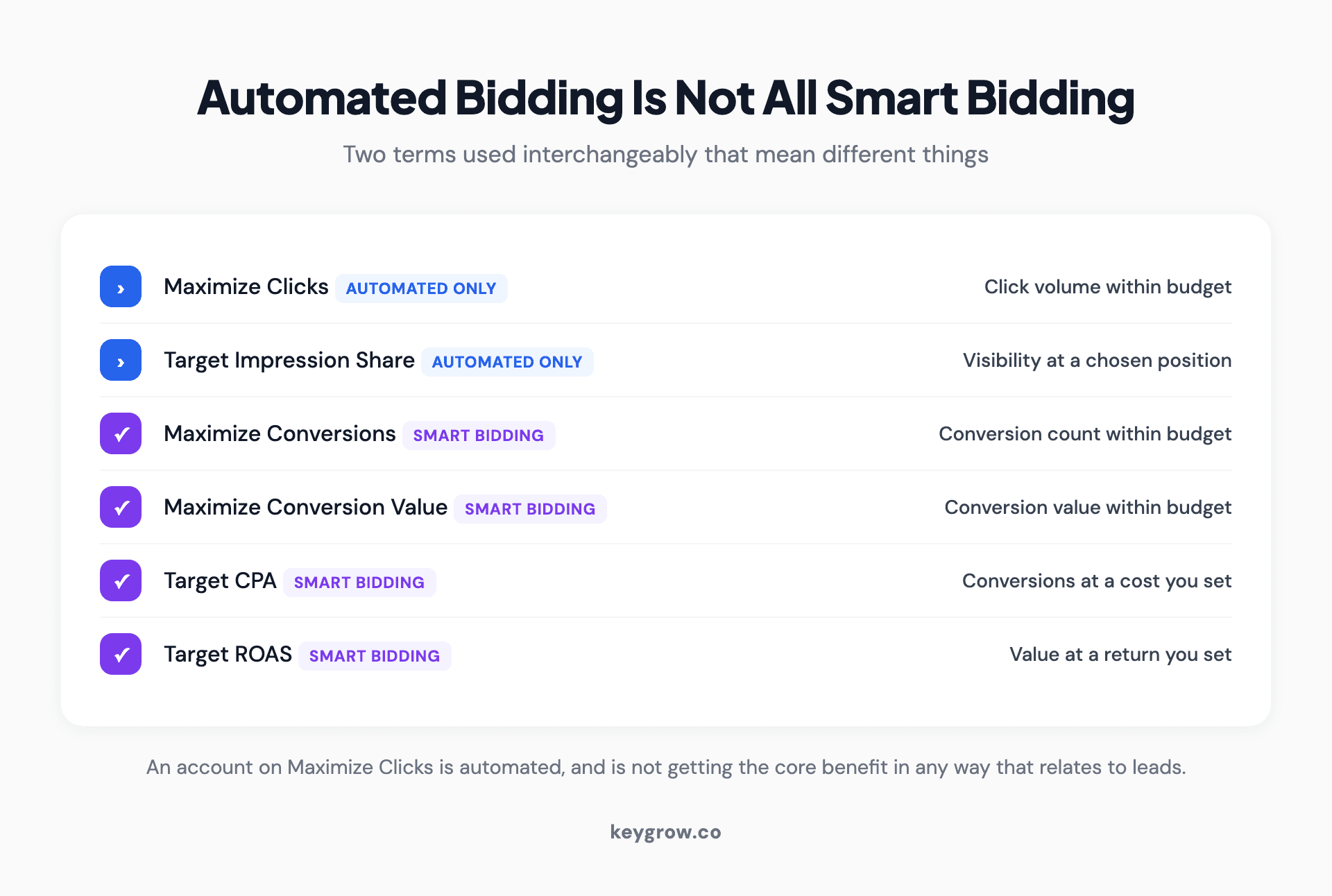
The Google Ads bidding strategies mapped by whether they are automated and whether they qualify as Smart Bidding.
The threshold nobody mentions
Here is the fact that decides whether any of this works for you, and it is absent from every page currently answering this question.
Smart Bidding needs conversion data to learn from, and Google's own requirements are specific. For Search and Shopping campaigns the guidance is at least 15 conversions in the past 30 days. Display asks for 15 conversions with valid values. App campaigns want 10 a day, or 300 in 30 days. Demand Gen asks for at least 50 in 35 days.
Read that against your own account before you switch anything.
A local business generating four leads a month is below the threshold by a wide margin. Turning on Target CPA there does not give the system enough signal to predict anything, and what you get is expensive erratic bidding with a confident-looking interface on top. That is not automation failing, it is automation being used outside the conditions it needs.
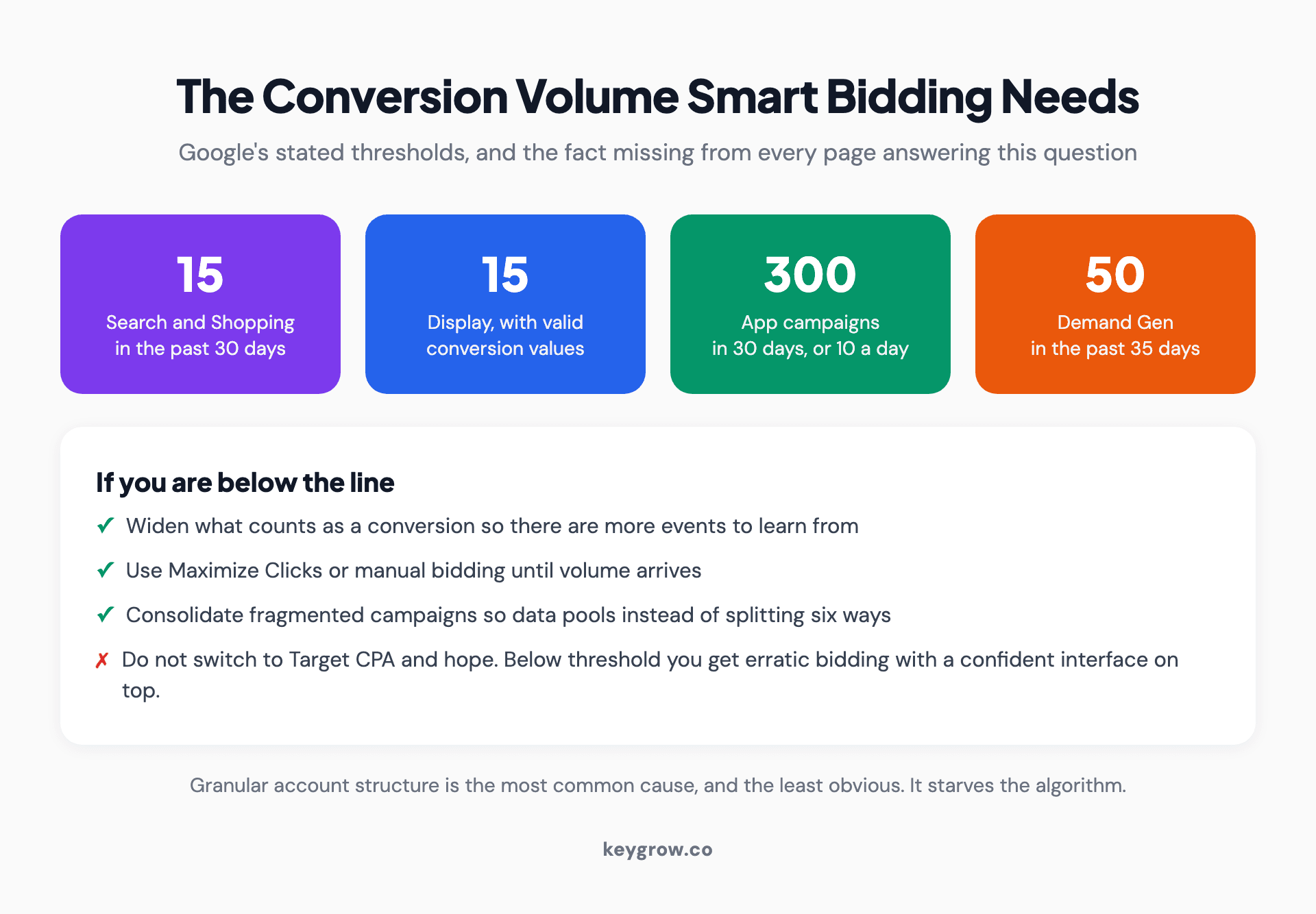
The conversion volume thresholds Google states for Smart Bidding, by campaign type, and what to do when you are below them.
If you are under the threshold, the useful moves are to widen what counts as a conversion so the system has more events to learn from, use Maximize Clicks or manual bidding until volume arrives, or consolidate fragmented campaigns so the data pools in one place instead of splitting across six ad groups that each see two conversions a month.
That last one is the most common fix and the least obvious. Accounts get built with granular structure because that is how they were taught, and granular structure starves the algorithm.
What automated bidding is actually good at
Three things, honestly.
Reacting to context you cannot see. Browser, exact time, remarketing list membership, device, location down to a level no manual modifier reaches, all combined per auction. No human is doing this, at any level of diligence.
Working continuously. The bids adjust at 3am on a bank holiday. A manual account is only as current as the last time somebody logged in, and most accounts are managed weekly at best.
Handling scale. An account with thousands of keywords across dozens of campaigns is beyond manual bid management as a practical matter. This is where automated bidding stops being an improvement and starts being the only option.
None of those three is about saving you time, incidentally, though that is how it usually gets sold. Time saved is a side effect of a decision being made better.

Person working through campaign data on a computer during a paid search review.
What it is bad at, and what it will not fix
Automation optimizes toward the goal you gave it. If the goal is wrong, it will pursue the wrong thing efficiently, which is worse than pursuing it slowly.
It cannot fix bad conversion tracking. This is the failure we see most. If your conversion action counts every form submission including spam, the system learns to buy spam. If it fires on page load rather than a real action, it learns to buy pageviews. Automated bidding does exactly what your tracking tells it is valuable, and it does so relentlessly.
It cannot tell a good lead from a bad one. All conversions look identical to the algorithm unless you tell it otherwise with values or offline conversion imports. An account where a tire-kicker and a qualified enquiry both register as one conversion will drift toward whichever is cheaper, and the cheaper one is almost always the worse one.
It cannot fix your keywords. This is where automated bidding and broad match together become genuinely expensive. Automation will happily bid on irrelevant traffic if that traffic converts on a badly defined conversion action. Broad match without negative keywords is a donation to Google, and adding automation to that combination simply speeds up the donation. Our guide to Google Ads broad match sets out when that pairing is worth switching on, and the guardrails to set first. Review search terms weekly. In unmanaged accounts, wasted spend typically hides 20 to 30 percent of the budget.
A cash home buyer client of ours illustrates the point from the other direction. They were drowning in unqualified leads, and the fix was not a bidding change. It was filtering: negative keywords, tighter match types, and qualifying language in the ads themselves. Serious leads went up 600 percent between December and January on the same budget. No bid strategy would have found that.
It cannot fix a bad landing page. Bidding buys the click. The page decides what happens next, and we have written elsewhere about what that costs when it goes wrong.
Nor will it reduce your cost per click on its own. Automation buys clicks it expects to convert, and expensive clicks that convert are a good purchase. If the click price itself is the problem, that is a separate set of levers.
What you can feed it to make it smarter
Automated bidding is only as good as what it is optimizing toward, which means the work that moves results most is not choosing a strategy. It is improving the signal.
Conversion values. A conversion with no value attached is worth the same as every other conversion, which is almost never true. Assigning even rough values, a quote request at one number and a booked consultation at a higher one, lets the system pursue the ones that matter instead of the ones that are cheapest.
Offline conversion imports. For anything with a sales process, the conversion in Google Ads is a form fill, and the thing you actually care about happens weeks later in a CRM. Importing that outcome back into the account closes the loop and is the single biggest improvement available to most lead generation accounts. It is also the one nobody sets up, because it needs a small amount of engineering rather than a settings change.
Audience lists. Remarketing and customer match lists are explicitly among the signals auction-time bidding uses. Uploading a customer list and building remarketing audiences gives the system a real basis for distinguishing between two otherwise identical searches.
Accurate exclusions. Negative keywords, placement exclusions and location exclusions all narrow what the system is allowed to buy. Automation is very good at finding cheap conversions inside whatever boundary you set, so the boundary is doing more work than the bid strategy is.
Any one of those improves results more than switching between Smart Bidding strategies will. The strategy choice is the last decision, not the first.
The learning period, and why accounts get abandoned during it
When you change bid strategy, the system enters a learning phase while it recalibrates. Performance during this window is unreliable and frequently worse than what you had.
Google's guidance is to allow one to two conversion cycles before judging a new strategy, where a conversion cycle is however long your buyers typically take between clicking and converting. For an emergency service that is a day. For a considered purchase it can be weeks.
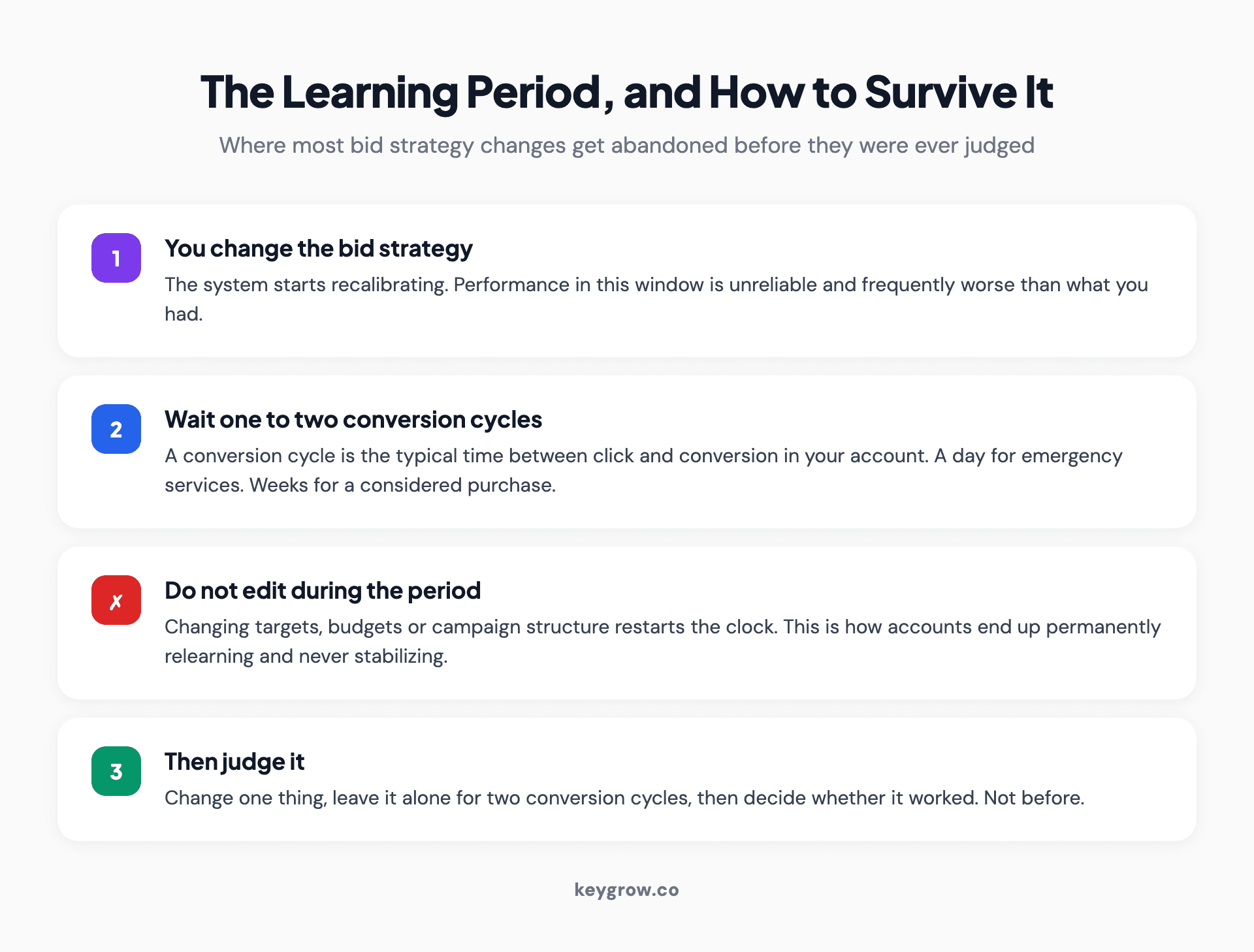
The Smart Bidding learning period timeline, showing what to expect and the changes that restart it.
Two rules make this survivable. Do not judge the strategy inside the learning period, and do not make changes during it, because significant edits restart the clock. Changing targets, budgets or campaign structure mid-learning is the most common way an account gets stuck permanently relearning and never stabilizes.
The practical version: change one thing, then leave it alone for at least two conversion cycles before deciding whether it worked.
Choosing between the Smart Bidding strategies
Once you are above the conversion threshold and tracking is honest, the choice is straightforward.
Maximize Conversions when you want to spend the budget and get as many conversions as possible, and you do not yet know what a sustainable cost per conversion is. It is the sensible starting point for a new campaign with enough volume.
Target CPA when you know what a lead is worth and what you can pay for it. Set the target near your recent actual cost per conversion rather than the number you wish it were, because an unrealistically low target simply suppresses delivery.
Target ROAS when conversions have different values, which mostly means ecommerce or anything with revenue attached. It needs conversion value tracking to be accurate, and if your values are guesses, so is the optimization. Our break-even ROAS calculator will tell you what target actually keeps you profitable. We run both targets through worked numbers in Target ROAS vs Target CPA.
Maximize Conversion Value when you want to spend the budget on the highest-value conversions available rather than the most conversions.
The order of operations matters more than the choice. Fix conversion tracking, get above the volume threshold, then pick a strategy. Doing it in any other order produces confident automation aimed at nothing in particular.

Two colleagues reviewing paid search performance together in an office.
Is manual bidding ever right?
Occasionally, and the honest answer is more often than the industry admits.
Manual bidding still makes sense for very low volume accounts below the conversion thresholds, for brand campaigns where you want a fixed cheap bid and nothing clever, and for tightly controlled tests where you need to isolate a variable that automation would obscure.
It stops making sense the moment you have enough conversion data and more than a handful of campaigns. At that point manual bidding is not control, it is a slower version of the same job with worse information, and the time spent on it is better spent on the things automation genuinely cannot do: your offer, your negatives, your landing pages, and whether the conversions you are counting are real.
FAQs
What is the core benefit of Google Ads automated bidding?
Auction-time bidding. Automated bidding sets a different bid for every individual auction based on real-time signals such as device, browser, location, time of day, and remarketing list membership, rather than applying one fixed bid to every search. Every other benefit attributed to it follows from that capability.
Is automated bidding the same as Smart Bidding?
No. Automated bidding is any strategy where Google sets the bid, including Maximize Clicks and Target Impression Share. Smart Bidding is the subset that optimizes for conversions or conversion value using auction-time bidding: Target CPA, Target ROAS, Maximize Conversions and Maximize Conversion Value.
How many conversions do you need for Smart Bidding to work?
Google's stated guidance is at least 15 conversions in the past 30 days for Search and Shopping campaigns. Display asks for 15 with valid conversion values, App campaigns for 10 a day or 300 in 30 days, and Demand Gen for at least 50 in 35 days. Below those levels the system has too little signal to predict well.
How long is the Smart Bidding learning period?
Google recommends allowing one to two conversion cycles, where a conversion cycle is the typical time between a click and a conversion in your account. That might be a day for an emergency service or several weeks for a considered purchase. Making significant changes during the period restarts it.
Does automated bidding work for small budgets?
It depends on conversion volume rather than budget size. A small budget generating 20 conversions a month can use Smart Bidding effectively. A larger budget generating four conversions a month cannot, because the constraint is data, not spend. Consolidating fragmented campaigns often solves this without spending more.
Can automated bidding fix a poorly performing account?
No. It optimizes toward whatever your conversion tracking tells it is valuable, so inaccurate tracking, undefined lead quality and irrelevant keywords all get pursued more efficiently rather than corrected. Fix tracking and search terms first, then automate.
Should I use Target CPA or Maximize Conversions?
Start with Maximize Conversions if you do not yet know a sustainable cost per conversion, then move to Target CPA once you do. Set the target close to your recent actual cost per conversion, because a target far below reality suppresses delivery rather than improving efficiency.
What to do with this in a real account
If you needed the exam answer, you have it: auction-time bidding, a bid set per auction from real-time signals.
If you are actually running an account, the order is different from what the question implies. Check that your conversion actions represent things you genuinely want more of. Count your conversions over the last 30 days against Google's thresholds. Consolidate campaigns if the data is split too thin. Then pick a strategy and leave it alone for two conversion cycles.
Automation is not the lever most accounts are missing. It is a good lever, applied to whatever you point it at, which is why pointing it correctly is the entire job. If you want someone to check where yours is aimed, that is what our PPC management does, month to month.