


Is 60 percent impression share bad?
Not on its own. Your ads showed for 6 of every 10 searches Google estimates they were eligible for. Whether that's a problem depends on why you missed the other 4, and whether the campaign makes money when it shows.
So what is impression share in Google Ads? Your impressions divided by the impressions you were eligible to get. Two more columns explain the gap, Search lost IS (budget) and Search lost IS (rank), and the three add up to 100 percent. Read together, they turn the 60 into a to-do list.
Here's what 60 percent looks like in one campaign
Take a month with 3,000 impressions at 60 percent impression share. Google estimated 5,000 eligible impressions, and two lost IS columns explain the missing 2,000.
Illustrative numbers for a local plumbing campaign:
| Column | Value | What it tells you |
|---|---|---|
| Impr. | 3,000 | Times your ads showed |
| Search impr. share | 60% | 3,000 of about 5,000 eligible |
| Search lost IS (budget) | 30% | About 1,500 missed, budget ran short |
| Search lost IS (rank) | 10% | About 500 missed, Ad Rank fell short |
| Search top IS | 50% | Half the top-ad spots you could have had |
| Search abs. top IS | 20% | First ad in 1 of 5 of those chances |
The arithmetic:
- Eligible impressions: 3,000 ÷ 0.60 = 5,000.
- The gap: 30 percent of 5,000 is 1,500 lost to budget, and 10 percent is 500 lost to rank. 60 + 30 + 10 = 100, give or take rounding.
- Top and absolute top: these use a smaller base, the impressions you were eligible for among top ads. If Google put that at 4,000, then 2,000 top impressions make 50 percent and 800 first-place impressions make 20 percent.
Don't confuse that with Impr. (Top) %, which divides the same 2,000 top impressions by your own 3,000 and shows 67 percent. Both numbers are true. Only the 50 is a share.
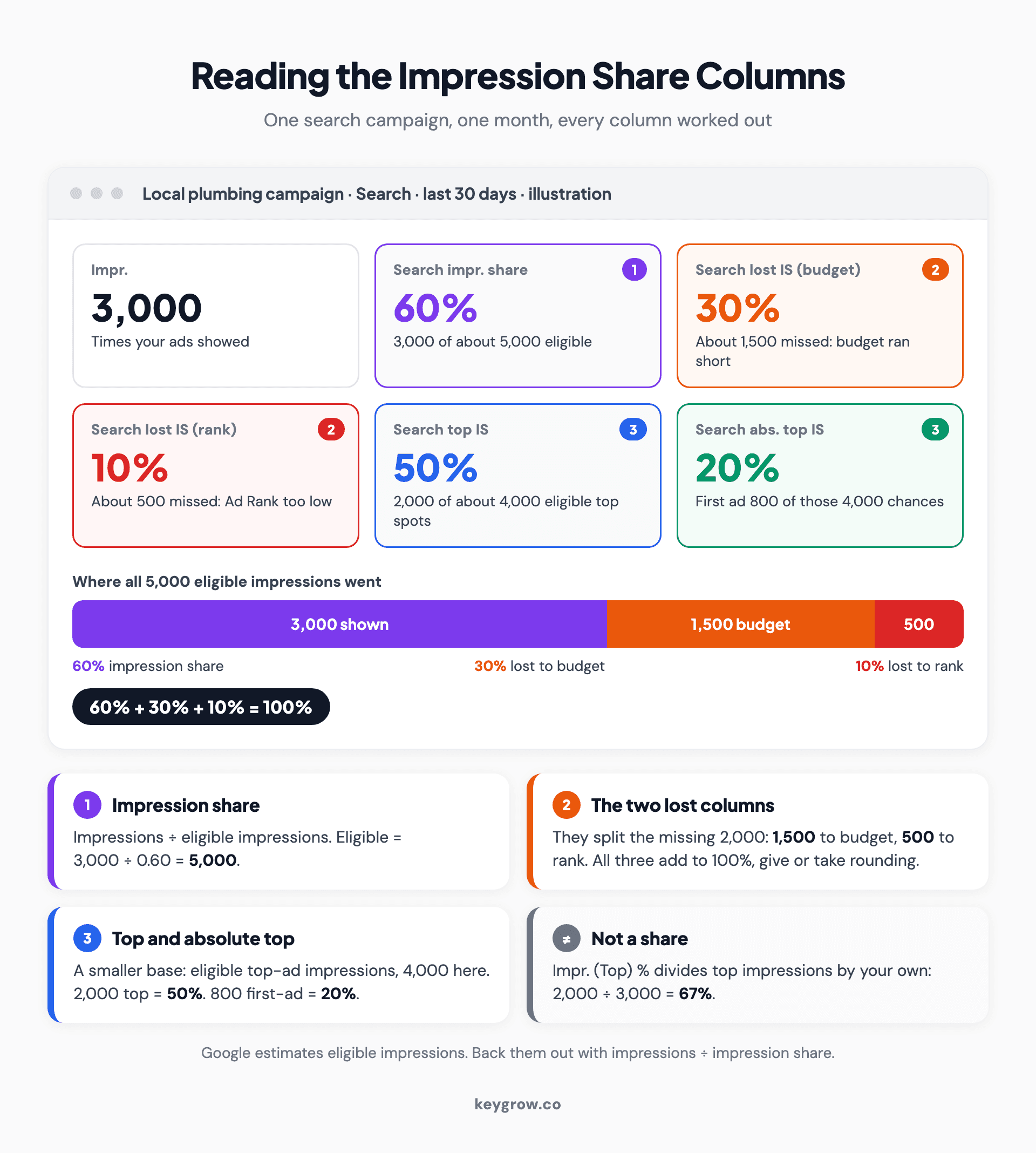
Annotated Google Ads metrics panel for one illustrative campaign: 60% search impression share, 30% lost to budget and 10% lost to rank across 5,000 eligible impressions, plus 50% top and 20% absolute top impression share.
Most of the gap is budget: auctions the campaign can win at today's bids, so buying them back should cost roughly today's CPC. Our post on PPC opportunity cost prices that gap in leads and dollars.
What does Google count as an eligible impression?
Eligible impressions are auctions where your ad showed or was competitive enough to show. Google estimates them, and they're fewer than every matching search.
Google's help page gives the boundary: the estimate could include auctions you'd win at twice your current bid, but could exclude ones that need a 1,000 percent increase.
That's why impressions can rise while impression share falls. Add keywords or widen your location radius and the denominator grows with them. Google's improvement tips warn that wider regional targets can lower the number.

Laptop on a home office desk showing a spreadsheet of campaign performance data in columns.
You'll find the columns under Competitive metrics in the Campaigns table. Search Partner traffic isn't counted, and Search lost IS (budget) only exists at the campaign level, where budgets live.
Lost to budget or lost to rank: which do you fix first?
Check profit first, then the bigger lost column. Budget loss means finding money inside the campaign before adding more. Rank loss means quality, then bids.
1. Is the campaign making money? If a lead costs more than it's worth, more share buys more of that loss. Fix conversion first, starting with the break-even math in our guide to a good Google Ads conversion rate.
We think sending ad traffic to a homepage is the most expensive default in PPC. A mobile detailing client came to us paying around $100 per booking that way. After we rebuilt the campaign around a dedicated booking page, cost per conversion fell to $22 and conversions grew 650 percent (August to December 2022). Buying more impression share first would only have bought more $100 bookings.
2. Budget is the bigger loss. Raising bids makes it worse, since each click costs more under the same cap. Cut junk search terms and dead keywords first (our broad match guide covers the cleanup), and if the campaign is still capped and profitable, raise the budget.
3. Rank is the bigger loss. More budget won't touch it. Ad Rank weighs your bid, ad and landing page quality, thresholds, competition, search context and asset impact, so fix relevance and the landing page before bids.
4. Both are high. Start with quality. Google says higher quality ads can often lead to lower CPCs, so one fix lifts rank and stretches the budget.
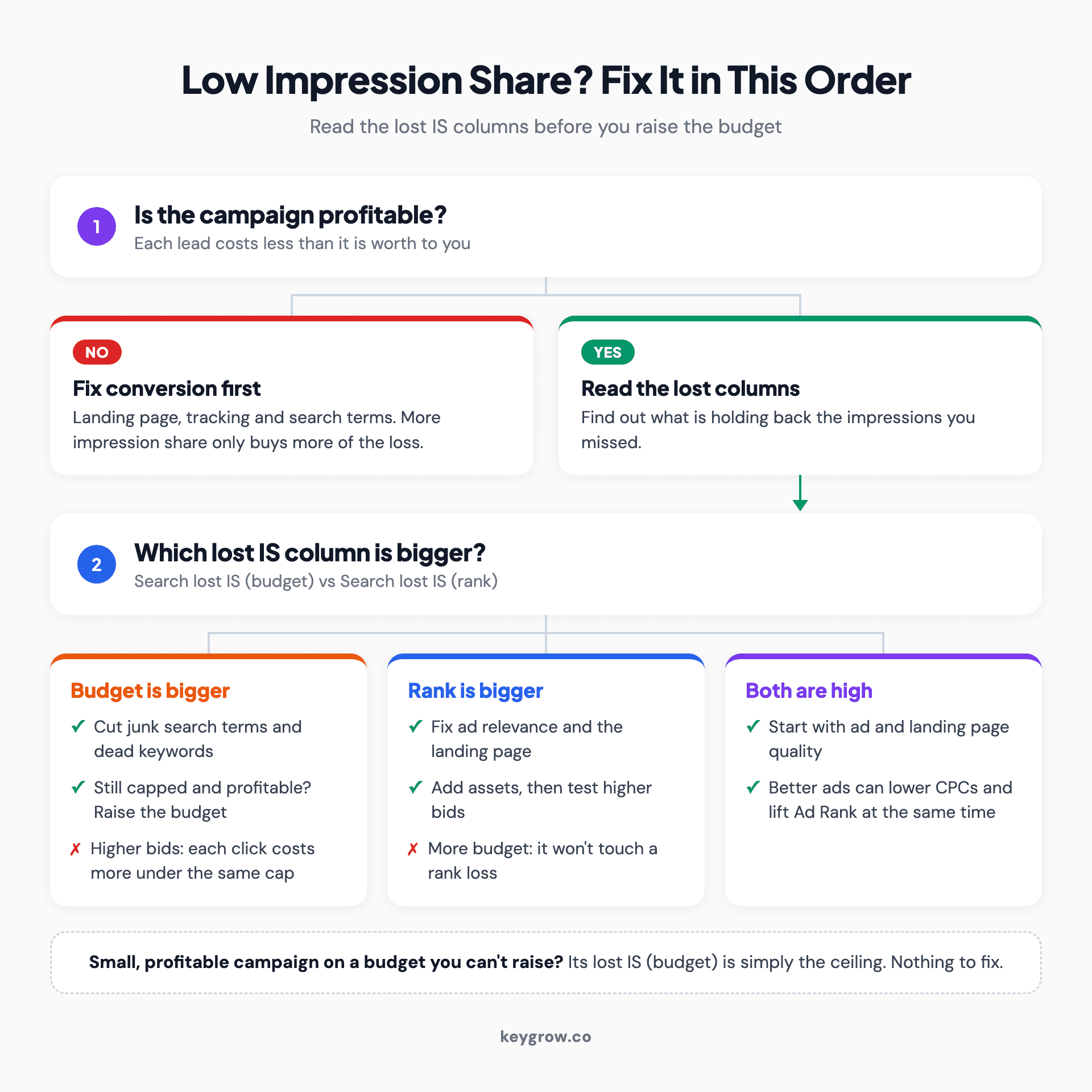
Decision flow for low impression share in Google Ads: check profit first, then compare lost IS (budget) with lost IS (rank). Budget loss means cutting waste before raising the budget, and rank loss means fixing quality before bids.
And if a small, profitable campaign is capped by a budget you can't raise, 30 percent lost to budget is simply its ceiling.
Top and absolute top impression share
Top IS is how often you showed among top ads when eligible. Absolute top IS is how often, of those chances, you came first.
"Top" is looser than it sounds. Per Google's definitions, top ads are ads adjacent to the top organic results: usually above them, sometimes below. That wording dates from March 2024, and Google's Ads Liaison said it didn't change how the metrics are calculated.

Smartphone lying on a wooden desk with the Google logo on its screen.
Don't bid to the rate columns, Impr. (Top) % and Impr. (Abs. Top) %. Google warns they can fall as bids rise, because higher bids can get you into tougher auctions where you land lower. Bid against the share columns instead.
Bid for impression share only on searches you must own
Target impression share sets your bids to reach a visibility goal you choose. It suits brand campaigns and a handful of must-win terms.
The settings, from Google's bidding documentation: you choose a placement (absolute top, top, or anywhere on the page) and a percentage, and you can cap bids with a Max CPC limit, as long as it isn't so low it blocks the target. The strategy ignores bid adjustments, except a -100% device setting, and runs on the Search Network only.
Google's own example is a brand campaign at 100 percent, and that's where we'd use it. On non-brand lead generation it buys visibility whether or not the clicks convert, so a conversion strategy fits better. Our comparison of Target ROAS vs Target CPA covers that choice.
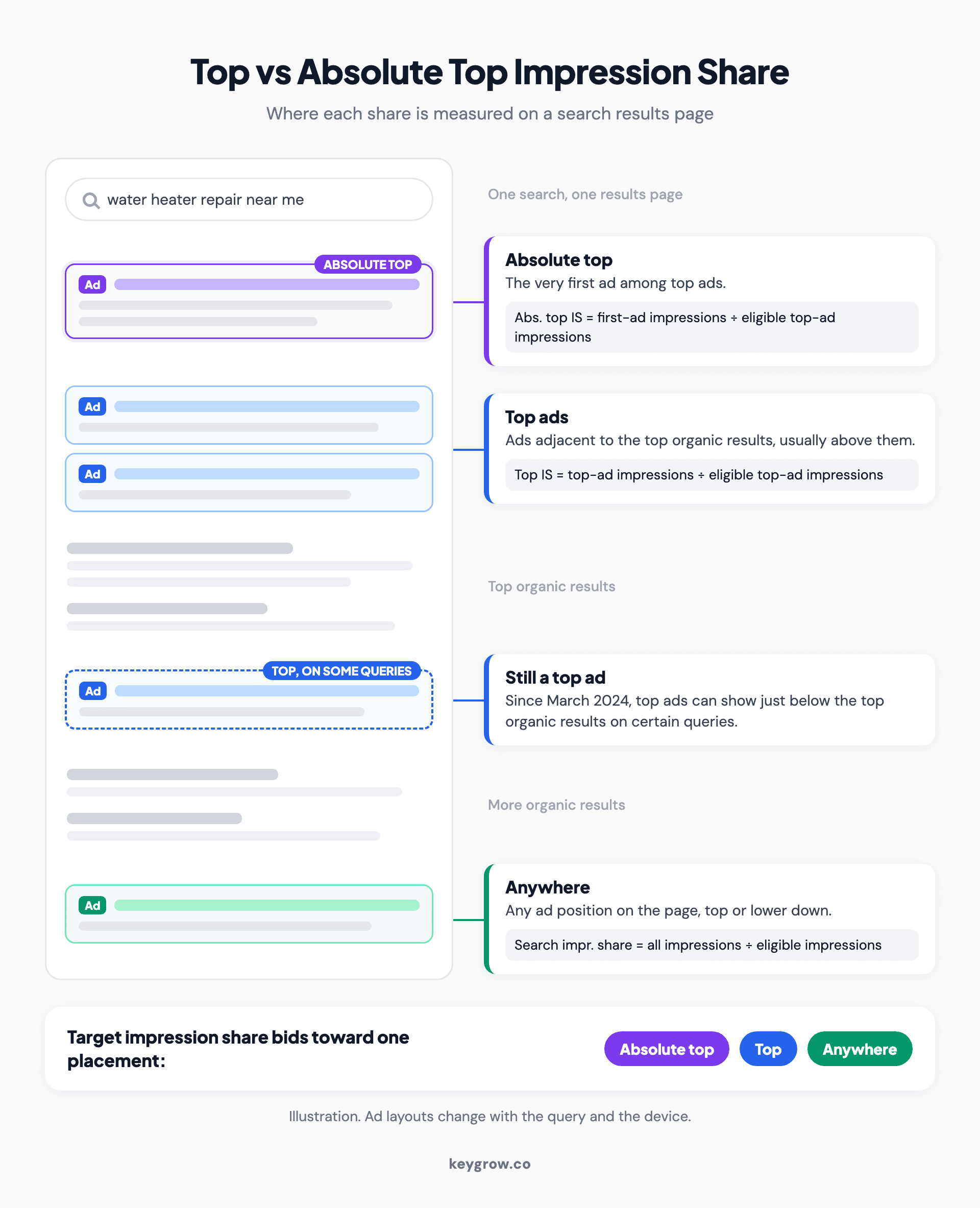
Diagram of a search results page showing where Google measures absolute top, top and overall impression share, including top ads that sit below the top organic results on some queries, and the three Target impression share placements.
FAQs
What does "< 10%" mean in the impression share column?
Your search impression share is under 10 percent, and Google doesn't show the exact figure. The lost IS columns cap the other way at "> 90%", so capped columns won't add up to exactly 100.
How often should I check impression share?
Weekly is enough for most accounts. The columns update within one to two days, and Google says small swings don't necessarily mean you need to act.
Is Target impression share a Smart Bidding strategy?
No. Google lists it as an automated strategy for visibility. Smart Bidding is the group that optimizes for conversions or conversion value: Target CPA, Target ROAS, Maximize conversions and Maximize conversion value.
Does Performance Max show impression share?
Yes. Google calculates it from Search and Shopping impressions combined, divided by the Search and Shopping impressions the campaign was eligible for.
Read it before you raise the budget
More budget is the obvious answer to a low impression share. It's only the right one when the campaign makes money and the budget column is the big number. Everything else on the panel points somewhere cheaper first.
You don't need an agency to read these columns. Ten minutes in the Campaigns table will do it. Help earns its fee when the fix means rebuilding landing pages or combing search terms every week, and our Google Ads management team can tell you which column to work on first.