

Opportunity cost is the value of the choice you gave up. In economics it is the trade-off you make when resources are limited. In PPC, it is the clicks, leads, and revenue you forfeit every time your budget, your Ad Rank, or your keyword choices keep your ad from showing. The useful part is that Google Ads makes this cost visible in a way most channels never do. A metric called impression share puts a number on exactly how much demand you were eligible to win and did not.
Most guides treat impression share as a health metric. It is really an opportunity-cost meter. Here is how to read it, how to turn it into a dollar figure, and how to decide which lost opportunity is worth buying back.
Where opportunity cost shows up in a Google Ads account
Opportunity cost appears in four concrete places: budget-limited campaigns, low-Ad-Rank losses, money spent on low-value keywords, and not advertising at all. Each one is demand you could have captured but did not.
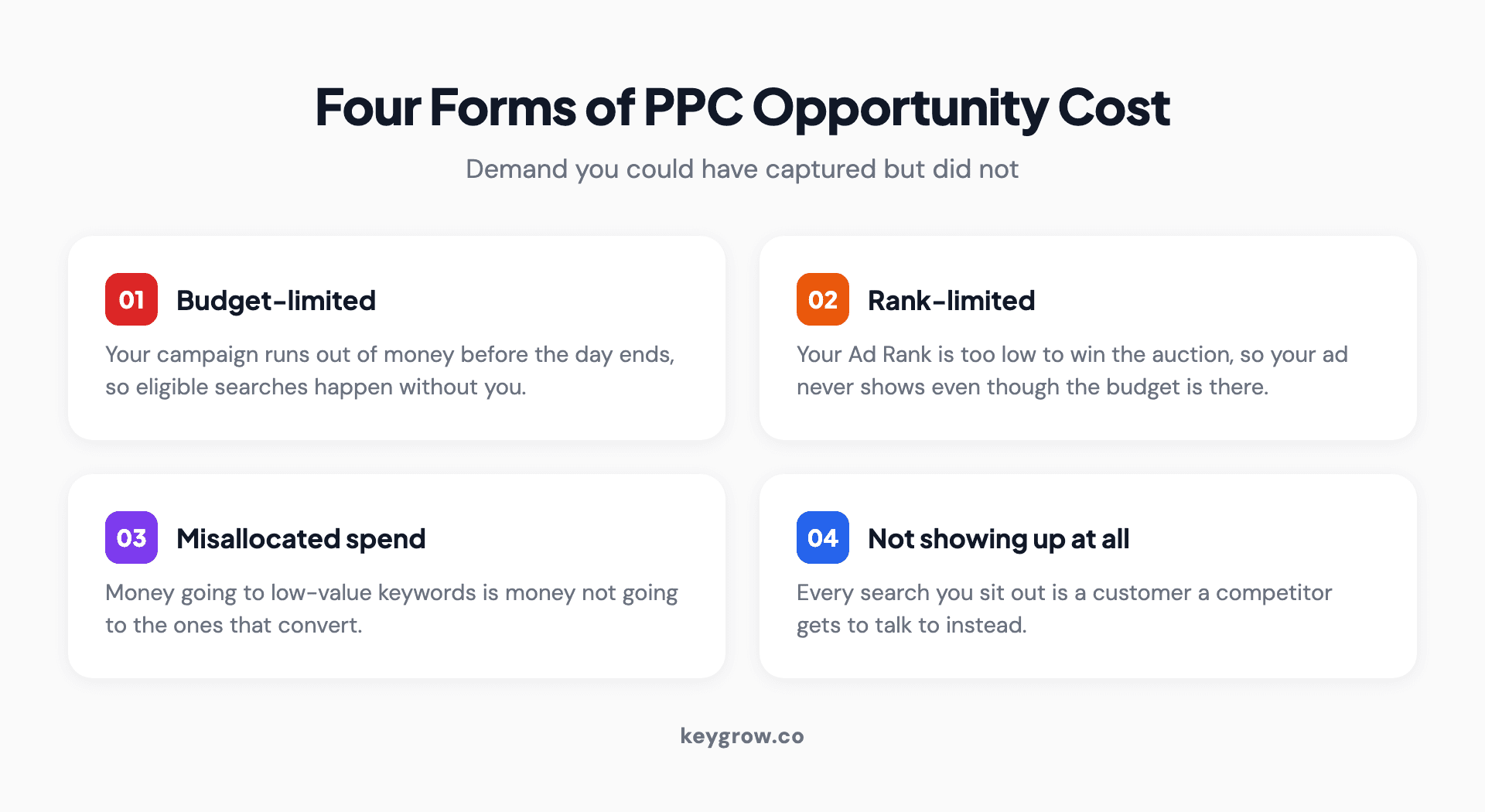
The four forms of opportunity cost in Google Ads: lost impressions from a budget cap, lost impressions from low Ad Rank, budget spent on low-value keywords instead of high-value ones, and the demand ceded to competitors when you do not advertise.
The four forms:
Google measures the first two directly. The other two take a little digging, but the account will tell you if you ask.
The two kinds of lost impression share
Google splits lost impression share into two causes, and they need opposite fixes. Lost impression share to budget means you ran out of money; lost impression share to rank means your ad was not good enough to win. Treating one like the other wastes money.
Per Google Ads Help, impression share is "the number of impressions your ad received divided by the total number of impressions your ad was eligible to receive." When you are not getting 100 percent, Google tells you why:
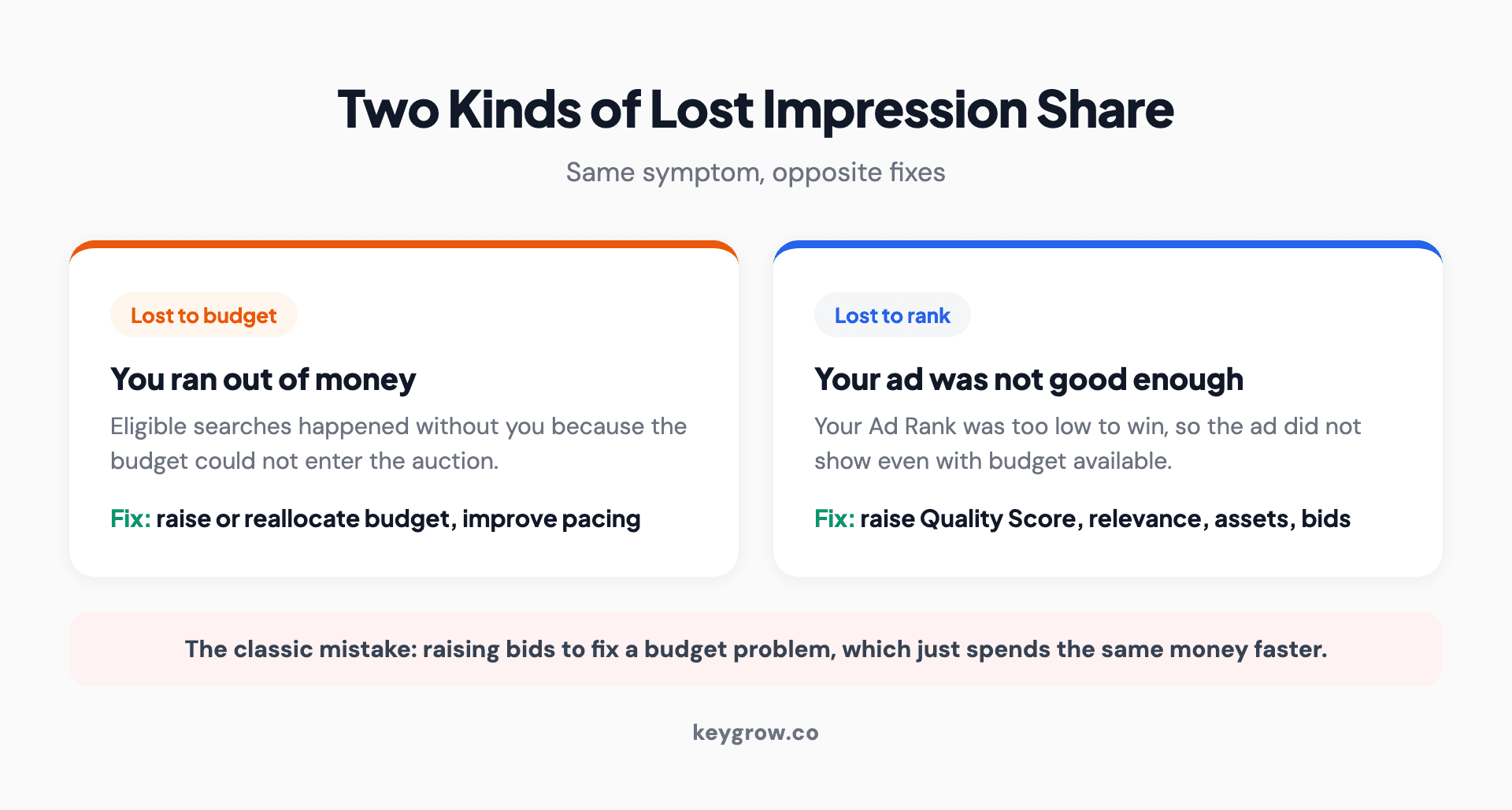
The two kinds of lost impression share and their opposite fixes: lost to budget means you ran out of money, so raise or reallocate budget; lost to rank means your Ad Rank was too low, so improve Quality Score, relevance, and bids.
The classic mistake is raising bids to fix a budget problem. If you are losing impressions to budget, a higher bid just spends your limited money faster and shows your ad even fewer times. Read which number is high before you touch anything.
Put a dollar figure on it
Lost impression share becomes real when you convert it to dollars. Walk the percentage down through your own clicks, conversion rate, and average value, and the opportunity cost stops being abstract.
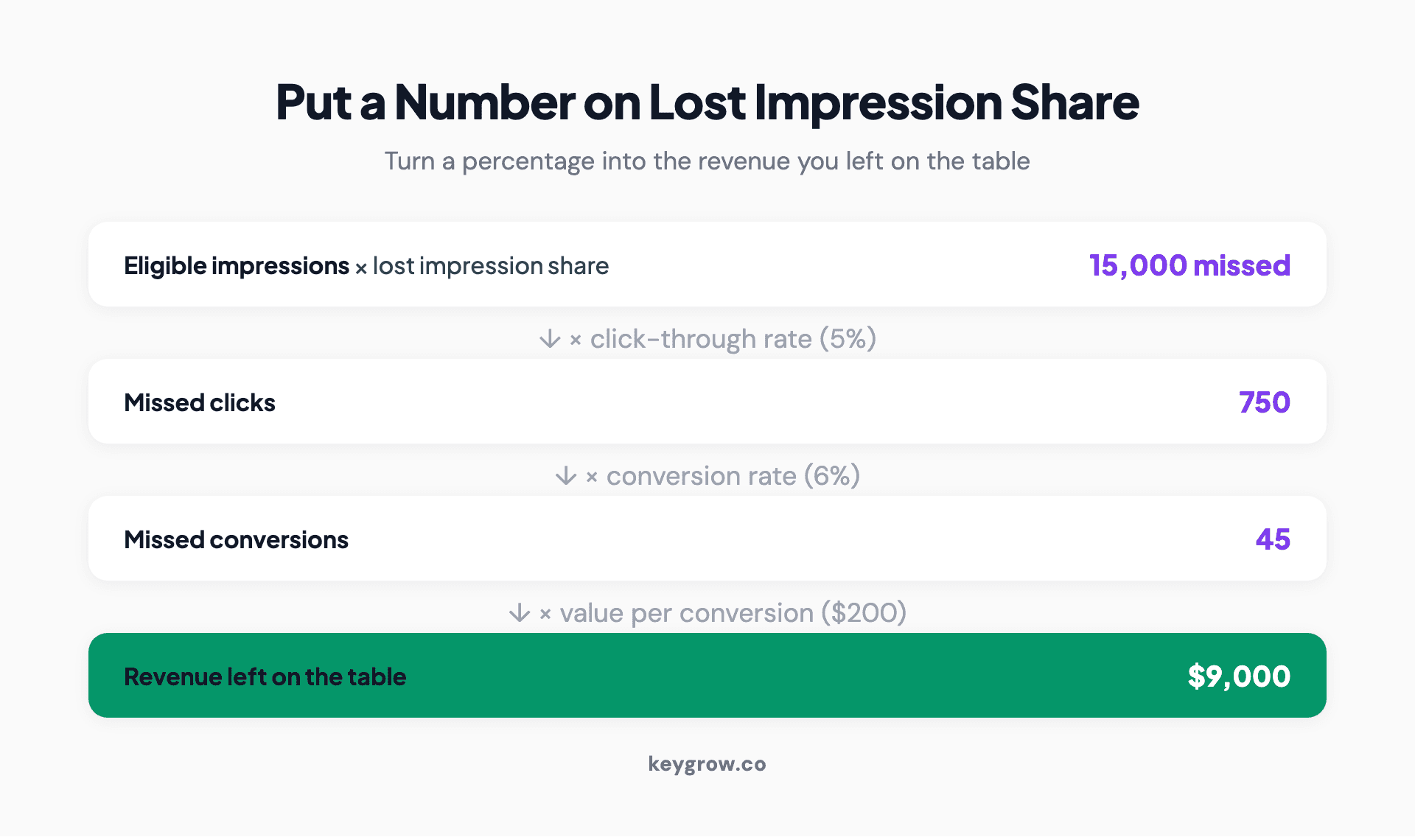
Turning lost impression share into dollars: total eligible impressions times lost impression share gives missed impressions, times click-through rate gives missed clicks, times conversion rate gives missed conversions, times value per conversion gives the revenue you left on the table.
Here is the chain, with round numbers for clarity. Say a campaign got 10,000 impressions at a 40 percent impression share. That means you were eligible for about 25,000 and missed 15,000. At a 5 percent click-through rate, that is 750 clicks you did not get. At a 6 percent conversion rate, about 45 conversions. If a conversion is worth $200 to you, that is roughly $9,000 in revenue you were eligible to win and left on the table this period. Now the decision is concrete: is buying back some of that 15,000 impressions, through more budget or better rank, worth what it would cost? Sometimes yes, sometimes no, but at least you are deciding with a number instead of a feeling.
The wasted-spend side of the same coin
The other half of opportunity cost is money you did spend on the wrong things. Every dollar going to a search that never converts is a dollar not spent on one that would.
Broad match without a real negative-keyword list is a donation to Google. In unmanaged accounts, wasted spend on irrelevant search terms typically runs 20 to 30 percent of the budget, and it hides in the search terms report where nobody looks. That waste is opportunity cost wearing a different hat: the budget existed, it just went to the wrong auctions.
A cash home buyer we worked with was drowning in junk leads from broad, untargeted traffic. The fix was not more budget, it was filtering: negative keywords, tighter match types, and qualifying language in the ads. Serious leads went up 600 percent between December and January on the same spend. Same money, aimed at the demand actually worth having. Reviewing your search terms weekly and cutting the junk is the highest-return habit in PPC, and our guide on negative keywords covers how.
The cost of not showing up at all
The opportunity cost that never appears on your own dashboard is the demand you cede by not bidding. When your ad is absent, a competitor answers the searcher instead, and the Auction Insights report is where you see it.
Impression share only measures auctions you entered. The searches you skip entirely, the keywords you decided were too expensive, the hours you paused, are invisible to it. That is real opportunity cost too. The Auction Insights report shows overlap rate and outranking share, which Google defines as how often a rival showed when you did and how often they ranked above you. Our guide on checking competitors' Google Ads covers how to read it. If a competitor consistently wins the auctions you sit out, they are compounding a relationship with customers you could have reached first. Not every skipped auction is worth entering, but you should skip them on purpose, not by accident.
What counts as a healthy impression share?
There is no official Google number, but practitioners aim high on the terms that matter. Around 80 percent or more is strong for your core non-brand keywords, and 90 percent-plus for your own brand terms. Below 50 percent on a keyword you care about is a flag, and below 20 percent means you are missing most of the demand.
Do not chase 100 percent everywhere. Pushing impression share to the ceiling on a low-value term costs more than it returns, which is its own opportunity cost. The goal is high share where the money is and a deliberate, eyes-open low share where it is not.
FAQs
What does "search lost impression share (budget)" mean?
It is the percentage of times your ad did not show on the Search Network because your budget was too low to enter the auction. A high number means eligible searches are happening without you purely because you ran out of money. The fix is more budget, better daily pacing, or reallocating spend away from low-value keywords, not raising bids.
What does "search lost impression share (rank)" mean?
It is the percentage of times your ad did not show because your Ad Rank was too low to win the auction. Unlike a budget problem, more money alone will not fix it. You improve rank by raising Quality Score, tightening ad and keyword relevance, adding assets, and where the return justifies it, bidding more.
Should I raise my budget or my bids to fix lost impression share?
Check which loss is higher first. If you are losing impressions to budget, raise or reallocate budget, because higher bids just spend your limited money faster. If you are losing to rank, work on quality and bids. Doing the opposite of what the numbers say is the most common way to make the problem worse.
How do I calculate how many conversions I am losing?
Divide your impressions by your impression share to estimate your eligible impressions, then subtract to get missed impressions. Multiply that by your click-through rate for missed clicks, by your conversion rate for missed conversions, and by your value per conversion for lost revenue. It turns a vague percentage into a dollar figure you can act on.
What is a good impression share in Google Ads?
Google publishes no official target, but a common rule of thumb is 80 percent or higher on important non-brand keywords and 90 percent or more on branded terms. Below 50 percent on a keyword you care about signals a budget or rank problem worth investigating. Chasing 100 percent everywhere usually costs more than it returns.
The bottom line
Opportunity cost in PPC is not a theory, it is a set of numbers your account already shows you. Read your lost impression share to see the demand you are missing, split it into budget versus rank so you apply the right fix, and convert it to dollars before you decide what to buy back. Then cut the wasted spend that is quietly funding the wrong auctions.
If you want someone to find where your budget is leaking and where the profitable demand is going unanswered, that is what a real account audit does. Bring your account to our Google Ads team through the get started page and we will show you the opportunity cost hiding in the impression-share columns.


