


The spend is real, the clicks are landing, and the sales are not. Before you rewrite a single headline, work down this list in order.
Google Ads not getting sales on a dropshipping store is almost never an ad copy problem. In rough order of how often it turns out to be the real problem: the margin arithmetic, then broken conversion tracking, then a catalog identical to two hundred other stores, then a product page that never answers the shipping question, and only then the campaign itself.
The order is the useful part. Every hour spent testing headlines on a store whose gross profit cannot cover a $40 acquisition cost is an hour spent decorating a problem ads cannot fix.
Do the arithmetic first, because it disqualifies a lot of stores
Work out the most you can pay for one sale before you touch anything else. Gross profit per order sets a hard ceiling on cost per acquisition, and if your real CPA sits above it, no amount of optimization closes the gap.
Here is the napkin version. A product sells for $39.99. Cost of goods is $14, inbound shipping $5, payment processing $1.50. Gross profit is $19.49.
Now the traffic side. COREPPC's benchmarks put the average ecommerce conversion rate on Google Shopping at 1.4 percent, with the 75th percentile at 2.6 percent. At 1.4 percent you need about 71 clicks to produce one sale. Divide $19.49 by 71 and your break-even cost per click is 27 cents.
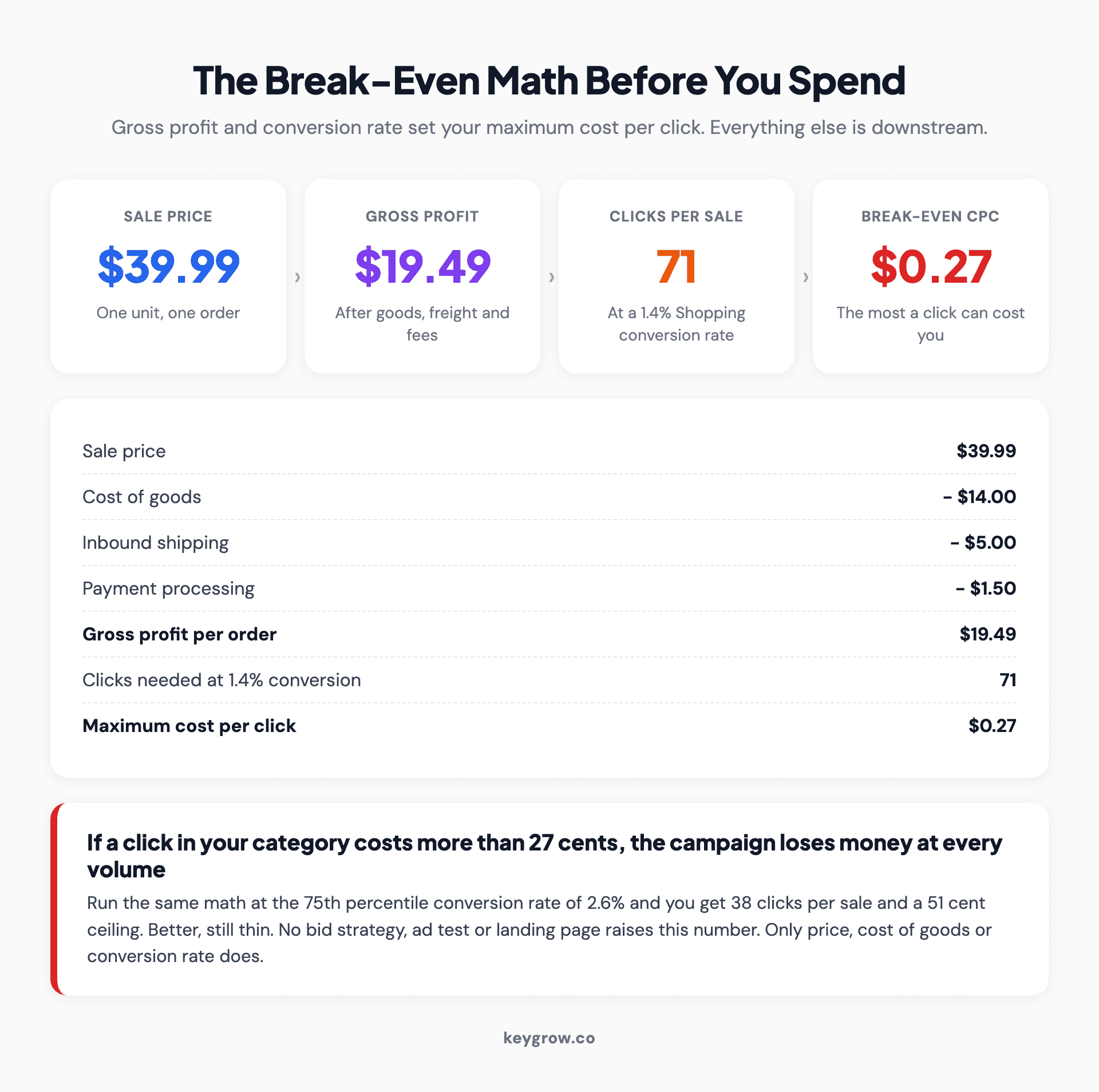
The break-even math behind a dropshipping Google Ads campaign, showing how gross profit and conversion rate set a maximum cost per click.
Twenty-seven cents. That is the number that has to survive a live auction against everyone else selling the same item. Run the same math at the 75th percentile conversion rate and you get 38 clicks per sale and a 51 cent ceiling, which is better and still thin.
This is why so many dropshipping accounts look like they are working right up to the moment somebody subtracts cost of goods. The dashboard reports conversions. The bank account reports a loss.
Do this with your own figures before anything else. Our break-even ROAS calculator will give you the target in about a minute, and if the number comes back below what a click costs in your category, stop reading and go change the product or the price. Nothing further down this page rescues that.
Check the tracking before you change a single bid
A store that appears to get no sales from ads is sometimes a store getting sales the account cannot see. Verify tracking before you conclude anything, because every decision after this depends on the numbers being real.

A laptop showing an ecommerce analytics dashboard on a desk.
Five failures account for most of it.
The purchase tag fires on the wrong page, usually every page, so the account records a conversion for anyone who loads the site. The purchase tag fires twice, once through the Google Ads tag and once through an imported analytics conversion, and the reported numbers are double the real ones. Conversion value is never passed, so a return-on-spend bid strategy is optimizing against a blank. Add to cart is set as a primary conversion action, so the algorithm goes and finds you people who add to cart and leave, which it will do very efficiently. Or consent settings block the tag for a chunk of visitors and the account under-reports by a margin nobody has measured.
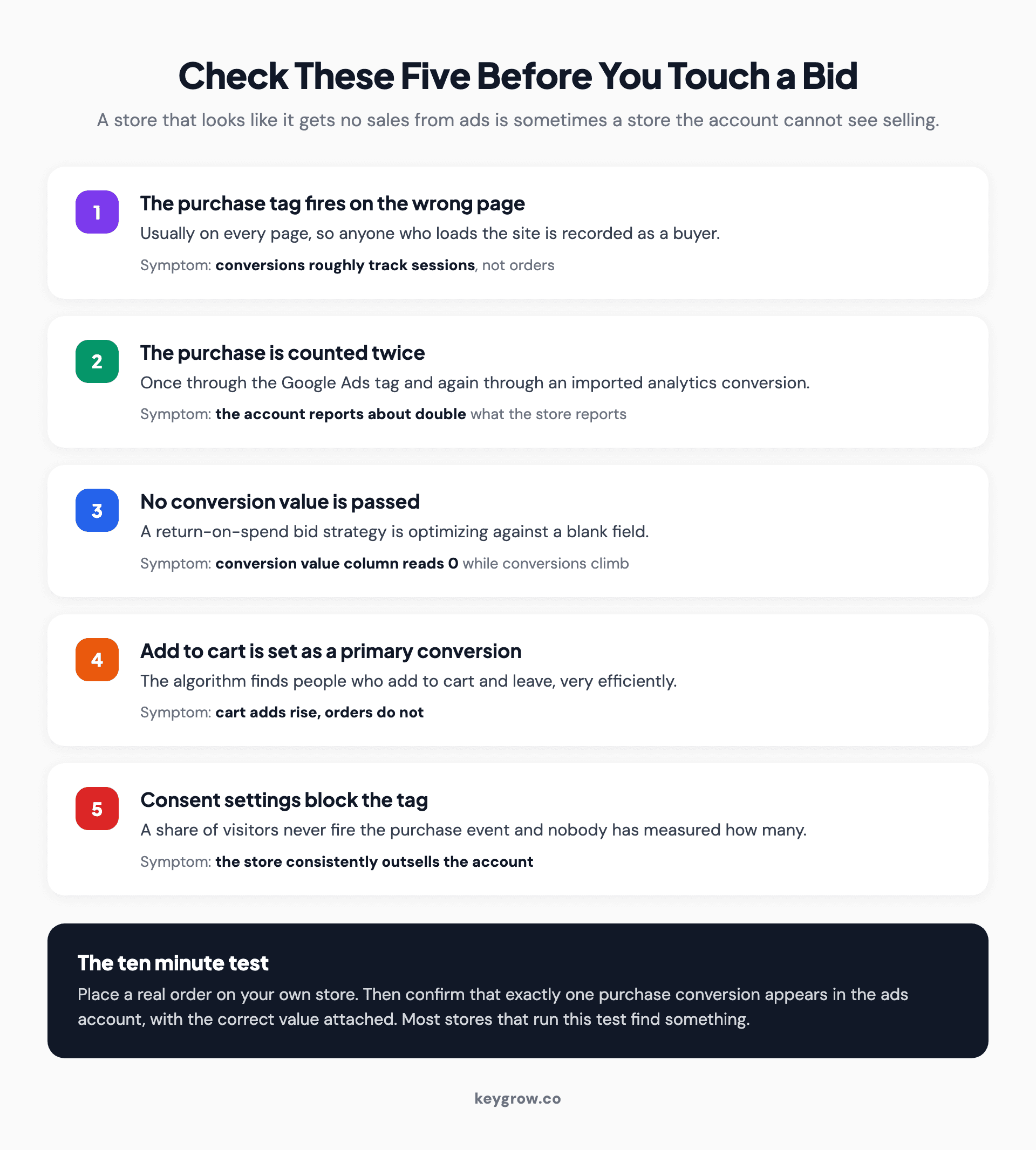
The five conversion tracking failures to rule out before changing bids on a Google Ads ecommerce account.
The test takes ten minutes: place a real order, then check that exactly one purchase conversion appears in the account with the correct value attached. Most stores that run this test find something.
Your Shopping ad is a price comparison you did not agree to
A Shopping listing puts your price, your image and your title in a row next to everyone else selling the identical item. If your catalog is a generic supplier catalog, that row is a price ladder and you are not at the bottom of it.
This is the structural problem with dropshipping on Shopping, and no bid adjustment solves it. Search ads let you compete on message. Shopping puts the price on the tile before anyone clicks, so the message is the price.
Three things follow from that.
Being 15 percent above the cheapest listing for the same item does not cost you 15 percent of the clicks, it costs you most of them. Shoppers scan the row. You are paying for impressions in a comparison you lose on sight.
Products available identically from any supplier have no defensible position. Somebody with a warehouse, better freight and no dropship markup can price below your cost. They are not being clever, their cost base is genuinely lower.
And Google has opinions about resellers. The Merchant Center misrepresentation policy covers unclear business identity, hidden shipping and return terms, and pricing that does not match the landing page. Generic reseller stores get caught by it more than anyone, usually for the return policy rather than anything dramatic.
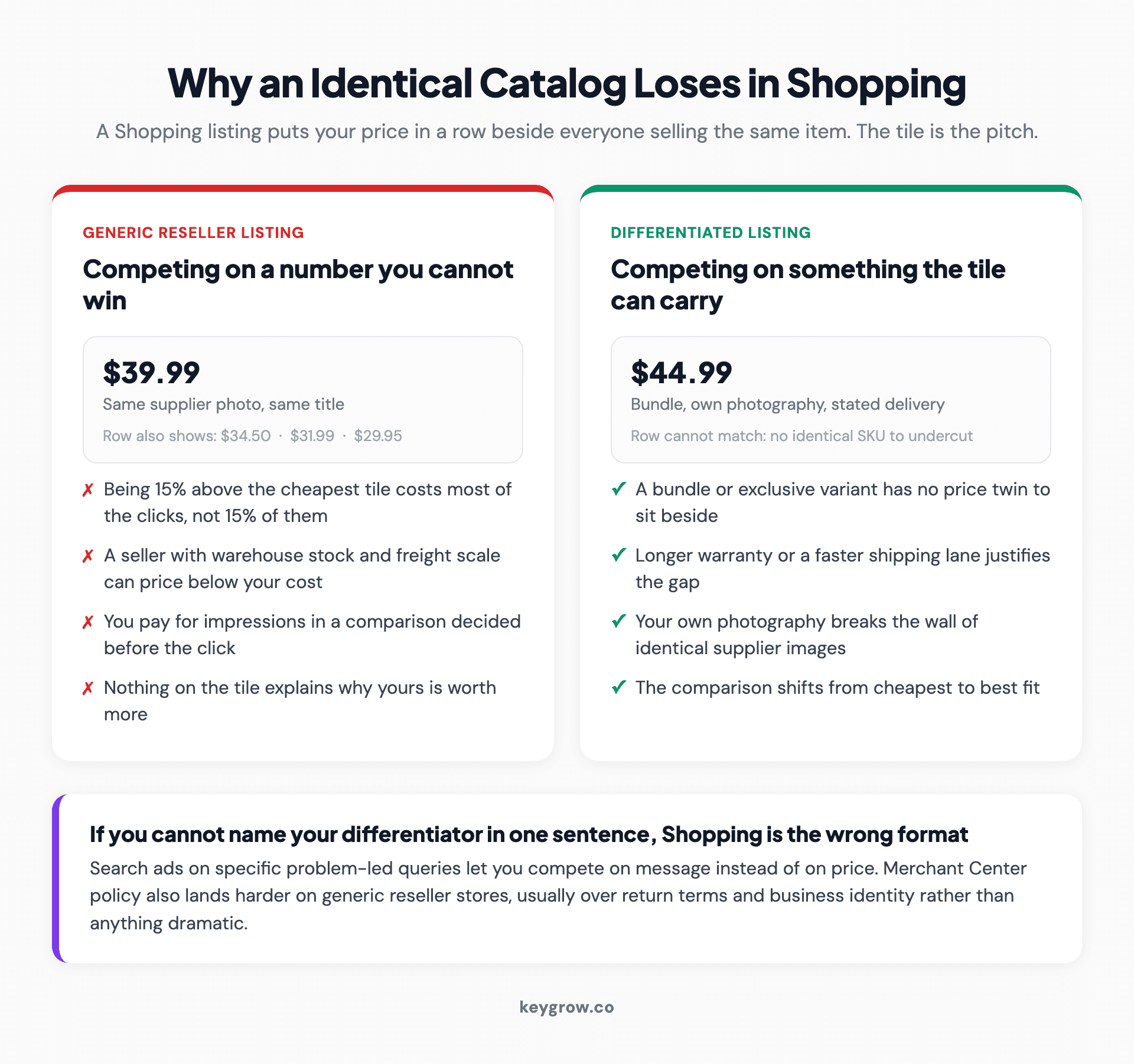
Why an identical dropshipping catalog loses in Google Shopping, comparing a generic reseller listing against a differentiated one.
The way out is not a better ad. It is a bundle, an exclusive variant, a longer warranty, a faster shipping lane, or a product nobody else is listing. If you cannot name your differentiator in one sentence, Shopping is the wrong format for you and Search on specific problem-led queries is a better first bet.
The search terms report is where the money actually went
Open the search terms report before you look at anything else in the campaign. In an unmanaged account, 20 to 30 percent of the budget is typically going to searches you would never have bought on purpose.
Broad match without a negative keyword list is a donation to Google, and dropshipping stores donate more than most because the product names are generic. A store selling posture correctors ends up paying for "how to fix posture at home", "posture corrector reviews", "posture corrector wholesale supplier" and a steady trickle of people looking for medical advice.
The negatives that earn their place in a reseller account:
- Research language: how to, DIY, reviews, is it worth it
- Supply-side language: wholesale, supplier, bulk, distributor, private label
- Price-floor language: free, cheap, discount code, coupon
- Marketplace names, unless you genuinely want to be the second-choice result
- Any competitor product name that is not yours
Do this weekly for the first two months. It is boring and it is the single highest-return hour in a new account.
Where in the funnel the sale is actually being lost
Clicks with no sales is not one problem, it is five, and the numbers tell you which one you have. Match the symptom to the stage before you start fixing.
| What you see | Where it breaks | First thing to check |
|---|---|---|
| Impressions, very few clicks | The listing | Your price and image next to the competing tiles |
| Clicks, no add to cart | Product page | Delivery time, price credibility, trust signals |
| Add to cart, no checkout started | Cart | Shipping cost appearing for the first time |
| Checkout started, no purchase | Checkout | Forced account creation, payment options, surprise fees |
| Sales, no profit | Arithmetic | Gross profit per order against your real CPA |
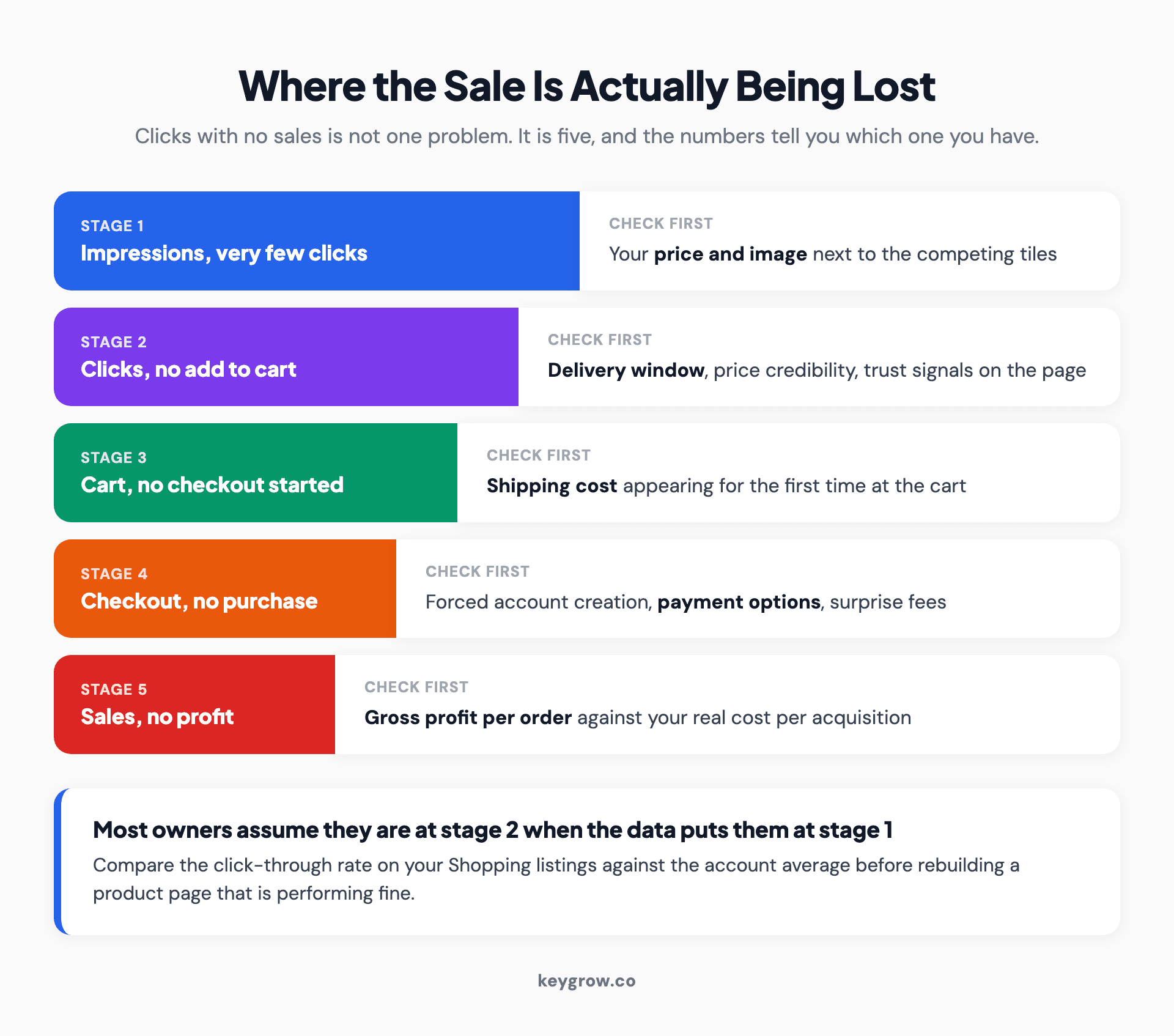
The five places a dropshipping sale gets lost between impression and purchase, with the first thing to check at each stage.
Most store owners assume they are in row two when the data puts them in row one. Check the click-through rate on your Shopping listings against the account average before you rebuild a page that is doing fine.
Delivery time is the objection, and your page is usually silent
The reason a visitor leaves a reseller product page is rarely price. It is that they cannot tell when the thing arrives, who they would contact if it did not, and whether they could send it back.

An open cardboard shipping box on a plain white background.
You know your fulfillment is slower than a large retailer's. So does the visitor. Saying nothing does not hide it, it just moves them along to a page that answers the question.
Put six things on the product page above the fold or near it:
- A delivery window in days, stated plainly, even when it is not fast
- Total delivered cost, with shipping shown before the cart
- A return window and a real address the return goes to
- Reviews with dates on them, and not only five-star ones
- A contact method that is not a form, ideally a phone number or a monitored inbox
- Whatever your differentiator is, in the first line of the description
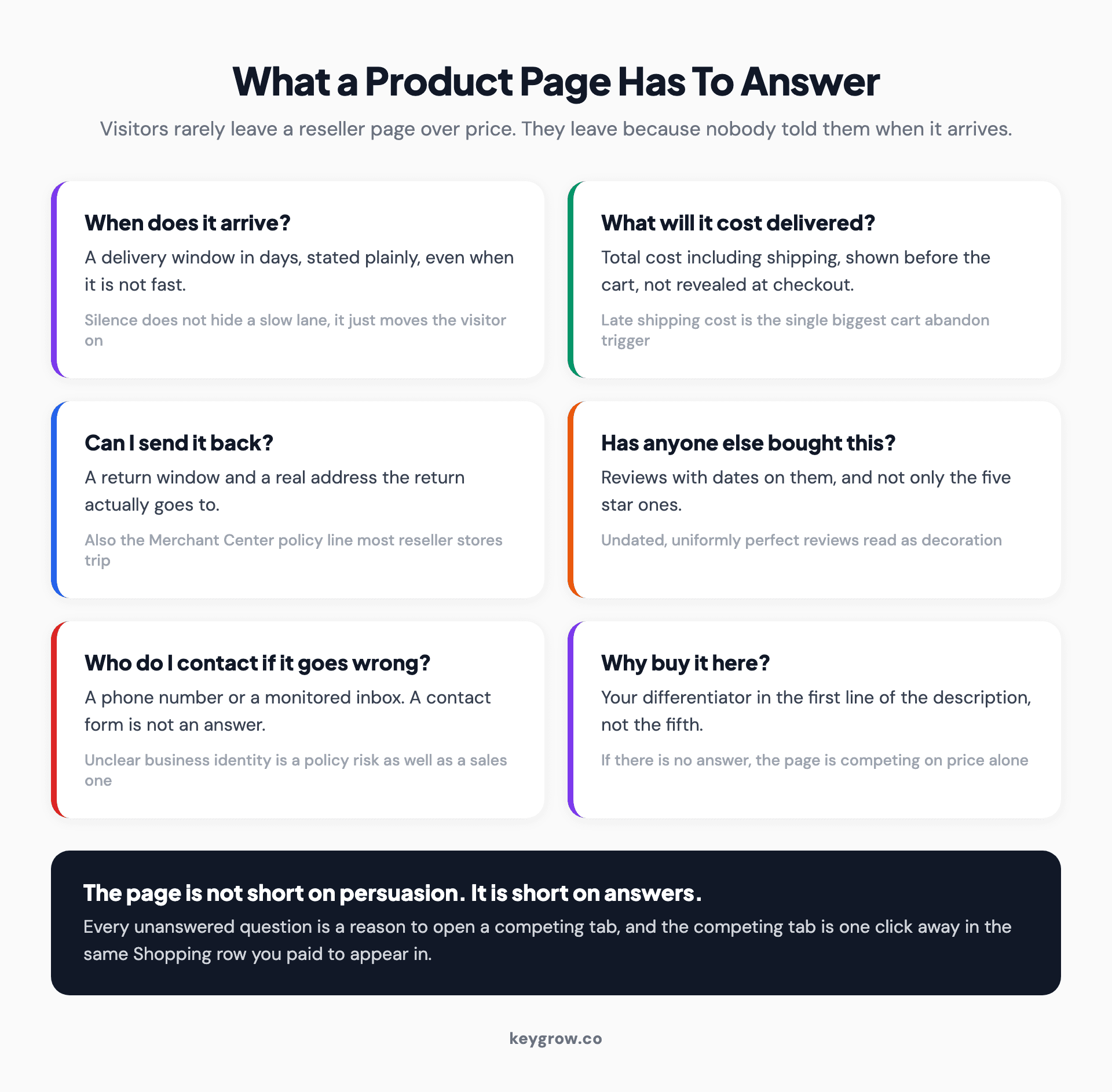
The six questions a dropshipping product page has to answer before a visitor will buy, from delivery window to return address.
We rebuilt a junk removal client's landing page around one clear action and lead form submissions rose 180 percent in eight weeks. Different industry, same mechanic: the page was not missing persuasion, it was missing answers. There is more on that pattern in how PPC drives sales for online stores.
Which campaign type to run, and which one to leave alone
Start with Standard Shopping on a clean feed, or Search on specific problem-led queries. Leave Performance Max until the account has conversion history to feed it.
Performance Max is the most common self-inflicted wound on a new store. It needs conversion signal to allocate spend sensibly, and a store with zero conversions gives it none, so it spends the budget on the cheapest inventory it can find and reports a pile of view-through numbers that mean very little. Give it thirty conversions of history first, then let it run.
On bidding, manual CPC or a click-capped strategy for the first few weeks is not old-fashioned, it is how you keep the ceiling you calculated in section one. Move to target ROAS once the account has enough conversions for the target to mean something.
If you are running a store on a hosted platform, the feed itself is worth an afternoon. Titles that lead with the product type rather than a brand-style name, correct GTINs where they exist, real product categories, and images without promotional overlays. We wrote about the organic side of the same problem in optimizing an ecommerce product page, and the feed rewards most of the same discipline.
You probably do not have enough data to conclude anything yet
Nine days and forty clicks is not a result. At a 1.4 percent conversion rate, forty clicks has an expected yield of roughly half a sale, so zero sales is exactly what a perfectly healthy campaign looks like at that volume.
This cuts both ways, and it is why the arithmetic in section one matters so much. You need somewhere around 30 conversions before an automated bid strategy has anything to learn from, and you need to be able to afford the clicks that produce them. If 30 conversions at your allowable CPA costs more than you are willing to lose while finding out, the honest answer is that you cannot afford to test this channel properly yet.
Set the test budget as a number you have decided to spend, not a number you expect to earn back. Then leave it alone for the length of the test. Changing bids on day four resets the learning and buys you nothing but a fresh start.
When Google Ads is the wrong channel for your store
Some stores should not be here, and an agency that will not say so is selling rather than advising.
Skip paid search for now if gross profit per order is under about $25 and the product is not a repeat purchase. The arithmetic does not clear and no operator changes that.
Skip it if the catalog is the same generic assortment available from a hundred other stores with no bundle, no exclusivity and no service advantage. You will be paying to lose a price comparison.
Skip it if you cannot fund a four to six week test at a level that produces 30 conversions. Underfunded tests produce noise, and people make expensive decisions from noise.
And skip it if nobody is searching for the product by name yet. Google Ads harvests existing demand. It is very good at that and completely unable to create demand for a category people do not know exists. That is a job for paid social or content, and pretending otherwise is how new stores burn a first budget.
If your numbers do clear, our PPC management is month to month with no lock-in, and we say no to stores where the margin will not support it. There is a longer version of what that work involves in what an ecommerce Google Ads agency does.
FAQs
Why am I getting clicks but no sales from Google Ads?
Usually one of five things: the tracking is not recording the sales that are happening, the traffic is arriving on searches with no buying intent, the product page does not answer the delivery and returns question, the checkout is losing people, or the volume is too low to have produced a sale yet. Check tracking first, then the search terms report, then the funnel stage where visitors drop.
How long should it take before Google Ads produces sales for a dropshipping store?
Plan on four to six weeks before the data means anything, and set the test budget at a level that will generate at least 30 conversions in that window. Below that volume you cannot tell a bad campaign from an unlucky one, and automated bidding has nothing to optimize against.
Is Performance Max a good choice for a new dropshipping store?
Not at the start. Performance Max allocates budget using conversion history, and a new store has none, so it tends to spend on cheap inventory and report soft numbers. Run Standard Shopping or Search until the account has roughly 30 conversions, then test it against what you already have running.
What conversion rate should a dropshipping store expect from Google Ads?
Benchmark data for 2026 puts the ecommerce average at about 2.8 percent on Search and 1.4 percent on Shopping, with stronger stores near 4.5 percent and 2.6 percent. Use the average for your break-even math and treat anything above it as upside rather than a plan.
Does Google allow dropshipping ads?
Yes, dropshipping is allowed, but reseller stores get caught by Merchant Center policy more often than most. The usual causes are unclear business identity, return and shipping terms that are hard to find, and a price in the feed that does not match the price on the page. Fix those before you appeal anything.
Should I use manual bidding or automated bidding?
Manual or click-capped bidding for the first few weeks, so you can hold the cost per click ceiling your margin allows. Switch to target ROAS once the account has enough conversion history for the target to be based on something. Automated bidding with no conversion data is guessing with your budget.
How much budget do I need to test Google Ads properly?
Work backwards from 30 conversions. Take your allowable cost per acquisition, multiply by 30, and that is roughly the test. If your allowable CPA is $18, budget around $540 across four to six weeks. If that number is uncomfortable, the honest read is that the channel is not affordable for this product yet.
Work the list from the top
Margin, then tracking, then the search terms report, then the funnel stage, then the page. Only after all of that does it make sense to touch the ads.
The reason for the order is that the checks get progressively more expensive to act on and progressively less likely to be the problem. Most stores that arrive convinced they have an ad copy problem discover in the first twenty minutes that they have a 27 cent ceiling and a 90 cent click.
If you want a second pair of eyes on the account before you spend more, tell us what you are selling and we will tell you whether the numbers work. Sometimes the answer is that they do not, and that is worth knowing before another month of spend.