


Hiring an ecommerce Google Ads agency is not the same as hiring a PPC agency that happens to have online stores on its client list. Most of the work that decides whether an ecommerce account makes money happens outside the ads interface, in Merchant Center and in your margin spreadsheet, and a generalist rarely goes there.
You can find out which kind you are talking to in about twenty minutes. Six questions, and they are all questions a real specialist will enjoy answering.
Retail buys cheap clicks that convert badly
Before the questions, the shape of the problem, because it explains why ecommerce needs its own kind of agency.
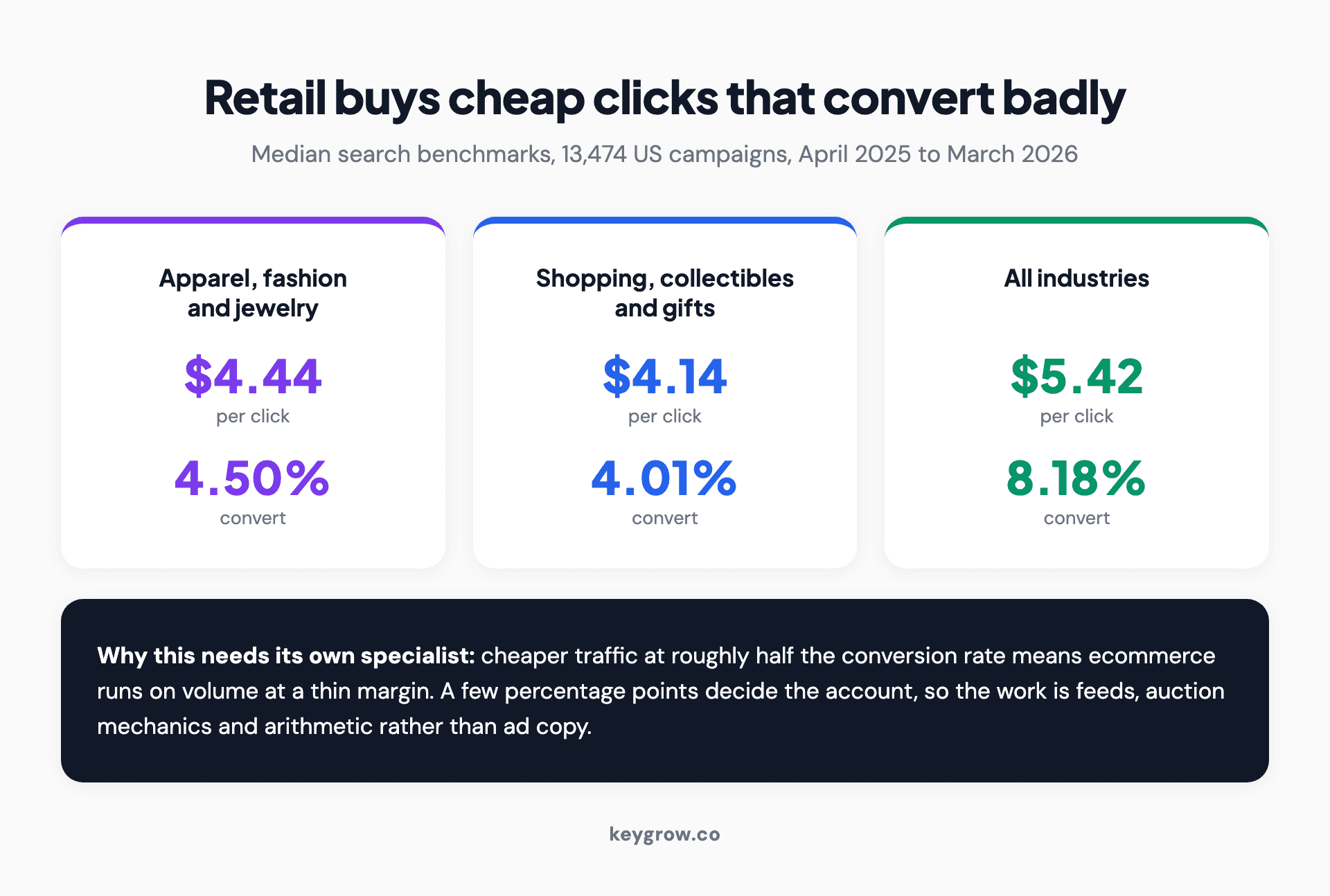
Comparison cards showing that apparel and shopping retail categories have below-average cost per click but roughly half the all-industry conversion rate.
| Category | Click-through rate | Cost per click | Conversion rate |
|---|---|---|---|
| Apparel, fashion and jewelry | 6.64% | $4.44 | 4.50% |
| Shopping, collectibles and gifts | 8.28% | $4.14 | 4.01% |
| All industries | 6.64% | $5.42 | 8.18% |
Those figures come from WordStream's 2026 benchmarks, drawn from 13,474 US search campaigns running between April 2025 and March 2026, reported as medians.
Retail clicks are cheaper than average. Retail conversion rates are roughly half the average. That combination is the entire reason ecommerce advertising is a different discipline. A lead generation account can survive a mediocre conversion rate because one lead is worth hundreds of dollars. An ecommerce account cannot, because it needs volume at a margin, and the margin is thin enough that a few percentage points decide the whole thing.
Which means the questions that matter are not about ad copy. They are about feeds, auction mechanics and arithmetic.
What an ecommerce Google Ads agency actually does
The job is different enough that the two roles barely overlap in daily practice.
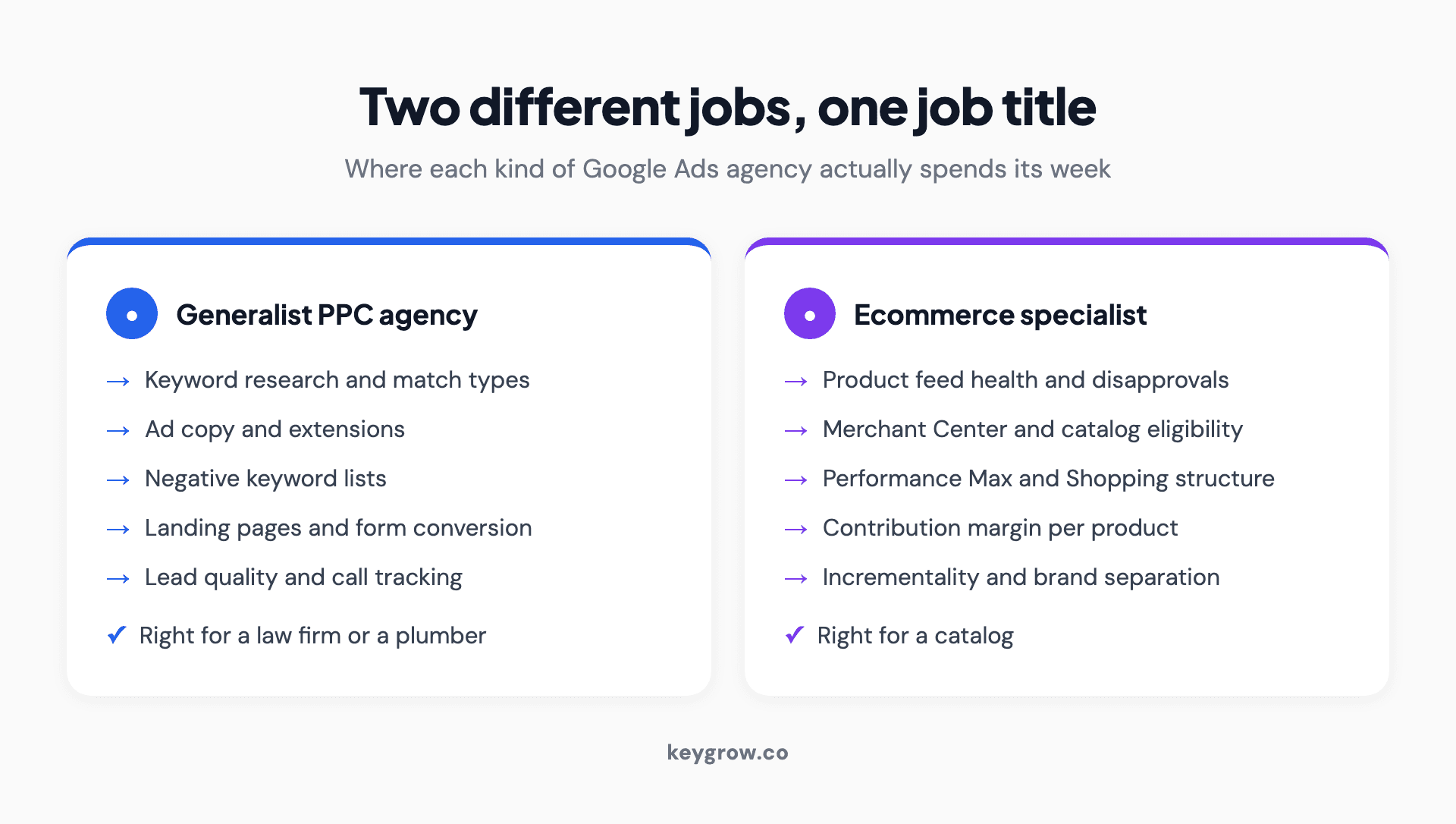
Two-column comparison of where a generalist PPC agency spends its time versus where an ecommerce Google Ads specialist spends its time.
A generalist PPC agency spends its week on keywords, ad copy, negative lists, landing pages and lead quality. All of that is real work and it is the right work for a law firm or a plumber.
An ecommerce specialist spends its week somewhere else. Product feed health and Merchant Center disapprovals. Which products are eligible to serve at all. How Performance Max and Shopping campaigns are competing inside your own account. What each product actually earns after cost of goods, shipping and returns. Whether the revenue being reported would have arrived anyway.
Both are called Google Ads management. They are not the same job, and a lot of the disappointment in this category comes from buying one and needing the other.
Question one: what is broken in our product feed right now
Ask this first, because a specialist can answer it within a day of getting access and a generalist will change the subject to campaign structure.
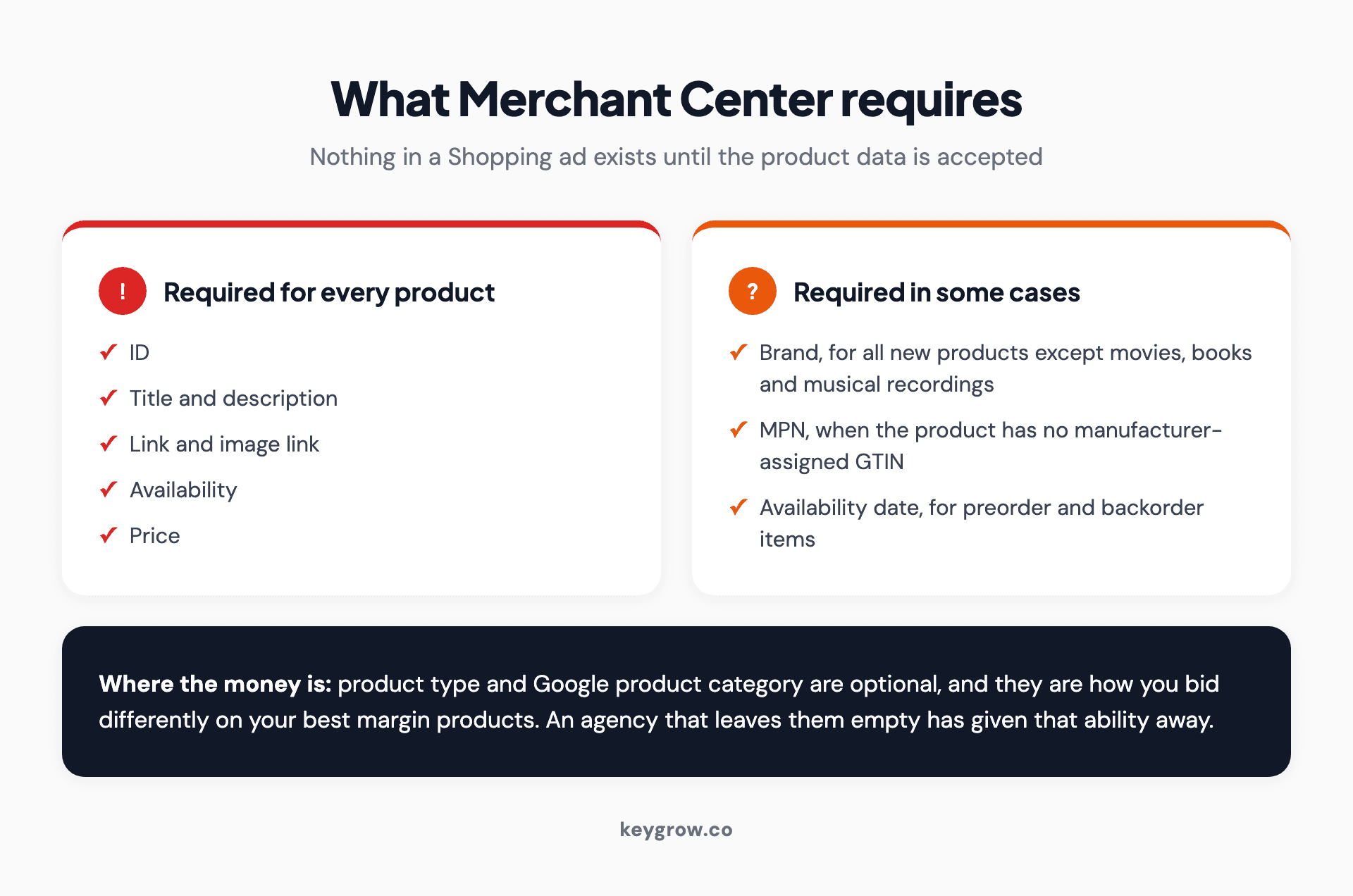
Cards listing the Merchant Center product attributes required for every product and those required only in certain conditions.
Nothing in a Shopping ad exists until the product data is accepted. Google's product data specification requires an ID, title, description, link, image link, availability and price for every product you submit. Brand is required for all new products other than movies, books and musical recordings. An MPN is required when the product has no manufacturer-assigned GTIN.
Beyond the required set, the optional attributes are where the money is. Product type and Google product category are both technically optional, and both are how you organize bidding across a catalog. An agency that leaves them empty has given up the ability to bid differently on your best margin products.
The failure mode here is quiet. Products get disapproved, drop out of the feed, and the account keeps running on whatever remains. Spend stays flat, revenue drifts down, and nobody mentions it because the campaign dashboard looks unchanged. Ask any prospective agency how they monitor disapprovals and how quickly they would notice a category going dark.
Titles deserve a specific question of their own. Feed titles are the single largest lever in Shopping performance and most catalogs ship whatever the manufacturer supplied. An agency that has never rewritten a feed title at scale has never really worked on ecommerce.
Question two: how do Performance Max and Shopping compete in our account
This is the question that separates people who read the documentation from people who repeat what they heard in 2022.
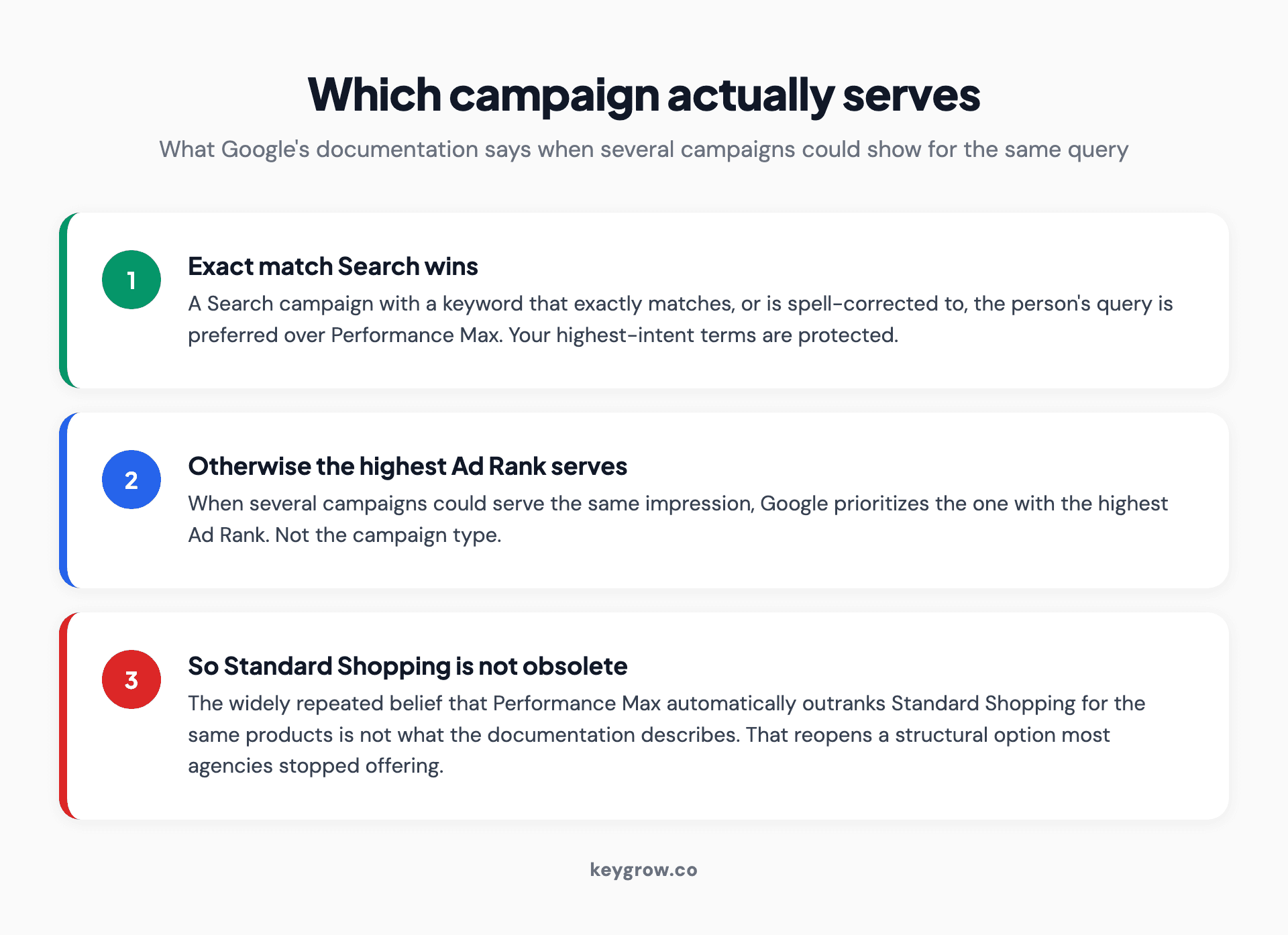
Diagram showing how Google decides which campaign serves when Performance Max, Standard Shopping and Search campaigns in the same account could all show for the same query.
There is a widely repeated belief that Performance Max automatically outranks Standard Shopping for the same products in the same account, which is why so many accounts were consolidated into a single Performance Max campaign and left there.
What Google's documentation on campaign interaction actually says is narrower. When several campaigns could serve the same impression, the campaign with the highest Ad Rank serves. There is one explicit carve-out, and it is worth memorizing: a Search campaign with a keyword that exactly matches, or is spell-corrected to, the person's query is preferred over Performance Max.
Two practical consequences follow. Your exact match Search keywords are protected from Performance Max, so a well-built Search campaign on your highest-intent terms is not being cannibalized the way people assume. And Standard Shopping is not automatically dead in an account that also runs Performance Max, which reopens a structural option most agencies stopped offering.
Somebody who has read this will have a view on what to test in your account. Somebody who has not will tell you Performance Max is the future and move on.
Question three: what ROAS do we break even at
If the answer to this comes back as a number the agency read off your Google Ads dashboard, you have learned something.
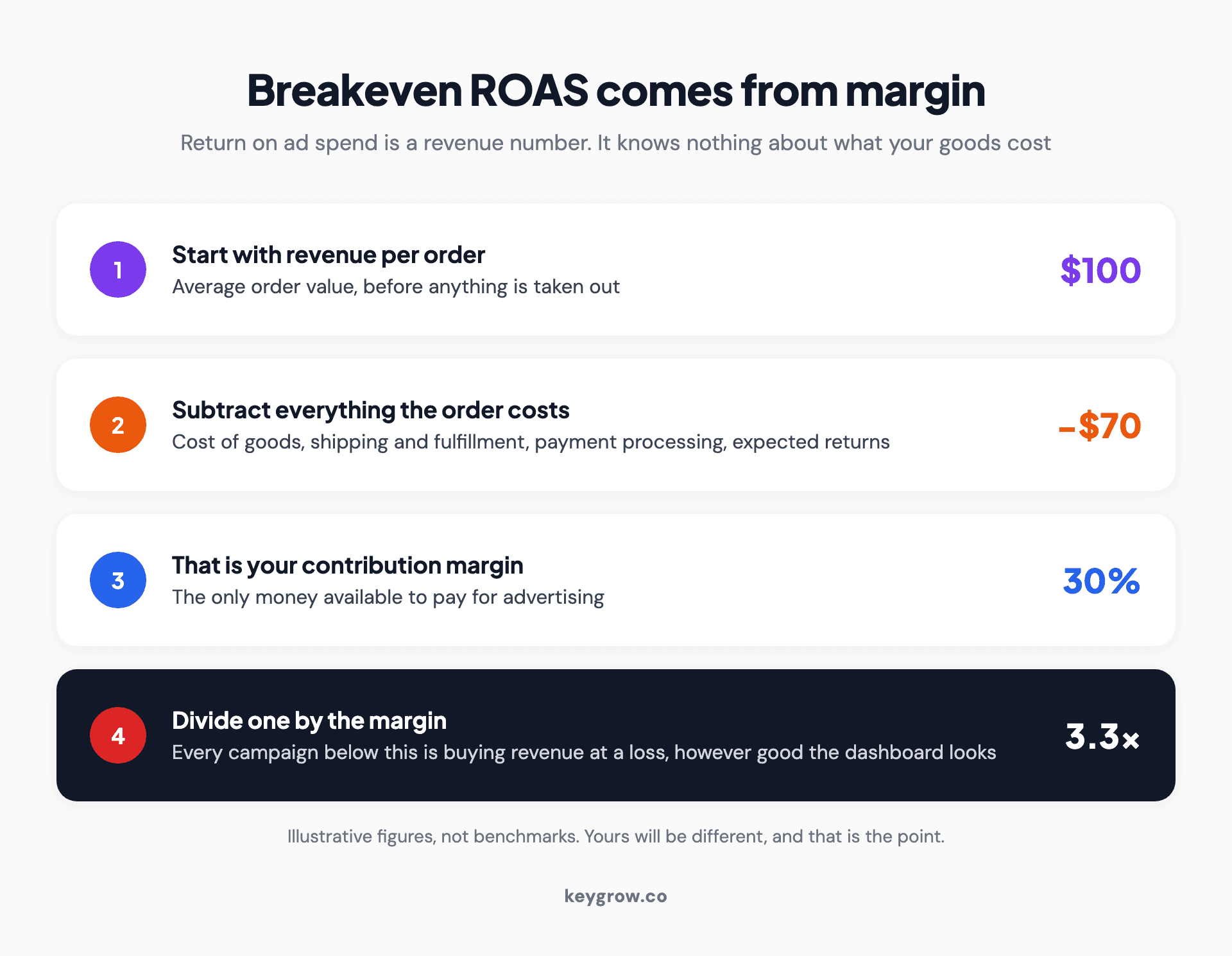
Four-step calculation converting product margin into a breakeven return on ad spend, showing how a thin margin forces a high ROAS target.
Return on ad spend is a revenue number. It has no knowledge of what your goods cost, what shipping costs you, or how much of the revenue comes back as returns. A 3x ROAS is excellent at a 60 percent contribution margin and loses money at a 25 percent one.
The arithmetic is short. Work out contribution margin per order, meaning revenue minus cost of goods, minus shipping and fulfillment, minus payment processing, minus expected returns. Divide one by that margin percentage and you have your breakeven ROAS. At a 30 percent contribution margin, breakeven sits around 3.3x, so every campaign running below that is buying revenue at a loss no matter how healthy the dashboard looks.
Figures used here are illustrative rather than benchmarks, and the whole point is that yours will be different. What matters is whether the agency asks for them. An agency that sets a ROAS target without ever asking what your products cost has picked a number out of the air, and you will find out which way it was wrong at the end of the quarter.
Catalogs make this harder in a useful way. Margin varies enormously across products, so a single account-level ROAS target quietly funds your worst products with the profit from your best. Ask how they would segment the catalog by margin, and whether they would run separate campaigns or use feed labels to do it.
Question four: what does our ROAS look like with brand removed
Brand search is the most flattering line in an ecommerce account and the easiest to hide behind.
People searching for your brand name were coming anyway in most cases. Those clicks are cheap, they convert at rates nothing else touches, and they are usually the largest single contributor to a blended return on ad spend figure. Fold them into the account total and a mediocre prospecting performance disappears inside a great-looking headline number.

A laptop on a desk showing an online store product page.
So ask for the split. Brand campaigns reported separately from non-brand, with their own ROAS, their own spend share and their own trend. Any agency that cannot produce that within a day either is not segmenting brand traffic or would rather you did not look.
None of this means brand campaigns are a waste. Defending your own name against resellers and competitors is usually worth doing, and the cost is low. It means brand belongs in its own line on the report, because the money you are paying an agency to earn is the non-brand money.
Ask the same question about Performance Max, which mixes brand and non-brand traffic by design and reports one blended figure unless somebody deliberately separates them out.
Question five: how would you prove any of this is incremental
The uncomfortable question, and the one that tells you the most about who you are dealing with.
Every ecommerce account contains revenue that would have happened without the ads. Returning customers who search your name, people who saw you elsewhere and clicked an ad on the way, buyers already halfway through a decision. Attribution assigns that revenue to the campaign that touched it last, and the campaign takes the credit.
A specialist will answer with a method. Geographic holdout tests, where a set of regions goes dark for a period and you compare total revenue rather than platform-reported revenue. Campaign-level pause tests on a defined budget. Google's own experiment tools for structural comparisons. None of these are exotic, and all of them produce a number you can defend to a finance team.
A generalist will answer with a dashboard. If the response to how do we know this is working is a screenshot of conversions in the platform, that is the whole answer you are going to get for the next twelve months.
Set the expectation early that you want at least one incrementality test in the first six months. It is the only thing that turns a reported ROAS into something you can plan a business on.
Question six: are we buying new customers or repeat customers
Most ecommerce accounts have no idea, and the distinction changes what the advertising is worth.
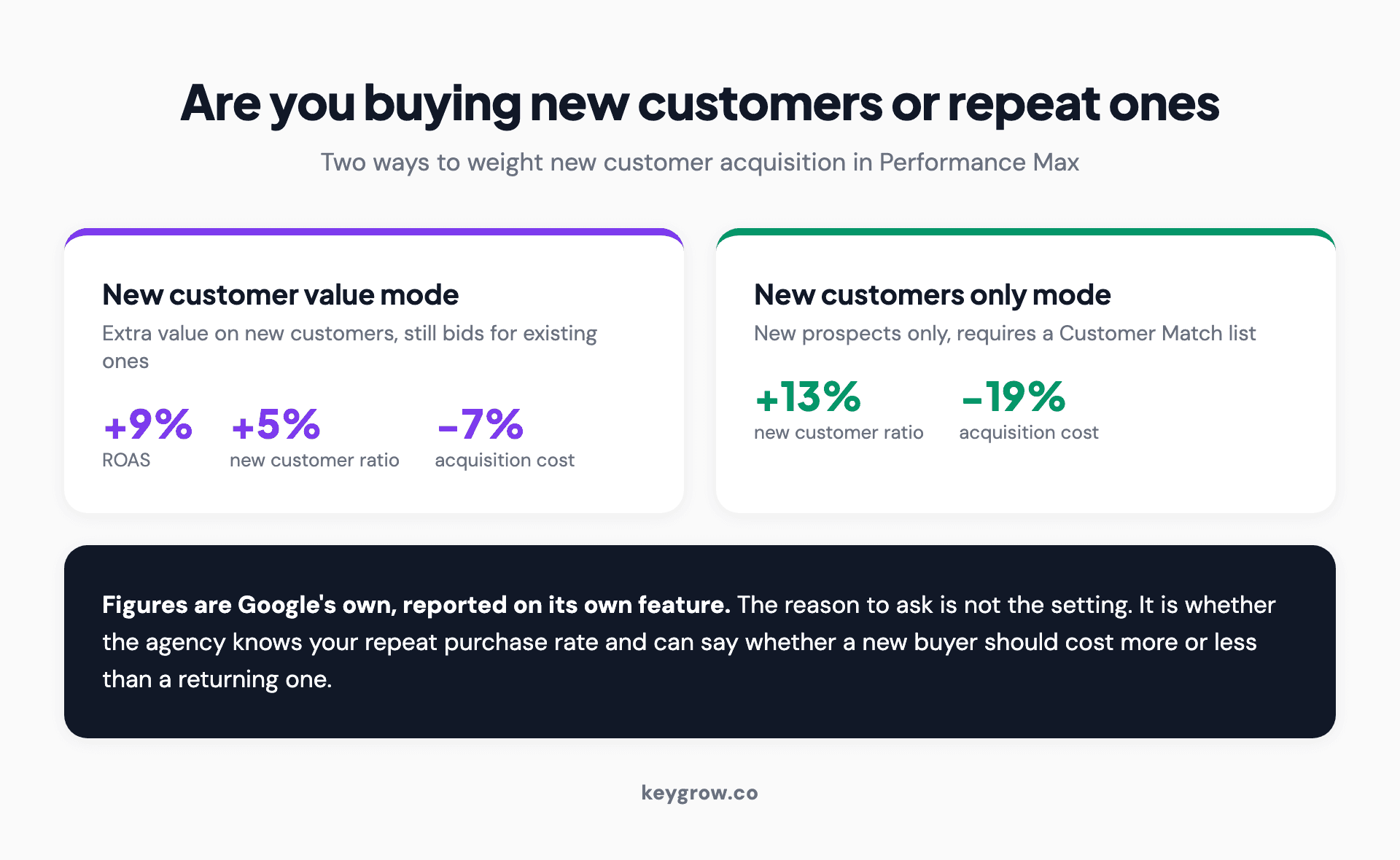
Two cards explaining the new customer value mode and new customers only mode in Performance Max, and what each one requires.
Google gives you two ways to weight this in Performance Max. New customer value mode assigns extra value to new customers while still bidding for existing ones. New customers only mode restricts the campaign to new prospects entirely, and it requires a Customer Match list so the system can tell one from the other.
Google's own reported figures for these are worth knowing, with the usual caution that a platform reporting on its own feature is not a neutral source. It states that advertisers using new customer value mode improved return on ad spend by 9 percent, improved their new customer ratio by 5 percent and reduced new customer acquisition cost by 7 percent. For new customers only mode, it reports a 13 percent improvement in new customer ratio and a 19 percent reduction in acquisition cost.
The reason to ask is not the feature. It is what the answer reveals. An agency that has thought about this knows your repeat purchase rate, knows what a first order is worth against a customer's second year, and can tell you whether you should be paying more or less for a new buyer than for a returning one. An agency that has not thought about it is optimizing every order identically, which means it is paying full price to re-buy customers you already own.
What the pricing model tells you
Three common structures, and each one changes the incentive in a specific direction.
| Model | How it works | What it quietly encourages |
|---|---|---|
| Percentage of ad spend | A share of media spend, commonly 10 to 20 percent | Spending more, whether or not more is profitable |
| Flat monthly fee | Fixed retainer regardless of spend | Predictability, but no reward for scaling you |
| Performance based | Fee tied to revenue or ROAS above a threshold | Depends entirely on which number the threshold uses |
Reported market rates for Google Ads management span a wide range. One published roundup of agencies puts monthly fees anywhere from $250 to $7,500, which tells you the label on the service means very little on its own.
Percentage of spend is the most common model in ecommerce and the one to think hardest about, because it pays an agency more for spending more. That is survivable when the account has genuine headroom and awkward when it does not, since the honest advice at a certain point is to stop increasing budget.
Then there is contract length, and here we have a position. A twelve month lock-in is a confession. If an agency needs a contract to keep you, the results are not doing that job. Work out what a year at their retainer actually costs before you sign, because at the upper end of that published range a twelve month commitment is a $90,000 decision made before a single test has run. We work month to month for exactly this reason.
When you should not hire an ecommerce Google Ads agency
An agency that will not tell you who it is a bad fit for is selling rather than advising, so here are three cases where the honest answer is not yet.
If your total ad budget is small, agency fees eat the account. At a $2,000 monthly media spend, a typical management fee is a large share of the total and the numbers rarely justify themselves. Run it yourself, or use a freelancer, until the spend can carry the fee.
If your Merchant Center account is not set up and your feed has never been validated, that is a project rather than a retainer. Some agencies will happily bill twelve months of management for what is really six weeks of feed work. Scope it as a project, get it done, then decide about ongoing management.
And if you do not know your contribution margin, get that first. Not approximately, and not gross margin. Every question above depends on it, and hiring an agency before you can answer it means paying somebody to optimize toward a target neither of you can justify. Our post on how PPC advertising drives sales for online stores walks through the arithmetic if you want to do it before you start talking to anyone.
FAQs
What does an ecommerce Google Ads agency do differently?
It works in Merchant Center and in your margin data, not just in the ads interface. The day to day is product feed health, disapproval monitoring, catalog segmentation by margin, campaign structure across Shopping and Performance Max, and proving that reported revenue is incremental. Keywords and ad copy are a smaller part of the job than in lead generation.
How much does an ecommerce Google Ads agency cost?
Published market ranges run from a few hundred dollars a month to several thousand, and one industry roundup lists $250 to $7,500. The common ecommerce model is a percentage of ad spend, usually in the region of 10 to 20 percent. Compare the fee against your contribution margin rather than against your revenue, since the fee comes out of margin.
Is Performance Max better than Standard Shopping for ecommerce?
Neither is automatically better. Google's documentation says the campaign with the highest Ad Rank serves when several could show for the same impression, with an explicit exception that exact match Search keywords are preferred over Performance Max. That means Standard Shopping remains a viable structure to test rather than something that has been made obsolete.
What ROAS should an ecommerce store target?
Whatever exceeds your breakeven, which is one divided by your contribution margin. At a 30 percent contribution margin, breakeven sits around 3.3x, so a 3x ROAS would be losing money. Any agency that gives you a target ROAS without asking what your products cost has guessed.
Should brand campaigns be reported separately?
Yes, always. Brand search converts at rates nothing else matches and inflates a blended ROAS figure enough to hide weak prospecting performance. Ask for brand and non-brand reported as separate lines, including within Performance Max, which blends the two by default.
How long should I give an ecommerce Google Ads agency?
Long enough for a structural change and a test to report, which usually means three to four months, and shorter than a twelve month contract. Ask for at least one incrementality test inside the first six months. If an agency requires a year before it will start, that requirement is telling you something.
Do I need an agency or can I run ecommerce Google Ads myself?
At smaller budgets, running it yourself often beats paying a fee that consumes the margin. The tipping point is usually feed complexity rather than spend. A catalog of thirty products is manageable alone. A catalog of thirty thousand, with variants, seasonal availability and disapprovals to chase, is where specialist help starts paying for itself.
Ask the six questions
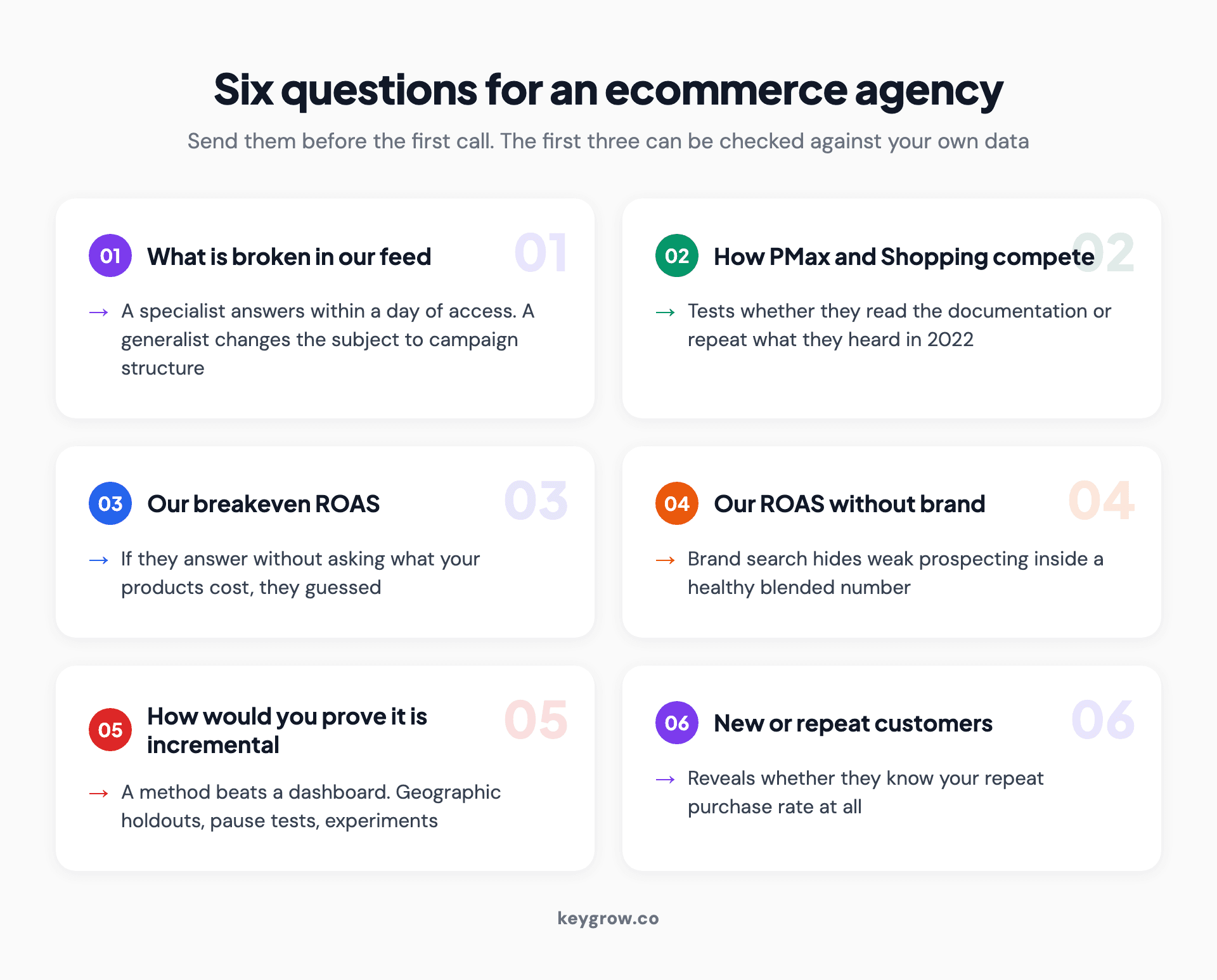
Checklist infographic of the six questions to ask an ecommerce Google Ads agency, covering product feed health, campaign competition, breakeven return on ad spend, brand reporting, incrementality testing and new customer acquisition.
Send them before the first call. What is broken in our feed, how do Performance Max and Shopping compete in our account, what ROAS do we break even at, what does our ROAS look like without brand, how would you prove it is incremental, and are we buying new customers or repeat ones.
The answers sort candidates faster than any case study will, because the first three can be checked against your own data and the last three cannot be improvised.
If the account is running and simply not producing sales, the diagnosis is a different job to the hire. Our post on Google Ads not getting sales works through the checks in order, starting with the margin arithmetic that decides whether the channel can work at all.
If you want that work done rather than assessed, our PPC management runs month to month and our ecommerce PPC page covers how we structure catalog accounts. For the broader vetting questions that apply to any paid search relationship, our guide on how to choose a PPC agency covers the ground this post assumes.