


Every guide on how to choose a PPC agency was written by someone selling PPC management. This one included. So instead of asking you to trust anyone's vibes, ours or theirs, this guide is built on evidence you can verify yourself: results denominated in dollars, an ad account that stays in your name, fees split from spend, a change history that proves work is happening, and contract terms that tell you how confident the agency really is.
That last sentence is the short answer. The long answer is a vetting system, the fee math small businesses never get shown, the questions that matter in 2026, and a 90-day timeline with walk-away triggers for after you sign. Use all of it on us too.
Test claims against evidence, not delivery
Agency sales calls run on five claims. Each one has a piece of evidence that either exists or does not, and asking for it converts a pitch into an audit.
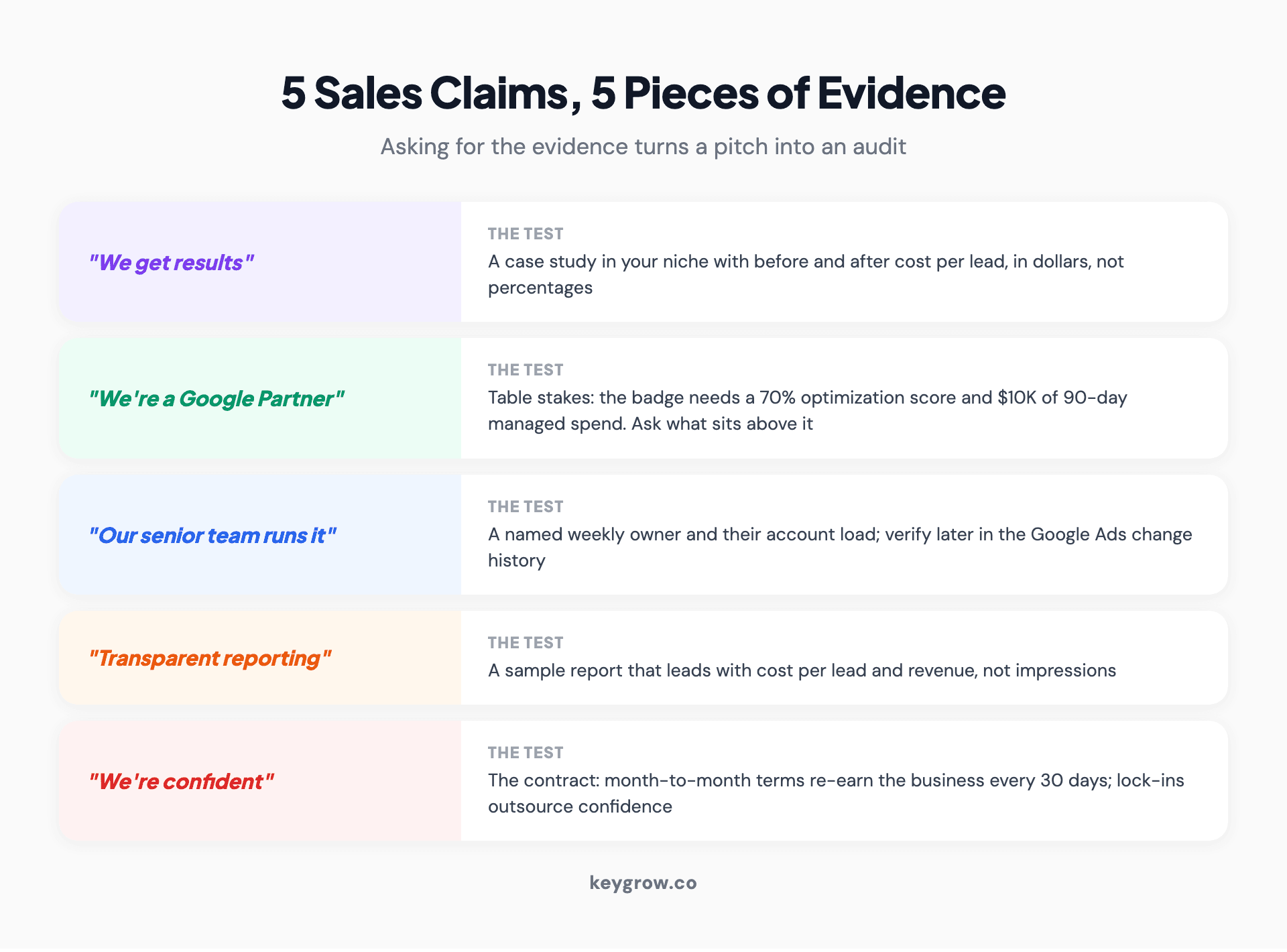
Five PPC agency sales claims and the evidence that tests each one: results claims need dollar cost-per-lead case studies, certification claims need context on how low the bar is, expertise claims need the account change history, transparency claims need a sample report, and confidence claims need the contract terms.
"We get results." Ask for a case study in your niche with real dollars: what a lead cost before, what it cost after, over what period. Percentages hide too much; a 300 percent improvement on a disastrous baseline is still bad. If every example is a different industry from yours, the agency is learning your market on your budget.
"We are Google certified, and a Partner." Table stakes, not a differentiator. The Partner badge requires a 70 percent optimization score, $10,000 in managed spend across 90 days, and at least half the agency's account strategists certified, per Google's Partner requirements. A capable freelancer clears that bar. Treat certifications as a floor and ask what sits on top of it.
"You will have our senior team." The bait-and-switch between the strategist who pitches and the junior who executes is the industry's oldest move. Ask directly who touches the account weekly and how many other accounts that person carries. Then verify after signing: Google Ads' change history shows nearly every edit made in the account over the past two years, and who made it, to anyone with account access. An actively managed account shows changes every week, not a flurry in week one and silence after.
"Our reporting is transparent." Ask for a sample report before you sign. If page one is impressions and clicks, you are looking at how they hide. A report built for an owner leads with cost per lead, leads that became customers, and revenue against spend.
"We are confident in our work." Then the contract will say so. More on that below, because contract terms are the most honest sentence an agency ever writes.
Pricing models, and what each one pays the agency to do
Every fee structure creates an incentive. None is evil; all of them lean.
| Model | Typical range | The lean |
|---|---|---|
| Flat monthly fee | varies widely by scope | Predictable, but scope creep arguments live here |
| Percentage of ad spend | roughly 15-30 percent | The agency earns more when you spend more, whether or not results follow |
| Hourly | $100-$149 at typical agencies | Transparent, but slow months still bill |
| Performance-based | rare | Sounds ideal; often optimizes for cheap, low-quality conversions |
| Hybrid (base + performance) | negotiated | The most balanced, and the most complex to audit |
Two useful outside anchors: marketplace data from Clutch puts common hourly rates at $100 to $149 and percentage fees at 15 to 30 percent of spend, and only 18 percent of agencies used value-based pricing in 2025, down from a 37 percent peak in 2022, per Promethean Research. Anyone promising pure pay-for-results is offering something most of the industry has tried and walked away from, which deserves a follow-up question rather than applause.
Whatever the model, insist on one thing: the management fee and the ad spend are separate line items, and the ad spend runs through your own billing. Bundled "all-in" pricing is where fee increases hide.
The fee math nobody shows small budgets
A management fee is only worth paying if enough budget remains to buy data and leads. Run this before any sales call.
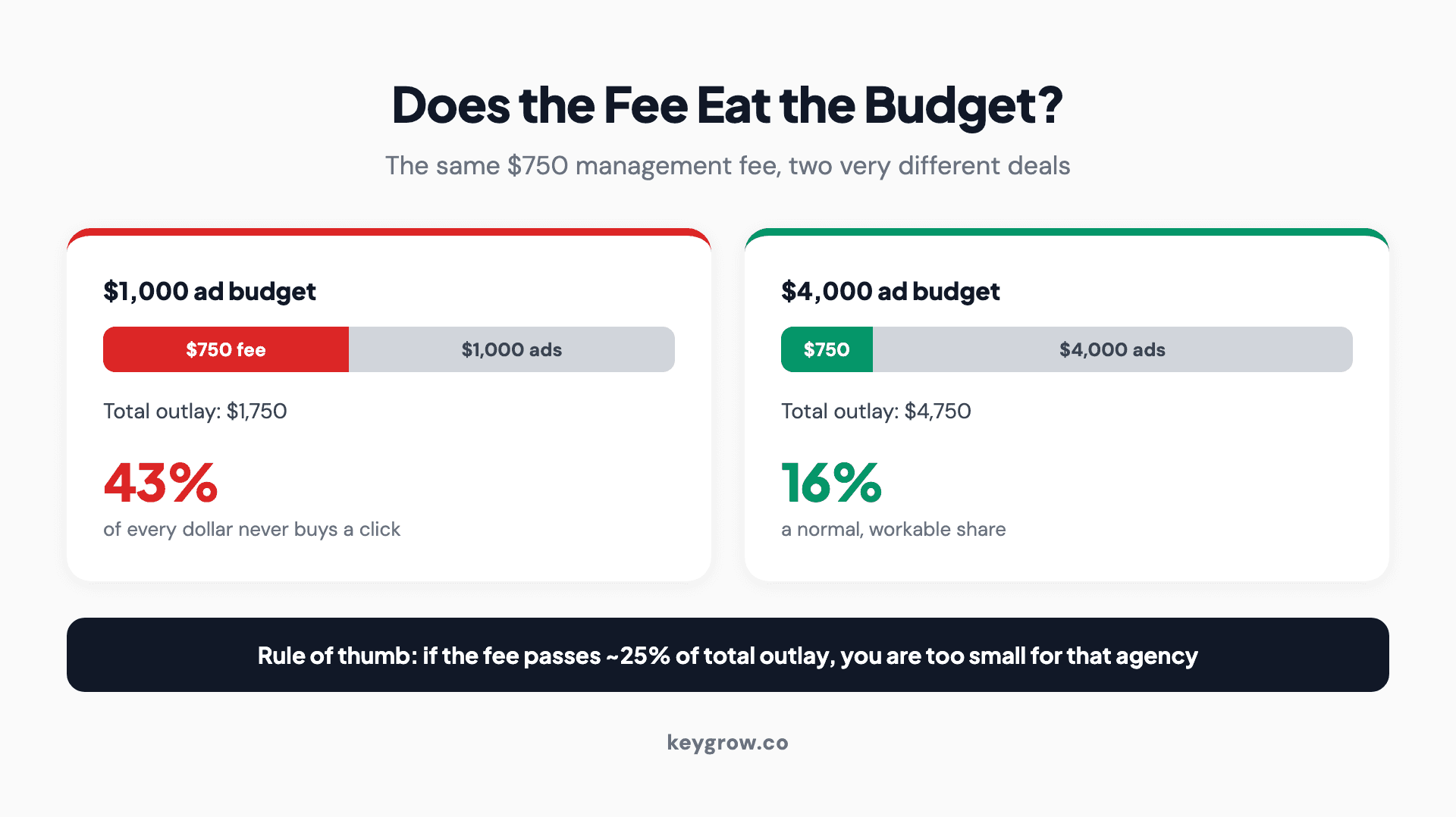
The minimum viable budget math for hiring a PPC agency: a $750 management fee on a $1,000 ad budget consumes 43 percent of the total, while the same fee on a $4,000 budget is 16 percent, with the rule of thumb that management fees should stay under roughly a quarter of total monthly outlay.
Say an agency charges $750 a month and you have $1,000 of ad spend. Your total outlay is $1,750, and 43 percent of it never buys a single click. The same fee against $4,000 of spend is 16 percent of outlay, which is normal. Our rule of thumb: if the management fee eats more than about a quarter of your total monthly outlay, you are too small for that agency, and that is nobody's fault. Below roughly $1,500 a month in ad spend, a good freelancer or a well-studied owner usually beats an agency arrangement on math alone. Our budget calculator makes this a two-minute check.
That answer costs us leads. It is still the right answer.
Ask the 2026 questions
The standard question banks were written a decade ago. The platform changed; the vetting should too.
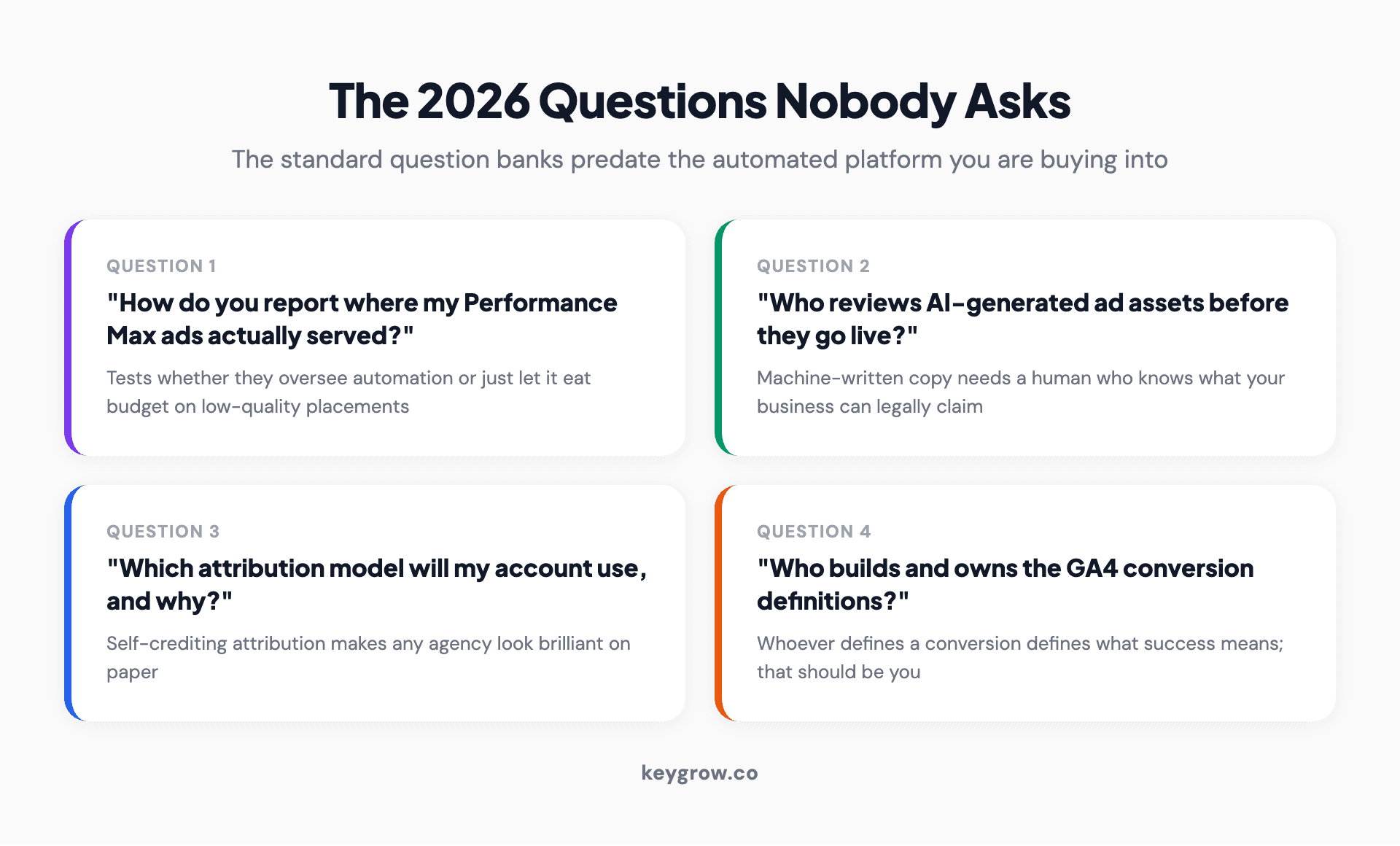
Four 2026-era questions to ask a PPC agency: how they report Performance Max placements and search themes, who reviews AI-generated ad assets before launch, which attribution model the account uses and why, and who builds and owns the GA4 conversion definitions.
Ask how they handle Performance Max transparency: Google added channel-level and full search-terms reporting to PMax in 2025, but placement detail is still thinner than standard campaigns, so ask what they watch to keep an automated campaign from quietly eating the budget on low-quality placements. Ask who reviews AI-generated ad copy and assets before anything goes live, and whether Google's automated asset settings are on or off in their accounts, and why. Ask which attribution model your account will use and who decides what counts as a conversion in GA4. The answers matter less for their technical content than for whether the person across the table has answers at all.
An agency that cannot explain automation oversight in plain language will not be overseeing the automation.
The first 90 days, with walk-away triggers
No ranking guide covers what happens after you sign, which is exactly when most agency relationships quietly fail. Here is the timeline a competent engagement follows, and the moments that justify leaving.
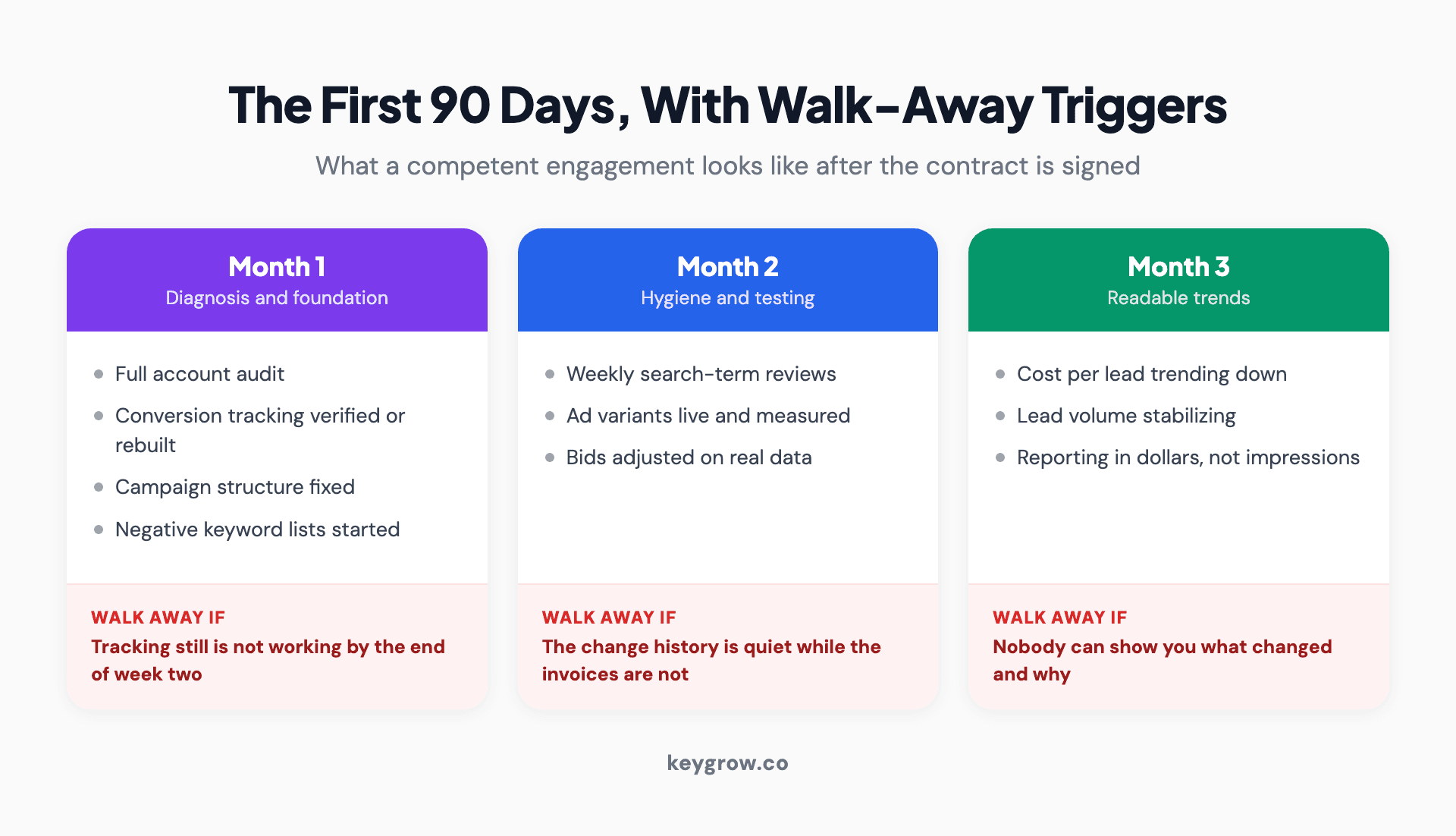
A 90-day PPC agency timeline with walk-away triggers: month one covers audit, tracking, and restructure with a trigger if conversion tracking is still missing by week two, month two covers search-term hygiene and testing with a trigger if the change history is empty, and month three covers readable cost-per-lead trends with a trigger if reports still lead with impressions.
Month one is diagnosis and foundation: a real audit, conversion tracking verified or rebuilt, campaign structure fixed, negative keywords started. If conversion tracking is not working by the end of week two, that is a walk-away trigger; everything downstream is guesswork without it.
Month two is hygiene and testing: weekly search-term reviews, ad variants running, bids adjusted on data. Check the change history yourself; you do not need permission. A quiet change log with an active invoice is the trigger here.
Month three is when trends become readable: cost per lead moving the right direction, volume stabilizing, a report that talks about money. We walked through why this timeline is what it is in how long PPC takes. The trigger at day 90 is not "results are imperfect," it is "nobody can show you what changed and why."
A detailing client of ours is the positive version of this arc: they arrived paying about $100 per booking from ads pointed at their homepage. Restructured campaigns and a dedicated booking page took them to $22 per booking, with bookings up 650 percent between August and December. That is what the first months look like when the work actually happens.

Two people working through an account plan on a whiteboard with a laptop in hand
Contracts are the most honest sentence an agency writes
Twelve-month lock-in contracts are a confession. If an agency needs a contract to keep you, the results are not doing it. That detailing account would have fired the previous setup by month two under a lock-in; month-to-month terms mean the agency re-earns the business every 30 days, which is the whole point.
Read three clauses before signing anything. Termination: how many days of notice, and does the agency keep billing through a notice period long enough to be a second lock-in. Ownership on exit: the ad account, its history, audiences, and conversion data stay yours; campaign data walking out the door with the agency is the expensive version of a bad breakup. And scope: what is included at the quoted fee, so "we can add that for an additional charge" does not become the relationship's theme song.
We run month-to-month, so read that opinion with the bias in mind. But notice the incentive it creates either way: an agency that can be fired next month has to keep proving the number every month.
When you should not hire a PPC agency at all
If your ad spend is under roughly $1,500 a month, the fee math above usually says freelancer or DIY. If your landing page does not convert, fix that first; an agency managing traffic into a leaking page is billing you to document a problem. And if nobody inside the business can define what a lead is worth, no agency can tell you whether $66 per lead is a triumph or a disaster; benchmark averages like LocaliQ's $5.42 CPC and $66.69 cost per lead, per LocaliQ's benchmarks, only mean something against your own economics.
Niche matters too. An agency that knows what an eviction filing or a dental implant lead is worth prices and filters differently from a generalist. If you run a practice, we wrote the dental-specific version of this guide in choosing a dental Google Ads agency, and the same logic extends to any specialized niche.
The scorecard
Copy this into your notes and score each agency on the call. Every "no" is a finding, not a dealbreaker; three or more is a pattern.
- Case study in my niche with before/after cost per lead in dollars
- Ad account stays in my name, on my billing, with my admin access
- Management fee and ad spend quoted as separate numbers
- Fee under about a quarter of my total monthly outlay
- Named person who runs my account weekly, and their account load
- Sample report that leads with cost per lead and revenue
- Clear answers on Performance Max oversight, AI asset review, GA4 conversions
- Month-to-month terms, or a lock-in they can justify out loud
- Exit clause: my data, my account, 30 days or less notice
- No guaranteed rankings, placements, or results anywhere in the pitch
FAQs
How much does it cost to hire a PPC agency?
Typical structures run $100 to $149 per hour, 15 to 30 percent of monthly ad spend, or flat monthly fees that vary with scope. On top of the fee you need enough ad budget that the fee stays under roughly a quarter of total outlay, which for most small businesses means $1,500 or more in monthly spend before an agency makes sense.
Who should own the Google Ads account, the client or the agency?
The client, without exception. The account, its billing, its history, and its conversion data belong to the business; the agency works inside it with manager access. An agency that insists on running ads from its own account is holding your data hostage for the exit.
What are the biggest red flags when choosing a PPC agency?
Guaranteed results, refusal to give you admin access to your own account, reports that lead with impressions instead of cost per lead, bundled pricing where the fee and ad spend blur together, and long lock-in contracts. Each one shifts risk from the agency to you.
Do Google Ads certifications matter when picking an agency?
They are a floor, not a differentiator. Partner status requires a 70 percent optimization score, $10,000 in managed spend over 90 days, and certified staff, which many small operations clear. Ask what evidence sits above the badge: niche case studies, change-history activity, and reporting quality.
How long should I give a PPC agency before judging results?
Ninety days is the fair window for a verdict, but process is judgeable much earlier. Conversion tracking should work by week two, the change history should show weekly activity from month one, and by month three cost per lead should be trending the right way with a report that talks in dollars.
Should I hire a freelancer or a PPC agency?
Budget decides. Under roughly $1,500 a month in ad spend, a good freelancer usually wins on math because agency fees eat too much of a small budget. Agencies earn their fee when the account is bigger, spans several campaign types, or needs landing pages, tracking, and creative handled as one system.
The last honest note
You now have more vetting criteria than most agencies' own sales teams prepare for, and every item on the scorecard is checkable evidence rather than charm. If you want to run it against us, tell us about your business and ask anything on the list. Month-to-month, your account stays yours, and if your budget math says an agency is premature, we will tell you that on the first call.