


Does PPC work for B2B? Yes, for most B2B companies, and the reason is arithmetic: when a single customer is worth $20,000 to $200,000 over their lifetime, a $300 lead and a $2,000 acquisition cost are bargains, not extravagances. That same math is why PPC fails for a predictable minority of B2B businesses, and this post names exactly who, with the cost benchmarks and the long-sales-cycle fixes the rest of the internet leaves out. (For the general version of the calculation, see whether PPC is worth it.)
B2C ecommerce often lives or dies on an order well under $100, so a $75 acquisition cost is a catastrophe. Flip the lifetime value to six figures and the entire calculation inverts. Understanding that inversion is most of understanding B2B PPC.
Why the economics usually favor B2B
The 20-second version: high lifetime value means B2B can profitably pay for clicks and leads at prices that would bankrupt a B2C store, so expensive-looking PPC is often cheap relative to what it returns.
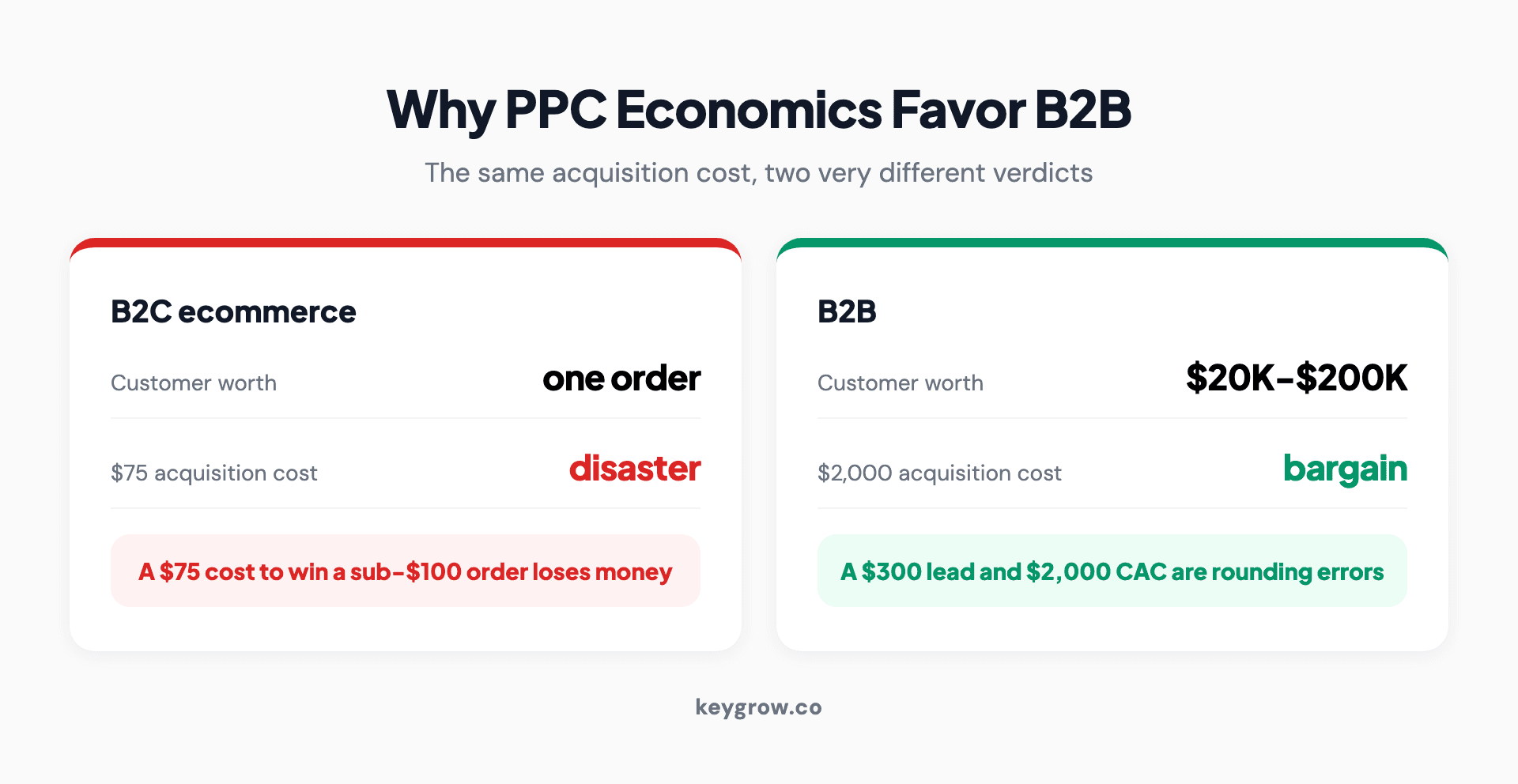
Why PPC economics favor B2B: a B2C ecommerce order worth about $85 cannot absorb a $75 acquisition cost, while a B2B customer worth $20,000 to $200,000 over their lifetime profitably absorbs a $300 lead and a $2,000 acquisition cost.
Work it backwards, which is the only correct direction. Start with lifetime value, apply the margin and close rate you actually see, and the acceptable cost per lead falls out. A company closing 20 percent of qualified leads into $50,000 customers can pay well over $500 per qualified lead and still print money. The mistake is judging a B2B lead by B2C instinct, panicking at a $200 cost per lead that is, in context, a rounding error.
This is also why niche focus wins. An agency that knows a qualified demo request from your category is worth $400 will out-bid a generalist who flinches at anything over $50. Industry context is a targeting advantage, not a nice-to-have.
Where B2B PPC actually differs from B2C
Same platforms, different physics. Five differences change every decision downstream.
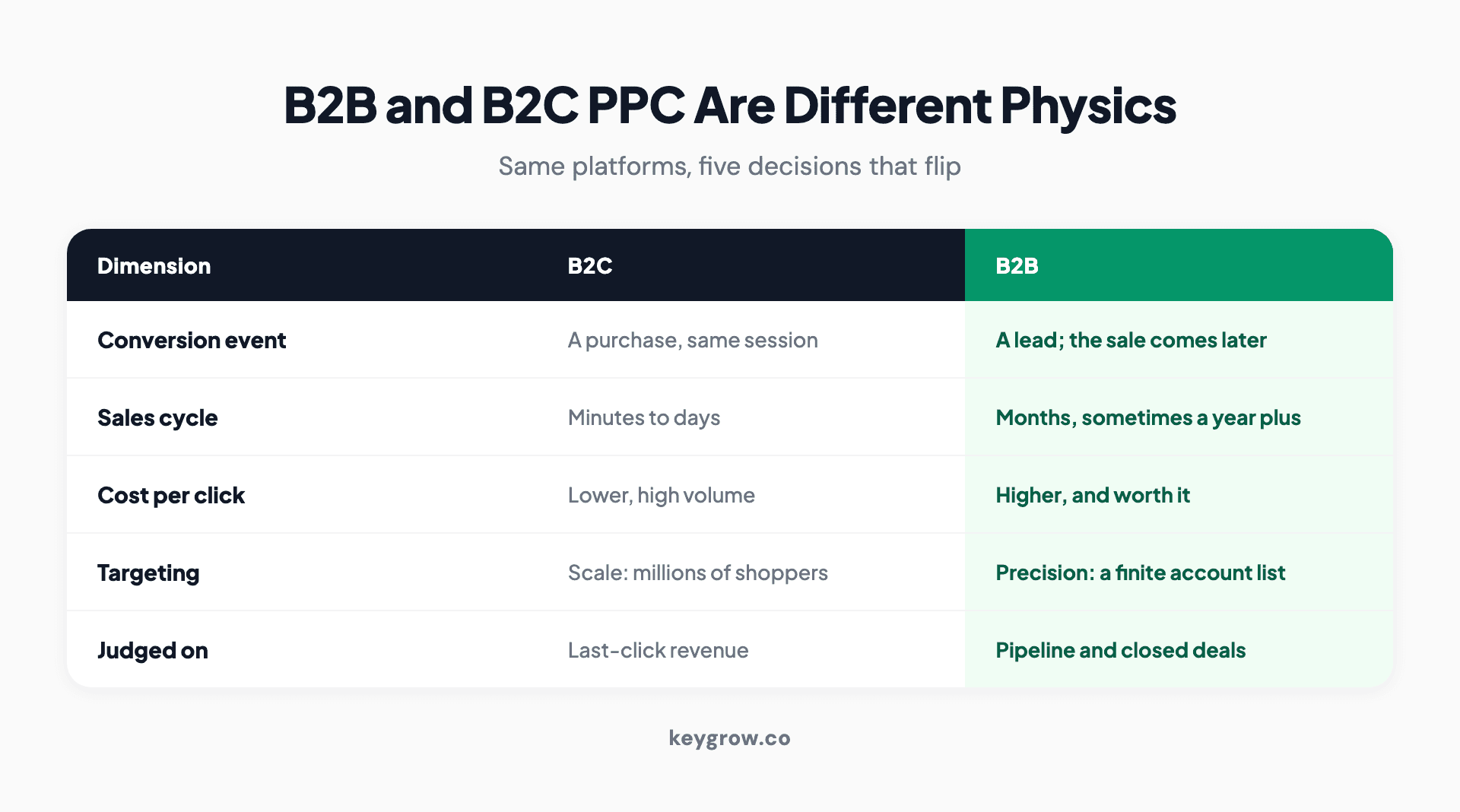
Five ways B2B PPC differs from B2C: the conversion event is a lead not a sale, sales cycles run months not minutes, cost per click is higher and worth it, targeting is precision over scale, and success is judged on pipeline not last-click revenue.
The conversion event is a lead, not a purchase; nobody buys $80,000 software from an ad in one session. Sales cycles run months, so the click and the closed deal live in different quarters. Clicks cost more because the keywords are commercial and the buyers are scarce. Targeting favors precision over reach, because your total addressable market might be 4,000 companies, not four million shoppers. And success is measured on pipeline and closed revenue, never on last-click conversions that fire the moment someone downloads a guide.
Miss that last point and you will kill winning campaigns for looking expensive on a metric that was never the goal.
What B2B PPC actually costs
Every guide ranking for this question dodges the numbers. Here they are, with the honest caveat that averages hide enormous variance by niche.
Across industries, the average search click runs $5.42 and the average cost per lead is $66.69 in LocaliQ's 2026 benchmarks. B2B verticals sit above those averages: competitive B2B keywords routinely clear $10 to $20 a click, and a qualified B2B lead frequently costs $100 to $400 depending on deal size and category. That looks alarming next to B2C until you put it beside a six-figure lifetime value.
| Channel | What it is good at | Cost posture |
|---|---|---|
| Google Search | Capturing active buying intent ("erp software for manufacturers") | Higher CPC, highest intent |
| Professional network ads | Targeting by job title, company, and industry | High CPC, unmatched precision |
| Retargeting (Display, video) | Staying visible across a months-long cycle | Cheap impressions, multi-touch glue |
| Bing / Microsoft Search | Reaching corporate desktops, often cheaper clicks | Lower CPC, smaller volume |
Search captures the person already looking; the professional networks reach the person who fits your ideal customer profile but has not searched yet. Most working B2B programs run both, with retargeting underneath to survive the sales cycle. Whatever the channel, send the click to a purpose-built page, never the homepage; that is the single most expensive default in PPC, and we covered the fix in our landing page guide.
Solving the long sales cycle, not just naming it
The competitors all mention long sales cycles and then change the subject. Here is the actual mechanism. The organic counterpart, where the influence never shows up as a click at all, is covered in LinkedIn marketing for B2B.
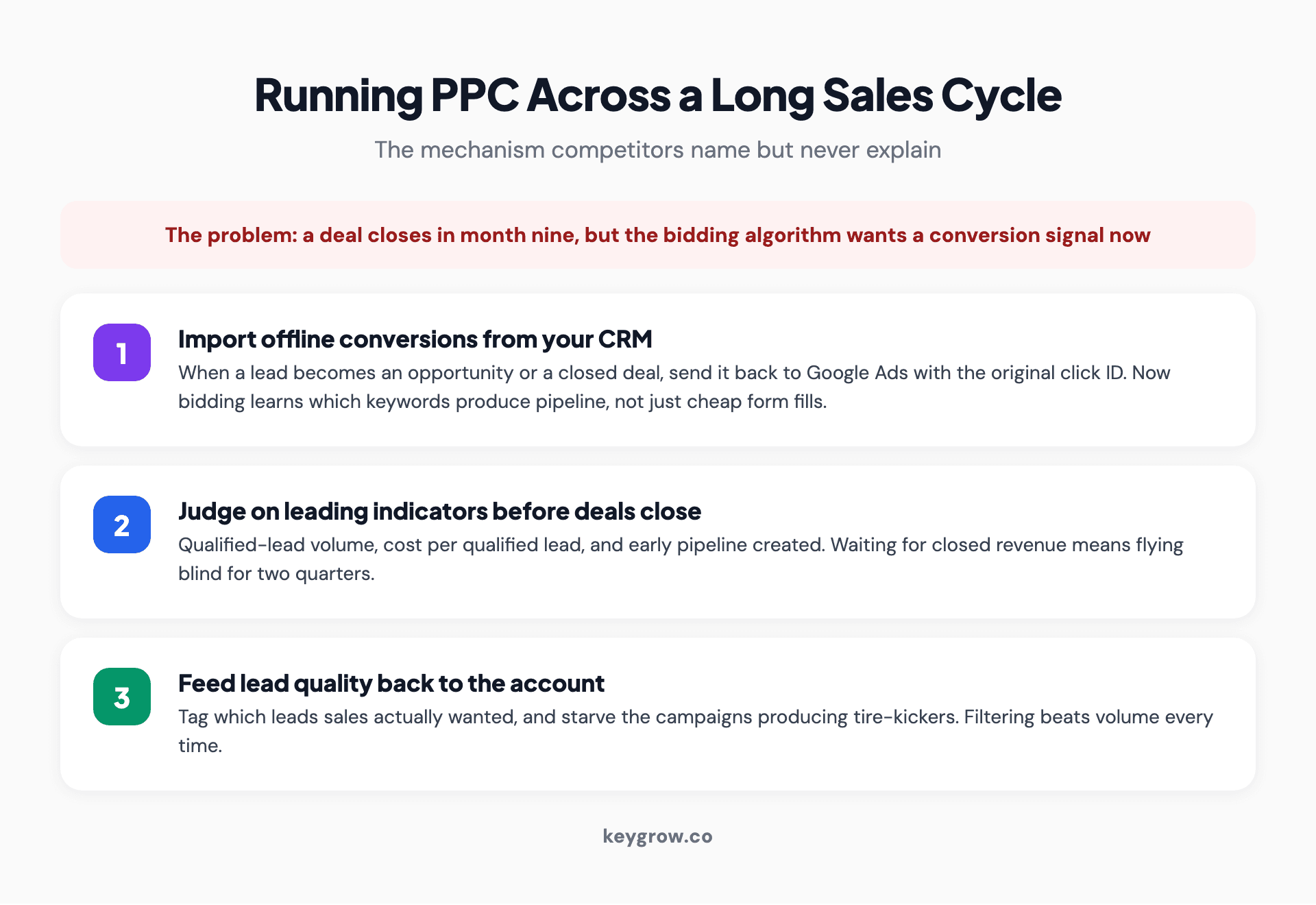
How to run B2B PPC across a long sales cycle: import offline conversions from your CRM so Google learns which clicks became pipeline and revenue, judge campaigns on early pipeline signals before deals close, and feed lead quality back so bidding optimizes for qualified leads not raw form fills.
The problem: a deal closes in month nine, but Google's algorithm wants a conversion signal now. Solve it with offline conversion import (Google now also offers Enhanced Conversions for Leads for the same purpose). When a lead becomes an opportunity or a closed deal in your CRM, send that event back to Google Ads tied to the original click. Now Smart Bidding learns which keywords and audiences produce pipeline and revenue, not just which produce cheap form fills. Those first-party audiences come straight from your analytics, as we cover in Google Ads audiences from Analytics. This one integration separates B2B programs that compound from those that plateau.
While deals mature, judge campaigns on leading indicators: qualified-lead volume, cost per qualified lead, and early pipeline created. Waiting for closed revenue to evaluate a campaign means flying blind for two quarters. And feed lead quality back manually if you must: tag which leads sales actually wanted, and starve the campaigns producing tire-kickers. More traffic is the wrong fix for bad lead quality; filtering beats volume, and it is exactly how we took one client to a 600 percent lift in serious leads on the same budget by tightening targeting and qualifying language rather than spending more.
When PPC does not work for B2B
The honest checklist nobody else writes. If two or more of these describe you, fix them before funding ads or skip PPC entirely.
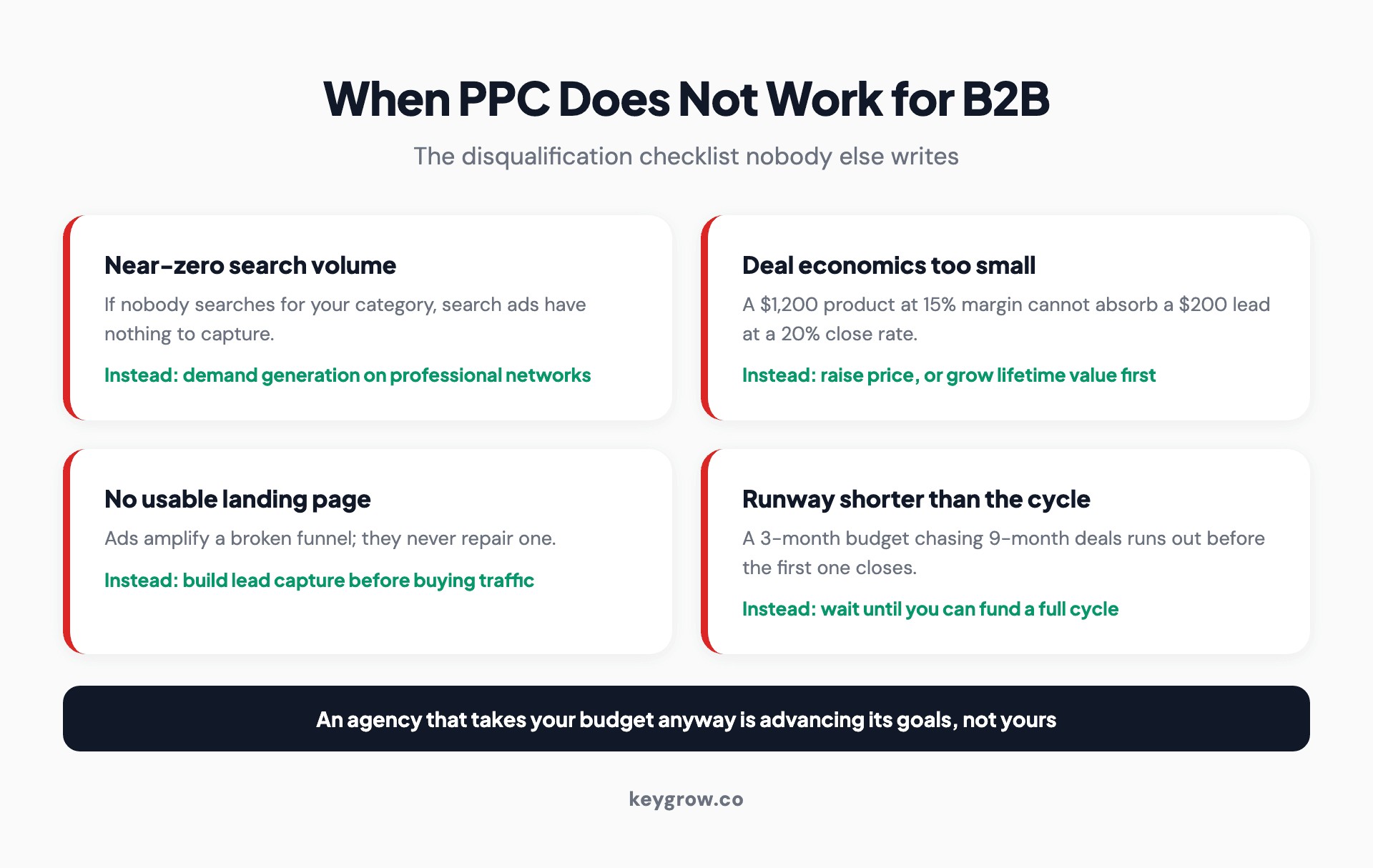
Four situations where PPC does not work for B2B: near-zero search volume for the category, deal economics too small to absorb a $100-plus cost per lead, no usable landing page or lead capture, and a runway under three months when the sales cycle is longer.
Near-zero search volume is the first killer. If you sell something so new or so niche that nobody searches for it, search ads have nothing to capture; you need demand generation on the professional networks, not demand capture on Google. Deal economics too small is the second: if your product sells for $1,200 with a 15 percent margin, a $200 lead at a 20 percent close rate loses money on contact. Third, no usable landing page or lead capture, because ads amplify a broken funnel instead of fixing it. And fourth, a runway shorter than your sales cycle; spending a three-month budget chasing nine-month deals runs out of money before the first one closes.
None of these is a character flaw. They are reasons to spend the money elsewhere until the situation changes, and an agency that takes your budget anyway is advancing its goals, not yours.
The small-B2B playbook
The pillar guides all write for enterprises with five-figure monthly budgets. Most B2B companies are not that. If you are running $1,500 to $5,000 a month, here is what that realistically buys.
Concentrate. A small budget spread across Search, professional networks, and retargeting funds none of them enough to learn. Pick the one channel matching your buyer's behavior, usually Google Search on your highest-intent keywords, and run it well. Expect the first two to three months to be tuition: the learning phase and the sales cycle mean early numbers are noise, a reality we detailed in how long PPC takes. Payback in B2B is measured in quarters, not weeks, because the deal that justifies the spend closes long after the click.
At this budget, DIY is a legitimate choice if you have the hours. Where our PPC management earns its fee is on the integration work, offline conversion import, lead-quality feedback loops, and account structure, that small teams rarely have time to build. If you do hire, the vetting questions apply doubly here: a generalist who does not understand pipeline attribution will optimize your account toward cheap, useless leads.
FAQs
Does PPC lead generation actually work for B2B?
Yes for most B2B companies, because high lifetime values make even $100 to $400 leads profitable. It works best with offline conversion tracking, purpose-built landing pages, and patience across the sales cycle. It fails for businesses with near-zero search volume, tiny deal sizes, or no working lead-capture funnel.
How does B2B PPC differ from B2C PPC?
The conversion event is a lead rather than a sale, sales cycles run months instead of minutes, clicks cost more, targeting favors precision over scale, and success is judged on pipeline and closed revenue rather than last-click conversions. Applying B2C instincts to B2B budgets is the most common way to kill a working campaign.
Which works better for B2B, Google Ads or professional network ads?
They do different jobs. Google Search captures people actively searching for a solution, which is the highest-intent traffic available. Professional network ads reach people who match your ideal customer profile but have not searched yet. Most effective B2B programs run both, with retargeting underneath to stay visible across the cycle.
How much does B2B PPC cost per lead?
Cross-industry averages sit around $5.42 per click and $66.69 per lead, but competitive B2B verticals run higher: often $10 to $20 per click and $100 to $400 per qualified lead. Whether that is expensive depends entirely on your customer lifetime value, which in B2B is frequently $20,000 or more.
How long does B2B PPC take to show results?
Leads can arrive within weeks, but judging the program takes a quarter or more because the sales cycle delays closed revenue. Expect the first two to three months to be a learning and calibration phase, then evaluate on pipeline created before deals actually close.
What metrics should B2B marketers track for PPC?
Cost per qualified lead, cost per opportunity, pipeline created, and eventually customer acquisition cost against lifetime value. Raw form fills and last-click conversions flatter the account without predicting revenue. The goal is connecting ad spend to closed deals through CRM data, not counting downloads.
The bottom line
PPC works for B2B whenever your lifetime value can absorb a lead that looks expensive next to B2C, your category has search demand, and you can track a click through to pipeline. It does not work when the deal economics are too small, the search volume is not there, or the runway is shorter than the sales cycle. Everything in between is execution.
If you want that execution handled by people who build the CRM integration and lead-quality loops rather than just running ads, tell us about your business. Month-to-month, and if your deal math says PPC cannot work yet, that is the first thing we will tell you.