


Two businesses are bidding on "emergency plumber dallas" at 11pm. One ad reads "Quality Plumbing Services | Family Owned | Contact Us Today." The other reads "Dallas Emergency Plumber | At Your Door in 90 Min | Upfront Price Before We Start." Same auction, similar bids, very different night.
That gap is the whole subject. Here is how to write compelling ad copy for PPC ads, compressed into one paragraph: mirror the exact thing the person searched, make one concrete promise with a number in it, name the reason you are the safer choice, qualify the click so the wrong people scroll past, and let the search term set the call to action. The rest of this guide is how you execute that inside Google's current ad format, with a full worked rebuild, the disapproval traps that catch punchy copy, and a testing method that does not require guessing.
One warning before the fun part: most advice ranking for this topic still teaches ad formats Google retired years ago. If a guide tells you to write one 25-character headline and two 35-character description lines, it is describing a format that has not accepted new ads since 2017.
Know the canvas: responsive search ads
You are not writing "an ad." You are writing parts for a machine that assembles ads. We cover how many responsive search ads to run in a separate guide. A responsive search ad takes up to 15 headlines of 30 characters and 4 descriptions of 90 characters, then mixes and matches them per auction, showing up to three headlines and two descriptions at a time, per Google's RSA documentation.
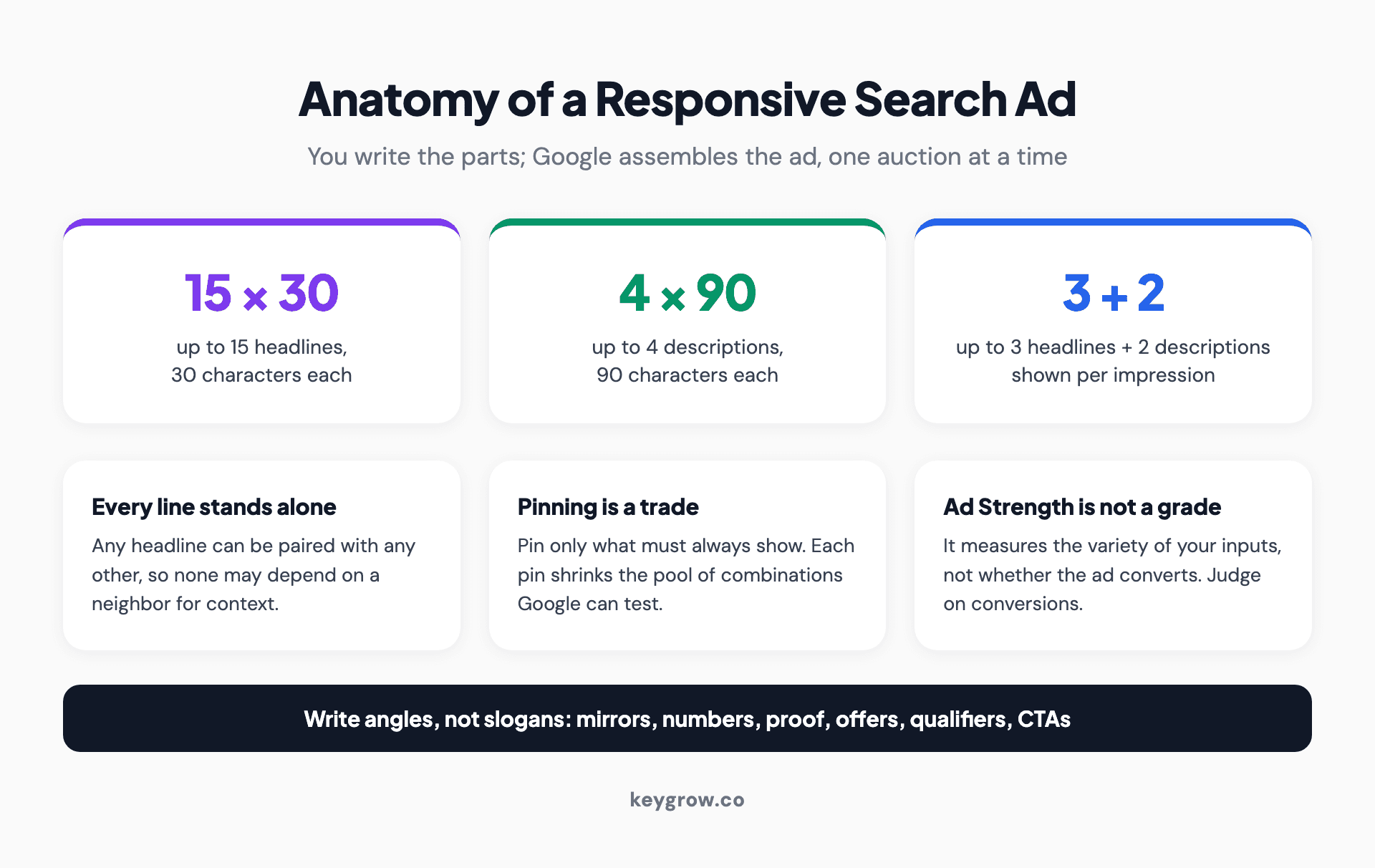
Anatomy of a responsive search ad: up to 15 headlines of 30 characters each, 4 descriptions of 90 characters each, Google assembles up to 3 headlines and 2 descriptions per impression, with optional pinning to lock a headline to position one.
Three consequences follow, and they change how you write.
Every headline must stand alone. Google can pair headline 3 with headline 11, so no headline gets to depend on another one for context. "And We Do Gutters Too" dies in most combinations.
Pinning is a trade with teeth. You can pin your brand or offer headline to position one so it always shows, but every pin shrinks the pool of combinations Google can test. Pin the one thing that is legally or commercially required, and leave the rest loose.
Ad Strength is a diversity meter, not a report card. "Excellent" means you gave the machine varied inputs; it is not a prediction that the ad converts. Chase conversions, not the label.
Start from the search term, not your brand
The searcher's own words are the most persuasive words available. An ad for "drain cleaning" that says "Drain Cleaning" outperforms a prouder ad that says "Full-Service Plumbing Solutions" because the first one confirms, in the first half-second, that the click leads somewhere relevant.
This is also why account structure quietly writes your copy. If one ad group holds forty loosely related keywords, no single ad can mirror them all; we covered that failure mode in our keyword bloat post. Tight ad groups make relevant copy possible, and relevant copy is most of what "compelling" means in search.
The mirror extends past the click. The headline promise, the landing page headline, and the form on that page should read like three sentences from the same person. We broke down that handoff in our landing page guide.
Write 15 headlines that survive any shuffle
Fifteen headlines sounds like a lot until you stop trying to write fifteen slogans and start covering angles. A working spread looks like this: three or four keyword mirrors, three concrete benefits with numbers, two trust signals, two offer or price lines, two calls to action, and one or two qualifiers that repel bad fits.
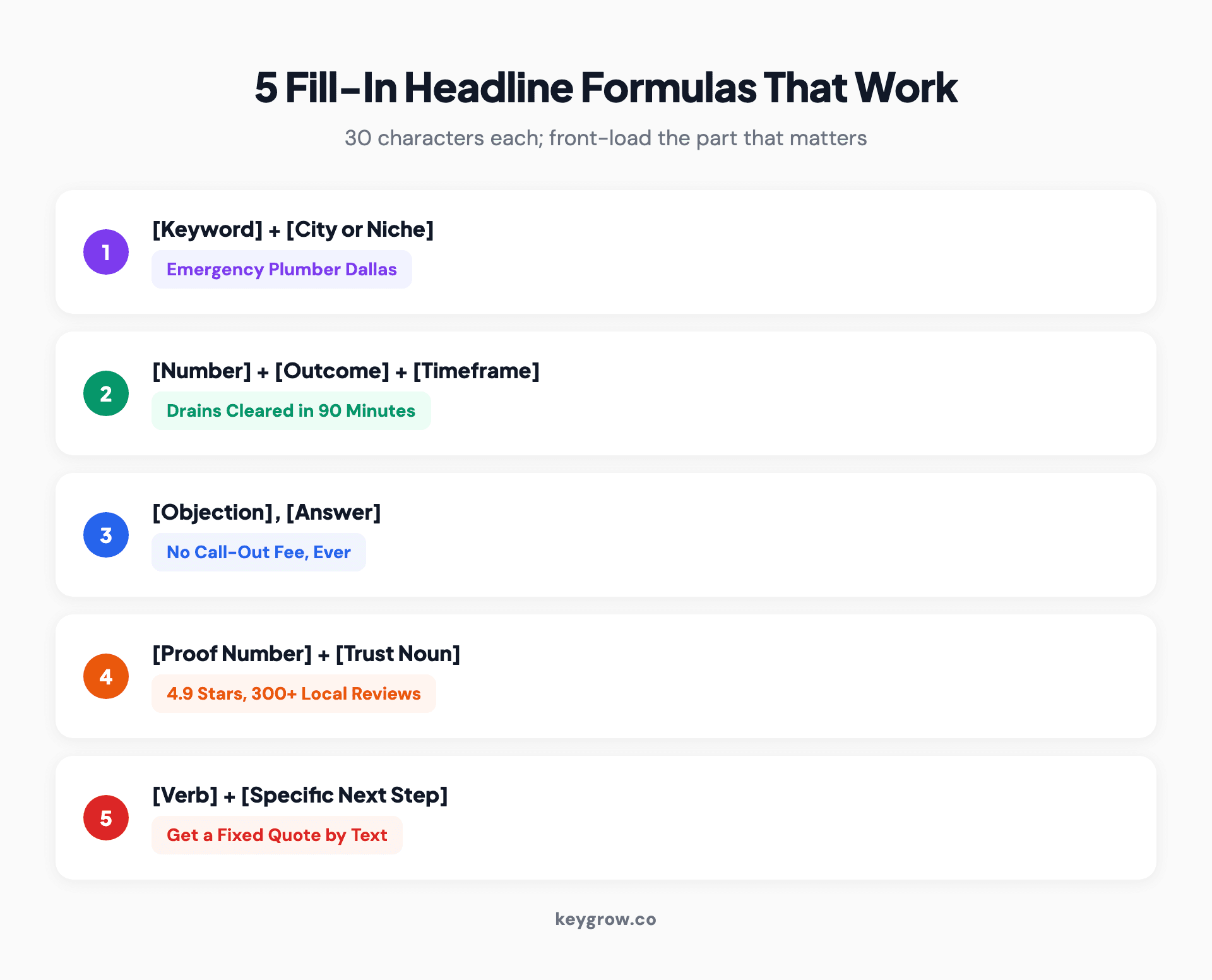
Five fill-in headline formulas for PPC ads with worked examples: keyword plus qualifier, number promise, objection killer, proof line, and direct call to action.
Front-load every one of them. On mobile, the end of a headline is the first thing truncation cuts. "90-Minute Emergency Response" survives the trim better than "We Will Respond Within 90 Minutes."
Formulas beat staring at a blank field. Steal these five:
| Formula | Worked example |
|---|---|
| [Keyword] + [City or Niche] | Emergency Plumber Dallas |
| [Number] + [Outcome] + [Timeframe] | Drains Cleared in 90 Minutes |
| [Objection], [Answer] | No Call-Out Fee, Ever |
| [Proof number] + [Trust noun] | 4.9 Stars, 300+ Local Reviews |
| [Verb] + [Specific next step] | Get a Fixed Quote by Text |
Numbers in that second slot matter more than adjectives anywhere else. David Ogilvy's rule that five times as many people read the headline as read the body, kept in circulation by Copyblogger's Ogilvy retrospective, was written for print, but the asymmetry is worse in search ads, where the headline is nearly the entire ad.
The rebuild: one weak ad, redone in full
No page ranking for this keyword shows a complete ad, so here is one. The "before" is a composite of what we see in most small-business audits.
Before (three headlines, one description, all vague):
| Slot | Copy |
|---|---|
| Headline 1 | Quality Plumbing Services |
| Headline 2 | Family Owned and Trusted |
| Headline 3 | Contact Us Today |
| Description | We offer a wide range of plumbing services for your home or business. Call us today. |
After (a 10-headline starter set plus two descriptions):
| Slot | Copy | Angle |
|---|---|---|
| H1 (pinned) | Dallas Emergency Plumber | keyword mirror |
| H2 | At Your Door in 90 Minutes | number promise |
| H3 | Upfront Price Before We Start | objection killer |
| H4 | Open Now, 24/7 Dispatch | availability |
| H5 | 4.9 Stars From Dallas Homeowners | proof |
| H6 | Burst Pipe? We Answer First Ring | scenario |
| H7 | No Call-Out Fee | offer |
| H8 | Licensed and Insured Techs | trust |
| H9 | Get a Fixed Quote by Text | CTA |
| H10 | Water Heaters Fixed Same Day | service depth |
| D1 | Talk to a live dispatcher in seconds. Flat, written quote before any work starts. | process clarity |
| D2 | Dallas crews on call around the clock. If we can't fix it on the spot, you don't pay a trip fee. | risk reversal |
Read the before-ad once more. Nothing in it is false. It is just information-free: no place, no time, no price posture, no reason to pick them over the ad above or below. Compelling copy is mostly the discipline of replacing adjectives with facts.
Qualify the click before you pay for it
An ad's job is not to win every click. Clicks cost money; the job is winning the right ones. Copy that names your price floor, your service area, or your specialty repels the people who were never going to buy, and that shows up directly in cost per lead.
A cash home buyer we worked with was drowning in junk leads from people who wanted retail price for pristine houses. Part of the fix was qualifying language in the ads themselves, alongside negative keywords and tighter match types. Serious leads rose 600 percent between December and January on the same budget. More traffic is the wrong fix for bad lead quality, and it is the fix most accounts reach for first. Filtering beats volume.
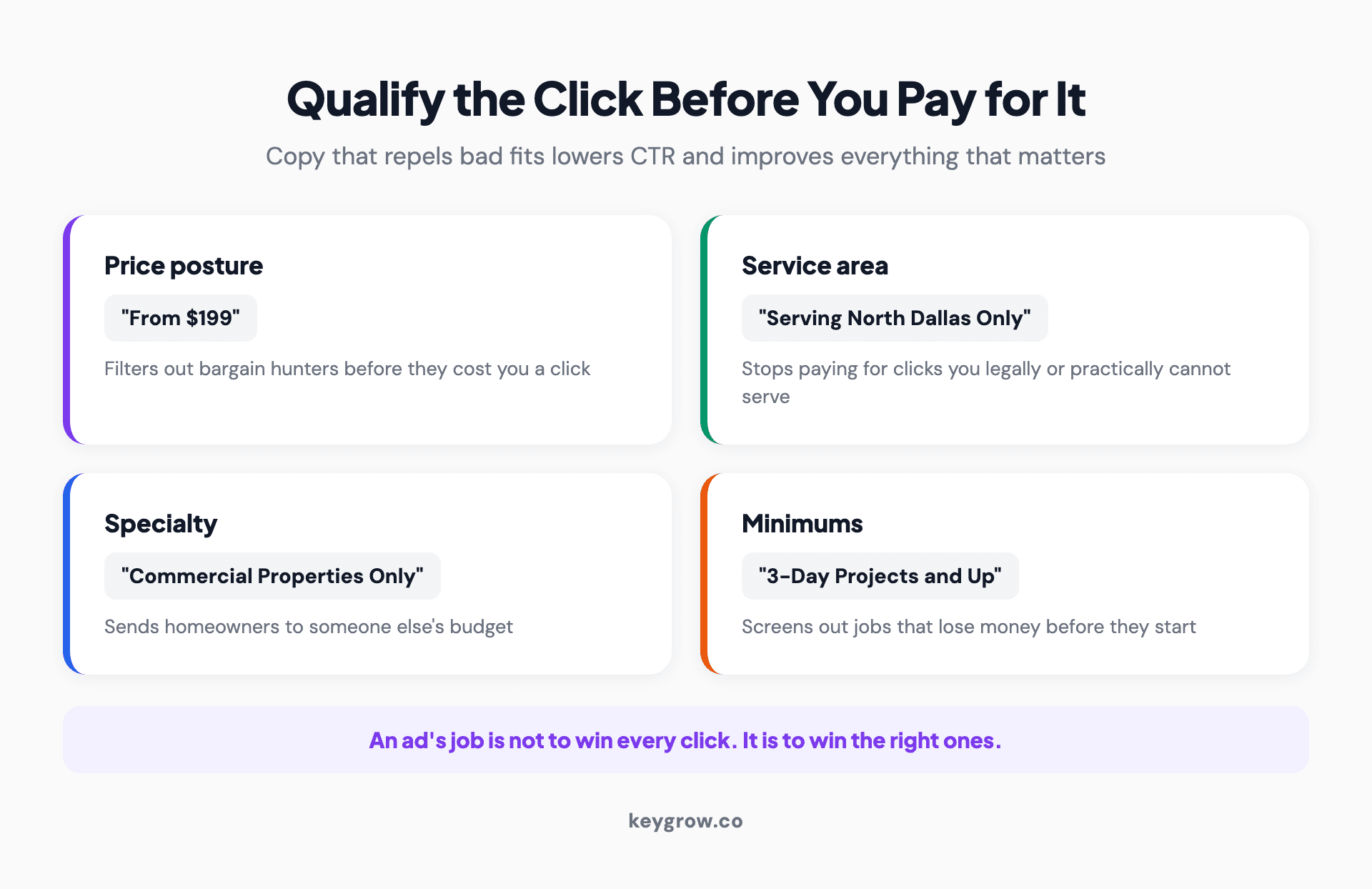
Ad copy qualifiers that filter out bad-fit clicks before you pay: price posture, service area, specialty, minimums, and who the service is not for.
The tools are plain: "From $199" filters bargain hunters. "Commercial Properties Only" filters homeowners. "Minimum 3-Day Project" filters the one-hour jobs. Each of those lines lowers click-through rate and improves everything you actually bank.
Match the call to action to the search, not to your funnel
"Buy Now" under a research query is a stranger proposing marriage. The search term tells you the temperature, and the CTA should match it.
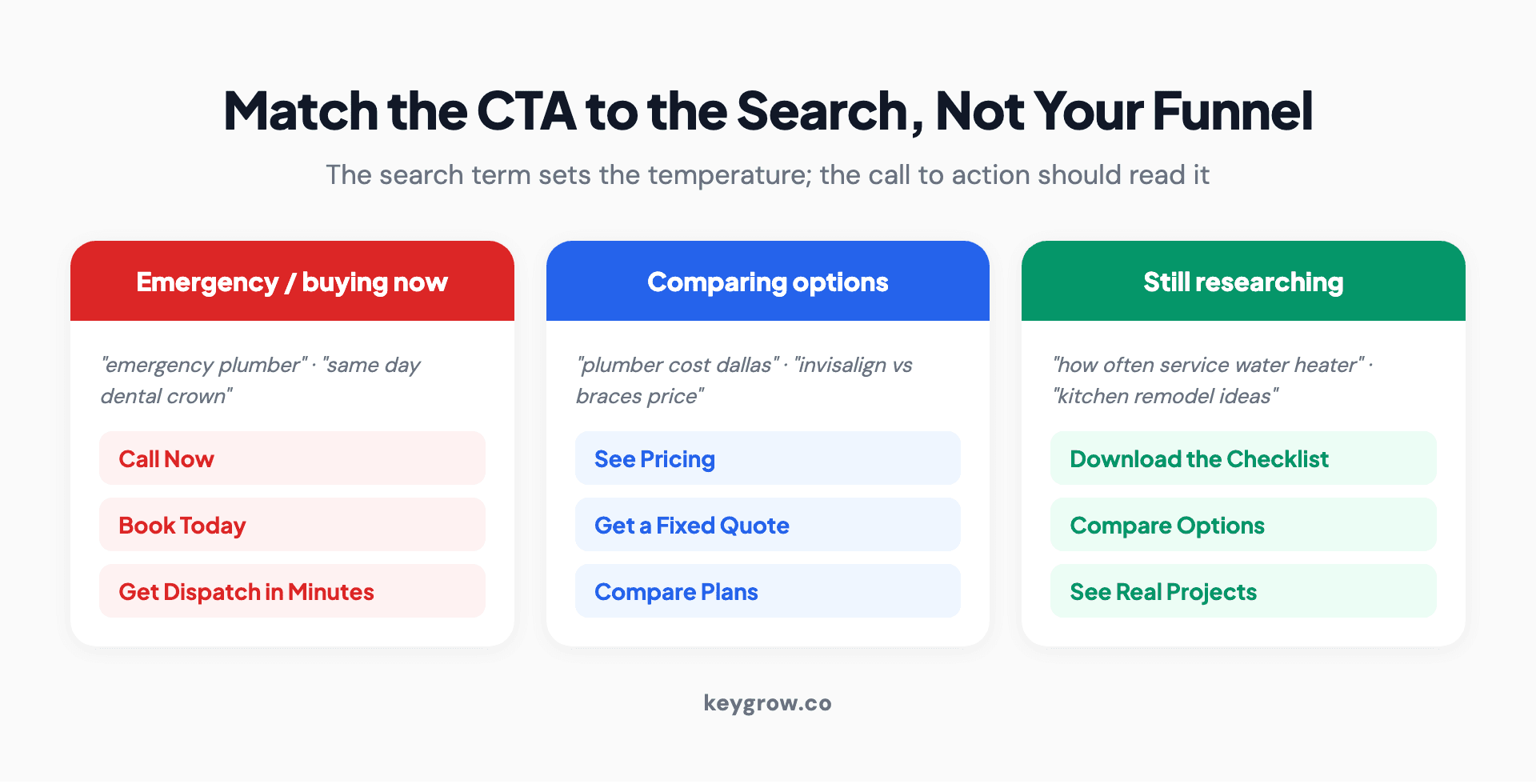
How to match a PPC call to action to search intent: emergency searches get immediate-action CTAs, comparison searches get quote and pricing CTAs, research searches get guide and checklist CTAs.
Emergency and near-purchase searches ("emergency plumber," "same day dental crown") earn direct action: Call Now, Book Today, Get Dispatch. Comparison searches ("plumber cost dallas," "invisalign vs braces price") earn commitment-free steps: See Pricing, Get a Fixed Quote. Research searches earn the lightest touch: Download the Checklist, Compare Options.
Urgency belongs in this section with a leash on it. A countdown customizer on a real end-of-month offer is honest and effective. "Limited Time" on an offer that has run since 2019 is the kind of thing that gets screenshotted.
The disapproval traps that catch punchy copy
Write copy the way most copywriting guides teach and Google's policy reviewer will bounce it before a human ever sees it. The rules that surprise people most, per Google's editorial policy: punctuation and symbols have to be used for their intended purpose, which outlaws repeated marks like "Best deal??", gimmicky patterns like "F.L.O.W.E.R.S.", and stars or arrows doing emphasis work. Capitalization gets the same test; "FREE ESTIMATE" reads as shouting to the reviewer too.
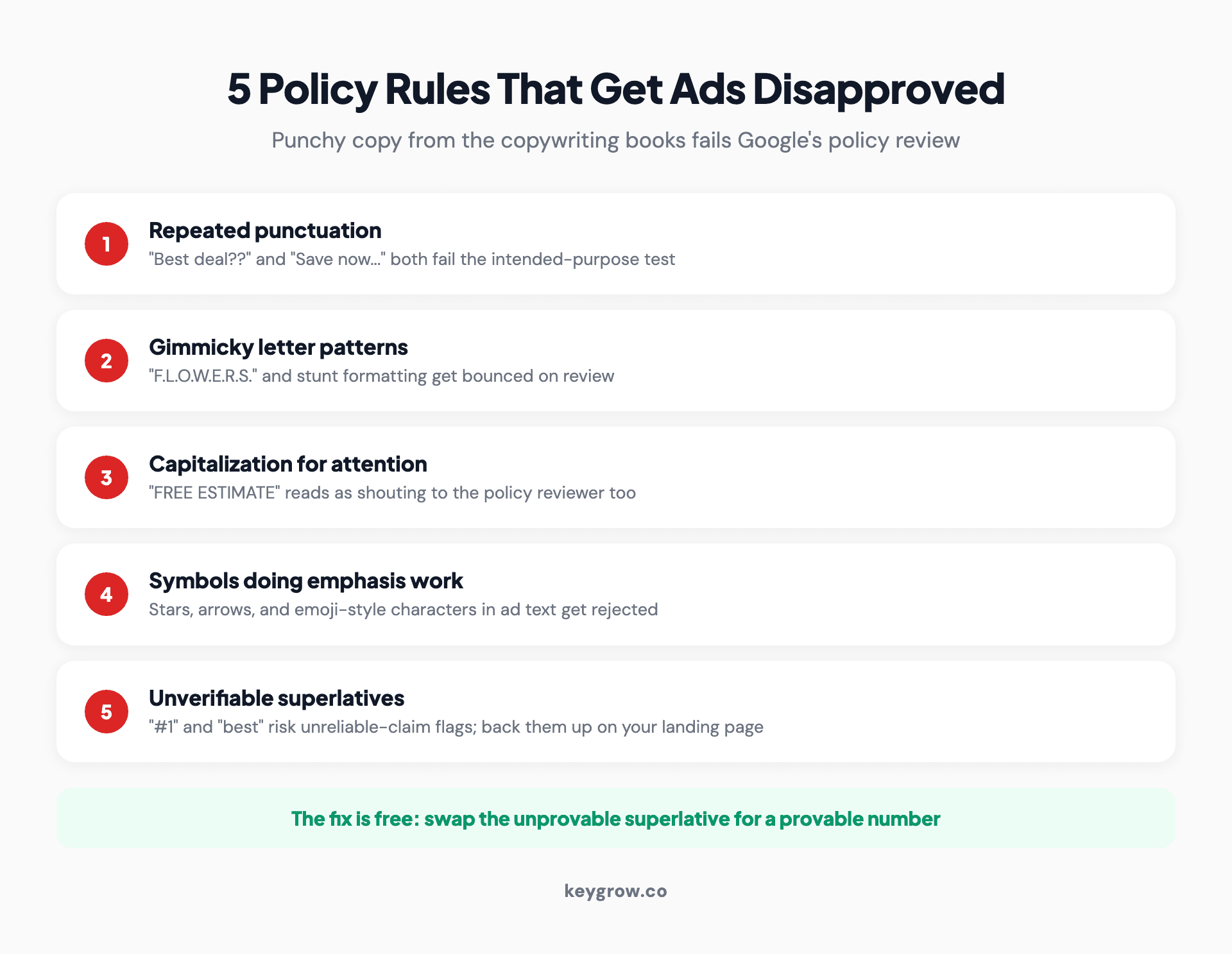
Five Google Ads policy rules that get ad copy disapproved: repeated punctuation, gimmicky letter patterns, capitalization used for attention, symbols doing emphasis work, and unverifiable superlative claims.
Superlatives get their own trap, under a different policy. "#1 Plumber in Dallas" can be flagged as an unreliable claim under Google's misrepresentation rules, and you will not win that review unless the ranking is backed up somewhere a reviewer can see, starting with your landing page. The fix costs nothing: swap the unprovable superlative for a provable number. "Voted Best Plumber 2025" needs a citation; "300+ Five-Star Reviews" just needs to be true.
We write our blog without exclamation marks for taste reasons. Google polices attention-grab punctuation for policy reasons. Either way the lesson holds: if the copy needs the punctuation to feel exciting, the copy is not done.
Use AI to draft, keep a human on final cut
Most PPC copy in 2026 starts life in a chat window, and that is fine. Fifteen headline slots is a brainstorming problem, and AI is a good brainstormer: feed it the search terms, your offer, your price posture, and the formulas above, and ask for thirty candidates. Expect to keep eight.

A marketer typing at a laptop by a window, working through draft ad copy variations
The editing pass is where the ad gets written. AI drafts regress to the mean of every ad ever written, which means your competitors' AI drafts sound identical. The lines worth keeping are the ones only your business could say: your response time, your fee structure, your review count, the objection you hear on every first call. Our ad title generator and description generator are built around that workflow, formulas first, specifics second.
One platform setting deserves attention here: text customization, which Google formerly called automatically created assets, lets the system write additional headlines and descriptions on your behalf, pulled from your landing page and domain. Review what it generates or switch it off at the campaign level. A machine paraphrasing your homepage does not know which claims you can legally make.
Test one variable, judge on conversions
Every ranking page for this keyword says "always be testing," and none of them says how. The how: change one meaningful variable at a time (the offer, the price posture, the CTA), run the variant against the original with Google's ad variations or a campaign experiment, and do not call a winner on click-through rate.
CTR is a popularity contest; you bank conversions. An ad that draws fewer, better clicks routinely beats a crowd-pleaser on cost per lead, which is the number that pays rent. Give the test enough conversions to mean something before judging, a few dozen per arm at minimum. On a small budget that takes weeks, and the patience math is the same one we walked through in how long PPC takes.
The testing order matters too. Test the offer before the phrasing, the price posture before the adjectives, the CTA before the word order. Nobody ever doubled their lead volume by swapping "rapid" for "fast."
When you do not need help with this
If you run a single-location business with one core service, write the copy yourself. You have heard the exact words customers use on the phone, and that vocabulary is the raw material; an agency intern three time zones away does not have it. The formulas above plus one honest afternoon will beat most managed accounts' ad copy.
Bring in help when the structure outgrows the writing: multiple locations, dozens of ad groups, seasonal offers that need customizers, or an account where nobody has run a controlled test in a year. At that point the bottleneck is systems rather than vocabulary, and that is a fair thing to pay for. Our PPC management runs month-to-month, so the copy has to keep earning its keep.
FAQs
What makes ad copy compelling in PPC?
Relevance and specificity. The ad should mirror the search term, make one concrete promise with a number in it, and give a reason to trust the click. Vague quality claims read as filler; facts like response time, price posture, and review counts do the persuading.
What are the character limits for Google Ads headlines and descriptions?
Responsive search ads allow up to 15 headlines of 30 characters each and 4 descriptions of 90 characters each. Google assembles up to three headlines and two descriptions per impression, so every line has to make sense in any combination.
Should you pin headlines in responsive search ads?
Pin only what must always show, usually a brand or compliance line in position one. Every pin reduces the combinations Google can test, so heavy pinning turns a responsive ad back into a static one and limits performance data. When you need a controlled answer rather than Google's automatic mixing, run a proper A/B test instead.
Should you use questions in PPC ad copy?
Sparingly, and only when the question mirrors the searcher's situation. "Burst Pipe at Midnight?" works because it names the emergency. Generic questions like "Looking for a Plumber?" waste characters restating the search itself.
How do you A/B test PPC ad copy?
Change one meaningful variable, run the variant against the control with ad variations or a campaign experiment, and judge on cost per conversion, not click-through rate. Wait for a few dozen conversions per arm before calling a winner; early leads reverse often.
How do you write ads that attract good leads instead of just clicks?
Add qualifiers that repel bad fits: price floors, service areas, minimums, and specialty lines. Click-through rate usually drops while conversion quality rises, and cost per qualified lead is the metric that matters.
Where this leaves you
Write the fifteen headlines from angles: mirrors, numbers, proof, offers, qualifiers, CTAs. Rebuild the descriptions around process clarity and risk reversal. Test the offer before the adjectives, and judge everything on conversions.
If you would rather hand the structure to someone who does this daily, tell us about your business and we will show you what your current ads are leaving in the auction.