


If you are here for the certification exam, here is the answer. How can Google Ads help you advance your business goals? By building awareness of your brand, influencing consideration of your products and services, and driving action: online sales, in-app sales, in-person sales, and over-the-phone sales. That is the framing Google teaches in its Skillshop certification, and it is the answer the exam is looking for.
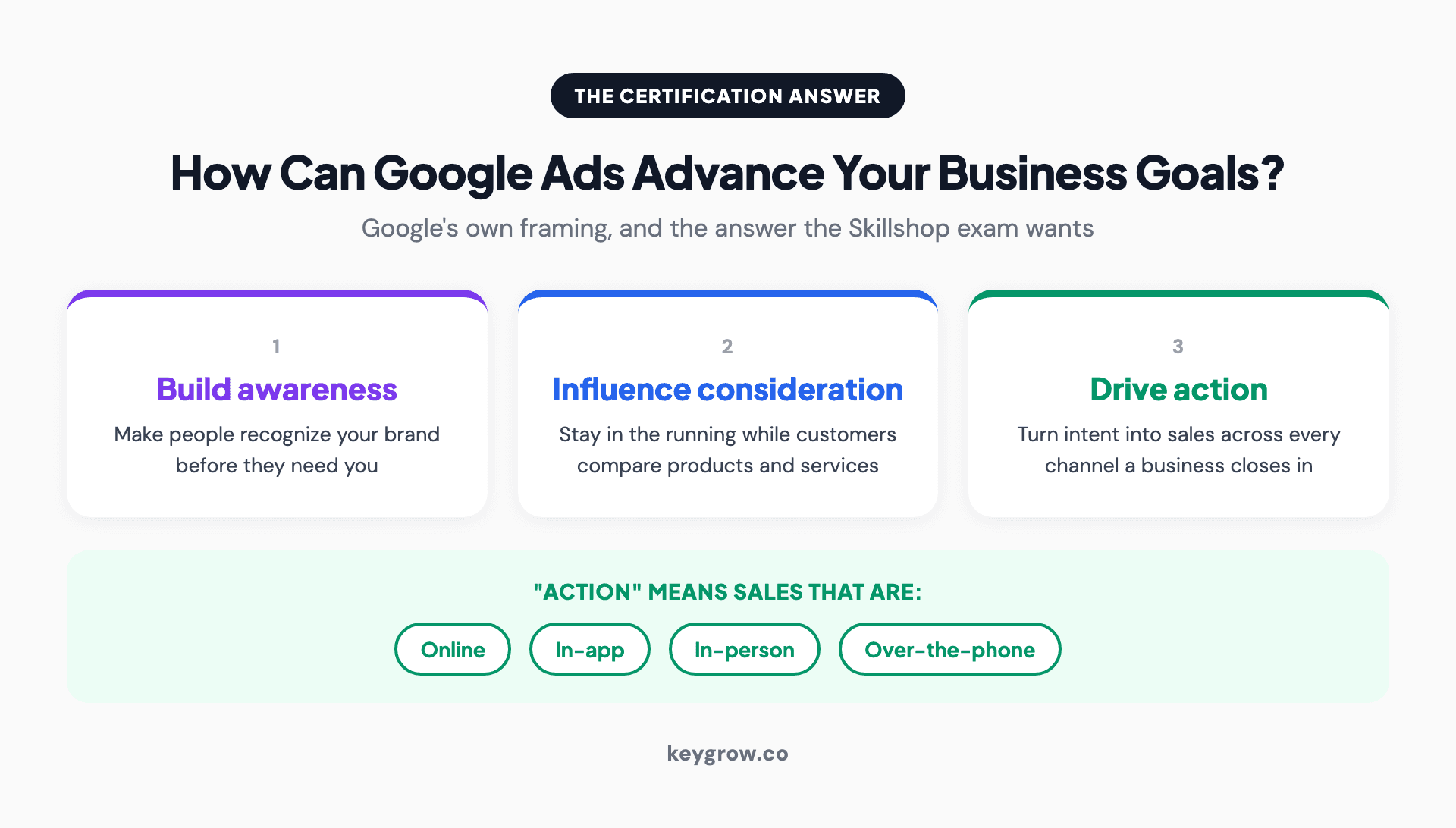
The official answer to how Google Ads can help you advance your business goals: build awareness of your brand, influence consideration of your products and services, and drive action through online, in-app, in-person, and over-the-phone sales.
If you own a business, that answer is true and useless in equal measure. The useful version is knowing which of those three goals to buy first, what each one costs, and when Google Ads will not advance your goals at all. That is the rest of this post.
The funnel is real, but you climb it backwards
Google's awareness, consideration, action framing describes how customers move. Inside the Ads interface itself those become campaign objectives like Sales, Leads, and Website traffic. Neither list describes how a small business should spend. Most local and service businesses should fund the stages in reverse: action first, consideration second, awareness last, if ever. Action campaigns pay for the others; run them the other way around and the budget dies before it reaches the part that produces revenue.
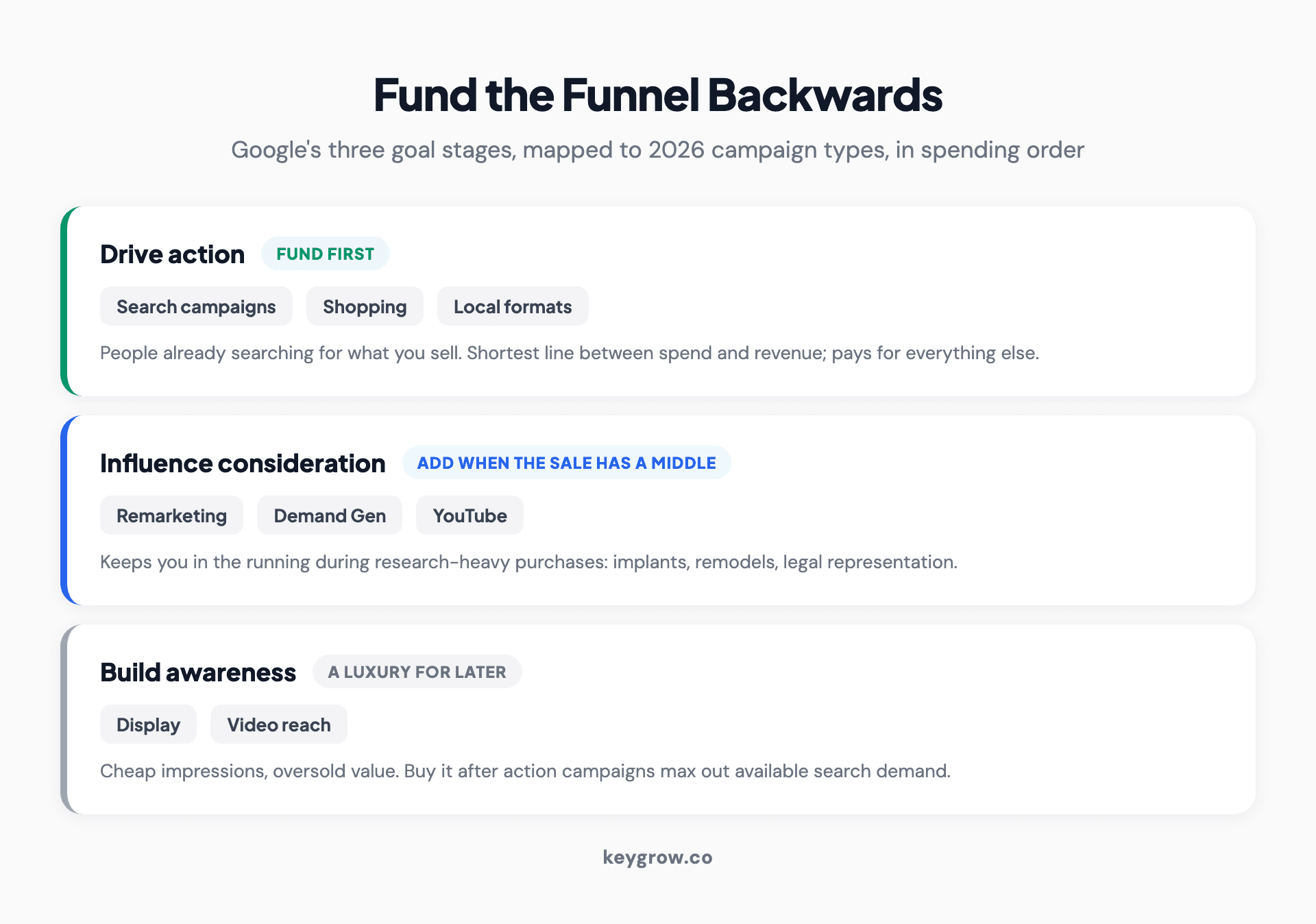
Google's three ad goal stages mapped to campaign types: awareness runs on Display and video campaigns, consideration runs on Demand Gen and remarketing, and action runs on Search, Shopping, and local campaigns, with the advice to fund action first.
Here is each stage with the campaign types that actually serve it in 2026, and who each one is for.
Driving action: where most businesses should start
Search campaigns aimed at people already looking for what you sell are the shortest line between ad spend and revenue.
Someone typing "emergency plumber near me" or "divorce attorney consultation" has a goal that matches yours. Search ads on those terms, pointed at a page built to convert, produce leads this week. This is the "driving action" stage, and it is where our PPC engagements almost always begin.
The gap between running action ads and running them well is not subtle. An eviction law firm came to us already advertising, with an existing landing page, and getting one conversion a week from 22 clicks at $240 per conversion. Visitors landed and did not know what to do next. We rebuilt the page around one clear action and restructured the campaigns. Within a week: 21 conversions from 189 clicks at $31.79 each. Same platform, same goal setting, different execution.

Two marketers sketching a campaign plan on a whiteboard, mapping ad groups to landing pages
Action campaigns also generate the raw material for everything else: search-term data that shows which words produce paying customers. If you write your own ads, we walked through that craft in our ad copy guide.
Influencing consideration: for sales cycles with a middle
Consideration campaigns keep you in the running while a customer compares options, and they only pay off when a real comparison window exists.
A homeowner picks a locksmith in an hour; nobody needs a consideration campaign for that. But implant dentistry, kitchen remodels, and legal representation get researched for weeks. Here remarketing earns its keep: people who visited your site see you again on YouTube and across the web while they deliberate. Demand Gen campaigns put your work in front of people scrolling feeds who match your past converters.
The mechanics are cheap compared to search clicks. The mistake is running consideration ads to strangers with no action campaign underneath, which is renting attention with nowhere to send it.
Building awareness: honest uses for the famous stage
Awareness campaigns make people recognize your name before they need you, and they are a luxury purchase for most small budgets.
Display and video reach are enormous and impressions are cheap, which is exactly why awareness is oversold. Where that reach actually pays off is covered in how Google Display ads grow results. Impressions do not pay rent. For a business with a finite budget, awareness spend competes directly with action spend, and action spend wins that fight on math almost every time.
The honest exceptions: a new location opening in a market where nobody knows you, a service people need suddenly and rarely (you want to be the name they already know), or a business whose action campaigns are already maxed out on available search demand. If you are not in one of those situations, let your Google Business Profile and organic presence do the awareness work for free.
What advancing each goal actually costs
No page ranking for this question offers a single dollar figure, so here is the math with sources. Across industries, the average search ad click costs $5.42 and the average search campaign converts 8.18 percent of clicks, per LocaliQ's benchmarks. Your niche will sit above or below those, but they anchor the exercise.
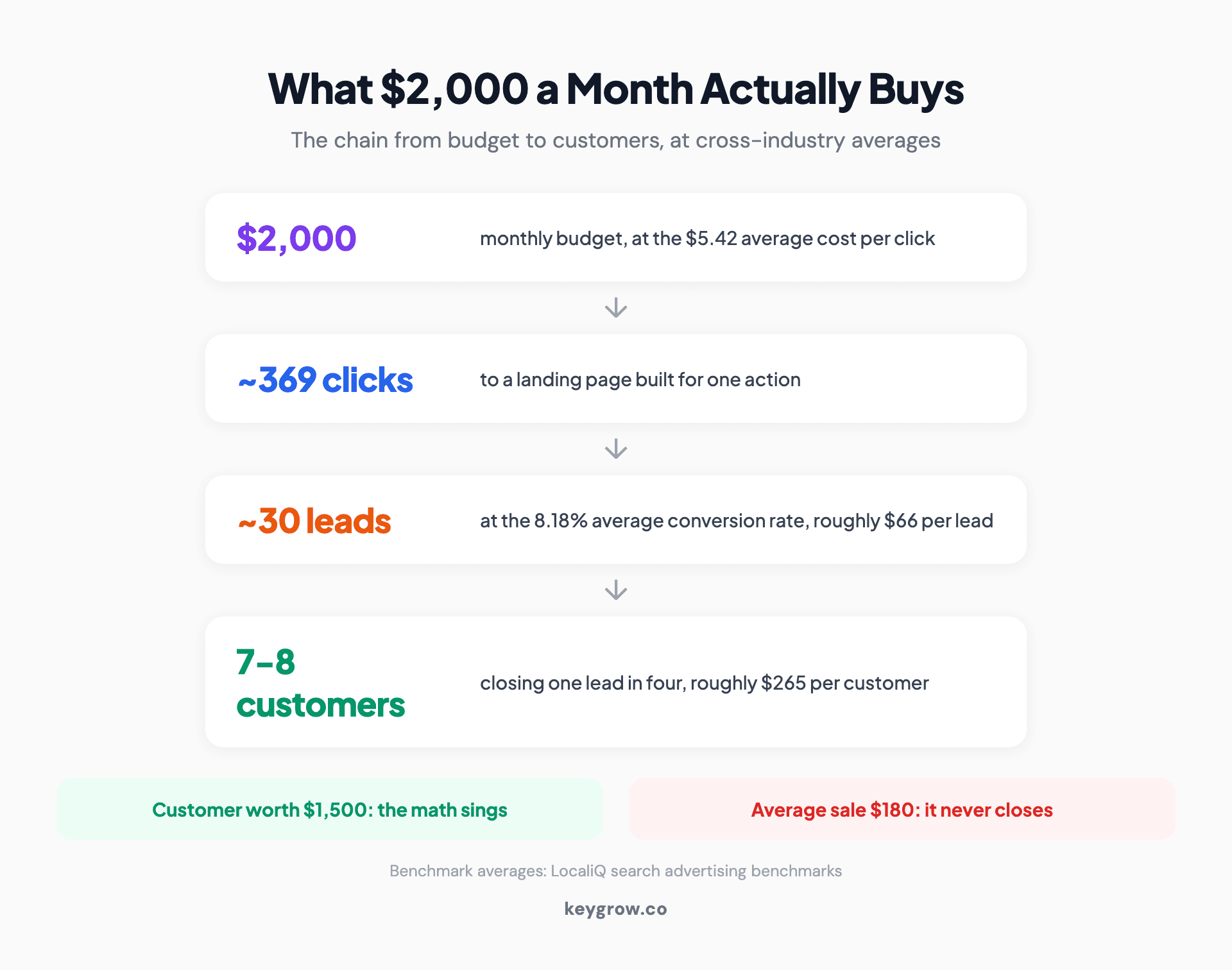
Worked minimum viable budget math for Google Ads: $2,000 per month at the $5.42 average cost per click buys about 369 clicks, an 8.18 percent conversion rate turns those into roughly 30 leads at about $66 each, and closing one in four produces customers at about $265 each.
Run the chain: $2,000 a month at $5.42 a click buys about 369 clicks. At an 8.18 percent conversion rate, that is roughly 30 leads at about $66 each. Close one in four and you get seven or eight customers at roughly $265 apiece. If your average customer is worth $1,500, that math sings. If your average sale is $180, it does not, and no amount of optimization changes the arithmetic enough.
That chain is also your minimum-budget test: you need enough spend to buy a statistically meaningful number of leads per month, which in most service niches means $1,000 to $2,000 minimum. Below that, results exist but arrive too slowly to learn from. Plug your own numbers into our budget calculator before committing.
One place that budget quietly leaks: broad match keywords without negative keywords are a donation to Google. In the accounts we audit, 20 to 30 percent of unmanaged spend typically goes to search terms that could never convert. Review the search-term report weekly; that is where the wasted spend hides.
When Google Ads will not advance your goals
Every page ranking for this keyword says yes to everyone and ends with a pitch. Here is the counter-case.
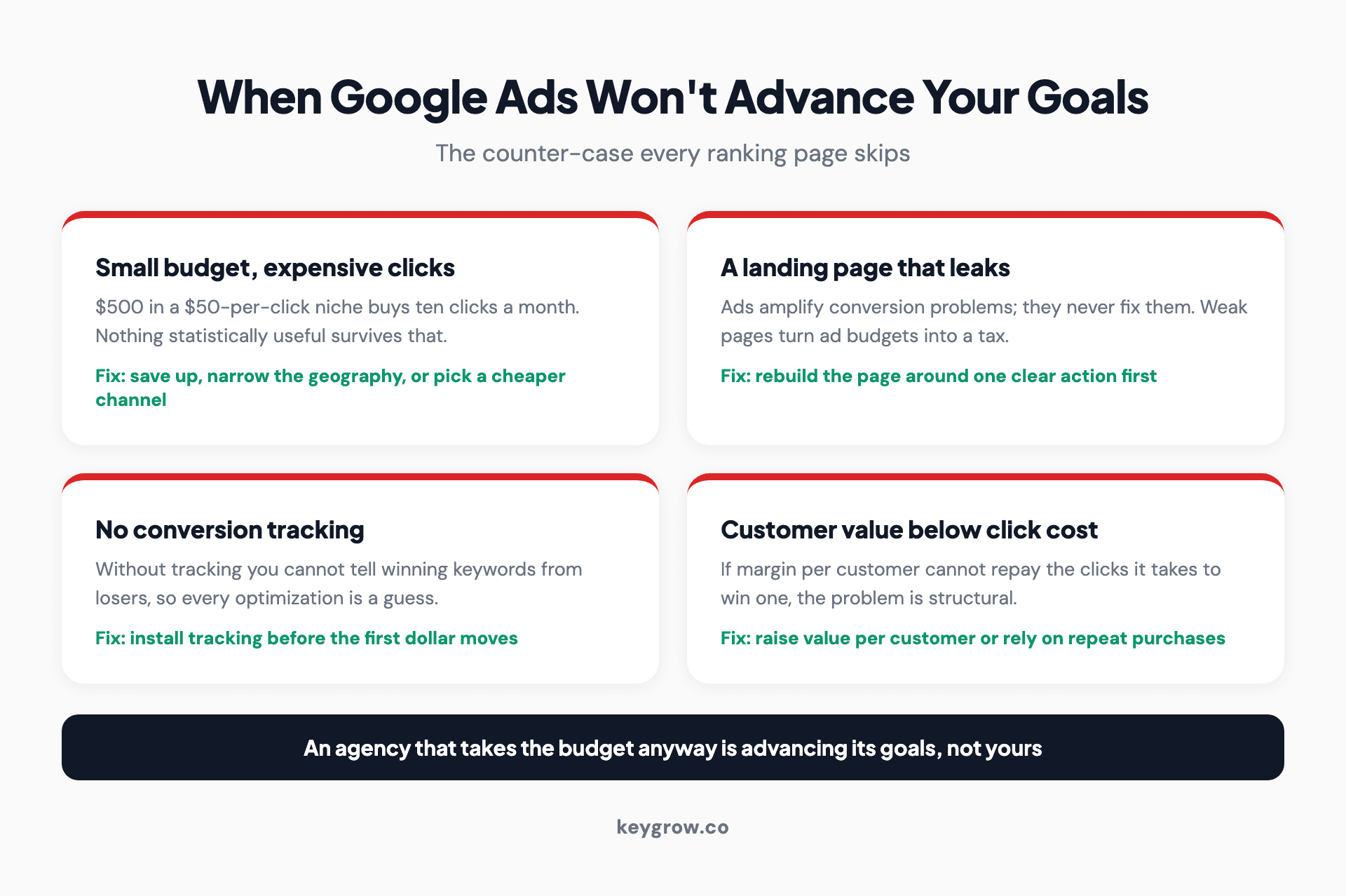
Four situations where Google Ads will not advance business goals: a small budget in an expensive-click niche, a weak or slow landing page, no conversion tracking installed, and customer value too low to repay click costs.
A $500 budget in a $50-per-click niche buys ten clicks a month; nothing statistically useful survives that. A weak or slow landing page turns ads into a tax, because ads amplify conversion problems rather than fix them. No conversion tracking means you cannot tell winning keywords from losing ones, so every optimization is a guess. And a customer value too low to repay click costs is a structural no; we walked through that exact margin math in our ecommerce channel guide.
If one of those describes you, fix the underlying problem first or spend the money elsewhere. An agency that takes your budget anyway is advancing its goals, not yours.
How to tell the goals are actually advancing
Judge Google Ads on cost per lead and booked revenue, never on impressions, clicks, or "engagement."
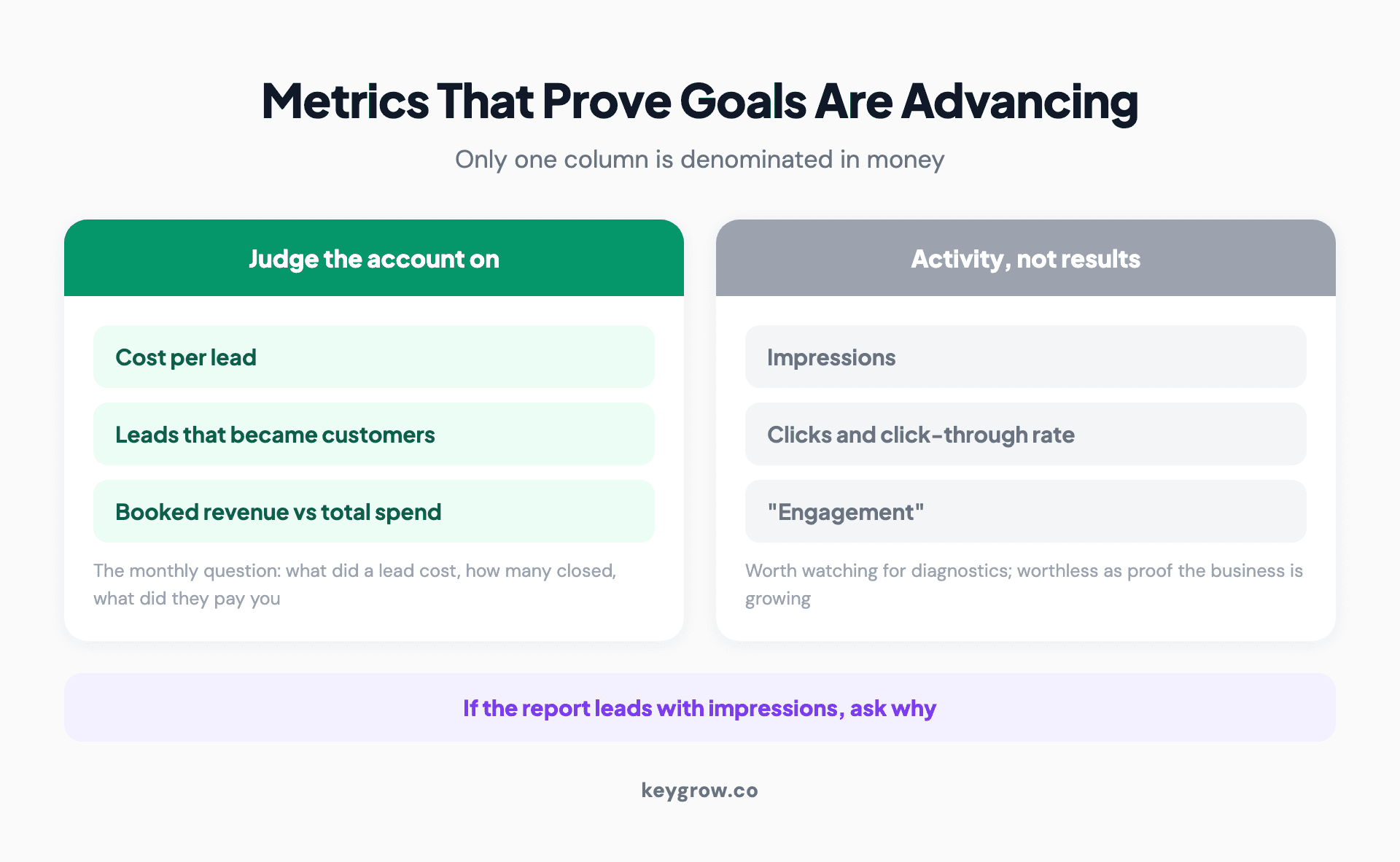
The Google Ads metrics that prove business goals are advancing versus the vanity metrics that just describe activity: cost per lead, customers won, and booked revenue versus impressions, clicks, and click-through rate.
Awareness campaigns report impressions, consideration campaigns report views and visits, and action campaigns report conversions. Only the last one is denominated in money. Whatever mix you run, the monthly question is the same: what did a lead cost, how many became customers, and what did those customers pay you. If a report leads with impressions and click-through rate, ask why. Google Ads and SEO also feed each other's data here; we covered the crossover effects in how PPC helps SEO.
Timeline expectations belong in this section too. Google's own learning period doc says bidding takes up to three weeks or one to two conversion cycles to calibrate, so week-one numbers are noise. In our experience, readable data takes a month or three, and judging the channel fairly takes a quarter.
FAQs
What is the exam answer to "how can Google Ads help you advance your business goals"?
Google Ads helps advance business goals by building awareness of your brand, influencing consideration of your products and services, and driving action: online sales, in-app sales, in-person sales, and over-the-phone sales. That is the framing used in Google's certification materials.
What are two ways Google Ads can fuel your business goals?
The certification's accepted pair: getting more of the right people to visit your website, and increasing online, in-app, in-person, and over-the-phone sales. In practice those translate to lead generation and sales, the two goals most businesses buy first.
Does Google Ads work for small businesses?
Yes, when the math works: a customer value high enough to repay click costs, a landing page built to convert, and a budget of at least $1,000 to $2,000 a month in most service niches. Below those thresholds, results arrive too slowly to learn from.
How much should I spend on Google Ads?
Enough to buy roughly 20 to 30 leads a month at your niche's cost per lead, which is the volume you need to judge and improve performance. At average benchmarks that means $1,500 to $2,500 monthly for most local businesses, more in expensive niches like legal.
How can I tell if my Google Ads are working?
Track conversions, then judge cost per lead against what a customer is worth, and booked revenue against total spend. Clicks, impressions, and click-through rate describe activity, not results. If you cannot see which keywords produce paying customers, fix tracking before touching anything else.
Do Google Ads help SEO rankings?
Not directly; ads do not change organic rankings. They help indirectly by revealing which search terms convert, which sharpens SEO targeting, and by covering the months while organic rankings build. The two channels share data, not ranking signals.
What to do with all this
Buy the action stage first: Search campaigns on buying-intent terms, pointed at a page with one clear next step, with conversion tracking installed before the first dollar moves. Add consideration when your sales cycle has a genuine middle. Treat awareness as a luxury for later. And if the math in the counter-case section describes your situation, keep your money until the underlying problem is fixed.
If you would rather have the whole funnel built by people who do it daily, tell us about your business. Month-to-month, and if your numbers say ads cannot work yet, we will tell you that too.