

Let me kill the most common belief in this topic before we go any further. Paying Google for ads does not buy you organic rankings. There is no secret loyalty score, no slow drip of ranking credit for big spenders. So when people ask how PPC can help SEO, the honest answer is that it helps everywhere except the place most people assume. It does not move your organic position. What it does is hand you keyword data, faster test results, more coverage of the results page, and brand lift that genuinely make your SEO better. (That data exchange is one of the four flows in integrating PPC with the rest of your marketing.)
That distinction matters because most guides on this subject either bury it or skip it. We are going to lead with it, source it to Google itself, then show you the exact reports to pull and what to do with each one.
Does PPC directly improve your organic rankings? No, and here is the proof
PPC does not improve your organic rankings. Google's own ad policy says investment in paid search has no effect on organic position, and the company keeps its search and advertising systems separate on purpose.
This is not an agency opinion. It is documented. The official line lives in the Google Ads Help center, which states plainly that buying ads does not influence organic ranking. Search Engine Journal's ranking-factors review reaches the same verdict, quoting Google's John Mueller saying the two systems are completely separate and citing Matt Cutts calling the buy-ads-to-rank idea a myth years ago.
So if someone pitches you ad spend as a way to climb the organic results, that is your first red flag. The connection is real, but it runs through people and data, not the algorithm.
Why Google keeps paid and organic on separate sides of a wall
Google separates ads from organic for the same reason a newspaper separates its newsroom from its sales floor. The product loses its value the moment buyers think they can pay their way to the top of the news.
If advertisers could purchase rankings, the results page would fill with whoever spent the most, search quality would drop, and users would leave for something they could trust. Google's whole business depends on people believing the organic results are earned. That trust is worth more than any single advertiser, which is why the wall is real and well-defended.
So stop looking for a direct lever between your ad budget and your organic position. There isn't one. The value is in everything that ad account quietly teaches you.
The real reason PPC helps SEO: it buys you data you would otherwise wait months for
Here is the reality. SEO is a slow feedback loop. You publish a page, wait for Google to crawl and rank it, wait for it to gather impressions, then wait again to see if it converts. That cycle runs in months. A PPC campaign runs the same test in days, with real searchers and real conversions, and the data it produces feeds straight into your SEO decisions.

Marketer at a desk holding a printed report above a laptop keyboard while reviewing performance data in natural office light
Think of paid search as a scout. It goes ahead of your organic effort, finds out which words customers type, which promises make them click, and which pages make them act, then reports back so you build the right organic page once instead of three times. The four bridges below are how that scouting report becomes SEO work you can do this week.
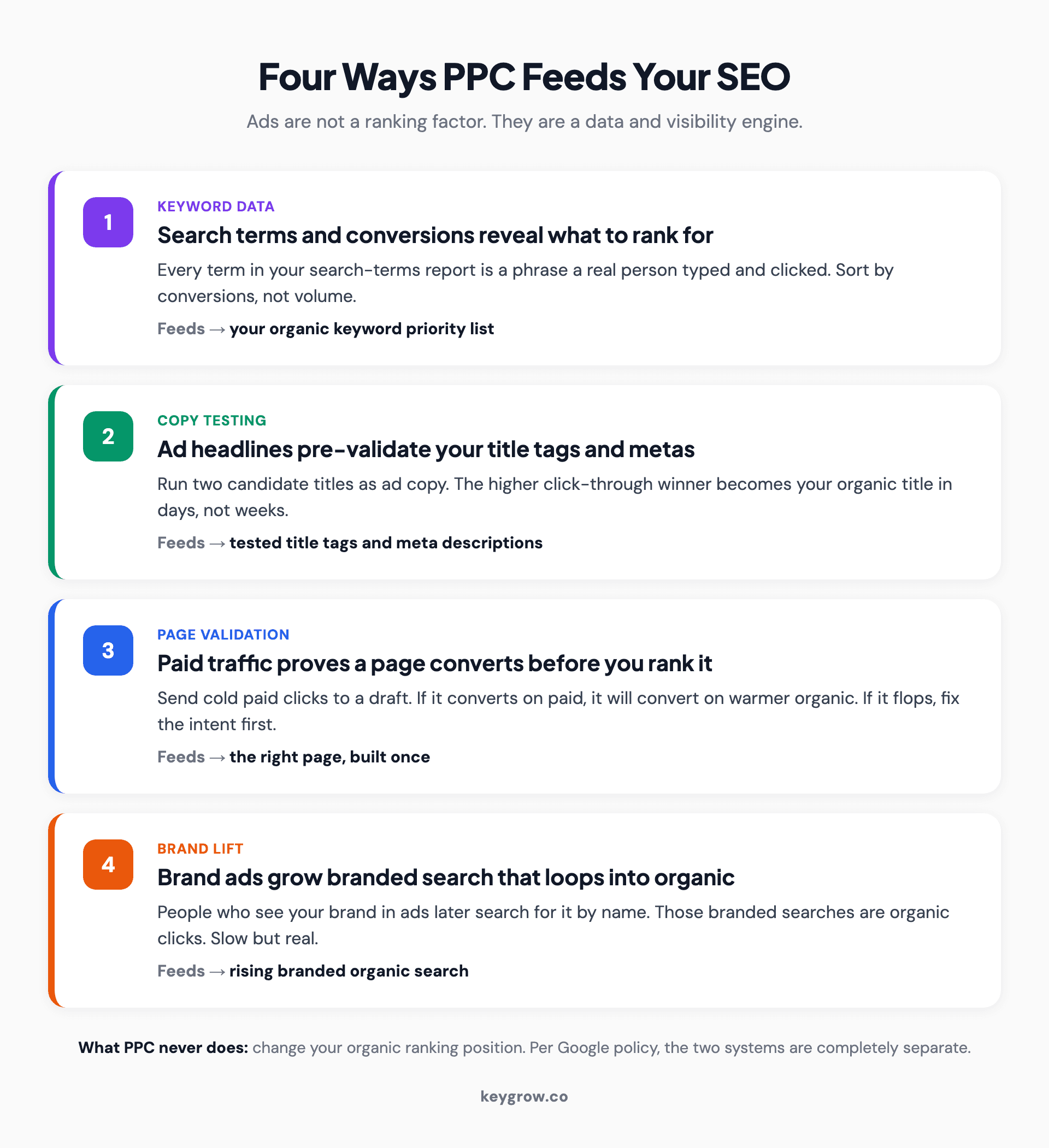
Infographic titled Four Ways PPC Feeds Your SEO, showing four left-accent rows: search terms and conversion data reveal the keywords worth ranking for, ad copy A/B tests pre-validate title tags and meta descriptions, paid traffic confirms landing page intent before you build organically, and brand campaigns lift branded search volume that loops back into organic.
Bridge 1: turn your search-terms and conversion report into an SEO keyword priority list
Your Google Ads search-terms report is the cleanest keyword research you will ever get, because every term in it is a phrase a real person typed that was relevant enough to trigger and click your ad.
Open the search-terms report and the conversion-by-query data together. You are not just looking for high-volume terms. You are looking for terms that converted. A keyword that drove ten clicks and two leads is worth more to your SEO roadmap than one that drove a thousand clicks and nothing. Pull those converting terms into your organic keyword list and prioritize building or strengthening pages for the ones you do not already rank for.
This is the opposite of guessing volume from a research tool. You already know these terms produce customers, because they just did. If you want to understand why intent like this still drives organic results, our piece on do keywords matter in SEO goes deeper on matching pages to what people actually search.
Bridge 2: A/B test your title tags and meta descriptions as ad copy first
Changing a title tag and waiting to see if organic click-through improves can take weeks. Running the same two headlines as ad copy tells you which one wins in a day or two, on the same audience, with statistical traffic.
Write your candidate title tag and meta description as a paid ad headline and description. Let them run against each other. The winner, the one with the higher click-through rate, becomes your organic title and meta. You have pre-validated the copy with paid clicks before committing it to a page that takes months to settle organically.
One honest caveat: ad headlines have different character limits and a different psychology than organic titles, so treat the result as a strong signal, not gospel. The angle that wins on paid almost always wins on organic too, but verify the exact wording fits the snippet length.
Bridge 3: validate the page and the intent before you build it organically
Paid traffic is the cheapest way to find out whether a page actually converts before you spend three months ranking it.
Send paid clicks to a draft of the page you plan to rank. Watch what happens. Do people read it, fill the form, call the number, or bounce in four seconds? If a page converts cold paid traffic, it will convert warmer organic traffic. If it flops on paid, you just saved yourself a quarter of SEO effort on a page nobody wants, and you can fix the intent mismatch before you build the real thing.
We learned this the expensive-then-cheap way with an eviction law firm. They were running ads to a page that pulled one conversion a week from twenty-two clicks, at two hundred forty dollars a conversion. Visitors landed and did not know what to do next, so they left. We rebuilt the page around one clear action and restructured the campaigns. Within a week it produced twenty-one conversions from one hundred eighty-nine clicks at $31.79 each. The paid lane proved the page worked before we put the slow organic effort behind it. That is the same logic behind choosing local PPC vs SEO for faster results when you need to learn quickly.
Bridge 4: brand campaigns lift branded search, and branded search feeds organic
This is the slow indirect loop, and it is the only one that touches organic volume at all. When people see your brand in ads repeatedly, more of them later search for you by name. Those branded searches are organic clicks, and a rising branded-search line is a leading indicator that your overall organic presence is strengthening.
It is slow and hard to attribute cleanly, so do not oversell it. But it is real, and it is the closest thing to a genuine paid-to-organic feedback effect that exists. If you run display or video brand campaigns, watch your branded organic search volume in Google Search Console over the following months. A steady climb there is the brand lift doing its quiet work.

Hand holding a smartphone open to a Google search results page, showing listings on a single screen
Owning more of the SERP in a zero-click, AI Overview world
The "own more of the results page" argument is the one every competitor makes, usually with no data. Here is the data, and it cuts both ways.
In early 2026, U.S. Google searches ended without any click 68.01% of the time, up from 60.45% in 2024, according to a SparkToro analysis of clickstream data reported by Search Engine Land. The same reporting found AI Overviews appearing on more than 20% of searches and cutting click-through rates by nearly 60% when they show up.
What that means for you is simple. The space available for any click, paid or organic, is shrinking. So when a query does still produce a click, owning both the ad slot and an organic result gives you two shots at it instead of one. That is the honest version of the SERP-real-estate argument: not "more visibility" as a vibe, but two entries on a page where clicks get rarer every year.
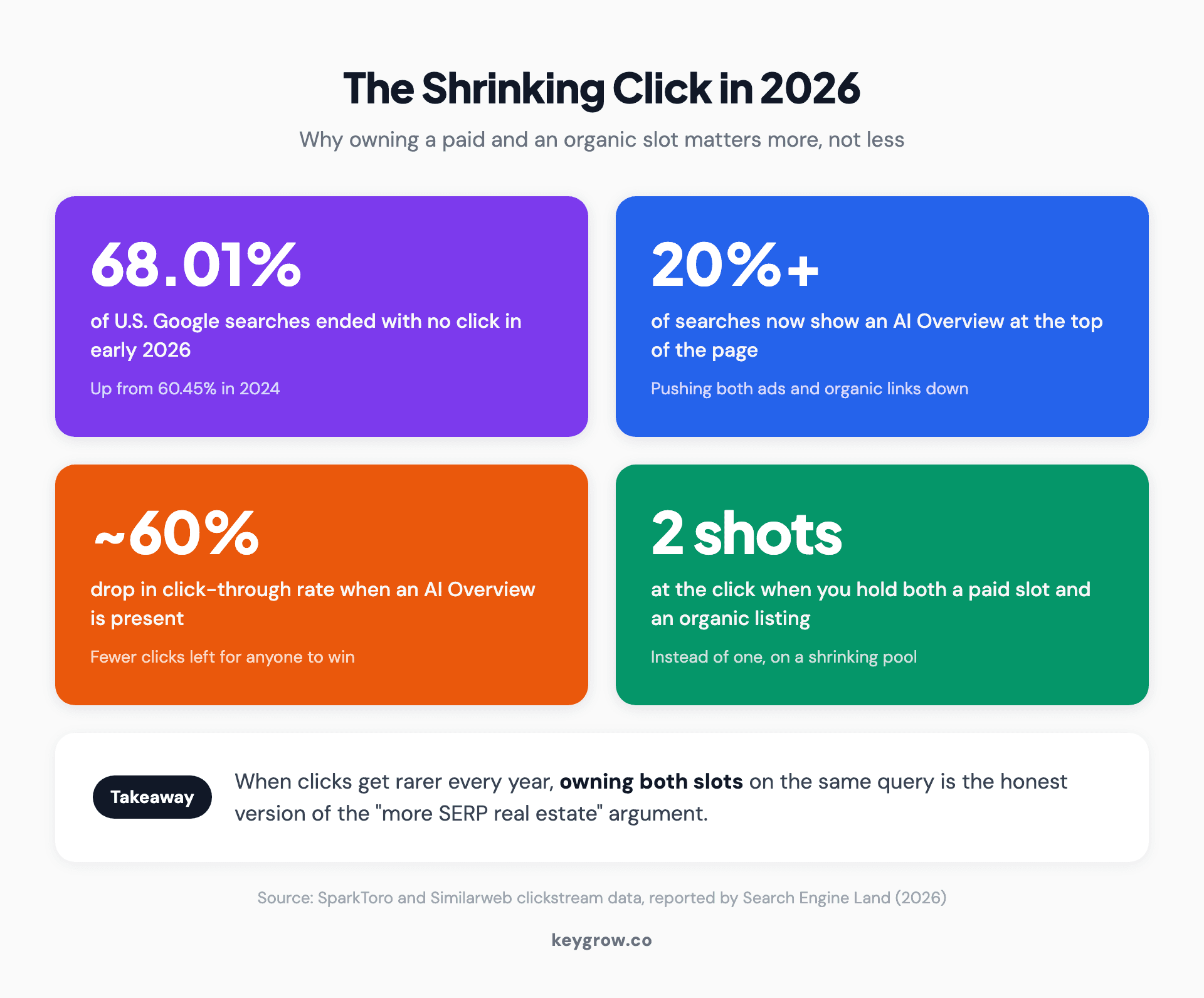
Infographic titled The Shrinking Click in 2026, a stat strip with four panels: 68.01 percent of U.S. Google searches ended without a click in early 2026, up from 60.45 percent in 2024, AI Overviews now appear on more than 20 percent of searches, AI Overviews cut click-through rate by nearly 60 percent when present, so owning both a paid and an organic slot gives two shots at a shrinking pool of clicks. Source SparkToro and Similarweb via Search Engine Land.
The incrementality truth: ads pay off even when you already rank number one
The smartest reason to run paid alongside organic is incrementality, and it has a real number behind it. Google research found that even when you hold the number-one organic spot, 50% of the clicks your ad gets are incremental, meaning they would not have come to your site without the ad. That figure climbs to 82% incremental when you sit in organic positions two to four, and 96% when you rank fifth or lower.
That research is reported by Search Engine Land. A separate Google study of more than four hundred paused-ad accounts found that, on average, 89% of the traffic from search ads was not replaced by organic clicks when the ads were turned off.
So running ads on a keyword you already rank for is not always wasteful, because most of those paid clicks are genuinely extra. The lower you rank organically, the more incremental the ad clicks become. That is the honest justification for running both channels on the same term, and it holds up where vague "more presence" claims do not.
How to actually measure PPC's indirect contribution to SEO
Measure the loop instead of assuming it. There are three practical ways.
First, watch branded organic search volume in Google Search Console while a brand campaign runs. A rising branded-query trend over months is brand lift feeding organic. Second, use the paid-and-organic report inside Google Ads, which shows how often the same query produces an ad click, an organic click, or both, so you can see where the channels overlap and where the ad is the only one pulling clicks. Third, run a geo holdout: turn ads off in one matched region, leave them on in another, and compare the difference in organic and total traffic.
The first two are free and take an afternoon. The third is for accounts with enough spend and traffic that a clean before-and-after signal will actually show. To fold this into a full reporting picture, our guide on how to measure SEO ROI lays out the leading-indicator approach that pairs with it.
The honest downsides nobody else mentions
There are three real costs to running both channels, and pretending otherwise is how people waste money.
Cannibalizing your own free clicks. When you rank number one organically and also run an ad, some paid clicks would have been free organic clicks. The incrementality numbers tell you how much: at position one, about half the ad clicks are not incremental, so you pay for clicks you would have gotten free. The fix is not to never bid, it is to bid hardest where the incremental share is high (lower organic positions) and reconsider where you already dominate and competition is thin.
Double-counted conversions. If your attribution gives full credit to both the ad click and the organic click for the same customer, your reports overstate both channels. Use a multi-touch view, or at least know which model you are reading before you make budget calls.
Paying for clicks you already own. If you sit at position one for a low-competition branded term nobody else bids on, the ad above your own organic listing is often pure waste. Test pausing brand ads where you are unchallenged and watch whether total clicks actually drop. Sometimes they barely move.
When mining PPC data for SEO is not worth the bother
This is the part most agencies skip, so here it is straight. If your ad account is tiny, the data is too thin to trust.
A search-terms report with twelve clicks a week is noise, not signal. Conversion data needs volume before it means anything, and a handful of conversions can swing your read entirely on luck. As a rough floor, if you are not generating at least a few dozen conversions a month across your paid keywords, treat the PPC-to-SEO data bridge as nice-to-have, not a decision input, and lean on traditional keyword research instead.
The same applies to brand lift. A small local business spending a few hundred dollars a month will not produce a branded-search lift you can measure cleanly against the normal week-to-week noise. The incrementality and brand-lift arguments are strongest at meaningful spend. Below that, the honest move is to run lean paid for leads and not pretend it is fueling a sophisticated SEO program. If you are weighing whether to invest at all, our take on whether SEO services are worth it is the place to start.
FAQs
Does running Google Ads improve your organic search rankings?
No. Google's own ad policy states that paid search investment has no effect on organic ranking, and the company keeps the two systems separate. Google's John Mueller has confirmed they are completely separate, and the buy-ads-to-rank belief was debunked years ago. Ads help your SEO through data and visibility, never through the ranking algorithm.
How does PPC help SEO if it does not affect rankings?
PPC helps SEO four ways. Its search-terms and conversion data show you which keywords actually produce customers, ad copy A/B tests pre-validate title tags and metas, paid traffic confirms a page converts before you spend months ranking it, and brand campaigns lift branded search that loops back into organic. All four are about data and reach, not the algorithm.
Can pausing PPC hurt your organic traffic?
Mostly no. Pausing ads removes paid clicks, but a Google study of more than four hundred paused accounts found 89% of ad traffic was not replaced by organic clicks, meaning that traffic was genuinely incremental and simply disappears. Your organic rankings themselves do not drop when you pause ads, because the two are separate. You lose the extra clicks, not the rankings.
How do I use Google Ads keyword data to improve my SEO?
Open the search-terms report alongside conversion-by-query data and find the terms that actually drove leads, not just clicks. Add those converting terms to your organic keyword list and build or strengthen pages for the ones you do not yet rank for. Because these terms already produced customers, they beat volume estimates from a research tool.
Should I run PPC and SEO at the same time or pick one?
Run both if you can afford it, because they do different jobs. Paid delivers leads now and scouts the data that makes your SEO smarter, while organic compounds into traffic that does not require ongoing spend. Google research shows even at organic position one, 50% of paid clicks are incremental, so the two rarely just cannibalize each other.
Does clicking your own ads or buying ads affect where you rank organically?
No, and clicking your own ads is against Google's policy and can get your account suspended. Buying ads does not raise organic rank because the systems are separate, and no amount of self-clicking changes that. If anyone tells you ad spend or click activity buys organic position, treat it as a sign they do not understand how Google works.
Use the paid lane to scout, then win the organic one
PPC and SEO are not rivals, and PPC is not a shortcut to organic rankings. It is the fast lane that tells you which keywords convert, which copy wins, and which pages work, so your slow organic lane gets built right the first time. The algorithm stays separate, the data does not.
If your account is large enough to produce real signal, mine it. Pull the converting search terms, test your titles as ad copy, validate pages with paid traffic, and watch your branded-search line. If your account is too small to trust the numbers, do not force it. Run lean for leads and let traditional research guide your SEO until the volume is there.
When you want both channels working as one system rather than two line items, that is the work our PPC management for local businesses is built around, on month-to-month terms so the results have to keep earning the spend.


