

You can have up to 3 enabled responsive search ads per ad group in Google Ads. Google recommends running at least 2, and for most ad groups 2 to 3 is the sweet spot. You can store more than 3 as paused, but only 3 enabled ones will serve at a time. The real question is not how many you are allowed, it is how many actually help, and the answer is fewer than most people think.
Here are the exact limits, how many you should actually run and why, and how to make the two or three you keep meaningfully different.
The exact limits
Google allows up to 3 enabled responsive search ads per ad group, each with up to 15 headlines and 4 descriptions. An ad group can hold up to 50 active text ads in total, but only 3 responsive search ads can be enabled at once.
Per Google Ads Help, a single responsive search ad gives you room for up to 15 headlines and up to 4 descriptions, and Google mixes and matches them automatically to assemble the ad. The limits at a glance:
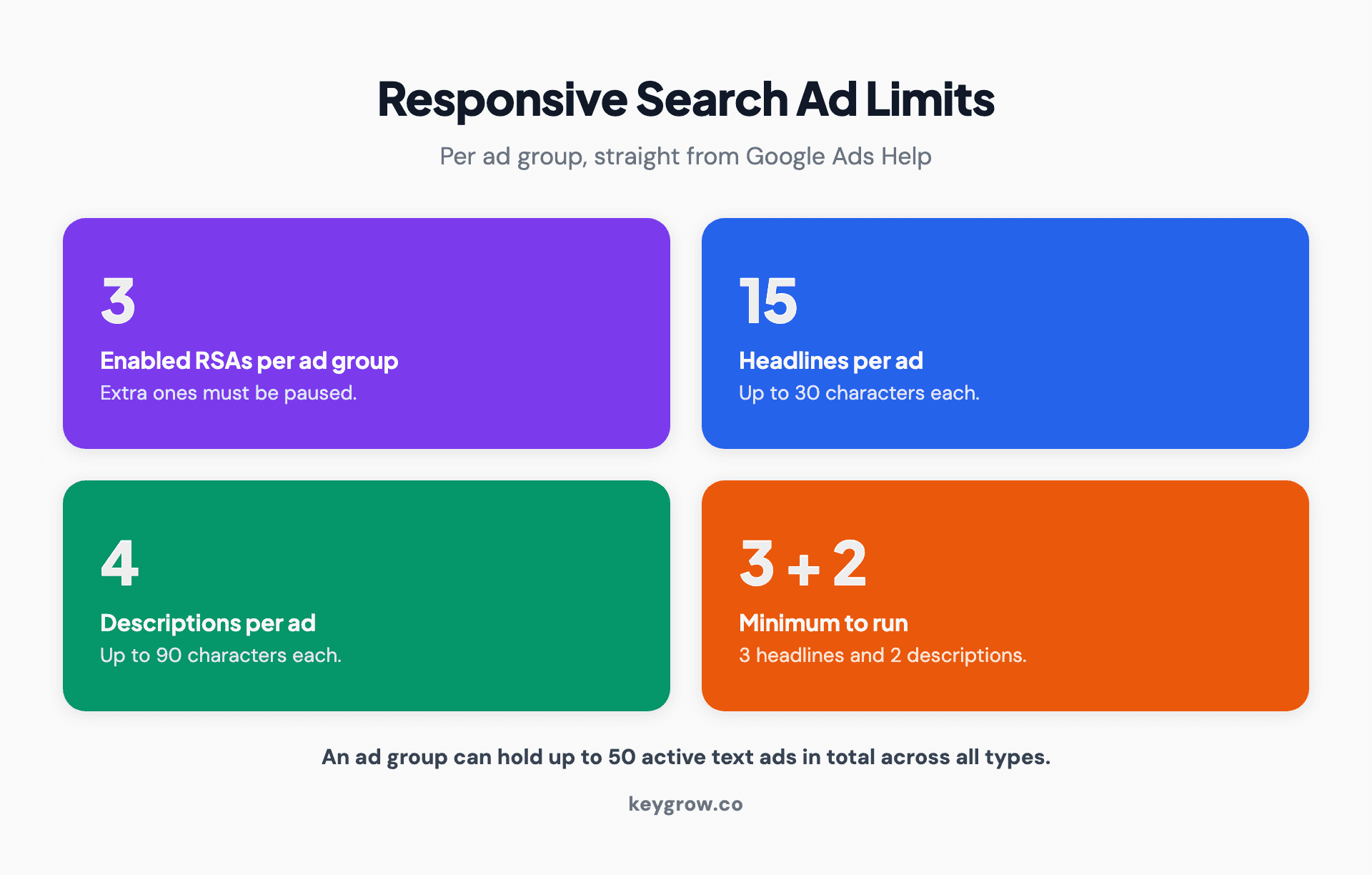
The Google Ads responsive search ad limits: 3 enabled RSAs per ad group, up to 15 headlines at 30 characters each, up to 4 descriptions at 90 characters each, and a minimum of 3 headlines and 2 descriptions to run.
How many should you actually run?
Run at least 2, and rarely more than 3. Google's own data shows the gain from each extra ad shrinks fast, so two well-built responsive search ads with strong Ad Strength beat three rushed ones.
This is where the number you can run and the number you should run part ways. Google recommends at least 2 responsive search ads with Good or Excellent Ad Strength per ad group, not the maximum of 3. The reason is in the numbers Google publishes:
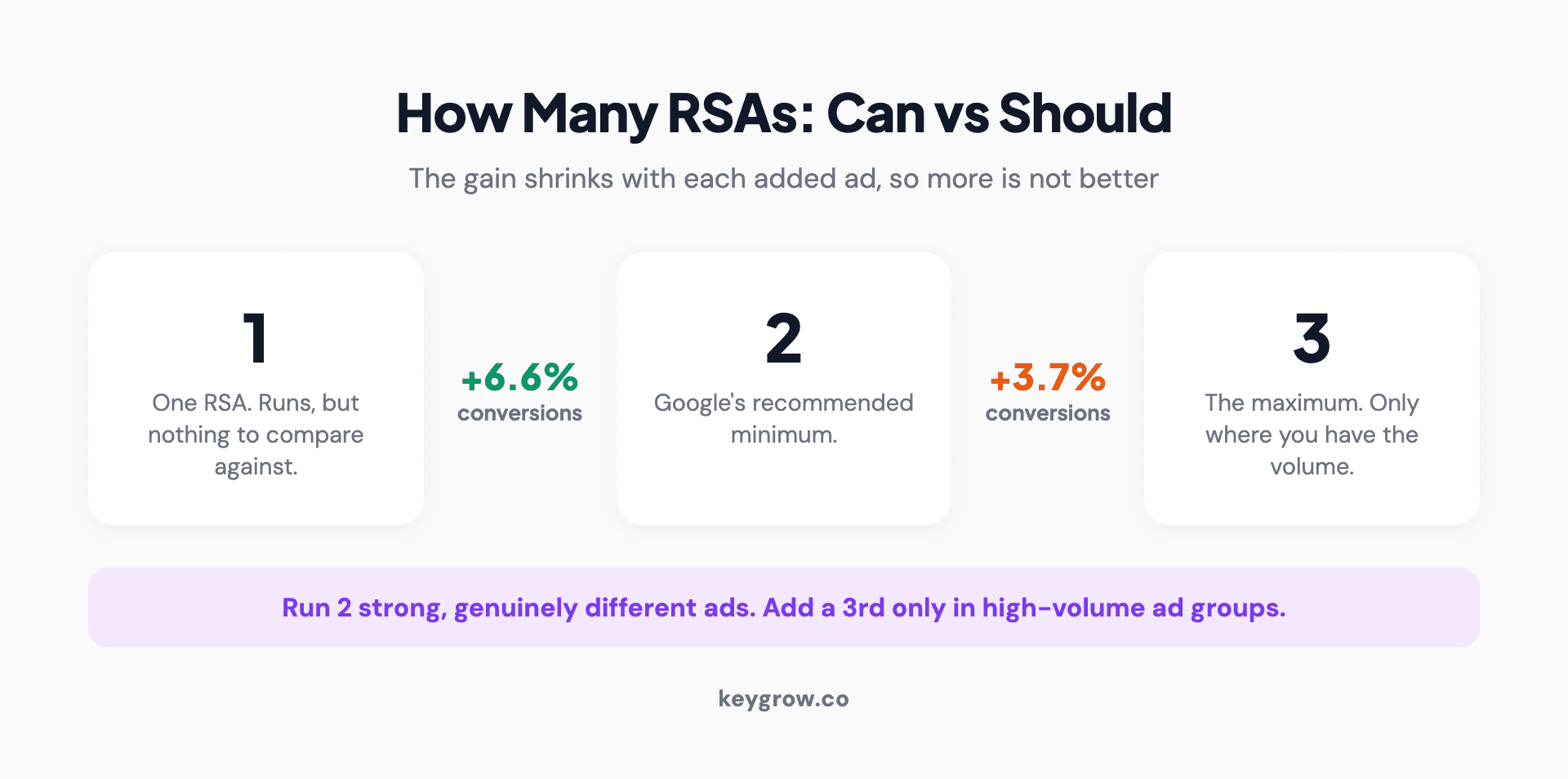
The diminishing return on adding responsive search ads: going from one RSA to two lifts conversions about 6.6 percent, going from two to three adds about 3.7 percent, and Google recommends at least two per ad group.
Advertisers who go from one responsive search ad to two see about a 6.6 percent lift in conversions at a similar cost. Going from two to three adds about 3.7 percent more. The gain is real but it halves with each ad, and every extra ad splits the same traffic into thinner slices of data. In a low-volume ad group, three ads can starve each other so none gathers enough signal to optimize. So the practical rule: two responsive search ads in most ad groups, a third only where you have the search volume to feed it.
Why Google caps it at 3
The cap exists because responsive search ads learn from consolidated data. Spreading a limited number of impressions across many ads slows learning for all of them, so Google limits how many compete inside one ad group.
A responsive search ad is a testing engine. It needs enough impressions across its headline and description combinations to figure out which ones win. Pile in too many ads and each one sees fewer combinations fewer times, which is the opposite of what the system needs. The 3-enabled cap is Google steering you toward a manageable test rather than a sprawling one you cannot read.
Make your 2 or 3 ads actually different
Two responsive search ads only help if they say different things. Give each one a distinct angle, offer, or audience, or you are just running the same ad twice and learning nothing.
The most common waste is three near-identical ads. Instead, build each around a different idea:
Testing two genuinely different angles is how you learn something. Our guide on A/B testing PPC ads covers how to read the results without fooling yourself, and the Google Ads title generator can help you draft varied headlines.
Ad Strength matters more than the count
The number of ads matters less than how good they are. Google says improving an ad's Ad Strength from Poor to Excellent brings about 15 percent more clicks and conversions, so aim for two strong ads over three weak ones.
Ad Strength is Google's read on how well your headlines and descriptions cover different angles, avoid repetition, and include your keywords. It is a guide, not a grade to obsess over, but Poor is a real warning. The lift from fixing it dwarfs the lift from adding a third ad. Ad Strength ties into the same relevance signals behind your Google Ads Quality Score, so improving one usually helps the other.
What about expanded text ads?
Responsive search ads are the only search ad type you can create now. Google stopped letting advertisers build or edit expanded text ads on June 30, 2022, so the old three-headline format is gone for new ads.
If you have old expanded text ads still running, they continue to serve and report, but you cannot make new ones. For every new campaign, responsive search ads are the format, which is why knowing how many to run and how to build them matters more than it used to.
FAQs
How many responsive search ads can you have per ad group?
Up to 3 enabled responsive search ads per ad group. You can create and store more, but any beyond 3 must be paused, and only the enabled ones serve. An ad group can hold up to 50 active text ads in total across all ad types.
How many responsive search ads should I run?
At least 2, which is Google's recommendation, and usually no more than 3. The conversion lift shrinks with each added ad, from about 6.6 percent for the second to about 3.7 percent for the third, and extra ads split your data thinner. Two strong, genuinely different ads beat three rushed ones in most ad groups.
How many headlines and descriptions can a responsive search ad have?
Up to 15 headlines and up to 4 descriptions. Headlines are limited to 30 characters and descriptions to 90 characters each. You need a minimum of 3 headlines and 2 descriptions for the ad to run, but providing more gives Google's system more combinations to test.
Can you have more than 3 responsive search ads per ad group?
Not enabled at the same time. You can create additional responsive search ads and keep them paused, then swap them in later, but only 3 can be enabled and serving in a single ad group at once. For most ad groups you will not need more than 2 or 3 anyway.
Is one responsive search ad enough?
It can run, but it is not ideal. Google recommends at least 2 per ad group, and advertisers who add a second ad see roughly a 6.6 percent lift in conversions at a similar cost. A single ad also gives you nothing to compare against, so you learn less about what messaging works.
Do expanded text ads still work?
Existing expanded text ads continue to serve and report, but you have not been able to create or edit them since June 30, 2022. Responsive search ads are now the only search ad type you can build, so any new ad you create will be an RSA.
The bottom line
You can run up to 3 responsive search ads per ad group, but two strong ones with different messaging and good Ad Strength will usually outperform three weak ones. Build them around distinct angles, aim for Good or Excellent Ad Strength, and let the combinations report tell you what to keep.
If your ad groups are stuffed with near-identical ads and you want a structure that actually tests and improves, that is the kind of cleanup our Google Ads management starts with. Bring your account to the get started page and we will show you where the waste is.


