


To improve your Google Ads Quality Score, work on the three signals it is built from: your expected click-through rate, how relevant your ad is to the search, and the experience of the landing page it points to. Raise those and the score follows, and so does your price: better quality on those signals means you pay less per click for the same position.
Here is the caveat most guides bury. Quality Score is a diagnostic, not a lever you pull directly, and it is not even an input in the live ad auction. So the goal is never the 1-to-10 number for its own sake. The goal is the three real things underneath it, which happen to be the same three things that decide whether your ads make money.
Below is how to read the score, fix each signal in order, and know when to stop.
What Quality Score actually is
Quality Score is a 1-to-10 estimate, shown at the keyword level, of how relevant and useful your ad and landing page are to someone searching that term. It is built from three components: expected click-through rate, ad relevance, and landing page experience, each rated below average, average, or above average.
One point clears up most of the confusion. According to Google's own documentation, Quality Score is a diagnostic tool, not a factor in the auction that decides your actual ad rank. The auction uses live quality signals calculated in the moment. So treat the score as a dashboard warning light that points at the weak component, not as a metric to polish. Because the same quality signals feed Ad Rank live in every auction, fixing what the score flags is also how you outrank competitors in Google Ads without bidding more. When we run a full PPC audit, Quality Score is exactly this: a map to the weak link, read early and then set aside.
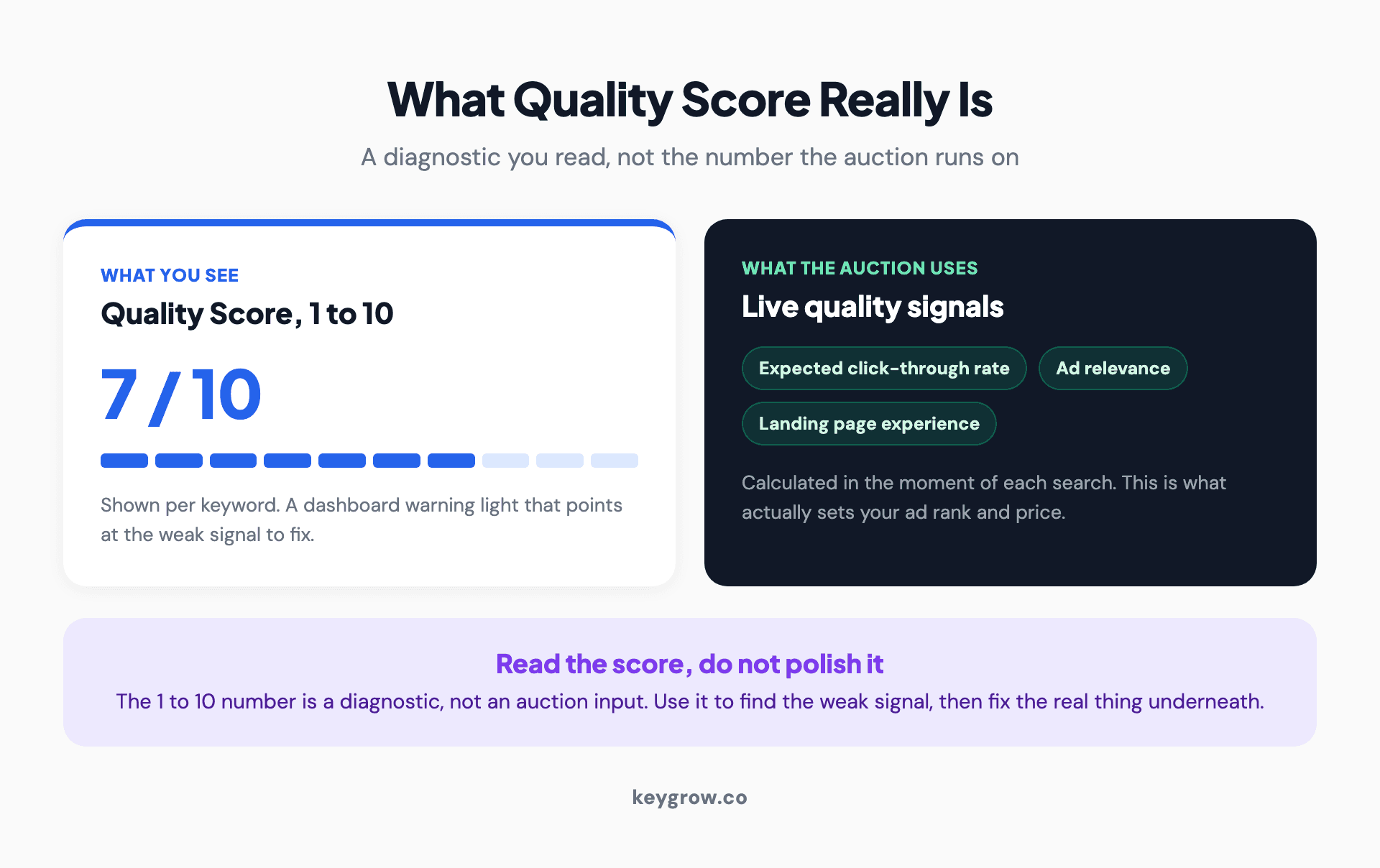
Two-panel diagram: the Quality Score you see is a 1 to 10 diagnostic, while the live auction runs on quality signals like expected click-through rate, ad relevance, and landing page experience.

Three brass pressure gauges side by side, each with its own reading, like the three components that make up a Quality Score.
The three signals, and which to fix first
| Signal | What it measures | Usual fix |
|---|---|---|
| Expected click-through rate | How likely people are to click your ad for that keyword | Better ad copy, assets, tighter keyword-to-ad match |
| Ad relevance | How closely the ad matches the intent of the search | Tighter ad groups, keyword in the headline |
| Landing page experience | How well the page delivers on the ad's promise | Message match, speed, one clear action |
Fix them in the order that moves the most money, which usually means relevance first, because it is the cheapest to fix and it lifts the other two at the same time.
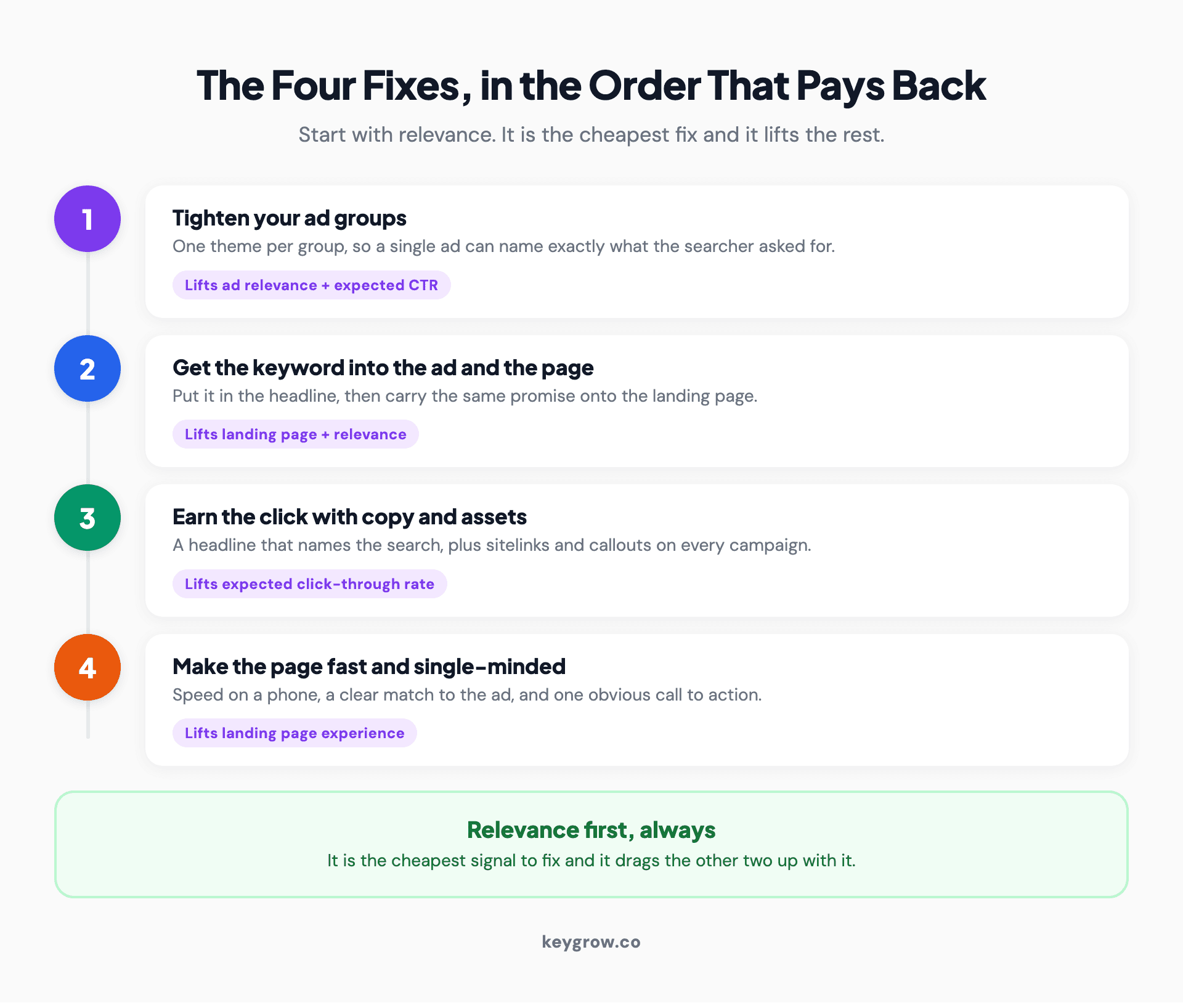
Numbered list of the four Quality Score fixes in the order that pays back: tighten ad groups, get the keyword into the ad and page, earn the click with copy and assets, then make the landing page fast and single-minded.
Fix 1: Tighten your ad groups so the ad can match the search
The most common cause of a low ad relevance rating is an ad group that tries to cover too much. If one group holds "emergency plumber," "how to fix a leak," and "water heater installation," no single ad can speak to all three, so the ad is generic and relevance suffers.
Split broad groups into tight themes, each covering one intent, so the ad can name exactly what the searcher asked for. Tight does not have to mean one keyword per group, and our look at single keyword ad groups explains why that older build now costs more than it returns. This is dull work, and it is the highest-return fix on the list. A tight group lets you write an ad that mirrors the search, which lifts both ad relevance and expected click-through rate in one move.
Fix 2: Get the keyword into the ad, and the page
Once the group is tight, make the match obvious. Put the keyword, or a close variant, in the headline so the searcher sees their own words reflected back. Then carry the same promise onto the landing page. If the ad says "same-day drain cleaning" and the page opens with a generic "welcome to our plumbing company," the message match breaks and the landing page experience rating drops.
This is where a lot of Quality Score problems actually live. The ad is fine, but it points at a homepage built for browsing rather than a page built to convert this specific search. We cover the difference in landing page versus website, and closing that gap often lifts the landing page signal and your conversion rate together.

Hands sketching a page flow with arrows from one screen to the next, like carrying an ad's promise straight through to its landing page.
Fix 3: Earn the click with better copy and assets
Expected click-through rate rewards ads people actually want to click. Two things move it. The first is the copy: a headline that names the search and a benefit, not a slogan. Our guide on writing PPC ad copy goes deeper on this. The second is assets: sitelinks, callouts, and structured snippets take up more of the results page and lift click-through at no extra cost per click, so turn them on for every campaign.
A higher click-through rate is not just good for the score. It is the clearest signal to Google that your ad deserves the impression, and it feeds directly into a lower price per click. If you want a sense of what a healthy rate looks like, see what a good CTR looks like.
Fix 4: Make the landing page fast and single-minded
The last signal is the page experience. Google is judging whether the visitor lands somewhere fast, relevant, and easy to act on. The three things that move it are speed on a phone, a clear match to the ad's promise, and one obvious call to action rather than five competing links.
Walk your important landing pages on a phone. If the page is slow, buries the offer, or asks for a browse when the searcher wanted to book, the experience rating and your conversion rate both suffer. Fixing the page is often worth more than any bid change, because it lifts Quality Score and turns more of the clicks you already pay for into leads.
Why you should not chase the number
It is tempting to treat Quality Score as a scoreboard and grind every keyword to a 10. Do not. Because the score is a diagnostic and not an auction input, a keyword sitting at 6 that brings in profitable leads is worth more than one polished to 10 that no one converts on. Read the score to find the weak signal, fix the real thing underneath, and then judge the keyword on leads and cost per booked job, not on the diagnostic number.
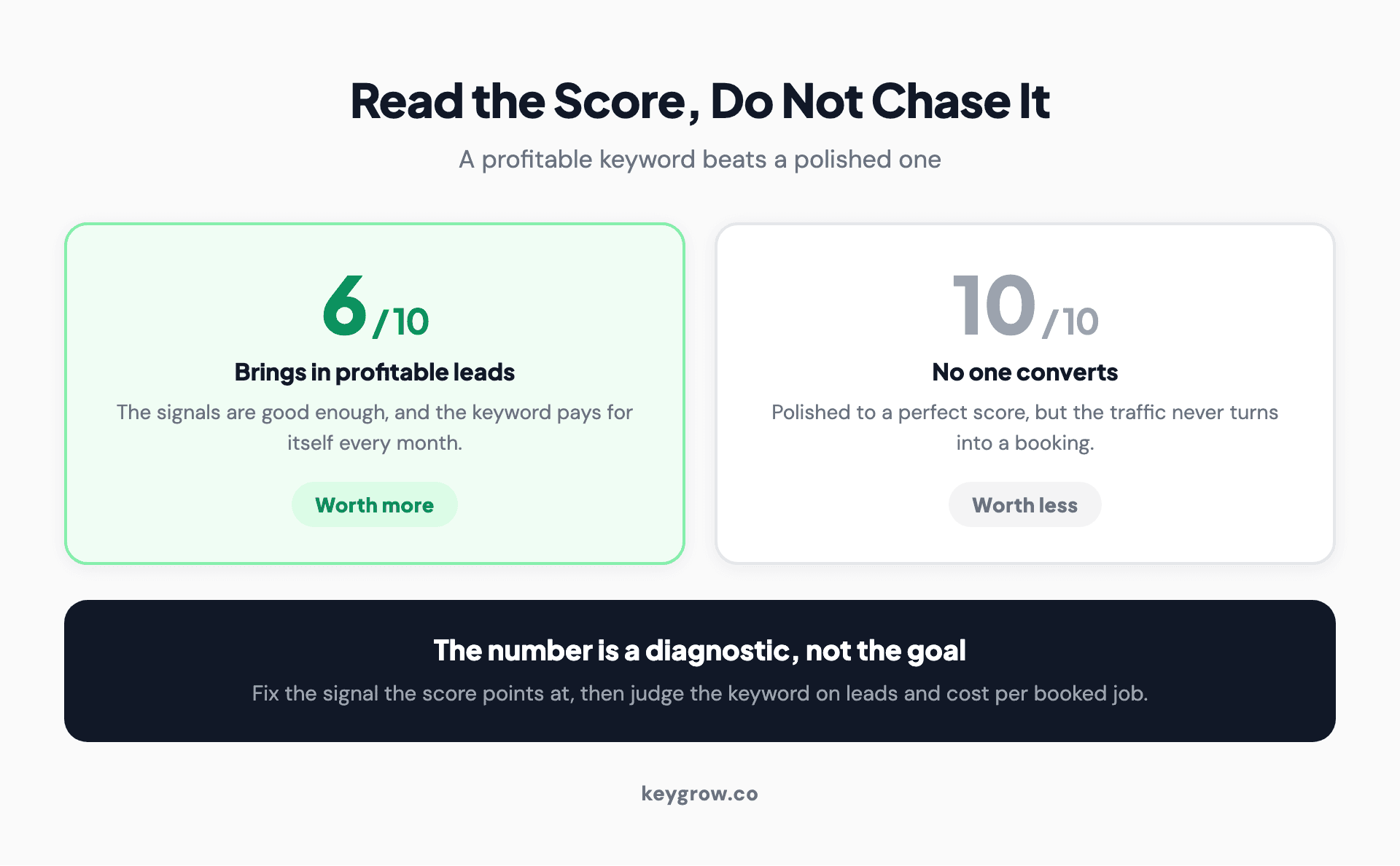
Two cards comparing a keyword at Quality Score 6 that brings profitable leads against one polished to 10 that no one converts on, showing the profitable keyword is worth more.
The payoff for fixing the three signals is real, though. Better relevance and a better page lower your cost per click for the same position, which is the whole point of the exercise.
FAQs
What is a good Quality Score in Google Ads?
Scores of 7 to 10 are generally considered good, 5 to 6 average, and below 5 a sign that one of the three signals needs work. That said, Quality Score is a diagnostic, not an auction input, so the number matters less than what it points at. A profitable keyword at 6 beats an unprofitable one at 10.
Does Quality Score affect how much I pay?
The Quality Score you see in your account is a diagnostic and is not itself used in the auction. But the underlying quality signals it summarizes, expected click-through rate, ad relevance, and landing page experience, are calculated live at auction time and do affect your ad rank and your actual cost per click. Improve the signals and you tend to pay less for the same position.
How do I improve a low Quality Score fast?
Start with ad relevance, because it is the cheapest fix and lifts the other signals too. Split loose ad groups into tight, single-theme groups, put the keyword in the ad headline, and make sure the landing page matches the ad's promise. Those three moves address all three signals and usually show up within a couple of weeks.
Does landing page experience really affect Quality Score?
Yes. Landing page experience is one of the three signals. A slow page, a mismatch between the ad and the page, or a page cluttered with competing links all drag the rating down. A fast page that keeps the ad's promise and gives the visitor one clear action lifts it.
Should I pause low Quality Score keywords?
Not automatically. A low score is a signal to investigate, not a reason to pause. If the keyword is relevant and converts, fix the ad and page rather than cutting it. Pause it only if, after fixing the signals, it still spends money without producing leads.
What to do this week
Open your keywords, turn on the Quality Score column, and sort by spend. Look at your highest-spend keywords with a below-average rating on any of the three signals, because that is where the money is and where the fix pays back fastest. Tighten the ad group, get the keyword into the ad and the page, and turn on your assets.
If you would rather hand this to a team that runs it week to week, our paid search service does exactly that, and reports on leads and cost per booked job rather than a diagnostic score. Tell us where you are stuck on the get started page.