

Do landing pages help SEO? Yes, but the answer depends entirely on which kind you build. A landing page made to target a real search query, that Google can index, can absolutely rank and pull in organic traffic. A pay-per-click landing page, the kind you send ad traffic to, is usually set to be invisible to Google on purpose and does nothing for organic. And mass-producing near-identical pages, the thing a lot of businesses try first, can quietly hurt you.
So "do landing pages help SEO" is really three questions wearing one coat. Let me separate them, because the difference between a page that ranks, a page that does nothing, and a page that gets you filtered is not subtle once you see it.
Can a landing page rank on Google?
Yes. A landing page is just a web page, and any indexable page that targets a real query with genuine content can rank. The only landing pages that cannot rank are the ones told not to, or the ones too thin to deserve it.
Two things have to be true. First, the page has to be indexable, meaning it is not blocked by a noindex tag or robots rule. Second, it has to target something people search for and answer it better than what already ranks. A landing page that nails both behaves like any other ranking page. One that fails either is invisible, no matter how good the design looks.
That is the cleanest way to think about it. Landing pages are not a special SEO category with their own rules. They either earn organic value the normal way or they do not.
SEO landing pages versus PPC landing pages
This is the distinction that resolves most of the confusion. An SEO landing page is built to rank organically and stays indexed. A PPC landing page exists to convert ad clicks and is usually set to noindex, so it never helps organic search at all.
People conflate the two because both are called "landing pages." They do opposite jobs.
| SEO landing page | PPC landing page |
|---|---|
| Built to rank for a search query | Built to convert paid ad clicks |
| Indexed, so it earns organic traffic | Usually noindex, so it earns none |
| Content depth and intent match matter | Message-match to the ad matters |
| Lives for years, compounds | Lives as long as the campaign runs |
Why are PPC pages set to noindex? Because they are often thin by design, sometimes near-duplicates across ad groups, and indexing them risks cannibalizing your real pages. As Search Engine Land explains, marking PPC pages noindex is the simplest fix and avoids that thin-content and cannibalization risk without hurting the campaign. So if your "landing pages" are all PPC pages, the honest answer to whether they help SEO is no, and that is by design, not a mistake.
If you are running ads, that is a different and very worthwhile job. Our PPC team handles the conversion side. Just do not expect those pages to show up in organic search.
What makes a landing page rank?
An SEO landing page ranks on the same fundamentals as any page: it matches search intent, covers the topic with real depth, loads fast, has clean on-page tags, and earns internal and external links. Nothing exotic, just done deliberately.
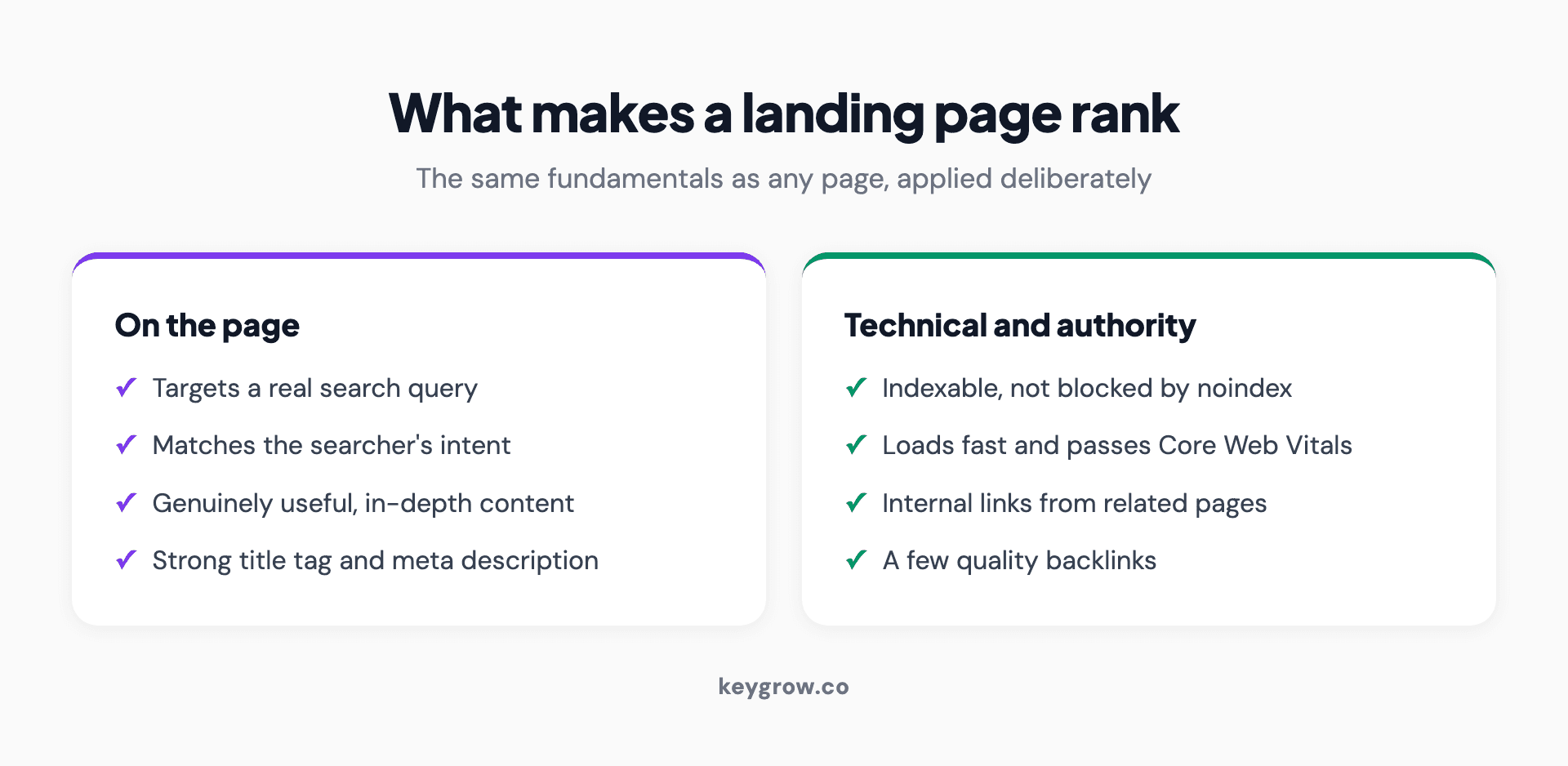
Infographic checklist of what makes a landing page rank in organic search: target a real search query, keep the page indexable, match search intent, write genuinely useful in-depth content, set a strong title tag and meta description, load fast and pass Core Web Vitals, add internal links, and earn a few backlinks.
The levers, in plain terms:
None of this is unique to landing pages. It is just SEO, applied to a page with a job.
The doorway-page trap: when landing pages hurt SEO
Landing pages start hurting your SEO when you mass-produce near-identical versions to blanket dozens of cities or keywords. Google calls these doorway pages, and its spam policies single them out.
Here is the temptation. A service business serves twenty towns, so someone spins up twenty landing pages that are the same template with the town name swapped in. It feels like coverage. Google reads it as manipulation. Its spam policies define doorway abuse as pages created to rank for specific, similar queries that lead users to intermediate pages less useful than the final destination. One of the listed examples is multiple pages targeted at regions or cities that funnel users to a single page. Google says sites that break its spam policies may rank lower or not appear at all.
Worth clearing up: duplicate content itself is not a penalty. As Search Engine Journal notes, Google filters near-identical pages by picking one to show rather than punishing you, which is its own guide on duplicate content territory. The doorway problem is different and worse: it is an active policy violation. The fix is the same either way. If you build a page per location, give each one genuinely different, locally useful content, or do not build it.
How many landing pages is too many?
More landing pages help right up until they start competing with each other. The gain comes from covering more distinct searches, not from copies of the same page, so the ceiling is set by how many real, different queries you can serve well.
There is real upside to more pages when each earns its place. HubSpot found that companies increasing from 10 to 15 landing pages saw 55 percent more leads, and those with more than 40 pages saw conversions climb over 500 percent. The catch is the word "distinct." Those gains come from pages targeting different needs, not from forty versions of one offer.
The failure mode is keyword cannibalization: two of your pages chasing the same query, splitting the signals, and both ranking worse than one strong page would. When you catch yourself making page eleven about nearly the same thing as page four, that is the sign to consolidate, not to publish. One excellent page usually beats a dozen thin ones.
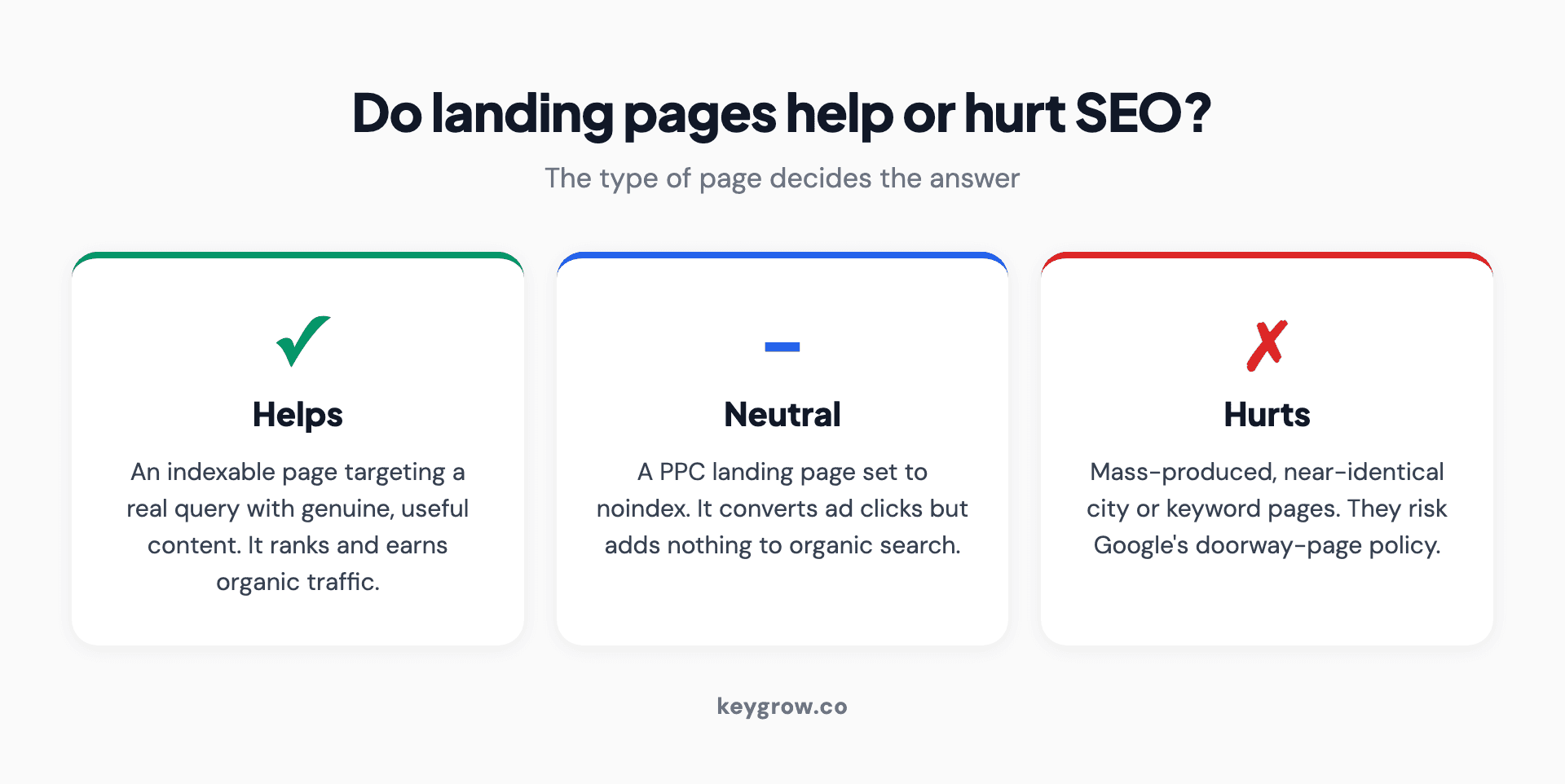
Infographic showing when landing pages help, do nothing, or hurt SEO: a page targeting a real query that is indexable and genuinely useful helps; a PPC page set to noindex is neutral and does not affect organic; and mass-produced near-identical city or keyword pages hurt as doorway pages.
Why landing pages pay off on conversion
The biggest reason to care about landing pages is not rankings at all. It is conversion. A page built for one query and one action turns more of your existing traffic into leads, which is often a faster win than ranking a new page from scratch.
The benchmarks set the bar. Across Unbounce's analysis of more than 41,000 landing pages, the median conversion rate was 6.6 percent, while WordStream found the average closer to 2.35 percent, with the top 25 percent of landing pages converting at 5.31 percent or higher. That spread is the opportunity. The difference between an average page and a top one is the same traffic earning more than double the leads.
We see this constantly on the paid side, and it is the clearest argument for the principle. A mobile detailing client was paying about $100 per booking sending every ad click to their homepage. We pointed the traffic at a dedicated booking page built for that one action, and the cost per booking dropped to $22 while bookings grew 650 percent between August and December. The ad was never the whole job. The page was the other half. Sending traffic to a general page instead of a purpose-built one is the most expensive default there is, paid or organic.
That is also why this is worth doing yourself before hiring anyone. If you have a steady stream of traffic landing on a homepage and bouncing, building one focused page for your main service is a free afternoon that often beats a month of chasing more traffic. Bring in help when you need many pages, ongoing testing, or a rebuild, not to put up a single page you could write yourself. Either way, judge a landing page on blended cost per lead, not on rankings alone.
FAQs
Do landing pages help SEO?
Yes, if they are SEO landing pages: indexable pages that target a real query with genuine content. Those can rank and pull in organic traffic. PPC landing pages are usually set to noindex and do not help organic, and mass-produced near-identical pages can hurt you as doorway pages. The type decides the answer.
Can landing pages rank on Google?
Yes. A landing page is an ordinary web page, so an indexable one that matches search intent and covers its topic well can rank like anything else. The only landing pages that cannot rank are those blocked by a noindex tag or robots rule, or those too thin to deserve a spot.
Do landing pages get indexed by Google?
SEO landing pages do, as long as you have not blocked them. PPC landing pages usually do not, because marketers deliberately set them to noindex to avoid thin-content and cannibalization problems. Check the page's robots meta tag: if it says noindex, Google will not include it in search results.
How is an SEO landing page different from a homepage?
A homepage serves everyone and every purpose, so it rarely ranks well for a specific query. An SEO landing page is built around a single search intent and one main action, which lets it match that query more precisely and convert better. Sending targeted traffic to a focused page usually beats sending it to the homepage.
How is an SEO landing page different from a PPC landing page?
An SEO landing page is built to rank organically and stays indexed, so it earns free traffic over time. A PPC landing page is built to convert paid ad clicks and is usually noindexed, so it earns no organic value. They look similar but do opposite jobs, and confusing the two is the root of most "do landing pages help SEO" confusion.
Does optimizing a landing page for SEO hurt its conversion rate?
It does not have to. The common fear is that adding content for search buries the offer. The fix is structure: keep your headline, value, and call to action above the fold for converting, and place the deeper SEO content below for ranking. Done that way, one page serves both search engines and buyers.
How many landing pages should a website have?
As many as you have distinct searches to serve well, and no more. HubSpot found moving from 10 to 15 pages lifted leads 55 percent, but those gains come from pages targeting different needs. The moment two pages chase the same query, they cannibalize each other, and one strong page would beat both.
Can too many similar landing pages hurt my SEO?
Yes. Mass-producing near-identical pages, especially city or keyword variations funneling to the same place, can trigger Google's doorway-page policy, and such sites may rank lower or not appear at all. Give every page genuinely distinct, useful content, or build fewer pages. Volume without difference is the trap.
The short version
So build landing pages on purpose, not in bulk. Pick distinct searches, give each page genuinely useful content, keep it fast and well linked, and judge it on cost per lead rather than rankings alone. Done that way, a landing page earns traffic and converts it at the same time, which is the whole point.
If you need one focused page, that is a great afternoon project. If you need many, or a rebuild, that is what our web development team does. Tell us about your pages and we will tell you whether you need one or ten.


