


To do a PPC audit, work through the account in a fixed order: confirm the conversion tracking is accurate, cut the wasted spend, tighten the keywords and ads, fix where the clicks land, then compare the results against real benchmarks. Run it in that sequence and a PPC audit usually pays for itself in the first week, because most of what it turns up is money the account was already losing.
Here is the part the ten-step checklists skip. The order matters more than the length. If your tracking is wrong, every number under it is a guess, so you audit that first and everything else second. This is close to the sequence we run on a new account before touching a single bid, and you can do most of it yourself in an afternoon.
Below is the six-step version: what to look for at each stage, the numbers to judge it against, and an honest note on when this is not worth paying anyone to do.
What is a PPC audit, and how often should you run one?
A PPC audit is a structured review of a paid search account that checks whether your budget is reaching the right clicks and whether those clicks turn into leads. Run a full one every quarter, and a quick one after any big change.
Quarterly is the baseline for an account that is ticking along. Auditing much faster tends to mean reacting to noise instead of trends, and much slower lets problems compound for months. The exception is a trigger event: a jump in budget, a new landing page, a seasonal shift in demand, a drop in conversions, or any change to your tracking setup. Those are the moments an account quietly starts leaking, and a short audit is how you catch it before a month of spend is gone.
An account rarely gets worse overnight. Usually nobody was watching, which is a different problem, and a regular audit is the fix for it. And once the audit surfaces the problems, our PPC ROI playbook is the fixing order we follow.
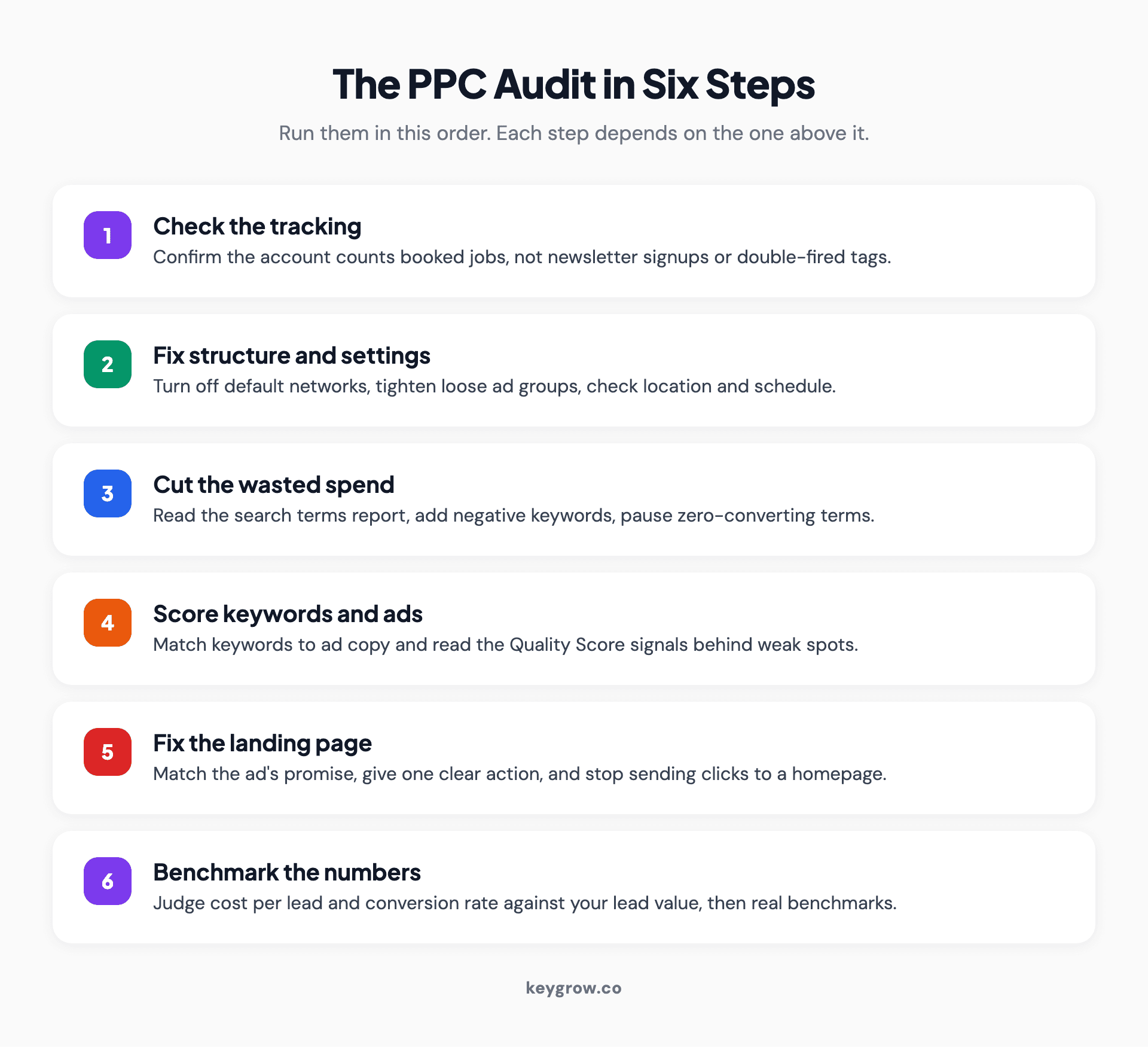
Infographic listing the six steps of a PPC audit in order: check the tracking, fix structure and settings, cut the wasted spend, score keywords and ads, fix the landing page, and benchmark the numbers.
Step 1: Confirm your conversion tracking is telling the truth
Before you judge a single metric, make sure the account is counting the right things. An audit built on broken tracking optimizes toward the wrong goal with perfect discipline.
Start here because everything downstream depends on it. Fire a real test conversion and watch it register. Check that a form submission and a phone call are both tracked, and that neither is counted twice because a thank-you page reloads or two tags fire on the same action. Confirm your primary conversion is a booked job or a qualified lead, not a newsletter signup sitting in the same column. If the account treats a newsletter signup and a booked job as the same event, the bidding will happily chase the cheaper one.
Then check that the accounts talk to each other: conversions importing cleanly, Google Analytics linked, and no duplicate conversion actions padding the totals. Get this right and the rest of the audit runs on real numbers instead of a story you would rather believe.

A laptop screen showing a performance line chart, representing the step of checking that PPC conversion tracking reports real results.
Step 2: Check the account structure and settings
Open the campaign settings before you touch the keywords. A handful of defaults quietly spend your budget in places you never chose, and they are the fastest waste to fix.
The usual offenders:
- The Display Network switched on inside a Search campaign. Google turns this on by default, and it spreads your search budget across apps and sites you never picked. Split search and display into separate campaigns so you can judge and fund them apart.
- Location targeting set to presence or interest. This can show your ads to people who are not in your service area but happened to search about it. For a local business, targeting presence in your area is almost always what you want.
- Loose ad groups. Each ad group should cover one tight theme so the ad can speak directly to the search. A group that mixes "emergency plumber" with "how to fix a leak" cannot write one ad that fits both.
Check the ad schedule and device performance while you are in there. If a whole day or a device type converts at a fraction of the rest, that is a bid adjustment waiting to happen.
Step 3: Hunt the wasted spend in your search terms
Open the search terms report and read what people actually typed to trigger your ads. This is where the money leaks, and it is the highest-return half hour in the whole audit.
Broad match without a negative keyword list is a donation to Google. In accounts nobody is actively managing, we routinely find a fifth to a third of the budget going to searches that were never going to convert. The fix is not complicated: read the report, add the junk as negative keywords, and tighten match types where broad is pulling in unrelated searches. Google's own search terms report is built for exactly this, and it rewards a weekly look rather than a quarterly one.
While you are in there, declutter the account. Pause keywords that have spent real money over a meaningful window with zero conversions, consolidate near-duplicate keywords competing against each other, and cut the ads that have not earned a click in months. A leaner account is easier to read and cheaper to run.
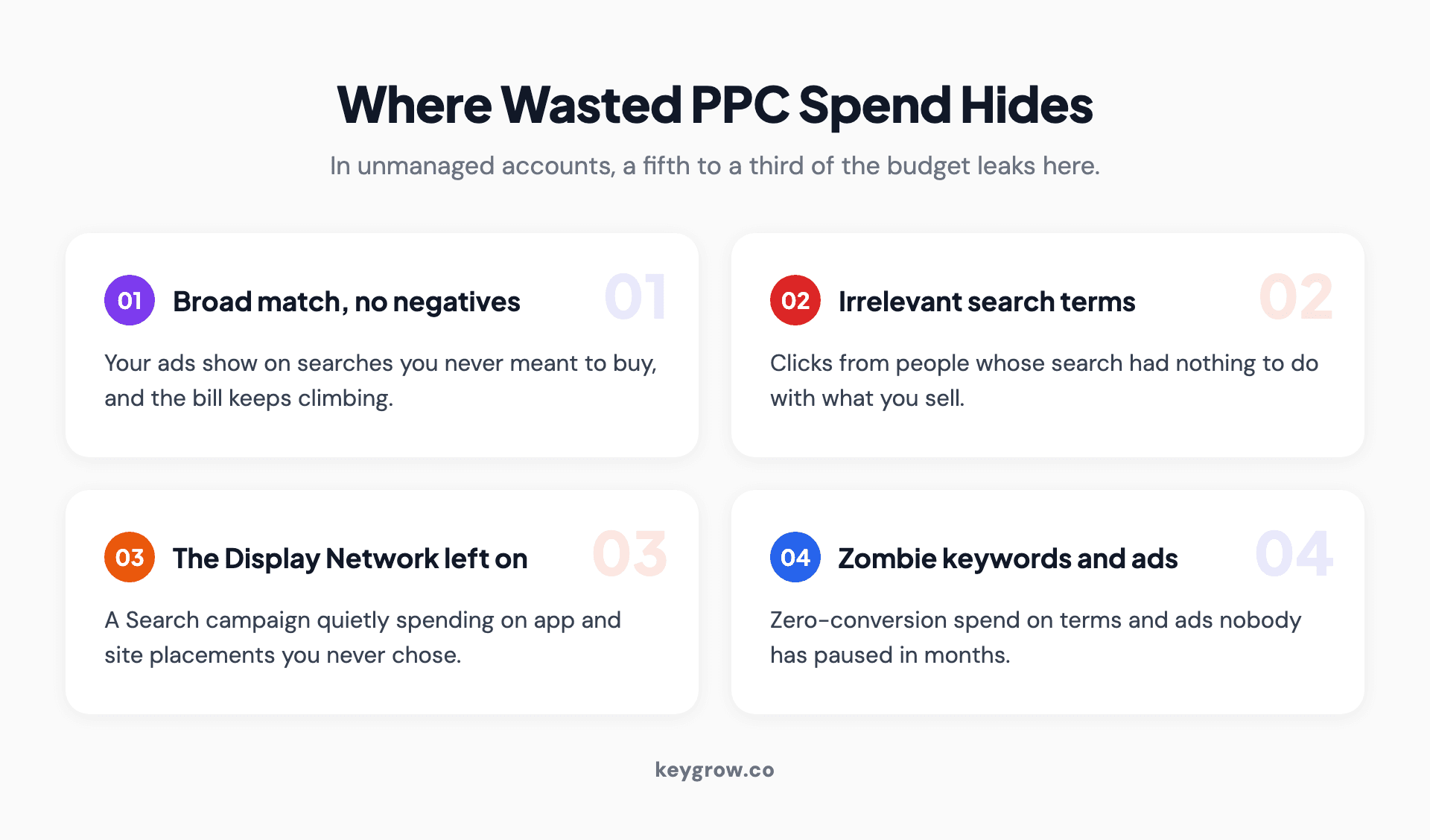
Infographic showing four places wasted PPC spend hides: broad match with no negatives, irrelevant search terms, the Display Network left on, and zero-conversion zombie keywords and ads.
Step 4: Score your keywords, ads, and Quality Score
Now judge relevance: how well your keywords, ads, and landing pages line up with what people searched. Google rolls this into Quality Score, a diagnostic that points straight at the weak link.
Quality Score is a 1-to-10 number built from three signals: your expected click-through rate, how relevant the ad is to the search, and the landing page experience. One caveat most guides miss is that Google's Quality Score is a diagnostic, not an input in the ad auction, so do not chase the number for its own sake. The three signals behind it still matter, because they feed your ad rank and what you pay per click. Treat a low score as a map to the weak link, not a metric to polish.
Read the ads with that in mind. Does the keyword show up in the headline? Does each ad group have a strong responsive ad rather than one thin line written three years ago? Are sitelinks, callouts, and other assets turned on, since they take more of the page and lift click-through at no extra cost per click? And look at what competitors are bidding on, because a keyword gap you have missed is often cheaper to win than outbidding everyone on the terms you already share. Our guide on checking competitor Google Ads shows how.
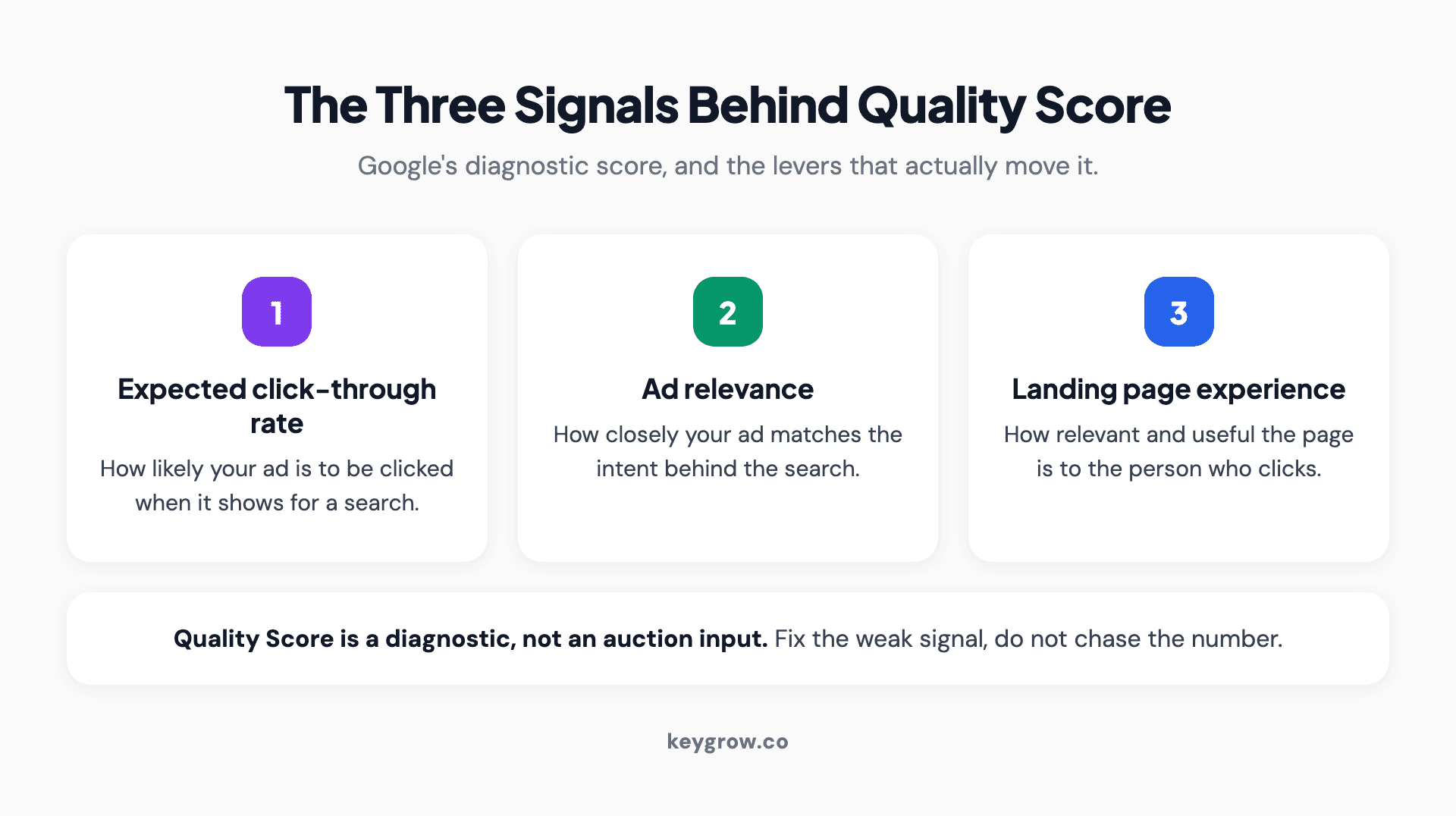
Infographic explaining the three signals behind Google Quality Score: expected click-through rate, ad relevance, and landing page experience, with a note that Quality Score is a diagnostic and not an auction input.
Step 5: Send the clicks to a page that converts
The ad is half the job. The page is the other half, and it is the half most audits barely look at. Check that the landing page keeps the promise the ad made and gives the visitor one obvious thing to do.
The most common landing page mistake is also the simplest: pointing paid clicks at your homepage. A mobile detailing client came to us paying about $100 per booking, sending every click to their homepage. We pointed the traffic at a dedicated booking page and rebuilt the campaign around it. Cost per booking dropped to $22, bookings grew 650 percent, and monthly revenue went from $1.2K to $5.1K between August and December. Same budget, different destination.
Walk each important landing page yourself and check the basics: the headline matches the ad's promise, there is one clear call to action rather than five competing links, the page loads fast on a phone, and the form asks only for what you actually need. If your ads point at a homepage or a page built for browsing rather than converting, closing that gap is usually worth more than any bid change. We cover the difference in landing page versus website.

A laptop open on a desk, representing the landing page that a paid search click arrives on.
Step 6: Benchmark the numbers that actually matter
With the account cleaned up, line your results against reality. Judge click-through rate, cost per click, conversion rate, and cost per lead, and read each one next to your own history and your lead value, not just an industry average.
Across 13,474 US search campaigns, WordStream's 2026 benchmarks put the median click-through rate at 6.64 percent, the median cost per click at $5.42, the median conversion rate at 8.18 percent, and the median cost per lead at $66.69. Use those as a sanity check, not a target. A $70 lead is cheap for a law firm and expensive for a pizza shop, so the number that counts is what a lead is worth to you. If your click-through rate looks low, the ad and keyword work in step four is usually the cause. If clicks are healthy but leads are thin, the problem is the page. For a fuller read on the click side, see what a good CTR looks like.
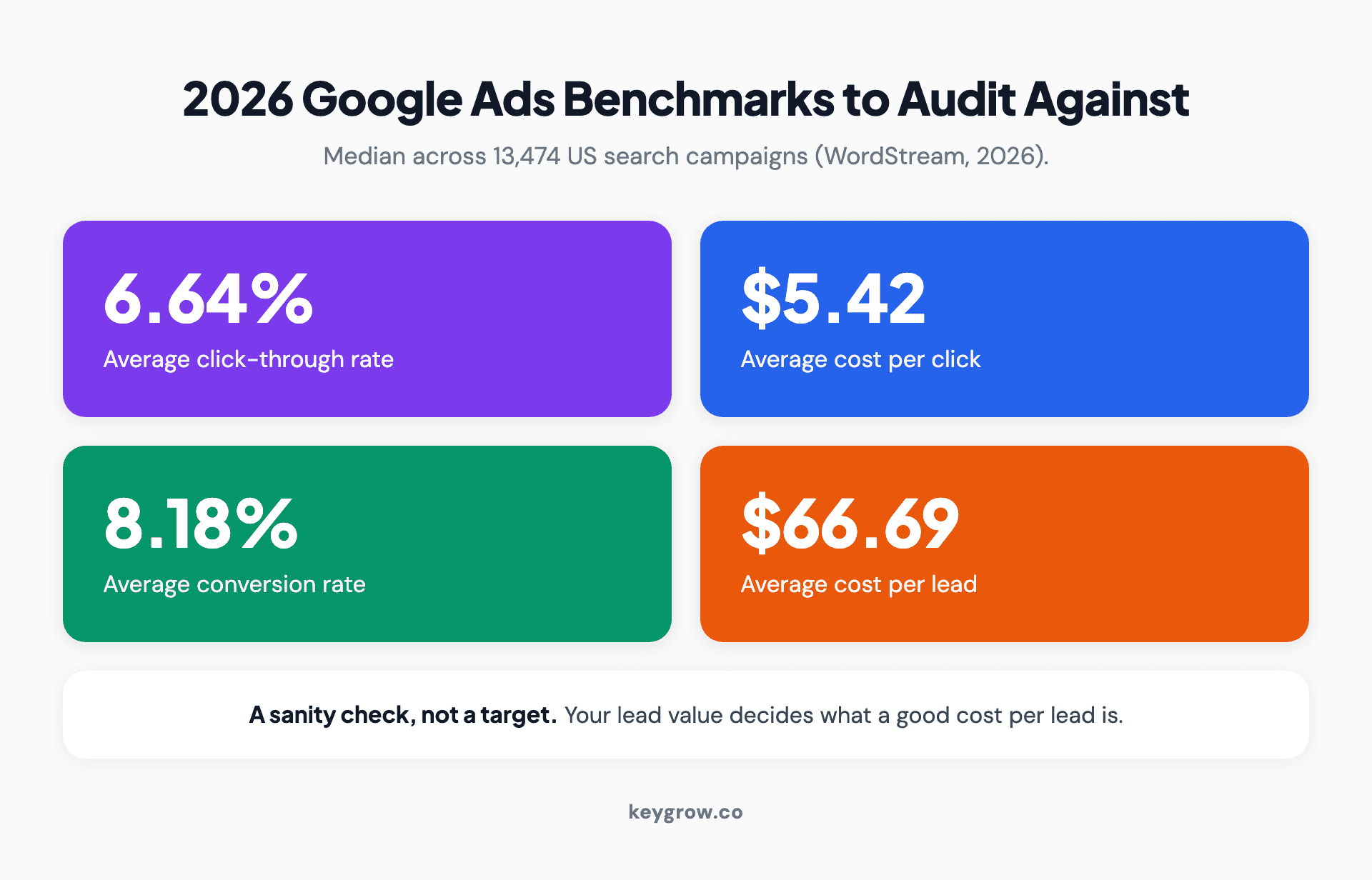
Infographic of 2026 Google Ads benchmarks to audit against: 6.64 percent average click-through rate, $5.42 average cost per click, 8.18 percent average conversion rate, and $66.69 average cost per lead, from WordStream.
What to fix first
You will finish the audit with a list longer than your week. Fix in order of money moved, not by what is quickest to tick off. Tracking and wasted spend come before cosmetic tweaks every time.
Here is the rough triage we use, ranked by impact against effort:
| Fix | Typical impact | Effort |
|---|---|---|
| Broken or duplicate conversion tracking | Very high, every decision depends on it | Low |
| Negative keywords for wasted search terms | High, recovers the biggest chunk of budget | Low |
| Display Network left on in a Search campaign | High | Low |
| Landing page message match | High | Medium |
| Ad relevance and assets | Medium | Low |
| Bid strategy and budget reallocation | Medium | Medium |
The pattern holds across almost every account: the cheapest fixes to make are often the ones that move the most money, and the expensive-looking rebuilds can usually wait. Start at the top and work down.
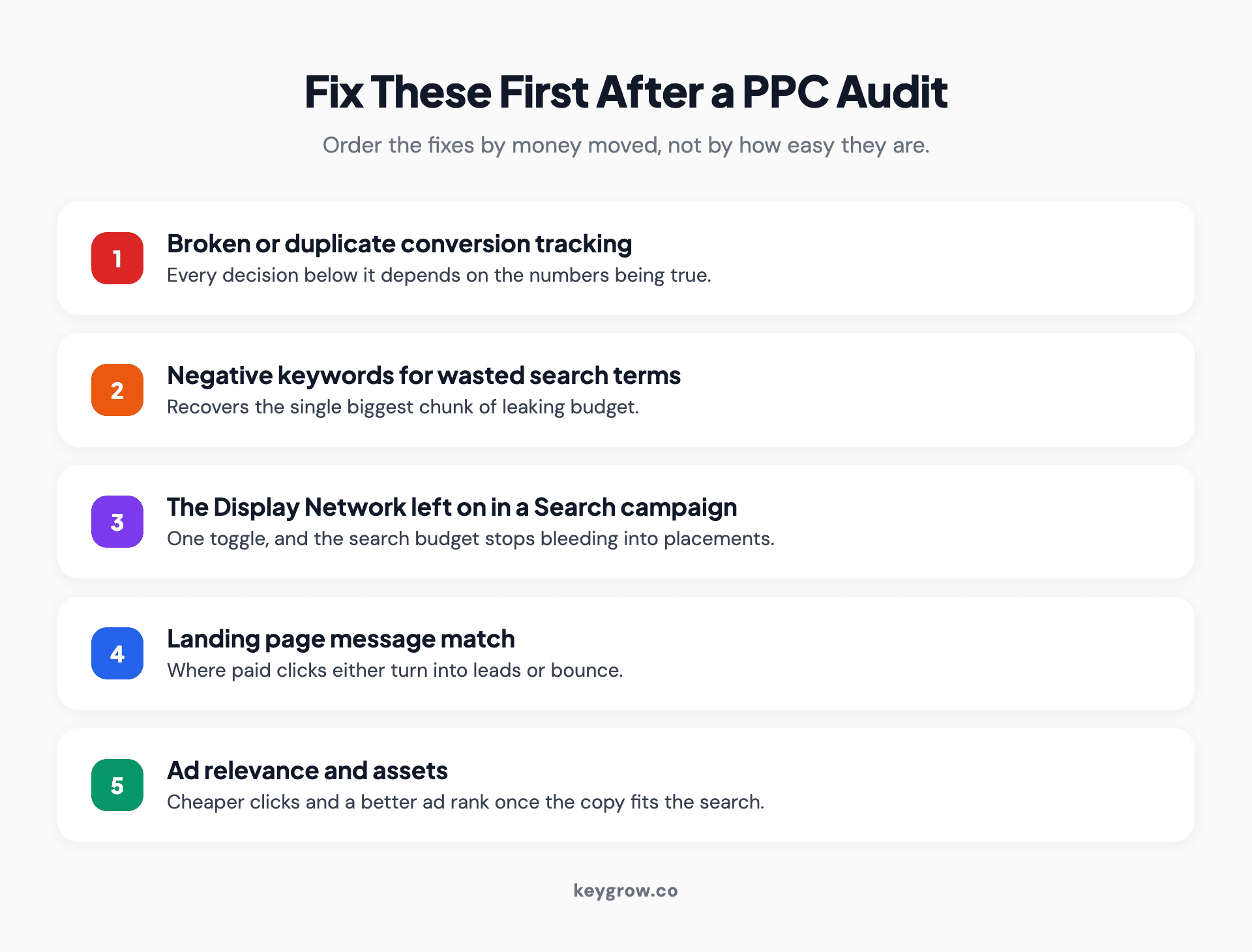
Infographic ranking the fixes to make first after a PPC audit: conversion tracking, negative keywords, the Display Network toggle, landing page message match, and ad relevance and assets.
When to run this yourself, and when to bring in help
Most of this is do-it-yourself work. If you run a single-location business spending a few thousand a month, you can work through steps one to five in an afternoon and recover most of the obvious waste. The tracking check and the search terms cleanup alone are worth the time, and nobody knows your customers better than you do.
Be wary of the free audit that arrives as a polished PDF with your account name pasted on top and a sales call attached. A real audit names specific wasted keywords and specific broken settings. A sales deck talks in round percentages about what it could save you.
Bring in help when the math changes: when you are managing serious monthly spend across several accounts, when the opportunity cost of your own time beats the fee, or when you have run the audit twice and the numbers still will not move. That last one usually means the problem is structural rather than cosmetic, and a second practiced set of eyes earns its keep. If you get there, our paid search team runs this same audit and reports on cost per booked job.
FAQs
What is a PPC audit?
A PPC audit is a structured review of a paid search account that checks whether your budget is going to the right clicks and whether those clicks convert into leads or sales. It covers conversion tracking, account structure and settings, keywords and negative keywords, ad relevance and Quality Score, landing pages, and the core performance metrics. The goal is to find wasted spend and the fixes that will move results.
How long does a PPC audit take?
A focused audit of a small account takes a few hours once you know the order to work in. A large account with multiple campaigns and thousands of keywords can take a day or more. The tracking check and the search terms review are the two steps worth the most time, so if you are short on hours, start there.
How often should you do a PPC audit?
Run a full PPC audit every quarter for a healthy account, and a quick one after any major change, such as a budget increase, a new landing page, a seasonal shift, or a drop in conversions. Auditing much more often tends to mean reacting to noise, and much less often lets small problems compound into months of wasted spend.
What should a PPC audit include?
At minimum it should check conversion tracking accuracy, campaign settings and network placement, account and ad group structure, keyword and match type choices, negative keywords, ad relevance and assets, Quality Score signals, landing page quality, and the headline metrics of click-through rate, conversion rate, cost per click, and cost per lead. Anything less leaves a common source of waste unexamined.
Can I do a PPC audit myself?
Yes, for most small accounts. The tracking check, the search terms cleanup, and the landing page review are all doable without an agency, and they catch the majority of the waste. Bring in help when you are running large or multi-account spend, when your time is worth more than the fee, or when you have audited twice and results are still flat.
How much wasted spend does a PPC audit usually find?
It varies with how well the account has been managed, but in accounts running broad match with no negative keyword list, a fifth to a third of the budget is commonly going to searches that will never convert. The search terms report is where most of that waste hides, which is why it is the first place to look once the tracking checks out.
What to do this week
Block an hour and do step one. Fire a test conversion and confirm the account is counting booked jobs, not newsletter signups or double-fired tags. That single check catches more misread spend than people expect, and it decides whether the rest of the audit is built on real numbers or on noise. From there, work down the list in order: settings, search terms, relevance, the landing page, then the benchmarks.
Run it once and the account gets leaner. Put it on the calendar every quarter and it stays that way. If you would rather hand the whole thing over and get back a prioritized fix list instead of a sales pitch, tell us your numbers on our get started page. We will run the audit month-to-month, and tell you honestly if you do not need us.