


Performance Max campaigns are not a campaign type you switch on. They are a bidding surface you feed, and the output is worth exactly as much as three inputs you control: the quality of your conversion data, what you exclude, and the signals you hand over.
Get those wrong and the campaign still reports beautifully. That is the part worth understanding before you launch one. Left unconfigured, Performance Max will find the cheapest conversions available to it, and the cheapest conversions available to almost any account are the people already searching for your brand. It will buy demand you already had, count it as new, and show you a cost per conversion that makes every other campaign look bad.
None of that means avoid it. It means configure it properly and read the reporting with a specific kind of suspicion.
What Performance Max actually is
One campaign that serves across Search, Shopping, YouTube, Display, Discover, Gmail and Maps, with Google deciding the split, the placements and most of the creative assembly.
You give it a budget, a conversion goal, a set of assets, and some hints. It decides everything else. There is no keyword list, no manual placement control, and no channel-level budget split.
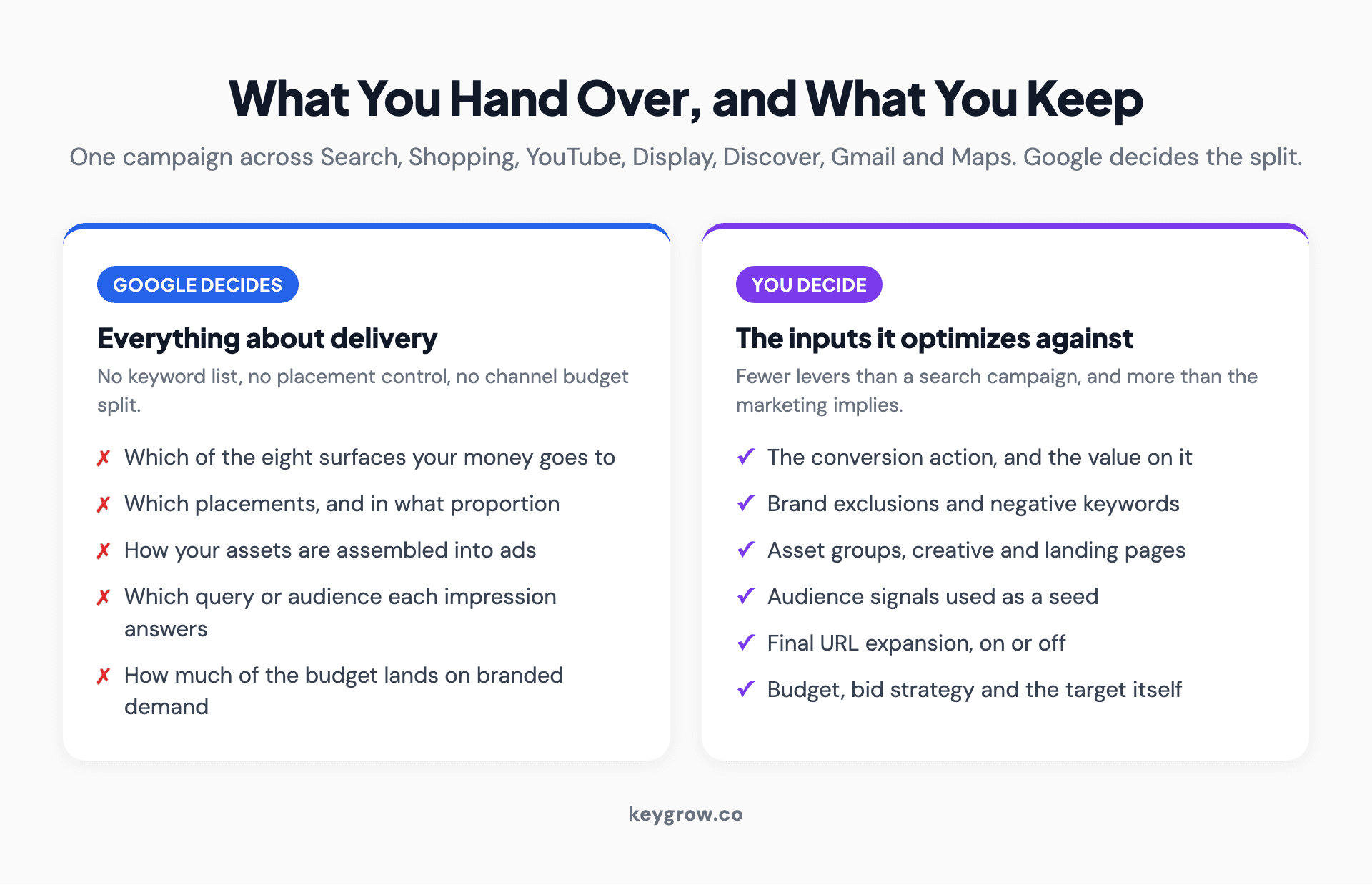
What you hand over to Performance Max and what Google decides in return, across all eight inventory surfaces.
It launched in 2021 and absorbed Smart Shopping and Local campaigns, which is why so many accounts ended up running it without ever deciding to. Google has continued folding other formats in the same direction, including moving Local Services Ads toward Performance Max with pay-per-lead goals, which we covered in the local lawyer Google Ads guide.
Read Google's own documentation for the feature list and the setup walkthrough before launching, and assume both have changed since, because this campaign type moves faster than any other. Search Engine Land's guide is the best independent reference if you want more depth than we go into here.
Why does your Performance Max ROAS look so good?
Because it is probably buying your brand traffic and charging you for people who were already coming.
This is the single most common finding when we audit an account running Performance Max. Someone searches your company name, the campaign serves, they click, they convert. That conversion was going to happen through organic or a brand search campaign at a fraction of the cost. Performance Max books it as its own and the reported cost per acquisition drops.
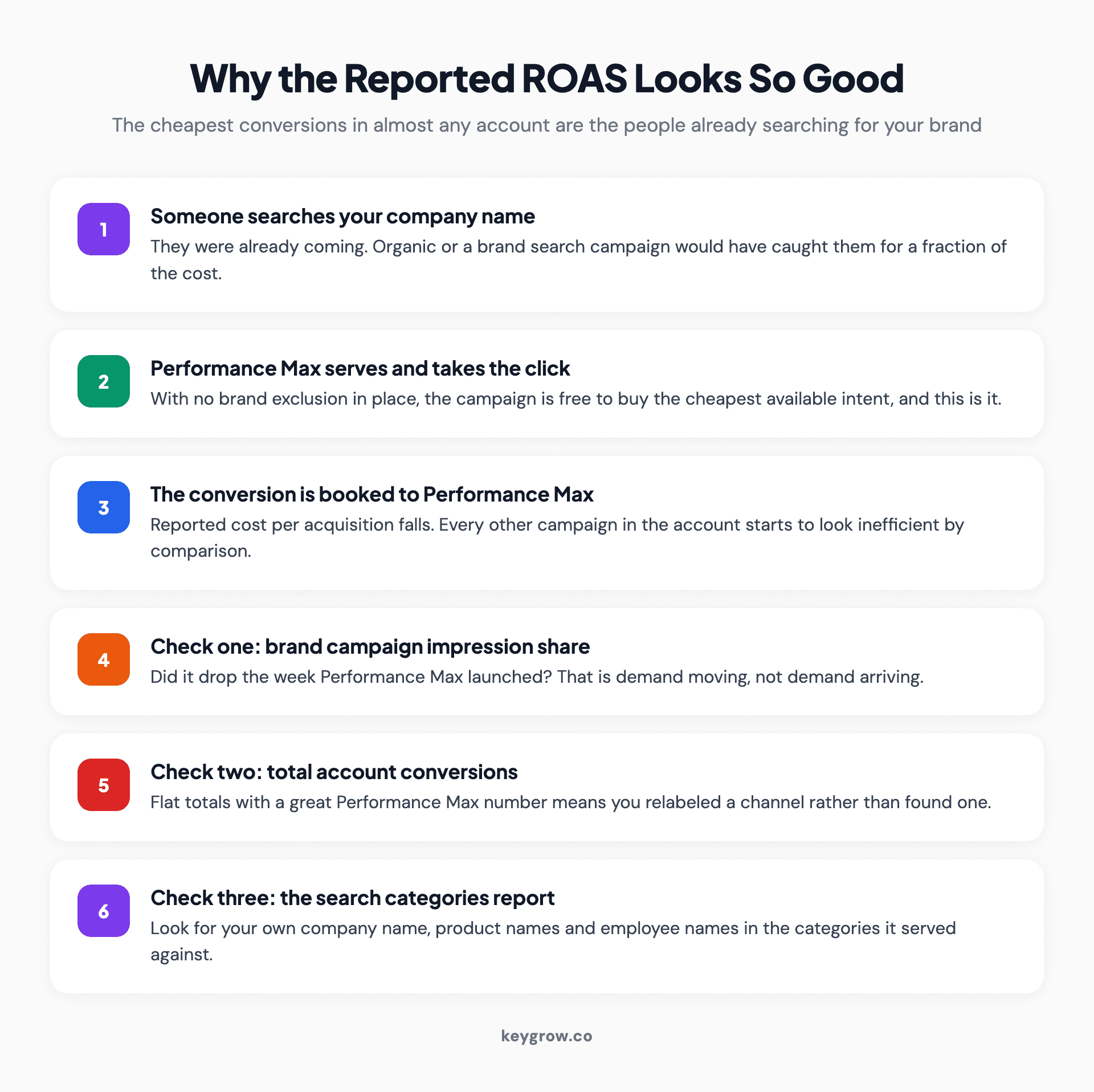
How Performance Max absorbs branded demand and reports it as new customer acquisition, and the three checks that expose it.
Three checks will tell you whether it is happening in your account. Look at whether your brand search campaign's impression share fell when Performance Max launched. Look at whether total conversions actually rose or just moved between campaigns. And look at the search categories report for terms that are obviously your own name.
If total account conversions are flat while Performance Max reports a great number, you have not found a new channel. You have relabeled an old one.
Exclude your brand before you spend anything
Brand exclusions and account-level negative keywords are the first configuration, not a later optimization.
Add your company name, common misspellings, your product names, and the names of employees people search for. Add them as brand exclusions where the option exists and as account-level negatives as well, because the two do not cover identical ground.
Then keep a separate brand search campaign running. It is cheap, it defends the term against competitors, and it gives you a clean read on how much branded demand exists independent of anything Performance Max claims.
This is the same argument as running broad match without negatives, which is a donation to Google. In unmanaged accounts we typically find twenty to thirty percent of budget going to search terms nobody would have chosen. Performance Max is that problem with less visibility, which makes the exclusion list more important rather than less.
The black box has seven handles
The campaign is marketed as automated. It is better described as constrained, and the constraints are the job.
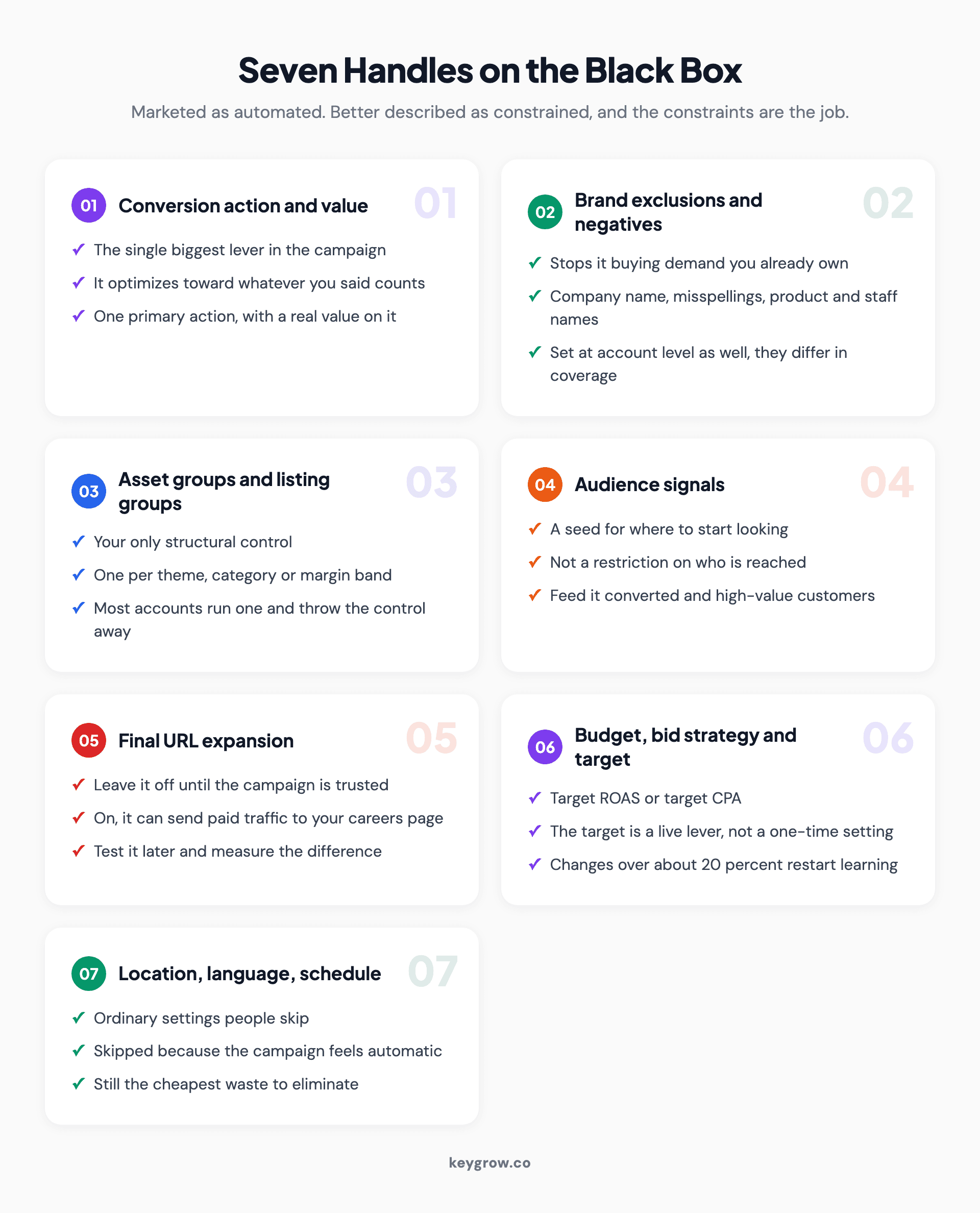
The seven controls that actually exist in a Performance Max campaign, ordered by how much each one changes performance.
Here is what you genuinely control, roughly in order of impact.
The conversion action and its value. The single biggest lever. The campaign optimizes toward whatever you told it counts, which is the whole argument in automated bidding applied to eight surfaces at once.
Brand exclusions and negative keywords. Covered above. Stops it buying what you already own.
Asset groups and listing groups. Your only structural control. One asset group per theme, product category or audience.
Audience signals. A hint about who to start with, not a targeting restriction.
Final URL expansion. Leave it off until you trust the campaign, or it will send traffic to any page on your site it likes, including your careers page.
Budget and bid strategy. Target ROAS or target CPA, and the target itself is a real lever most people set once and forget.
Location, language and schedule. Ordinary settings that people skip because the campaign feels automatic.
Seven handles is not nothing. It is considerably more control than the "just let it learn" advice implies, and every one of them is a place accounts lose money.
Your conversion data decides everything downstream
Performance Max is an optimization engine pointed at whatever you defined as success. If that definition is loose, it will find the loosest possible version of it, efficiently.
The three failures we see most often: counting every form fill as one conversion regardless of quality, counting a phone call of any length as a conversion, and having several conversion actions marked primary so the campaign optimizes toward a blur.
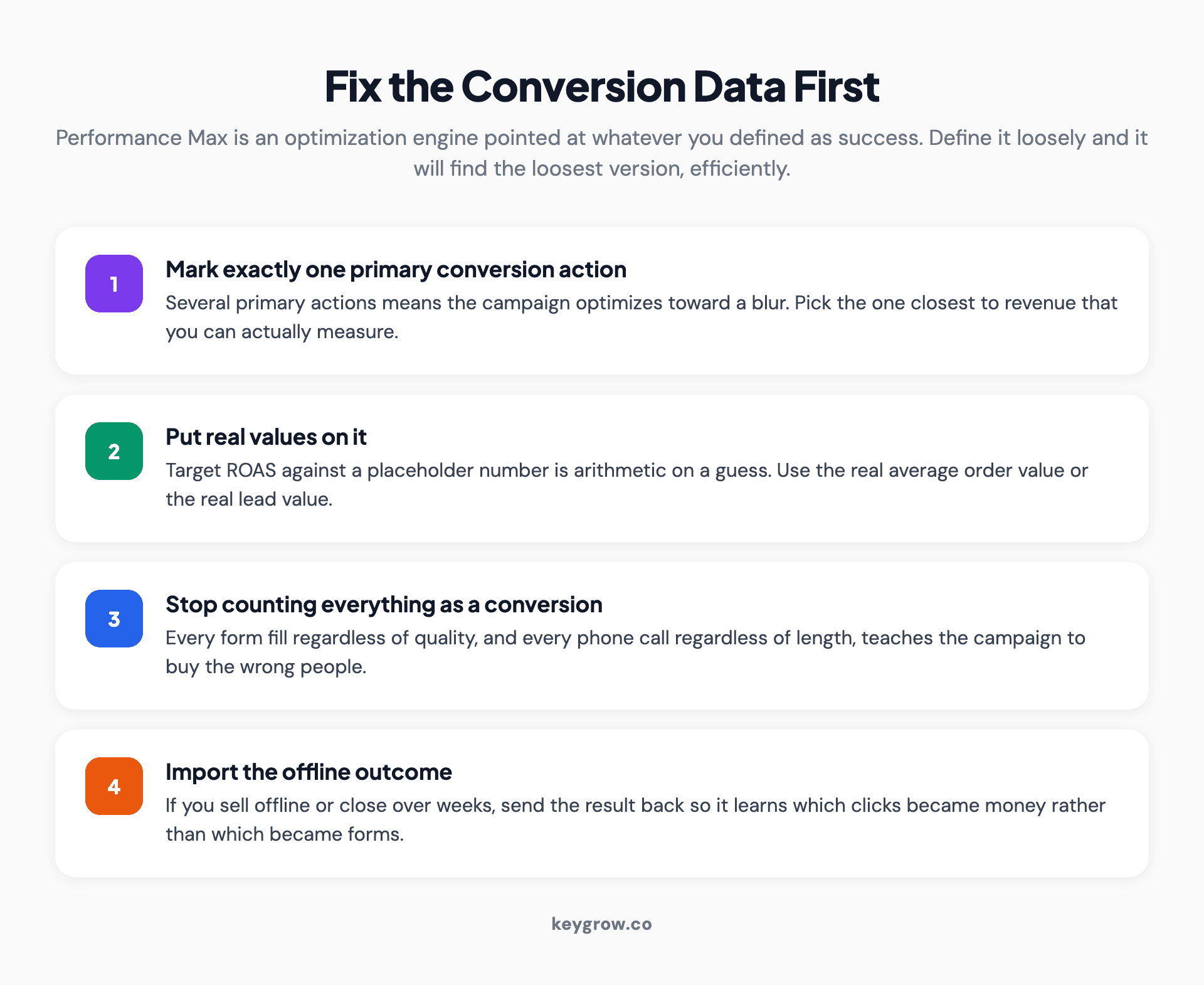
The order to fix Performance Max conversion data in, from one primary action to offline outcome import.
Fix it in this order. Mark exactly one primary conversion action, the one closest to revenue you can measure. Assign real values, not placeholder ones, because target ROAS is meaningless against a made-up number. Then, if you sell offline or close over time, import the outcome back so the campaign learns which clicks became money rather than which became forms.
One detailing client arrived paying roughly $100 a booking, every click landing on their homepage. Once the conversion was defined properly and the traffic had a page built for it, the number settled at $22, and bookings rose 650 percent across August to December. Automation did not do that. Defining the conversion properly and giving it a page worth landing on did.
Lead generation and ecommerce are two different products here
Performance Max works well for ecommerce and is genuinely risky for lead generation, and the reason is the feedback loop.

Stock and pallets in a fulfilment warehouse.
For a retailer with a product feed, the conversion is a purchase with a real value attached, which arrives within minutes. That is a clean signal, and the machine learns fast.
For a lead generation business, the conversion is a form submission with no value, and the actual outcome happens weeks later in a CRM the campaign cannot see. Left alone, it will optimize toward whoever fills in forms most readily, and that population is rarely your best customer.
| Ecommerce | Lead generation | |
|---|---|---|
| Conversion signal | Purchase, with a real value | Form fill, usually valueless |
| Feedback delay | Minutes | Weeks or months |
| Risk if unmanaged | Overspending on existing customers | High volume of low-quality leads |
| Required setup | Clean product feed, accurate values | Offline conversion import, lead scoring |
| Verdict | Usually a good fit | Only with the feedback loop built first |
If you run lead generation and cannot yet send qualified-lead data back into Google Ads, do that first or run search campaigns instead. This is the same trap as judging any channel on form fills, and it is why the honest answer for a lot of service businesses is not yet.
Asset groups are the only structure you get
With no keywords and no placements, asset groups are where your entire account structure now lives. Most accounts run one, which throws away the control.
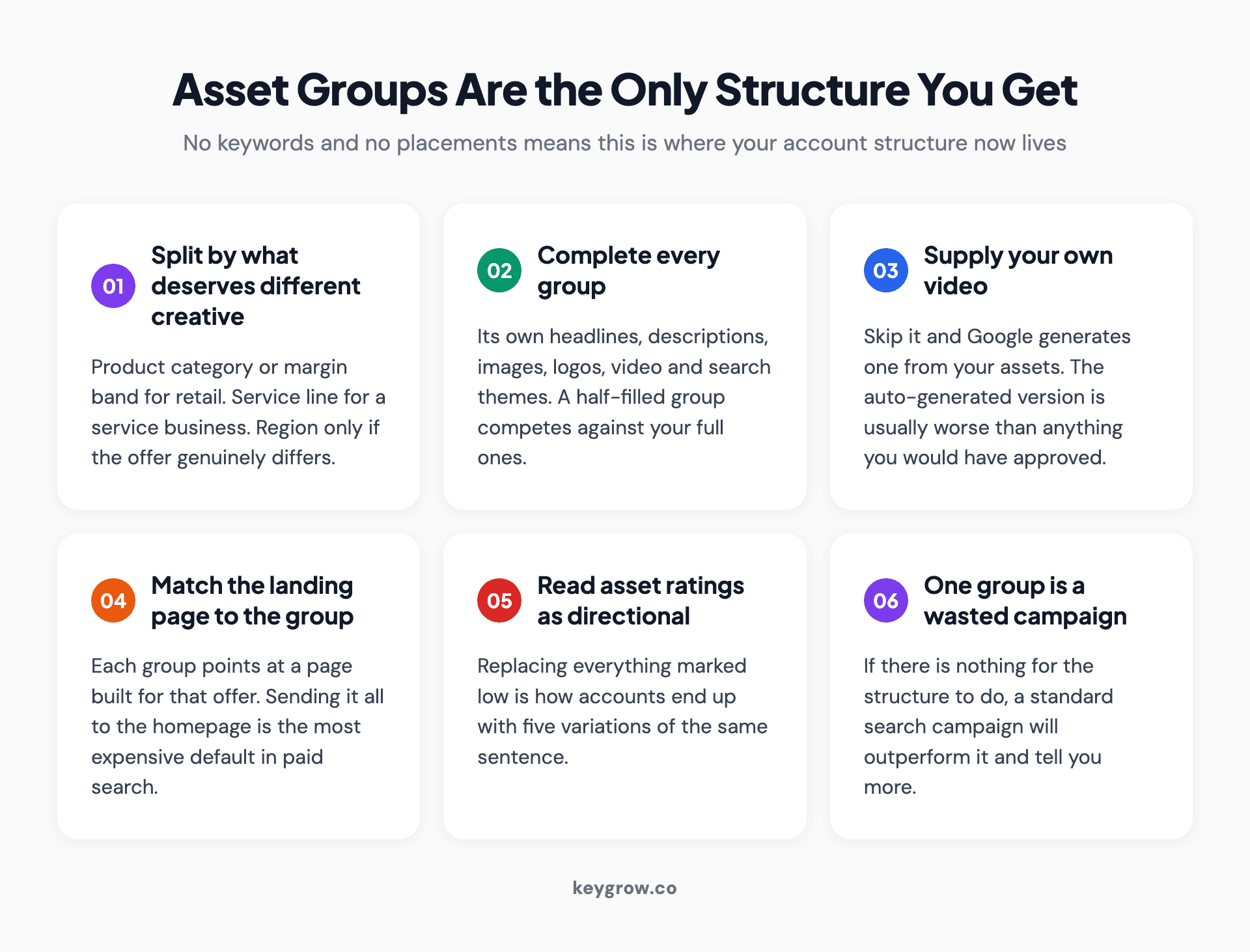
How to structure Performance Max asset groups by theme, and what each group needs to be complete.
Build one asset group per theme that deserves different creative and a different landing page. For a retailer that is usually product category or margin band. For a service business it is service line. For a multi-location business it is region, if the offer genuinely differs.
Each asset group needs its own headlines, descriptions, images, logos and video, plus search themes describing what it is about. Give it real video. If you do not supply one, Google will generate something from your assets, and the auto-generated version is usually worse than anything you would have approved. Point each group at a page built for that offer rather than your homepage, for the reasons in landing page versus website.
Watch the asset performance ratings, but treat them as directional. Swapping out every asset marked low is how accounts end up with creative that all sounds identical.
Audience signals are a hint, not targeting
This is the most misunderstood setting in the campaign, and the misunderstanding costs money in both directions.
An audience signal tells Google where to start looking. It does not restrict who the campaign reaches. Upload a customer list and the campaign will use it as a seed, then go well beyond it. People who expect targeting get surprised by their traffic, and people who expect nothing skip the setting entirely and give the algorithm a cold start.

Packaged products on stocked retail shelving.
Give it your best first-party data: converted customers, high-value customers, cart abandoners, people who spent real time on key pages. The better the seed, the shorter the expensive learning phase.
What it will not do is keep you inside that audience. If you need genuine restriction, you need a different campaign type, and that is a legitimate reason to keep standard search campaigns running alongside.
What the reporting will not show you
Plan for the visibility gap rather than being annoyed by it later.
You do not get a channel-level breakdown of spend, so you cannot see how much went to YouTube versus Search. You get search categories rather than a full search terms report. Asset-level data is thin. And attribution between Performance Max and your other campaigns is murky by design, since the same user may be touched by both.
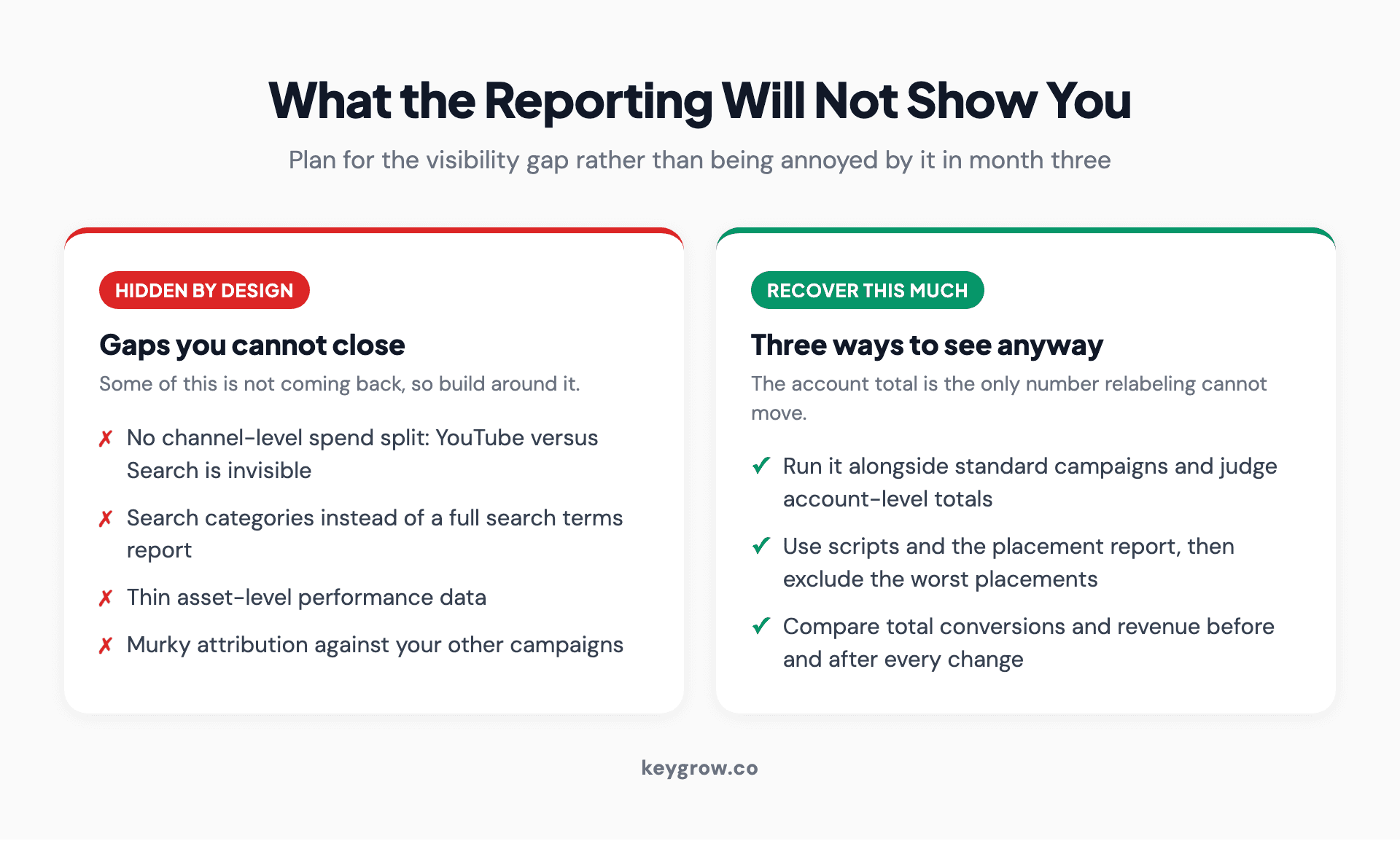
What Performance Max reporting hides, and the three ways to recover visibility into where the money went.
Three things recover some visibility. Run Performance Max alongside standard campaigns and watch the account-level totals rather than the campaign ones, because the account total is the only number that cannot be moved by relabeling. Use scripts or the placement report to see where impressions actually went, and exclude the worst placements. And check total conversions and total revenue before and after any change, at the account level, every time.
If your agency reports Performance Max in isolation and never shows account totals, ask why. That is the reporting equivalent of leading with impressions.
How long to leave it alone
Give it six weeks before judging, and resist the urge to adjust in week two.
The learning phase is real and every material edit restarts some of it. Budget changes over about twenty percent, target changes, new asset groups and conversion action changes all reset the clock to some degree.
That does not mean do nothing. Exclusions, negative keywords and obvious placement waste can be handled early, because those are constraints rather than optimization targets. What should wait is target ROAS or CPA tuning, which needs conversion volume to be meaningful.
If the campaign has produced fewer than about thirty conversions in a month, no amount of patience will help. It does not have the data to learn from, and that is a budget or a market size problem rather than a settings problem.
When not to run Performance Max
Five of them, and in each case a different campaign type does more with the same money.
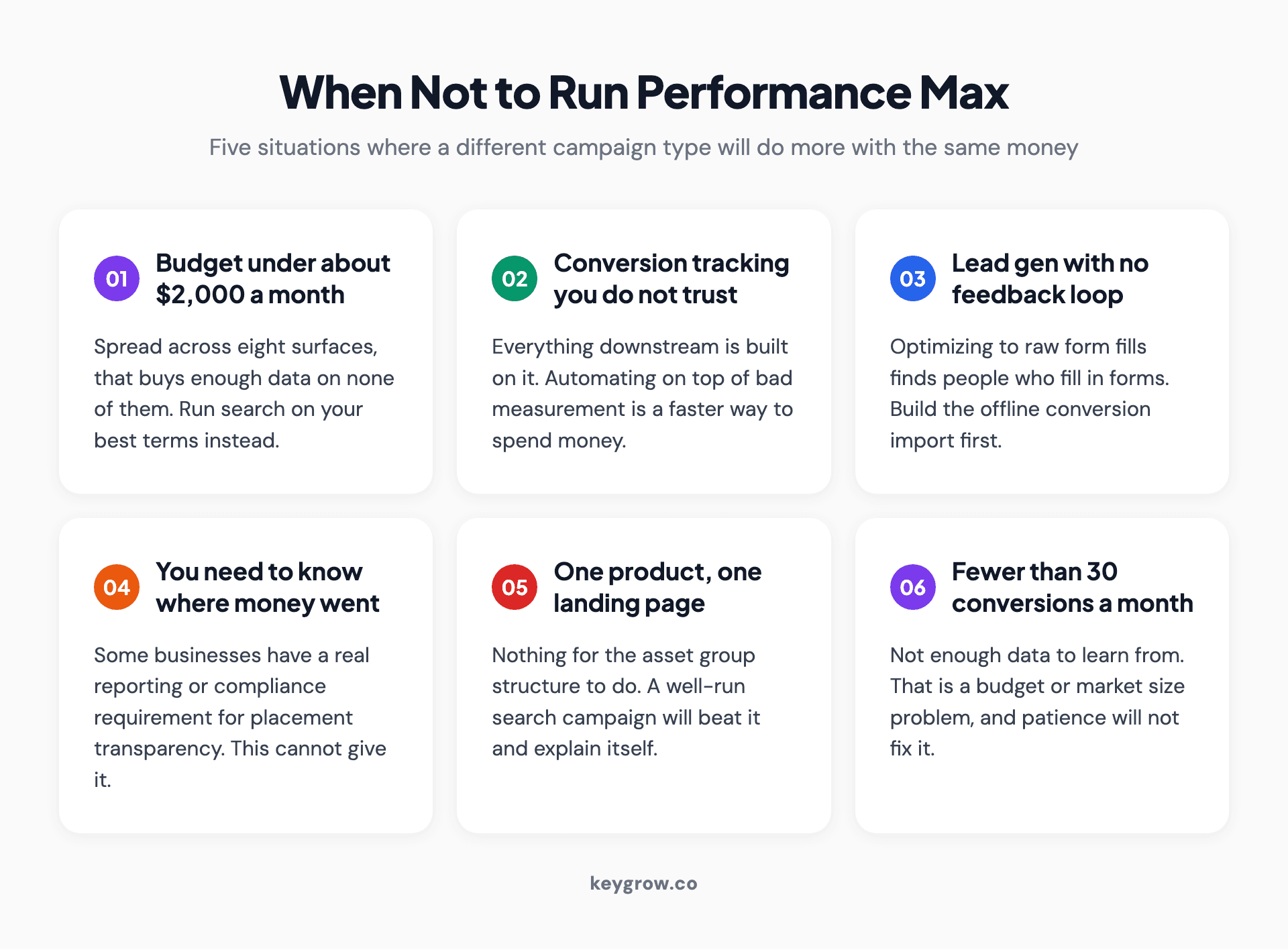
Five situations where Performance Max is the wrong campaign type, and what to run instead in each case.
Your budget is under about $2,000 a month. Spread across eight surfaces, that buys enough data on none of them. Run search on your best terms instead.
Your conversion tracking is not trustworthy. Everything downstream is built on it. Fix tracking, then automate.
You are lead generation with no offline feedback loop. Covered above, and the most expensive version of this mistake.
You need to know where your money went. Some businesses have a genuine reporting or compliance requirement for placement transparency. Performance Max cannot give it.
You have one product or service and one landing page. There is nothing for the asset group structure to do, and a well-run search campaign will outperform it while telling you more.
We say no to this fairly often, usually on the tracking point, because selling automation to an account that cannot measure outcomes is selling a faster way to spend money.
FAQs
Is Performance Max better than standard search campaigns?
Neither is better in the abstract. They do different jobs. Search buys demand that already exists with keyword-level control, Performance Max finds demand across channels with almost none. Most healthy accounts run both, with brand and high-intent terms protected in search campaigns and Performance Max working the rest.
Does Performance Max steal traffic from my other campaigns?
It can, and by default it often does. Search campaigns with exact match keywords generally take priority over Performance Max for the same query, but branded and broader traffic is frequently absorbed. Add brand exclusions and account-level negatives, then judge everything on account-level totals rather than per-campaign numbers.
What budget does Performance Max need?
Around $2,000 a month is a realistic floor for most accounts, and more where the market is expensive. The campaign spreads spend across eight inventory surfaces, so a small budget produces too little data on each for the learning to work. Below that, a tightly run search campaign is the better use of the money.
How long does Performance Max take to learn?
Roughly six weeks before the numbers mean anything, assuming reasonable conversion volume. Material edits restart part of the learning, so batch your changes rather than adjusting weekly. If the campaign generates fewer than about thirty conversions a month, it will not stabilize regardless of how long you wait.
Can you see search terms in Performance Max?
Only partially. You get search categories rather than the full search terms report available in standard campaigns, and the detail is thinner than most advertisers expect. Account-level negative keywords and brand exclusions are the practical controls, and placement reports plus scripts recover some of the missing visibility.
Should I use audience signals in Performance Max?
Yes, and understand what they do. A signal seeds the algorithm rather than restricting reach, so it shortens the learning phase without limiting who sees your ads. Feed it converted customers and high-value segments. If you need actual audience restriction, use a campaign type that offers it.
Is Performance Max good for lead generation?
Only once you send qualified-lead data back into Google Ads. Optimizing toward raw form fills teaches the campaign to find people who fill in forms, which is not the same as people who buy. Build the offline conversion import first, or run search campaigns until you can.
What does final URL expansion do in Performance Max?
It lets Google send traffic to any page on your site it judges relevant, rather than only the final URL you set. Turn it off at launch, because you do not yet know which of your pages convert paid traffic. Once the campaign is stable you can switch it on, with URL exclusions already in place for pages that should never receive ads.
The order to do this in
Fix conversion tracking first, and mark one primary action with a real value. Add brand exclusions and account-level negatives before the campaign spends a dollar. Build one asset group per theme with your own video and a landing page that matches. Seed the audience signal with converted customers. Turn final URL expansion off. Then leave it for six weeks and judge it on account-level totals, not on the campaign's own report.
That sequence is most of the difference between Performance Max working and Performance Max quietly repricing traffic you already had. Nothing in it is exotic, and almost none of it happens by default.
If you want someone to check whether your campaign is finding new customers or rebilling the old ones, send us the account and we will show you the account-level numbers, which is where the answer always is. We run this alongside the rest of our paid search work, month to month.