

Most of what gets called PPC optimization is fidgeting. Pause a keyword here, nudge a bid there, rewrite a headline, feel productive. Meanwhile the three things that actually move return on investment sit untouched: the money math nobody ran, the conversion data Google never sees, and bidding targets set by feel instead of margin.
Optimizing PPC for better ROI means working those three first, then letting the familiar tactics (negatives, ad copy, landing pages, budget shifts) compound on top. This is the full playbook we run on client accounts, in order, with the formulas and the decision thresholds written down. It's long because the job is. Skim the headings and go where your account hurts.
Start with the only formula that matters
Answer this before touching a single setting: what return does your account need to break even?
Two terms get confused here, so let's fix them. ROAS is revenue divided by ad spend. ROI is profit divided by total cost. An account can have a healthy-looking ROAS and still lose money, because revenue is not profit.
The bridge between them is your margin, and it gives you the one number every optimization decision hangs on:
Breakeven ROAS = 1 / profit margin.
| Your profit margin | Breakeven ROAS | A "3x ROAS" campaign is... |
|---|---|---|
| 20% | 5.0x | losing money |
| 33% | 3.0x | breaking even exactly |
| 50% | 2.0x | earning $1 profit per $2 spent |
| 70% | 1.4x | comfortably profitable |
Look at the third column. The same 3x campaign is a loser, a wash, or a winner depending entirely on margin, which is why copying someone else's ROAS target is meaningless.
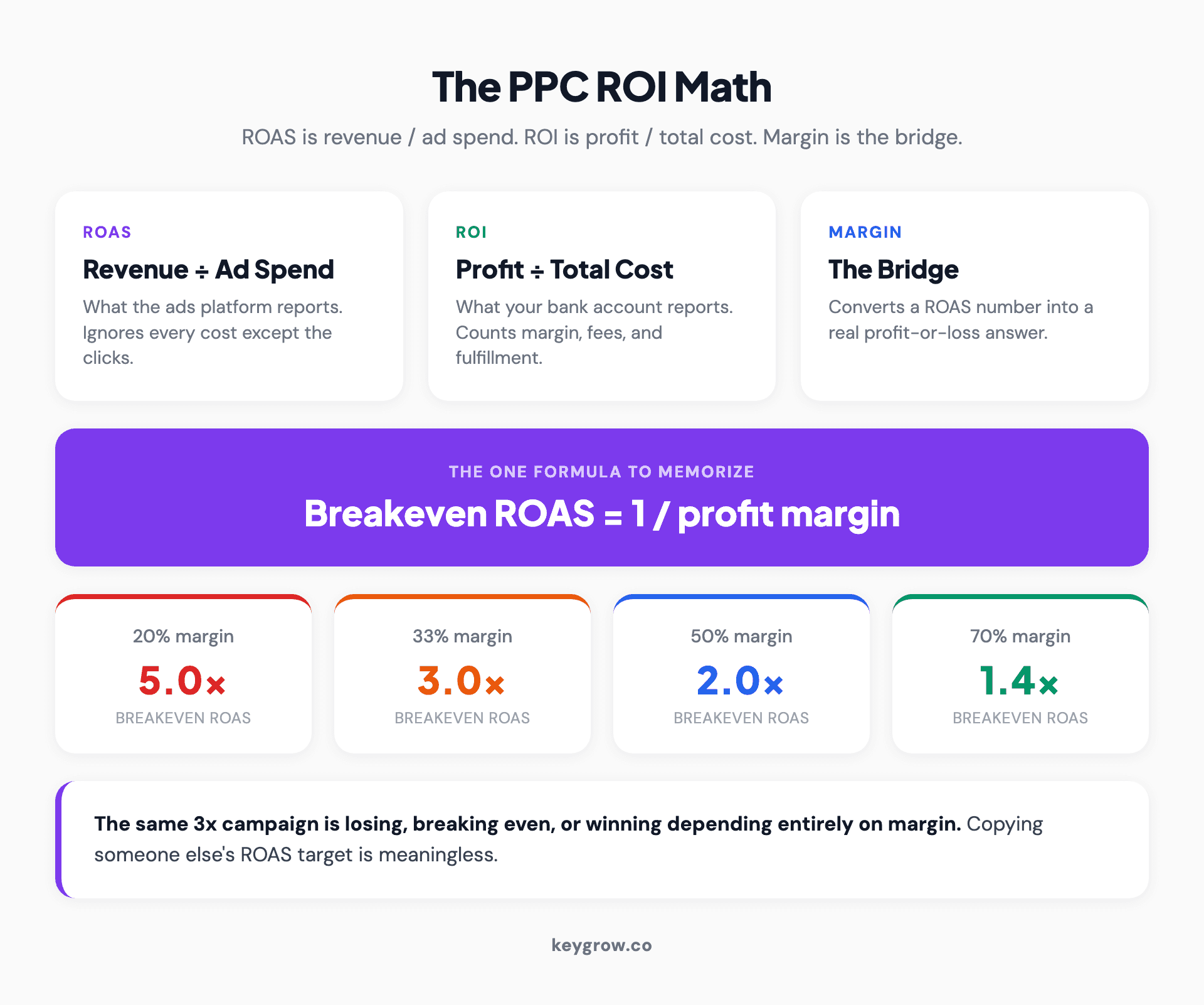
The PPC ROI math worked end to end: ROAS versus ROI, the breakeven ROAS formula from profit margin, and the same 3x campaign shown losing, breaking even, and winning at different margins.
Lead-gen businesses run the same logic through one more step: a lead is worth customer value x close rate. A remodeler closing 25 percent of leads into $20,000 jobs at 40 percent margin can pay up to $2,000 per lead and break even. A $66.69 cost per lead, the 2026 cross-industry average per LocaliQ's benchmarks, is either terrifying or trivial depending on that math.
Write your breakeven number down. Every section below either lowers your costs toward it or raises the value above it.
Before optimizing anything, diagnose where the money goes
Ten minutes of triage saves weeks of optimizing the wrong thing. Open the account and answer three questions with real numbers.
Where is the spend concentrated? Sort campaigns by cost. In most accounts, three campaigns spend 80 percent of the budget, which means your optimization time should follow the same ratio. An hour spent perfecting a $200-a-month campaign is an hour billed against a rounding error.
What is each concentration actually returning? Line up spend against conversions and revenue per campaign. You're looking for the two classic disease patterns: the big spender with mediocre returns that survives because "it gets volume," and the small campaign quietly producing your cheapest customers while starving on a leftover budget.
Is anything spending with zero conversions over 90 days? There almost always is, and it's the closest thing PPC has to free money. Pausing spend that produces literally nothing improves ROI on day one with no downside to test.
The output of this triage is a priority list. The sections below are presented in the order that usually pays fastest, but if your triage shows tracking is fine and one campaign is bleeding, start where the bleeding is.
Step 1: Fix what Google can see
Here's the highest-payoff ROI move in modern PPC, and every guide waves at it in one sentence: your bidding algorithm optimizes toward whatever conversion data you feed it, and most accounts feed it junk.
The default lead-gen setup counts a form fill as a conversion. So Smart Bidding dutifully hunts for people who fill forms, including the tire-kickers, the job applicants, and the person asking whether you're hiring. The algorithm is doing its job. You gave it the wrong job.
The fix is a ladder, and each rung improves what the machine optimizes for:
1. Count real actions, not pageviews. Forms, calls over 60 seconds, booked appointments. Nothing squishy.
2. Use enhanced conversions. Privacy changes punched holes in tracking; enhanced conversions patch a meaningful share of them by matching hashed first-party data.
3. Import offline outcomes. This is the big one for lead gen. Push your CRM's qualified-lead and closed-deal data back into Google Ads, so the algorithm learns which clicks became customers, not just which clicks became forms.
4. Assign values. A closed $20,000 job and a $200 service call should not teach the algorithm the same lesson. Value-based bidding needs values.
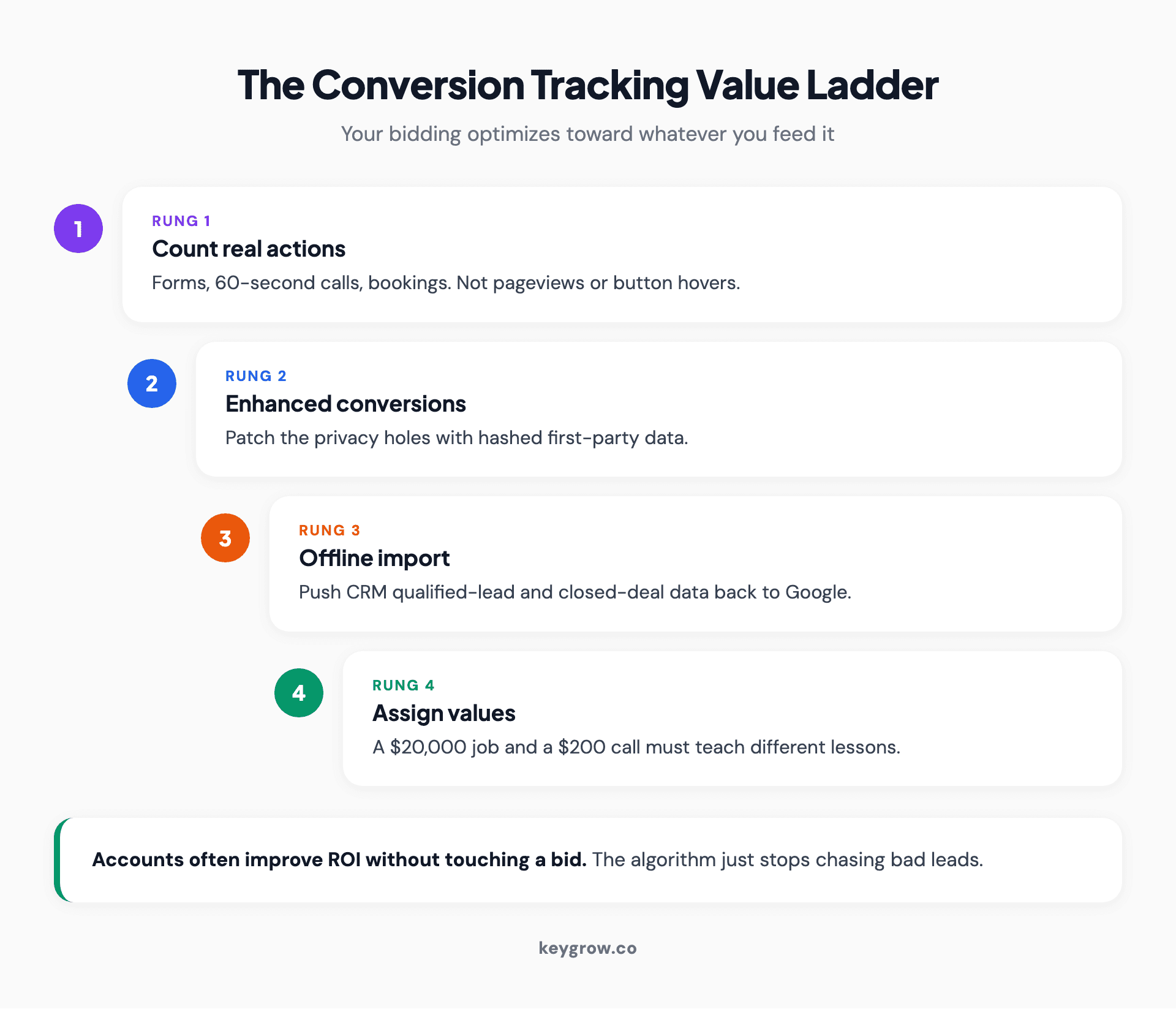
Four-rung conversion tracking ladder from counting form fills to feeding closed-deal revenue back into Google Ads, with each rung improving what Smart Bidding optimizes toward.
Accounts that climb this ladder often improve ROI without changing a single bid, because the algorithm finally stops spending toward lookalikes of their worst leads. If you fix one thing this quarter, fix this.

Computer screen showing a conversion tracking line graph trending upward in a dark analytics interface.
Step 2: Kill the spend that never converts
With tracking trustworthy, the fastest ROI gain is subtraction. In the unmanaged accounts we audit, 20 to 30 percent of budget typically hides in search terms that will never produce a customer.
Make the hunt systematic instead of occasional:
To picture what the report typically holds, take a landscaper bidding on "lawn care" in broad match. That keyword will happily match "lawn care jobs near me," "how to start a lawn care business," and "free lawn care for seniors." Three queries, three different humans, zero customers among them, all billed at full price. Three negatives ("jobs," "how to," "free") and a match-type tightening end that permanently, and versions of this exact pattern sit in nearly every unaudited account we open.
The point isn't tidiness. Every wasted dollar you cut flows either to your bottom line or to auctions that convert, and either way ROI rises without a single new lead needed. Our PPC audit walkthrough covers the full teardown if you want the deeper version.
Step 3: Bid to targets, and know when to switch
Bidding strategy questions produce more anxiety than any other PPC topic, mostly because nobody publishes thresholds. Here are the rules we actually use.
Start new campaigns on Maximize Conversions (or Maximize Conversion Value for ecommerce) with no target attached. The algorithm needs data before it can hit a target, so let it gather some.
Switch to Target CPA once you have roughly 30 conversions in 30 days. Below that volume, a target starves delivery and the algorithm flails. Set the initial target at your actual trailing 30-day CPA, not your wish. Walk it down 10 to 15 percent at a time, every two to three weeks.
Switch to Target ROAS only with value data flowing and, per Google's guidance, ideally 15 or more conversions in 30 days for search campaigns. Target ROAS with thin value data is astrology.
Respect the learning period. After any bidding change, the algorithm recalibrates for roughly a week or two. Judging (or worse, reverting) a change three days in resets the clock and teaches you nothing. Change one thing, wait two weeks, read the results, then move.
Know your kill criteria before you need them. A keyword that has spent three times your target CPA with zero conversions gets paused, no sentiment. A campaign underwater for two consecutive months after the fixes above gets its budget moved to a winner. Deciding these rules in advance is what keeps you from optimizing by mood.
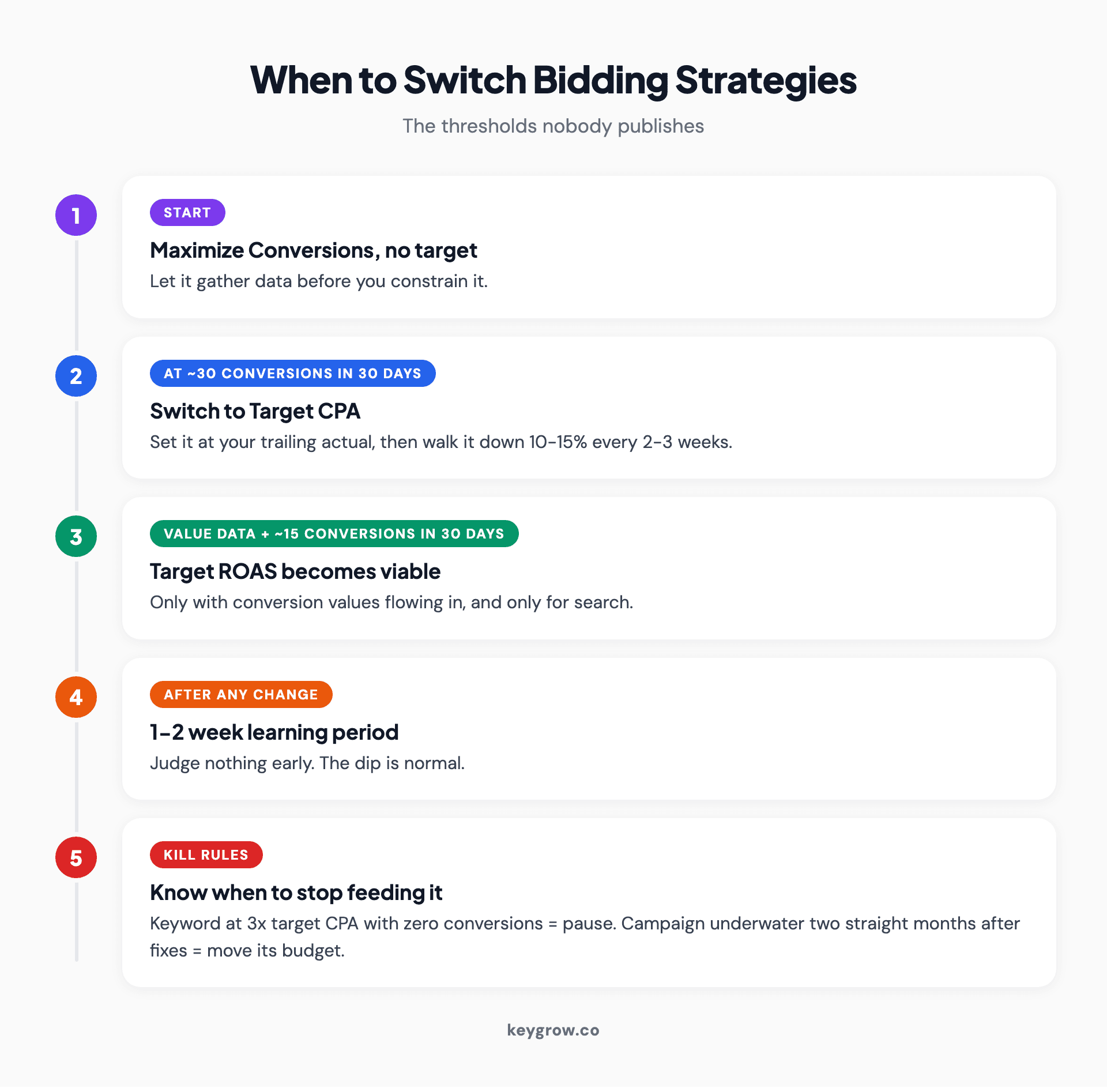
Decision thresholds for Google Ads bidding: when to start on Maximize Conversions, when 30 conversions qualifies you for Target CPA, when 15 conversions with value data qualifies you for Target ROAS, and the pause rules for keywords and campaigns.
Step 4: Make the landing page do its half
The ad is half the job. The page is the other half, and it's where most "PPC problems" actually live.
An eviction law firm came to us already running ads to an already-built landing page and getting almost nothing: one conversion a week from 22 clicks, at $240 per conversion. Visitors landed, didn't know what to do next, and left. We rebuilt the page around one clear action, restructured the campaigns, and split-tested side campaigns with small budget slices. Within a week: 21 conversions from 189 clicks at $31.79 each. Same business, same market, same platform. The page was the problem.
The checklist that matters:

Two marketers reviewing a landing page layout together on a laptop during a conversion audit.
Dedicated pages beat website pages for paid traffic in almost every test we run; we've written up why landing pages outperform your site's regular pages if you need convincing. And when you test, test properly: one variable, enough traffic to decide, and a written hypothesis. Our guide to A/B testing PPC ads applies the same discipline to pages.
Step 5: Reallocate budget like an investor
Most accounts spread budget the way it was set up two years ago and never move it. Fixing allocation is free ROI.
The monthly ritual: rank every campaign by ROI (not ROAS, not conversions, ROI after margin). Then apply a simple rule: the bottom performer funds the top performer. Move 10 to 20 percent of the loser's budget to the winner and watch whether the winner absorbs it at the same return, since scale can dilute efficiency. Repeat monthly. Over two or three quarters this quietly rebuilds the account around what makes money.
Layer in the cheap structural wins while you're there. Check performance by hour and day, and daypart if your leads cluster (most service businesses see weekday-daytime dominance). Split geographies with different economics into their own campaigns so a strong suburb stops subsidizing a weak metro. Separate brand from non-brand so cheap brand clicks stop flattering your blended numbers, a distinction that matters when you calculate what a lead is really worth.
The brand split deserves the extra sentence, because it's the most common way accounts lie to their owners. Brand keywords (people searching your business name) convert at several times the rate of anything else and cost a fraction per click, so blending them into overall numbers makes a struggling account look healthy. A blended 4x ROAS is often a 12x brand campaign carrying a 1.8x everything-else. Split them, then judge the non-brand number, because that's the one your marketing actually earned.
Step 6: Point audiences at your best prospects
Search intent is the main targeting, but audience layers are free information and cheap efficiency, and most small accounts ignore them entirely.
Start with observation, not restriction: add your remarketing lists, customer-match list, and relevant in-market segments to campaigns in "observation" mode. They don't change who sees your ads, they just report how each group performs. After a month, the data usually surprises: past site visitors converting at triple the rate of cold traffic, or an in-market segment quietly outperforming everything.
Then act on the gaps. Bid up on returning visitors for your money keywords, since someone searching "emergency plumber" who visited your site last month is the warmest click in the auction. Exclude converted customers from lead-gen campaigns so you stop paying to re-acquire people you already have. And build the remarketing audience now even if you won't use it for months, because it only accumulates while the tag is live.
This is a supporting lever, not a primary one, and it's the reason it sits sixth rather than first. But it's twenty minutes of setup for a permanent data stream, and in accounts with real traffic it routinely finds a bid adjustment worth 10 to 15 percent of budget.
Step 7: Improve the inputs Google prices
Quality Score is the auction's pricing input you control: it's Google's 1-10 read on expected clickthrough rate, ad relevance, and landing page experience, and a poor score is a standing surcharge on every click.
The work is unglamorous. Tighten ad groups until keyword, ad, and page all say the same thing. Fill your responsive search ads with genuinely different headlines rather than fifteen rephrasings, and pin sparingly (we've covered how many RSAs to run separately). Add every assets type that fits: sitelinks, callouts, structured snippets, calls. Assets cost nothing and expand your real estate on the page.
None of this is a growth hack. It's the compounding layer: better inputs lower CPCs, cheaper clicks buy more data, more data makes every bidding decision smarter. Our full Quality Score guide walks the details.
What the sequence does to the numbers, worked through
To see why the order matters, walk a plausible lead-gen account through it. Say it starts at $4,000 a month in spend, a $120 blended cost per lead, and leads closing at 20 percent into $2,000 customers at healthy margin, so a customer costs $600 in ad spend against the math's comfortable ceiling.
The waste cut comes first because it's pure subtraction. Trimming the 20-plus percent of never-converting spend we typically find doesn't add a single lead, but the same lead count now comes from $3,200 of effective spend, and CPL drops toward $96 by deletion alone.
The tracking fix changes what the machine hunts. Feeding qualified-lead data back instead of raw form fills lets bidding shift budget toward the queries producing real prospects. Form-fill counts often drop here while qualified leads hold or rise, which looks like failure in the old reporting and is exactly the point.
The bidding target then locks the gain in, holding the improved CPL steady instead of drifting with the auction. The landing page multiplies everything upstream: lifting page conversion from 8 to 11 percent cuts CPL by more than a quarter across every keyword at once, the kind of lift our eviction-firm rebuild showed in exaggerated form.
Stack modest versions of those four moves and a $120 CPL account lands near $70-80 with the same budget, which at a 20 percent close rate takes a customer from $600 of spend to roughly $375. No single heroic fix, just the sequence, compounding. Your numbers will differ; the shape of the improvement won't.
The metrics that matter, and the ones that flatter
Here's an opinion we hold strongly: vanity-metric reporting is the industry's biggest scam. Impressions, clicks, and "engagement" don't pay rent. If a report about your money opens with impressions, ask why.
| Metrics that pay | Metrics that flatter |
|---|---|
| Cost per qualified lead | Impressions |
| Cost per acquired customer | Clicks |
| ROAS against your breakeven | CTR in isolation |
| Revenue and profit by campaign | "Engagement" |
| Lead-to-customer close rate | Impression share alone |
The flattering column isn't useless, it's diagnostic. CTR helps explain a Quality Score problem; impression share explains a volume ceiling. But diagnosis is not performance. Judge the account, and anyone you pay to run it, on the left column only.
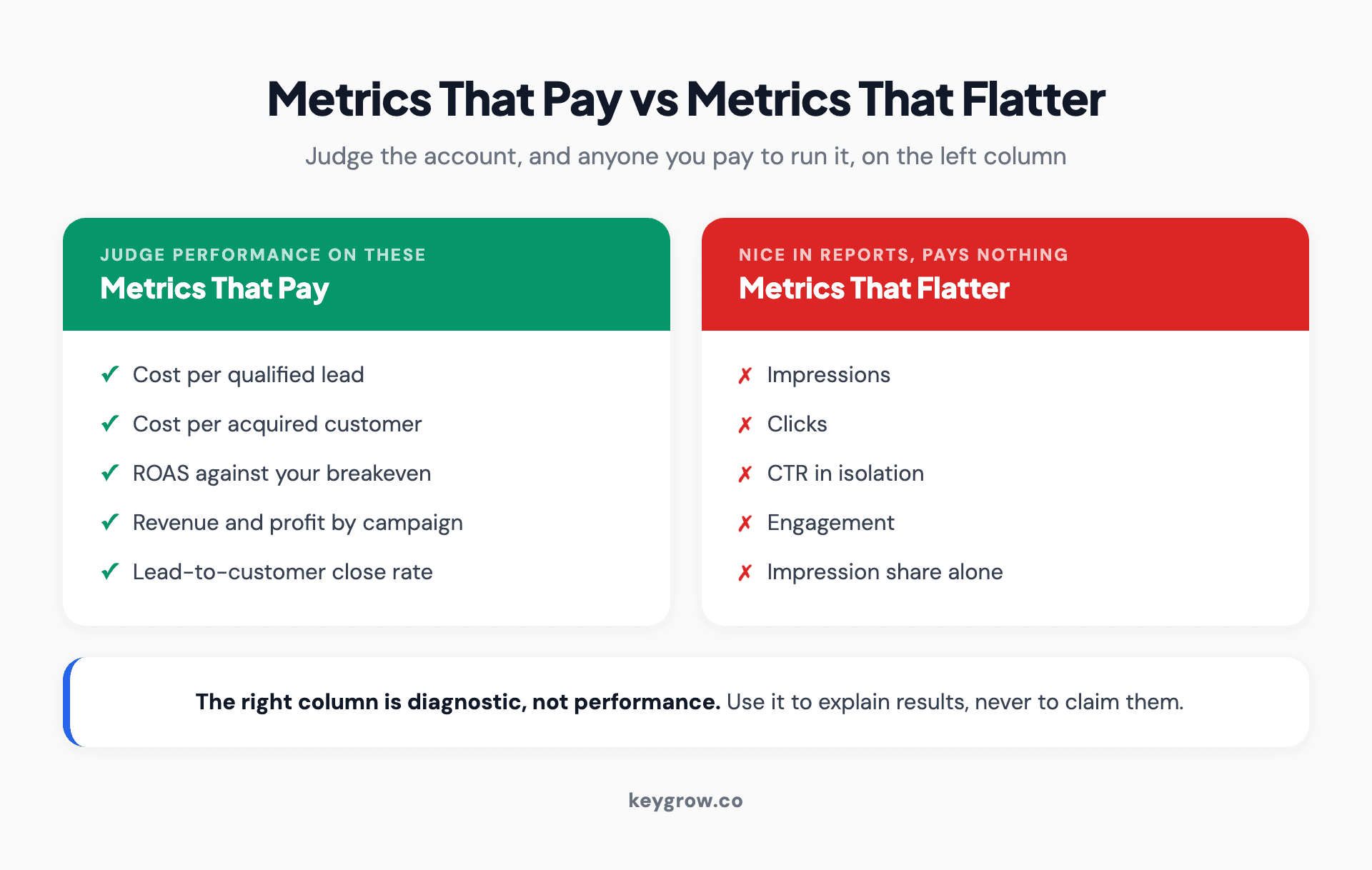
Split panel of PPC metrics that pay (cost per qualified lead, customer acquisition cost, profit by campaign) versus metrics that flatter (impressions, clicks, raw CTR).
The wider context is worth knowing while you read your own numbers: 2024 saw average CPCs climb about 10 percent to $4.66 while conversion rates slipped to 6.96 percent, and cost per lead jumped 25 percent year over year. The 2026 benchmark data finally showed cost per lead falling for the first time in five years. Costs drift up over time; the accounts that hold their ROI are the ones running this playbook, not the ones hoping the market gets cheaper.
The cadence: weekly, monthly, quarterly
Optimization isn't an event, it's a schedule. Ours looks like this.
Weekly (30-45 minutes): search terms review and new negatives. Budget pacing check. Scan for disapprovals and broken pages. Note anything anomalous, don't react to it yet.
Monthly (2-3 hours): the budget reallocation ritual. Bid target adjustments where volume allows. One new test launched (ad copy, page variant, or audience), one old test concluded with a decision. Review by device, hour, and geography for new splits worth making.
Quarterly (half a day): the account teardown. Re-run the breakeven math, because margins and prices change. Revisit paused campaigns and keywords with fresh eyes. Audit the conversion ladder from step 1, especially whether offline data is still flowing. Ask the uncomfortable question: if we started this account from zero today, would it look like this?
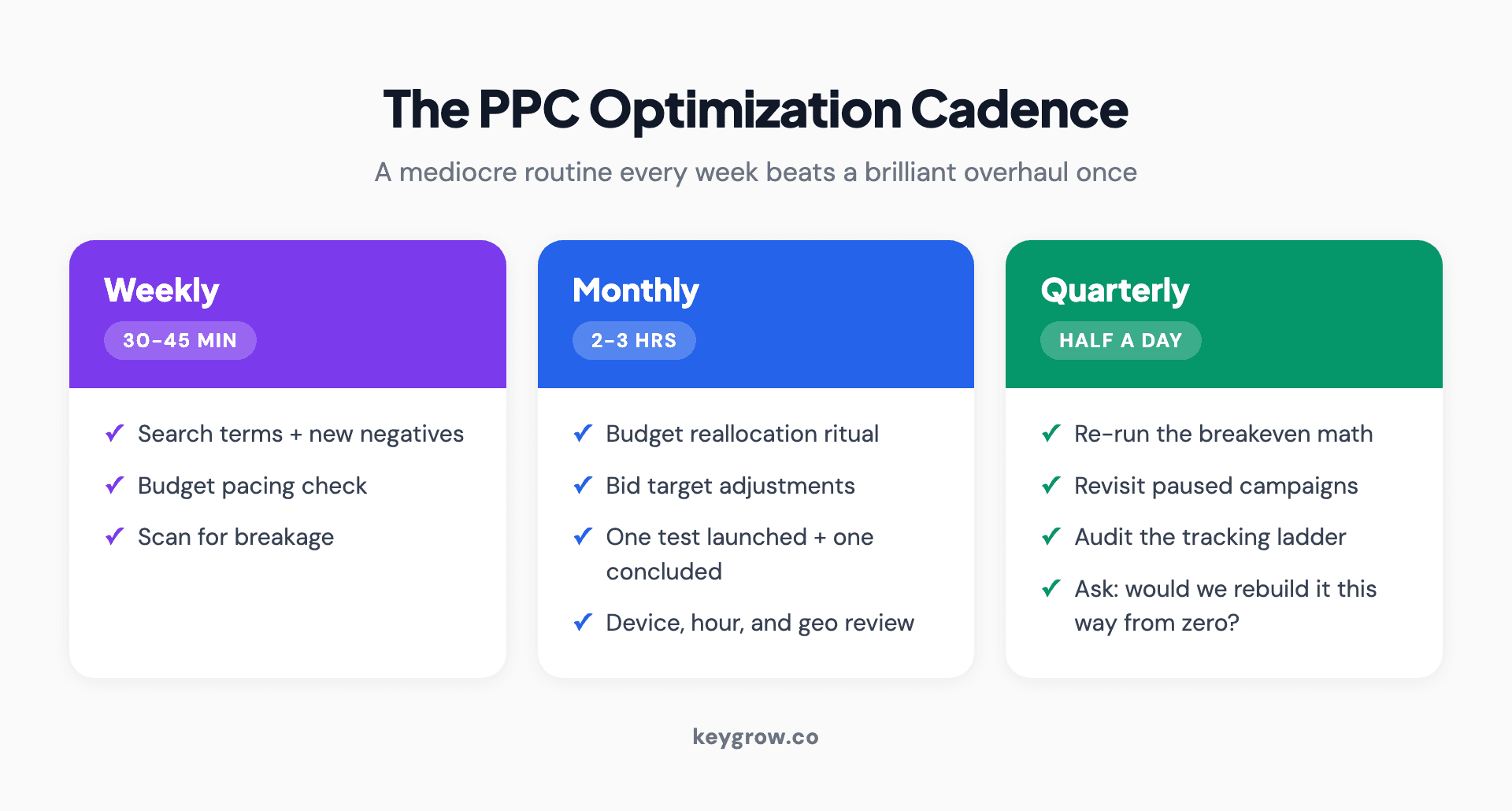
Weekly, monthly, and quarterly PPC optimization cadence showing the recurring tasks at each interval from search terms review to the quarterly account teardown.
The discipline matters more than the calendar. Accounts decay by default: search behavior shifts, competitors adjust, Google changes defaults. A mediocre routine executed every week beats a brilliant overhaul executed once.
The five ways accounts undo their own optimization
After enough audits you stop being surprised by what breaks ROI, because it's the same five moves every time.
Optimizing during learning periods. Change a bid strategy Monday, panic at Wednesday's numbers, revert Thursday. The algorithm never gets a stable week to work with, and the account lives in permanent recalibration. One change, two weeks, then judge.
Treating CTR as the goal. A clever ad that attracts curious clickers raises CTR and torches conversion. The qualifying ad that says "from $180" filters at the impression, and its lower CTR is the feature working.
Adding keywords faster than negatives. Every expansion without a matching negative pass grows the surface area for waste. The account that adds 50 keywords a month and reviews search terms quarterly is digging faster than it fills.
Chasing position one on ego terms. Paying a premium to sit first on a broad head term, while exact-match variants three positions lower produce cheaper conversions all day.
Set-and-forget Smart Bidding. Automation with stale targets drifts. The target CPA you set in March is wrong by August, because your close rate, your competition, and your margins all moved. The machine bids, but the human owns the target.
Every one of these is really the same mistake wearing different clothes: reacting to the number that moves fastest instead of the number that pays. The whole discipline of PPC ROI is refusing that trade.
When optimization can't save the account
Sometimes the honest answer is that no amount of optimization fixes the underlying math, and you should hear that from us rather than discover it $10,000 later.
If your margin can't clear breakeven ROAS at your market's going CPC even with a clean account, the problem is the offer or the pricing, not the campaigns. If your sales process loses half its leads to slow follow-up, fix intake before buying more leads to lose. And if your budget is small and your market local, the boring free work (Google Business Profile, reviews, site basics) may return more than click-buying at all.
You also don't automatically need an agency for the playbook above. A focused owner with one campaign and a spare hour a week can run steps 2 through 4 alone, and plenty should. The point where help pays for itself is when the account's spend is large enough that the waste an expert removes exceeds the fee, or when the offline-conversion plumbing in step 1 is beyond your stack. Before that point, keep your money.
FAQs
What is a good ROAS for PPC campaigns?
There is no universal good ROAS, only your breakeven, which is 1 divided by your profit margin. A business at 33 percent margin breaks even at 3x and should target 4x or better; a 70 percent margin business profits at 1.5x. Work out your own number before comparing against anyone else's benchmark.
How often should I optimize my PPC campaigns?
Weekly for search terms and budget pacing, monthly for bid targets, budget reallocation, and testing decisions, and quarterly for a full account teardown. Daily fiddling is actively harmful because it never lets bidding algorithms exit their learning period, and quarterly-only attention lets waste compound for months.
Is manual or automated bidding better?
Automated bidding wins for most accounts in most situations, but only when it's fed accurate conversion data and given realistic targets. Manual CPC still makes sense for tiny budgets, brand-new campaigns with no conversion history, and tightly controlled tests. The practical answer is automated bidding with a human checking its homework on a schedule.
How long does it take to see results from PPC optimization?
Subtraction works fastest: cutting wasted spend shows up within days. Bidding and tracking changes need two to four weeks to move through learning periods and gather enough data to judge. Structural work like landing page rebuilds shows results in our client accounts within three to eight weeks. Judge nothing in the first week except outright breakage.
How much of my marketing budget should go to PPC?
Work backwards from the math rather than a fixed percentage: your breakeven numbers say what you can afford per lead, and your capacity says how many leads you can handle. Fund PPC up to the point where marginal cost per lead approaches your affordable ceiling or your intake maxes out, whichever comes first. A percentage rule that ignores both is a guess.
What is a healthy cost per acquisition?
Healthy is defined by your economics, not a benchmark table: a CPA is healthy when it sits comfortably below customer value times close rate, with enough margin left to make the effort worthwhile. The 2026 cross-industry average cost per lead is $66.69, but averages mix $30 restaurant leads with $130 legal leads. Compute your ceiling from your own numbers and treat industry figures as scenery.
How can I increase my PPC conversion rate?
The biggest lever is almost always the landing page: match its headline to the ad, cut it to one clear action, and get load time under three seconds. Behind that, tighten targeting so fewer wrong-fit visitors arrive, and qualify harder in the ad copy itself. Chasing conversion rate through bid changes alone is working the smallest lever first.
What to do next
Don't try to do all of this on the first pass. Run the sequence: breakeven math today, the tracking ladder this month, waste-cutting this week and every week, bidding targets once the data supports them, then the page, then the cadence forever. Each step makes the next one work better, which is the whole reason the order matters.
If you'd rather hand the playbook to someone who runs it daily, that's what our PPC management does, month-to-month, no lock-in. Or ask us for a second opinion on your account first. Either way, run the breakeven math tonight. Everything else is downstream of that number.


