


To measure the LTV of leads from PPC, calculate what a customer is worth over their whole relationship with you (average sale value x purchases per year x years retained), then multiply by your lead-to-customer close rate. That number is what a lead is actually worth, and dividing it by three gives you a defensible maximum cost per lead.
Almost nobody running lead-gen ads does this math. The guides that rank for it do not help much either; nearly all of them calculate LTV for ecommerce customers and never bridge the gap to leads, which is the entire problem for a dentist, lawyer, or contractor buying clicks. So this is the lead-gen version, worked through with real benchmarks, plus the Google Ads features that let you bid on it.
Cost per lead is the number that lies most confidently
A falling CPL can hide a dying account, and a rising CPL can hide a thriving one, because CPL says nothing about what the leads are worth.
Here is the reality: vanity-metric reporting is the marketing industry's biggest scam, and CPL without lead value is the lead-gen version of it. A report that celebrates CPL dropping from $80 to $50 while the new leads close at half the rate is celebrating a loss. Prefilled Facebook forms make this trap easy to fall into, and our guide to Facebook ads for leads shows how to grade those leads by stage instead.
We saw this from the other side with a mobile detailing client. Their cost per booking fell from around $100 to $22 after we rebuilt the campaigns and landing page, and bookings grew 650 percent. But the number that justified the whole engagement was not the $22. It was that monthly revenue went from $1.2K to $5.1K, because detailing customers come back. A $22 booking that becomes a recurring customer is a different asset than a $22 one-off, and only LTV math can tell those two stories apart.
Step 1: Pull four numbers out of your CRM
You need average customer value per year, purchase or visit frequency, average customer lifespan, and your lead-to-customer close rate. Estimates are fine to start.
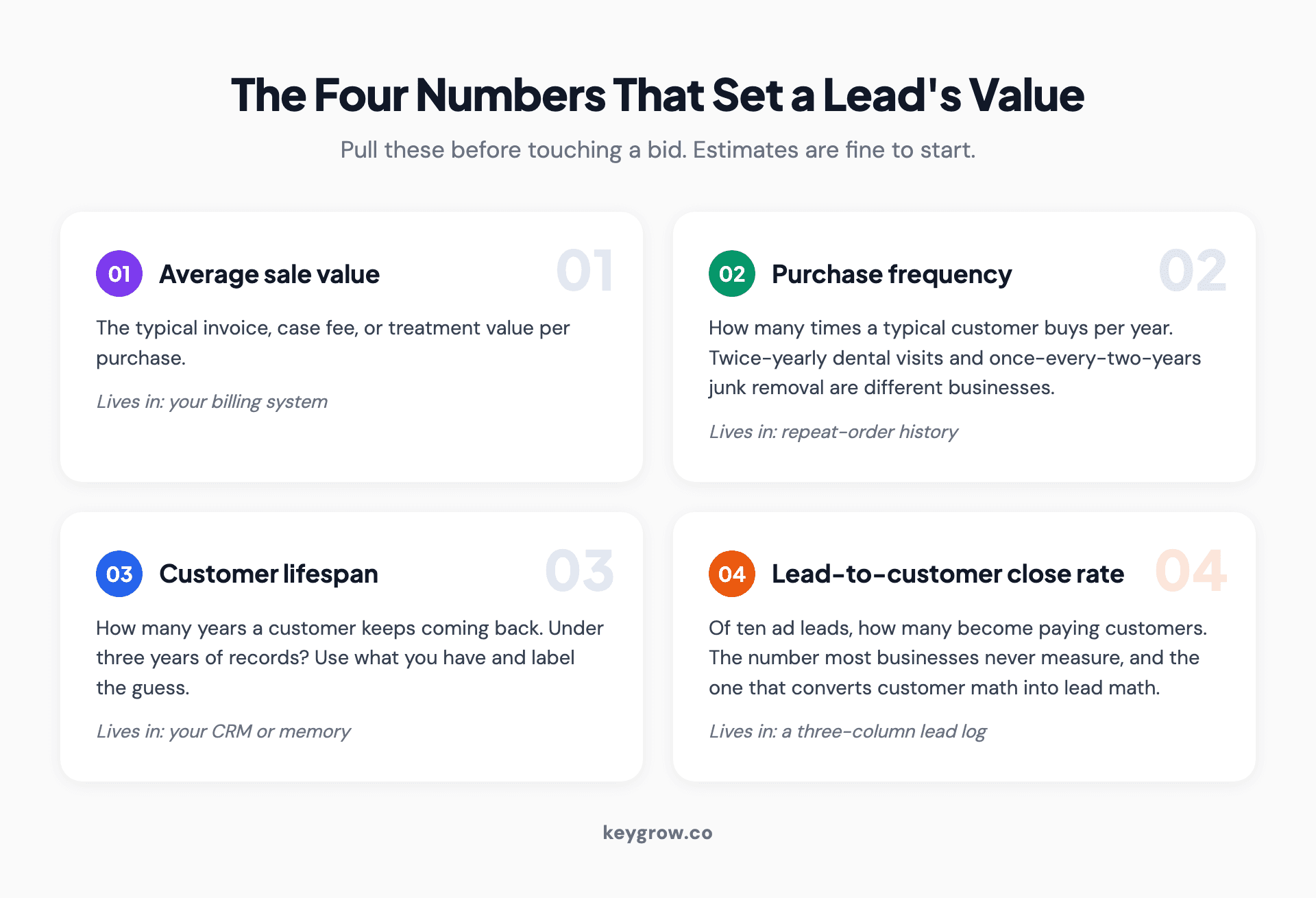
Card layout of the four numbers needed to measure PPC lead LTV: average sale value, purchase frequency, customer lifespan, and lead-to-customer close rate.
- Average sale value. The average invoice, case fee, or treatment value. Your billing system knows this even if your marketing does not.
- Frequency. How many times a typical customer buys per year. A junk removal customer might be once every two years; a dental patient, two visits a year.
- Lifespan. How many years a customer stays. If you have under three years of records, use what you have and note the guess.
- Lead-to-customer close rate. Of every ten leads from your ads, how many become paying customers? This is the number most businesses have never measured, and it is the one that converts customer math into lead math.
If your close rate is a shrug, start tracking lead outcomes this week in a spreadsheet with three columns: lead date, source, closed or not. Thirty days of that beats a year of guessing.
Step 2: Calculate customer LTV
Customer LTV is average sale value times purchases per year times years retained. Use gross profit instead of revenue if you want the honest version.
The standard formula, the same one HubSpot documents, is:
Customer LTV = average sale value x purchases per year x average years retained
A dental example: a patient worth $400 per visit, visiting twice a year, staying five years, is a $4,000 customer. A margin-adjusted version multiplies by gross margin (at 60 percent margin, $2,400 of lifetime gross profit), and that is the version to use for bidding decisions, because you cannot pay for ads with revenue you never keep.
Step 3: Bridge from customer value to lead value
Lead LTV equals customer LTV multiplied by your lead-to-customer close rate. This one multiplication is the step every generic LTV guide skips.
A lead is not a customer. It is a lottery ticket on a customer, and the close rate is the odds. So:
Lead LTV = customer LTV x close rate
If that dental patient is worth $4,000 and your front desk converts 30 percent of ad leads into booked patients, each lead is worth $1,200 in expected lifetime revenue ($720 in gross profit at 60 percent margin). A law firm signing 10 percent of its inquiry calls on $5,000 cases holds $500 leads. Same formula, wildly different numbers, which is exactly why copying someone else's target CPL is a mistake.
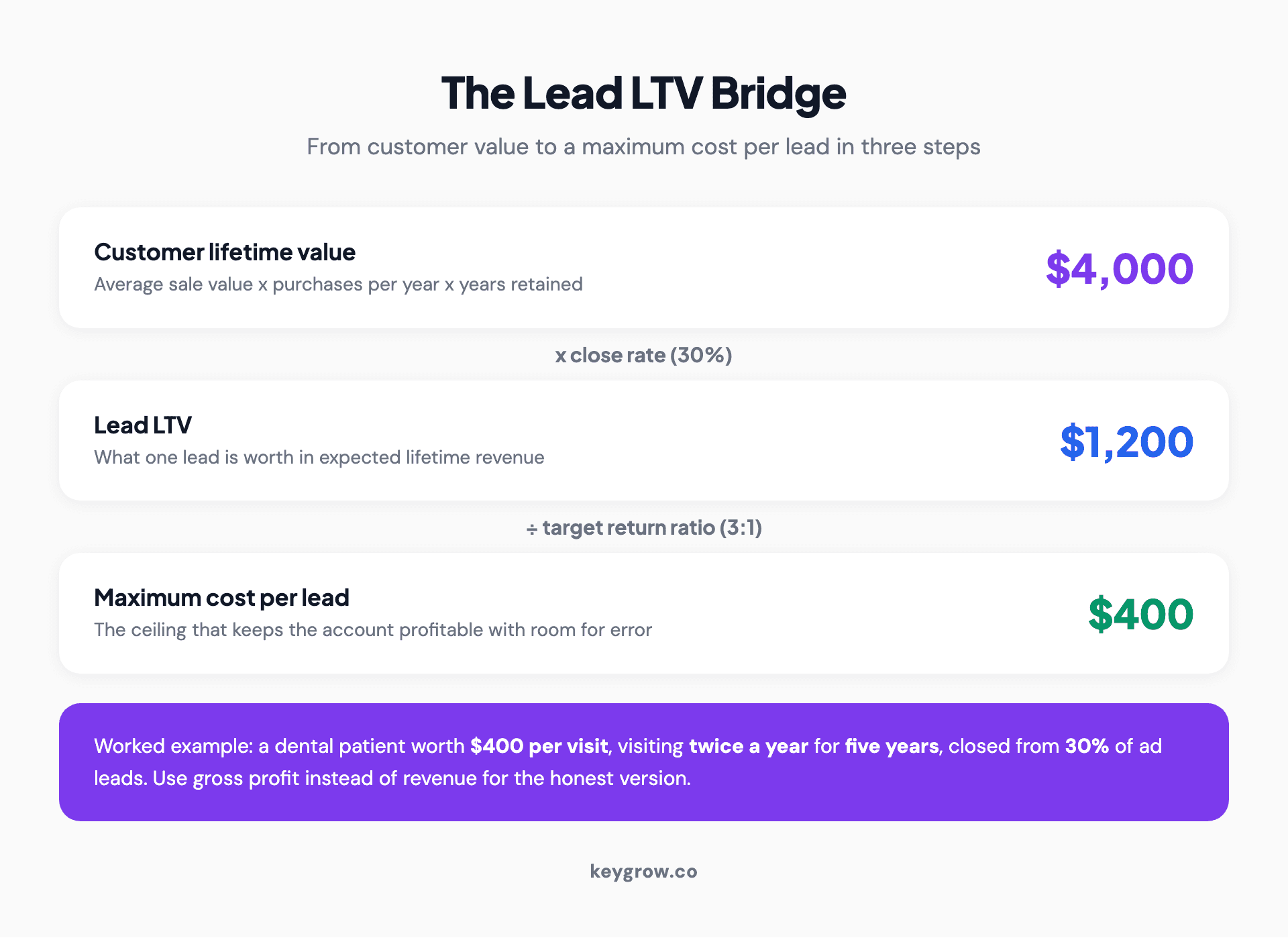
Flow diagram of the lead LTV bridge: customer lifetime value multiplied by close rate gives lead value, divided by three gives maximum cost per lead.
Step 4: Set your maximum cost per lead
Divide lead LTV by your target return multiple. The common 3:1 rule is a reasonable default, applied to the gross-profit version of lead value.
The 3:1 LTV-to-acquisition-cost guideline traces back to David Skok's SaaS metrics work, and it is worth being honest about its pedigree: it started as an investor's rule of thumb that later matched what strong companies showed, not a law of nature. Cash-flow reality matters as much as the ratio. A $720 gross-profit lead supports a $240 max CPL by the rule, but if the $4,000 arrives over five years and you pay the ad bill this month, your working capital may cap you well below the math.
Still, the direction of the exercise is what changes accounts. Most lead-gen advertisers set CPL targets by feel, usually anchored to what leads cost last quarter. Working backwards from LTV regularly reveals they could profitably pay two or three times more per lead than they believed, which is how you outbid competitors who are still guessing.
Three worked examples
| Input | Dental practice | Law firm (single case) | Real estate agent |
|---|---|---|---|
| Average sale value | $400 per visit | $5,000 per case | $9,000 commission |
| Frequency x lifespan | 2 visits x 5 years | One-time | One-time (referrals aside) |
| Customer LTV | $4,000 | $5,000 | $9,000 |
| Close rate on PPC leads | 30% | 10% | 2% |
| Lead LTV | $1,200 | $500 | $180 |
| Max CPL at 3:1 | $400 | $167 | $60 |
Two things jump out. First, the dental number explains why dental PPC stays competitive: recurring visits and multi-year retention make each lead worth more than the one-off invoice suggests. Second, the real estate row explains why so many agents feel PPC "does not work": at a 2 percent lead-to-close rate, even a $9,000 commission only supports about $60 per lead, so the lever is the close rate, not the bidding.

Desk with a laptop, notebook, and printed charts used to work through customer value numbers.
For context on the close rates: Ruler Analytics' 2026 benchmarks put average paid search visitor-to-lead conversion at 5.4 percent, with legal at 7.8 percent, and published legal intake benchmarks run from about 5 percent on shared purchased leads to 20 percent or more for well-run intake teams. Your own CRM beats any benchmark table, though. These are starting guesses, not answers.
Feed the number back into Google Ads
Once leads carry values, Google's bidding can optimize for value instead of volume: import offline conversions, apply value rules, then graduate to Target ROAS.
This is the part every ranking guide skips, and it is where the measurement starts paying. The setup path:
- Assign values to lead stages. Even static proxy values work: a form fill worth $50, a qualified call $200, a signed customer their actual value. Anything beats every conversion counting as 1.
- Import the truth from your CRM. Enhanced conversions for leads matches your closed deals back to the ad click using hashed email or phone data, so Google learns which clicks became customers rather than which clicks became forms. Details are in Google's documentation.
- Adjust values by segment. Conversion value rules let you multiply values by location, device, or audience, which is how "leads from our best zip codes close at twice the rate" becomes something the bidding actually acts on.
- Graduate to value-based bidding. Google requires at least 15 conversions in the past 30 days before you can use Target ROAS on Search. In Google's own 2021 data, advertisers who switched from Target CPA to Target ROAS saw an average of 14 percent more conversion value at a similar return on ad spend.
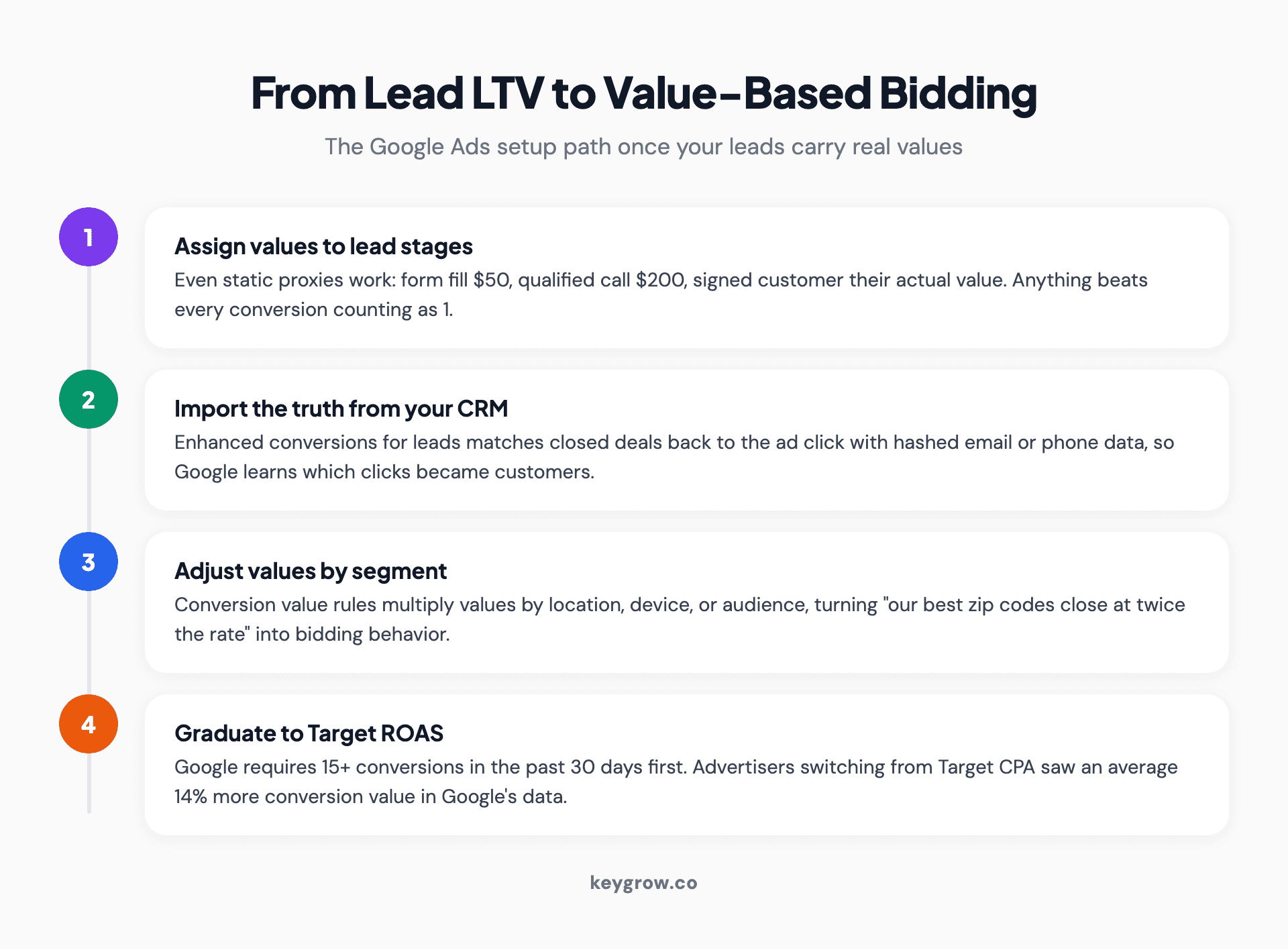
Numbered path for feeding lead LTV into Google Ads: assign stage values, import offline conversions from the CRM, apply value rules, then move to value-based bidding.
When this is overkill
A new account with a handful of leads a month should track close rates in a spreadsheet and skip the automation. The math still matters; the plumbing can wait.
If you get fewer than 20 leads a month, you do not have enough data for value-based bidding to learn from, and wiring a CRM integration will consume a week you should spend on ad copy and landing pages. Do steps 1 through 4 of the measurement on paper, set a max CPL, and revisit the automation when volume justifies it. And if you have one location, steady referrals, and ads are a side channel, the spreadsheet version may be all you ever need. That is not a failure. It is right-sizing.
Where an agency earns its fee is the full loop: PPC management that connects CRM outcomes to bidding, kills the keywords producing leads that never close, and reports on what the spend actually returned instead of what it cost.
FAQs
What is LTV in PPC marketing?
LTV (lifetime value) is the total revenue or gross profit a customer generates across their entire relationship with your business, first purchase included but never the whole story. In PPC it is the number that tells you what you can afford to pay for a click or a lead while staying profitable.
How do you calculate the lifetime value of a lead?
Multiply average sale value by purchases per year by years retained to get customer LTV, then multiply by your lead-to-customer close rate. A $4,000 customer at a 30 percent close rate makes each lead worth $1,200.
What is a good LTV to CAC ratio?
The common guideline is 3:1, meaning lifetime value should be at least three times acquisition cost. It originated as David Skok's SaaS heuristic rather than a research finding, so treat it as a sane default and adjust for your margins and cash flow.
How much should I pay for a PPC lead?
Divide your lead LTV by your target ratio, typically 3. If your leads are worth $600 in expected lifetime gross profit, a max cost per lead around $200 keeps the account profitable with room for error.
Can small businesses use LTV for PPC bidding?
Yes, and the measurement matters even when the automation does not. A spreadsheet tracking which leads closed is enough to calculate lead LTV and set a max CPL. The Google Ads value-bidding features become worth wiring up once you pass roughly 15 to 20 conversions a month.
Do I need expensive software to track LTV?
No. Your billing history plus a three-column lead log (date, source, closed or not) contains everything the formulas need. CRM integrations and offline conversion imports make it automatic later, but they are conveniences, not prerequisites.
Why is my cost per lead a misleading metric on its own?
Because leads are not equally valuable. A campaign with a $50 CPL closing 5 percent of leads is worse than a $90 CPL campaign closing 20 percent, and only close-rate and LTV tracking reveals it. Optimizing to CPL alone quietly rewards the cheapest leads, which are often the worst ones.
If you remember one thing
A lead is worth its customer value times the odds it becomes a customer. Every other number in your PPC account, CPL included, is downstream of that multiplication, and most of your competitors have never done it.
So do the twenty-minute version today: pull the four numbers, run the bridge, set your max CPL. Then check what your account is actually paying with our Google Ads ROI calculator, and if the gap between what leads cost and what they are worth looks wrong, we will audit the account and show you where the value is leaking. Month-to-month, cancel anytime.