


To conduct A/B testing for PPC ads, change one variable, split traffic evenly between the control and the variant using Google Ads Experiments, run the test for four to six weeks, and only declare a winner at 95 percent statistical confidence. That is the whole method. Everything that goes wrong in PPC testing is a violation of one of those four clauses.
And plenty goes wrong, usually in the direction of false confidence. At Microsoft, where experimentation is practically a religion, only about one third of experiments actually improved the metric they targeted, a figure from Ronny Kohavi's work in Harvard Business Review. If most tests lose even at that level of rigor, a test run casually is mostly a random-number generator with a dashboard. This guide is the rigorous version, sized for real accounts rather than enterprise traffic.
Pick one variable and write the hypothesis down
A valid test changes exactly one thing and predicts the outcome in a sentence: "changing X will improve metric Y because Z." No sentence, no test.
Test one of these per experiment, never several at once:
- The offer or hook in your headlines ("Free consultation" versus "Same-day appointments")
- The landing page the click goes to
- The bidding strategy (manual versus Smart Bidding, or CPA versus ROAS targets)
- Match types or audience segments
The hypothesis sentence does two jobs. It forces you to name the single metric that decides the test before you see any data, which prevents the classic self-con of picking whichever metric happened to improve. And it makes the result reusable: "emergency-focused headlines beat price-focused ones for us" is a finding your ad copy, email, and landing pages can all inherit.
One eviction law firm we worked with is the cleanest example of why disciplined testing beats bright ideas. They were getting 1 conversion a week from 22 clicks at $240 per conversion. Rather than redesign everything at once on instinct, we rebuilt the landing page around one clear action, then split-tested side campaigns with small budget slices to find what else moved. Within a week of the rebuild the account hit 21 conversions from 189 clicks at $31.79 each. The wins came from testing one deliberate change at a time, so we knew exactly what worked and could keep it.
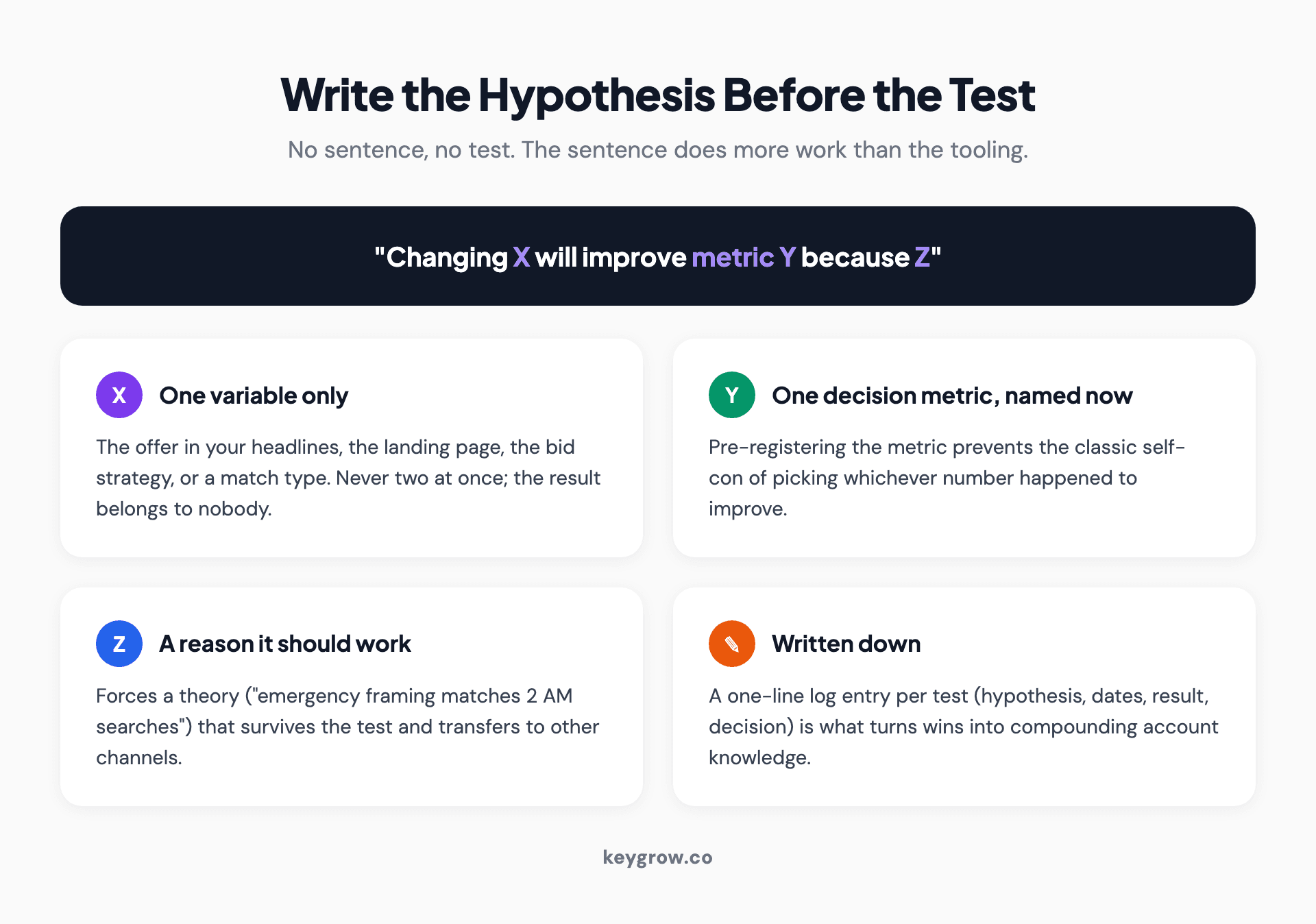
Checklist card for a valid PPC test hypothesis: one variable, one decision metric named in advance, a written prediction, and a reason it should work.
Check you have the volume before you build anything
Run the sample-size math first. If reaching significance would take more than eight weeks of your real traffic, test something bigger or do not test.
This is the step every guide skips, usually by substituting a made-up threshold ("1,000 clicks", "5,000 impressions") for actual math. Significance depends on your baseline conversion rate and how big a lift you are trying to detect, not on a flat click count. The practical pre-flight:
- Pull your weekly clicks and conversion rate for the campaign you want to test.
- Put the baseline rate and the minimum lift you care about (be honest: 20 percent, not 3 percent) into any free sample-size calculator.
- Divide the required sample per variant by your weekly traffic. That is your test duration.
A worked example: a campaign converting at 5 percent with 400 clicks a week, testing for a 20 percent relative lift (5 to 6 percent), needs roughly 8,000 clicks per arm at standard confidence. At 200 clicks per arm per week, that is about 40 weeks. The same account hoping to detect a subtle 5 percent lift would need roughly 120,000 clicks per arm, more than a decade of its traffic. The math is brutal, and it is the point: the traffic tells you what you are allowed to test.
If the math says no: test bigger swings (a different offer or landing page, not a comma), test a higher-traffic metric (CTR needs far less volume than conversion rate, and is a fair decision metric for pure copy tests), or consolidate the test at account level instead of campaign level. A losing pre-flight is not failure. It just saved you eight weeks of theater.
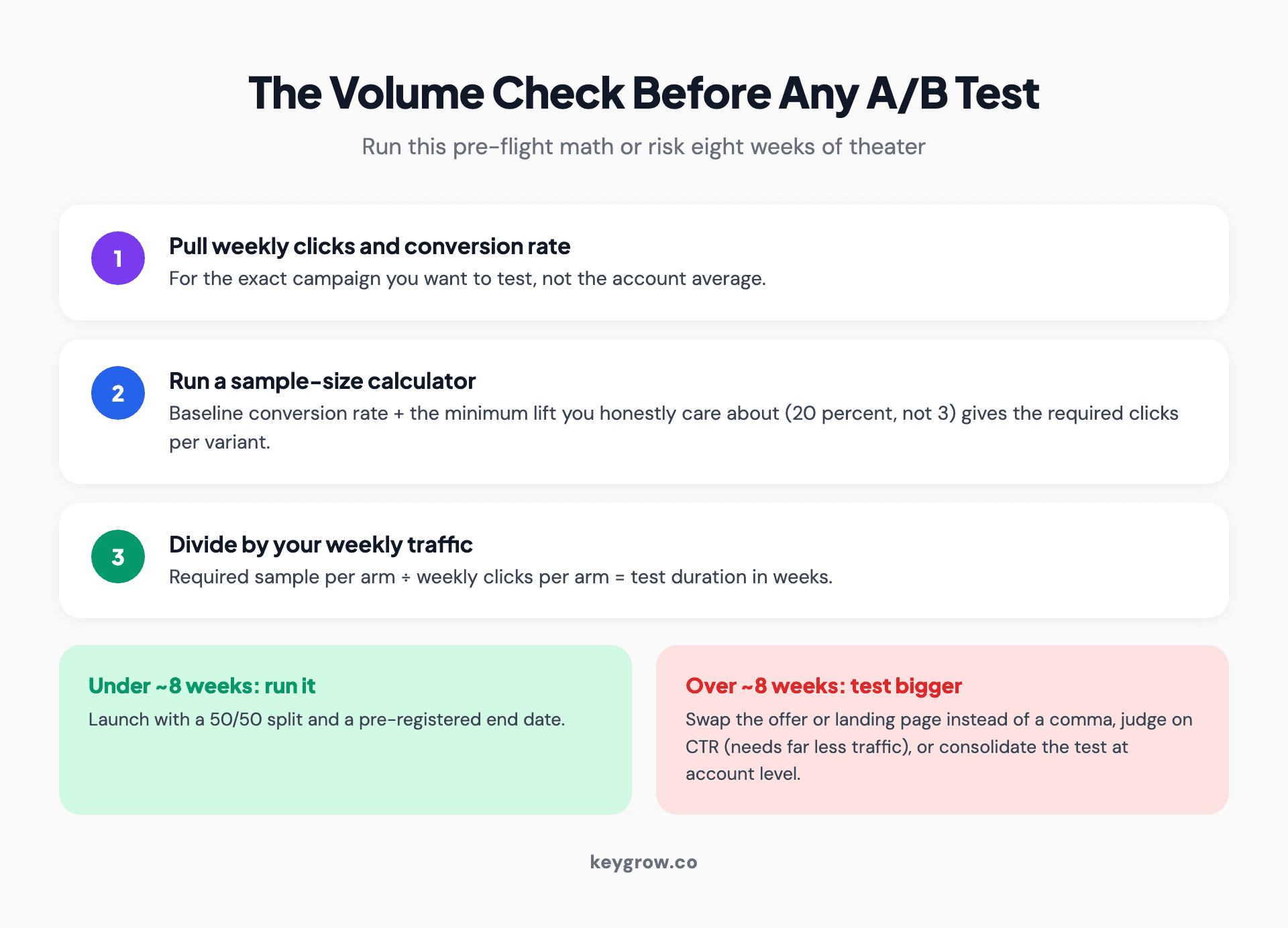
Three-step pre-flight volume check for PPC A/B tests: pull weekly clicks and conversion rate, run a sample size calculator, divide by traffic to get test duration.
Choose the right tool for the test
Google's Experiments hub houses several native testing tools; for most PPC accounts three matter, plus the manual method. Each fits a different job, and using the wrong one quietly invalidates the test.
| What you are testing | The right tool | Why |
|---|---|---|
| Bidding, landing pages, match types | Custom experiment | True randomized split of one campaign |
| Ad copy across many campaigns | Ad variations | Find-and-replace test across the account |
| Performance Max assets | PMax experiment | Only supported method for PMax |
| Two ads in one ad group | Manual rotation | Crude but workable at low stakes |
The details that matter, from Google's documentation: custom experiments cover Search, Display, Video, and Hotel campaigns (not Shopping), you can schedule up to five experiments per campaign but run only one at a time, and you choose a cookie-based split (each user consistently sees one arm, cleanest for landing page tests) or search-based split (re-randomized per search, faster data accumulation).
For ad copy specifically, responsive search ads complicated the old two-ads-in-an-ad-group method, since Google assembles combinations dynamically. The ad variations feature is the workaround most advertisers miss: it applies a find-and-replace copy change across your chosen scope and runs it as a proper split test. And resist the urge to pin single headlines just to force clean comparisons: Optmyzr's study of 13,671 accounts found impressions ran 3.9 times higher when advertisers left Google flexibility, pinning several text options per position rather than locking one text into each slot. Pinning a lone variant for test purity trades away real volume.
If you run Microsoft Ads too, it has its own Experiments feature. Microsoft's docs even suggest an A/A run first (two identical arms for two weeks) to validate the split before trusting a real test, which is nerdy and correct.
Set it up so the test stays clean
Split 50/50, define the end date before launch, and freeze both arms. Mid-test edits corrupt the comparison whether or not they sync across.
Setup is mostly menus; the discipline is in three decisions:
- 50/50 split, no cleverness. Uneven splits stretch the timeline for the smaller arm and complicate the math.
- Four to six weeks minimum. That is Google's own guidance, extended if your sales cycle delays conversions. In Shopping and Performance Max experiments, Google discards the first seven days as ramp-up; custom Search experiments get no automatic trim, so treat your own first week as unreliable while serving stabilizes. A "two-week test" is often one usable week wearing a costume.
- Freeze both arms. For Search and Display custom experiments, Google turns experiment sync on by default, so edits to the original campaign copy across to the experiment automatically (and if you created the experiment with sync off, they do not). Either way the result is the same: a mid-test "quick fix" makes the comparison uninterpretable, which is why Google warns against it. Queue the fixes; apply them after.
Read the results like a statistician, not a fan
Wait out the full duration, require 95 percent confidence on the metric you pre-registered, and treat everything else you notice as a hypothesis for the next test.
The experiment scorecard in Google Ads flags statistically significant differences for you, with an asterisk and confidence intervals. The rules that keep you honest:
- No peeking decisions. Checking daily is fine; acting on day nine is not. Early leads flip constantly, which is exactly what the ramp-up caveat and confidence thresholds exist to prevent.
- 95 percent or it did not happen. At lower confidence you will "win" tests that quietly lose money at scale. One winner in three is the realistic base rate even for disciplined teams, so a string of inconclusive tests means the process is working, not failing.
- Judge on the pre-registered metric. A variant that lost on conversions but won on CTR did not win. It generated a new hypothesis about what CTR is actually telling you, which is a different thing.
When the test concludes, Google lets you apply the winning arm to the original campaign or spin it into a new campaign. Do one or the other promptly. A finished experiment left running is budget split against a known loser.
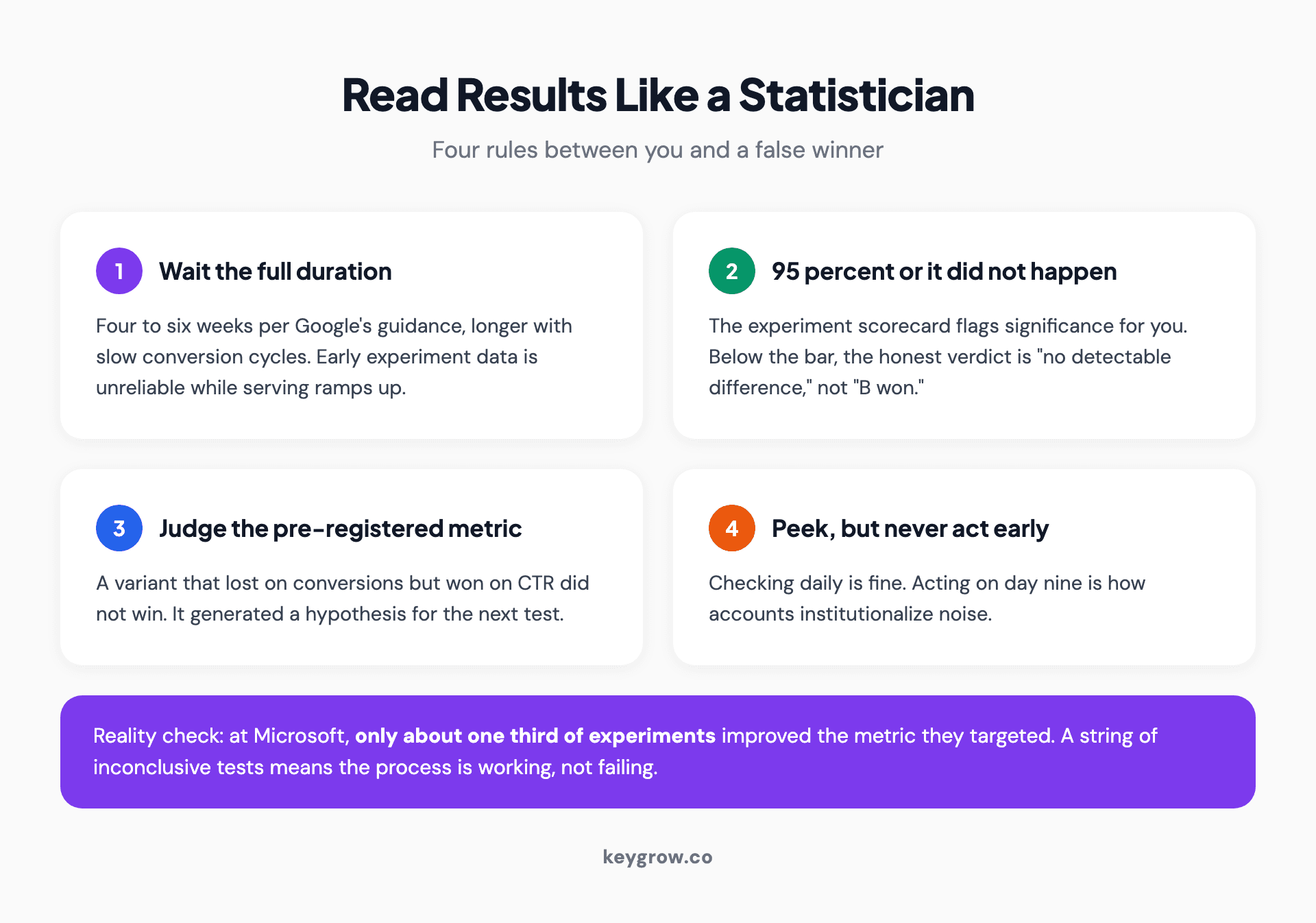
Four rules for reading PPC test results: wait the full duration, require 95 percent confidence, judge only the pre-registered metric, and treat side observations as new hypotheses.
Keep a test log and queue the next one
A one-line log per test (hypothesis, dates, result, decision) turns individual wins into compounding account knowledge. Testing is a program, not an event.

Chess pieces mid-game, with one dark pawn standing out among light pieces.
The log matters more than any single result for three reasons. It stops you from re-testing something that already lost two managers ago. It reveals themes across wins (every urgency-framed headline winning is a message strategy, not a coincidence). And it keeps the cadence honest: one meaningful test always running beats bursts of enthusiasm twice a year. Grow the queue from your search terms report, your losing tests' surprises, and the sections of your landing pages that heatmaps say nobody reads.
The classic mistakes, collected
Most failed PPC testing programs die from one of six self-inflicted wounds, all preventable in setup.
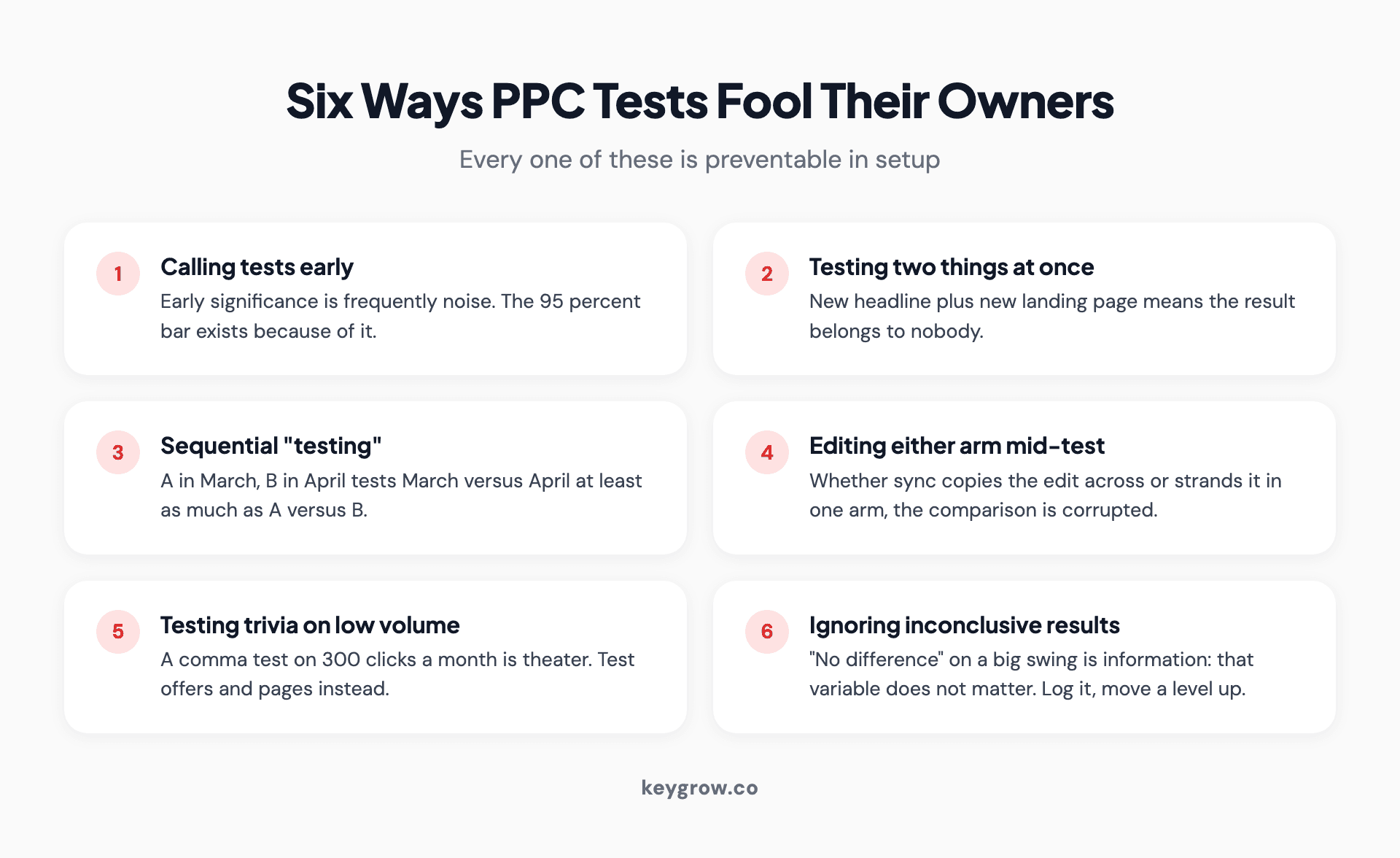
Six-card checklist of classic PPC A/B testing mistakes: calling tests early, testing two things at once, sequential testing, mid-test edits, low-volume trivia, and ignoring inconclusive results.
- Calling tests early. The most common and most expensive. Early significance is frequently noise; the 95 percent bar exists because of it.
- Testing two things at once. A new headline and a new landing page in the same window means the result belongs to nobody.
- Sequential "testing." Running version A in March and version B in April tests March versus April (seasonality, competitors, weather) at least as much as A versus B. Split simultaneously or do not call it a test.
- Editing either arm mid-test. Whether sync copies the edit across or strands it in one arm, the comparison is corrupted, and the test keeps reporting numbers anyway.
- Testing trivia on low volume. A comma-placement test on 300 clicks a month is theater. The volume check exists to redirect that energy at offers and landing pages, where detectable differences live.
- Ignoring inconclusive results. "No difference" on a big swing is information: that variable does not matter for your audience. Log it and move a level up.
FAQs
What is A/B testing in PPC?
A/B testing in PPC runs two versions of one campaign element (an ad, landing page, or bid strategy) against each other simultaneously on randomly split traffic, holding everything else constant. The goal is a statistically defensible answer about which version performs better, rather than an impression of one.
How long should you run an A/B test on Google Ads?
Google recommends at least four to six weeks, longer if conversions lag clicks in your sales cycle. Early experiment data is unreliable while serving ramps up, so very short tests mostly measure noise.
Can you A/B test responsive search ads?
Yes, with the ad variations feature, which applies a find-and-replace change to your RSA copy across a chosen scope and splits traffic properly. The old method of two ads rotating in an ad group is muddied by Google's dynamic assembly of RSA combinations.
What is a good sample size for A/B testing ads?
There is no universal number; it depends on your baseline conversion rate and the smallest lift worth detecting. A calculator gives the real answer in seconds, and flat thresholds like "1,000 clicks" are guesses. Low-traffic accounts should test bigger changes or higher-volume metrics like CTR.
What is the difference between an experiment and an ad variation in Google Ads?
A custom experiment splits one campaign into control and trial arms and can test bidding, landing pages, or structural changes. An ad variation tests only ad copy changes, but can run across many campaigns or the whole account at once.
How do you know when an A/B test is statistically significant?
Google's experiment scorecard flags significant results and shows confidence intervals; the standard bar is 95 percent confidence, meaning a gap this large would show up by chance less than 5 percent of the time if the versions truly performed the same. If the test ends without reaching it, the honest verdict is "no detectable difference," not "the variant with the higher number won."
Should you test more than one variable at a time in PPC?
Not in a single A/B test, because you cannot attribute the result. If you genuinely need to test combinations, that is a multivariate test, which requires far more traffic than most PPC accounts have. Sequential single-variable tests are the practical route for almost everyone.
The bottom line
A/B testing PPC ads is four disciplines in a trench coat: one variable with a written hypothesis, a volume check before launch, the right native tool with a clean 50/50 split, and a 95 percent bar read without peeking. Run that loop continuously and a third of your tests winning is enough to compound into a meaningfully better account every quarter.
If you would rather have the loop run for you, testing cadence is built into our PPC management, month-to-month, and an account audit will tell you which test your account should run first. Either way, write the hypothesis down before you touch anything. Future you will want the receipt.