


A good CTR for Google Ads is roughly 4 to 6 percent or higher on non-branded Search campaigns, and around 20 percent on branded Search where people are typing your name. On Display it is 0.5 to 1 percent, on Shopping above 1 percent, and on Performance Max about 0.7 to 1.5 percent because it spans every network at once. Those are the numbers. The harder truth is that a "good" click-through rate depends on your campaign type, your industry, and whether those clicks actually convert.
Click-through rate is clicks divided by impressions. If 100 people see your ad and 5 click, your CTR is 5 percent. It matters because Google reads it as a relevance signal that feeds Quality Score, and a higher Quality Score lowers what you pay per click and lifts your ad rank. So CTR is worth improving, but only for the right reason, and this guide is about telling the difference.
What counts as a good CTR by campaign type
The single biggest mistake is judging every campaign against one number. A 1 percent CTR is a disaster on branded Search and completely normal on Display. Here is the 2026 cheat sheet.
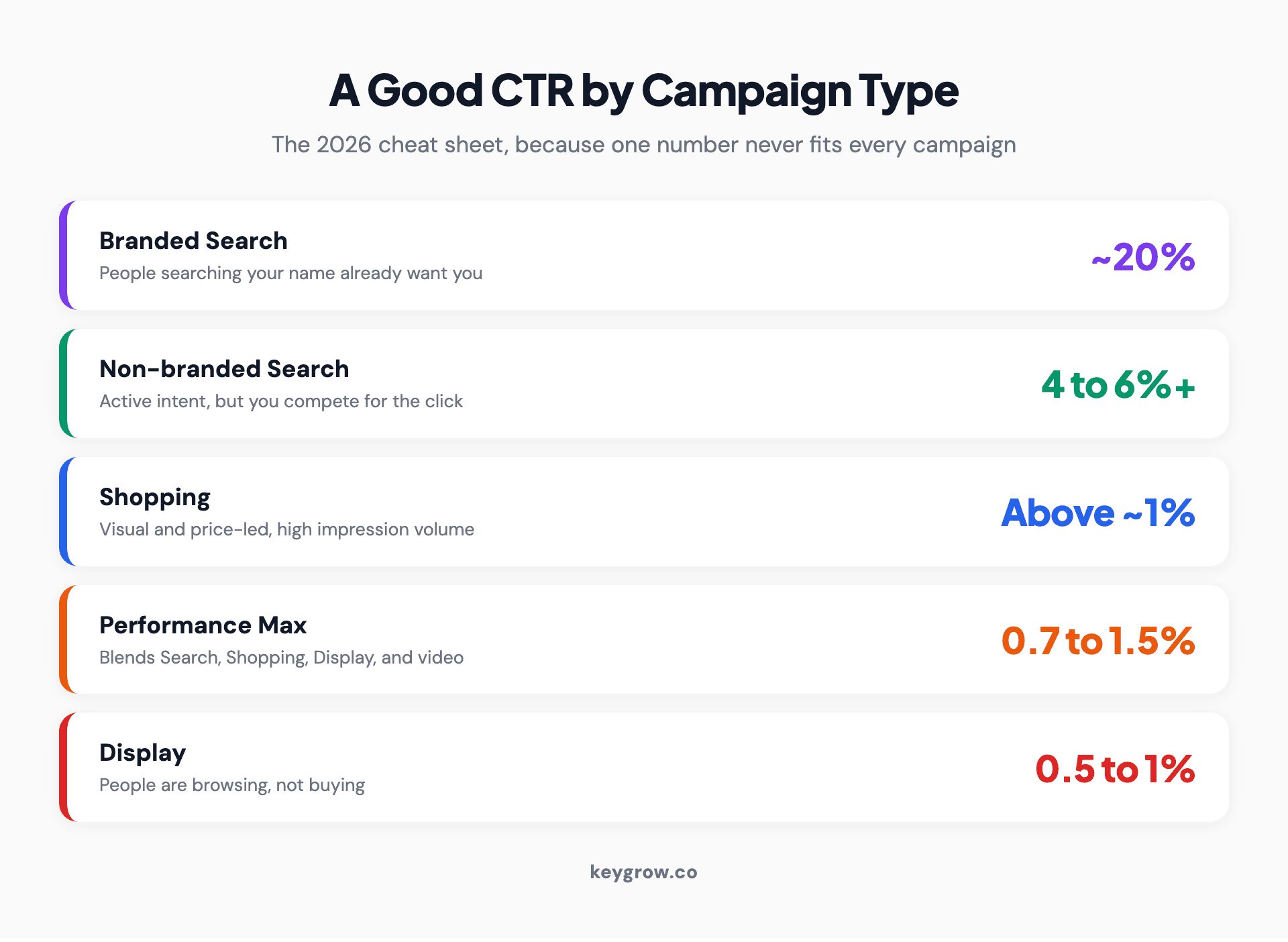
A 2026 cheat sheet of what counts as a good Google Ads click-through rate by campaign type: non-branded Search 4 to 6 percent or higher, branded Search around 20 percent, Shopping above 1 percent, Display 0.5 to 1 percent, and Performance Max 0.7 to 1.5 percent.
| Campaign type | A good CTR | Why it lands there |
|---|---|---|
| Branded Search | ~20% | People searching your name already want you |
| Non-branded Search | 4 to 6%+ | Active intent, but you compete for the click |
| Shopping | Above ~1% | Visual, price-led, high volume of impressions |
| Performance Max | 0.7 to 1.5% | Blends Search, Shopping, Display, and video |
| Display | 0.5 to 1% | Interruptive placements, people are browsing, not buying |
The pattern behind the numbers is intent. Search catches someone who just typed what they want, so clicks come easily. Display shows your banner while someone reads the news, so most scroll past, and half a percent is a win. The Shopping, Display, and Performance Max figures here are practitioner ranges rather than a single published benchmark, since Google does not report a clean CTR average for each. Judge each campaign against its own network, never against a blended average.
The 2026 industry benchmark, and the catch inside it
Across industries, the widely cited 2026 average Google Ads CTR is about 6.64 percent. That figure comes from WordStream's benchmarks, drawn from more than 13,000 campaigns. There is a catch worth knowing before you compare yourself to it.
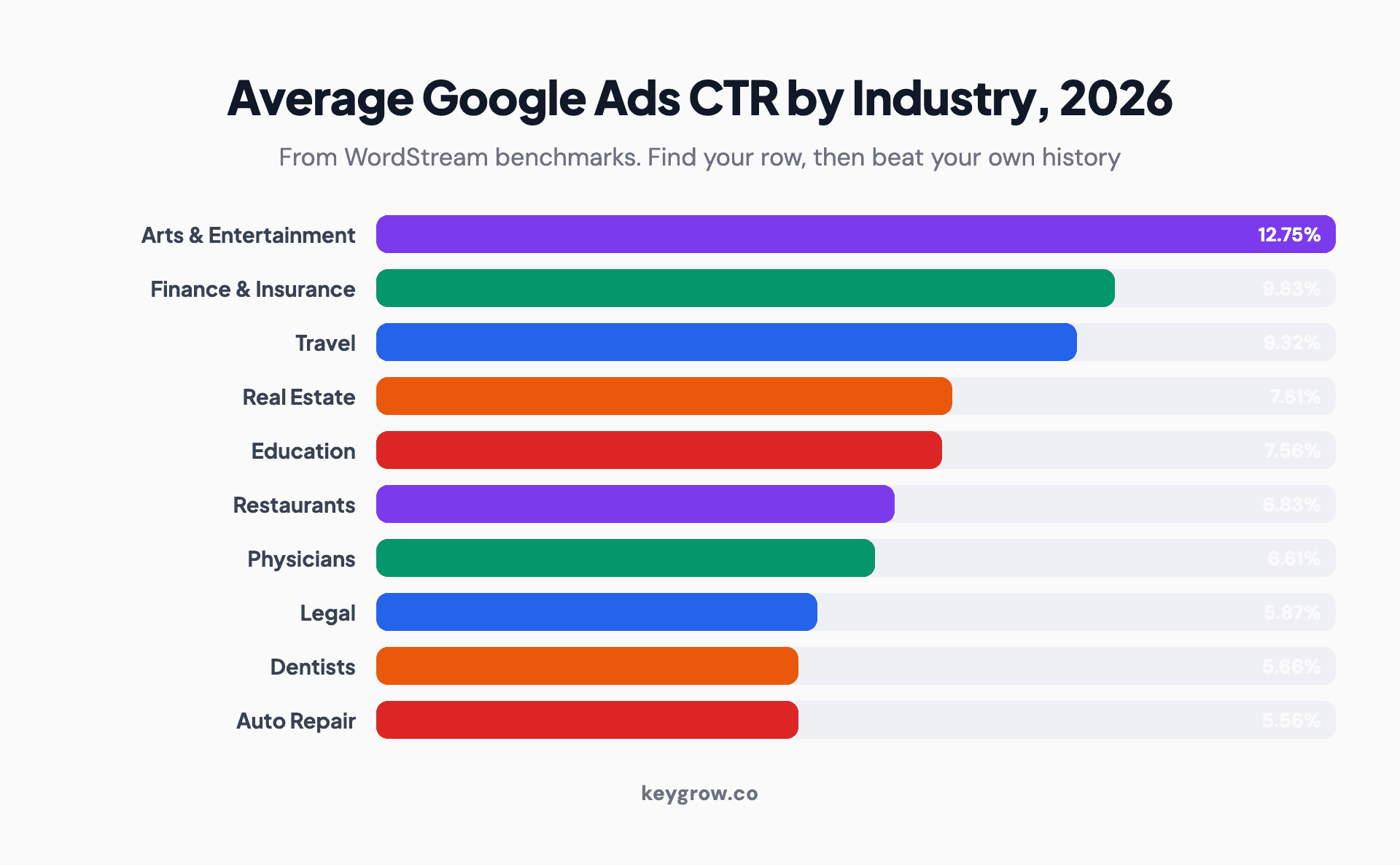
Average Google Ads click-through rate by industry in 2026: arts and entertainment 12.75 percent, finance and insurance 9.83 percent, travel 9.32 percent, real estate 7.61 percent, education 7.56 percent, restaurants 6.83 percent, physicians 6.61 percent, legal 5.87 percent, dentists 5.66 percent, and automotive repair 5.56 percent at the low end.
That 6.64 percent blends Google and Microsoft search data together, so pure Google Search intent tends to run lower. Industry matters enormously on top of that. Arts and entertainment averages 12.75 percent, finance and insurance 9.83 percent, and travel 9.32 percent, while automotive repair sits near the bottom at 5.56 percent, dentists at 5.66 percent, and legal at 5.87 percent. If you run a dental practice, beating a travel company's CTR was never the assignment. Find your row, then aim to beat your own history.
Branded versus non-branded is the biggest swing
Nothing moves your CTR more than whether the searcher is typing your brand name. Branded Search commonly clears 20 percent because those people already decided they want you. Non-branded, where you are one of several options, a strong CTR is 8 to 12 percent, and 4 to 6 percent is respectable.
This is why a blended account CTR can mislead you. Mix a 25 percent branded campaign with a 4 percent competitive one and your average looks fine while the campaign that actually finds new customers quietly underperforms. Always split branded and non-branded before you judge anything. If your reporting lumps them together, that is the first fix.
What actually moves your CTR
Five levers move click-through rate, and most of them are inside your control.
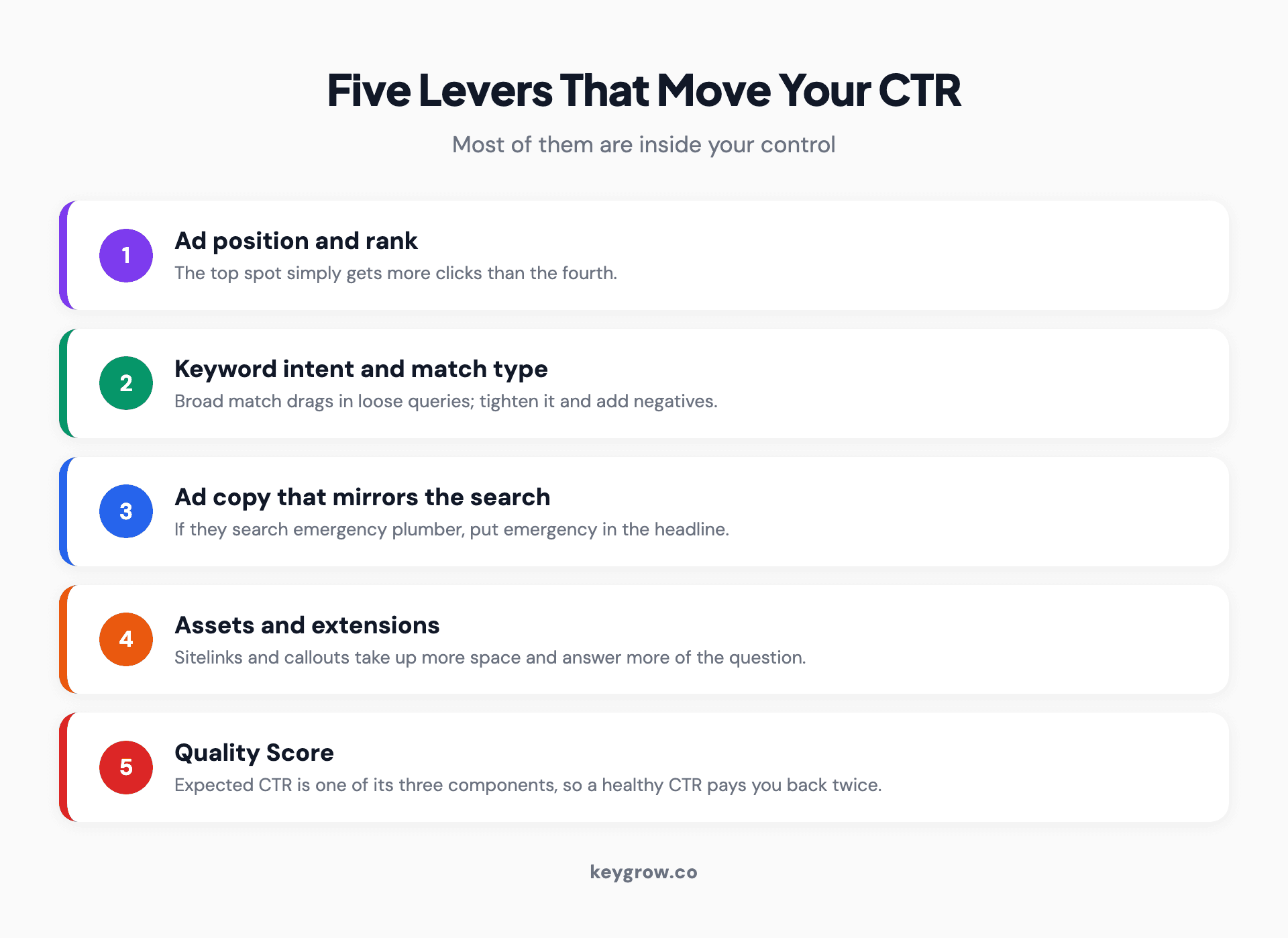
Five levers that move Google Ads click-through rate: ad position and rank, keyword intent and match type, ad copy that mirrors the search, ad assets and extensions which can lift CTR 10 to 25 percent, and Quality Score which is fed by expected CTR.
Ad position comes first, because the top spot simply gets more clicks than the fourth. Keyword intent and match type are next: broad match drags in loose queries that do not fit your ad, so tighten match types and pile on negative keywords. Ad copy that mirrors the exact search is the cheapest win there is; if someone searches "emergency plumber," the word "emergency" belongs in your headline.
Then come assets. Adding the full stack of sitelinks, callouts, and structured snippets can lift CTR by an estimated 10 to 25 percent over headlines and descriptions alone, because your ad takes up more space and answers more of the question. All of this feeds Quality Score, where expected CTR is one of three components alongside ad relevance and landing page experience, which is why a healthy click-through rate pays you back twice: more clicks now, cheaper clicks later.
When a high CTR is actually a bad sign
Here is the part the benchmark posts skip. A high CTR is not always good, and chasing it blindly can cost you money. Clicks are not customers.
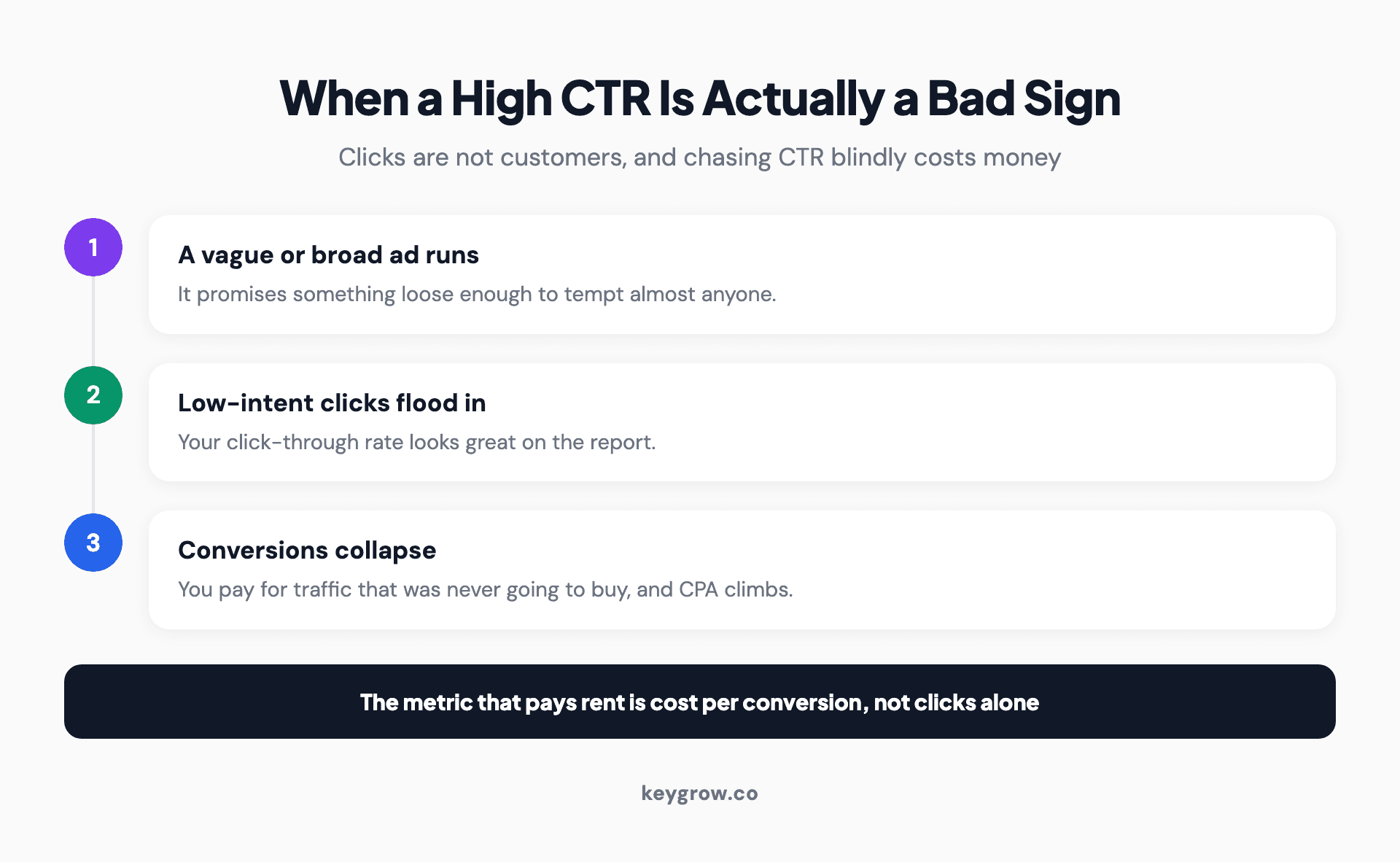
When a high Google Ads CTR is actually a bad sign: a vague or broad ad pulls low-intent clicks, so the click-through rate looks great while the conversion rate collapses and budget drains on people who were never going to buy; the metric that matters is cost per conversion.
A vague or overly broad ad can pull a flood of low-intent clicks. Your CTR looks great, your conversion rate collapses, and you pay for traffic that was never going to buy. We once inherited a mobile detailing account paying around $100 per booking, sending every click to a homepage. The clicks were not the problem. The traffic quality and the destination were. After restructuring the campaigns and pointing ads at a dedicated booking page, cost per conversion dropped to $22 and bookings grew 650 percent between August and December. CTR was a footnote in that story; conversions were the plot.
So treat CTR as a diagnostic, not a goal. If yours is below your industry average and your Quality Score is under 7, fix the ad. But if your CTR is high while conversions stay flat, the click-through rate is lying to you, and the real problem is that you are attracting the wrong people. The metric that pays rent is cost per conversion, which we get into in does PPC work for B2B and across our PPC management work.
How to improve your CTR
First, diagnose before you fix. Pull your CTR by campaign and split branded from non-branded, then compare each against its own network and your industry row, not against a blended number. If a non-branded Search campaign sits below its industry average and its Quality Score is under 7, the ad needs work. If the CTR is already healthy, leave it alone and spend your time on conversion instead.
When a campaign genuinely needs work, four moves do most of the lifting. Match your headline to the search term so the ad reads like the answer. Turn on every relevant asset, since sitelinks and callouts are free real estate. Tighten match types and add negative keywords weekly so you stop paying for irrelevant impressions. And test two or three ad variations per group, letting the winners run. None of this is exotic. It is just the unglamorous maintenance that separates a 3 percent account from a 7 percent one, and it is the same discipline we cover in how long PPC takes.
FAQs
What is a good CTR for Google Ads?
Roughly 4 to 6 percent or higher on non-branded Search, and around 20 percent on branded Search. On Display a good CTR is 0.5 to 1 percent, on Shopping above 1 percent, and on Performance Max about 0.7 to 1.5 percent. The right target depends on your campaign type and industry, so compare like with like.
What is the average CTR for Google Ads?
The widely cited 2026 average is about 6.64 percent across industries, from WordStream's benchmarks of more than 13,000 campaigns. That figure blends Google and Microsoft search data, so pure Google Search intent often runs a bit lower. Google Search alone historically averaged closer to 3 percent.
Is a 10 percent CTR good?
On non-branded Search, yes, a 10 percent click-through rate is excellent and well above most industry averages. On branded Search it is unremarkable, since brand terms often clear 20 percent. On Display, a 10 percent CTR would be so far above normal that it usually signals a tracking issue or accidental clicks.
Is a 2 percent CTR bad for Google Ads?
On non-branded Search it is below average and worth improving through tighter targeting and better ad copy. On Display or Performance Max, 2 percent is actually strong. Context decides, so check the number against your campaign type before treating it as a problem.
Does a higher CTR mean more conversions?
Not always. A high CTR pulls in more visitors, but if your keywords are too broad or your ad overpromises, those clicks will not convert and you will waste budget. The clearer measure of success is cost per conversion, not clicks alone.
Does CTR affect Quality Score?
Yes. Expected click-through rate is one of the three components of Quality Score, alongside ad relevance and landing page experience. A higher Quality Score lowers your cost per click and improves ad rank, so a healthy CTR reduces what you pay over time.
The number that actually matters
A good Google Ads CTR is real and worth chasing, roughly 4 to 6 percent on non-branded Search, higher on branded, lower on Display and Performance Max. But treat it as a health check, not a scoreboard. A click-through rate that climbs while conversions stall is a warning, not a win, and the account that quietly makes money is often not the one with the flashiest CTR.
If you want a straight read on whether your click-through rate is helping or hiding a problem, tell us about your account and we will look at the metric that actually pays: what each conversion costs you.