


Google Display ads grow marketing results by putting visual ads in front of people across millions of websites, apps, YouTube, and Gmail, reaching them early, before they ever search, then re-engaging the ones who already visited you. They do it at a low cost per impression, which makes Display a cheap way for advertisers to build awareness and stay in front of buyers through a long decision. That is the short, correct answer, and it is also the one the Google Ads certification is looking for.
Now the useful part. Display is powerful in a specific way and wasteful in another, and most guides only tell you the flattering half. Here is what Display actually does for your results, backed by Google's own numbers, plus an honest read on where it earns its budget and where it quietly burns it.
How Display grows results, in one picture
Display works up and down the funnel at once: it introduces you to new people, keeps you visible while they think it over, and pulls back the ones who already showed interest.
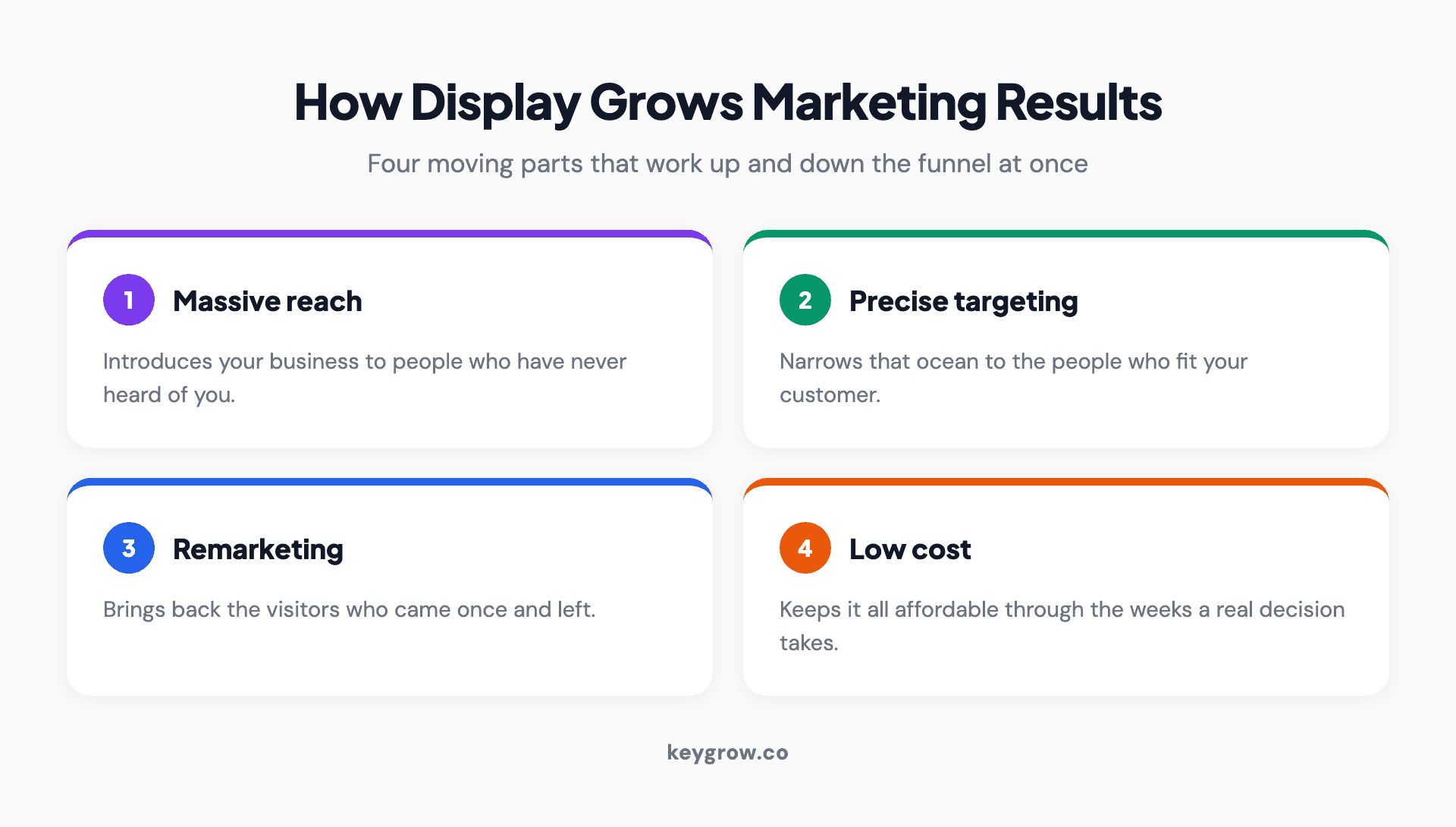
How Google Display ads grow marketing results: massive reach across millions of sites and apps introduces your brand to new people, audience and contextual targeting puts you in front of the right ones, remarketing re-engages past visitors, and low cost per impression keeps you visible through a long buying decision.
The mechanism has four moving parts. Reach introduces your business to people who have never heard of you. Targeting narrows that ocean to the people who fit your customer. Remarketing brings back the ones who visited and left. And low cost keeps all of it affordable enough to run for the weeks or months a real buying decision takes. Search captures demand that already exists. Display creates and sustains it.
The reach is genuinely enormous
The Google Display Network is one of the largest ad canvases on earth, and that scale is the foundation of everything Display does.
By Google's own account, the Display Network reaches over 90 percent of internet users worldwide across more than 2 million sites, videos, and apps. Google states the reach slightly differently in different places, describing Display ads as appearing on 35 million websites and apps in one help page and more than 3 million sites in a company blog post, so treat the exact count as approximate. The point survives the discrepancy: wherever your customers spend time online, Display can reach them there, including on YouTube and in Gmail.
Scale alone is not a strategy, though. Reaching 90 percent of the internet is only useful if you then narrow to the slice that matters, which is the next piece.
Targeting turns reach into relevance
Raw reach would waste money without targeting. The Display Network lets you aim at people by who they are and by what they are reading right now.
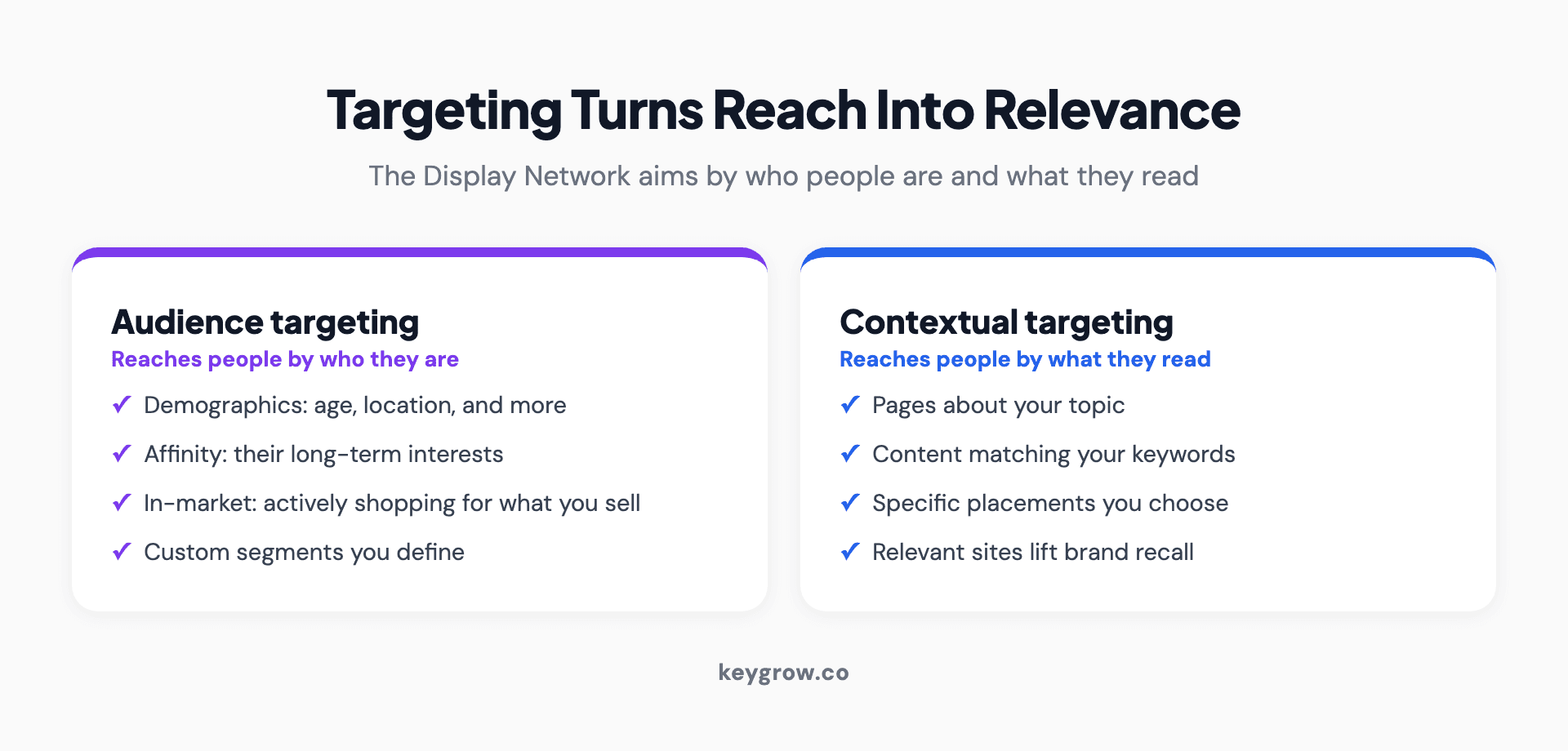
Google Display targeting options: audience targeting by demographics, affinity, in-market intent, and custom segments, plus contextual targeting that places ads on pages about topics and keywords your customers are reading.
Audience targeting reaches people based on who they are: their demographics, their affinities, whether they are actively in-market for what you sell, or custom segments you define. Contextual targeting reaches people based on what they are looking at: pages about your topic, or content matching your keywords. Google notes that brand recall rises meaningfully when ads run in contextually relevant places rather than random ones, which is why a garden-tool ad on a gardening blog outperforms the same ad on a news homepage. Good targeting is the difference between Display that builds a brand and Display that decorates the internet with your logo.
Remarketing is where Display pays for itself
Most first-time visitors do not buy. Remarketing is how Display brings them back, and for many advertisers it is the single most profitable use of the network.
When someone visits your site and leaves, remarketing shows them your ads as they move around the web afterward, keeping you in mind until they are ready. It works because these are warm people who already found you once. If you sell anything that takes more than one visit to decide on, and most services do, remarketing is the part of Display to start with. It is also cheap relative to chasing brand-new strangers, which brings us to cost.
Why Display is so cost-effective
Display impressions are cheap, and that changes what you can afford to do. You can stay in front of a prospect for weeks without the budget a Search-only approach would demand.
The average cost per click on the Display Network runs far below Search. Third-party benchmarks have long put the Display click on the order of $0.63 against about $2.69 on Search; those particular figures are several years old, so treat them as directional, but the gap holds, and Display is often priced per thousand impressions in the low single digits to low tens of dollars. That affordability is the whole reason Display can play a long game. Here is the number that should reframe how you judge it, though: Google reports that for the median advertiser, the Display Network drives nearly 20 percent of total conversions, and when Display runs alongside Search, its cost per acquisition lands within about 2 percent of the Search cost per acquisition. Display is not the expensive, fluffy cousin of Search. Used well, it converts at a similar cost while doing work Search cannot.
What Display is good at, and where it wastes money
This is the section the other guides leave out. Display is excellent at some jobs and terrible at others, and knowing the difference is what separates a profitable account from a drained one.
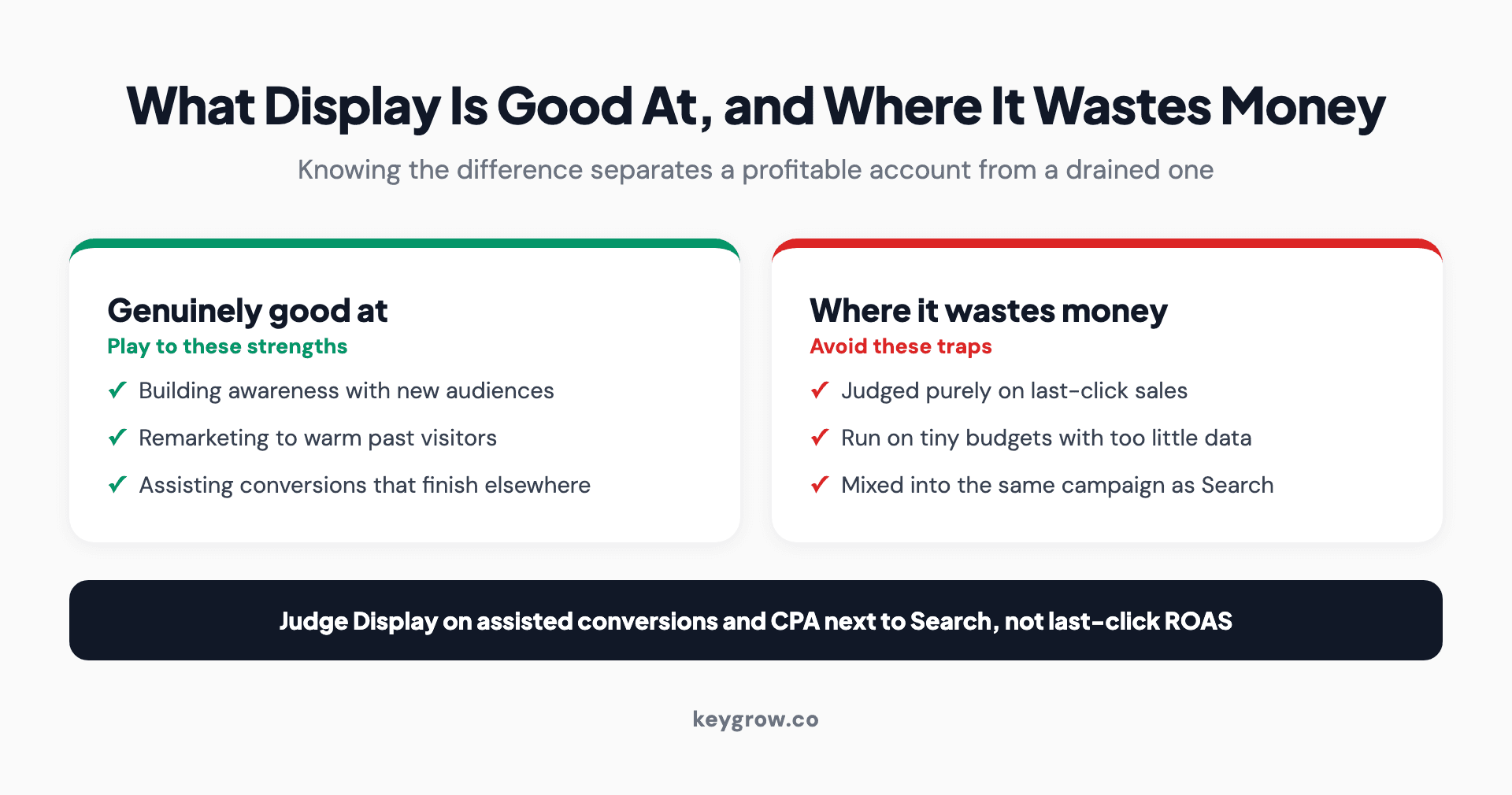
What Google Display is good at versus where it wastes money: strong at building awareness, remarketing to past visitors, and assisting conversions across a long funnel; weak when judged on last-click sales, run on tiny budgets with too little data, or mixed into the same campaign as Search.
Display is genuinely good at building awareness, remarketing to warm visitors, and assisting conversions that finish elsewhere. It struggles in three situations. First, when you judge it purely on last-click sales, because Display usually assists the conversion rather than closing it, so a last-click report makes it look worthless even when it is doing real work. Second, on tiny budgets, because the system needs enough volume to learn, and a few hundred dollars spread thin gets eaten by placements that never convert. Third, when you mix Display and Search in one campaign, which lets cheap Display clicks swallow the budget while hiding the true performance of each.
An honest opinion, backed by Google's own data: Display should be judged on assisted conversions and its cost per acquisition next to Search, not on last-click ROAS. Hold it to the wrong metric and you will switch off a channel that quietly drives a fifth of your conversions. This is the same measurement discipline we bring to all our PPC management.
Display or Performance Max in 2026
A fair question in 2026 is whether to run standalone Display at all, since Performance Max now spans the same inventory. The answer depends on control.
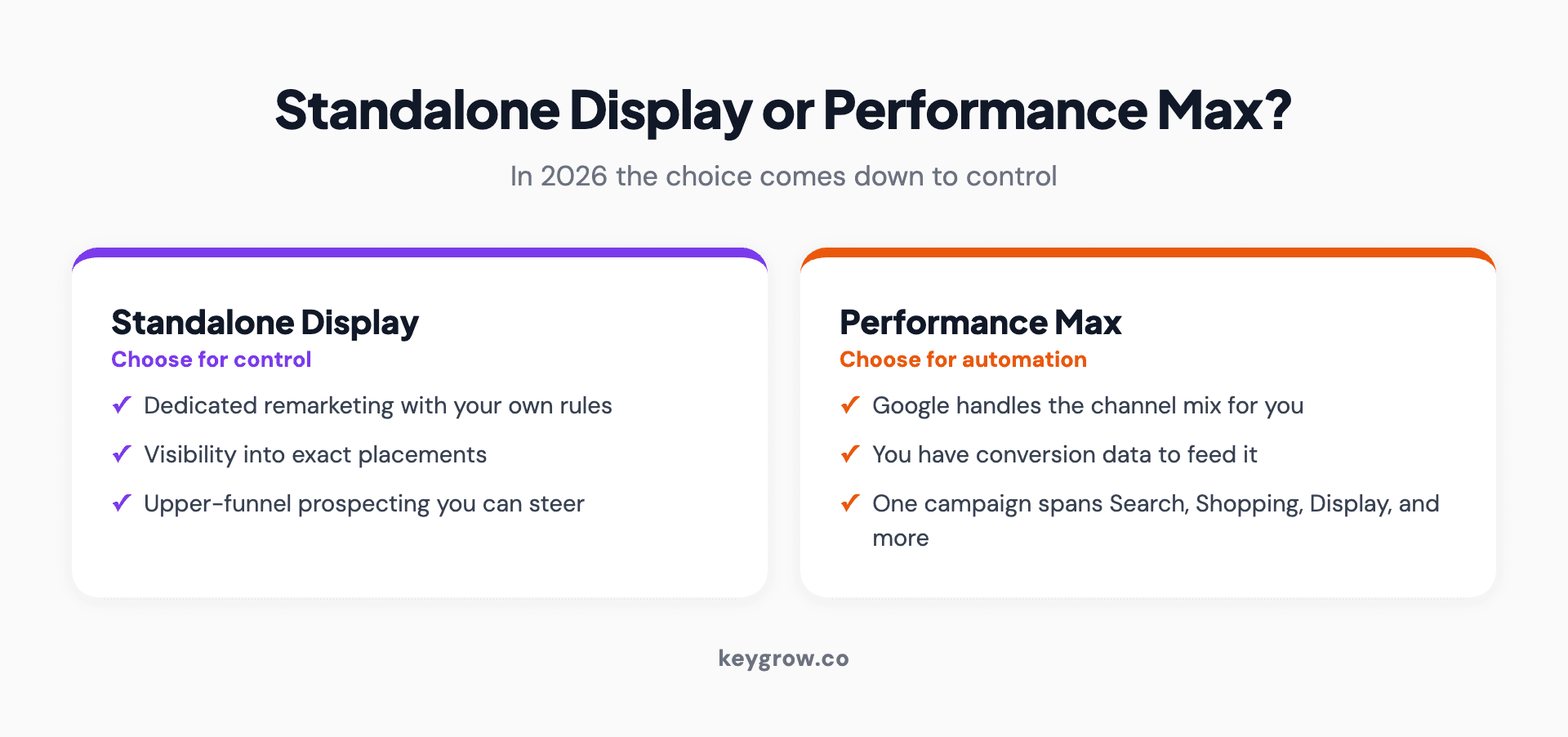
Standalone Display versus Performance Max in 2026: choose standalone Display when you want control and transparency, dedicated remarketing with your own audience rules, and visibility into exact placements; choose Performance Max when you want Google's automation to handle the channel mix and you have conversion data to feed it.
Performance Max automatically places ads across Search, Shopping, Display, YouTube, and more, and it can absorb the Display job for you. Standalone Display still makes sense when you want control and transparency: dedicated remarketing with your own audience rules, visibility into exact placements, or upper-funnel prospecting you can see and steer. Performance Max makes sense when you want Google's automation to handle the mix and you have conversion data to feed it. Many advertisers run both, and you can compare their logic in how Google Ads advances your goals. Whichever you choose, measure Display on the right terms, which we get into next.
How to measure whether Display is working
Judge Display by looking past the last click. The metrics that tell the truth are assisted conversions and conversion paths, view-through conversions, and Display's cost per acquisition compared with Search. If Display is touching journeys that convert later, the assisted-conversion and path reports will show it, even when last-click gives it no credit.
Watch your placements too, and exclude the junk apps and low-quality sites that eat budget without intent. Creative carries more of the result than most expect; Google attributes a large share of an ad's recall to creative quality, so weak banners cap your ceiling no matter how good the targeting is. And wherever the click lands, the page it lands on still has to pay it off, a point we make in landing page versus website.
FAQs
How does Google Display ads grow marketing results for advertisers?
By showing visual ads across millions of sites, apps, YouTube, and Gmail, Display reaches people early, before they search, then remarkets to past visitors to bring them back. It builds awareness and assists conversions at a low cost per impression, which is why Google reports it drives nearly 20 percent of the median advertiser's conversions.
How are Display ads different from Search ads?
Search ads capture people who are actively searching for what you sell, so they carry high intent and close sales. Display ads reach people who are browsing other content, so they build awareness and re-engage past visitors. Search harvests existing demand; Display creates and sustains it.
Are Google Display ads cheaper than Search ads?
Usually, yes. Display cost per click commonly runs well under a dollar, against several dollars on Search, because Display placements interrupt browsing rather than answering a search. The trade-off is intent: cheaper clicks convert less directly, which is why Display often assists conversions rather than closing them.
Can Display ads generate leads, or just awareness?
Both, but awareness and remarketing are its strengths. Display can generate leads, especially through remarketing to warm visitors, but it rarely matches Search for pure lead intent. Expect it to assist conversions across a longer journey rather than deliver last-click leads on demand.
Are Google Display ads good for small businesses?
They can be, if the budget is large enough to gather data and the goal is remarketing or local awareness. On very small budgets, standalone prospecting Display often wastes money on non-converting placements. Most small businesses should start Display with remarketing to past visitors before expanding to cold audiences.
What is a good click-through rate for Display ads?
A CTR of roughly 0.5 to 1 percent is healthy for Display, far below Search because people are browsing, not buying. Judge Display on conversions assisted and cost per acquisition rather than click-through rate alone, since a high Display CTR can still mean little for revenue.
Where Display fits
Google Display ads grow results by reaching the right people cheaply, early, and repeatedly, then handing warm prospects back to the parts of your funnel that close. The reach is real, the cost is low, and Google's own numbers say it drives close to a fifth of conversions for the typical advertiser. The mistake is holding it to a last-click standard it was never built to meet.
Run Display for awareness and remarketing, measure it on assisted conversions, and keep it out of the same campaign as your Search. If you want that set up and measured properly, tell us about your business and we will build Display to do the job it is actually good at.