


You do not outrank competitors in Google Ads by outbidding them. You outrank them by earning a better Ad Rank, which Google builds from your bid, your ad quality, and a few other factors together. The practical result is that a smaller advertiser with a higher Quality Score can sit above a bigger spender and pay less per click while doing it. Raising your bid is the crude lever. Raising your quality is the one that wins position and saves money at the same time.
So the real question is not "how do I bid higher than them." It is "how do I improve the things Ad Rank rewards." Here is how Ad Rank actually works and what to do about it.
Ad Rank decides position, and bid is only part of it
Ad Rank determines whether your ad shows and where. Google calculates it from six inputs, and your maximum bid is just one of them. Quality and relevance carry real weight.
Per Google's Ad Rank documentation, Ad Rank is "a set of values that are used to determine whether your ads are eligible to show and if eligible, where on the page your ads are shown." It is recalculated every auction, every search, so position is never locked in.
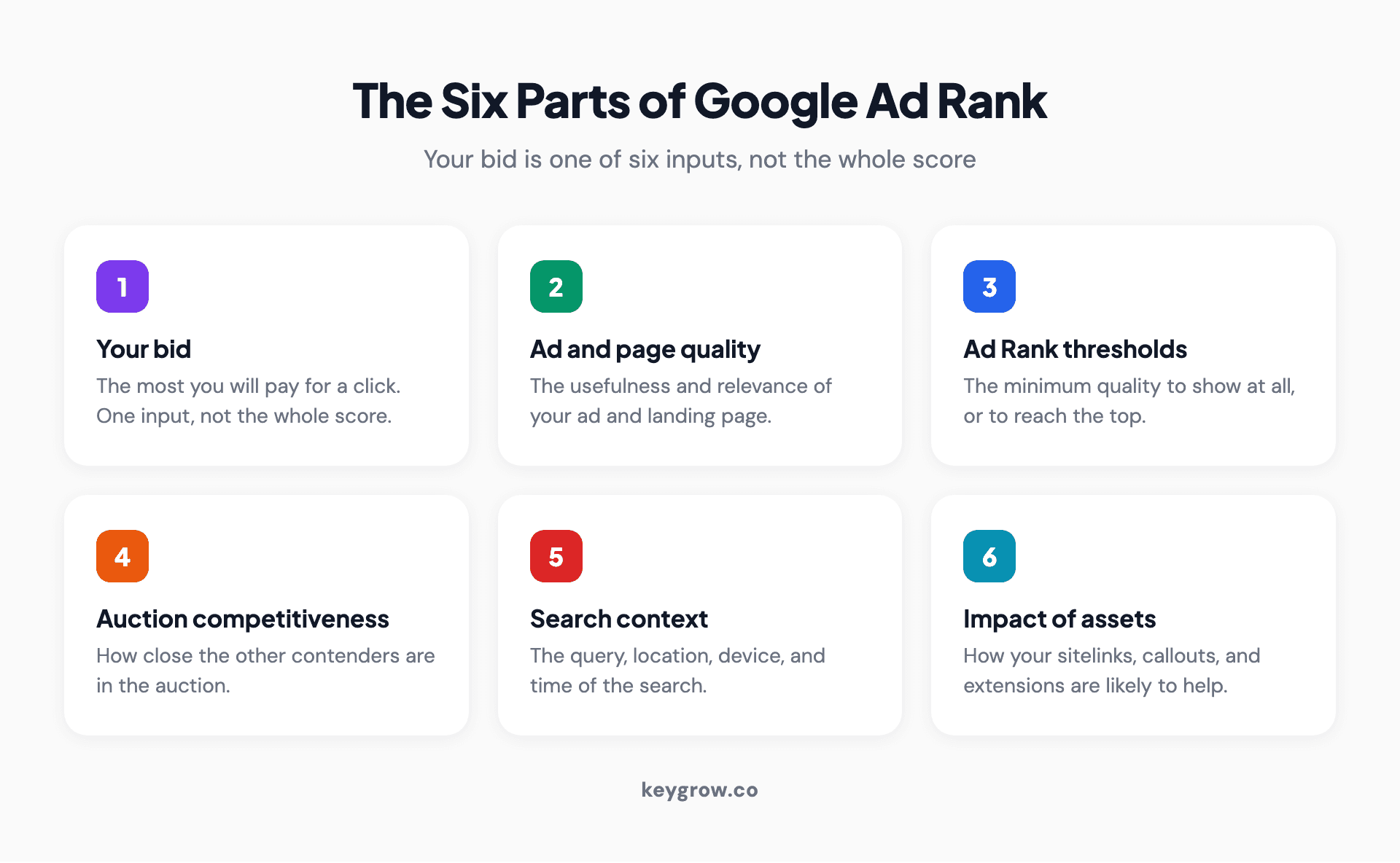
The six factors in Google Ad Rank: your bid, ad and landing page quality, the Ad Rank thresholds, auction competitiveness, the search context, and the expected impact of your assets.
The six factors Google names:
- Your bid, the most you will pay for a click. It matters, but it is one input, not the whole score.
- Ad and landing page quality, the usefulness and relevance of your ad and the page behind it.
- Ad Rank thresholds, the minimum quality an ad must clear to show at all, or to reach the top.
- Auction competitiveness, how close the contenders are.
- The search context, the person's query, location, device, and time of search.
- Expected impact of your assets, how your sitelinks, callouts, and other extensions are likely to help.
Bid is one of six. That is why "just spend more" is the wrong instinct.
Why a higher Quality Score wins position and lowers cost
Quality Score is Google's read on your expected click-through rate, ad relevance, and landing page experience. Improve it and you both climb the auction and pay less per click, because Google discounts higher-quality ads.
This is the part that makes quality the smart lever instead of bid. Google states plainly that "higher quality ads can often lead to lower CPCs," meaning you pay less per click when your ads are more relevant. The effect is large and long documented. An often-cited WordStream analysis of the Quality Score to cost relationship found that a top Quality Score can cut cost per click roughly in half against the average advertiser, while a below-average score can cost you well more per action.
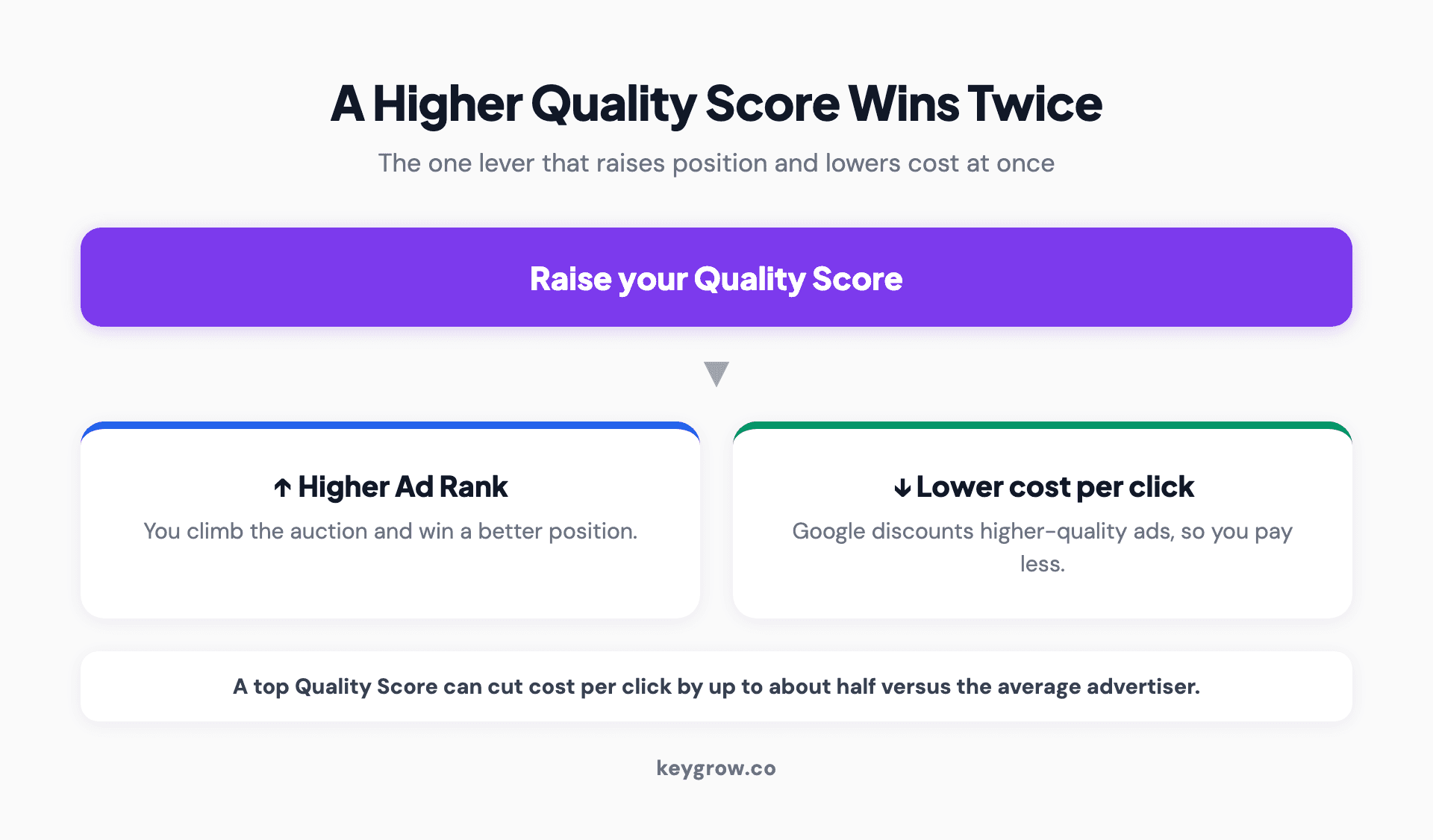
How a higher Quality Score compounds: it raises your Ad Rank so you climb the auction, and it lowers your cost per click because Google discounts higher-quality ads, so you win better position for less money.
So a competitor outbidding you is not the problem you think it is. A tightly themed ad group, an ad that closely matches the search, and a fast landing page that delivers what the ad promised can lift you above them for less. We saw the mechanism on a car detailing account paying about $100 per booking by sending every click to its homepage. Pointing traffic at a page built for the offer, alongside a cleaner campaign structure, took cost per booking to $22. Better quality, lower cost, same auction. The three components to work on: improving your Quality Score is the single most valuable fix in the whole account.
Find out who you actually compete with
Use the Auction Insights report to see which advertisers you overlap with and who is beating you. It shows your impression share and how often rivals rank above you, so you stop guessing about the competition. Those same impression-share columns reveal your PPC opportunity cost, the demand you are missing.
Most advertisers imagine their competitors. Auction Insights names them.

The Google Ads Auction Insights metrics that reveal who is outranking you: impression share, overlap rate, outranking share, position above rate, and top of page rate, each with a one-line meaning.
Per Google's metric definitions, the report gives you:
- Impression share: the impressions you got divided by the impressions you were eligible for. Low share means you are leaving demand on the table.
- Overlap rate: how often another advertiser showed when you did. This tells you who you actually run against.
- Outranking share: how often your ad ranked above theirs, or showed when theirs did not.
- Position above rate: how often their ad sat higher than yours when both showed.
- Top of page rate: how often your ad reached the top block above the organic results.
Read together, these point you at the right fight. If one advertiser has a high overlap rate and keeps beating you on position, that is where to focus quality and bid work. Our guide on checking your competitors' Google Ads covers how to see their actual ads too.
The levers that actually move position
To outrank a competitor, tighten ad-group relevance, improve the landing page, add every relevant asset, and only then adjust bids. Assets and relevance raise Ad Rank without raising cost.
In rough order of return:
- Tighten ad groups. Fewer, closely related keywords per ad group, with ad copy that echoes the search term. Relevance is a Quality Score component and the cheapest to fix.
- Fix the landing page. Fast, mobile-friendly, and delivering exactly what the ad promised. Landing page experience feeds Ad Rank directly.
- Add your assets. Sitelinks, callouts, structured snippets, and call assets. Google factors the expected impact of assets into Ad Rank, so a fuller ad can outrank a barer one at the same bid.
- Then tune bids. Once quality is working, raise bids where the math supports it, and use bid adjustments for the devices, locations, and times that convert.
Do these in order. Advertisers who jump straight to bidding skip the levers that would have let them win for less.
When not to chase position one
Do not assume the top spot is the goal. Google itself notes that top ads usually cost more per click, so the most profitable position is often not the highest one.
This is the discipline most "outrank everyone" advice ignores. Per Google, "top ads typically have higher CPCs than ads elsewhere." Pushing for the absolute top of the page on every keyword can spike your cost per click past the point where the clicks still pay back. The goal is not to outrank every competitor on every search. It is to win the auctions that convert profitably and let the rest go. If a rival wants to overpay for the top slot on a low-value term, sometimes the right move is to let them, and take the cheaper position that still makes money. Chase profitable outranking share, not a trophy.
FAQs
How is Ad Rank calculated in Google Ads?
Google calculates Ad Rank from six factors: your bid, the quality of your ad and landing page, the Ad Rank thresholds, how competitive the auction is, the context of the search (query, location, device, time), and the expected impact of your assets. It is recalculated for every search, so your position can change auction to auction even without changing your bid.
Does a higher bid always mean a higher position?
No. Bid is only one of six Ad Rank factors. An advertiser with a lower bid but higher ad quality can rank above one with a higher bid. That is the core of outranking competitors without outspending them: improve the quality and relevance signals so your Ad Rank beats theirs at a lower cost.
How do I improve my Ad Rank without raising my bid?
Improve the quality inputs. Tighten your ad groups so keywords and ad copy match closely, speed up and align your landing page with the ad, and add relevant assets like sitelinks and callouts. Each of these raises Ad Rank through the quality and asset factors, and higher quality also tends to lower your cost per click.
Does Quality Score affect what I pay per click?
Yes. Google says higher quality ads can lead to lower costs per click, and analyses of the relationship show a top Quality Score can roughly halve cost per click versus the average advertiser, while a poor score costs more. So improving Quality Score both lifts your position and reduces your cost, which is why it is the most valuable thing to work on.
How do I beat a competitor who keeps outbidding me?
Do not match their bid, beat their Ad Rank. Check Auction Insights to confirm how often they outrank you, then raise your quality: sharper ad relevance, a better landing page, and full assets. Higher quality can lift you above a bigger bidder while lowering your own cost per click. Reserve bid increases for the high-value searches where the return justifies them.
What is the difference between Ad Rank and ad position?
Ad Rank is the score Google calculates each auction from your bid, quality, thresholds, competition, context, and assets. Ad position is the result, where your ad actually appears on the page. You do not set position directly; you influence the Ad Rank inputs, and Google translates that into where your ad shows.
The takeaway
Outranking competitors in Google Ads is an Ad Rank problem, not a budget problem. Improve ad relevance, the landing page, and your assets to raise quality, use Auction Insights to pick the fights worth having, and remember that the top slot is not always the profitable one. Better Ad Rank wins position and lowers cost at once.
If you want a team to audit your Quality Score, rebuild the structure, and find where you are losing the auction, that is what our Google Ads management does. Bring your account and your target keywords to the get started page and we will show you where a quality fix would outrank the competition for less.